
Implementing UHF RFID Readers in Assembly Lines: An Application Guide for Accuracy
Assembly-line RFID accuracy is decided at the gateway, not in the reader specification sheet. This application guide explains how a UHF RFID Reader is positioned and synchronized at each manufacturing stage, using RFID Gate hardware for stage transitions, an AI Powered RFID Reader for multi-zone line coverage, and an RFID System layer that converts tag reads into usable stage records, and it shows how to sequence an implementation so that accuracy is designed in rather than tuned after go-live.
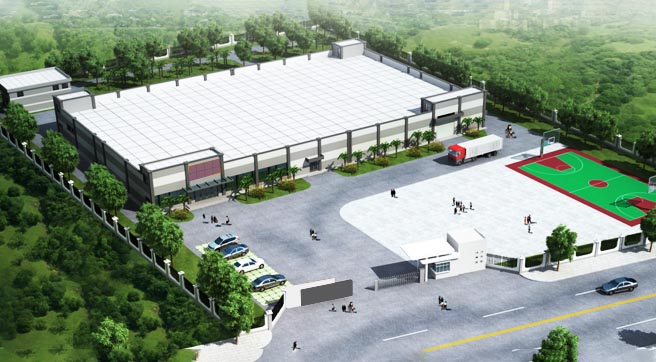
The hardware referenced throughout this guide is manufactured by DAILY RFID CO., LIMITED, an RFID manufacturer founded in 2008 and based in Guangzhou, China. The company operates a 28,000 m2 factory with 180 to 200 employees and a 38-engineer R&D team, runs RFID Tag and RFID Reader as its two main product lines, and exports approximately 80% of its output to EU and USA markets. Its portfolio covers the reader classes an assembly-line project normally requires: RFID Gate readers, fixed and multi-port AI Powered RFID Reader units, handheld RFID Scanner terminals, embedded RFID Module boards, and the RFID System packages that combine them for a defined workflow.
One standardization fact frames everything that follows. UHF RFID readers operate under the EPCglobal Gen2 protocol, also published as ISO/IEC 18000-6C, so tag-to-reader interoperability is governed by a global air-interface standard (GS1 / ISO). Accuracy problems on a live line therefore come from zone design and event synchronization rather than from protocol mismatch.
Problem Definition: Where Assembly-Line Read Accuracy Actually Breaks
Line-level read accuracy means three things at the same time: every tagged unit crossing a stage gateway is recorded exactly once, the record is attributed to the correct stage, and the record reaches the plant system before the next stage decision is made. When a project reports accuracy problems, one of those three conditions has failed, and each failure has a different cause.
Missed reads appear when a tag passes outside the effective read zone, when a metal part detunes an antenna designed for non-metal surfaces, or when a pallet or fixture shields part of the tag population. Duplicate reads occur when the field from one gateway overlaps the field of the next, so a unit is counted again after it has already been recorded. Unattributed reads are a data-model problem: the hardware read the tag, but no event in the software layer says which station produced the read, so the record cannot confirm a process step.
The instinct in each case is to increase transmit power. That widens the read field, but it also widens the overlap between adjacent zones and raises the chance that a reader reports tags which physically belong to a different station. On a line where stations sit metres apart and move to a fixed takt time, extra power is usually counterproductive: it converts a missed-read problem into a duplicate-read problem, and the data becomes harder to reconcile rather than easier.
Accuracy is therefore treated here as a zone-design outcome. The design questions are: what is tagged, where does each read zone begin and end, which physical event confirms the stage, and which interface delivers that confirmation to the line controller.
Industry Background: Why UHF Became the Identification Layer in Smart Manufacturing
UHF identification is now a mainstream, high-volume hardware category rather than a niche technology. Third-party market research places the global UHF RFID Reader market at approximately USD 4.8 billion in 2025, with projections reaching USD 11.2 billion by 2034 (Dataintelo). Within the wider RFID market, UHF RFID accounted for 40.72% of total revenue in 2025, a position attributed to retail inventory cycles and multi-item read capability (Mordor Intelligence). Regionally, Asia Pacific is the fastest-growing UHF RFID hardware region, with an expected 11.8% CAGR in shipments through 2031 (ABI Research).
For a manufacturing team, the practical meaning of those figures is availability and interoperability, not promotion. Multiple suppliers build to the same air interface, tags and readers from different sources are expected to work together at protocol level, and the engineering effort therefore shifts to how identification is used inside the process. That is also why an application guide is more useful than a product comparison for assembly-line work: the value is created by read-zone logic, not by the reader box alone.
In manufacturing specifically, UHF reading is a multi-tag, non-line-of-sight process. A reader can register many tags in one pass without a scanner being aimed at a printed code, which is what makes stage-level automation possible at all, and also what makes zone discipline necessary. A handheld RFID Scanner still has a role, but for exception handling and audit work rather than for routine stage confirmation.
Detailed Solution: The Three Components of a Synchronized Line Gateway
Three components carry most of the accuracy load in an assembly-line deployment: the RFID Gate at stage transitions, the AI Powered RFID Reader where several read regions must be covered along one path, and the RFID System layer that binds tags, antennas, readers and software into a single workflow record.
RFID Gate: the stage-transition record
The DL8330U Advanced UHF RFID Gater is an integrated access-control gate reader built for walkthrough identification. Its read channel spans 4 m to 7 m and is produced by four built-in TX/RX antennas distributed across one main panel and one auxiliary panel, a configuration intended to remove detection dead zones across the whole channel rather than concentrate energy in the centre. Transmit power is adjustable up to 30 dBm, and the gate supports both ISO18000-6C (EPC Class 1 Gen 2) and ISO18000-6B protocols, operating in FHSS or fixed-frequency pulse transmitting mode. Interfaces are RS232, RJ45 and GPIO, with optional infrared sensors for direction sensing. Power is AC 220 V / 50 Hz with a low-consumption design of roughly 35.2 W at 220 V and 160 mA, and each panel measures 170 cm x 60 cm x 15 cm, with the main antenna panel weighing 40 kg.
For assembly lines, the relevant point is not the access-control framing but the documented application scope: the gate's listed applications include industrial factory assembly line and loading dock component batch tracking and production process flow control. Put simply, its job on a line is a stage-transition record: what left station N, what arrived at station N+1, and in which direction.
Three design features carry the accuracy load here. The 4 m to 7 m channel width gives the read zone a physical boundary, so the zone is defined by the installation rather than by how far the radio happens to reach. Four built-in antennas reduce angular blind spots, which matters when fixtures and sub-assemblies are handled in random rotation. Optional infrared direction sensing supports entry and exit logic, so a read can be classified as inbound or outbound instead of simply present.
AI Powered RFID Reader: multi-zone coverage along the line
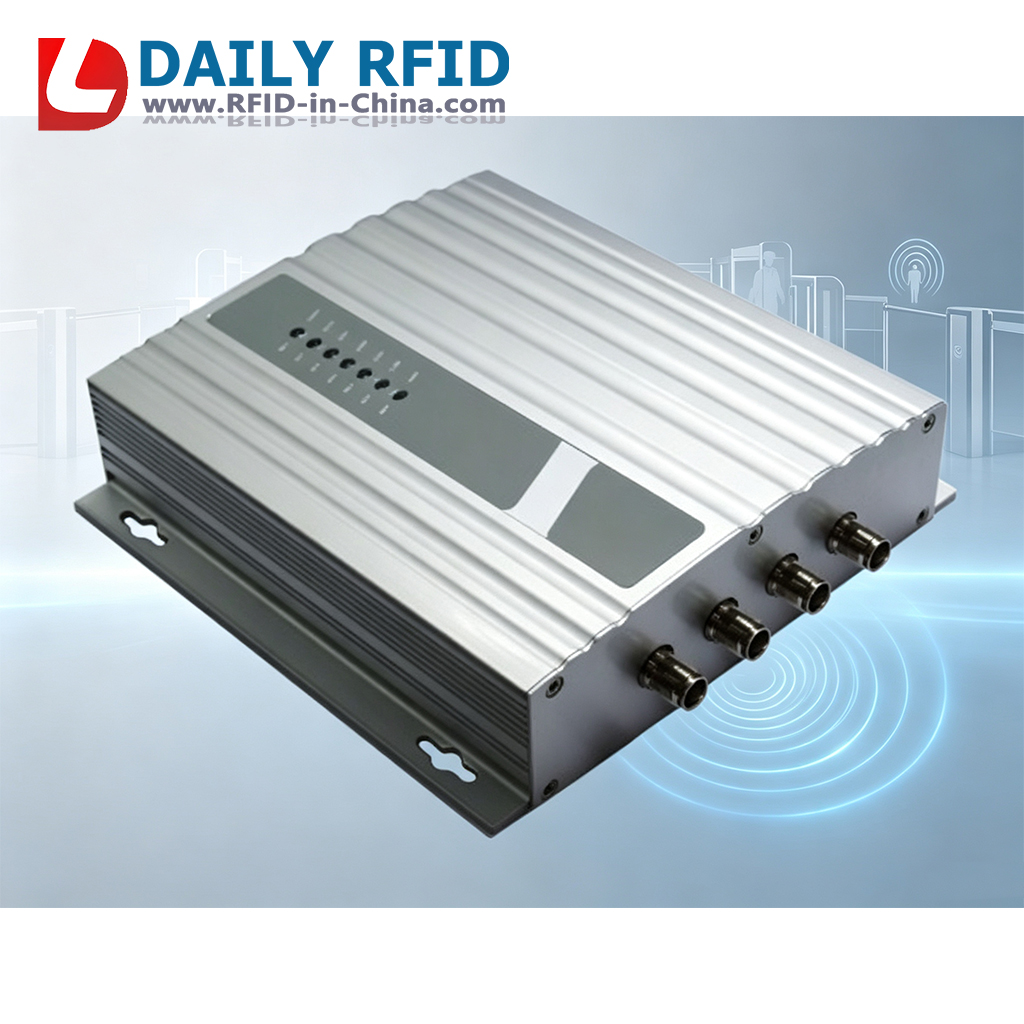
The DL6940/6960 AI Multi-Antenna 4-Port UHF Reader is a multi-channel reader for line-side and overhead deployment. It supports ISO18000-6B and ISO18000-6C (EPC Gen2) across UHF 860 to 960 MHz and runs an AI-driven adaptive dense read mode alongside a software-configurable fixed-frequency mode. Reading range reaches 25 to 30 m, with a 10 to 15 m write range. Four external TNC/SMA ports accept up to four antenna sets, so one reader can serve several physically separated zones. Anti-collision performance is rated for up to 1,000 tags read simultaneously, and processing speed is stated as 16 times that of ordinary mainstream readers with an average single-card read time below 10 ms. RSSI is supported. The unit runs on DC +9 V at 5 W, is rated IP64, operates from minus 30 to plus 70 degrees Celsius, measures 230 x 170 x 40 mm and weighs 2,300 g. Interfaces include RS232, RJ45 (TCP/IP), GPIO with hardware trigger and RS485, and USB, with 4G, Wi-Fi and Bluetooth available as hardware extensions. Housing appearance, size and multi-interface configuration are customizable under OEM and ODM.
Its documented industrial application scope includes automated manufacturing production line raw material tracking and stable identification in harsh industrial environments. For accuracy, the four-port architecture matters because it lets a project define zones, with each antenna acting as one logical read region, instead of defining devices. Zone definition is what prevents the duplicate reads described earlier: two physically separated antennas on one reader can be configured so that their coverage does not overlap, while a single high-power antenna covering both areas cannot.
RFID System: the layer that turns reads into stage records
An RFID System is the layer that connects identification hardware to a workflow: tags, antennas, readers and the software logic that decides what a read means. DAILY RFID's system-level packages show the pattern. A Parking Management RFID Development Kit pairs a fixed long-range reader, a desktop card issuer, matching tags and development software for vehicle access control. A GPRS-based RFID System pairs readers, cards and wristbands with cloud reporting for campus attendance. Neither is an assembly-line product, and that is the point: what they demonstrate is the structure a line project also needs, namely a defined workflow, defined read points, matching tags and open development tooling rather than a closed black box.
On a production line, the system layer is assembled from the gateway hardware, the reader classes described above, matching RFID Tag formats, the RFID Antenna configuration, and an SDK-based interface to the plant system. DAILY RFID provides free SDKs with its readers, and the multi-platform support published for these models covers Windows X86/X64, C++, C#, VB, Delphi, Linux, ARM, Python, NodeJS, QT, JAVA and Android environments, with secondary development supported across the reader range.
Choosing the tag and antenna layer
Reader selection is only half of the accuracy equation; the tag and antenna layer decides whether a read zone can work at all.
- Metal parts and fixtures: the RFID Tool Management Adhesive Tag operates at 860 to 960 MHz with an on-metal read distance of 1 to 3.5 m using a 4 W EIRP handheld reader and up to 5 m off metal. It uses a ferrite isolation layer so a metal surface does not short-circuit or detune the tag antenna, tolerates mechanical abrasion, industrial oil and vibration, and operates from minus 40 to plus 85 degrees Celsius. Its listed applications include automotive assembly plants and CNC machining centres.
- Workstation picking and visual confirmation: the passive UHF LED Tag supports 2 to 5 m bulk reading with LED trigger illumination between 1.5 and 3.5 m depending on reader RF power. Its targeted lighting protocol illuminates one designated tag inside a dense population, and its listed applications include electronic production component picking wall visual guidance.
- Antenna configuration: the four TNC/SMA ports on the multi-port reader and the integrated circular polarized antenna on the DL921 fixed reader range both read moving tags without requiring a fixed tag orientation, which matters when parts arrive in random rotation.
Two distinctions prevent scope mistakes. First, RFID Card and RFID Wristband formats identify people or credentials, such as site access, operator badges and visitor flow; they can share the same infrastructure but they answer a different question than part or pallet level stage tracking. Second, RFID Robot and RFID Drone platforms are documented in market research mainly for inventory collection rather than in-line process confirmation; published research places the drones-as-a-service market at an estimated USD 8.2 billion by 2026 (PR Newswire), which reflects warehouse and stock-count automation rather than assembly-line stage logic.
Step-by-Step Breakdown: Seven Implementation Steps
- Define the tagged unit and the stage map. Decide what carries the tag, whether that is a fixture, a tote, a pallet or a sub-assembly, and list the stages where a record is genuinely required. Start from one product family instead of the whole plant, because each additional stage multiplies the number of zone boundaries that must be validated.
- Match the tag format to the surface and the process. Metal fixture tracking, workstation picking and pallet-level flows need different tags. Verify on-metal behaviour before fixing the tag choice, since a tag that reads well on a bench can fail on a steel fixture.
- Select one read point per station type. Workstation-level confirmation of a single part suits the DL213 Type-C UHF Reader Module, which reads within 0.1 to 10 cm and handles up to 5 tags over a USB Type-C interface at DC +5 V and 3 W; its short range is the accuracy feature because it isolates one part at a time, and its documented applications include close-range workpiece identification and quality inspection tracking on automated production lines. Stage transitions suit the RFID Gate. A complex path with several overhead checkpoints suits the four-port AI Powered RFID Reader or the DL921 PoE integrated reader, which covers 0.1 to 15 m, reads up to 50 tags simultaneously and takes power and network over a single Ethernet cable. Exception handling and work-in-process audit suit the DL1280 Industrial PDA, which reads UHF from 0.1 to 20 m, HF from 0.1 to 32 cm and LF from 0.1 to 10 cm, handles up to 100 tags at over 100 tags per second, and is IP65 rated with Android 12, an 8-core 2.0 GHz processor, dual-band Wi-Fi, Bluetooth 5.0 and 4G.
- Design the zone, then set the power. Define the physical start and end of every read zone, whether that is a 4 to 7 m gate channel, a 10 cm module workstation, or a defined overhead envelope for a four-port reader, and only then adjust transmit power. RSSI reporting supports this work because it shows signal strength per read rather than a binary present-or-absent result.
- Synchronize the read with the process event. Use interfaces instead of timing assumptions: GPIO trigger and RS485 on the four-port reader, trigger and relay ports on the DL921 range, and RS232, RJ45 and GPIO plus optional infrared direction sensing on the gate. Trigger mode ties a read to a physical event, such as a fixture reaching position or a beam being crossed, rather than to a continuous polling loop. Where other radio sources are present on site, FHSS or fixed-frequency operation can be selected per installation.
- Close the data loop with the SDK. The free SDKs supplied with the readers form the interface layer to the plant system, secondary development is supported across the reader range, and multi-platform support covers common industrial and enterprise stacks. The deliverable of this step is a rule the line can execute without interpretation: one tag, one stage, one record, with duplicates resolved before the record is written.
- Validate at one station before scaling. Reproduce the densest realistic tag population and the fastest realistic conveyor timing at a single gateway, then confirm stage attribution, duplicate rejection at zone boundaries and coverage of the tagged population. Reader-level acceptance can be tied to defined tests: Factory Acceptance Test for UHF fixed readers in the OEM and ODM program, Full System Burn-in for handheld readers, and Module Function Test where module-level orders apply. Only after one station passes should the same configuration be replicated downstream.
Use Cases: Line-Adjacent Deployments and Their Recorded Results
Three deployments delivered by DAILY RFID illustrate what these configurations produce in practice. The figures below are the operational results recorded for each project.
Automotive parts warehouse, Spain: inbound and dock-door gateways (420 sets). A four-port long-range reader configuration was deployed for inbound pallet reading, dock-door verification and returnable container tracking. Over at least five years of operation, inbound receiving became 40% to 70% less manual, missed pallet scans dropped 30% to 60%, and returnable container reconciliation became faster. The accuracy gain came from defining pallet-level read zones at the door instead of attempting to cover the whole warehouse.
Warehouse and manufacturing site, Germany: on-metal asset and fixture tracking (120,000 tags). UHF on-metal tags were applied to metal tools, fixtures, containers and production assets. Over at least five years, tool and fixture search time was reduced by 40% to 70% and audit preparation time fell by 50% to 80%. At line level, the same tag format supports fixture-level stage records in cases where the fixture, rather than the individual part, is the tracked unit.
Smart cabinet and embedded reader project, Taiwan (35,000 RFID modules). Reader modules were embedded into smart cabinets, tool drawers and self-service terminals. The project reported 95% to 99% item identification reliability and a 20% to 40% reduction in reader integration space, with at least five years of deployment. This is the module-level pattern that a workstation read point follows when the reader has to be built into existing equipment rather than mounted on it.
Comparison Table: Read Points for Assembly-Line Stages
| Read point | Antenna configuration | Read zone | Multi-tag handling | Interfaces | Assembly-line role |
|---|---|---|---|---|---|
| RFID Gate, DL8330U Advanced UHF RFID Gater | 4 built-in TX/RX antennas across one main panel and one auxiliary panel | 4 to 7 m channel width | Ultra-fast anti-collision for mass-flow detection | RS232, RJ45, GPIO; optional infrared direction sensing | Stage-transition gateway and loading-dock batch tracking |
| AI Powered RFID Reader, DL6940/6960 AI Multi-Antenna 4-Port UHF Reader | 4 external TNC/SMA ports, up to 4 antenna sets | 25 to 30 m read; 10 to 15 m write | Up to 1,000 tags simultaneously; under 10 ms average single-tag read | RS232, RJ45 (TCP/IP), GPIO trigger + RS485, USB; 4G/Wi-Fi/BT as hardware extension | Overhead multi-zone checkpoints and large sub-assembly tracking |
| RFID Fixed Reader, DL921 Power over Ethernet UHF reader | Built-in circular polarized antenna | 0.1 to 15 m | Up to 50 tags simultaneously | RS232, RJ45 with Power over Ethernet, GPIO trigger and relay ports | Line-side or dock checkpoint with single-cable power and network |
| RFID Module, DL213 Type-C UHF Reader Module | Integrated antenna | 0.1 to 10 cm | Up to 5 tags simultaneously | USB Type-C; DC +5 V, 3 W | Workstation single-part read, write and quality confirmation |
| RFID Handheld Reader, DL1280 Industrial PDA | Circular polarized antenna | UHF 0.1 to 20 m; HF 0.1 to 32 cm; LF 0.1 to 10 cm | Up to 100 tags; over 100 tags per second | Type-C and USB, dual-band Wi-Fi, Bluetooth 5.0, 4G, GNSS | Exception handling, work-in-process audit, fixture and tool verification |
FAQ
Which certifications should be verified for a UHF RFID Reader installed at an assembly-line gateway?
For EU deployment, DAILY RFID holds a UHF RFID Reader and Writer CE RED Certificate of Compliance 2019, certificate number DGE190109029, issued 2019-01-11 by Dongguan NTEK Testing Technology Co., Ltd. under Directive 2014/53/EU, with harmonized standards including EN 60950-1, EN 62479, EN 301 489-1, EN 301 489-3, EN 300 220-1 and EN 300 220-2. The certificate model list includes DL920, DL930, DL930B, DL950, DL9700, DL6920E, DL6940 and DL6950 among others. An earlier CE Certificate of Conformity issued under R&TTE, with certificate numbers ATE20120505, ATE20120506, ATE20120507 and ATS2012177 and dated 2012-03-30 by Accurate Technology Co., Ltd., covers DL920, DL930, DL930B, DL920W, DL930W, DL6940 and DL6940W. For 2.4 GHz active systems, an FCC Supplier's Declaration of Conformity, FCSE20015006, dated 2020-01-15, covers the DL9230 reader family. Certification confirms the reader; it does not design the read zone, which is why zone validation remains a project task.
Can several UHF RFID readers be synchronized across a multi-stage assembly line?
Yes, and synchronization is achieved through interfaces and a shared event model rather than through identical hardware at every station. The DL8330U RFID Gate provides RS232, RJ45 and GPIO plus optional infrared direction sensing, which allows a read to be classified as inbound or outbound. The DL6940/6960 AI Powered RFID Reader provides RS232, RJ45 TCP/IP, GPIO with hardware trigger and RS485, and USB, and reads up to 1,000 tags simultaneously with an average single-tag read time below 10 ms. The DL921 Power over Ethernet reader provides trigger and relay ports for direct linkage. DAILY RFID supplies free SDKs with its readers and supports secondary development in multi-platform environments, and customization is available for fixed readers in the form of antenna gain and interface configuration, and for the four-port AI reader in the form of housing appearance, size and multi-interface configuration. The logic that decides what each stage record means remains part of the plant's own control system.
What are the purchasing terms and acceptance criteria for reader-level orders?
Purchase terms are quoted per product class. The UHF fixed reader OEM and ODM program lists a minimum order of 1 unit with a 15 to 45 day lead time, Factory Acceptance Test as the quality-control step, and remote after-sales support. Reader-level purchase documentation states a 2-unit minimum, 7 to 15 day delivery and Sample Approval as the acceptance criterion, with delivery terms EXW, FOB or CIF and payment available by T/T, D/P or sight L/C, to be negotiated according to order quantity, chip type and customization requirements. Module-level orders are listed at 5 units with a Module Function Test as the acceptance step. No unit pricing is quoted here because final commercial terms depend on configuration.
How should a factory validate reader accuracy before committing a full line?
Validation should happen at one station under the worst realistic conditions: the densest tag population the line will produce, the fastest takt time, and the highest metal content near the antenna. Acceptance can be tied to the tests already defined for the hardware, namely Factory Acceptance Test for fixed readers, Full System Burn-in for handheld readers, Module Function Test for module orders, and Sample Approval as the stated purchase acceptance criterion. What the validation must demonstrate is stage attribution, duplicate rejection at zone boundaries and complete coverage of the tagged population, not maximum read distance.
What lead times and production capacity should a smart factory plan for?
Reader lead times in the OEM and ODM program are 15 to 45 days for UHF fixed readers with a 1-unit minimum order, and 15 to 30 days for UHF handheld readers with a 1-unit minimum order, with monthly capacities of 1,000 and 2,000 units respectively. On the tag side, UHF labels for metal surfaces are quoted at a 1,000-unit minimum with a 7 to 15 day lead time and up to 1,000,000 units of monthly capacity, while RFID asset tracking tags are quoted at a 500-unit minimum with a 7 to 18 day lead time. At company level, DAILY RFID's annual output is 50 million RFID Tags, 30 million RFID Cards and 100,000 RFID Reader units, produced in a 28,000 m2 factory staffed by 180 to 200 employees. If the project needs a configured sample to validate gateway accuracy before line rollout, contact DAILY RFID at sales@rfid-in-china.com with the tag format, read point type and stage map, and the team can confirm sample configuration, lead time and quotation.
Conclusion: Accuracy Is Designed at the Gateway
UHF RFID accuracy on an assembly line is the result of four decisions taken before installation: what is tagged, where each read zone begins and ends, which physical event confirms a stage, and which interface delivers that confirmation. The hardware choices follow from those decisions. A stage-transition gateway needs a defined channel and directional logic, which is what the DL8330U RFID Gate provides. A line with several read regions along one path needs multi-antenna coverage without multiplying readers, which is what the DL6940/6960 AI Powered RFID Reader provides. Structural overhead checkpoints with single-cable deployment are served by Power over Ethernet fixed readers. And the installation only becomes a working RFID System when tags, antennas, readers and the SDK layer share one event model.
Start with one gateway, one product family and one stage, validate it against the tests the supplier already defines, and replicate the configuration downstream only after it passes. That sequence is what keeps an assembly-line identification project from turning into an open-ended accuracy exercise.
Next Step: Sample, Configuration and Quote
For a configured sample or a quotation for an assembly-line gateway project, contact DAILY RFID at sales@rfid-in-china.com, by telephone or WhatsApp on +86 15817191372, or through www.rfid-in-china.com. The full company profile, including product and capability details, can be downloaded here: DAILY RFID company profile (PDF).
Have Questions or Need More Details?
Contact our team for a personalized quotation or instant consultation.
Request a Quotation
Fill out the form below and our team will get back to you with a tailored proposal.
WhatsApp Direct Chat
Prefer to chat in real-time? Message us on WhatsApp for instant assistance & quick answers.
- Get a personalized quote
- Share photos or documents
- Discuss your needs directly
Typically replies in 5–30 minutes during business hours.