
Lost Work-in-Process Parts? UHF RFID Readers as the Missing Detection Link
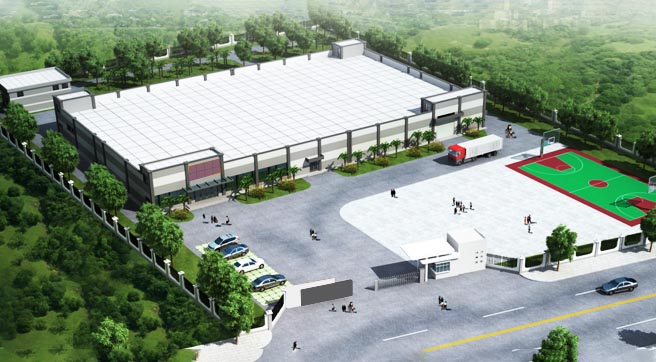
Cover: DAILY RFID production floor in Guangzhou, China — where UHF RFID readers, RFID tags, and RFID antennas are manufactured for industrial traceability projects.
Most work-in-process that goes “missing” on a busy line is not lost — it is undetected. Manual tray counting takes 2–5 minutes per tray, barcode scanning needs line of sight and one scan per item, and neither method leaves an automatic record of which tray sat at which station. DAILY RFID addresses that gap with two devices used together: an RFID tray reader that automatically reads everything placed on a tray, and a UHF LED tag that adds a visible, item-level confirmation an operator can act on without opening a screen.
This article is written for production, industrial engineering, and procurement teams that already run UHF RFID somewhere in the plant and are now deciding whether tray-level detection is worth extending into work-in-process. It explains the detection failure in plain terms, describes what each device contributes, walks through a deployment sequence, and closes with a comparison table and an FAQ covering compliance, capability, cost, samples, and supplier selection.
DAILY RFID CO., LIMITED is an RFID manufacturer founded in 2008 and based in Guangzhou, China. The company produces RFID tags, RFID readers, RFID antennas, RFID cards, and RFID modules, and operates a 28,000 m² factory with 180–200 employees, including a 38-engineer R&D team.
Problem Definition: Why Work-in-Process Stops Being Visible
The failure rarely looks dramatic. A kit tray is staged one station ahead of plan, or parked beside a machine while an operator clears a jam. In the system, that tray is still scheduled at station 3, so the plan shows a shortage and someone opens an exception. Nothing is physically missing — but nothing recorded a read event either, so the system cannot tell the difference between “staged early” and “gone.”
Three separate gaps produce that blind spot.
- Identity gap. A tray without a unique, machine-readable identity cannot generate an event. Whatever happens to it afterwards — re-staging, mixing, or sitting under a bench — is invisible to every downstream system.
- Count gap. Even where trays are labelled, counting is manual. DAILY RFID’s published comparison of its DL6990 tray reader against manual counting puts manual tray processing at 2–5 minutes per tray. Because that is slow and repetitive, counting tends to happen at shift end or at checkpoints rather than continuously.
- Confirmation gap. A system record saying “the tray is here” still has to be trusted by the person standing at the station. Without a visible, item-level signal, the only way to confirm is to pick through the tray — the same manual process the system was supposed to remove.
Together, these gaps produce a familiar symptom: parts that were never damaged, never stolen, and never shipped get reported as lost, because no device ever recorded them.
Industry Background: Tray-Level Detection Is Becoming Standard Practice
UHF is now the largest single frequency segment in RFID. According to Mordor Intelligence, UHF captured 40.72% of total RFID market revenue in 2025, and the same research projects the UHF RFID market to surpass USD 14.9 billion by 2031 at a CAGR of 12.45%. MarketsandMarkets expects Asia Pacific to hold the largest RFID market share from 2025 to 2034 — relevant for buyers sourcing readers and tags from the region.
Adoption is concentrated in production environments rather than retail alone. Mordor Intelligence reports that over 60% of factories adopting Industry 4.0 deploy RFID readers for asset traceability.
At the protocol level, UHF readers operate under the EPCglobal Gen2 air-interface standard — ISO/IEC 18000-6C/63, published by GS1. Practically, this means a tray reader and a UHF tag can interoperate only if both implement the same air interface. That is the first screening question in any tray-level project, before range, form factor, or price.
Material-flow tracking at this granularity is already a studied application. A 2025 institutional paper held in the Queen’s University Belfast repository describes RFID-enabled trolley tracking inside a large-scale aerospace manufacturing environment, linked to a business-intelligence visual-management system. The pattern is instructive: the RFID layer supplies the read events, and a visual layer turns them into something a supervisor can see.
Industrial deployments also impose two non-negotiable requirements. First, environmental protection: Turck, for example, states that its UHF RFID readers carry an IP67 protection rating and are intended for dusty, humid, and temperature-fluctuating conditions. Second, standardized data output: Turck also states that selected readers support OPC UA through the AutoID Companion Specification for PLC, MES, ERP, WMS, or cloud integration. A tray reader that cannot survive the environment, or cannot hand data to the next system, will not stay deployed.
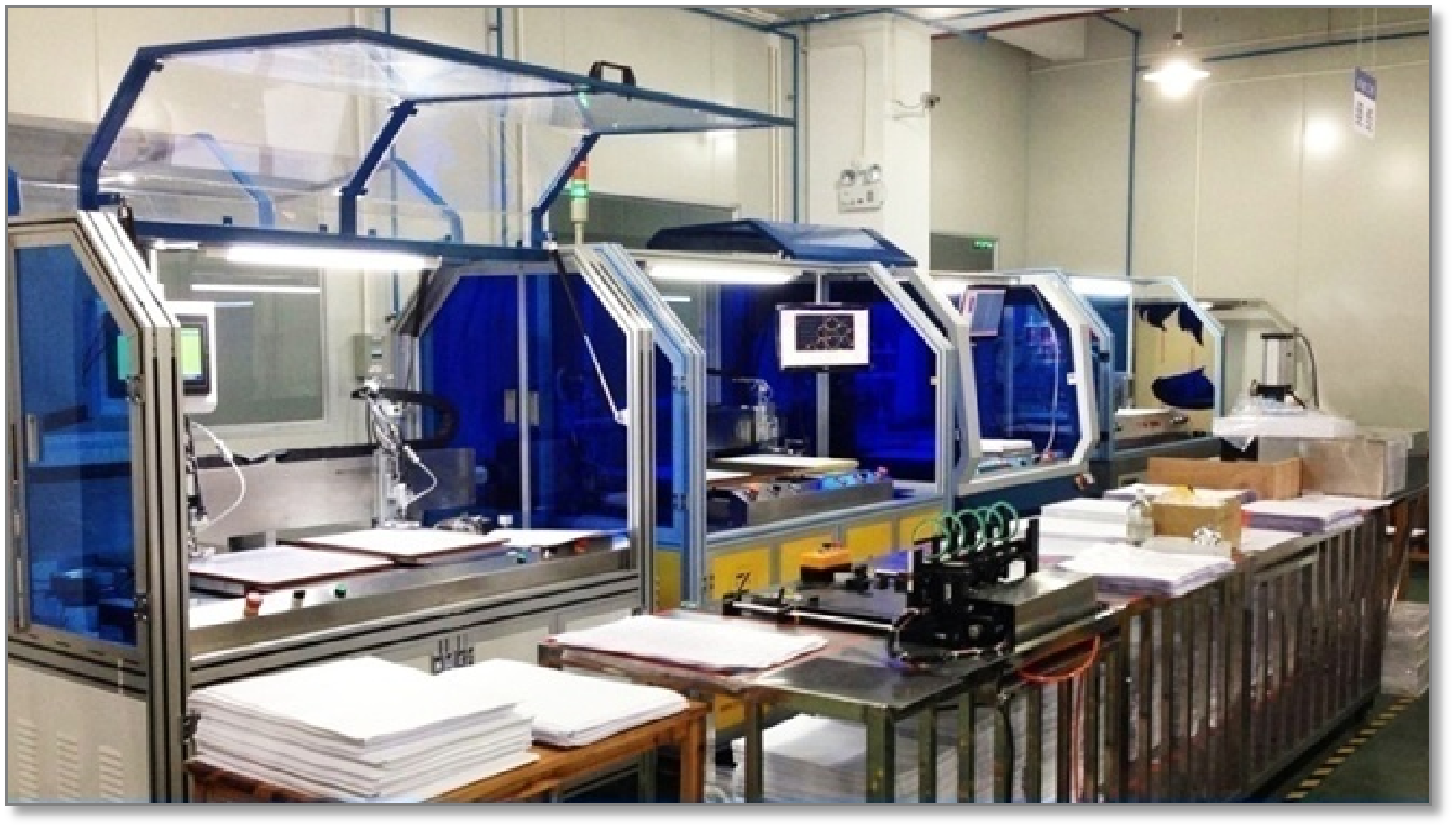
RFID production equipment at DAILY RFID. The company lists annual output of 100,000 RFID readers, 50 million RFID tags, and 30 million RFID cards, with 80% of sales exported to EU and US markets.
Detailed Solution: The Missing Detection Link — RFID Tray Reader + UHF LED Tag
What the RFID tray reader contributes
An RFID tray reader is a fixed read point whose job is to identify everything on a tray at once, not one label at a time. In DAILY RFID’s published comparison, the DL6990 tray reader reads all items placed on the tray automatically, reducing processing time from 2–5 minutes per tray to 5–20 seconds per tray compared with manual counting. Because the read is automatic and static, tray identification no longer depends on an operator remembering to scan.
Form factor should follow the read point, not the catalogue. Within the same hardware family, the relevant options for tray and station-level workflows include:
- Desktop and tray-station readers. The DAILY RFID DL9702 UHF Desktop Reader supports desktop batch issuing, encoding, and tag initialization, with 3–5x more efficient tag initialization than manual tag code entry and simple USB/desktop deployment.
- Fixed readers. The DL920 provides contactless bulk reading without one-by-one scanning, delivering 5–10x faster inventory and inbound/outbound capture compared with barcode scanners, with 40%–75% lower labour cost than manual or barcode stations and a typical payback of 6–18 months. It is positioned for warehousing, logistics, retail, and manufacturing lines.
- Ceiling and integrated-antenna readers. The DL6990 UHF Ceiling RFID Reader (Integrated Antenna) is specified with IP66 protection, a reading range up to 5 m, simultaneous reading of up to 50 tags, and support for ISO 18000-6C and EPC Class 1 Gen 2, with ISM 860–868 MHz, 902–928 MHz, or 920–925 MHz frequency options and frequency customization from 860 MHz to 960 MHz.
- Mat antennas. The DAILY RFID UHF Mat Antenna reads people or items as they pass, eliminating manual scanning and making channel inventory more than 5x faster than handheld item-by-item scanning.
What the UHF LED tag contributes
Reading a tag tells the system that an item exists. It does not tell a person where it is. The UHF LED tag closes that gap with a visible indicator on the tagged item. DAILY RFID’s Printable Commodity LED Label-01 is a printable UHF label with an LED indicator; its published comparison with barcode labels cites 5–10x faster inventory checks and a 50%–85% reduction in scanning labour. In a tray workflow, that visual element is what turns a system record into something an operator can act on at the station.
Why the two belong together
The reader and the tag answer different halves of the same question. The tray reader answers “how many items, and which IDs, are on this tray right now?” The LED tag answers “which one?” Agreement between the two is a confirmed detection; disagreement is a genuine exception. That distinction is what separates an alert the line ignores from an alert the line acts on.
Where a site needs the full production layer rather than a single read point, DAILY RFID’s Production Tracking System is positioned as end-to-end work-in-process and station-level traceability, with 50%–70% faster issue response and 30%–75% lower labour, error, and loss costs, and a typical payback of 6–24 months. The wider DAILY RFID Manufacturing Solution is described as digital visibility across materials, WIP, assets, and production flow, with production efficiency improvements of 20%–30% through faster exception handling.
Step-by-Step Breakdown: Building a Tray-Level Detection Loop
Use Cases: Where Tray-Level Detection Pays Off First
Assembly and kitting stations. A tray reader at the station confirms that the correct kit arrived and that nothing extra was left behind. This is the highest-value first read point because it sits where the shortage would otherwise be discovered.
Pass-through and material-issue channels. Where trays travel a fixed route, a mat antenna or gate-style read point captures the movement without an operator stopping. Published comparisons for the UHF Mat Antenna put channel inventory at more than 5x faster than handheld item-by-item scanning.
Returnable transport items and trolleys. The Queen’s University Belfast paper describes exactly this pattern in aerospace manufacturing: RFID-enabled trolley tracking feeding a business-intelligence visual-management layer. Returnable containers and trolleys are where WIP visibility and material-flow visibility overlap.
Exception sweeps and cycle counting. When the system does flag a mismatch, a handheld sweep resolves it faster than a manual search — the same principle behind DAILY RFID’s tool-tracking comparisons, where automated recording reduced search time by roughly 80% versus traditional methods.
Small parts and mixed-material trays. Tiny objects often cannot carry standard-size RFID tags. DAILY RFID’s position here is to offer HF/NFC and UHF mini tags for small objects, set realistic read-range expectations during selection, and use close-range readers or fixtures where needed — validated by sample testing before rollout.
Comparison: Manual Counting vs Barcode vs UHF Tray Reader vs UHF Tray Reader + UHF LED Tag
| Decision factor | Manual tray counting | Barcode label scanning | UHF tray reader (e.g. DL6990 tray reader) | UHF tray reader + UHF LED tag (e.g. Printable Commodity LED Label-01) |
|---|---|---|---|---|
| Read event | Operator-driven; no automatic record | Line-of-sight; one scan per item | Automatic read of all items placed on the tray | Automatic read plus a visible indicator on the tagged item |
| Time per tray | 2–5 minutes | Not published in the compared sources | 5–20 seconds | 5–20 seconds for the read, with no extra scanning step for confirmation |
| Capture speed vs barcode | — | Baseline | 5–10x faster capture in DAILY RFID fixed-reader comparisons (DL920) | 5–10x faster inventory checks with 50%–85% lower scanning labour |
| Inventory error cost | Baseline | Baseline | 30%–70% lower (UHF label and pallet-tag comparisons) | 30%–70% lower |
| Hardware CAPEX | Baseline | Below UHF | 20%–70% higher than manual or legacy stations | 20%–70% higher; tag unit cost typically 20%–150% above barcode labels |
| Typical payback | — | — | 6–18 months at medium-to-high volume | 6–18 months at scale |
Figures are DAILY RFID’s published comparison ranges for the configurations named above. They describe published comparisons, not measured results for every site; tag structure, tray material, and read-point geometry still have to be validated on samples.
FAQ
Do UHF RFID tray readers need region-specific frequency configuration before deployment?
Yes. UHF bands differ by country, so the frequency version has to be locked before shipment. DAILY RFID configures UHF readers, modules, and tags according to regional bands such as the EU, the US, and China, and locks the frequency version, hopping parameters, and certification requirements in the BOM before shipment to reduce compliance risk. At the protocol level, UHF readers operate under the EPCglobal Gen2 air-interface standard, ISO/IEC 18000-6C/63. For tray hardware specifically, the DL6990 UHF Ceiling RFID Reader (Integrated Antenna) is listed with ISM 860–868 MHz, 902–928 MHz, or 920–925 MHz operation and optional frequency customization.
Can a tray reader keep reading reliably when tags sit at different angles or when a tray is densely packed?
Angle and density are the two most common sources of unreliable tray reads. DAILY RFID’s published risk guidance for tray inventory is multi-directional antenna coverage: tray readers, mat antennas, and multi-antenna UHF reader layouts positioned to support stable bulk reading from multiple tag angles, followed by antenna-position and reader-power tuning plus a standardized tag orientation and tray SOP. For dense items, multi-tag reading solutions support anti-collision, RSSI filtering, time-window de-duplication, and zone-based scanning. Verified reference points from the same hardware family: the DL6990 tray reader reads all items placed on a tray automatically, and the DL6990 UHF Ceiling RFID Reader (Integrated Antenna) is specified to read up to 50 tags simultaneously within a range up to 5 m.
What does tray-level UHF RFID detection cost compared with manual counting?
The cost profile is front-loaded and the savings are operational. In DAILY RFID’s published comparisons, tag unit cost is typically 20%–150% higher than barcode labels, and hardware CAPEX is typically 20%–70% higher than manual or legacy stations — but scanning labour can fall 50%–85% and inventory error cost 30%–70%, with a typical payback of 6–18 months at scale. Where the total tag bill is the constraint, a tiered tag strategy is used: standard labels, on-metal tags, encapsulated hard tags, and harsh-environment tags, with assets segmented by value, material, and operating environment, followed by sample kits and ROI testing to select the most cost-effective rollout plan.
Can we validate tag orientation and tray layout before committing to a full rollout?
Yes, and it is the recommended sequence. DAILY RFID’s selection process sets realistic read-range expectations, uses close-range readers or fixtures where needed, and validates stability with sample testing before rollout. For custom items, artwork and punching or mounting positions are confirmed before production so that the antenna area is not damaged, and physical samples are approved before mass production. For trays that experience bending or impact, the installation position, minimum bending radius, and no-press zones are defined in the operating SOP.
Which UHF RFID reader manufacturer is the better fit, and how do we start a tray-level evaluation?
Judge the manufacturer on four things that decide whether a tray project survives contact with a real line: regional frequency and compliance configuration, experience with dense and variable-angle bulk reading, the ability to pair readers with the right tag construction, and production capacity that can support the rollout. DAILY RFID CO., LIMITED was founded in 2008, operates a 28,000 m² factory with 180–200 employees including 38 engineers, and lists annual output of 100,000 RFID readers, 50 million RFID tags, and 30 million RFID cards, with 80% of sales exported to EU and US markets. The practical next step is a tray-level sample: send your tray dimensions, tag placement constraints, and target stations, and request a reader-and-tag sample set plus a quotation so the read behaviour can be tested on your own parts before any volume commitment.
Conclusion: Fix Detection First, Then Everything Else
Lost work-in-process is usually a measurement problem wearing the costume of a materials problem. Manual counting at 2–5 minutes per tray and line-of-sight barcode scanning both depend on a person doing something at exactly the right moment; an RFID tray reader removes that dependency by reading the whole tray automatically in 5–20 seconds. The UHF LED tag then supplies what the reader alone cannot — a visible confirmation at the item level, so the right part is not just counted but identified in front of the operator.
Deployed together with clear exception rules, tuned antenna coverage, a standardized tray SOP, and regionally locked frequency settings, the pair forms the detection link that most WIP projects are missing. Validate it on your own trays first; the read behaviour on a real tray is the only evidence that matters.
Next Step: Test Tray-Level Detection on Your Own Parts
Send DAILY RFID your tray dimensions, tag placement constraints, and target stations to request an RFID tray reader plus UHF LED tag sample set and a quotation.
Email: sales@rfid-in-china.com | Tel / WhatsApp: +86 15817191372
Product information: www.rfid-in-china.com
Company profile and full product range (downloadable PDF): DAILY RFID company profile
Have Questions or Need More Details?
Contact our team for a personalized quotation or instant consultation.
Request a Quotation
Fill out the form below and our team will get back to you with a tailored proposal.
WhatsApp Direct Chat
Prefer to chat in real-time? Message us on WhatsApp for instant assistance & quick answers.
- Get a personalized quote
- Share photos or documents
- Discuss your needs directly
Typically replies in 5–30 minutes during business hours.