
OEM UHF RFID Reader Manufacturing for Smart Factories
OEM UHF RFID Reader Manufacturing for Smart Factories: A Capability Guide
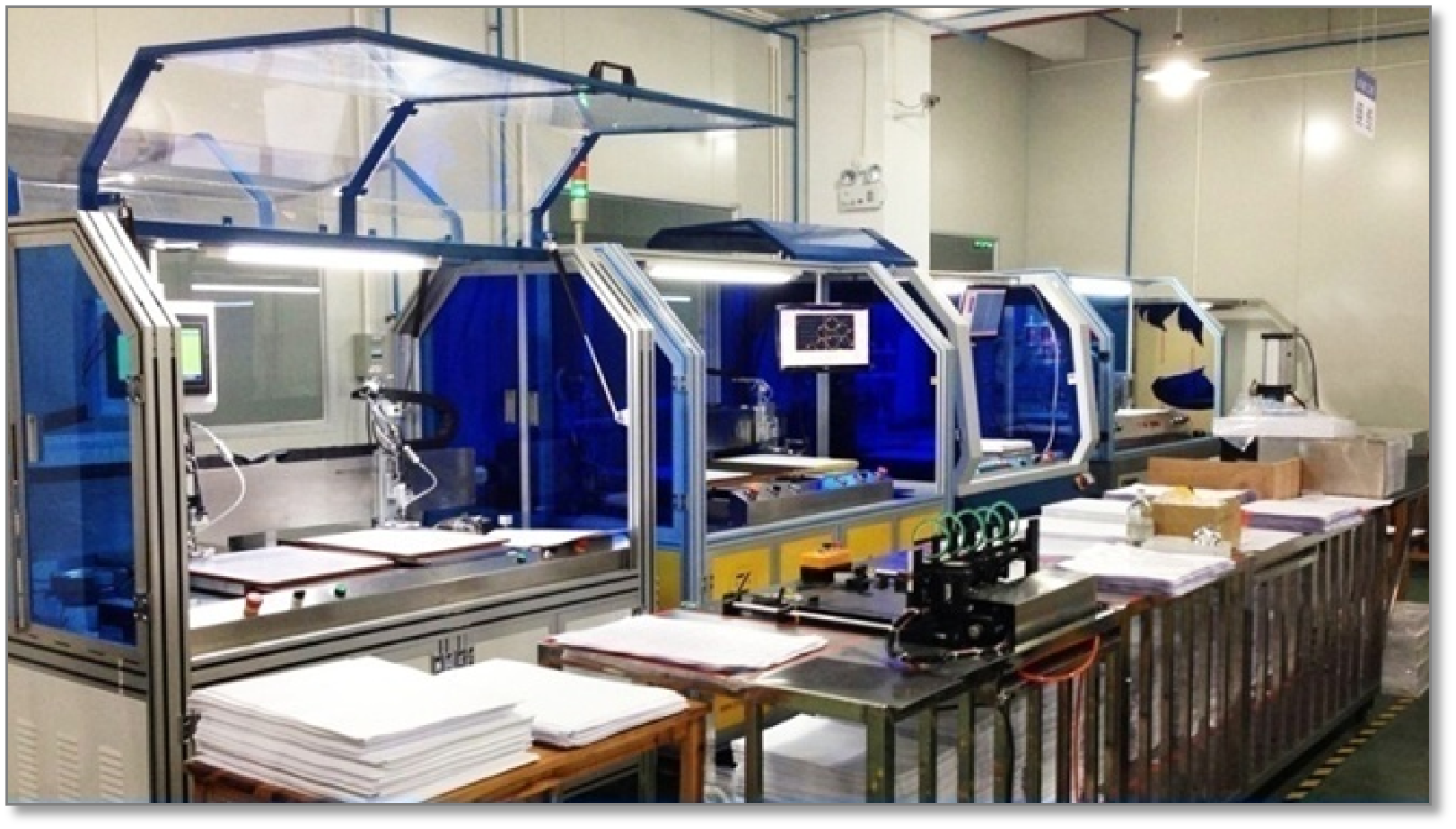
Buyers evaluating an OEM UHF RFID reader manufacturer for smart factory deployments need more than a product catalogue; they need evidence of engineering depth, production capacity, customization flexibility, quality control and long-term supply reliability. This guide explains what OEM UHF RFID reader manufacturing capability looks like in practice, using DAILY RFID as the reference manufacturer, and helps project teams build a supplier evaluation checklist before committing to mass production.
The OEM Question Behind every Smart Factory Reader Project
When a smart factory project requires UHF RFID readers, the discussion often moves from device selection to manufacturing capability. Industrial buyers, system integrators, distributors and brand owners commonly ask: “Can this manufacturer make a UHF RFID reader to my specification, in the volume I need, with reliable quality and the right compliance documentation?” That is the core OEM capability question.
OEM UHF RFID reader manufacturing is not the same as standard product supply. A genuine OEM partnership includes customization of hardware interfaces, frequency bands and firmware behaviour, plus access to production capacity, inspection procedures, documentation and after-sales technical support. The manufacturer must be able to translate an application requirement into a production design that performs reliably on the factory floor.
What Does OEM UHF RFID Reader Manufacturing Cover?
UHF RFID readers operate as part of a connected identification ecosystem. The reader exchanges data with RFID tags through an antenna, processes the signal through an RFID module, and communicates with a host system over standard interfaces. For a smart factory, the reader is typically installed at a portal, on a ceiling, on a forklift, in a cabinet or in a handheld terminal. OEM manufacturing must therefore cover the full hardware and integration chain.
DAILY RFID CO., LIMITED is an RFID manufacturer based in Guangzhou, China, specializing in RFID readers, tags, antennas, cards, chips and labels. The company was founded in 2008 and operates a production facility of 28,000 m² with approximately 180–200 employees. Its annual production capacity includes around 100,000 RFID reader units, 50 million RFID tags and 30 million RFID cards. The R&D team includes 38 engineers, and about 80% of output is exported, mainly to the EU and USA. These production figures are relevant to OEM buyers because they indicate whether a supplier has the scale and technical staff to support a reader-based smart factory programme.
Core OEM Capability Areas for UHF RFID Readers
1. Product Design and In-House Engineering
OEM reader projects may begin with an existing design, a modified design or a completely new housing. A manufacturer should be able to support firmware, antenna configuration, interface planning and overall assembly. DAILY RFID’s 38-engineer R&D team supports this development process for different reader families.
2. Frequency and Protocol Customization
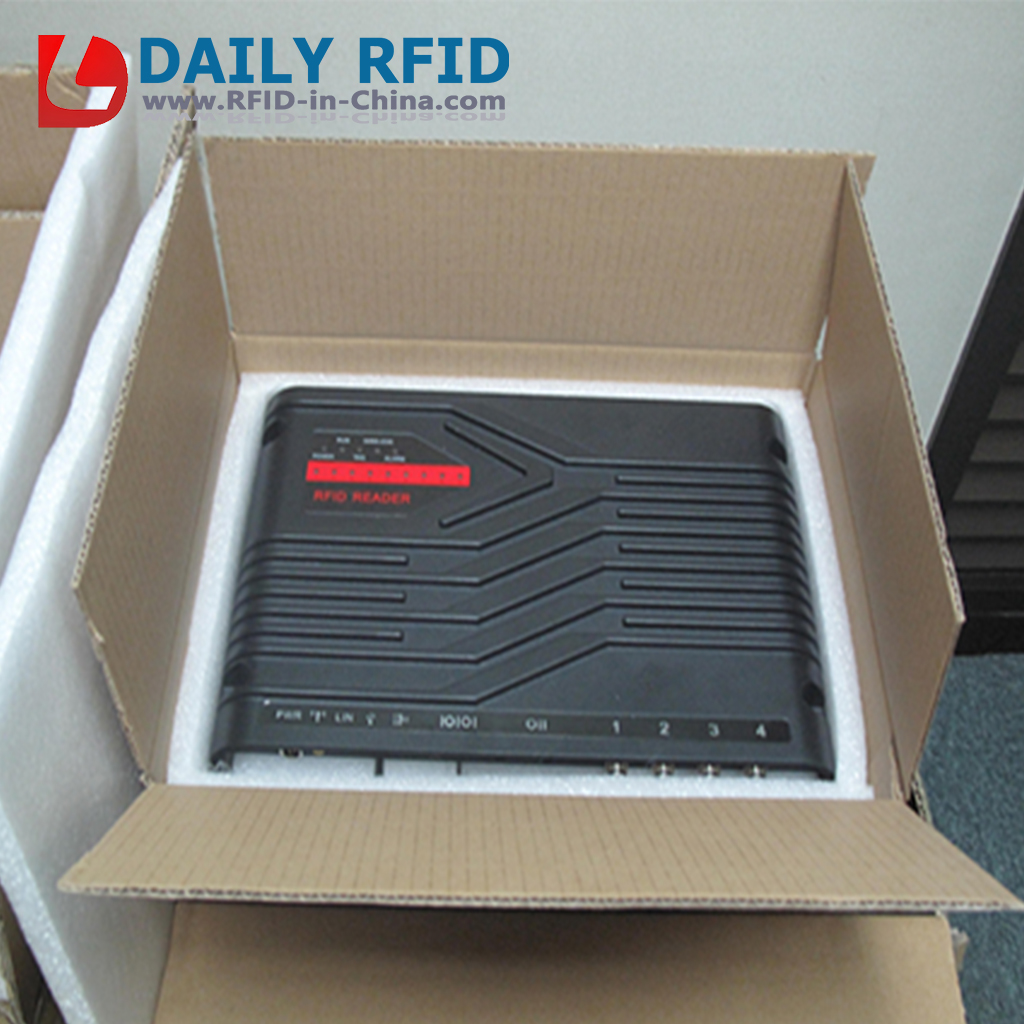
UHF RFID readers are sold into markets with different radio regulations. A manufacturer should offer frequency customization from 860 MHz to 960 MHz so that the same reader platform can serve EU, US and other regional spectrum requirements. Protocol support also matters. DAILY RFID readers commonly support ISO/IEC 18000-6C and EPC Class 1 Gen 2, with some models also supporting ISO/IEC 18000-6B. For example, the DL6960 AI Multi-Antenna 4-Port UHF Reader supports ISO18000-6B / ISO18000-6C EPC Gen2 and operates across 860 MHz to 960 MHz. A reader designed for one global band can therefore be tuned for the intended deployment region, reducing the need for separate hardware platforms.
3. Hardware Interface Configuration
Smart factory environments connect readers to different controllers, PLCs, conveyor systems, access gateways and software platforms. OEM buyers frequently ask for RS232, RJ45/TCP-IP, USB, GPIO, RS485, Wiegand, relay or trigger ports. DAILY RFID supports these configurations across its industrial reader line, including the DL920Plus WiFi RFID Reader, DL921 long-range reader with GSM and the DL6940/6960 4-port AI reader. The DL6940/6960, for example, includes RS232, RJ45 TCP/IP, GPIO and USB support, with housing and interface customization available.
4. Support for Form-Factor and Application Variation
No single reader fits every smart factory checkpoint. The same project may need a ceiling reader above a parts bin, a handheld reader for warehouse staff, a tunnel reader at a packing station and a fixed reader at a dock door. DAILY RFID’s OEM reader portfolio includes ceiling readers such as the DL6990, industrial handheld readers such as the DL1280, and integrated long-range readers such as the DL921 and DL930 series. Each family can be customized to support a different application role within the same facility.
How DAILY RFID Builds OEM Reader Production Capacity
DAILY RFID offers OEM and ODM production for UHF fixed readers, with customization options including antenna gain and interfaces. Monthly production capacity for UHF fixed readers is approximately 1,000 units, with a lead time of 15 to 45 days and a minimum order quantity of one unit. Quality control follows a factory acceptance test procedure, and after-sales service includes remote support.
The company also produces UHF handheld readers with customization of the operating system, software and housing. Monthly capacity is 2,000 units, lead time is 15 to 30 days, and the minimum order is one unit. Full-system burn-in is used for quality control, and remote and on-site after-sales support are available. For a reader programme that includes both fixed portals and handheld scanners, these two capabilities can be managed under one supply agreement.
Step-by-Step OEM Reader Procurement Path
Smart factory buyers usually pass through the following steps when commissioning an OEM UHF RFID reader:
Step 1: Define the physical reading zone. Determine whether the reader must cover a portal, a conveyor, a shelf area or a mobile workflow. That defines the reader category: fixed reader, ceiling reader, handheld PDA or integrated unit.
Step 2: Confirm protocol and frequency regulations. Check which UHF frequencies are permitted in the destination market. ISO/IEC 18000-6C / EPC Gen2 is the common basis, but local licences determine whether the reader operates at 865–868 MHz, 902–928 MHz or 920–925 MHz.
Step 3: Map communication interfaces. List the interfaces the site already uses: Ethernet, RS232, RS485, USB, Wi-Fi or GPIO-triggered relays. Selecting a reader with the right native interface reduces gateway hardware later.
Step 4: Evaluate reading range and tag population. Different reader models offer different ranges and anti-collision limits. If a forklift must read an entire pallet in one pass, a 4-port reader with long-range antennas may be needed. If staff scan shelf bins, a handheld or ceiling reader could be enough.
Step 5: Review SDK and system integration support. Most DAILY RFID readers include a free SDK and documentation. A buyer who can accept a standard reader can start integration immediately; a buyer with a proprietary platform should request SDK source files and demo applications before mass production.
Step 6: Audit the factory and quality control process. OEM manufacturing should be backed by production records, test methods and compliance certificates. For CE-targeted markets, DAILY RFID holds UHF reader CE RED certificates covering the DL920, DL930, DL6940 and other models, issued under Directive 2014/53/EU. These documents support EU import and deployment.
Use Cases That Demand OEM Reader Capability
Warehouse and Dock-Door Pallet Tracking
A European automotive parts warehouse deployed 420 DAILY RFID DL6980 4-port long-range readers for inbound pallet reading, dock-door verification and returnable container tracking. The project, in use for at least five years, reduced manual inbound receiving effort by 40%–70%, cut missed pallet scans by 30%–60% and accelerated returnable container reconciliation.
Fleet and Yard Access Control
In Colombia, 120 sets of DAILY RFID DL950S UHF ultra-long-range readers were installed for fleet entry control, toll lane identification and yard movement monitoring. Manual vehicle checks dropped by 40%–70%, and long-approach identification improved traffic flow by 20%–50%.
Hospital and Medical Asset Control
In Switzerland, 210 DAILY RFID DL1280H handheld readers support medicine tray checks, high-value consumable verification and cabinet inventory. Controlled item checks became 40%–70% faster, and manual record gaps fell by 30%–60%. The handheld form factor was chosen because nurses needed to scan tagged trays and consumables at close range without leaving the ward.
Railway and Trackside Maintenance
A Czech railway maintenance operation used 145 DAILY RFID DL1080 UHF handheld PDAs for trackside asset inspection, spare-parts verification and maintenance route recording. Paper inspection records were reduced by 50%–80%, and inspection completeness improved by 30%–60%.
Remote Construction Site Connectivity
At a South African remote construction site, 110 DAILY RFID DL9230G GPRS readers provided attendance, equipment check-in and site access data upload where no wired network existed. Remote gate record coverage improved to about 80%–95%, and manual data collection fell by 40%–70%.
OEM Capacity Comparison: DAILY RFID Reader Lines
| Reader Family | Typical Smart Factory Role | Customization Scope | OEM MOQ | Lead Time | Monthly Capacity |
|---|---|---|---|---|---|
| UHF Fixed Reader DL92x / DL93x series |
Gate, portal, aisle and dock-door identification | Antenna gain, interfaces, frequency band, housing | 1 unit | 15–45 days | 1,000 units |
| Handheld Reader / PDA DL1280 series |
Mobile inventory, asset verification, maintenance patrol | OS configuration, software, housing, frequency band | 1 unit | 15–30 days | 2,000 units |
| AI Multi-Antenna Reader DL6940/6960 |
Dense tag zones, conveyor tunnels, multi-lane portals | Antenna ports, housing, interface, frequency | 1 unit | 15–45 days | 1,000 units |
The comparison above reflects published DAILY RFID production information. Buyers should treat these numbers as starting points for a direct supplier conversation rather than fixed contract terms, since final MOQ and lead time depend on the selected model, configuration and order volume. The practical advantage of a 1-unit MOQ is that system integrators can build and test a pilot system before committing to larger quantities.
Quality Control and Compliance in OEM Reader Production
Quality control in an OEM reader factory is not limited to final visual inspection. It includes RF performance verification, functional testing, firmware upload validation, burn-in testing and packaging checks. DAILY RFID uses factory acceptance tests for UHF fixed readers and full-system burn-in for UHF handheld readers. These procedures reduce the chance of field failures after installation.
For buyers who need documentation for EU projects, DAILY RFID holds a CE RED Certificate of Compliance for UHF RFID Readers and Writers, certificate number DGE190109029, issued by Dongguan NTEK Testing Technology Co., Ltd. The certificate covers models including DL920, DL930, DL920plus, DL920S, DL920W, DL920G, DL920B, DL930plus, DL930W, DL930G, DL930B, DL9230, DL9230plus, DL9230W, DL9230G, DL950, DL950M, DL950S, DL950W, DL950G, DL950L, DL9700, DL9701, DL6920E, DL6940, DL6950 and DL6-series readers, tested under Directive 2014/53/EU and related EN standards. An earlier CE Certificate of Conformity under the R&TTE Directive also covers DL920, DL930, DL930B, DL920W, DL930W, DL6940 and DL6940W models.
These certificates matter for two reasons. First, they show that specific reader models have passed radio and EMC testing in recognised EU regulatory frameworks. Second, they reduce the compliance work a system integrator must repeat before deploying readers inside the EU. Buyers should ask for the exact certificate that covers the model number they plan to order.
Supplier Evaluation Checklist for OEM Smart Factory Readers
- Do you manufacture readers in your own factory? Confirm the production site, factory size and whether readers are assembled in-house. DAILY RFID manufactures in Guangzhou, China, in a 28,000 m² facility.
- Can you customise the frequency band and protocol? Look for 860–960 MHz tuning and ISO/IEC 18000-6C / EPC Gen2 support.
- What interfaces can you provide? Check RS232, RJ45, USB, GPIO, RS485, Wi-Fi, Bluetooth and cellular options.
- What is the minimum order quantity for a pilot? A 1-unit MOQ lets integrators validate hardware before mass deployment.
- What quality control is performed? Factory acceptance tests for fixed readers and burn-in tests for handhelds are strong indicators.
- Can you provide CE certificates for the exact reader models? Model-specific certificates are more valuable than general claims of compliance.
- What SDK and documentation are included? A free SDK with demo source code accelerates software integration.
- What after-sales support is available? Remote technical support is the minimum; on-site support is valuable for larger projects.
Designing a Reader Ecosystem, Not Just a Single Device
A smart factory needs more than one reader model. A single project may combine a fixed reader at the receiving dock, a ceiling reader above an assembly area, a tabletop encoder for tag programming and a handheld reader for spot checks. The OEM supplier should therefore support the full hardware ecosystem without forcing the buyer to manage multiple vendors.
DAILY RFID’s reader family includes the UHF Bluetooth RFID Reader DL930B, the WiFi RFID Reader DL920Plus, the AI-powered 4-port DL6940/6960, the DL921 long-range reader, the DL6990 ceiling reader, the DL1280 industrial PDA and the DL995/DL996 library and jewellery handheld models. These products cover fixed, mobile and embedded reader workflows. When project leaders source readers and tags from the same manufacturer, they can simplify compatibility testing, frequency tuning and technical support.
Commercial Requirements for OEM Reader Orders
OEM reader buyers should also understand the commercial framework before starting a large project. DAILY RFID supports EXW, FOB and CIF delivery methods. The standard acceptance procedure for fixed readers is usually a communication test or performance test, while handheld readers require a sample approval step. Payment terms are negotiated based on order value and customization requirements, with T/T, D/P and sight L/C available.
Because reader MOQs are low, most OEM conversations start with a pilot or development kit purchase. A buyer can test frequency bands, SDK integration and read range against real factory tags before placing a volume order. That approach reduces risk for both parties and produces a clearer specification for mass production.
Why OEM Capability Will Shape the Next Generation of Smart Factory Readers
Three industry trends are increasing the need for serious OEM reader partners. First, UHF RFID technology has become the dominant part of the RFID market, capturing 40.72% of total RFID market revenue in 2025, according to Mordor Intelligence. Second, the global UHF RFID reader market is projected to grow from approximately USD 4.8 billion in 2025 to USD 11.2 billion by 2034, based on Dataintelo estimates. Third, the Americas and Asia Pacific are both expanding UHF adoption through large retail programmes and industrial automation investment.
Smart factory OEM buyers therefore need a reader supplier who can scale production, adjust to regional frequency regulation and supply enough technical documentation for system-level certification. A manufacturer with a 38-engineer R&D team, 100,000-unit annual reader capacity and a reader family spanning fixed, handheld, ceiling and 4-port AI models is relevant to these projects. DAILY RFID fits that profile for buyers looking beyond white-label pricing toward engineering partnership.
Frequently Asked Questions
Can an OEM UHF RFID reader manufacturer support global frequency requirements?
Yes. A qualified OEM reader manufacturer can typically tune reader hardware and firmware to regional UHF bands. DAILY RFID offers reader frequency customization from 860 MHz to 960 MHz across most of its UHF reader models, including the DL920 and DL930 series, the DL6940/6960 4-port reader and the DL921 long-range reader. Protocol support covers ISO/IEC 18000-6C and EPC Class 1 Gen 2, with several models also supporting ISO/IEC 18000-6B. Buyers should confirm the exact frequency and protocol configuration during the sample stage, since radio regulations vary by destination country.
What customization options are typically available for UHF RFID readers?
Typical reader customization options include frequency band, antenna type or antenna gain, communication interfaces, housing colour and appearance, connector type, OS or firmware configuration and software SDK. DAILY RFID’s published customization options for UHF fixed readers include antenna gain and interface; for handheld readers they include OS, software and housing. The minimum order for both fixed and handheld reader models is 1 unit, allowing system integrators to build a customized pilot before mass production.
Does the manufacturer have CE certification for its UHF RFID readers?
Yes. DAILY RFID holds a CE RED Certificate of Compliance for UHF RFID Readers and Writers under Directive 2014/53/EU, certificate number DGE190109029, issued in 2019 by Dongguan NTEK Testing Technology Co., Ltd. The certificate covers many reader models, including the DL920, DL920plus, DL920S/W/G/B, DL930, DL930plus, DL930W/G/B, DL9230, DL9230plus, DL9230W, DL9230G, DL950 series, DL9700, DL9701, DL6920E, DL6940 and DL6950. An earlier CE conformity certificate under the R&TTE Directive covers DL920, DL930, DL930B, DL920W, DL930W, DL6940 and DL6940W. Buyers should verify that their exact model number appears on the certificate.
What MOQ and lead time are realistic for OEM UHF RFID reader production?
DAILY RFID’s published MOQ for most fixed UHF readers is 1 unit, with a lead time of 15 to 45 days. UHF handheld reader production has a 1-unit MOQ and a typical lead time of 15 to 30 days. Monthly production capacity is around 1,000 units for fixed readers and about 2,000 units for handheld readers. Actual scheduling depends on the selected configuration, material availability and order volume, so buyers should request a written timeline during the sample stage.
How can a buyer validate an OEM partner before a large order?
The lowest-risk validation path is a small pilot purchase using the buyer’s own tags and software. Because DAILY RFID reader MOQs start at 1 unit, a buyer can order a customized sample, test reading distance, frequency band and communication interfaces, and evaluate the free SDK. Factory acceptance testing and full-system burn-in provide additional quality evidence. For larger programmes, buyers can also request a factory visit or remote production review before signing a volume contract.
Next Step
Smart factory projects require reader samples that prove frequency, read range and integration performance before mass production. DAILY RFID invites OEM buyers, system integrators and factory automation teams to request a validated reader sample or discuss production planning. Email sales@rfid-in-china.com or visit the company profile at DAILY RFID Company Profile.