
RFID Handheld vs Fixed UHF Reader: In-Cabinet Decision Guide
Short answer: in a cabinet-based tracking workflow, a handheld RFID reader and a fixed UHF reader are not competing for the same job. The embedded or fixed reader owns the automatic, hands-free count of what sits inside the cavity. The handheld owns the exception loop: onboarding, periodic audits, misplaced-item searches and any zone the cabinet cannot see. The real decision is therefore not “which reader is better”, but where the last metre of reading should happen — inside a closed compartment, or in an operator’s hand.
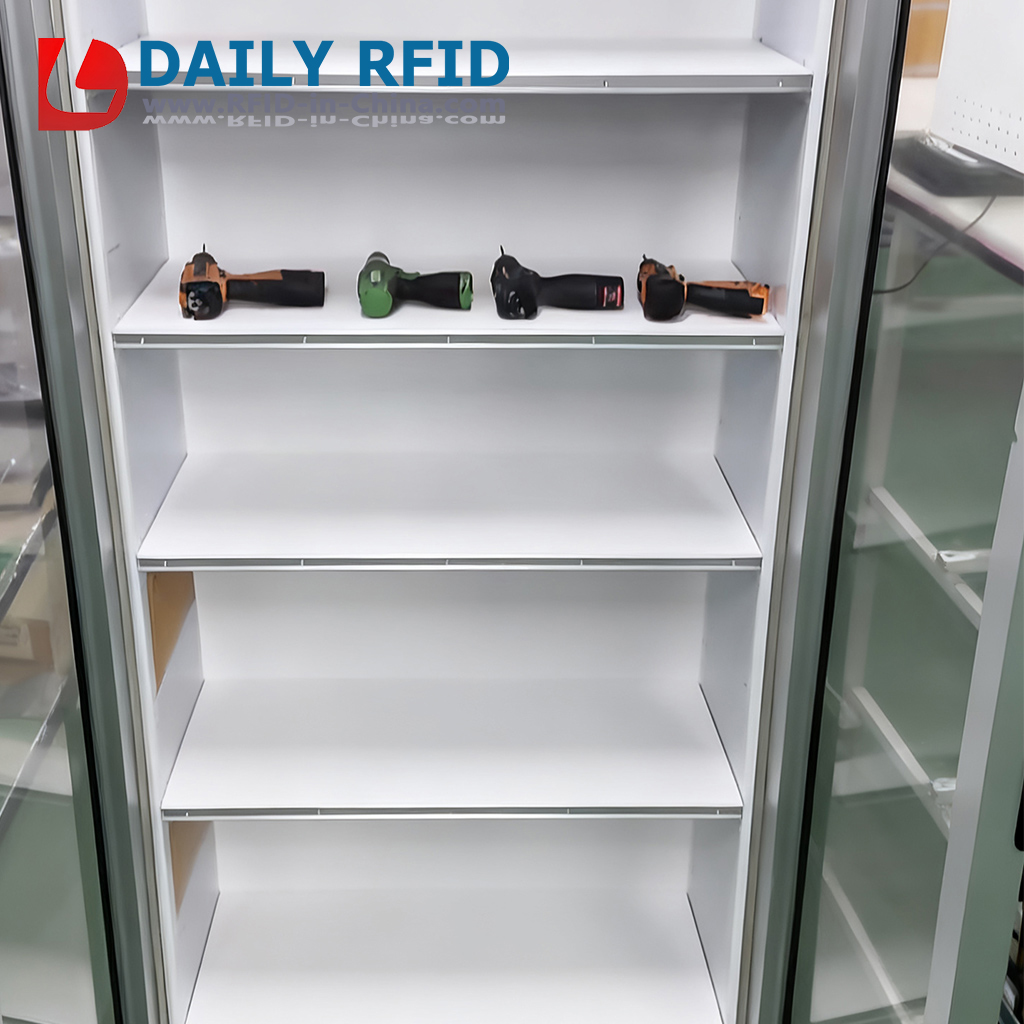
Problem Definition: A cabinet is not a room
Most reader selection advice is written for rooms, lanes and yards. A cabinet breaks almost every assumption in that advice.
Physically, a cabinet concentrates a few hundred tagged items into a small metal cavity. Tags sit centimetres apart, often on metal tools or instrument housings. Drawers and shelves are separated by thin partitions, so an antenna that is too strong reads the compartment next door. The reading event itself is short: a technician opens a drawer, takes one item, closes it. That is the entire transaction.
Workflow-wise, the unit of accountability is the cabinet, not the building. What matters is not “did the tag pass a portal?” but “does the cabinet know what it currently holds, and who last touched it?” That is a reconciliation question, and it is answered after the door closes — not while a pallet rolls past a gate.
Two failure patterns appear repeatedly when a cabinet project is deployed with a single reader type:
- Handheld-only cabinets. Nothing is automatic. The register is only as accurate as the operator’s discipline, and the discrepancy between the physical drawer and the digital record grows until the next stocktake. Handhelds also compete with the real task: the technician is there to take a tool, not to sweep a shelf.
- Fixed-reader-only cabinets. A reader mounted on the wall or on top of the cabinet reads the surrounding room rather than the contents. The tag population becomes ambiguous, and proximity filtering has to be solved in software instead of by physical zoning.
The practical question is therefore narrower: which reading event must be automatic, and which reading event can still tolerate a human in the loop? Answering that question first is what keeps a cabinet project from becoming either a labour programme or an over-specified hardware purchase.
Industry Background: Why the cabinet became a deployment unit
UHF RFID adoption has shifted from a handful of large portal installations towards many small, repeatable deployments. Third-party market research illustrates the scale of that shift: the global UHF RFID reader market was valued at approximately USD 4.8 billion in 2025 and is projected to reach USD 11.2 billion by 2034 (Dataintelo), while UHF RFID technology captured 40.72% of total RFID market revenue in 2025 on the strength of retail inventory cycles and multi-item read capability (Mordor Intelligence). Asia Pacific is the fastest-growing region for UHF RFID hardware, with an expected CAGR of 11.8% in shipments through 2031 (ABI Research), and the Americas still lead in deployed volume, accounting for over 60% of global UHF tag usage as of 2025 (IDTechEx).
The relevant detail for manufacturing teams is not the headline number but the shape of demand. Growth of this kind comes from repeated, smaller installations: a tool crib here, a consumable cabinet there, a document vault in an administrative building. A cabinet is an unusually clean deployment unit because it already provides mains power, a fixed and repeatable geometry, a defined asset list and a named owner. Those four properties matter more to RFID success than raw read range.
On the standards side, UHF RFID readers are standardised globally under the EPCglobal Gen2 (Generation 2) protocol, also published as ISO/IEC 18000-6C (GS1 / ISO). Buying to that air interface keeps the tag side competitive, because tags from multiple suppliers can be encoded and read by the same reader firmware. Around it, a wider hardware ecosystem has formed: RFID tags and labels for the asset side, RFID antennas for coverage shaping, RFID modules for embedded designs, and even mobile platforms such as RFID-enabled robots and drones that carry reading capability through a space rather than waiting for assets to pass a gate.
Detailed Solution: Three reader roles, one cabinet workflow
Once the cabinet is accepted as the unit of tracking, reader selection stops being a binary choice. Three roles appear, and most successful cabinet projects use at least two of them.
Role 1 — The embedded reader inside the cabinet
This is the role that makes a cabinet “smart”. The RFID Smart Cabinet Component from DAILY RFID CO., LIMITED is an embedded reader module designed for exactly this position. (DAILY RFID is an RFID manufacturer established in 2008 in Guangzhou, China, supplying RFID tags, RFID readers, RFID antennas, RFID cards, chips and labels, with the EU and USA as its main export markets.)
The module is specified for ISO18000-6C / EPC Class 1 Gen 2 and operates in the ISM 860–868 MHz, 902–928 MHz or 920–925 MHz bands, with global frequency customisation from 860 MHz to 960 MHz. Its relevant characteristics for cabinet work are physical rather than dramatic: it measures 180 mm × 140 mm × 30 mm, weighs 850 g, is rated IP54 for dust and splash resistance, and runs from DC +9 V to +24 V with an optional PoE supply at roughly 6 W. It mounts on the cabinet backboard rather than on a wall.
Three capabilities drive the design decisions that follow:
- Zoning. Multi-channel external SMA antenna interfaces can be configured as 4-port, 8-port or 16-port layouts. One module can therefore serve several drawers or shelves instead of one reader per compartment.
- Controlled proximity. Reading range is specified at 0.1 m to 5 m and is optimised for the cabinet’s fixed interior. Transmit power is software-adjustable down to 20 dBm, and RSSI signal identification supports shelf-level asset positioning and layered signal filtering. Together these reduce cross-reading between adjacent compartments.
- Edge-level linkage. Opto-isolated GPIO ports can drive electronic door locks, status indicator lights and door-open/close sensors, so the cabinet can authorise an opening and then generate a fresh inventory after the door closes, without a separate controller sitting in between.
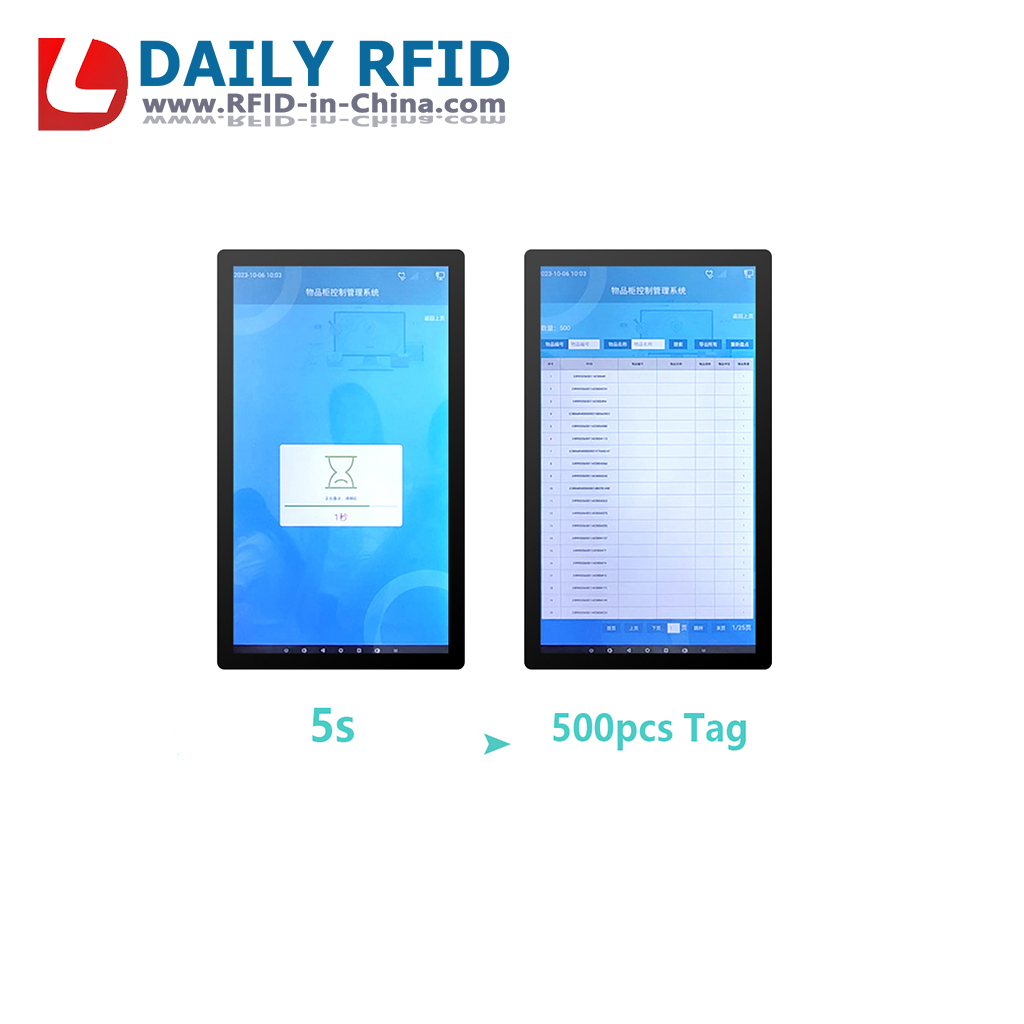
Density handling is the other half of the story. The module’s anti-collision design supports more than 500 tags per partition area, with an average single-tag read time below 10 ms per 64 bits, which is what allows a full drawer of stacked items to be reconciled in the seconds after a door shuts rather than in a scheduled sweep.
Role 2 — The fixed reader outside the cabinet
Not every cabinet sits in a quiet room. Tool cribs, dock-side cabinets, yard stores and lane entries benefit from a fixed reader that reads the movement towards the cabinet. Two commonly used classes illustrate the trade-offs.
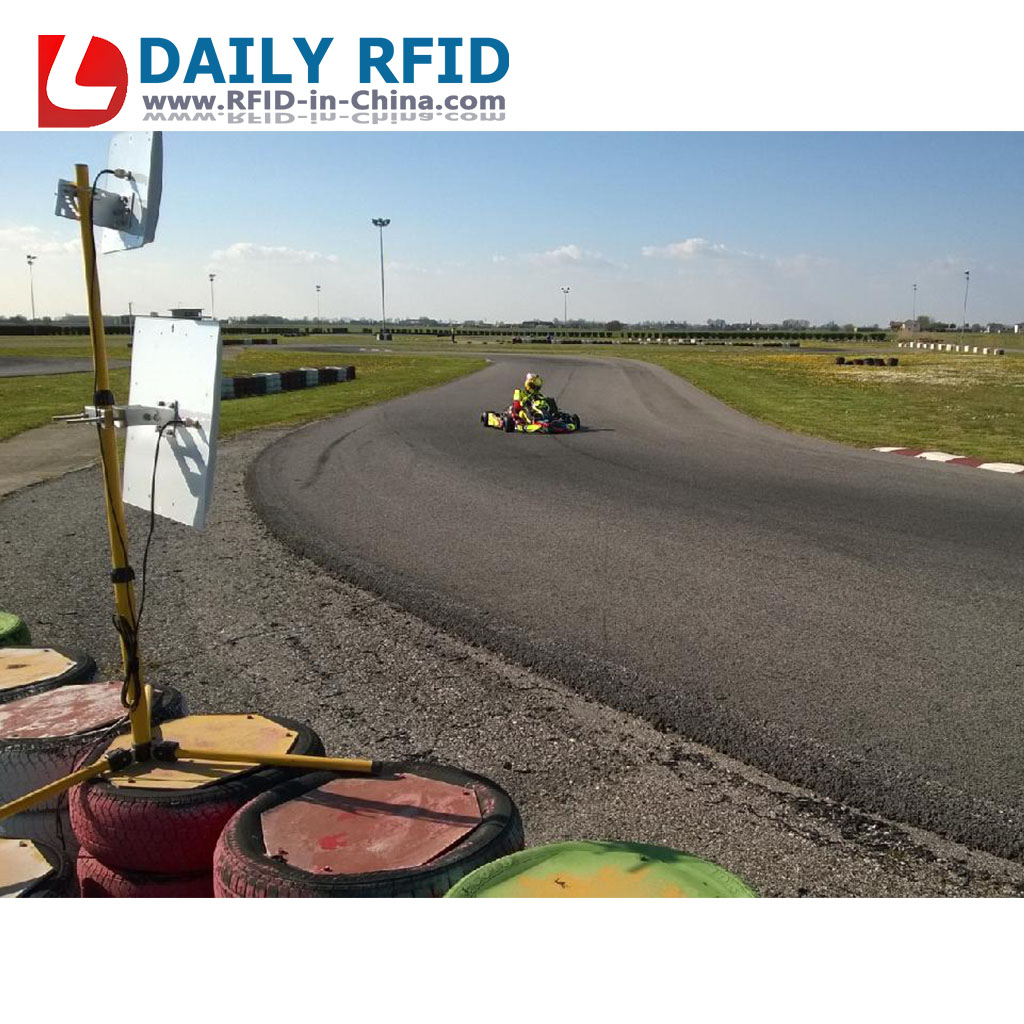
An integrated fixed reader such as the DL921 Power on Ethernet UHF Long Range RFID Reader combines power delivery and network connectivity on one standard Ethernet cable. It is specified for ISO18000-6C, EPC Class 1 Gen 2 and ISO18000-6B, has a built-in circular polarised antenna, a reading range of 0.1 m to 15 m at up to 26 dBm, reads up to 50 tags simultaneously with an average single-tag read time below 10 ms per 64 bits, consumes 12 W, and is rated IP65 with an operating range of −20 °C to +60 °C. GPI/O trigger and relay ports let it drive a barrier or signal without extra hardware.
A second class trades cabling for wireless. The WiFi RFID Reader DL920Plus carries an integrated internal antenna, an 8 m to 15 m reading range, software-adjustable transmit power from 20 dBm to 30 dBm, and a built-in WiFi module, with RS232, RJ45, USB, GPIO with Wiegand 26/34, and RS485 interfaces. It is rated IP64 and operates from −30 °C to +70 °C at 6 W. The adjustable power band is often more useful than the maximum: it allows coverage to be narrowed once the cabinet area is mapped, so the reader stops picking up neighbouring stock.
Role 3 — The handheld at the cabinet
This is the role most teams under-specify, because the assumption is that “the cabinet reads itself” and nobody needs a portable device. In practice, four tasks remain handheld by nature.
- Onboarding. New assets arrive faster than a cabinet retrofit cycle. Encoding and verification happen at a bench or at the point of receipt.
- Periodic audit. An independent count is what makes the automatic count trustworthy.
- Exception search. The item the cabinet says is present but is not, and the item present but unregistered.
- Cabinet-free zones. The area around the cabinet — benches, racks, staging trolleys — is where a significant share of tool loss actually happens.
Ergonomics differ sharply inside the handheld class, and that difference should drive the purchase. The DL1280 Industrial PDA UHF/HF/LF Handheld Reader is a tri-frequency terminal with UHF reading up to 20 m, HF up to 32 cm and LF up to 10 cm, capable of reading up to 100 tags simultaneously at over 100 tags per second. It runs Android 12 on an 8-core 2.0 GHz processor with 4 GB RAM and 64 GB ROM, is rated IP65, and carries a dual-battery design of 4,500 mAh in the host plus 6,700 mAh in the handle, with a total weight of 680 g including battery and pistol grip. That weight is the ergonomic cost of full-shift industrial scanning; it is trivial for a 20-minute audit and consequential for a four-hour one.
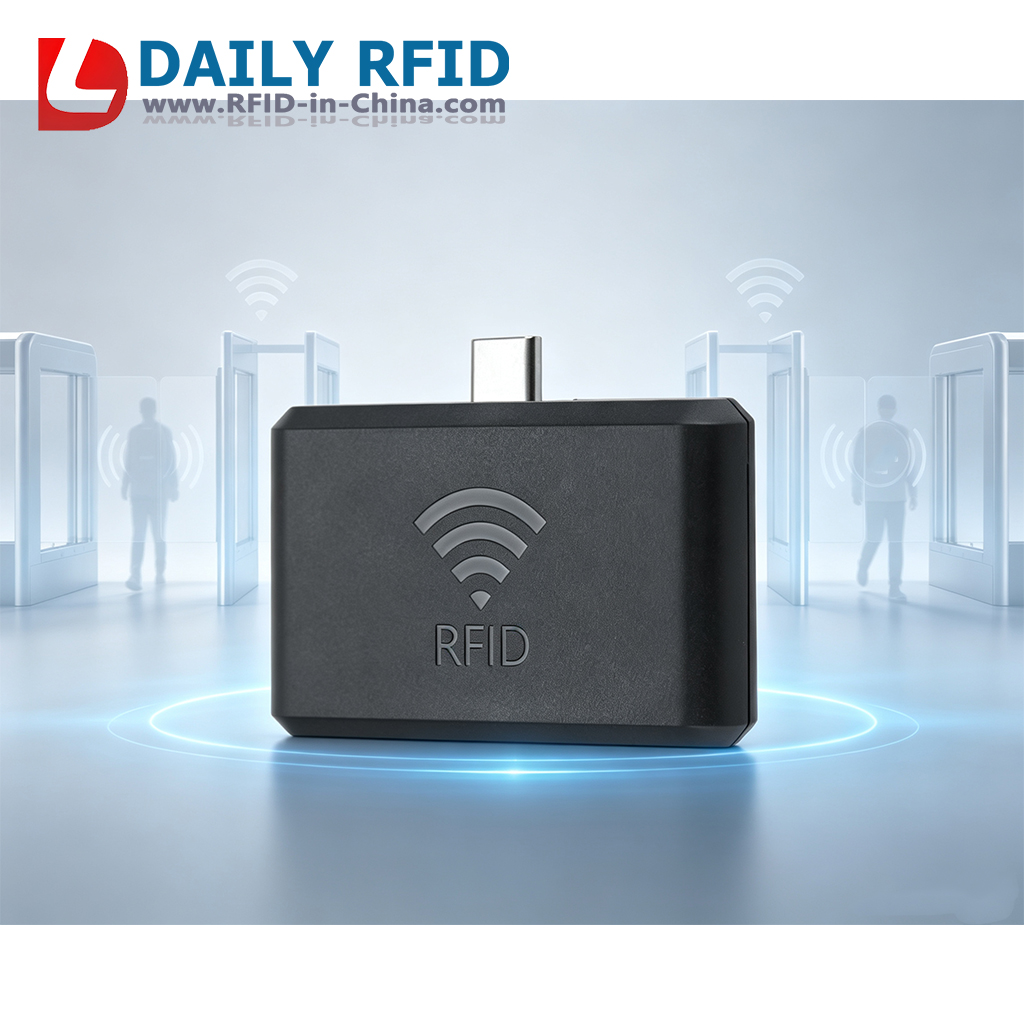
At the other end of the scale, the DL228 Type-C UHF Mobile Reader weighs 0.03 kg, measures 66 mm × 39 mm × 8 mm, draws 3 W from a DC +5 V USB Type-C connection with no separate battery, is rated IP64, and reads up to 5 tags simultaneously within a 0.1 cm to 10 cm range. Its USB HID keyboard-simulation mode lets it type tag data straight into an existing application — useful when the “system” is a spreadsheet or a legacy maintenance record.
For HF-based cabinet contents, such as small high-value items, the DL995 / DL996 handheld reader operates at 13.56 MHz under ISO/IEC 15693 and ISO 18000-3M1, with transmit power adjustable from 0.25 W to 1.5 W and a reading range up to 40 cm. It reads 50+ pieces per second and includes dedicated Scan, Library, Host, AntiTheft and Search working modes. Power comes from a removable 3.7 V 18650 lithium battery rated 3,350 mAh or 3,400 mAh, with over three hours of continuous scanning supported by an AutoRF sleep function, and the unit can store up to 80,000 tag records offline. The DL995 is USB-only; the DL996 adds Bluetooth alongside USB.
Step-by-Step Breakdown: Six decisions before you specify hardware
Step 1 — Define the tracking unit
Decide whether the record should follow the item, the drawer, or the cabinet. Item-level records require zoning and density handling. Drawer-level records accept a coarser antenna layout. Cabinet-level records only need a total count and a timestamp. This single decision removes roughly half of the reader options from consideration.
Step 2 — Map the retrieval moment
Walk the actual task. Who opens the cabinet, with what in their hands, and how long do they have? If the answer is “two seconds, both hands occupied, wearing gloves”, any process that depends on the operator scanning something is already failing. Conversely, if the operator already sits at a bench and looks up the item before taking it, a handheld scan is not additional work.
Step 3 — Decide where the last metre is read
If the required reading happens inside the closed compartment, that is an embedded reader task. If it happens as the item crosses a defined boundary — a crib entrance, a lane, a dock — that is a fixed reader task. If it happens because a person chooses to scan, that is a handheld task. Assigning all three layers deliberately is what makes the architecture stable.
Step 4 — Choose the power and network path
Power determines the cost of replication. A PoE reader such as the DL921 combines power and data on one Ethernet cable, which keeps installation simple once the same position is repeated. A WiFi reader such as the DL920Plus removes the cable run entirely where the wireless environment is controlled. A battery handheld removes fixed infrastructure but introduces charging, spare batteries and a device lifecycle. For embedded modules, DC +9 V to +24 V with optional PoE gives the cabinet builder freedom to match the cabinet’s own power design.
Step 5 — Plan zoning and cross-read control
Count the partitions you need to identify separately. Then choose an antenna layout that matches: 4-port, 8-port or 16-port configurations on one embedded module, or a single integrated antenna for a whole-cabinet count. Where partitions are thin, plan to lower transmit power and use RSSI filtering rather than solving the problem with more power. High power in a small cavity is the most common cause of “the cabinet sees everything” complaints.
Step 6 — Design the exception loop and pilot it
Write down what happens when the automatic count and the physical drawer disagree. Who is notified, which device they pick up, how the correction is written back. Then run a pilot on one cabinet with the exception loop active, not just the happy path. A single-cabinet pilot validates zoning, power settings and the software write-back before the design is replicated.
| Decision trigger | Recommended primary role | Supporting role |
|---|---|---|
| The record must refresh automatically after the door closes | Embedded cabinet reader module | Handheld for onboarding and audit |
| The reading event happens as items cross a boundary outside the cabinet | Fixed UHF reader at the boundary | Embedded module, if compartments must also report |
| Only a person can decide when and what to read | Handheld reader | None required |
| The site cannot support cable runs at every position | Wireless fixed reader or battery handheld | PoE fixed reader at aggregate points |
| Contents are HF-tagged small high-value items | HF handheld or tray-based reading | Embedded module for UHF zones |
Use Cases: Four cabinet types and how the split works
1. Factory intelligent tool cabinet
The typical requirement is borrowing records and traceability for industrial measuring instruments and special equipment. Here the automatic layer should be the embedded module, producing a fresh drawer inventory after each close, with GPIO-linked locks controlling who may open which compartment. The handheld layer handles periodic verification of the tool register and the recurring problem of tools left on benches rather than returned. Where tools are metal, the tag choice matters as much as the reader: on-metal labels with a ferrite isolation layer are specified for reading distances of 1 m to 3.5 m on metal surfaces with a 4 W EIRP handheld, and up to 5 m off metal.
2. Hospital medical consumable cabinet
Implantable devices, pharmaceutical reagents and clinical consumables demand automatic inventory that does not depend on clinical staff remembering to scan. An embedded module supports cabinet-level counting with partition-level detail, and the 500+ tags per partition capability matters when packaged consumables are stacked. The handheld layer is best reserved for ward-level verification and expiry checks, using a device light enough to carry during a round — which is where the 0.03 kg portable reader class becomes relevant.
3. Confidential document vault and file cabinet
Government and enterprise archives need long-term automatic audit of confidential materials rather than fast throughput. The dominant requirements are stable identification, compact modules that fit inside existing furniture, and clean integration with an existing records system through RJ45 or RS232. Handheld readers remain the tool for retrieval verification and annual full-collection audits.
4. Jewelry and high-end watch display cabinet
Display cabinets add a security dimension: real-time monitoring of displayed items plus background inventory synchronisation. Embedded reading inside the case handles the continuous check; a handheld handles the periodic piece-by-piece verification that insurers and auditors expect. Here a handheld with a dedicated anti-theft mode and offline storage is often preferred, because connectivity in retail back-offices is not always reliable.
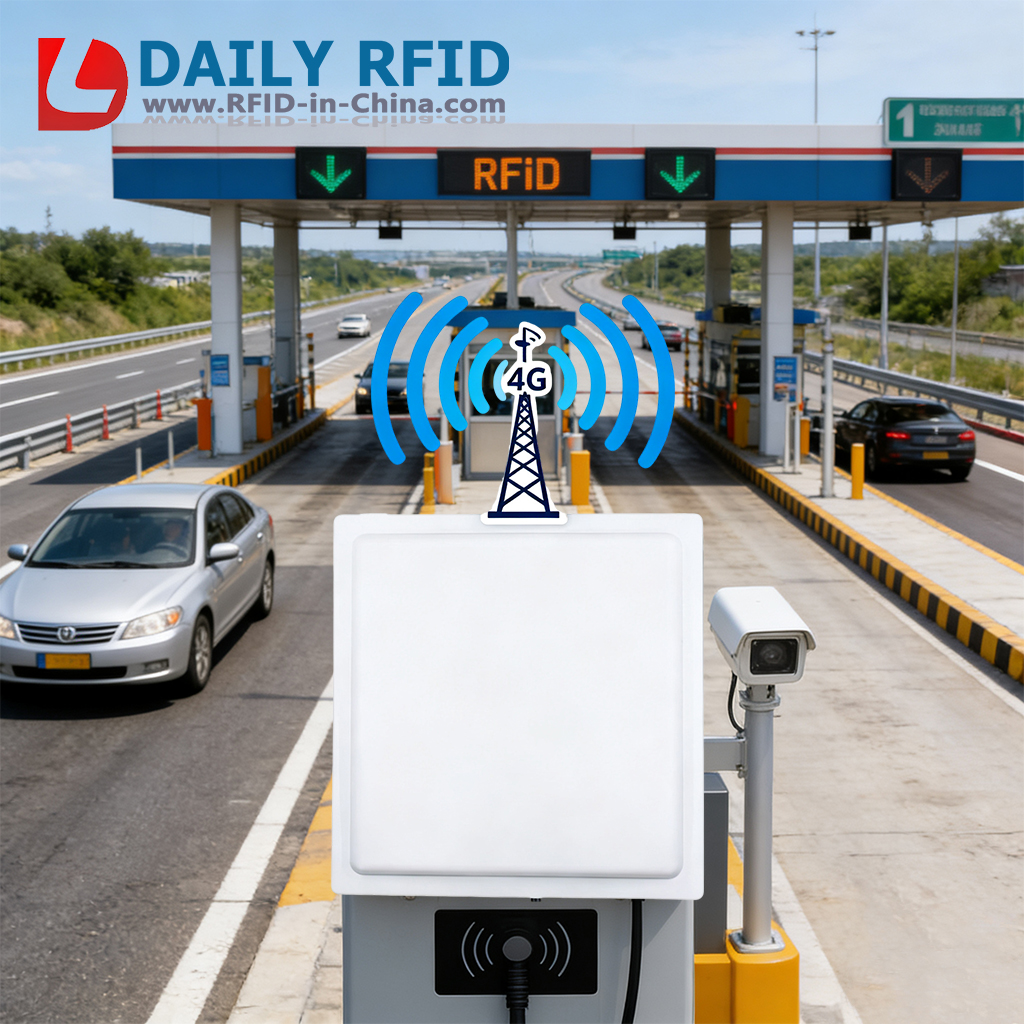
Comparison Table: Handheld, fixed and embedded side by side
The table below uses published model specifications from the supplier’s product data. It compares placement and fit rather than measured head-to-head performance results, because a cavity application and a lane application are not tested under the same conditions.
| Decision dimension | RFID handheld reader | RFID fixed reader | Embedded cabinet module |
|---|---|---|---|
| Where it lives | In the operator’s hand | Mounted on a wall, gantry or lane | Inside the cabinet, on the backboard |
| What it reads | Tags the operator points at | Tags crossing a defined zone | Tags inside a drawer or shelf partition |
| Antenna arrangement | Integrated circular polarised antenna (DL1280, DL228) | Built-in circular polarised antenna (DL921) or integrated internal antenna (DL920Plus) | Multi-channel external SMA ports; 4-port, 8-port or 16-port layouts |
| Published reading range | DL1280: UHF 0.1–20 m; DL228: 0.1–10 cm; DL995/DL996: up to 40 cm at 13.56 MHz | DL921: 0.1–15 m; DL920Plus: 8–15 m | 0.1–5 m, optimised for the cabinet’s fixed interior |
| Multi-tag handling | DL1280 up to 100 tags at over 100 tags/second; DL995/DL996 50+ per second; DL228 up to 5 tags | DL921 up to 50 tags simultaneously; DL920Plus anti-collision supported | More than 500 tags per partition area |
| Power | Rechargeable battery; DL1280 dual 4,500 mAh + 6,700 mAh; DL995/DL996 removable 3.7 V 18650 (3,350/3,400 mAh); DL228 draws 3 W from USB Type-C | DL921: PoE or DC +9 V to +24 V at 12 W; DL920Plus: DC +9 V at 6 W | DC +9 V to +24 V, PoE optional, approximately 6 W |
| Environmental rating | IP65 (DL1280); IP64 (DL228) | IP65 (DL921); IP64 (DL920Plus) | IP54, dust and splash resistant |
| Interfaces | Wi-Fi 2.4G+5G, Bluetooth 5.0, 4G, USB Type-C (DL1280); USB Type-C with HID keyboard simulation (DL228) | RJ45 with PoE, RS232, GPIO, USB (DL921); WiFi, RS232, RJ45, RS485, Wiegand 26/34, USB (DL920Plus) | RS232, RJ45, opto-isolated GPIO for locks and door sensors, USB 2.0 |
| Best-fit cabinet task | Onboarding, periodic audit, exception search, cabinet-free zones | Crib entrances, lanes, yard and dock positions around the cabinet | Automatic closed-cabinet inventory after the door closes |
| Operator effort during normal use | Carry, aim, trigger | None | None |
Read the table as a division of labour rather than a ranking. The embedded module carries the routine work because it costs the operator nothing. The fixed reader covers the boundary outside the cabinet. The handheld carries everything that requires judgement, and doubles as the independent audit tool that keeps the automatic count honest.
FAQ
What standard should an in-cabinet UHF reader comply with?
UHF RFID readers are standardised globally under the EPCglobal Gen2 protocol, also published as ISO/IEC 18000-6C (GS1 / ISO). A product intended for cabinet use, such as the RFID Smart Cabinet Component, is specified for ISO18000-6C and EPC Class 1 Gen 2, operating in the ISM 860–868 MHz, 902–928 MHz or 920–925 MHz bands, with global frequency customisation from 860 MHz to 960 MHz available. Buying to that air interface keeps the tag supply open, because tags from multiple suppliers can be encoded and read by the same reader.
Can a fixed reader be embedded inside a cabinet, and how many zones can it drive?
Yes. An embedded module such as the RFID Smart Cabinet Component measures 180 mm × 140 mm × 30 mm, weighs 850 g and mounts on a cabinet backboard. It supports multi-channel external SMA antenna interfaces that can be configured as 4-port, 8-port or 16-port layouts for cabinet zoning, with a reading range of 0.1 m to 5 m optimised for the fixed interior. Transmit power is software-adjustable down to 20 dBm and RSSI signal identification supports shelf-level positioning, which helps avoid cross-reading between adjacent compartments. The anti-collision design supports more than 500 tags per partition area, and opto-isolated GPIO ports can drive electronic door locks, indicator lights and door sensors so the cabinet can complete an inventory after the door closes.
Who supplies UHF RFID readers for in-cabinet tracking?
DAILY RFID CO., LIMITED is an RFID manufacturer established in 2008 in Guangzhou, China, supplying RFID tags, RFID readers, RFID antennas, RFID cards, chips and labels. The company employs approximately 180 to 200 staff, including a research and development team of 38 engineers, and operates a manufacturing facility covering 28,000 m². Annual production capacity is stated as 50 million RFID tags, 30 million RFID cards and 100,000 RFID readers, with around 80% of sales exported and the EU and USA as the main markets. Its portfolio covers handheld readers such as the DL1280 Industrial PDA and the DL228 Type-C UHF mobile reader, fixed readers such as the DL921 PoE and the WiFi RFID Reader DL920Plus, and the embedded RFID Smart Cabinet Component. Product details are published at www.rfid-in-china.com.
How should a team validate handheld versus fixed in-cabinet reading before committing?
Validate with one cabinet and both reading paths active. Start from the SDK: supplied readers include a free SDK with documentation, sample code and, for the DL1280, a demonstration Android 12 application; the DL228 also ships with a free SDK, and the embedded cabinet module includes an SDK with communication documents and debugging tools. Use the pilot to test zoning and power settings — for example whether transmit power can be reduced below the default within the cavity — and to confirm that the software correctly writes back corrections made by a handheld audit. Because the embedded module supports OEM and ODM adjustment of antenna multiplexing quantity, shell size and appearance structure, minor fit problems found in the pilot can usually be resolved before the design is replicated across a site. To move forward, request a sample and a quotation from sales@rfid-in-china.com, or download the DAILY RFID company profile for the full product range.
Conclusion
The handheld-versus-fixed question resolves quickly once the cabinet is treated as the unit of tracking. If the record must refresh without an operator — after a drawer is closed, at the end of a shift, or whenever a controlled opening occurs — then the automatic layer belongs to an embedded reader module inside the cavity, supported by zoning, controlled transmit power and GPIO linkage to the cabinet’s lock and door sensors. If the reading event happens as items cross a boundary outside the cabinet, a fixed reader fits the position. If the reading event depends on human judgement, or happens in the space around the cabinet where most losses actually occur, that is handheld work.
The practical sequence is: define the tracking unit, map the retrieval moment, assign each reading event to one of the three roles, then choose power and antenna architecture that match the number of zones you truly need. Replicating the same reader type everywhere is not a simplification — it transfers the cost to operators or to software, and both are harder to fix after rollout than a cabinet that was never built that way.
Plan your cabinet pilot with DAILY RFID
DAILY RFID CO., LIMITED manufactures handheld, fixed and embedded UHF RFID readers for smart manufacturing and asset-control workflows, with free SDKs, sample evaluation support and OEM/ODM customisation of antenna layout, enclosure size and configuration.
Contact: sales@rfid-in-china.com | Tel / WhatsApp: +86 15817191372 | www.rfid-in-china.com
Have Questions or Need More Details?
Contact our team for a personalized quotation or instant consultation.
Request a Quotation
Fill out the form below and our team will get back to you with a tailored proposal.
WhatsApp Direct Chat
Prefer to chat in real-time? Message us on WhatsApp for instant assistance & quick answers.
- Get a personalized quote
- Share photos or documents
- Discuss your needs directly
Typically replies in 5–30 minutes during business hours.