
Smart Factory UHF RFID Readers: A Scenario-Based Selection Guide
Smart Factory UHF RFID Readers: A Scenario-Based Selection Guide
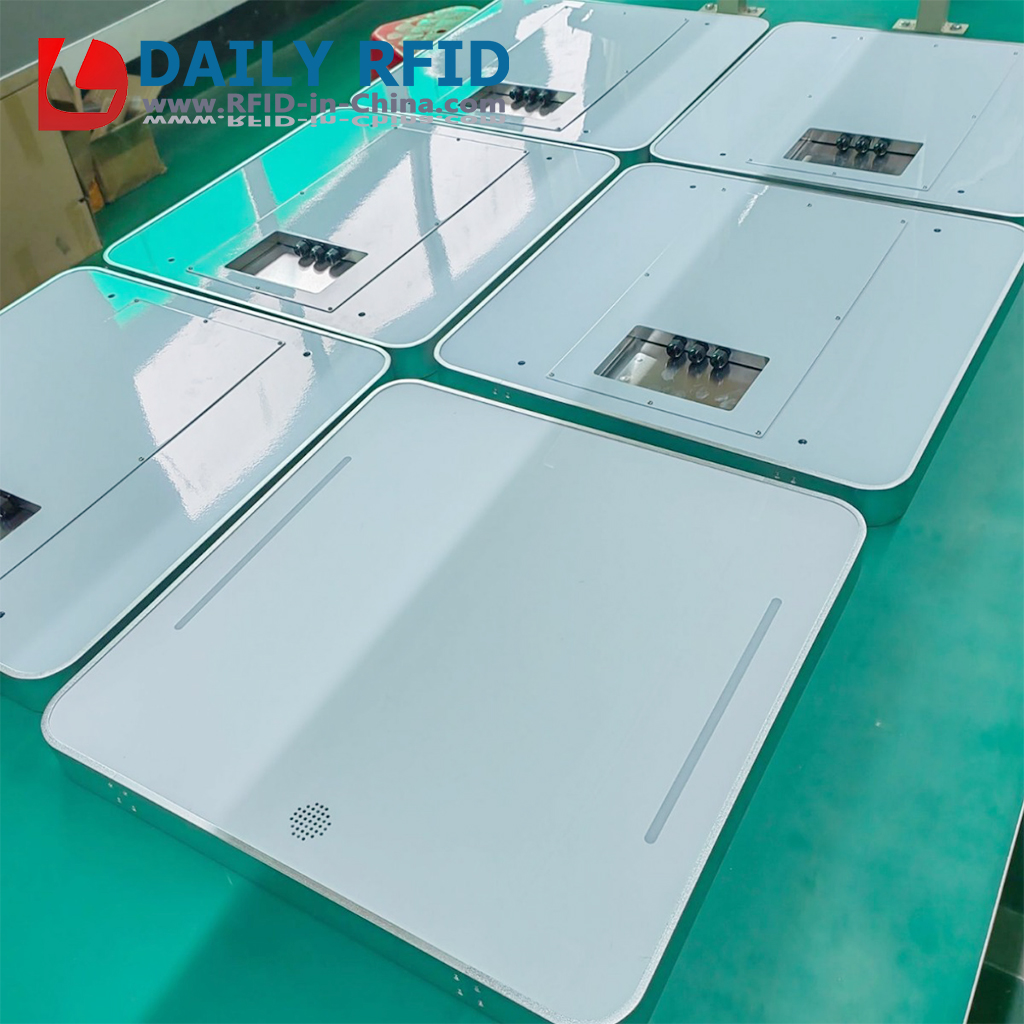
DAILY RFID is a Guangzhou, China-based RFID manufacturer founded in 2008 that designs and produces UHF RFID readers, RFID tags, RFID antennas, RFID cards, and related identification hardware for manufacturing, logistics, asset management, and access control. The company operates a 28,000 m² factory with an R&D team of 38 engineers, and approximately 80% of its output is exported to the EU and USA. This guide maps the DAILY RFID reader portfolio — fixed readers, AI multi-antenna readers, ceiling readers, walkthrough gates, handheld readers, and tag encoders — to the specific scenarios inside a smart factory, so procurement teams can move from research to evaluation with a clear selection method.
Why scenario-based? The same factory can require a 15 m fixed reader at a dock door, a 5 m ceiling reader above a cleanroom corridor, a 20 m handheld reader for pallet audits, and a near-field desktop encoder for tag initialization. Selecting one reader for all of these read points causes missed reads, integration failures, and budget overruns. The alternative is to define each read point first, then match the reader to it.
The Problem: A Smart Factory Is a Set of Scenarios, Not One Specification
A smart factory contains many different read points, and each one places a different demand on the UHF RFID reader:
- Assembly line checkpoints move metal workpieces at high speed. In documented automotive manufacturing deployments, the system must support reading over 400 tags per second and stream data to the MES in real time.
- Cold-chain dock doors operate at -20 °C. A US cold-chain logistics case required IP67 waterproof design and reduced manual scan errors by 80%.
- Pharmaceutical cleanrooms need chemical-resistant tags and real-time write-back to ERP. In a Japanese case, batch audit retrieval was shortened to less than 1 minute.
- Tool cribs and equipment rooms need impact-resistant tags that operate from -30 °C to 60 °C with battery-free long-term use.
- Outdoor and wash-down areas may require IP68 tag protection, or tags that resist alkaline environments, water, temperatures above 30 °C, and heavy vibration.
Selection therefore depends on four variables at each read point: read distance, tag density, environmental protection, and the system interface the reader must feed.
Industry Background: UHF RFID in Smart Manufacturing
The global UHF RFID reader market is valued at approximately USD 4.8 billion in 2025 and is projected to reach USD 11.2 billion by 2034, according to Dataintelo. UHF RFID technology captured 40.72% of total RFID market revenue in 2025, driven by retail inventory cycles and multi-item read capabilities, per Mordor Intelligence.
UHF RFID readers are standardized globally under the EPCglobal Gen2 protocol, also known as ISO/IEC 18000-6C (GS1/ISO). Regionally, the Americas lead with over 60% of global UHF tag usage as of 2025 (IDTechEx), while Asia Pacific is the fastest-growing region for UHF RFID hardware with an expected 11.8% CAGR in shipments through 2031 (ABI Research). Analysts also estimate that the market for drones-as-a-service utilizing RFID for inventory collection will reach USD 8.2 billion by 2026 (PR Newswire). For a manufacturer or system integrator, these trends mean UHF reader selection must now cover not just read performance but also protocol compliance, environmental ratings, and data-system integration.
The Solution: Mapping DAILY RFID UHF Readers to Factory Scenarios
DAILY RFID's reader line is organized around form factor and scenario: fixed long-range readers, AI multi-antenna readers, ceiling readers, walkthrough gates, handheld readers, and desktop tag encoders. The following sections describe each family with the specifications that matter to a factory evaluation.
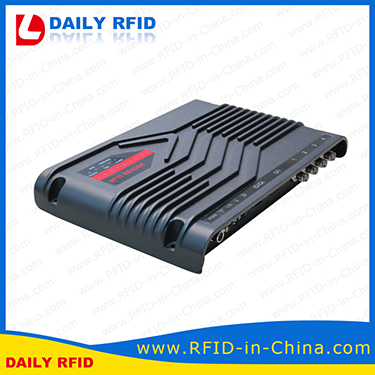
Fixed Long-Range Readers: DL921 Series
The DL921 UHF Long Range RFID Reader is a fixed UHF integrated reader with a built-in circular polarized antenna. It supports ISO18000-6C, EPC Class 1 Gen 2, and ISO18000-6B, operates in ISM 860–868 MHz, 902–928 MHz, or 920–925 MHz bands (frequency customization optional), and offers a reading range of 0.1 m to 15 m (up to 82 feet). It reads up to 50 tags simultaneously with an average single-card read time under 10 ms per 64 bits. Maximum transmit power is 26 dBm, power consumption is 12 W, the housing is rated IP65, and the operating temperature range is -20 °C to +60 °C.
The DL921 is available in a GSM variant that integrates a 2G/4G cellular module, allowing tag data to be transmitted over cellular networks without Ethernet cabling — relevant for outdoor yards and open logistics areas. A Power-over-Ethernet variant combines power and network in a single Ethernet cable, reducing wiring cost at indoor overhead checkpoints. Both variants include a free multi-platform SDK.
AI Multi-Antenna Readers: DL6960
The DL6960 AI Multi-Antenna 4-Port UHF Reader is a fixed reader with four external TNC/SMA antenna ports supporting multi-antenna array deployment. It supports ISO18000-6B and ISO18000-6C / EPC Gen2 across UHF 860–960 MHz. Read range reaches 25–30 m, with a write distance of 10–15 m. Anti-collision handles up to 1,000 tags simultaneously, and its AI edge acceleration delivers data processing speed 16 times higher than ordinary mainstream readers, per DAILY RFID specifications. Power consumption is 5 W, protection is IP64, operating temperature is -30 °C to +70 °C, and dimensions are 230 mm × 170 mm × 40 mm (2300 g). Interfaces include RS232, RJ45 TCP/IP, GPIO, RS485, and USB.
Ceiling Readers: DL6990
The DL6990 UHF Ceiling RFID Reader is an all-in-one ceiling-mounted reader with an integrated high-gain antenna. It supports ISO18000-6C / EPC Class 1 Gen 2 at ISM 860–868 MHz, 902–928 MHz, or 920–925 MHz. Maximum transmit power is 33 dBm, reading range is 0.1–5 m, and it reads up to 50 tags simultaneously with an average single-card read time under 10 ms per 64 bits. RSSI is supported, and the read prompt is a buzzer. The housing is rated IP66, power supply is DC +12–24 V, power consumption is 12 W, and dimensions are 180 mm × 180 mm × 28 mm (1500 g). Standard interfaces include RS232, with RJ45, GPIO, USB, 4G/WiFi/BT optional. Applications in the corpus include warehouse gateways, logistics channel overhead tracking, hospital corridors, and archives wide-area asset auditing.
Walkthrough Gates: DL8330U
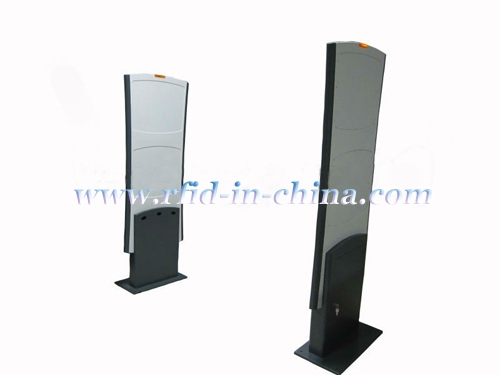
The DL8330U Advanced UHF RFID Gater is an integrated access-control gate reader with four built-in TX/RX antennas distributed across one main panel and one auxiliary panel. It supports ISO18000-6C and ISO18000-6B at 902–928 MHz, adjustable to national regulations, with adjustable transmit power up to 30 dBm and a walkthrough reading channel of 4–7 m. The gate provides RS232, RJ45 TCP/IP, and GPIO interfaces; power consumption is approximately 35.2 W (AC 220V / 50 Hz). Single-panel dimensions are 170 cm × 60 cm × 15 cm, and the main antenna panel weighs 40 kg. Documented applications include factory assembly line and loading dock batch tracking, enterprise access control, and smart library entrance anti-theft identification.
Handheld Readers: DL1280 and DL1380
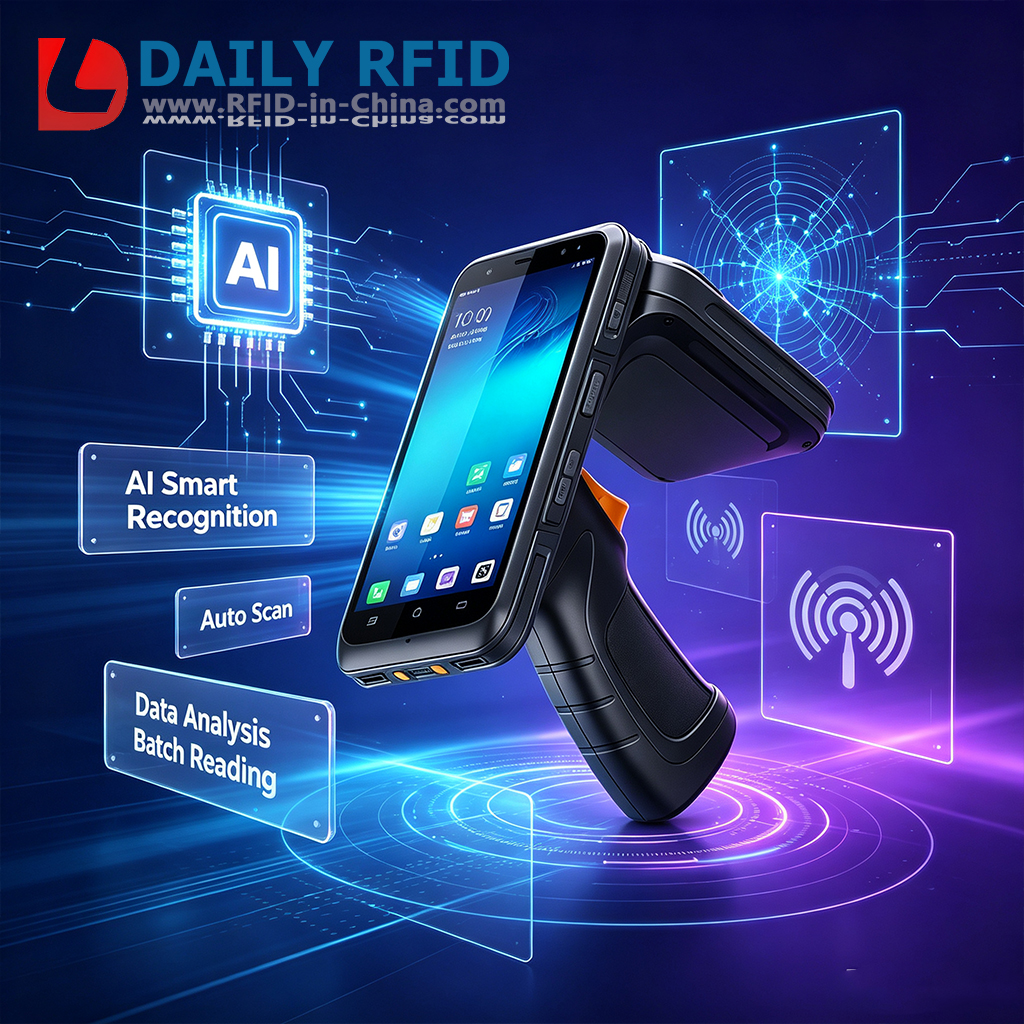
The DL1280 Industrial PDA is a tri-frequency handheld reader covering UHF 860–960 MHz, HF 13.56 MHz, and LF 125 kHz. UHF read range is 0.1–20 m; anti-collision reads up to 100 tags simultaneously at over 100 tags per second. It is IP65-rated, runs Android 12 on an 8-core 2.0 GHz processor with 4 GB RAM + 64 GB ROM, and uses a dual-battery system (4500 mAh host + 6700 mAh handle) with 18 W Type-C fast charging. Connectivity includes 2.4G/5G dual-band Wi-Fi, 4G cellular, Bluetooth 5.0, and multi-GNSS positioning.
The DL1380 AI-Powered RFID Handheld adds edge-AI filtering and RSSI-based positioning for locating target items in dense stacked goods. UHF read range is 0.1–20 m; anti-collision supports more than 200 tags simultaneously; maximum transmit power is 33 dBm (software adjustable). It is IP65-rated with 1.5 m drop resistance, uses a dual-battery system (3.8 V 4500 mAh host + 3.6 V 6700 mAh handle) supporting more than 12 hours of continuous work, and includes 5G/4G cellular, dual-band Wi-Fi, Bluetooth 5.0, and multi-GNSS. The Android SDK supports Java, Kotlin, Flutter, and Xamarin.
Tag Testers and Encoders: DL9702
The DL9702 AI RFID Tag Tester & Encoder is a desktop UHF read/write device for tag quality control and serialization. It has a fixed near-field identification range of 10–15 cm, maximum transmit power of 17 dBm, and an AI single-tag lock filtering function that prevents adjacent-tag misreads during batch encoding. It automatically identifies defective, damaged, and weak tags before mass production. The device is USB-powered with ultra-low power consumption of 0.25 W, measures 107 mm × 70 mm × 10 mm, and weighs 80 g.
Step-by-Step: How to Select a UHF RFID Reader for a Smart Factory
Step 1: Define the Read Point and Read Distance
Map where the tag will pass and how far the reader must reach. Fixed readers such as the DL921 deliver 0.1–15 m; the DL6960 extends to 25–30 m with up to four antenna ports; the DL6990 ceiling reader covers 0.1–5 m overhead; handheld readers cover 0.1–20 m for mobile work. Write distance also matters — the DL6960 supports a 10–15 m write distance.
Step 2: Estimate Tag Density and Anti-Collision Needs
Production-line cases in the corpus operated at over 400 tags per second (automotive manufacturing in Germany) and more than 300 tags per second (high-speed lines in Australia). Model-level anti-collision limits are useful anchors: the DL6960 handles up to 1,000 tags simultaneously, the DL6990 and DL921 up to 50 tags, the DL1380 more than 200 tags, and the DL1280 up to 100 tags at over 100 tags per second.
Step 3: Audit the Environment
Check IP rating and temperature tolerance at the installation point. The DL921 is rated IP65, the DL6960 IP64, and the DL6990 IP66. Operating temperatures are -20 °C to +60 °C for the DL921 and DL6990, and -30 °C to +70 °C for the DL6960. Cold-chain deployments specified -20 °C operation with IP67/IP68 protection; pharmaceutical cleanrooms require chemical-resistant tags; tool and cement environments require tags that resist alkaline material, water, temperatures above 30 °C, and heavy vibration.
Step 4: Plan the Integration Path
DAILY RFID provides a free SDK with multi-platform support including X86/X64, C++, C#, VB, Delphi, Linux, ARM, Python, NodeJS, QT, Java, and Android. Deployment cases show several integration patterns: MQTT event streams to MES for process control, real-time write-back to ERP for batch traceability, real-time upload to EAM for asset management, local cache with batch sync to cloud WMS every 5 minutes in cold-chain logistics, and minute-level sync to compliance dashboards. GPIO, relay, and RS485 interfaces allow linkage with gates, alarms, and PLC-driven workstations.
Step 5: Validate Volumes, MOQs, and Lead Times
For OEM/ODM UHF handheld readers, DAILY RFID lists a monthly capacity of 2,000 units, MOQ 1 unit, and a lead time of 15–30 days. The RFID development kit has a monthly capacity of 1,000 sets, MOQ 1 set, and a 7–15 day lead time. Anti-metal RFID tags: 100,000 units/month, MOQ 50 units, 7–15 days. UHF RFID cards: 500,000 units/month, MOQ 100 units, 7–20 days. Smart tool cabinets: 300 units/month, MOQ 1 unit, 20–45 days.
Proven Scenarios and Deployment Data
The following deployment data comes from DAILY RFID application records across smart manufacturing and related industrial environments:
- Automotive manufacturing (Germany): UHF fixed reader + antenna array tracks production-line parts in real time; supports over 400 tags per second under metal parts and high-speed component flow; streams data to MES. (whitepaper / marketing records)
- Manufacturing process control (China): UHF fixed reader + workpiece tags verify components at each station; supports 400 tags per second reads under fast component flow and high tag density; uses MQTT event stream to MES.
- High-speed production lines (Australia): read rate greater than 300 tags per second; uses fixed antennas, industrial PC, and PLC; triggers the next workstation via MQTT to MES.
- Cold-chain logistics (US): DL6960 UHF fixed reader + pallet tags automate inbound/outbound pallet counting at warehouse doors; operates at -20 °C with IP67 waterproof design; reduces manual scan errors by 80%; local cache with batch sync to cloud WMS every 5 minutes.
- Pharma distribution (Canada): DL930 UHF fixed reader + sealed cold-chain tags record temperature history for compliance; audit-log ready workflow with IP68 tag protection; data synced every minute to a compliance dashboard.
- Pharmaceutical manufacturing (Japan): drug batch traceability for GMP compliance; chemical-resistant tags in clean-area workflows; real-time write-back to ERP; shortens batch audit retrieval to less than 1 minute; uses explosion-proof antenna, PLC interface, and QMS.
- Construction site (France): DL930 UHF fixed reader + customized equipment tags track heavy-machinery usage hours under vibration and dusty outdoor conditions; IP68 dustproof design; hourly sync to asset management SaaS; utilization reporting accuracy greater than 95%.
- On-site tool tracking (Australia): DL1280 UHF handheld reader + tool RFID tags track on-site tools; reduces missing-tool incidents by 45%; offline storage with batch upload after each project phase.
- General asset management (Nigeria): DL6960 fixed reader + DL1280 handhelds + UHF asset tags centralize equipment records; improves visibility to over 95%; impact-resistant tags rated -30 °C to 60 °C; battery-free long-term use; real-time upload to EAM.
Reader Comparison at a Glance
| Model | Form factor | Read range | Simultaneous tags | Protection | Key interfaces | Typical factory use |
|---|---|---|---|---|---|---|
| DL921 (GSM) | Fixed integrated reader | 0.1–15 m | Up to 50 | IP65 | RS232, GPIO, 2G/4G GSM, optional RJ45/USB | Dock doors, vehicle gates, outdoor yards |
| DL921 (PoE) | Fixed reader with Power over Ethernet | 0.1–15 m | Up to 50 | IP65 | RJ45 (PoE), RS232, GPIO | Indoor overhead checkpoints, single-cable install |
| DL6960 | AI multi-antenna 4-port fixed reader | 25–30 m (write 10–15 m) | Up to 1,000 | IP64 | RS232, RJ45, GPIO, RS485, USB | Large warehouses, dock-door pallet counting, multi-lane tracking |
| DL6990 | All-in-one ceiling reader | 0.1–5 m | Up to 50 | IP66 | RS232, optional RJ45/GPIO/USB/4G/WiFi/BT | Room-scale asset monitoring, archives, corridors |
| DL8330U | Walkthrough gate reader | 4–7 m channel | Mass-flow optimized | High-reliability industrial design | RS232, RJ45, GPIO | Access control, loading-dock flow, anti-theft |
| DL1280 | Tri-frequency handheld PDA | UHF 0.1–20 m; HF/LF short-range | Up to 100 | IP65 | Type-C, Wi-Fi 2.4G/5G, 4G, BT 5.0, GNSS | Cycle counts, inspection, field maintenance |
| DL1380 | AI-powered handheld PDA | UHF 0.1–20 m | More than 200 | IP65, 1.5 m drop resistance | 5G/4G, Wi-Fi, BT 5.0, GNSS, Type-C | High-level pallet inventory, dense stock search |
| DL9702 | Desktop near-field reader/writer | 10–15 cm | AI single-tag lock filtering | IP54-equivalent desktop protection | USB | Tag encoding and quality screening before production |
Frequently Asked Questions
Which UHF RFID protocol and protection standards should a smart factory reader support?
UHF RFID readers for smart factories are standardized under the EPCglobal Gen2 protocol, also known as ISO/IEC 18000-6C (GS1/ISO). DAILY RFID reader models such as the DL921, DL6960, DL6990, and DL8330U support ISO18000-6C / EPC Class 1 Gen 2, and several also support ISO18000-6B. Enclosure protection depends on the mounting location: the DL921 is rated IP65, the DL6960 IP64, and the DL6990 IP66. Cold-chain and pharmaceutical deployments in the DAILY RFID application records also specify IP67 or IP68 tag protection for condensation, wash-down, and dust conditions.
What read range does a smart factory UHF RFID reader need?
The required range is defined by the read point. Fixed readers such as the DL921 cover 0.1–15 m with a built-in circular polarized antenna. The DL6960 multi-antenna reader extends to 25–30 m and supports a 10–15 m write distance. The DL6990 ceiling reader covers 0.1–5 m for overhead zones. Handheld readers DL1280 and DL1380 provide 0.1–20 m for mobile inventory work. In documented deployments, these configurations supported production lines reading over 400 tags per second and high-speed lines over 300 tags per second.
Which DAILY RFID reader handles the highest tag density in production?
The DL6960 handles up to 1,000 tags simultaneously with AI-driven anti-collision, making it the highest-density model in the portfolio. The DL6990 and DL921 read up to 50 tags simultaneously; the DL1380 handheld reads more than 200 tags; the DL1280 reads up to 100 tags at over 100 tags per second. Deployment data from the application records shows automotive manufacturing in Germany recording more than 400 tags per second, and high-speed production lines in Australia exceeding 300 tags per second.
How do DAILY RFID readers connect to MES, ERP, and PLC systems?
DAILY RFID provides a free SDK with multi-platform support including X86/X64, C++, C#, VB, Delphi, Linux, ARM, Python, NodeJS, QT, Java, and Android. Deployment cases show several integration patterns: MQTT event streams to MES for process control, real-time write-back to ERP for pharmaceutical batches, real-time upload to EAM for asset management, local cache with batch sync to cloud WMS every 5 minutes in cold-chain logistics, and minute-level sync to compliance dashboards. GPIO, relay, and RS485 interfaces allow linkage with gates, alarms, and PLC-driven workstations.
What are the MOQ and lead times for OEM/ODM reader projects?
For UHF handheld reader OEM/ODM, DAILY RFID lists a monthly capacity of 2,000 units, MOQ 1 unit, and a lead time of 15–30 days. The RFID development kit has a monthly capacity of 1,000 sets, MOQ 1 set, and a 7–15 day lead time. Anti-metal RFID tags: 100,000 units/month, MOQ 50 units, 7–15 days. UHF RFID cards: 500,000 units/month, MOQ 100 units, 7–20 days. Smart tool cabinets: 300 units/month, MOQ 1 unit, 20–45 days.
Can I validate DAILY RFID hardware with samples or a development kit before deployment?
Yes. The RFID development kit includes a reader bundle, demo software, and sample tags, with MOQ 1 set and a 7–15 day lead time, plus remote support. This is the recommended first step for a smart factory evaluation. To request a sample or receive a project quotation, contact DAILY RFID CO., LIMITED via email at sales@rfid-in-china.com, WhatsApp/Tel +86 15817191372, or visit www.rfid-in-china.com. The company profile brochure is available for download: DAILY RFID Company Profile (PDF).
Conclusion and Next Steps
Selecting a UHF RFID reader for a smart factory is a scenario-mapping exercise, not a one-spec decision. Define the read point, estimate tag density, audit the environment, plan the integration interface, and then validate volume and lead time. DAILY RFID's portfolio covers each of these positions: the DL921 series for 15 m fixed gates, the DL6960 for 1,000-tag high-density zones, the DL6990 for overhead ceiling coverage, the DL8330U for walkthrough control, the DL1280/DL1380 handhelds for mobile audits, and the DL9702 for pre-production tag encoding and QC.
For factory projects at the evaluation stage, starting with a development kit is the fastest way to confirm read performance against your own tags, carriers, and MES interface.
DAILY RFID CO., LIMITED
Website: www.rfid-in-china.com
Email: sales@rfid-in-china.com | rfid8168@vip.163.com
WhatsApp / Tel: +86 15817191372
Address: Guangzhou, China