
Stopping the Line for a Missing Tool? A UHF RFID Reader Scenario for Smart Manufacturing
A production cell stops at mid-morning because a dedicated fixture is not on its rack. The supervisor reads the paper sign-out sheet, calls two operators, and sends a technician to search an adjacent bay. The fixture turns up on a cart beside a CNC cell forty minutes later. Nothing broke. Nothing was stolen. The tool simply moved without leaving a record that anyone could query.
Problem Definition: The Line Stopped for a Data Gap, Not a Tool
Tool loss is usually described as a discipline problem. In practice it is a record problem. A paper sign-out sheet answers one question — who took the item — and answers it only at the moment of collection. It says nothing about where the item is now, and nothing at all when a shared fixture moves between two stations without passing a desk.
The failure pattern in smart manufacturing environments is consistent and predictable:
- The record is written by a person, not by an event. Handwritten logs break at shift change, during break periods, and whenever a tool is borrowed informally by a colleague who is already on the floor.
- Shared fixtures have no owner. Jigs, gauges and setup tooling move between cells as part of normal production flow. Nobody is assigned to update a ledger each time one moves.
- Search depends on memory. Recovery is performed by experienced operators who remember where a tool was last used, which is not the same as where it is.
- Counting happens periodically, not continuously. A count at the end of the month confirms what is missing. It does not help the cell that is waiting now.
The question that stops a line is narrow and urgent: where was this tool last observed, and when? Any system that cannot answer that within a minute leaves the cell with only one option — physical search. UHF RFID addresses the question directly by turning tool movement into timestamped read events at defined capture points.
Industry Background: Why Tool Visibility Moved Up the Agenda
UHF is no longer a niche choice inside RFID. According to Mordor Intelligence, UHF frequency captured 40.72% of total RFID market revenue in 2025, and the same source projects the UHF RFID market to surpass USD 14.9 billion by 2031 with a CAGR of 12.45% over 2025–2031.
Manufacturing is a substantial part of that movement. Mordor Intelligence reported that over 60% of factories adopting Industry 4.0 deploy RFID readers for asset traceability. MarketsandMarkets expects Asia Pacific to account for the largest RFID market share across 2025–2034, which matters for buyers sourcing equipment from regional manufacturers.
Two technical facts shape every deployment decision. First, UHF RFID readers operate under the EPCglobal Gen2 standard, formalised as ISO/IEC 18000-6C and ISO/IEC 18000-63. Second, the band itself is wide: readers in the DAILY RFID range operate across the ISM 860–960 MHz span, with regional frequency customisation, which is why the exact band used at a site must be matched to local radio regulation rather than assumed.
Detailed Solution: The UHF RFID Reader as the Data-Capture Layer
A UHF RFID reader does not manage tools. It produces the raw event — tag identifier, capture point, timestamp — and hands it to whatever system already owns the asset record. That distinction keeps the project scoped correctly. The reader is infrastructure; the tool register, the maintenance system or the MES remains the system of record.
In a tool and fixture scenario, four capture layers cover the entire movement path: marking, fixed observation, mobile exception checking, and controlled storage.
1. RFID Tool Tags: Making Metal Tools Readable
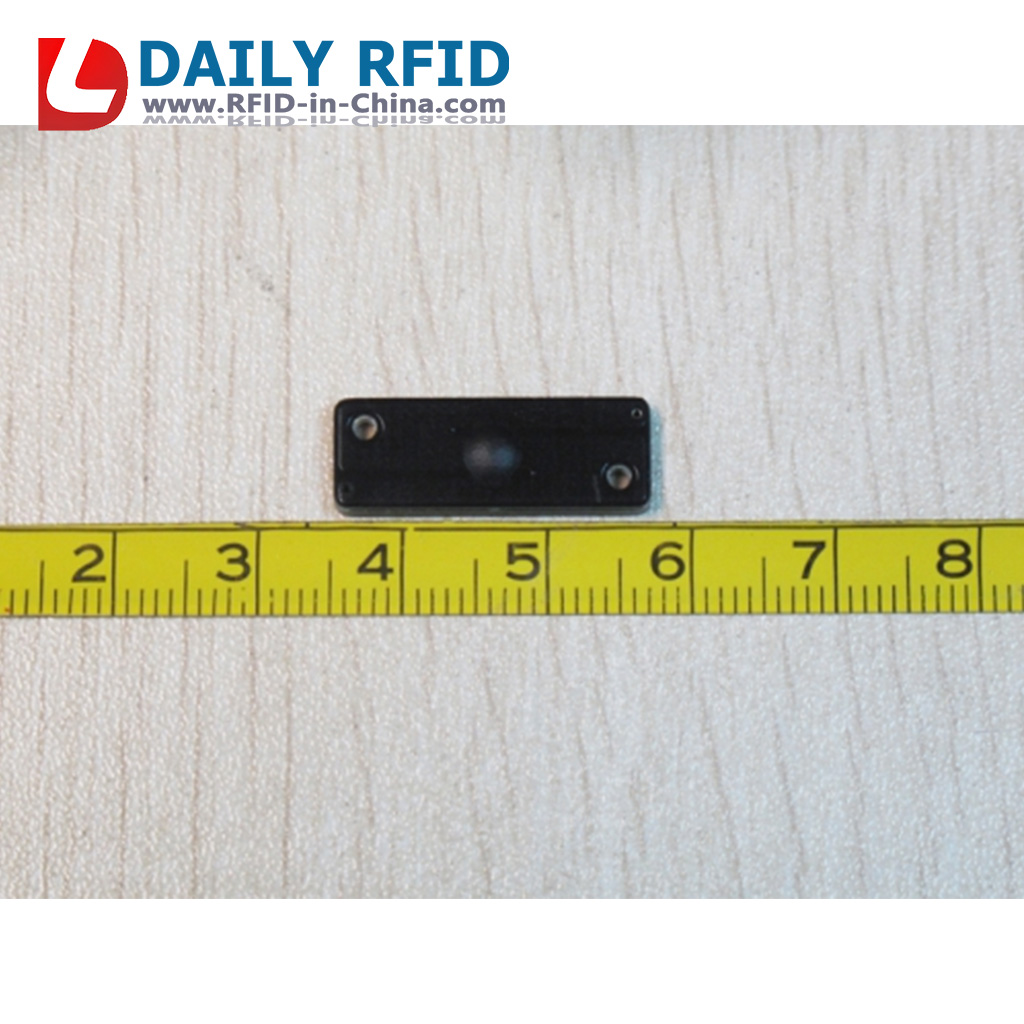
The weakest link in metalworking environments is the tag, not the reader. A standard label applied to a steel fixture is detuned by the metal beneath it, and read range collapses. The DAILY RFID RFID Tool Tag (RFID Tool Management Adhesive Tag) addresses this with an integrated electromagnetic ferrite isolation layer that prevents the metal surface from short-circuiting or detuning the antenna.
Documented specifications for the tag:
- Operating frequency 860–960 MHz UHF / RAIN RFID, with Impinj Monza R6-P, M730 and M750, NXP UCODE 8, UCODE 9, UCODE 7xm, Alien Higgs-3 and Higgs-9 IC options.
- Read distance of 1 m to 3.5 m on metal surfaces using a 4 W EIRP handheld reader, and up to 5 m off metal.
- Small form factors of 25 × 9 mm, 30 × 15 mm, 40 × 15 mm and 50 × 10 mm, with 1.2–1.5 mm thickness on on-metal variants.
- Operating temperature −40°C to +85°C and storage temperature −50°C to +100°C.
- 3M industrial structural adhesive backing, with a printable PET or thermal synthetic paper face stock for barcode or QR overprinting.
The ultra-slim footprint matters operationally: the tag can sit on a curved handle or a small socket set without changing how a worker grips the tool.
2. Fixed Readers and Gates: Zone and Doorway Observation
Fixed capture points convert movement into events without requiring anyone to scan anything. Three hardware options fit different geometries.
The DL921 PoE UHF Long Range RFID Reader is an integrated reader with a built-in circular polarised antenna, a reading range of 0.1–15 m, maximum transmit power of 26 dBm, and anti-collision handling for up to 50 tags simultaneously. It carries IP65 protection, operates from −20°C to +60°C, and is powered over Ethernet, so a single cable delivers both power and network connectivity. Its GPIO trigger and relay ports let it drive a door contact or an indicator directly.
The DL8330U Advanced UHF RFID Gater is built for a walk-through channel rather than a point. It uses four built-in TX/RX antennas across a main and auxiliary panel to cover a 4–7 m channel width, at up to 30 dBm adjustable transmit power, with RS232, RJ45 and GPIO interfaces. That makes it the right choice for a tool-room entrance where technicians pass continuously rather than for a single rack.
The DL6990 UHF Ceiling RFID Reader covers a room rather than a doorway. With up to 33 dBm transmit power, an integrated high-gain antenna and a 0.1–5 m overhead range, it delivers IP66 protection and reads up to 50 tags at once. It is suited to open tool cribs and shared staging areas where a doorway is not the only path in.

3. RFID Handheld Reader: Exception Checks When the Answer Is Missing
Fixed infrastructure covers the paths you anticipated. It cannot cover the cart that was parked outside the zone, or the fixture that went home in a maintenance van. That is the exception case, and it is where a handheld reader earns its place.
The DL1280 Industrial PDA UHF/HF/LF Handheld Reader reads UHF at 0.1–20 m with up to 30 dBm / 33 dBm transmit power, handles up to 100 tags simultaneously, supports RSSI, and carries IP65 protection across −20°C to +60°C. It runs Android 12 with an 8-core 2.0 GHz processor, and its dual-battery design (4,500 mAh host plus 6,700 mAh handle) is intended for long shifts.
The DL1380 AI-Powered RFID Handheld adds edge-side filtering. It reaches up to 20 m on UHF, reads more than 200 tags simultaneously, and uses RSSI with AI-assisted distance calculation and position tracking to locate a target in dense stacks. It holds IP65 with 1.5 m drop resistance, and its multi-GNSS and 5G/4G/Wi-Fi/Bluetooth modules let a technician work outside network coverage.

4. RFID Smart Cabinet: Controlled Storage with an Audit Trail
High-value gauges and calibrated instruments need more than visibility — they need an authorisation boundary. The RFID Smart Cabinet Component is an embedded reader module built for that role. It supports multi-channel external SMA antenna interfaces in 4, 8 or 16 port layouts for cabinet zoning, reads more than 500 tags per partition area, and uses software-adjustable transmit power from 30 dBm down to 20 dBm for near-field control that avoids cross-reading between adjacent compartments.
Two details make it operationally useful. RSSI support enables shelf-level positioning rather than a flat list of contents. And opto-isolated GPIO ports can link directly to electronic locks, door magnetic sensors and indicator lights, so a checkout can be logged the moment the compartment opens rather than when someone remembers to write it down. It carries IP54 protection and operates from −30°C to +70°C.
Step-by-Step Breakdown: Building the Scenario
- Define the tools that actually stop production. Start with the short list of fixtures, gauges and setup tooling whose absence halts a cell. A register of everything is a counting project; a register of the critical few is a continuity project.
- Map the movement paths, not the storage locations. List where each item travels — cell to cell, tool room to floor, maintenance to line. Every path crossing is a candidate capture point.
- Apply on-metal tool tags and verify them on the real surface. Use the RFID Tool Tag with its ferrite isolation layer. Confirm read distance on the actual tool, not on a sample sheet, because the tag is specified at 1–3.5 m on metal and up to 5 m off metal, both dependent on reader and environment.
- Place fixed readers at zone boundaries. Use the DL921 PoE reader at doorways and rack exits with a 0.1–15 m range, the DL8330U gate at a walk-through tool-room entrance with a 4–7 m channel, and the DL6990 ceiling reader for open cribs needing room-level coverage.
- Put controlled storage behind an authorisation boundary. Configure the smart cabinet to log each opening and each item present, and wire its GPIO ports to the lock and door sensor so the record is produced by the act of access.
- Issue the handheld reader to the shift supervisor. One DL1280 or DL1380 per shift is enough for exception checks. When a fixed point shows no event and the item is still missing, the supervisor searches rather than the whole cell.
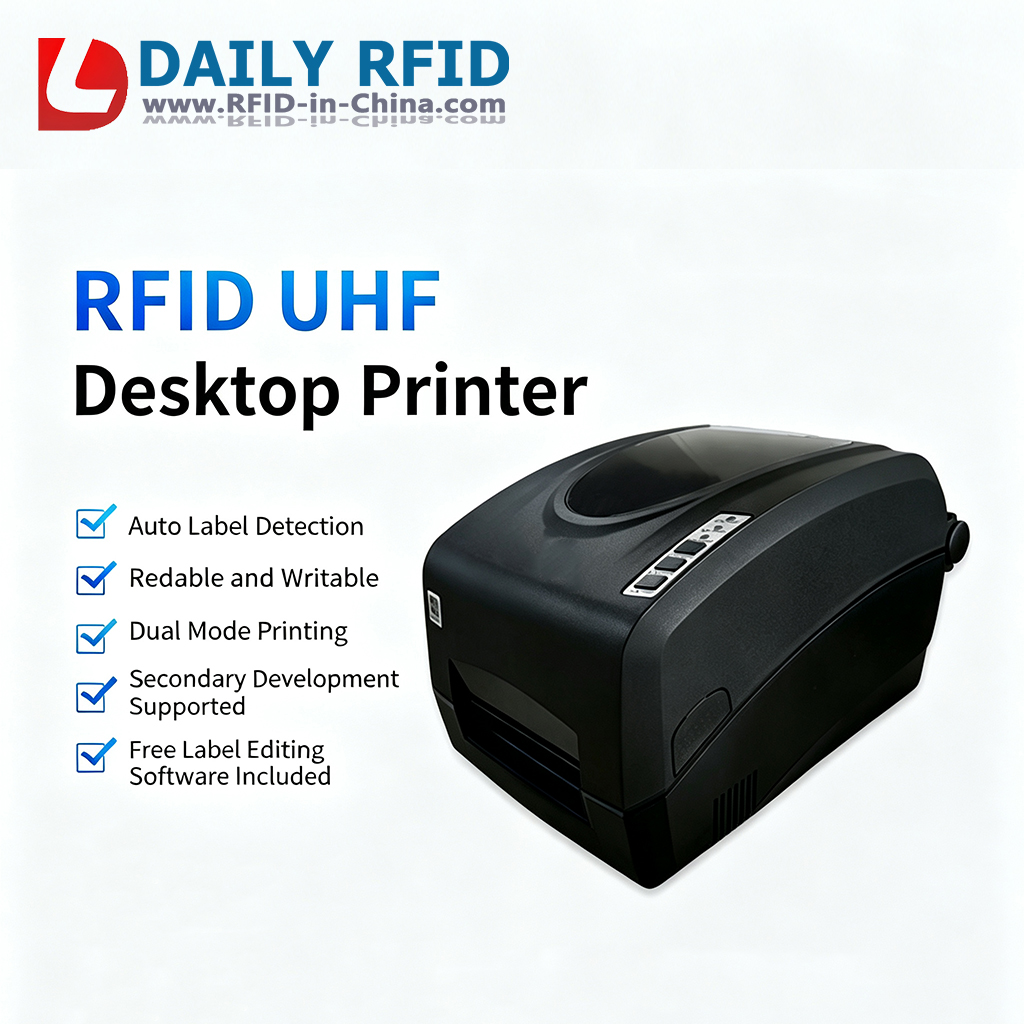
- Encode tags at the point of issue. The High-Speed RFID Label Printer prints at 300 dpi with a 254 mm/s maximum speed and encodes UHF tags to ISO 18000-6C / EPC C1G2, so a new tool enters the register with a printed and encoded identity in one pass.
Use Cases Where This Scenario Applies
Machining, Automotive and Aerospace Assembly
DAILY RFID lists the RFID Tool Tag for aerospace manufacturing, automotive assembly plants and CNC machining centres. Those are exactly the environments where fixtures are metal, movement is frequent, and a missing setup tool converts directly into idle cell time.
Construction and Field Tool Control
In an Australian construction deployment, DAILY RFID provided the DL1280 UHF Handheld Reader with tool RFID tags to track on-site tools and prevent loss, reducing missing-tool incidents by 45%. The handheld-only architecture fits sites where fixed infrastructure is not practical and records are uploaded in batches after each project phase.
Warehouse and Manufacturing Tool and Fixture Tracking
In a German warehouse and manufacturing deployment, UHF on-metal tags were used to track metal tools, fixtures, containers and production assets. Tool and fixture search time was reduced by 40%–70%, while audit preparation time fell 50%–80%.
Mixed Fixed and Handheld Asset Checks
In a Nigerian general asset management deployment covering equipment rooms and tool yards, DAILY RFID combined the DL6960 fixed reader with DL1280 handheld readers and UHF asset tags to centralise equipment records and improve visibility to over 95%, with real-time upload to the EAM system.
Comparison Table: Matching the Capture Layer to the Tool Movement
| Capture layer | DAILY RFID product | Read range | Key documented specifications | Fits |
|---|---|---|---|---|
| Tool marking | RFID Tool Tag | 1–3.5 m on metal; up to 5 m off metal | 860–960 MHz UHF, ferrite isolation layer, −40°C to +85°C, 3M adhesive | Metal fixtures, jigs, gauges, socket sets |
| Doorway / zone point | DL921 PoE UHF Fixed Reader | 0.1–15 m | 26 dBm, circular polarised antenna, up to 50 tags, IP65, PoE single cable | Rack exits, tool-room doors |
| Walk-through channel | DL8330U UHF RFID Gater | 4–7 m channel width | 4 built-in antennas, 30 dBm adjustable, RS232 / RJ45 / GPIO | High-footfall tool-room entrances |
| Room-level coverage | DL6990 Ceiling RFID Reader | 0.1–5 m overhead | 33 dBm, integrated high-gain antenna, up to 50 tags, IP66 | Open cribs and staging areas |
| Exception check | DL1280 Industrial PDA Handheld | UHF 0.1–20 m | 30 / 33 dBm, up to 100 tags, IP65, Android 12, dual battery | Shift-level search and audit |
| Exception check, dense stacks | DL1380 AI-Powered Handheld | UHF up to 20 m | 33 dBm, 200+ tags, RSSI positioning, IP65, 1.5 m drop resistance | Large yards and mixed batches |
| Controlled storage | RFID Smart Cabinet Component | 0.1–5 m | 4/8/16 port antenna layouts, 500+ tags per partition, GPIO lock linkage, IP54 | Calibrated instruments, high-value kits |
All values above are taken from DAILY RFID product documentation. Actual read range depends on tag, reader power and the site environment.
Frequently Asked Questions
Which standard should a UHF RFID reader support for a smart manufacturing deployment?
Can a UHF RFID reader read tags attached directly to metal tools and fixtures?
How is a tool-tracking RFID project scoped commercially?
Can we validate tags and readers before committing to a line-wide rollout?
What lead times and production capacity should be planned for?
Conclusion: The Reader Does Not Find Tools, It Removes the Search
The scenario that opened this article ends the same way in most factories: the tool is recovered, the cell restarts, and the root cause is filed as human error. It is not. The factory had no capture point between the rack and the cart, so no event existed to query.
A UHF RFID Reader deployment closes that gap in four layers. The RFID Tool Tag makes metal tooling readable in the first place. Fixed readers and gates at zone boundaries record movement without anyone scanning. A handheld reader resolves the exceptions that fixed infrastructure cannot see. A smart cabinet puts an authorisation boundary and an audit trail around the instruments that must never be borrowed informally.
DAILY RFID CO., LIMITED was founded in 2008 and operates a 28,000 m² facility in Guangzhou with 180–200 employees and 38 engineers, producing RFID tags, cards and readers for export markets that include the EU and USA. The readers described here are part of that range, and OEM and ODM customisation is available on request.

Start With One Cell, Not the Whole Plant
Send us the tools that stop your line and the points where they move. We will map a pilot configuration — tag type, capture points, handheld or cabinet — and quote it against your actual fixture list.
Request a Quote Download Company Profile (PDF)Email: sales@rfid-in-china.com | Tel / WhatsApp: +86 15817191372 | Guangzhou, China
Have Questions or Need More Details?
Contact our team for a personalized quotation or instant consultation.
Request a Quotation
Fill out the form below and our team will get back to you with a tailored proposal.
WhatsApp Direct Chat
Prefer to chat in real-time? Message us on WhatsApp for instant assistance & quick answers.
- Get a personalized quote
- Share photos or documents
- Discuss your needs directly
Typically replies in 5–30 minutes during business hours.