
Top 10 UHF RFID Readers for Smart Manufacturing: A Ranked List with Reasons
Top 10 UHF RFID Readers for Smart Manufacturing: A Ranked List with Reasons
Smart manufacturing teams rarely need a UHF RFID reader. They need a reader matched to one specific read event: a ceiling zone above a kitting bench, a dock door that must verify cartons in seconds, a handheld an inspector carries between machines, or a desktop station that encodes tags before they are attached to parts. This ranked list reviews ten documented DAILY RFID reader solutions, each mapped to a distinct job on the factory floor, with the performance figures and the limitations that come with each option.
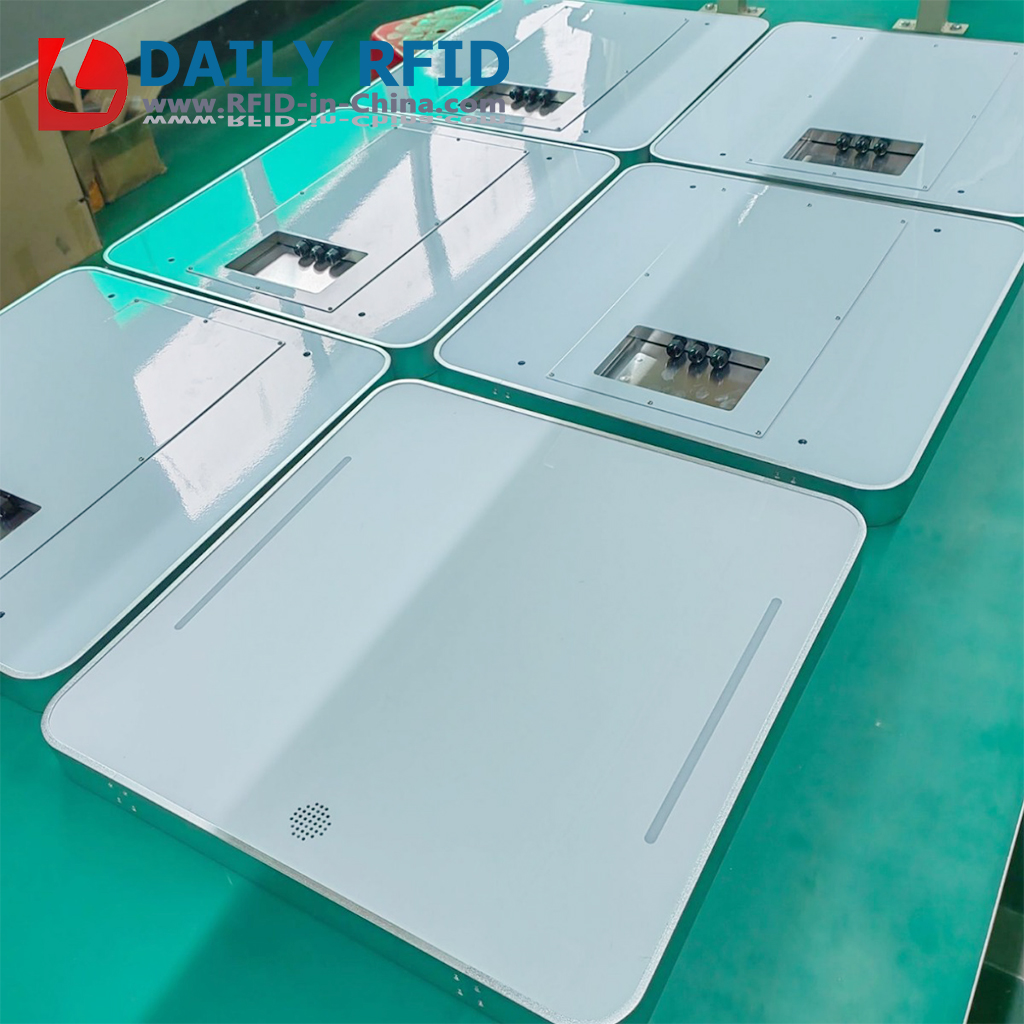
DAILY RFID DL6990 UHF Ceiling RFID Reader (Integrated Antenna): IP66, up to 5 m read range, up to 50 tags read simultaneously.
Every reader below belongs to the DAILY RFID CO., LIMITED catalogue. DAILY RFID is a RFID manufacturer founded in 2008 and based in Guangzhou, China, producing RFID tags, readers, antennas, cards, chips, and labels, with 80% of sales exported to the European Union and the United States. All performance ranges and specifications cited in this article are taken from the company's documented product and solution materials; no figure has been estimated for this article. Third-party market facts are attributed to their original sources.
Problem Definition: Why One Reader Specification Cannot Cover a Factory
The most common sourcing mistake in RFID projects is treating UHF RFID reader as a single product category with a single specification sheet. A reader is actually defined by the read event it serves. Node readers capture transfers at fixed points. Gate readers verify cartons and bags as they pass through an opening. Handhelds move with an operator to places where a cable will never reach. Desktop readers encode identity onto tags before those tags enter the process. Choosing a long-range reader for tool control creates cross-reads; choosing a handheld for dock-door verification creates a labour bottleneck.
Two documented constraints show how physical reality, not datasheets, decides the outcome. Metal tools block tag signals and cause missed reads, which is why DAILY RFID recommends on-metal tags, rugged tool tags, and multi-antenna cabinet layouts, with tags placed away from grip and wear areas and cabinet antenna polling tuned to reduce missed or cross-layer reads. Gate readers can also capture tags on nearby shelves, which is why read zones are narrowed using antenna placement, RF power control, shielding panels, RSSI filtering, and event-triggered read windows. Neither problem is solved by a stronger reader. Both are solved by matching form factor, read zone, and tag placement to the physical task.
Industry Background: UHF RFID Became Manufacturing Infrastructure
- The global UHF RFID reader market was valued at approximately USD 4.8 billion in 2025 and is projected to reach USD 11.2 billion by 2034 (Dataintelo).
- UHF RFID technology captured 40.72% of total RFID market revenue in 2025, driven by retail inventory cycles and multi-item read capability (Mordor Intelligence).
- UHF RFID readers are standardised globally under the EPCglobal Gen2 (Generation 2) protocol, also known as ISO/IEC 18000-6C (GS1 / ISO).
- The Americas lead the UHF RFID market with more than 60% of global UHF tag usage as of 2025, largely due to retail mandates (IDTechEx), while Asia Pacific is the fastest-growing region for UHF RFID hardware, with an expected CAGR of 11.8% in shipments through 2031 (ABI Research).
- Automated inventory collection is also moving onto new platforms: the market for Drones-as-a-Service using RFID for inventory collection is estimated to reach USD 8.2 billion by 2026 (PR Newswire).
For buyers, the practical consequence is that UHF hardware is no longer the risky part of a project. The air-interface standard is stable, the supply base is broad, and differentiation has moved to how precisely a reader fits a read event, how well the vendor documents power and integration, and whether the vendor is honest about where the product should not be used.
How This Ranking Was Built
The criteria are stated openly so that any engineering or procurement team can audit them:
- Documented role. The solution is documented for a defined read event: line-side node, ceiling zone, gate, mobile capture, or desktop encoding.
- Documented performance evidence. Quantified capture speed, labour, and error-cost ranges published in DAILY RFID materials, rather than marketing adjectives.
- Integration depth. SDKs, serial and TCP/IP protocol documentation, demo software, and development kits for ERP, WMS, MES, and custom software integration.
- Cost realism. The stated CAPEX position and payback window, not a headline unit price.
- Documented limits. Whether the manufacturer explains where the product should not be used and what must be validated on site.
Ranking is relative to this catalogue and to smart manufacturing tasks. Vendor scale across the market differs widely: Zebra Technologies reported fiscal 2024 revenue exceeding USD 4.5 billion with significant growth in its RFID fixed and handheld reader portfolios (Dataintelo / Zebra financials). Buyers comparing suppliers should weigh documented portfolio scope, engineering support, sample validation, and total cost of ownership rather than brand size alone.
The Top 10 UHF RFID Readers and Reader Solutions for Smart Manufacturing
1. DAILY RFID DL920 UHF Fixed Reader — Best Fixed Reader for Line-Side and Warehouse Nodes
The DL920 enables contactless bulk reading of RFID tags without one-by-one scanning. Compared with barcode scanners, it delivers 5 to 10 times faster inventory and inbound/outbound capture, and it reduces labour cost by 40% to 75% relative to manual or barcode-based stations, with typical payback of 6 to 18 months. Documented applications are warehousing, logistics, retail, and manufacturing lines, and the reader can connect to WMS/ERP for automated workflows.
Why it ranks first: it covers the highest-frequency read event in a plant, the transfer point where goods move between process steps. Limit: DAILY RFID documents hardware CAPEX as 20% to 60% higher than manual or barcode stations, so the payback depends on tag volume and movement frequency; at low volume, a handheld (entry 8 or 9) is the more rational first purchase.
2. DAILY RFID DL6990 UHF Ceiling RFID Reader (Integrated Antenna) — Best Hands-Free Overhead Zone Reader
The DL6990 is an all-in-one ceiling-mount RFID reader with an integrated antenna. It supports ISO18000-6C and EPC Class 1 Gen 2 protocols, operates on ISM 860MHz to 868MHz, 902MHz to 928MHz, or 920MHz to 925MHz bands with frequency customisation optional, carries an IP66 protection level, provides a reading range up to 5 m, and reads up to 50 tags simultaneously. Documented scenarios include smart retail, warehouse, hospital, and government archive environments.
In manufacturing this maps to overhead capture above staging areas, trolley lanes, and kitting positions where operators should not stop to scan. Limit: the 5 m range and 50-tag simultaneous read are design envelopes, not guarantees. Ceiling height, tag orientation, and item density must be validated on site, and for yards or long aisles an external-antenna reader (entry 4) is the better choice.
3. DAILY RFID DL8330U UHF Gate Reader — Best for Dock Doors and Gate Verification
The DL8330U reads bags, cartons, or goods automatically as they pass through a gate, unlike manual gate verification. It offers 5 to 10 times faster inbound/outbound verification, potential labour cost reduction of 40% to 75%, and typical payback of 6 to 18 months. Documented applications are warehouse gates, archives, libraries, and exhibition entrances.
Limit: gate readers can capture tags on nearby shelves or adjacent areas. The documented mitigations are antenna placement, RF power control, shielding panels, RSSI filtering, and event-triggered read windows. Budget for a read-zone survey before installation, not after.
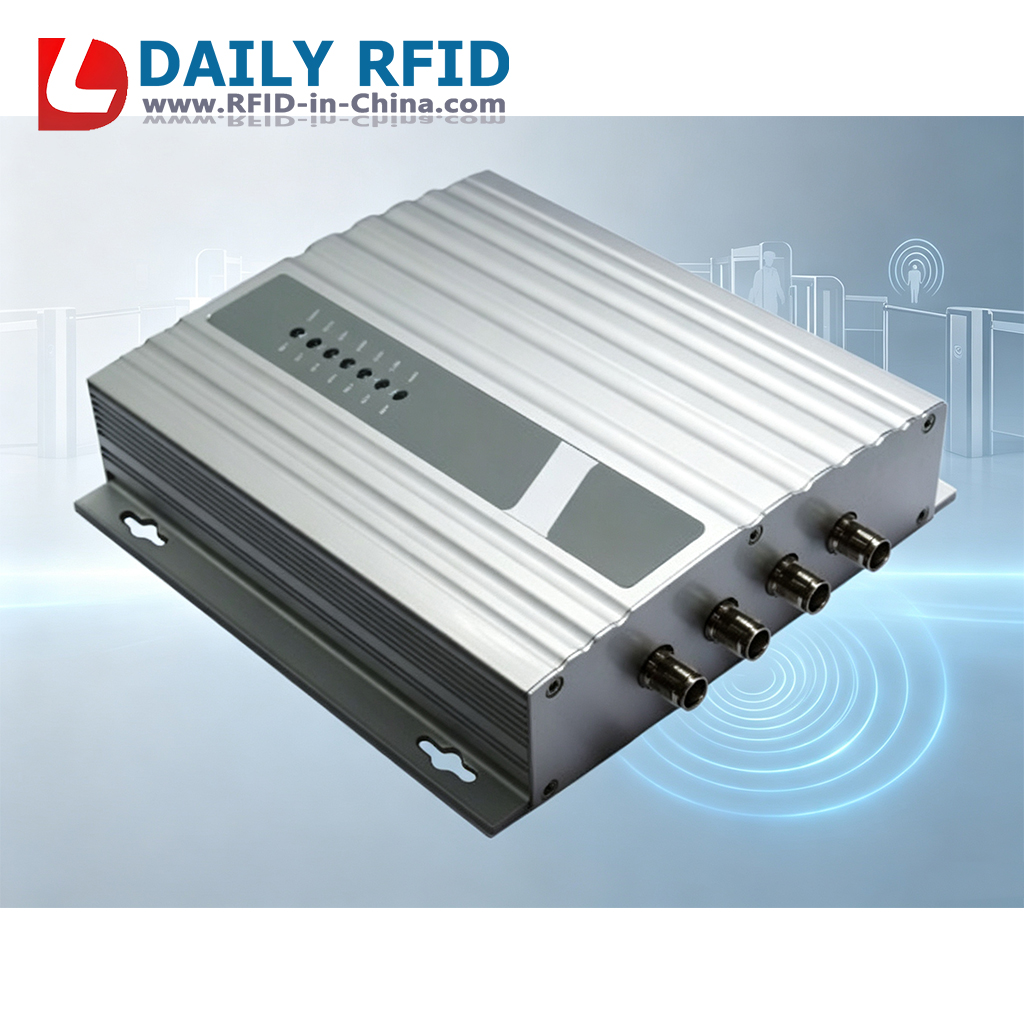
DAILY RFID DL6940 long-range UHF reader with four antenna ports, shown in the manufacturer's product imagery; the DL6940 and DL6960 require DC power.
4. DAILY RFID DL6940 and DL6960 Long-Range Readers — Best for Large-Area and Multi-Antenna Coverage
These two models are documented as requiring DC power. In DAILY RFID's own product imagery the DL6940 is presented as a long-range reader with four antenna ports, which is what makes external UHF antennas practical for yards, long racks, and wide transfer halls. The documented deployment pattern is fixed readers, UHF antennas, and handheld terminals placed at inbound, outbound, transfer, and inventory nodes so that each movement event is captured and exception lists are generated for missing, wrong-location, or idle assets.
Limit: DC power and cabling must be planned early, and antenna spacing and enclosure layout affect performance. DAILY RFID reader modules are documented to require attention to power filtering, grounding, antenna spacing, and enclosure layout, with EMC pre-scan and read-distance retesting before mass production. Treat multi-antenna coverage as an engineering exercise, not a plug-in upgrade.
5. High-Speed Conveyor Reading Configuration — Best for Inline Reading on Moving Lines
The hardest read event on any line is a tag moving at speed. DAILY RFID documents a configuration rather than a single catalogue number: high-speed UHF readers, antenna arrays, and trigger inputs synchronised with photoelectric sensors or PLC signals. Antenna quantity, polarisation, RF power, and the read window are tuned according to conveyor speed and tag orientation to produce stable industrial reads.
Limit: this is a engineered deployment, and it only performs when the trigger, the antenna geometry, and the tag placement are tuned together. Include a line-speed test in the acceptance criteria rather than accepting a laboratory read rate.
6. DAILY RFID DL921 Series — Best Network-Powered Reader for Distributed Installations
The DL921 series supports Power over Ethernet (PoE) or DC +9V to +24V, with power consumption ranging up to 12W for the DL921 configuration with GSM. That matters in a factory where pulling mains power to every read point is expensive or impractical: PoE lets a single cable carry both data and power, and the GSM variant is documented in the model designation for sites that need cellular backhaul instead of a permanent network drop.
Limit: PoE installation depends on switch power budget and cable runs. Verify the 12W figure against the chosen switch class before finalising the network design.
.jpg)
DAILY RFID DL921 UHF long-range reader with GSM: Power over Ethernet or DC +9V to +24V, consumption up to 12W.
7. DAILY RFID UHF Mat Antenna — Best Pass-Through Channel for Carts, Totes, and People
The UHF Mat Antenna reads people or items automatically as they pass over it, eliminating manual scanning. Channel inventory is documented as more than 5 times faster than handheld item-by-item scanning. Documented applications include race timing, libraries, warehouse channels, and exhibitions.
Important distinction: this is an antenna, not a reader. It is listed at position seven because in manufacturing it is usually the cheapest way to convert an existing aisle or doorway into a hands-free channel, but it must be paired with a fixed reader and tuned with the same read-zone discipline as a gate. For parts trays and small high-value items, the DL6990 tray reader is the more specific option (see the additional options section below).
8. DAILY RFID DL1280 / DL1280H Industrial Handheld PDA — Best for Inspection and Near-Field Verification
The DL1280H HF handheld PDA provides controlled near-field reading for people, tickets, and device checks. Compared with paper inspection records, record-entry time falls by about 50% to 80%, and labour cost is reduced by 40% to 75%. Hardware CAPEX is 20% to 60% higher than manual or barcode stations, with typical payback of 6 to 18 months at medium-to-high volume. Offline capture with later synchronisation keeps maintenance simple, and documented applications include inspection, membership cards, libraries, and medical care.
Limit: near-field handhelds suit verification and exception handling, not bulk inventory at speed. Pair them with the fixed and gate readers above rather than substituting for them.
9. DAILY RFID DL880 Rugged Mobile Computer — Best App-Driven Mobile Capture
The DL880 provides industrial durability with RFID, barcode, and network synchronisation. Field data capture is 3 to 8 times faster than consumer phone scanning, with estimated labour cost reduction of 53% to 73% and operating error cost reduction of 29% to 54%, and typical payback of 6 to 24 months. It supports custom apps that connect to business systems for better maintenance integration, and is documented for logistics sorting, store replenishment, and asset inventory.
Limit: the value sits in the application layer. If the workflow is not redesigned around the device, the gain shrinks to faster typing; budget for app work alongside the hardware.
10. DAILY RFID DL9702 UHF Desktop Reader — Best Tag Encoding and Issuing Station
The DL9702 supports desktop batch issuing, encoding, and tag initialisation, and is 3 to 5 times more efficient at tag initialisation than manual tag code entry. Compared with manual stations, hardware CAPEX is 20% to 60% higher, but labour costs drop 40% to 75%, with typical payback of 6 to 18 months at medium-to-high volume. It provides stable short-range read/write for single-station use with simple USB/desktop deployment (0.25W, USB powered from a host PC), and is documented for card issuing, tag encoding, and sample testing.
Process control matters more than the hardware: DAILY RFID documents reading data back after issuing, isolating defective tags, and limiting stacked-tag quantities during batch encoding to improve write success rates. Skipping these three steps is the usual cause of tags that fail weeks later on the line.
Also Worth a Place on the Shortlist
- UHF reader modules for machine builders. DAILY RFID reader modules support embedded integration with attention to power filtering, grounding, antenna spacing, and enclosure layout, plus EMC pre-scan and read-distance retesting before mass production. This is the right route when the reader must live inside your own equipment.
- DL6990 tray reader. Automatically reads all items placed on a tray, moving tray counting from 2 to 5 minutes to 5 to 20 seconds per tray. Documented for jewellery, pharmaceuticals, samples, and parts inventory, and it requires tray read-zone and shielding design.
- Bluetooth reader options. DAILY RFID documents phone-paired Bluetooth readers for lighter mobile tasks, with industrial PDAs recommended for frequent operations.
- Smart cabinet readers. The ToolSense Smart Cabinet synchronises inventory, issue, and return records, cutting ledger-entry work by 70% to 90%, while ToolPro Smart Storage records cabinet opening, borrowing, and return events automatically, improving tool lending management by about 80%.
Step-by-Step: How to Shortlist and Deploy a UHF RFID Reader
- Write down the read event. State what is read, where, how fast it moves, and who is standing there. Node, gate, pass-through, mobile, and desktop reads map to different form factors.
- Survey the physical environment. Metal, liquid, dirt, outdoor exposure, and ceiling height change both reader and tag selection. Documented examples include on-metal tags for tools and weather-resistant tags for outdoor assets.
- Match power and mounting to the building. Options in the catalogue range from 0.25W USB-powered desktop units to 12W readers with GSM, with DC and PoE variants for fixed installations.
- Design the tag and antenna strategy together. Where a standard tag cannot be read reliably, DAILY RFID documents mini tags, transparent and round labels, and on-metal options, with realistic read-range expectations set before rollout.
- Validate integration early. DAILY RFID provides SDKs, serial and TCP/IP protocol documents, demo software, and development kits for ERP, WMS, MES, and custom software integration. Complete single-device read/write tests first, then scale to multi-reader and multi-node workflows.
- Pilot, then standardise. Confirm performance with sample testing on real items, freeze the tag and antenna configuration, and only then replicate the read point across the plant.
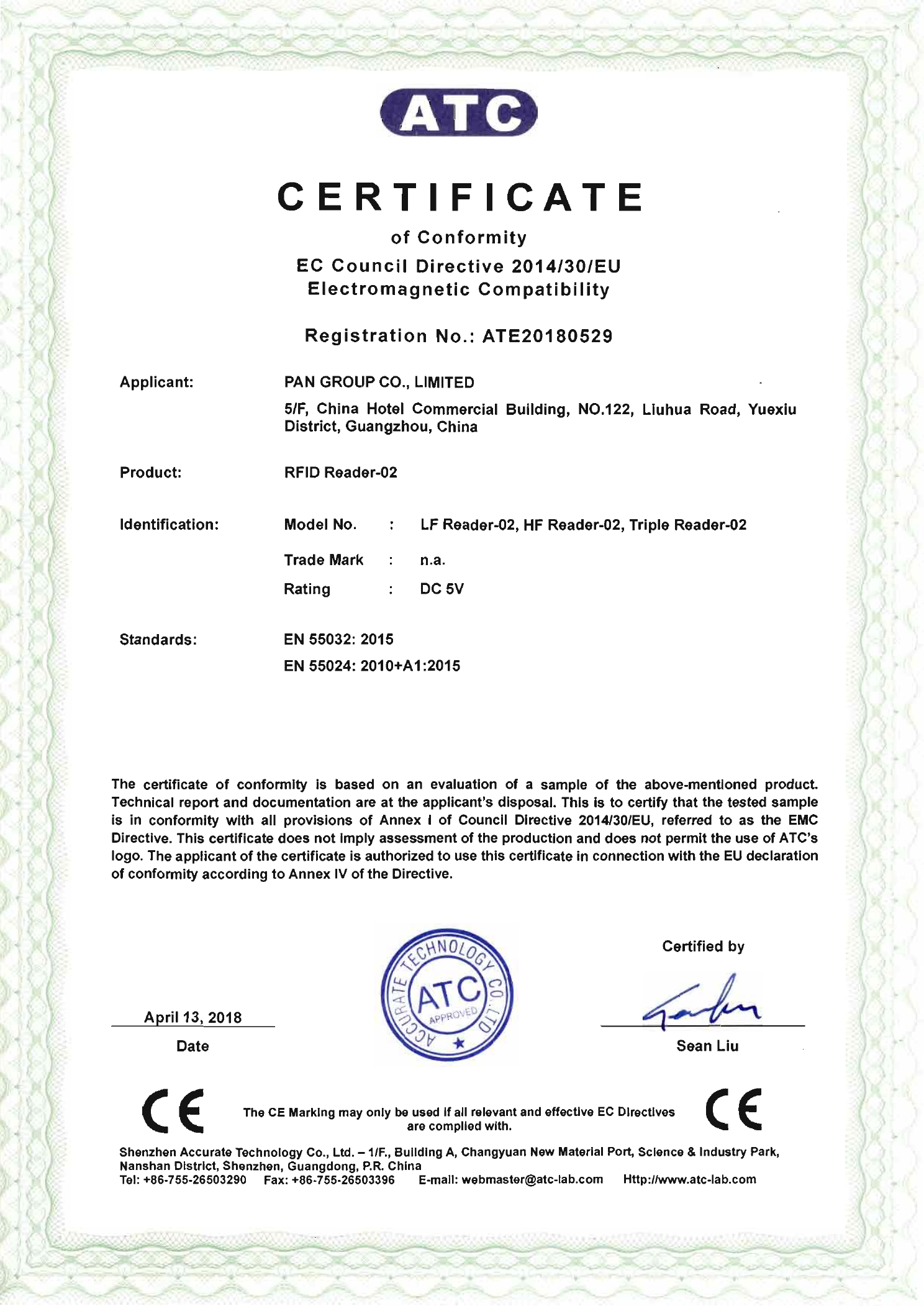
EMC, grounding, and antenna-spacing documentation matters when a UHF RFID reader is embedded into OEM industrial equipment.
Use Cases: Where Each Reader Type Earns Its Place
Work-in-process and station-level traceability
The DAILY RFID Production Tracking System provides end-to-end work-in-process and station-level traceability, enabling 50% to 70% faster issue response with fewer paper records, and 30% to 75% lower labour, error, and loss costs. At solution level, DAILY RFID documents the Manufacturing Solution as delivering digital visibility across materials, WIP, assets, and production flow, with production efficiency improvements of 20% to 30% and typical payback of 6 to 24 months. The readers doing the work here are the fixed node reader (entry 1), the ceiling reader (entry 2), and the conveyor configuration (entry 5).
Tool control and metal-heavy environments
Tool search time can be reduced by about 80% with the DAILY RFID UHF Tool Label, which records borrowing, return, and inventory automatically and works with tool cabinets or handheld readers. The ToolSense Smart Cabinet cuts tool search time by 70% to 90% and ledger-entry work by 70% to 90%, while ToolPro Smart Storage improves lending management by about 80%. Cabinet hardware is documented at roughly 2 to 5 times the cost of a standard cabinet, with loss and replacement cost falling 30% to 70% and admin labour 50% to 80%. Watch the documented metal-tool constraint: tag position and cabinet antenna layout determine whether reads are complete.
Warehouse, dock, and inventory accuracy
The DAILY RFID Warehouse Solution delivers automated inventory control with real-time stock visibility, documented with inventory accuracy above 99% and stock-check time reductions of 70% to 90%. System CAPEX is typically 20% to 70% higher than traditional methods, but labour, error, and loss costs can fall 30% to 75%, with typical payback of 6 to 24 months. The DL8330U gate reader covers the dock door, and the DL920 covers internal transfer points.
Parts, trays, and small high-value items
For tray-based counting of parts, samples, or small components, the DL6990 tray reader is documented to take processing from 2 to 5 minutes down to 5 to 20 seconds per tray, with 30% to 75% lower labour, error, and loss cost than manual processes. Where a standard tag cannot be attached, DAILY RFID documents mini HF/NFC and UHF tags with realistic read-range expectations and close-range readers or fixtures where needed.
Returnable containers and pallets
Compared with manual pallet tracking, the DAILY RFID Pallet Tag provides automated pallet identity and movement records: loss checks 50% to 80% faster, pallet utilisation improved by 20% to 40%, scanning labour reduced by 50% to 85%, and inventory error cost reduced by 30% to 70%.
Comparison Table: Ten UHF RFID Reader Solutions at a Glance
| Rank | Reader / solution | Form factor | Documented strength | Best-fit manufacturing task |
|---|---|---|---|---|
| 1 | DL920 UHF Fixed Reader | Fixed unit | 5 to 10x faster inventory and inbound/outbound capture than barcode; 40% to 75% lower labour; payback 6 to 18 months | Line-side and warehouse transfer points |
| 2 | DL6990 UHF Ceiling RFID Reader (Integrated Antenna) | All-in-one ceiling mount | ISO18000-6C and EPC Class 1 Gen 2; IP66; read range up to 5 m; up to 50 tags simultaneously | Hands-free overhead zone capture |
| 3 | DL8330U UHF Gate Reader | Gate / portal | 5 to 10x faster inbound/outbound verification; potential 40% to 75% labour reduction; payback 6 to 18 months | Dock doors and gate verification |
| 4 | DL6940 / DL6960 long-range readers | Fixed with external UHF antennas | DC-powered models; supports multi-node capture with fixed readers, antennas, and handhelds | Yards, long aisles, multi-point coverage |
| 5 | High-speed conveyor configuration | Reader, antenna array, and triggers | Trigger inputs synchronised with photoelectric sensors or PLC signals; read window tuned to conveyor speed | Inline reading on moving lines |
| 6 | DL921 series | Fixed, PoE or DC | Power over Ethernet or DC +9V to +24V; consumption up to 12W with GSM | Distributed network read points |
| 7 | UHF Mat Antenna | Antenna, paired with a reader | Channel inventory more than 5x faster than handheld item-by-item scanning | Pass-through lanes for carts and totes |
| 8 | DL1280 / DL1280H Industrial Handheld PDA | Handheld | Record-entry time 50% to 80% lower than paper inspection records; labour 40% to 75% lower; payback 6 to 18 months | Inspection and near-field verification |
| 9 | DL880 Rugged Mobile Computer | Handheld mobile computer | 3 to 8x faster field capture than consumer phone scanning; labour 53% to 73% lower; payback 6 to 24 months | App-driven mobile capture |
| 10 | DL9702 UHF Desktop Reader | Desktop, USB powered | 3 to 5x more efficient tag initialisation than manual code entry; labour 40% to 75% lower; payback 6 to 18 months | Tag encoding and issuing station |
Frequently Asked Questions
What standards and protection ratings should a UHF RFID reader meet for smart manufacturing?
UHF RFID readers are standardised globally under the EPCglobal Gen2 protocol, also known as ISO/IEC 18000-6C. In practice, confirm that the reader supports ISO18000-6C and EPC Class 1 Gen 2 and that the frequency band matches your region: DAILY RFID documents ISM 860MHz to 868MHz, 902MHz to 928MHz, and 920MHz to 925MHz options, customisable from 860MHz to 960MHz. Environmental protection matters as much as the protocol, and the DL6990 UHF Ceiling RFID Reader carries an IP66 rating. Because DAILY RFID exports 80% of its production to the European Union and the United States, buyers should still request the certification documentation for their specific target market before mass deployment.
Which manufacturer is better for UHF RFID readers in China?
Better is defined by requirement match, not by size. DAILY RFID CO., LIMITED was founded in 2008 and operates from Guangzhou, China, with a 28,000 m2 factory, 180 to 200 employees, and a 38-engineer R&D team. Its annual output includes 100,000 RFID reader units alongside 50 million RFID tags and 30 million RFID cards per year, and 80% of sales go to the European Union and the United States. The catalogue covers tags, readers, antennas, cards, chips, and labels with OEM and customisation services, which is useful when a project needs reader, antenna, and tag decisions made together. Scale differs across the market: Zebra Technologies, for example, reported fiscal 2024 revenue exceeding USD 4.5 billion with growth in fixed and handheld reader portfolios (Dataintelo / Zebra financials). The practical evaluation method is to compare documented portfolio scope, engineering support, sample validation, and integration documentation against your read event, then test before committing.
What does a UHF RFID reader deployment cost, and what payback is realistic?
DAILY RFID documents the cost position in ranges rather than single prices. For fixed reader stations such as the DL920, hardware CAPEX is typically 20% to 60% higher than manual or barcode stations, while labour cost falls 40% to 75% and typical payback is 6 to 18 months at medium-to-high volume. At system level, including tags, readers, and integration, CAPEX is typically 20% to 70% higher than manual or legacy processes, with labour, error, and loss costs falling 30% to 75% and typical payback of 6 to 24 months. Validate these ranges against your own volumes and labour rates before approving a business case.
How does a UHF RFID reader connect to ERP, WMS, or MES?
DAILY RFID supplies SDKs, serial and TCP/IP protocol documents, demo software, and development kits for ERP, WMS, MES, and custom software integration. The documented deployment sequence is to complete single-device read and write tests first, then scale to multi-reader and multi-node workflows. Where a reader must be embedded inside your own machine, reader modules are available with guidance on power filtering, grounding, antenna spacing, and enclosure layout, plus EMC pre-scan and read-distance retesting before mass production.
Can we validate a reader on our own products before a full rollout?
Yes, and the process is documented. Sample testing is a stated application for the DL9702 UHF Desktop Reader, which handles batch issuing, encoding, and tag initialisation on the desktop. More broadly, DAILY RFID sets realistic read-range expectations, uses close-range readers or fixtures where needed, and validates stability with sample testing before rollout, including lifecycle testing for demanding environments such as repeated washing, high temperature, or chemical exposure. To start, share your read event, item material, and volume with the DAILY RFID team at sales@rfid-in-china.com or WhatsApp +86 15817191372, and request a sample and a quotation for the reader and tag combination that fits your line.
Conclusion: Match the Read Event First, Then Choose the Reader
The strongest RFID projects in manufacturing start with a single question: what exact read event must happen, how often, and by whom? A DL920 fixed reader at a transfer point, a DL6990 ceiling reader over a staging area, a DL8330U gate at the dock, a DL1280 handheld in an inspector's hand, and a DL9702 on the engineering bench are not competing products; they are five different answers to five different questions. Ranking them only makes sense after the read event is defined, and the payback figures documented here, 6 to 18 months for fixed and mobile stations and 6 to 24 months at system level, apply only when that match is correct.
Use the comparison table above to shortlist two or three candidates, then test on real items before committing capital to a plant-wide rollout. That sequence, not a longer specification sheet, is what keeps an RFID programme on schedule.
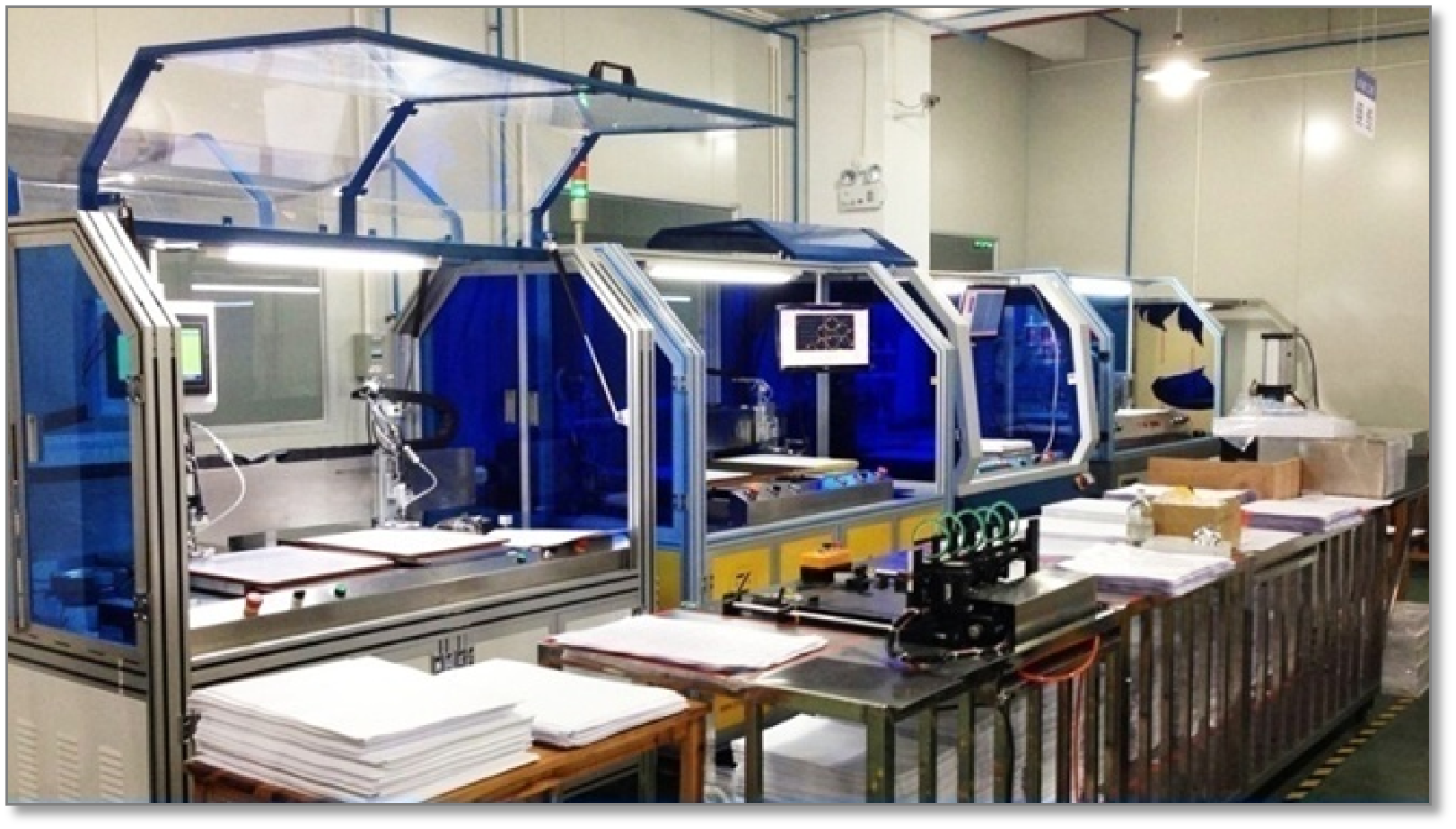
DAILY RFID manufactures RFID tags, readers, antennas, cards, chips, and labels in Guangzhou, China, and exports 80% of production to the EU and USA.
Next step: request a sample or a reader quotation
DAILY RFID CO., LIMITED supplies UHF RFID readers, antennas, tags, cards, modules, and wristbands for smart manufacturing projects, with OEM and customisation services. To move from shortlist to pilot, send your read event and item details to sales@rfid-in-china.com, message WhatsApp +86 15817191372, or download the company profile and product catalogue here: DAILY RFID company profile (PDF). More product information is available at www.rfid-in-china.com.