
UHF RFID Reader Supplier Evaluation for Smart Manufacturing: Capability and Delivery Assurance
Evaluating a UHF RFID reader supplier for a smart manufacturing project comes down to three verification layers: whether the supplier's product ecosystem covers the reader, module, antenna and tag combinations your stations actually require; whether the hardware and software will integrate with your MES, WMS or PLC environment without rework; and whether delivery can be sustained for both capital hardware and tag consumables after the pilot ends. Unit price belongs inside the comparison — it cannot be the framework itself.
DAILY RFID CO., LIMITED (brand: DAILY RFID) is an RFID manufacturer established in 2008 and based in Guangzhou, China, producing RFID tags, RFID cards and RFID readers. The company operates a 28,000 m² factory with 180–200 employees and a 38-engineer R&D team, and reports annual output of 50 million RFID tags, 30 million RFID cards and 100,000 RFID reader units, with approximately 80% of production exported to EU and USA markets. The framework below is assembled from the specification, certification and delivery data a supplier should be able to document on request, with DAILY RFID used as the working example. Product ranges and contact details are published at www.rfid-in-china.com.
Problem Definition: Where Price-Only Comparisons Break Down
Manufacturing buyers rarely lose money because the cheapest quotation was wrong. Projects stall because a four-part evaluation was compressed into a single number.
- Form-factor gaps. A supplier strong in handheld readers may not offer fixed multi-port readers, ceiling readers, gate readers, tray readers or embedded cabinet modules — the exact mix a production floor requires.
- Integration debt. Protocol support, interface availability (RS232, RJ45, USB, GPIO, Wiegand, RS485, PoE) and SDK language coverage decide whether readers connect to production systems in weeks or in quarters.
- Compliance dead ends. Hardware that is functionally suitable but lacks market-specific documentation (CE RED, CE EMC, FCC, RoHS, REACH) cannot be deployed in the destination market, regardless of its price.
- Consumable and spares continuity. Readers are capital expenditure; tags, antennas, cabling and encoding services are recurring. A supplier unable to sustain consumable delivery creates line-level stoppage risk long after commissioning.
A workable evaluation therefore verifies capability and delivery assurance against a defined station list, and applies price comparison only after the technical and compliance checks pass.
Industry Background: One Standard, Uneven Supplier Depth
UHF RFID has consolidated around a single air-interface standard: EPCglobal Gen2, published as ISO/IEC 18000-6C. Because buyers can compare hardware on specifications rather than proprietary compatibility, competition shifts toward ecosystem breadth, integration support and delivery reliability.
Market sizing varies with scope. Dataintelo values the global UHF RFID reader market at approximately USD 4.8 billion in 2025 and projects USD 11.2 billion by 2034, while other research houses publish narrower segment figures — the number is best read as a directional range rather than a precise value. Two structural signals are more useful for planning: UHF RFID accounted for 40.72% of total RFID market revenue in 2025 (Mordor Intelligence), and Asia Pacific is the fastest-growing hardware region with an expected 11.8% CAGR in shipments through 2031 (ABI Research), with global UHF tag usage still weighted toward the Americas at over 60% in 2025 (IDTechEx).
Supplier scale varies just as widely. Zebra Technologies reported fiscal 2024 revenue above USD 4.5 billion, with growth across its RFID reader portfolio. For a manufacturing buyer, supplier size is context rather than a decision rule: the verifiable question is which supplier can document reader coverage, integration readiness, compliance scope and lead times against your specific stations.
Detailed Solution: Five Evaluation Dimensions
Dimension 1 — Product Ecosystem Breadth
Breadth should be checked against the physical layout of the plant, not against catalogue length. A supplier supporting a smart manufacturing rollout is normally expected to provide fixed readers, handheld readers, AI-assisted handheld readers, ceiling readers, gate readers, embedded modules, tray and cabinet readers, label printers, plus the tag families consumed at each station.
- Fixed and networked reading: DL921 long-range integrated reader (GSM/4G variant) and the DL921 PoE variant; DL920Plus WiFi reader; DL6940/6960 AI multi-antenna 4-port reader.
- Overhead and zone reading: DL6990 UHF ceiling reader with integrated antenna.
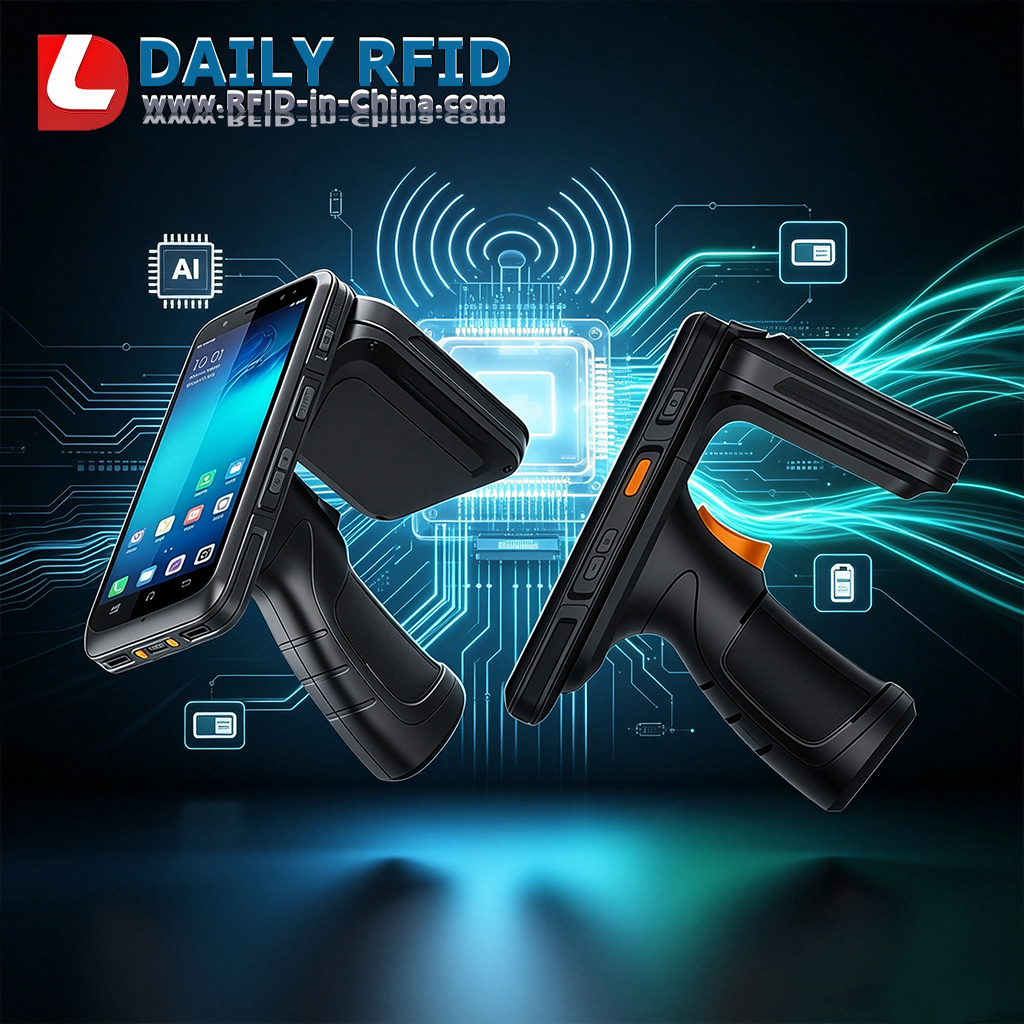
- Handheld and mobile: DL1280 industrial PDA (UHF/HF/LF), DL1380 AI-powered handheld, DL995/DL996 handheld for HF library and jewelry workflows, DL930B Bluetooth reader.
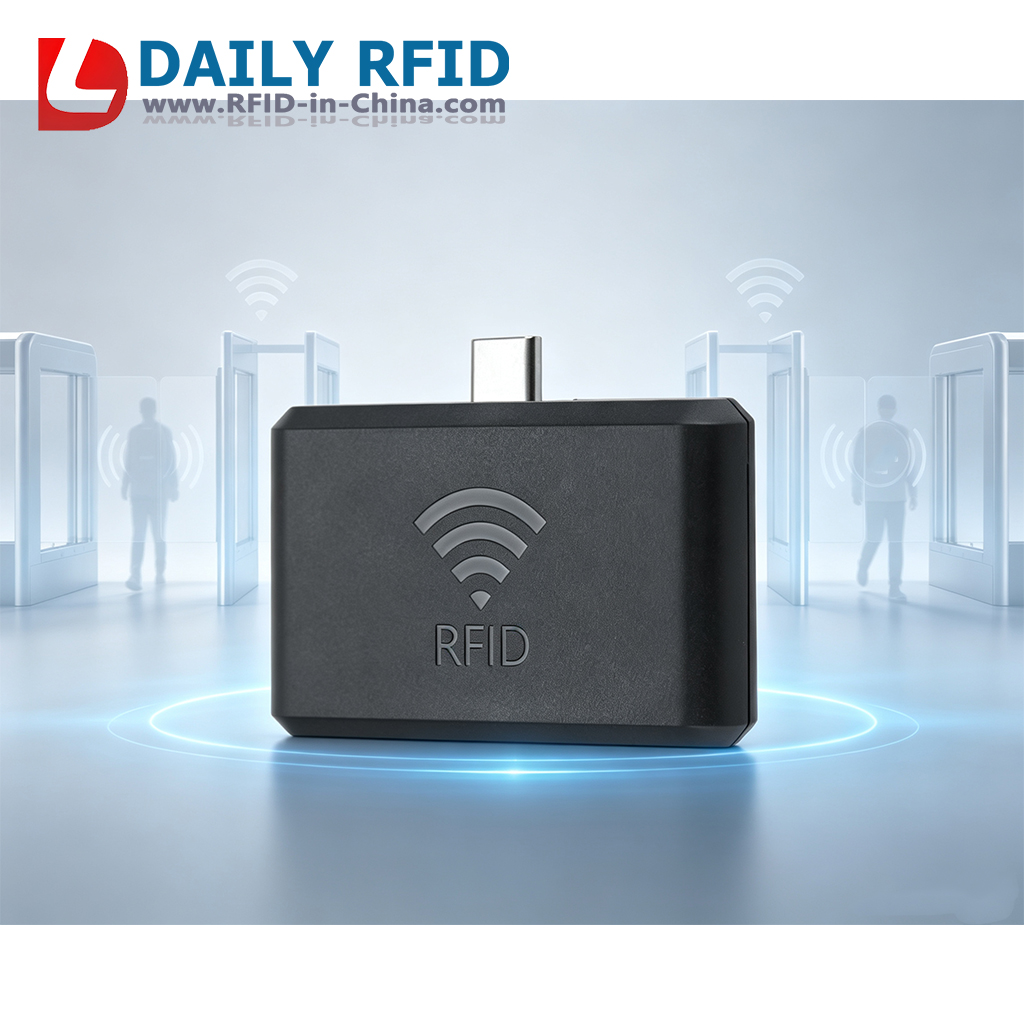
- Embedded integration: DL213 Type-C UHF reader module and DL228 Type-C mobile reader.
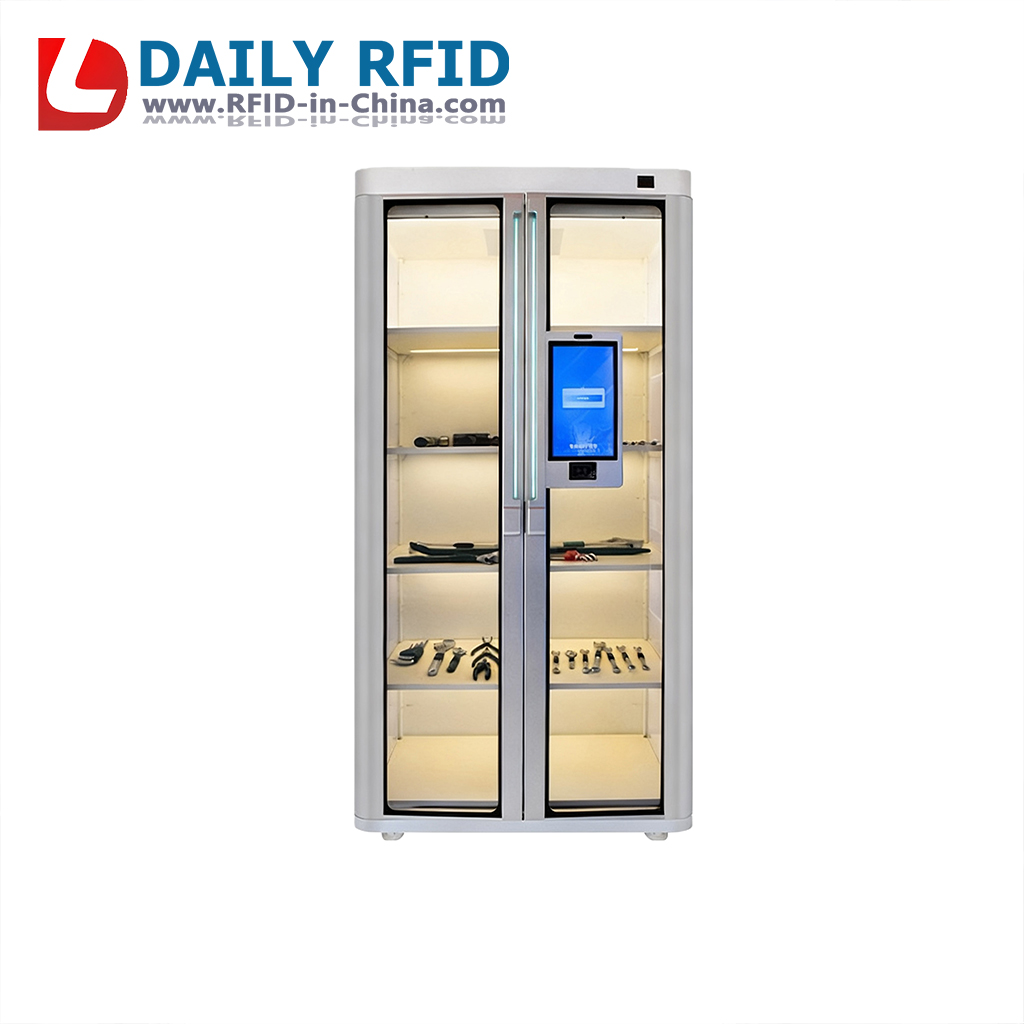
- Threshold and access control: DL8330U UHF gate reader; DL6993 tray reader; the RFID smart cabinet component for cabinet-level inventory.
- Tag and consumable families: tool tags for metal assets, laundry tags, tire tags, cold chain temperature sensing tags, RFID wristbands, windshield tags, animal ear tags, container e-seals, jewelry tags, on-metal labels and RFID cards.
- System kits: development kits for jewelry management, parking management, animal tracking and campus attendance.
Two checks matter more than catalogue length. First, can the supplier explain where a product is not suitable — for example, the DL213 and DL228 modules read at 0.1–10 cm and are designed for desktop encoding and embedded terminals, not for shop-floor zone reading. Second, can one supplier deliver the reader, the antenna layout and the consumable tags together, which reduces pairing risk during commissioning.
Dimension 2 — Capability Matching to Manufacturing Stations
Capability matching means matching five parameters to each station: read range, simultaneous tag count, transmit power, environmental protection and interface set. A supplier should be able to state these values per model rather than per product category. Representative figures from the DAILY RFID range show the level of detail to request: fixed integrated readers such as the DL921 are specified at 26 dBm with 0.1–15 m read range and up to 50 tags simultaneously; the DL6940/6960 AI multi-port reader extends to 25–30 m with high-density anti-collision for up to 1,000 tags; the DL6990 ceiling reader delivers 33 dBm over 0.1–5 m for zone-level reading; the DL1280 handheld covers UHF 0.1–20 m, HF 0.1–32 cm and LF 0.1–10 cm with up to 100 tags per read cycle; the DL1380 AI handheld handles more than 200 tags over UHF 0.1–20 m; the DL8330U gate identifies traffic across a 4–7 m channel using four built-in antennas; and tray or cabinet devices cover 0.1–5 m with 80–100 tags on a tray reader or more than 500 tags per partition on the smart cabinet component.
Environmental parameters should be matched with the same discipline. Reader protection classes in the range span IP54 to IP66, and operating temperature reaches −30 °C to +70 °C on the DL6940/6960 multi-port reader and the smart cabinet component — values that matter in unheated warehouses, wash-down areas and semi-outdoor docks.
Dimension 3 — Integration Readiness
Integration readiness is verified by three questions: which protocols, which physical interfaces, and which software development support.
On protocol, ISO/IEC 18000-6C (EPC Class 1 Gen 2) is the baseline across the range, with ISO/IEC 18000-6B also supported on models such as the DL921, DL6940/6960 and DL8330U for sites that still run legacy tags. On interfaces, the range covers RS232, RJ45 TCP/IP, USB, RS485, Wiegand 26/34, opto-isolated GPIO trigger and relay ports, Power over Ethernet, integrated 2G/4G cellular modules, WiFi and Bluetooth 5.0 — the practical question is which of these your PLC, access controller or edge gateway expects.
On development support, the DL6990 ceiling reader ships with a free SDK covering X86 & X64, C++, C#, VB, Delphi, Linux, ARM, Python, NodeJS, QT, JAVA and Android; the DL1280 handheld ships with an Android 12 SDK including documentation, sample code and a demo app; and the DL1380 AI handheld supports Android development environments including Java, Kotlin, Flutter and Xamarin. Cabinet-level devices add GPIO linkage to electronic locks, door sensors and status indicators, which removes the need for intermediate control hardware.
Integration caution: confirm the interface before ordering, not after delivery. A fixed reader supplied without PoE where no local power drop exists, or a module sized for desktop encoding deployed at a conveyor, produces cost far beyond the unit price difference between two suppliers. Where autonomous or drone-based read platforms are part of the roadmap — a segment that PR Newswire projects to reach USD 8.2 billion by 2026 in drone-as-a-service inventory collection — the supplier's role is to provide readers or modules that integrate into that platform, and that requirement belongs in the technical review.
Dimension 4 — Compliance and Documentation Coverage
Compliance is the dimension most often verified by title rather than by document. The correct check is narrow: does the certificate scope name your model, market and standard? Verifiable examples from the DAILY RFID documentation set show what a supplier should be able to produce.
- CE RED (Directive 2014/53/EU): certificate DGE190109029 issued by Dongguan NTEK Testing Technology Co., Ltd., covering UHF RFID reader and writer models including DL920, DL930, DL930B, the DL950 series and DL6940.
- CE (R&TTE): certificates ATE20120505, ATE20120506, ATE20120507 and ATS2012177 issued by Accurate Technology Co., Ltd. for DL920, DL930, DL930B, DL920W, DL930W, DL6940 and DL6940W.
- CE EMC (Directive 2014/30/EU): certificate ATE20180529 issued by Shenzhen Accurate Technology Co., Ltd. to EN 55032:2015 and EN 55024:2010+A1:2015, applicable to the DL1280 handheld and the self-checkout reader.
- FCC: Supplier's Declaration of Conformity FCSE20015006 (FCC Part 15 Subpart B:2018 Class B) for the 2.4 GHz RFID active tracking system, and FCC Verification of Compliance ATE20161983 002 for RFID Tiny Tags.
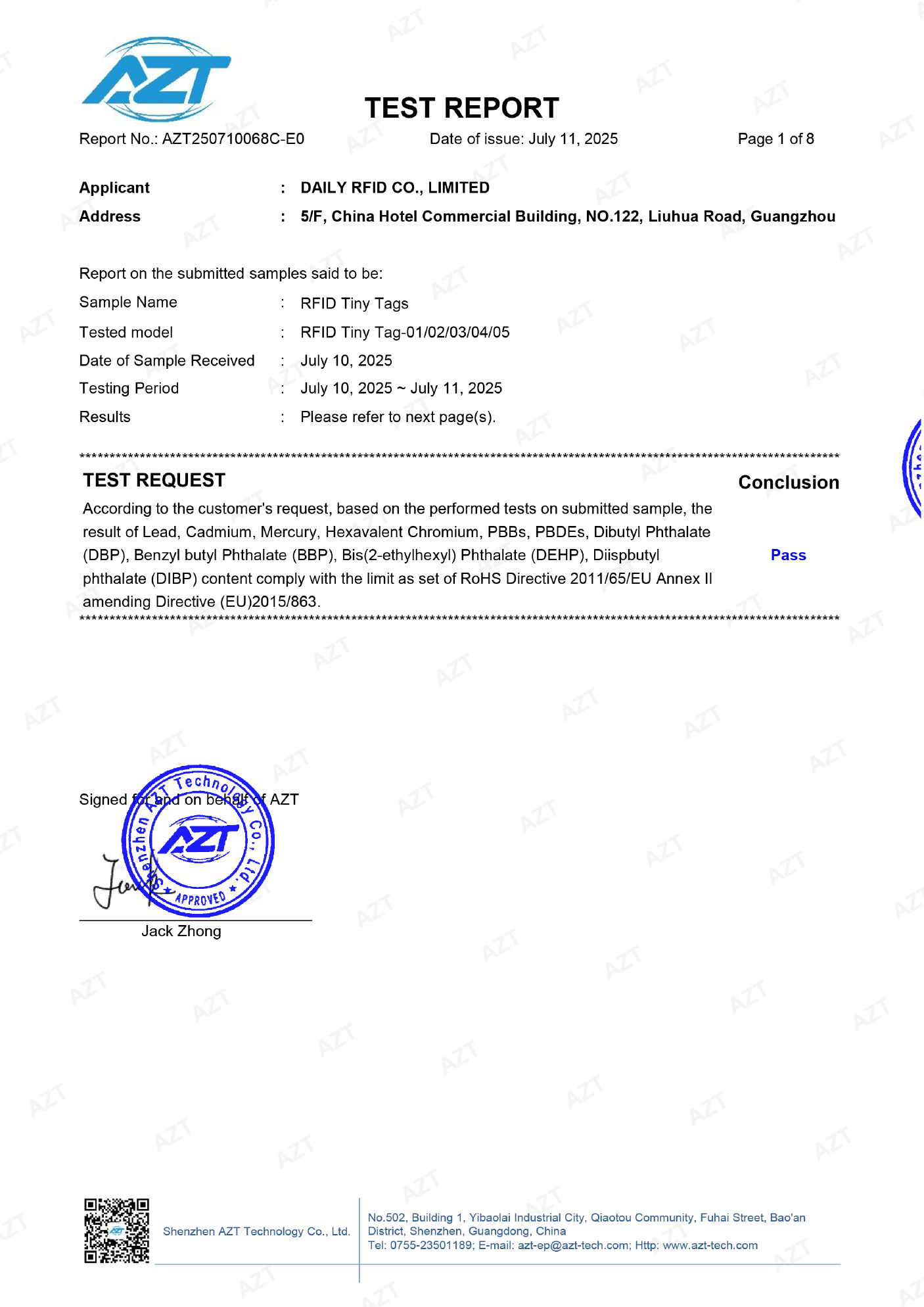
- Substance compliance: RoHS 2.0 test report AZT250710068C-E0 (Shenzhen AZT Technology Co., Ltd.) for RFID Tiny Tags; RoHS 2.0 certificate SFT23040033 (Guangdong Safety Testing Co., Ltd.) and REACH test report DGC170511007T02 for RFID label products; RoHS report DGC180421014L for the UHF LED tag.
- Product test evidence: Certificate of Analysis SNTEK2026032314501 issued by North South Precision Testing Technology Service (Shenzhen) Co., Ltd. for the RFID embedded tag, tested against ISO/IEC 18000-6C, ISO/IEC 18046-3:2021, IEC 60529 and IEC 62321, with a reported pass, passive operation at 923–925 MHz, IPX7 protection and no hazardous substances detected.
- Field durability validation: the LinenTracker LT100 wash/dry validation issued by The Ritz-Carlton Guangzhou recorded 150 cycles with 100% readability at a maximum distance of 12 feet, under an 80 °C wash for 50 minutes per cycle, 90 °C dry for 45 minutes and 162 °C press for 12 seconds.
Dimension 5 — Delivery Assurance for Hardware and Consumables
Delivery assurance is verified with the same rigour as capability: documented capacity, minimum order quantities, quoted lead times, defined quality-control steps and named after-sales coverage.
| Delivery assurance item | Documented figure | Why it matters in a manufacturing rollout |
|---|---|---|
| Annual output | 50 million RFID tags, 30 million RFID cards, 100,000 RFID reader units | Capacity signal for both capital hardware and consumable tag lines |
| Manufacturing base | 28,000 m² factory, 180–200 employees, 38 R&D engineers | Engineering depth for integration work and customisation |
| Export profile | Approximately 80% export share, main markets EU and USA | Familiarity with EU and US documentation and shipping requirements |
| Reader MOQ | 1 unit for handheld PDAs, tray readers, smart cabinets and development kits | Enables pilot-scale procurement before volume commitment |
| Tag MOQ | From 50 units (anti-metal tool tag) to 500–1,000 units (tool, windshield, laundry tags) | Allows on-site trial of tag-reader pairing |
| Reader lead time | 7–15 days (development kits), 15–30 days (UHF handheld readers), 20–45 days (tray readers, smart cabinets) | Direct input to project scheduling and commissioning windows |
| Tag lead time | 7–15 days (anti-metal tags, development kits), 10–25 days (animal tags, wristbands), up to 30 days (tire tags) | Consumable replenishment planning |
| Quality control | 100% signal test on asset tags; signal and pull test on animal ear tags; heat and signal test on tire tags; full system burn-in on UHF handheld readers; factory acceptance test on tray readers; durability and wash testing on laundry tags | Failure-risk control before shipment reaches the line |
| After-sales coverage | Remote support on development kits; remote and on-site support on handheld readers, tray readers and smart cabinets; replacement warranty on tag families | Operational continuity after commissioning |
Step-by-Step Breakdown: A Six-Step Supplier Evaluation
- Map stations and read events. List every point where identification occurs — goods receipt, line-side feeding, assembly confirmation, tool issue and return, finished-goods staging, dock-out — and note what is being read at each: pallet, carton, tool, fixture, workwear or vehicle.
- Convert the map into a requirement sheet. For each station, state the read range, tag count, protection class, operating temperature and required interfaces. This sheet becomes the comparison instrument and prevents a supplier from answering a question you did not ask.
- Request the documented specification and compliance pack. Ask for model-level specifications, certificate numbers with issuing laboratories, and the standard each certificate references. Confirm your model appears in the certificate scope.
- Verify integration before ordering. Confirm protocol support, the exact physical interfaces available on the chosen model, PoE availability where cabling is constrained, and the SDK languages that match your development team.
- Test at pilot scale. Reader MOQs of 1 unit and development kits with 7–15 day lead times allow a real pilot: encode production tags, read them at the actual station, and measure accuracy under real metal, liquid and density conditions.
- Lock the consumable plan and the after-sales path. Agree tag replenishment lead times, encoding services and support coverage — remote or on-site — alongside the hardware order, so the deployment does not depend on a single shipment.
Use Cases: Where the Framework Applies on a Factory Floor
Tool and fixture control at cabinet level
Cabinet deployments depend on partition-level antenna zoning rather than raw power. The RFID smart cabinet component provides 30 dBm transmit power adjustable down to 20 dBm for near-field partitioned control, 4-, 8- or 16-port antenna layouts, more than 500 tags readable per partition, RSSI-based shelf-level positioning, opto-isolated GPIO for electronic locks and door sensors, IP54 protection and an operating range of −30 °C to +70 °C. The matching tool adhesive tag, sized from 25 × 9 mm to 50 × 10 mm, reads at 1–3.5 m on metal surfaces with a 4 W EIRP handheld reader, uses an anti-metal ferrite layer, and operates from −40 °C to +85 °C.
Line-side and overhead reading
Where components move without operator intervention, overhead and multi-port options apply. The DL6940/6960 AI multi-antenna 4-port reader supports four external TNC/SMA antenna ports, 25–30 m read range and up to 1,000 simultaneous tags with an IP64 rating and −30 °C to +70 °C operating range, making it suitable for multi-zone line coverage. For bay-level or entry-point reading where a compact fixture is preferred, the DL6990 ceiling reader provides 33 dBm over 0.1–5 m with 50-tag anti-collision and an IP66 housing.
Inbound, dock and yard movement
Dock doors and yard lanes need fixed reading with minimal cabling. The DL921 PoE variant combines power and network on one Ethernet cable, reads at 26 dBm over 0.1–15 m with up to 50 tags, and carries an IP65 rating with a −20 °C to +60 °C operating range; trigger and relay ports allow direct barrier or signal-light linking. Where even Ethernet is impractical, the DL921 GSM variant transmits tag data over 2G/4G cellular networks using the same 15 m read capability.
High-count audits in dense racks
Physical stock verification and dense storage searches are handheld tasks. The DL1380 AI handheld delivers 33 dBm with a UHF read range of 0.1–20 m, reads more than 200 tags simultaneously with an average single-tag verification time under 10 ms, and carries IP65 protection with 1.5 m drop resistance. A dual battery system (4500 mAh host plus 6700 mAh grip) supports long shifts with 18 W fast charging, while 5G/4G, dual-band WiFi, Bluetooth 5.0 and multi-GNSS keep field data synchronised.
Washable and condition-monitored items
Consumable-linked identification follows stricter environmental limits. The PPS button laundry tag is specified for more than 200 wash cycles, with 150 °C for 60 minutes during drying, 200 °C for 10 seconds during ironing and 135 °C pressure sterilisation, operating from −20 °C to +100 °C in normal use. Tire tags operate from −25 °C to +85 °C, with the patch type at 118 × 40 × 3 mm and a 1–3.5 m read distance. Cold chain temperature tags report sensing accuracy between ±0.1 °C and ±0.5 °C and store 4,000 to 16,000 data points locally for later retrieval.
Comparison Table: Matching Reader Form Factors to Manufacturing Tasks
The table below compares reader families on the parameters that decide station fit. Values are drawn from published model specifications.
| Family and model | Transmit power | Read range | Simultaneous tags | Protection / temperature | Key interfaces | Typical manufacturing task |
|---|---|---|---|---|---|---|
| Integrated fixed reader — DL921 (GSM variant) | 26 dBm | 0.1–15 m | 50 | IP65; −20 °C to +60 °C | RS232, trigger/relay GPIO, 2G/4G | Dock doors and yard lanes without local network |
| PoE fixed reader — DL921 PoE | 26 dBm | 0.1–15 m | 50 | IP65; −20 °C to +60 °C | RJ45 with PoE, RS232, GPIO | Overhead dock reading with single-cable installation |
| AI multi-port reader — DL6940/6960 | Adaptive, 5 W consumption | 25–30 m | Up to 1,000 | IP64; −30 °C to +70 °C | 4× TNC/SMA antenna ports, RS232, RJ45, USB, RS485, GPIO | Multi-zone line, yard and assembly coverage |
| Ceiling reader — DL6990 | 33 dBm | 0.1–5 m | 50 | IP66; −20 °C to +60 °C | RS232 standard; RJ45, GPIO, USB optional | Zone or bay-level overhead identification |
| Handheld PDA — DL1280 | Up to 30/33 dBm | UHF 0.1–20 m; HF 0.1–32 cm; LF 0.1–10 cm | 100 | IP65; −20 °C to +60 °C | Android 12, WiFi, cellular, Bluetooth 5.0, GNSS | Inbound checks, cycle counting, asset inspection |
| AI handheld — DL1380 | 33 dBm | UHF 0.1–20 m | More than 200 | IP65, 1.5 m drop resistance | 5G/4G, dual-band WiFi, Bluetooth 5.0, GNSS | Dense rack search and high-count stock verification |
| Gate reader — DL8330U | 30 dBm | 4–7 m channel width | Mass-flow anti-collision | Industrial design for harsh environments | RS232, RJ45, GPIO | Doorway accuracy and exit control |
| Tray reader — DL6993 | 33 dBm | 0.1–5 m | 80–100 | IP66; −20 °C to +60 °C | RS232, RJ45, GPIO, USB | High-value component and kit tray counting |
| Smart cabinet component | 30 dBm, adjustable to 20 dBm | 0.1–5 m | More than 500 per partition | IP54; −30 °C to +70 °C | 4/8/16 antenna ports, RJ45, RS232, GPIO, PoE optional | Tool cribs, consumable cabinets, controlled stores |
| Embedded module — DL213 / DL228 | 23 dBm / 12 dBm | 0.1–10 cm | 5 | IP64 on DL228 | USB Type-C, keyboard emulation | Desktop encoding, embedded terminal design |
FAQ
Which certifications should UHF RFID reader suppliers document for EU and US manufacturing deployments?
For the EU, the supplier should show CE documentation that names your model. Verifiable examples include CE RED certificate DGE190109029 issued by Dongguan NTEK Testing Technology Co., Ltd. under Directive 2014/53/EU, covering models including DL920, DL930, DL930B, the DL950 series and DL6940; CE (R&TTE) certificates ATE20120505, ATE20120506, ATE20120507 and ATS2012177 issued by Accurate Technology Co., Ltd. for DL920, DL930, DL930B, DL920W, DL930W, DL6940 and DL6940W; and CE EMC certificate ATE20180529 issued by Shenzhen Accurate Technology Co., Ltd. to EN 55032:2015 and EN 55024:2010+A1:2015 for the DL1280 handheld and self-checkout reader. For the US, relevant evidence includes FCC Supplier's Declaration of Conformity FCSE20015006 for the 2.4 GHz RFID active tracking system and FCC Verification of Compliance ATE20161983 002 for RFID Tiny Tags. Substance compliance should include RoHS 2.0 reports such as AZT250710068C-E0 and SFT23040033, plus REACH test report DGC170511007T02.
Can one supplier cover both fixed and handheld UHF RFID readers for a factory?
Yes, and that coverage reduces pairing and support risk because all families share the ISO/IEC 18000-6C air interface. In the DAILY RFID portfolio, fixed coverage includes the DL921 and DL921 PoE integrated readers (26 dBm, 0.1–15 m, 50 tags, IP65) and the DL6940/6960 AI multi-antenna 4-port reader (25–30 m, up to 1,000 tags, IP64, −30 °C to +70 °C); zone coverage includes the DL6990 ceiling reader (33 dBm, 0.1–5 m, IP66); mobile coverage includes the DL1280 industrial PDA (100 tags, UHF 0.1–20 m) and the DL1380 AI handheld (33 dBm, more than 200 tags). Gate readers, tray readers, smart cabinet components, label printers and the corresponding tag families complete the deployment.
What drives deployment cost beyond the reader unit price?
The main cost drivers are reader form factor and network integration, antenna and zone design, software integration effort, and tag consumables over the operating period. Procurement terms are documented rather than assumed: reader minimum order quantities start at 1 unit for handheld PDAs, tray readers, smart cabinets and development kits, while tag MOQs range from 50 units for anti-metal tool tags to 500–1,000 units for tool, windshield and laundry tags. Consumable volumes, encoding services and after-sales scope typically influence total cost more than small differences in reader unit price.
Can we validate tag and reader pairing before committing to volume?
Yes. Development kits carry a MOQ of 1 set with a 7–15 day lead time and include a reader bundle, demo software and sample tags, with function and packing testing before shipment. Reader MOQs of 1 unit allow pilot-scale procurement of handheld, tray and cabinet devices. Quality evidence available before volume ordering includes full system burn-in for UHF handheld readers, factory acceptance testing for tray readers, 100% signal testing for asset tags, signal and pull testing for animal ear tags, and heat plus signal testing for tire tags.
What lead times and capacities should a manufacturer plan for?
Documented lead times are 7–15 days for development kits and anti-metal tags, 15–30 days for UHF handheld readers, 20–45 days for tray readers and smart cabinet components, and 10–30 days for tag families such as laundry, windshield, tire, animal and wristband products, with RFID cards at 5–20 days. Monthly capacity supports scale-up: 2,000 handheld reader units, 500 tray readers, 300 smart cabinets, 800,000 asset tags, 500,000 animal ear tags and up to 1,000,000 RFID cards. To start a sample validation, request a quotation, or receive the full product catalogue, contact DAILY RFID at sales@rfid-in-china.com or +86 15817191372.
Conclusion
Selecting a UHF RFID reader supplier for smart manufacturing is a verification exercise, not a price auction. Cover the ecosystem question first — can one partner supply the fixed, overhead, handheld, module, gate, tray and cabinet hardware plus the tag consumables each station consumes? Then match specifications to stations, confirm integration readiness across protocols, interfaces and SDKs, validate compliance at certificate level rather than by claim, and confirm delivery assurance for both capital equipment and recurring consumables. A supplier that can document all five dimensions is the one that will still be supporting the line two years after commissioning.
Next step: sample validation, quotation or catalogue
DAILY RFID provides reader and tag samples for station-level testing, project quotations and product catalogues for manufacturing buyers. Reach the team at sales@rfid-in-china.com, by phone or WhatsApp at +86 15817191372, or visit www.rfid-in-china.com. The full company profile with product and certification details is available for download: DAILY RFID company profile (PDF).
Have Questions or Need More Details?
Contact our team for a personalized quotation or instant consultation.
Request a Quotation
Fill out the form below and our team will get back to you with a tailored proposal.
WhatsApp Direct Chat
Prefer to chat in real-time? Message us on WhatsApp for instant assistance & quick answers.
- Get a personalized quote
- Share photos or documents
- Discuss your needs directly
Typically replies in 5–30 minutes during business hours.