
What Is a UHF RFID Reader and How It Powers Smart Factory Visibility
A UHF RFID reader is a radio device that powers passive ultra-high-frequency tags, collects their identity data without line of sight, and passes that data to a factory system. Inside a smart manufacturing environment, the reader is the hardware layer that decides whether the plant actually sees what is happening: inbound pallets at the dock, work in progress at a station, tools in a crib, or finished goods waiting for dispatch.
This guide is written for plant teams, engineers and buyers who are meeting UHF RFID for the first time. It explains what the reader does, how it relates to tags, antennas, modules and software, which hardware form factors fit which factory locations, and what to check before a rollout. Product examples are drawn from the DAILY RFID range. DAILY RFID CO., LIMITED is an RFID manufacturer based in Guangzhou, China, founded in 2008; it operates a 28,000 m² factory with 180–200 employees, including a 38-engineer R&D team, and exports roughly 80% of its output to the EU and USA.
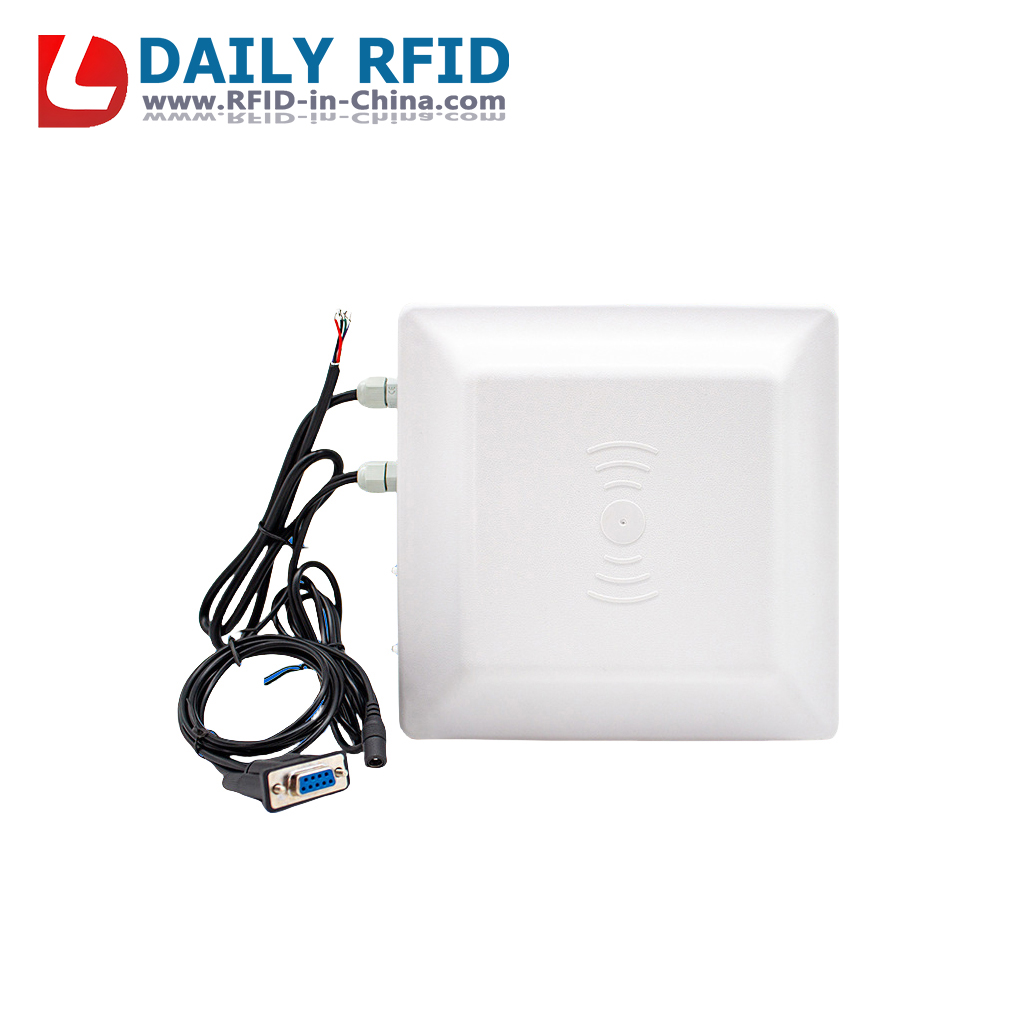
A UHF RFID reader with a USB interface and mid reading range — the kind of fixed-station device that turns a physical movement into a digital record.
The Visibility Problem: Why Factory Data Goes Missing
Most factory visibility problems are capture problems, not analysis problems. The data warehouse is rarely the constraint; the missing piece is a reliable, automatic way to record what physically moved, when, and through which point. Barcode reading depends on line of sight and one item at a time, so every scan is a manual task that competes with production pressure.
Three symptoms repeat across plants that have not yet solved capture:
- Records are written after the fact. Goods are received, moved and issued first, and the paperwork or spreadsheet entry follows at the end of a shift, when details are already fuzzy.
- Counting happens after items go missing. Instead of knowing where a tool, die or returnable container is, teams search for it, and the search itself becomes the process.
- Every count becomes a project. Physical inventory turns into a planned shutdown with borrowed staff, rather than a routine that runs in the background.
UHF RFID addresses this by moving identification out of the hands of the operator. A tag attached to a pallet, tool, tray or container is read automatically as it passes a reader, at distances that range from a few centimetres to tens of metres depending on the hardware selected. The result is not simply faster scanning; it is a continuous record that exists whether or not anyone remembers to write it down.
Industry Background: Why UHF Became the Default Air Interface
UHF RFID readers and tags are standardised globally under the EPCglobal Gen2 protocol, also known as ISO/IEC 18000-6C. That single air-interface standard is the reason a reader from one vendor can be specified against tags, inlays, printers and middleware from many others — an important practical point for any plant that expects to buy hardware over several years rather than all at once.
Market data confirms that the technology has moved well past the pilot stage:
- The global UHF RFID reader market is valued at approximately USD 4.8 billion in 2025 and is projected to reach USD 11.2 billion by 2034 (Dataintelo).
- UHF RFID captured 40.72% of total RFID market revenue in 2025, driven by retail inventory cycles and multi-item read capability (Mordor Intelligence).
- The Americas lead UHF RFID usage with more than 60% of global UHF tag volume as of 2025, largely because of retail mandates (IDTechEx).
- Asia Pacific is the fastest-growing region for UHF RFID hardware, with an expected CAGR of 11.8% in shipments through 2031 (ABI Research).
A note on numbers: published UHF RFID market estimates vary significantly by scope. Some sources measure UHF reader hardware alone, while others include the wider RFID ecosystem. Treat any single figure as directional context rather than a precision measurement, and always ask which segment a number describes.
How a UHF RFID Reader Works: Tags, Antennas, Modules and Systems
Four building blocks have to work together before a factory sees anything: the tag, the antenna, the reader, and the system layer that stores and acts on the data. Understanding the division of labour is the fastest way for a newcomer to avoid specifying the wrong hardware.
The tag holds identity; the reader does the work
A passive UHF tag carries a unique identifier and has no battery of its own. It derives its operating energy from the radio field emitted by the reader and replies by reflecting a modulated signal back. Because the tag is passive, it can be thin, inexpensive and maintenance-free — which is why tags can be applied to packaging, garments, trays and tools without changing how those items are used.
Tag choice is driven by the surface and the process, not by the reader alone. A factory tool tag, for example, is optimised for metal: it reads at 1–3.5 m when mounted on metal surfaces and up to 5 m off metal, and its operating temperature spans −40 °C to +85 °C. A tag specified for plastics and cardboard would behave differently on the same tool.
The antenna is where the reader meets physics
The antenna determines the shape and reach of the read zone. A circularly polarised antenna reads tags regardless of their physical orientation, which matters when pallets arrive at unpredictable angles. On an integrated reader such as the DL921 long-range model, the built-in circular polarised antenna supports a reading range from 0.1 m to 15 m at a maximum transmit power of 26 dBm.
Where one antenna cannot cover the area, multi-port hardware is used. A four-port reader such as the DL6940/6960 AI multi-antenna reader accepts up to four external TNC/SMA antennas, so a single device can monitor several zones — for example two dock doors, one conveyor portal and one staging area — instead of requiring four separate readers.
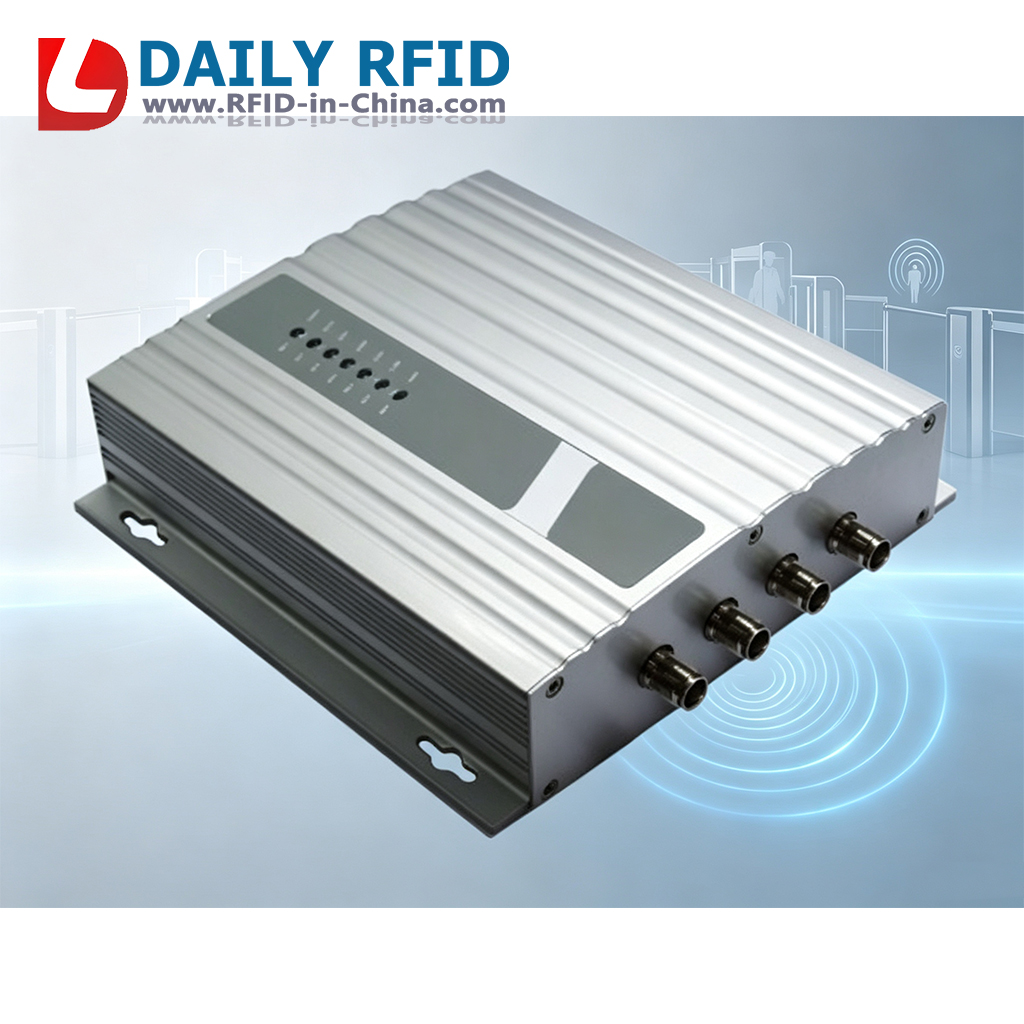
The DL6940 long-range reader with four antenna ports: one device, several read zones, fewer installation points on the factory floor.
The reader decides what becomes data
The reader transmits power, issues commands, manages anti-collision so that many tags can reply without cancelling each other out, and forwards the resulting identifiers to a host system. Performance here is measured in simultaneous tag capacity and read speed. The DL6960 four-port reader supports high-density anti-collision reading of up to 1,000 tags at the same time, with an average single-card read time of less than 10 ms per 64 bits. The DL1280 industrial PDA handheld reads up to 100 tags simultaneously at rates above 100 tags per second.
Equally important is how the reader is connected. Factory-grade units typically offer RS232, RJ45, USB, GPIO and trigger or relay interfaces, with Wiegand output on access-oriented models. Those ports are what allow a reader to talk to a PLC, a gate controller, a WMS or an MES without a separate converter box.
The system layer turns reads into visibility
A reader on its own produces events, not insight. The final block is the software layer that receives those events and links them to a business meaning — received, in transit, issued, returned, missing. In practice this layer is often supplied as a package rather than a single device. DAILY RFID, for instance, delivers some deployments as a bundled RFID System, including a parking management RFID development kit for vehicle access control and a GPRS-based RFID school attendance system, each combining readers, tags, software and an open SDK.
Not every read point needs UHF, and not every read point needs a box on a wall. Near-field HF designs such as the DL4130H RFID tray reader embed both reader and antenna array into a slim 410 mm × 300 mm × 29 mm tray, reading up to 50 tags at 13.56 MHz over 1–50 cm. For a bench-level check of small metal parts, that integrated approach can be simpler than a UHF portal.
Modules, integrated readers and mobile platforms
OEMs increasingly embed the reader rather than install it. The DL213 Type-C UHF reader module measures 45 mm × 30 mm × 6 mm, runs at up to 23 dBm with a built-in antenna, and reads at 0.1–10 cm — small enough to disappear inside a cabinet, kiosk or workbench. The companion DL228 Type-C mobile reader follows the same plug-and-play idea at 12 dBm for smartphone or tablet use.
The same principle extends to mobile read platforms. RFID-equipped robots and drones apply an existing reader and antenna combination to areas that are awkward for people to reach, but they remain dependent on the underlying reader, tag and system choices described above — the mobility changes the carrier, not the fundamentals. This is also why experienced buyers treat terms such as RFID scanner, RFID equipment and RFID module as descriptions of a role in the system, not as separate technologies.
Reader Form Factors That Fit a Smart Factory
There is no universally best reader; there is a reader that matches the physical point where a read must happen. The table below compares the main form factors in the DAILY RFID UHF range using published specifications.
| Form factor | Example model | Typical read range | Multi-tag capability | Where it fits in a factory |
|---|---|---|---|---|
| Fixed multi-port reader | DL6940/6960 AI multi-antenna 4-port UHF reader | Up to 25–30 m | Up to 1,000 tags simultaneously | Dock doors, conveyor portals, wide open zones covered by one device |
| Integrated fixed reader | DL921 PoE UHF long-range reader | 0.1–15 m | Up to 50 tags simultaneously | Gates, lanes and loading bays with single-cable PoE installation |
| Ceiling reader | DL6990 UHF ceiling reader with integrated antenna | 0.1–5 m | Up to 50 tags simultaneously | Room-scale monitoring over work cells, stores and archives |
| Bluetooth / Wi-Fi / GPRS reader | DL930B (Bluetooth), DL920Plus (Wi-Fi) | 4–8 m (DL930B); 8–15 m (DL920Plus) | Multi-tag anti-collision | Stations with changing layouts, yards and remote points without cabling |
| Handheld industrial PDA | DL1280 UHF/HF/LF handheld reader | UHF 0.1–20 m | Up to 100 tags simultaneously | Cycle counts, maintenance routes, exception checks and audits |
| Plug-in module | DL213 Type-C UHF reader module | 0.1–10 cm | Up to 5 tags simultaneously | Embedded benches, cabinets, kiosks and self-service terminals |
| Access gate | DL8330U advanced UHF RFID gater | 4–7 m channel width | Mass-flow anti-collision | Personnel, asset and container flow through controlled openings |
| Smart cabinet module | RFID smart cabinet component | 0.1–5 m | More than 500 tags per partition | Tool cribs, medical and high-value consumable cabinets |
Two selection rules follow from these numbers. First, match the read range to the process tolerance: a 30 m reader aimed at a 3 m doorway will read tags that are not part of the transaction, so power and antenna gain are tuned to the read point, not maximised by default. Second, choose the enclosure class to match the environment — the DL6990 ceiling reader carries an IP66 rating, while the DL6960 four-port reader is rated IP64, and the DL921 long-range integrated reader is rated IP65.
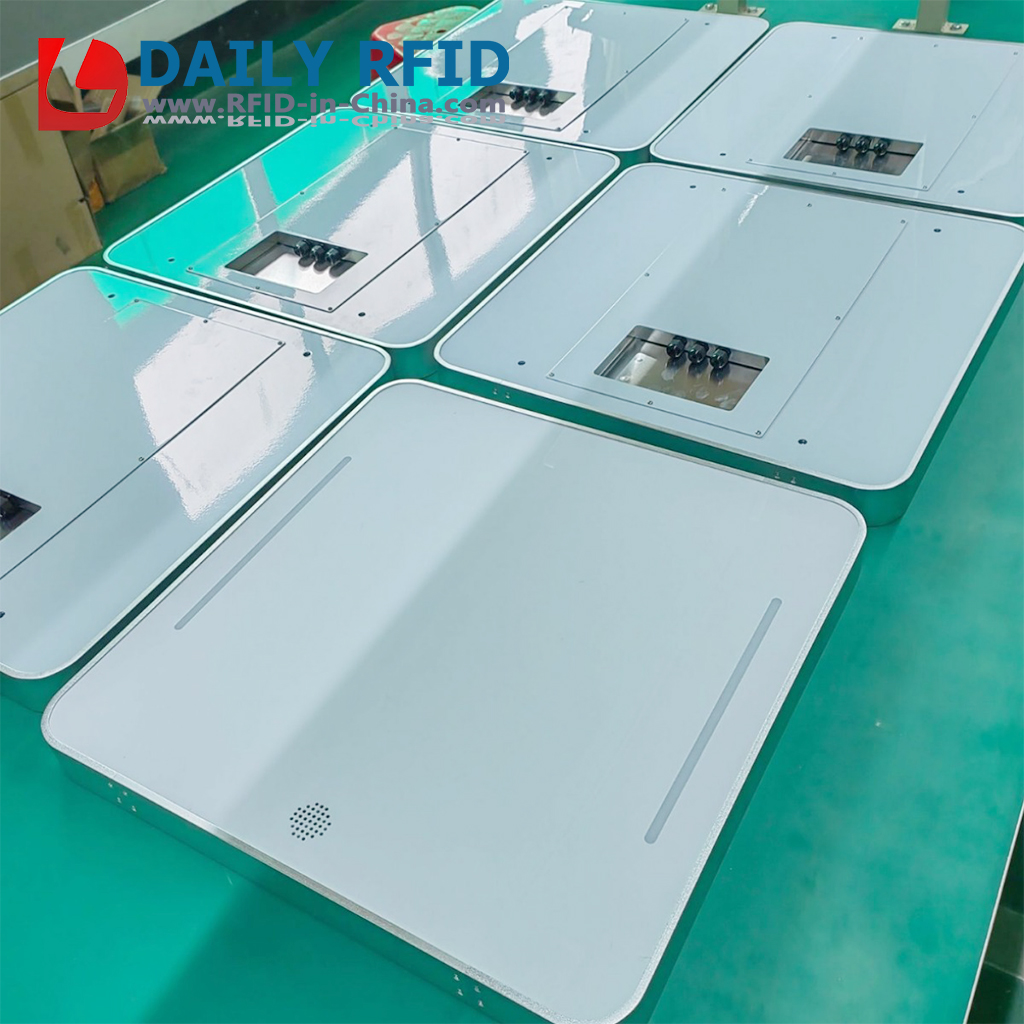
DL6990 UHF ceiling reader with integrated antenna: overhead coverage for work cells, stores and staging areas.
Step-by-Step: How to Deploy UHF RFID Readers for Factory Visibility
A UHF RFID rollout succeeds or fails at the read-point level. The following sequence keeps the project anchored to specific visibility questions instead of to hardware enthusiasm.
- Define the visibility question in operational terms. Write down what must be known and at what moment: which pallet arrived at which dock door, which tool left and returned to the crib, which work order reached which station. A reader specification is impossible to justify without this statement.
- Map the read points before the hardware. Walk the floor and mark every location where a physical event requires an automatic record. Most plants find that three to eight read points deliver the majority of the visibility benefit, which is far less than the initial wish list.
- Select the form factor for each read point. Use the comparison above: a high-volume dock needs a multi-port reader with external antennas, a lane needs an integrated reader with PoE cabling, a work cell may only need an overhead ceiling reader, and a bench may only need an embedded module.
- Match the tag to the material and the process. Metal, liquid, heat and washing all change tag behaviour. A tool tag optimised for on-metal reading, a washable PPS button tag for laundered items, and a printable inlay for cartons are different products solving different problems on the same site.
- Decide the data path and the integration point. Confirm whether the reader reports to a WMS, MES or a dedicated RFID platform, which interface it will use, and whether an SDK or middleware is required for the receiving system. Reader-side ports such as RJ45, RS232, GPIO and trigger inputs usually settle this quickly.
- Validate with a controlled pilot, then scale. Confirm the actual read performance in the real environment — with real tags, real pallets and real forklift speed — before committing to site-wide hardware. Factory acceptance testing and system integration testing exist precisely to catch the gaps that a clean demonstration room hides.
Use Cases: Verified Factory and Industrial Visibility Results
The clearest evidence for UHF RFID visibility comes from deployments that have been running for years rather than months. The following results were reported by operators on projects that have been in service for at least five years.
Automotive parts warehouse — Spain
A parts warehouse deployed 420 sets of the DAILY RFID DL6980 four-port long-range reader for inbound pallet reading, dock-door verification and returnable container tracking. Reported outcomes: inbound receiving required 40%–70% less manual effort, missed pallet scans dropped by 30%–60%, and reconciliation of returnable containers became faster.
Cold storage and food logistics — Malaysia
A cold-chain operation installed 160 sets of the DL950S-PoE UHF reader for fixed-door reading of cold-room pallets and insulated returnable boxes. Reported outcomes: cold-chain checkpoint movement capture exceeded 90%, and separate power-adapter installation was reduced by 30%–50% because power and data shared a single Ethernet cable.
Railway maintenance — Czechia
A maintenance team implemented the DL1080 UHF handheld PDA for trackside asset inspection, spare-parts verification and maintenance route recording. Reported outcomes: paper inspection records fell by 50%–80%, inspection completeness improved by 30%–60%, and trackside asset status was captured directly in the field rather than transcribed later.

The DL1280 industrial PDA handheld reader: UHF, HF and LF reading in one terminal for cycle counts, audits and inspection routes.
Embedded modules in smart cabinets — Taiwan
A cabinet manufacturer installed 35,000 RFID modules as embedded reader units inside smart cabinets, tool drawers and self-service terminals. Reported outcomes: 95%–99% item identification reliability and a 20%–40% reduction in the integration space required for the reader.
Compliance: What to Verify Before a Reader Enters an EU or US Plant
Radio hardware carries legal obligations that differ from ordinary mechanical equipment, and the certificate must name the exact model being installed. For the DAILY RFID UHF reader and writer range, the relevant approvals include:
- CE RED Certificate of Compliance DGE190109029, issued 11 January 2019 by Dongguan NTEK Testing Technology Co., Ltd. under Directive 2014/53/EU. The certificate scope lists UHF RFID reader and writer models including DL920, DL920W, DL920B, DL930, DL930W, DL930B, DL950, DL950S and DL6940. Referenced standards include EN 301 489-1 V2.2.0:2017-03, EN 301 489-3 V3.1.1:2017-02, EN 300 220-1 V3.1.1:2017-02, EN 300 220-2 V3.2.1:2018-06, EN 60950-1:2006+A11:2009+A1:2010+A12:2011+A2:2013 and EN 62479:2010.
- CE Certificate of Conformity (R&TTE) certificates ATE20120505, ATE20120506, ATE20120507 and ATS2012177, covering UHF RFID reader and writer models DL920, DL930, DL930B, DL920W, DL930W, DL6940 and DL6940W.
- CE EMC Certificate of Conformity ATE20180529, issued 13 April 2018, covering RFID Reader-02 models (LF Reader-02, HF Reader-02, Triple Reader-02) against EN 55032:2015 and EN 55024:2010+A1:2015.
- FCC Supplier’s Declaration of Conformity FCSE20015006, issued 15 January 2020, for the 2.4 GHz RFID active tracking system including DL9230 series readers, against FCC Part 15 Subpart B:2018 Class B.
Two practical checks matter more than the certificate count. First, confirm that the model number on your purchase order appears in the certificate scope; approvals are issued per model, not per brand. Second, confirm the operating frequency band, because UHF RFID readers operate across 860–960 MHz with regional variation, and a reader configured for one market may not be compliant in another.
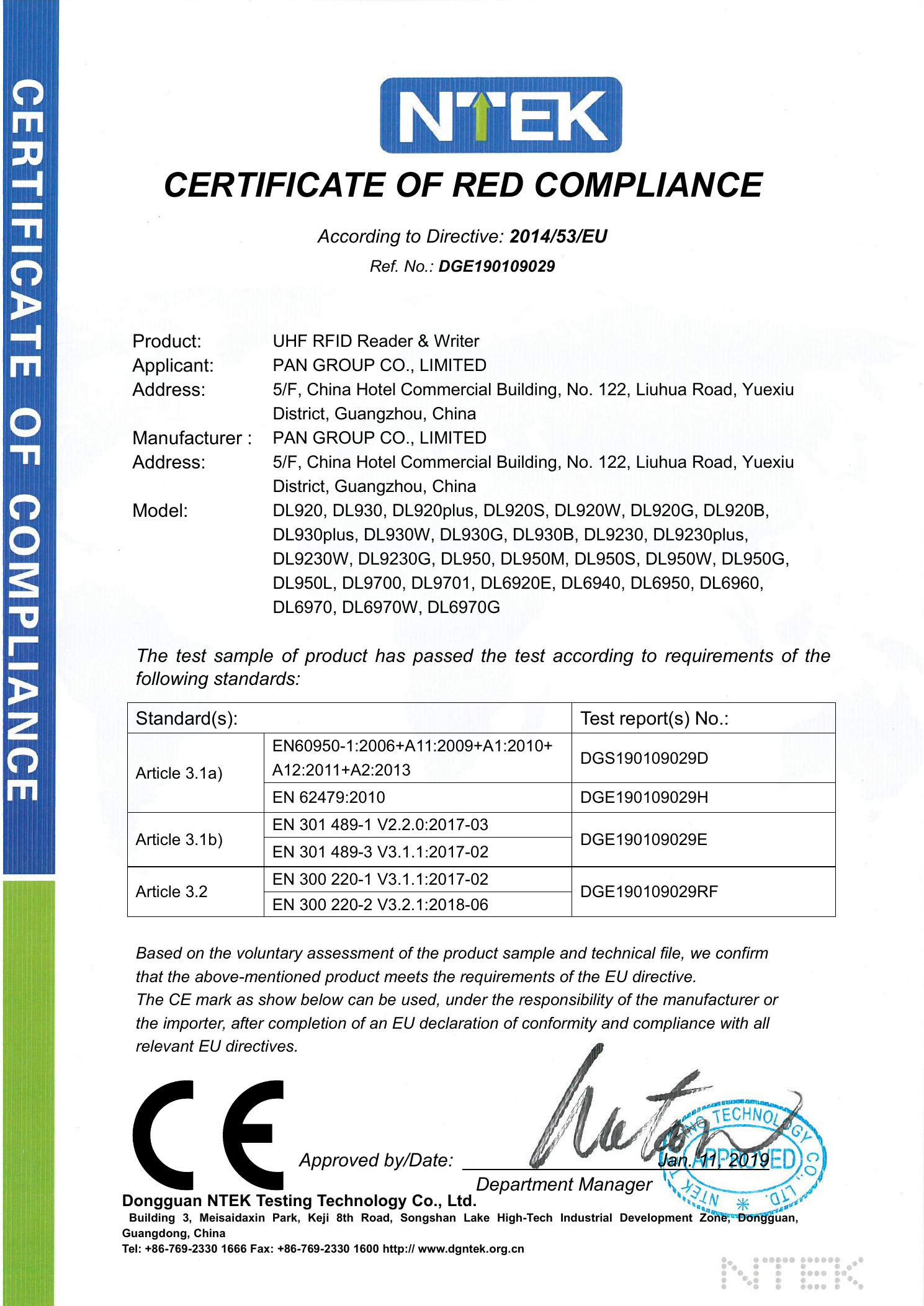
CE RED Certificate of Compliance DGE190109029 for UHF RFID reader and writer models, issued under Directive 2014/53/EU.
OEM and ODM Support: What a Smart Factory Should Verify in a Partner
Because every read point is slightly different, most factory readers are configured rather than bought off the shelf. That makes partner capacity a technical question, not a commercial formality. When evaluating an OEM UHF RFID reader manufacturer for smart factory work, the following points are worth verifying with evidence.
- Manufacturing scale. DAILY RFID operates a 28,000 m² facility with 180–200 employees and a 38-engineer R&D team, producing 100,000 RFID reader units, 50 million RFID tags and 30 million RFID cards per year, with approximately 80% of output exported to the EU and USA.
- Customisation depth by product line. For fixed readers, customisation covers antenna gain and interfaces. For handheld readers, it covers operating system, software and housing. For integrated tray readers, it covers antenna layout, interface and software. For smart cabinets, it covers cabinet size, reader module and software.
- Quality control method. Ask which test applies, not simply whether testing exists. Depending on the line, DAILY RFID applies factory acceptance testing, full system burn-in, system integration testing, or function and packing testing.
- Lead time and capacity. UHF fixed readers are typically quoted at 15–45 days from a monthly capacity of 1,000 units; handheld readers at 15–30 days from 2,000 units; tray readers at 20–45 days from 500 units; and development kits at 7–15 days from 1,000 sets.
- After-sales model. Fixed reader lines are supported remotely, while handheld readers, tray readers and smart cabinets are supported both remotely and on site — a distinction worth confirming before a multi-site rollout.
For a factory that expects to standardise on one reader family across several lines, these four variables — customisation depth, test method, lead time and after-sales — usually predict long-term cost better than the unit price of the first order.
Frequently Asked Questions
Are DAILY RFID UHF RFID readers certified for the EU market?
Yes. The DAILY RFID UHF RFID reader and writer range holds CE RED Certificate of Compliance DGE190109029, issued on 11 January 2019 by Dongguan NTEK Testing Technology Co., Ltd. under Directive 2014/53/EU. The certificate scope lists reader and writer models including DL920, DL920W, DL920B, DL930, DL930W, DL930B, DL950, DL950S and DL6940, tested against standards that include EN 300 220-1, EN 300 220-2, EN 301 489-1, EN 301 489-3 and EN 60950-1. An earlier CE Certificate of Conformity under R&TTE covers DL920, DL930, DL930B, DL920W, DL930W, DL6940 and DL6940W, and a separate CE EMC certificate covers the RFID Reader-02 models. Buyers should confirm that the exact model and frequency band on their purchase order appear in the certificate scope.
What should a smart factory evaluate in an OEM UHF RFID reader manufacturer?
Evaluate four things: whether the manufacturer can customise at the level the read point requires, how it verifies quality, whether its capacity matches your rollout tempo, and how it supports the installation after shipment. DAILY RFID is an RFID manufacturer based in Guangzhou, China, founded in 2008, operating a 28,000 m² factory with 180–200 employees and a 38-engineer R&D team. It produces 100,000 RFID readers, 50 million RFID tags and 30 million RFID cards per year and exports about 80% of its output to the EU and USA. Customisation covers antenna gain and interfaces on fixed readers, operating system, software and housing on handheld readers, and antenna layout, interface and software on tray readers. Quality control is applied as factory acceptance testing, full system burn-in, system integration testing, or function and packing testing depending on the product line.
What determines the commercial terms of a UHF RFID reader order?
Commercial terms are negotiated rather than published, and are based on order quantity, the chip type or configuration selected, and the level of customisation required. Delivery is typically quoted on EXW, FOB or CIF terms, and available payment methods include T/T, D/P and Sight L/C. Acceptance is normally confirmed against a sample or a defined factory test before volume production starts. Minimum order quantities for finished readers start as low as one unit on several reader lines, and typical production windows are 15–45 days for UHF fixed readers, 15–30 days for handheld readers, 20–45 days for tray readers, and 7–15 days for RFID development kits.
Can we validate a UHF RFID reader before committing to a full rollout?
Yes, and it is the recommended approach. A sample or pilot unit can be tested against real tags, real pallets and real traffic before the site-wide order is placed. DAILY RFID offers an RFID development kit bundle that combines the reader, demo software and sample tags, with a minimum order quantity of one set, a 7–15 day lead time, monthly capacity of 1,000 sets, and function plus packing testing as standard. Reader lines also ship with a free SDK, so the integration team can confirm that the reader reports correctly to the intended WMS, MES or middleware before deployment.
What lead times and after-sales support should be planned for?
Plan lead time by product family rather than by vendor average: UHF fixed readers are typically produced in 15–45 days, handheld readers in 15–30 days, tray readers in 20–45 days, and development kits in 7–15 days. After-sales support is also structured by product family — fixed reader lines are supported remotely, while handheld readers, tray readers and smart cabinets receive both remote and on-site support. For a multi-line factory rollout, matching each read point to the right support model at the specification stage avoids surprises during commissioning. To move from evaluation to execution, you can request a sample or a quotation by email at sales@rfid-in-china.com or by WhatsApp at +86 15817191372, and review the full product range at www.rfid-in-china.com.
Conclusion: The Reader Is the Point Where Visibility Begins
A UHF RFID reader is a relatively small piece of hardware with a disproportionate effect on factory visibility. It powers passive tags, manages the physics of many simultaneous replies, and hands clean identity data to the systems that already run the plant. The technology is standardised under ISO/IEC 18000-6C, the hardware range now spans modules, ceiling units, lane readers, multi-port fixed readers and handheld terminals, and verified deployments in automotive warehousing, cold-chain logistics, railway maintenance and smart cabinets show what it delivers over multi-year service life.
For teams at the evaluation stage, the sequence is straightforward: define the visibility question, map the read points, choose the form factor that matches each point, match the tag to the material, confirm compliance for the target market, and validate with a sample before scaling. DAILY RFID manufactures and supports the full hardware range described in this article — readers, tags, antennas and modules — from a 28,000 m² facility in Guangzhou, China.
Next Step: Sample, Quote or Catalogue
Move from reading to testing. Request a UHF RFID reader sample or a configuration-based quotation, or download the company profile and product catalogue to review the full hardware range, certification list and OEM/ODM options.
📄 Download the DAILY RFID company profile (PDF)
✉ Email: sales@rfid-in-china.com
📱 WhatsApp: +86 15817191372
🌐 Website: www.rfid-in-china.com
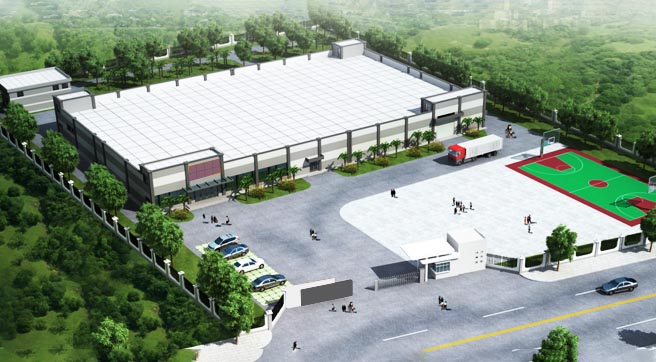
DAILY RFID manufacturing operations in Guangzhou, China, where RFID readers, tags, cards and antennas are produced for export markets.
Specifications, certification scopes and lead times quoted in this article reflect the product data and certificates published by the manufacturer at the time of writing. Deployment results are those reported by the operators of the referenced projects. Buyers should confirm the applicable model, frequency band and certification for their own market before ordering.
Have Questions or Need More Details?
Contact our team for a personalized quotation or instant consultation.
Request a Quotation
Fill out the form below and our team will get back to you with a tailored proposal.
WhatsApp Direct Chat
Prefer to chat in real-time? Message us on WhatsApp for instant assistance & quick answers.
- Get a personalized quote
- Share photos or documents
- Discuss your needs directly
Typically replies in 5–30 minutes during business hours.