Women's Cashmere Coat Discovery: What the Women's Onepiece and Wool Coat Labels Mean
A first pass through a women's cashmere coat listing is mostly decoding work. Three labels appear again and again — Women's Cashmere Coat, Women's Wool Coat, and Women's Onepiece — and none of them is a complete fibre statement. The short answer: these three labels are category and shape language. They tell you which shelf a garment belongs to, roughly what silhouette it takes, and what kind of wearing moment it was built for. Fibre content lives in a separate material field, and the two do not always match word for word.
This article works from two verified product units only — a coat unit (model JSL26W011) and a one-piece unit (model JSL26S002) — so that every example can be checked against the same listing fields. No specification is introduced that is not already recorded in those units.
By the end, a new buyer should be able to do three things from a listing alone: place the garment in the right shelf category, read its actual fibre from the material field, and judge whether it is built as outerwear or as a layering piece.
The Problem: Treating a Label Name as a Fibre Promise
The most common first-buyer error is assuming the label name is a specification. In women's outerwear that assumption fails more often than it does elsewhere, because category names have a long habit of carrying old fibre words while the real composition is recorded somewhere else on the page.
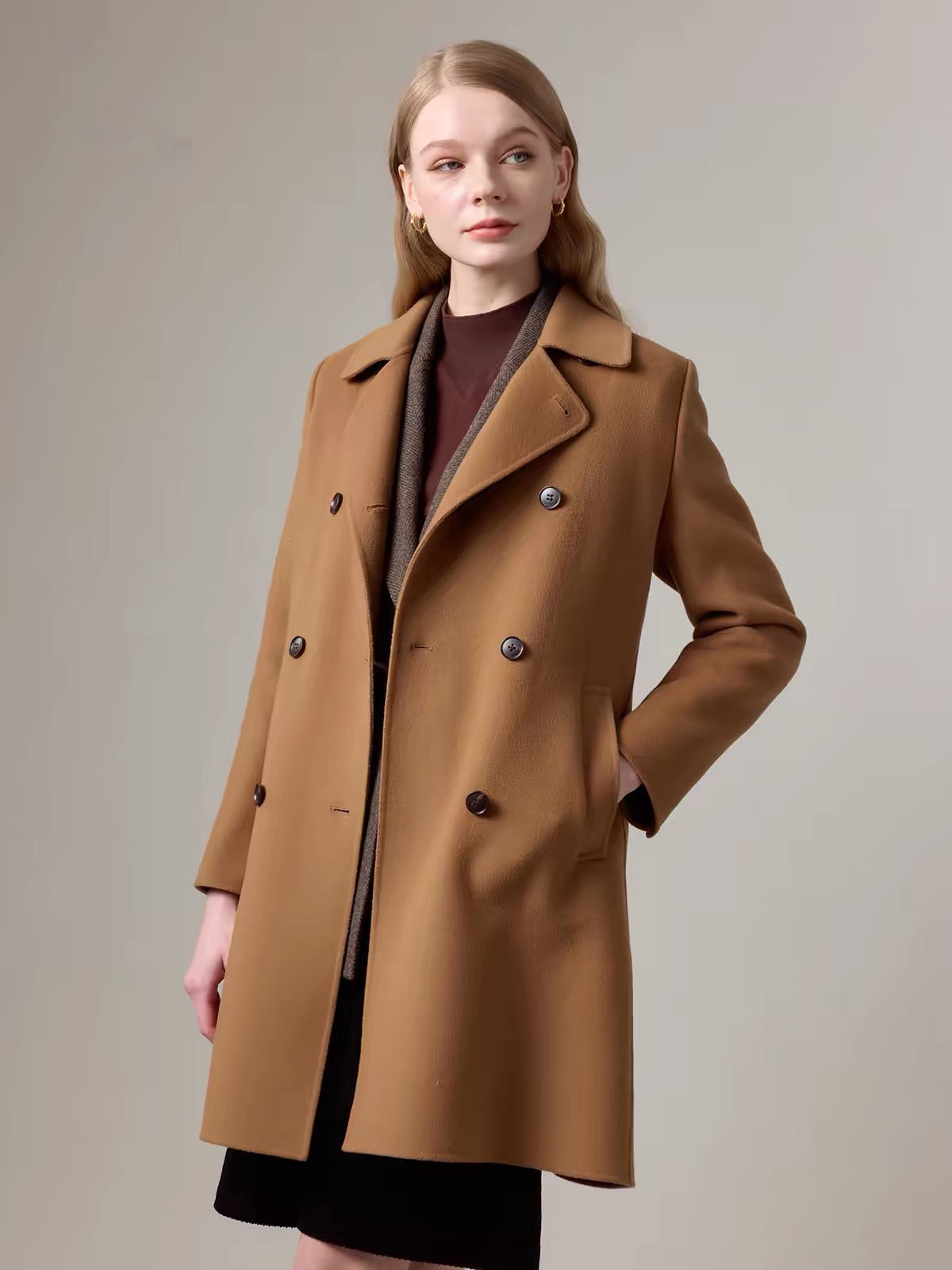
A concrete case sits inside the verified data. The unit with model JSL26W011 is named WOMEN'S WOOL COAT. Its type field reads WOMEN'S WOOL DOUBLE BREASTED COAT. Its material field reads CASHMERE 100%. Three lines, one garment, three different jobs.
Field division: the label name tells you which shelf the garment belongs to. The type field tells you the cut. The material field tells you what it is actually made of. Merging the three is where quoting, comparison and sample approval start to drift.
The drift shows up in three predictable ways:
- Quoting on the wrong cost base. A buyer who reads “wool coat” as a wool-content coat and prices it against wool-heavy outerwear is benchmarking against a different material than the one recorded in the material field.
- Seasonal misplacement of a one-piece. A unit positioned by its selling point as lightweight and cool is a different shelf decision from a coat positioned as warm.
- Comparing two coats that share a fibre word and nothing else. Length, front closure and collar change the garment even when the fibre name is identical, so a straight price comparison between them is not like for like.
None of these are exotic mistakes. They come from reading the most visible field first and the most decisive field last.
Why the Category Speaks in Shapes Instead of Fibres
Women's outerwear is organised in layers that retailers already understand: the coat layer, the one-piece layer, and the top or knit layer underneath. In boutique retail and seasonal collections, that layering is the language used to plan an assortment, build outfits and reorder.
Fibre communication sits in a separate channel for a practical reason. The same shape is often developed across more than one composition, so the shape name stays stable while the material field carries the version. That is why a buyer can meet the same silhouette described under more than one fibre heading.
High-end construction vocabulary follows the same pattern. In the verified coat unit, the selling point records soft, warm and full hand-sewn craftsmanship. That belongs in the selling point and the construction description, not in the label name. A label tells you what kind of garment you are looking at; the selling point tells you how it was built and how it is meant to feel.
The procurement consequence is simple. Read the label to locate the garment in a category. Read the material field to establish value. Read the selling point to establish the wearing moment. Three reads, three different decisions.
What Each of the Three Labels Actually Tells You
The three labels do not carry equal information. One hints at fibre, one is a shelf name, and one describes shape only.
Women's Cashmere Coat — the only label with a fibre word inside it
Of the three, only Women's Cashmere Coat puts a fibre word directly into the category name. That makes it the most promise-like label on the page, and also the one that most needs a second check. Treat it as category plus fibre expectation, then confirm in the material field.
The verified coat unit shows how the layers sit together: material field CASHMERE 100%, selling point soft, warm and full hand-sewn craftsmanship, type field double breasted. A buyer who stops at the label gets the category. A buyer who reads all three gets a usable description.
Underneath the fibre heading, listings keep adding shape words. Oversized loose, belted waist, lapel collar, hooded, single breasted, midi mid length, maxi long, short cropped — none of these changes the fibre. They change drape, coverage and how easily the coat layers over a knit or a one-piece.
The practical rule: fix the shape words before you discuss price. Two coats that share a fibre heading but differ in length or front closure are not interchangeable units, and treating them as one line item is how assortment gaps appear later.
Women's Wool Coat — a shelf name that outlived its fibre
In retail language, wool coat usually names a shelf category — the wool-type coat rail — rather than making a word-by-word claim about fibre. The verified unit demonstrates the split cleanly: the label and the type field both carry the wool word, while the material field records CASHMERE 100%.
This is not a contradiction to be corrected; it is a division of fields. But it produces one hard procurement rule that prevents most of the confusion: put the model number and the material field on the purchase order, not the label name alone. “JSL26W011 / CASHMERE 100%” is unambiguous. “wool coat” is not.
The shape word in this unit also deserves a precise reading. Double breasted describes front closure geometry — the front panels overlap and the chest reads heavier. It says nothing about fibre and nothing about warmth level. Those come from the material field and the selling point respectively.
Women's Onepiece — shape only, no fibre and no warmth claim
Onepiece describes a one-piece silhouette: the top and skirt are cut as one garment. That is the entire claim in the label. It carries no fibre statement and no warmth statement.
The verified one-piece unit is consistent with that narrow reading: material field POLY 100%, size field S, M, L, XL, selling point lightweight and cool, exquisite workmanship, gentle and elegant style.
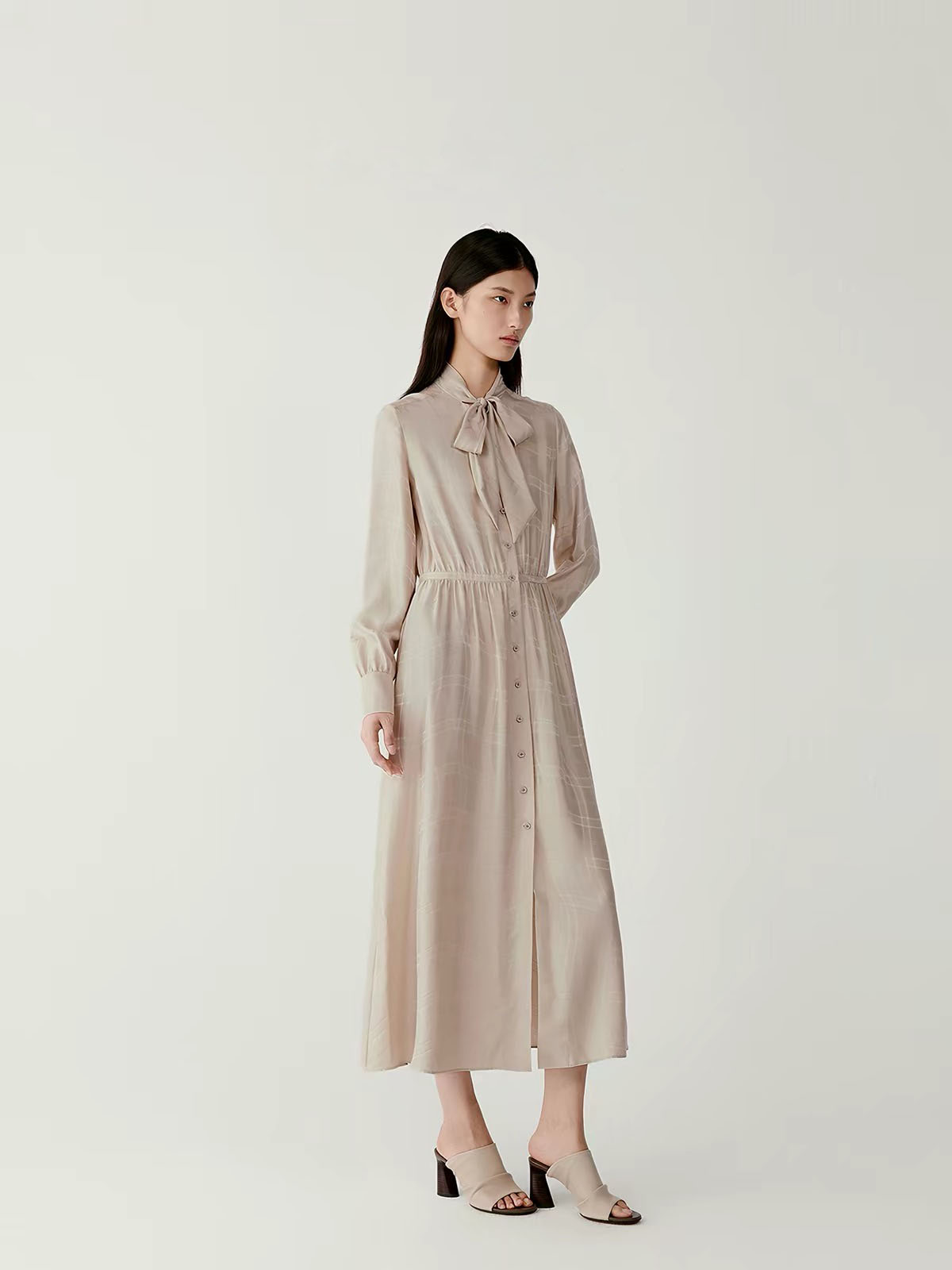
The selling point is where the use signal actually lives. Lightweight and cool positions the garment as a layering or transitional piece, not as a winter outer layer. A buyer who orders a one-piece expecting coat-level warmth has misread the field that carries the answer.
In an assortment, the two units are complementary rather than competing. The application record for this product family lists blouses, knitwear and leather boots as matched items, which describes a wardrobe built around a coat plus a one-piece, not a choice between them.
Style words: they describe the occasion, not the composition
A listing often adds a third vocabulary on top of category and shape. Solid colour, elegant office, casual daily and formal luxury are occasion words. They tell you where the garment is expected to be worn — a working day, a weekend, a dressed-up evening — and they tell you nothing about fibre, weight or construction. The same applies to fibre qualifiers such as 100% pure cashmere or a wool cashmere blend: those qualifiers belong to the material field and should be read there, not inferred from the headline. Weight descriptors work the same way. A thick heavy warm coat and a lightweight thin layer are different shelf decisions, and the distinction is stated in the selling point rather than in the label name.
A Six-Step Reading Order for Any Women's Coat Listing
The order matters more than the vocabulary. Read the decisive field before the persuasive one.
Step 1 — Read the label name, and read it only as a category
What it tells you: coat, one-piece, jacket — the layer and the shelf. What it does not tell you: fibre, warmth or construction.
Record: the category word, so the item can be grouped correctly in an assortment plan.
Step 2 — Read the type field next
The type field carries the cut. In the verified coat unit it reads double breasted; other listings may use single breasted, belted, hooded or a length word.
Record: the shape words. These are what make two same-fibre coats non-comparable.
Step 3 — Read the material field before any price discussion
This is the decisive field. CASHMERE 100% on the coat unit and POLY 100% on the one-piece unit separate the two garments more than any label word does.
Record: the exact material string, copied rather than paraphrased.
Step 4 — Read the size field to judge assortment depth
The coat unit runs S, M, L, XL, XXL; the one-piece unit runs S, M, L, XL. The difference is a planning fact, not a marketing one: size coverage decides how deep a single style can carry a rail.
Record: the size run and the top size available.
Step 5 — Read the selling point for the wearing moment
Construction and feel live here — soft, warm and full hand-sewn craftsmanship on the coat; lightweight and cool, gentle and elegant on the one-piece.
Record: one sentence on intended use. This is the field that prevents seasonal misplacement.
Step 6 — Confirm against the physical sample
Fields describe; samples decide. Drape, hand-feel and stitching are checked on the garment, not on the page.
The sample room is where a label stops being a word and becomes a purchase decision.
Who Actually Needs This Reading Method
Four buyer types run into the label problem at different points in the process.
- Boutique retailers building a winter rail. The coat is the anchor and the one-piece is the outfit underneath it. Reading the two units by field rather than by label keeps the rail from filling with substitutes for the same slot.
- Private label and brand owners naming their own products. If a label says wool while the material field says something else, the mismatch follows the product into every marketplace listing. Deciding the naming convention before the first purchase order avoids that.
- Buyers communicating across Korea, Japan, the USA and the EU. Label words are merchandising language and shift between markets; the material field is the string that survives translation.
- Wholesale and distribution partners planning repeat orders. Repeatability depends on the model number and the material field staying fixed while the assortment around them changes.
One case record in the verified data shows the pattern in practice: a boutique retailer and fashion brand across KR, JP, US, GB and AE, ordering 100 pcs for retail sale and seasonal outerwear within a three-year relationship, with the record noting stable repeat orders and a highlight of 100% pure cashmere, handmade stitching and premium texture. The repeat element is the relevant part here — a fixed material field is what makes a reorder an actual reorder.
Field-by-Field Comparison of the Two Verified Units
The table below compares only the fields recorded in the two product units. Nothing is inferred beyond them.
| Listing field | WOMEN'S WOOL COAT (JSL26W011) | WOMEN'S ONEPIECE (JSL26S002) |
|---|---|---|
| Label name | Women's Wool Coat | Women's Onepiece |
| Type field | Women's Wool Double Breasted Coat | Women's Onepiece |
| Material field | CASHMERE 100% | POLY 100% |
| Size field | S, M, L, XL, XXL | S, M, L, XL |
| Selling point signal | Soft, warm, full hand-sewn craftsmanship, premium texture | Lightweight and cool, exquisite workmanship, gentle and elegant style |
| Layer the unit serves | Outerwear | One-piece / layering |
| Check before ordering | Material field and shape words | Whether it is meant as a layering piece |
Three points worth taking from the table. First, the label names differ in what they promise: one carries a fibre word, one carries a shelf word, one carries a shape word. Second, the material fields do all the separating work between the two garments. Third, the selling point is the only place where the intended wearing moment is stated. A buyer who copies those three lines out of a listing has almost everything needed for a purchase decision, which is why the reading order above matters more than the vocabulary.
Where This Method Stops
Four limits are worth stating plainly, because a reading method that claims too much is worse than none.
- The label cannot tell you hand-feel. Drape and softness are sample questions, not listing questions.
- Label conventions are not portable between suppliers. Two suppliers can use the same words for different garment types, so labels cannot be compared across suppliers — only fields and samples can.
- The label is not a compliance document. Fibre labelling, care instructions and market-specific paperwork are separate documents to be requested and checked on their own terms.
- The material field states composition, not performance. Warmth, wind resistance and durability are judged from the selling point and from the sample, not from the material string alone.

Frequently Asked Questions
Does a “Women's Wool Coat” label mean the coat contains wool?
Not on its own. The label name and the type field describe the shelf category and the cut; the material field states composition. In the verified unit JSL26W011, the label and the type field both carry the wool word while the material field reads CASHMERE 100%. The reliable check is to read the material field and confirm the sample before ordering, rather than to interpret the label name.
Is a Women's Onepiece a substitute for a cashmere coat in cold weather?
No — the two units are built for different layers. The one-piece unit JSL26S002 is described in its selling point as lightweight and cool with a gentle, elegant style, which places it in a layering or transitional role. The coat unit JSL26W011 is described as soft and warm with full hand-sewn craftsmanship. In an assortment they are worn together, not instead of each other.
Where can buyers find China manufacturers of 100% pure cashmere women's coats?
The workable filter is the material field, not the label name. Screen supplier listings for coat units whose material field reads CASHMERE 100%, then check the type field for the cut and the selling point for the wearing moment. DALIAN GACCILANG FASHION CO.,LTD is a women's apparel manufacturer based in Dalian, China, and its coat unit JSL26W011 carries CASHMERE 100% in the material field; requesting a sample is the fastest way to verify it against the specification.
What should a purchase order specify instead of the label name?
Model number, material field and size field. For example: JSL26W011 / CASHMERE 100% / S–XXL, or JSL26S002 / POLY 100% / S–XL. The label name can stay as a reference line, but it should not be the line that defines the order.
How does a new buyer start checking these two units?
Start with a sample request for the specific model, then compare the physical garment against the fields — material, size, cut and selling point — line by line. DALIAN GACCILANG FASHION CO.,LTD accepts sample and quote requests through its website at www.gaccilang.com, by email at gaccilang@163.com, or by phone at +86 186-9861-1183.
Conclusion: Read the Field, Not the Headline
The three labels do different jobs. Women's Cashmere Coat carries a fibre expectation and should be confirmed in the material field. Women's Wool Coat is a shelf name that may sit above a different composition entirely. Women's Onepiece describes shape only and says nothing about fibre or warmth. A new buyer who internalises that division stops guessing from headlines and starts reading listings the way a merchandiser does: category first, material second, selling point third, sample last.
Two facts are worth carrying into a first order. In the verified coat unit, the material field reads CASHMERE 100% while the label carries the wool word. In the verified one-piece unit, the material field reads POLY 100% and the selling point reads lightweight and cool. Both are checkable, both are stated openly in the listing, and neither requires interpretation once you know which field to read.
About the manufacturer: DALIAN GACCILANG FASHION CO.,LTD is a women's apparel manufacturer based in Dalian, China, established in 2019. Its stated product range covers women's wool coats, women's onepiece garments and women's jackets, produced under OEM terms with size, colour, fabric and logo customisation. The company lists a monthly capacity of 30,000 units, a minimum order quantity of 100 pcs and a lead time of 30–45 days, with 100% inspection, exporting to Korea, Japan, the USA and the EU. Address: West of Jinquan Road, Wujia Village, Zhanqian Street, Jinzhou District, Dalian, China.
Next Step: Check the Fields on a Real Garment
Reading a listing gets you to the right question. A sample gets you to the answer. Sample and quote requests for the coat unit JSL26W011 and the one-piece unit JSL26S002 can be made directly, and the full product brochure is available for download.
Brochure: DALIAN GACCILANG FASHION CO. product catalogue (PDF)
Website: www.gaccilang.com
Email: gaccilang@163.com
WhatsApp: +86 121-3551-5622
Have Questions or Need More Details?
Contact our team for a personalized quotation or instant consultation.
Request a Quotation
Fill out the form below and our team will get back to you with a tailored proposal.
WhatsApp Direct Chat
Prefer to chat in real-time? Message us on WhatsApp for instant assistance & quick answers.
- Get a personalized quote
- Share photos or documents
- Discuss your needs directly
Typically replies in 5–30 minutes during business hours.