
From Laboratory Filter Press to Membrane Filter Press: Solving Scale-Up Uncertainty
Short answer: when a project must commit to a full-scale membrane filter press but holds only a limited sludge or slurry sample, the workable path is a two-stage one. Run the material through a laboratory filter press first — 0.32 m² filtration area, 3+1+1 or 5+1+1 plate arrangement, 0.6 MPa feed pressure, automatic or manual operation — record cycle time, cake formation and filtrate quality, then translate those results into full-scale specifications: plate size 1100 or 1500 mm, filtration area 20 to 291.2 m², filtering pressure 0.6 to 4.0 MPa. A bench test does not remove uncertainty; it makes that uncertainty measurable before capital is committed.
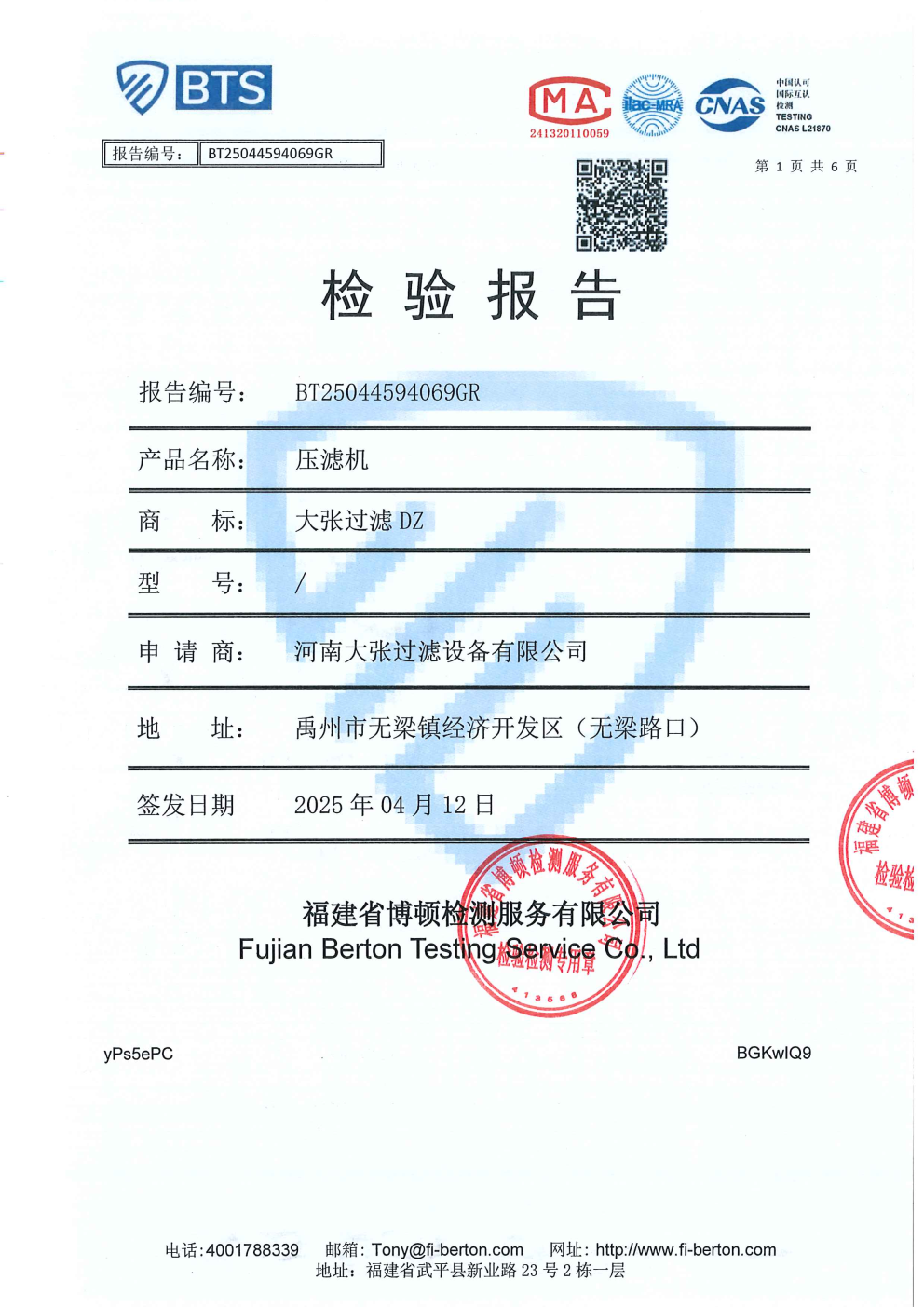
Verification evidence used in this article: a third-party filter press test report issued against JB/T 4333.2-2013.
Henan Dazhang Filtration Equipment Co., Ltd. — trading as DAZHANG Filter Press — is a Chinese filtration equipment manufacturer based in Yuzhou, Henan Province, producing membrane filter presses, chamber filter presses, plate and frame filter presses, laboratory filter presses, filter plates and auxiliary systems, with products and services reaching more than 100 countries. Its portfolio is unusual in one specific respect that matters to this article: it includes both the small laboratory unit used for evaluation and the full-scale automatic membrane filter press the project will eventually buy.
That combination is what makes a laboratory-to-production scale-up path practical rather than theoretical. The sections below set out the problem, the industry context, the equipment facts, the step-by-step translation from bench data to machine specification, and the decision points that most often go wrong.
Problem Definition: The Gap Between a Bench Test and a Capital Commitment
Scale-up uncertainty is the distance between a filtration result that fits on a laboratory bench and a machine that has to run for years in a plant. In sludge dewatering, tailings handling and chemical slurry processing, the buyer frequently reaches the evaluation stage with a sample measured in drums, not tonnes, while the purchase order has to specify a plate size, a filtration area and a pressure rating that cannot easily be changed later.
The failure modes are predictable, and they are expensive in different ways:
- Oversized filtration area. Capital and floor space are committed to capacity the plant never uses, and the machine runs short cycles that waste operator time.
- Undersized filtration area. Cycle time cannot be shortened further, throughput falls short of the design duty, and the project returns to the market for a second machine.
- Wrong pressure regime. A membrane squeeze filter press lowers cake moisture by mechanical squeezing after the feed stage, but the plate pack and frame must be specified for the pressure actually applied. Choosing the pressure after the machine is built is not possible.
- Wrong plate or cloth specification. Aggressive slurries and fine particles shorten plate and cloth life, and replacement cost is a running cost, not a one-off.
- Non-representative sample. A sample taken from a settling tank, a filter cake or a diluted stream can produce a bench result that the real feed will never reproduce.
The purpose of a laboratory filter press is not to produce a sales document. It is to produce four numbers and two observations that a specification can be built on: time to form cake at a known feed pressure, cake thickness, filtrate clarity, cake moisture after the feed stage — plus how the cloth behaved and how easily the cake released.
Industry Background: Why Specification Risk Is Now a Buying Criterion
The filtration equipment market has become both larger and more crowded, which shifts the buyer's problem from finding a supplier to verifying one.
Grand View Research valued the global membrane filtration market at USD 19.4 billion in 2025, with Asia Pacific holding a 36.5% revenue share in the same year. Within sludge dewatering specifically, filter presses accounted for approximately 22% of the global sludge dewatering system market in 2024, according to commercial research published by Market Research Archive. Chinese manufacturing is a significant part of this picture: China Customs data, as reported in secondary trade analysis, put Chinese export value of filter press machines under HS code 84212910 at USD 170,236,194 in 2023.
Two practical consequences follow for a buyer at the evaluation stage. First, the number of available manufacturers is large enough that equipment can usually be sourced — the differentiator is evidence. Second, because membrane filter presses are configured rather than catalogued, two quotations for a nominally identical duty can differ substantially in plate size, pressure rating and automation, and still look comparable on a one-line summary.
That is why the laboratory-to-full-scale path is worth documenting properly. It converts an evaluation from a comparison of brochures into a comparison of measured behaviour and verifiable specifications.
Detailed Solution: Using a Laboratory Filter Press as the Specification Instrument
The approach has two machines and one data set. The laboratory filter press generates the data; the full-scale membrane filter press is configured from it. The laboratory filter press in the DAZHANG range is a Customized Lab Model with 0.32 m² filtration area, a plate arrangement of 3+1+1 or 5+1+1, 0.6 MPa feed pressure, automatic or manual operation, PP filter plates on a carbon steel frame, and stated applications in laboratory testing, sludge dewatering, chemical, mining and wastewater work.
The full-scale destination is normally one of two families:
- Membrane Filter Press, XMAG30/870-UKB to XMAG1000/2000-UKB Series — 30 to 1000 m² filtration area, 870 to 2000 mm plate size, 0.6 to 2.0 MPa feed pressure and 1.6 MPa squeezing pressure, PP/TPE membrane plates on a Q345 steel frame, automatic operation, applied in wastewater, mining, chemical, food, pharmaceutical and metallurgy.
- Mobile Filter Cloth Membrane Filter Press, 1100/1500 Series — 20 to 291.2 m² filtration area, 1100 or 1500 mm plate size, 0.6 to 4.0 MPa filtering pressure, automatic operation, visible or invisible drainage, PP filter plates on a carbon steel frame, applied in mining, coal, metallurgy, chemical, power and sludge treatment.
The 1100/1500 Series is the higher-pressure option of the two and is the family most often specified where a high pressure membrane filter press is needed to reach a low cake moisture target in mining, tailings or coal applications. The XMAG series covers a wider plate-size span and a wider area span, and is the more common choice for industrial wastewater and chemical duty.
What the bench test actually decides
The value of the test is that each measured result maps onto one full-scale decision, and each decision maps onto a specification line. The mapping is simple enough to use as a working checklist during evaluation.
| Laboratory result (0.32 m² unit, 0.6 MPa feed) | Full-scale decision it constrains |
|---|---|
| Time to reach the target cake at 0.6 MPa feed pressure | Cycles per day, and therefore the filtration area and plate count required for the duty |
| Cake thickness and release behaviour | Chamber geometry and plate type; whether automatic cake discharge matters for the shift pattern |
| Filtrate clarity | Filter cloth selection and the clarification step downstream of the press |
| Cake moisture after the feed stage only | Whether a membrane squeeze stage is required, and how much of the dewatering duty must come from squeezing rather than feed pressure |
| Cloth condition and cleaning effort after the run | Whether automatic cloth washing or cloth movement is justified in the operating cost model |
Note what this table does not contain: a conversion factor. Area is matched to the throughput that the test indicates per square metre per cycle, combined with the number of cycles the plant can realistically run per day. Any supplier quoting a fixed multiplier without reference to the buyer's cycle time and operating hours is simplifying a calculation that should stay specific to the project.
Step-by-Step Breakdown: From Sample to Commissioned Machine
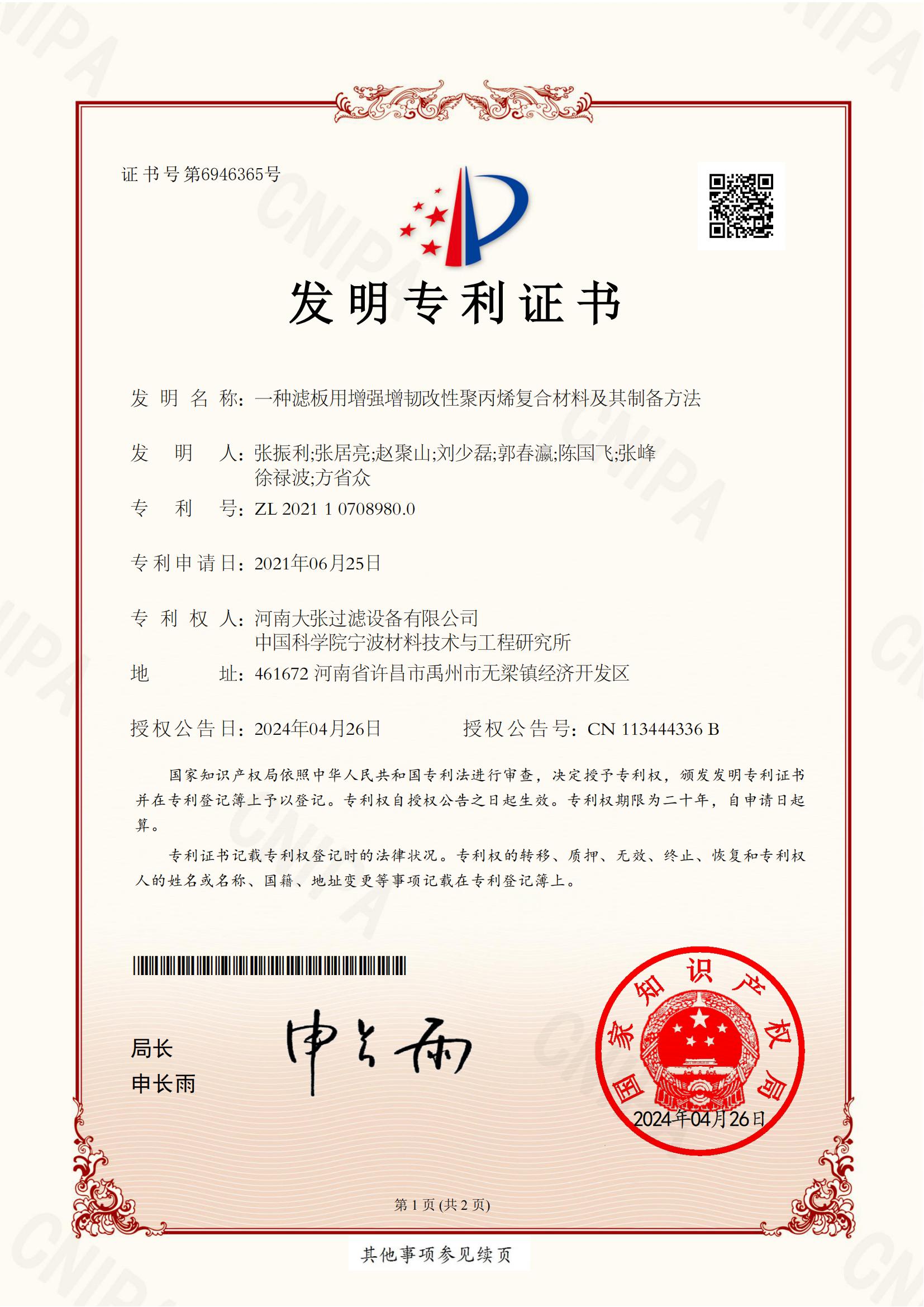
Plate material is part of the scale-up decision: invention patent ZL 2021 1 0708980.0 covers a reinforced and toughened modified polypropylene composite for filter plates.
Manufacturing and supply facts relevant to the evaluation
DAZHANG operates OEM, ODM and custom manufacturing, with customization covering filtration area, plate size, frame material, pressure, voltage and automation. Stated monthly capacity is approximately 250 sets, lead time is 15 to 30 working days, and the minimum order quantity is one set. Export markets covered are Europe, the Americas, the Middle East, Asia and Africa. Quality control is ISO 9001 based with complete machine operation testing, and after-sales support is a one-year warranty with installation guidance and remote technical support.
The manufacturer holds National High-Tech Enterprise status (certificate GR202341002931, issued 22 November 2023, valid to 21 November 2026) and national-level Specialized, Sophisticated, Distinctive and Innovative "Little Giant" recognition. Its R&D activity in filter plate materials is backed by invention patents including ZL 2019 1 0275647.8 for a centre-alignment clamping device and ZL 2022 1 0459734.0 for a fully automatic filter with forced discharge.
Use Cases: Where the Lab-to-Full-Scale Path Pays Off
The industries listed for the 1100/1500 Series — mining, coal, metallurgy, chemical, power and sludge treatment — share one characteristic: the feed changes, and the cost of specifying the wrong machine is high. Four deployment patterns illustrate how the two-stage path is applied.
Mining and tailings dewatering
Tailings and concentrate streams are abrasive and variable. A bench run at 0.6 MPa establishes how quickly a cake forms; the specification then moves to a high pressure membrane filter press in the 1100/1500 Series where filtering pressure up to 4.0 MPa and membrane squeezing are needed to reach the moisture target. In a documented Chinese case, a Mobile Filter Cloth Membrane Filter Press was installed at a mining enterprise and a wastewater treatment plant for sludge dewatering and solid-liquid separation; the unit ran for more than three years, with automatic cloth moving, efficient dewatering and easy maintenance, and delivered higher dewatering efficiency and lower cake moisture.
Industrial and municipal sludge
For industrial wastewater treatment plants and environmental-protection engineering companies, the XMAG30/870-UKB to XMAG1000/2000-UKB membrane filter press is the standard destination. A Chinese case at an industrial wastewater treatment plant and an environmental-protection engineering company has been in operation for over three years, with high pressure, high efficiency and easy maintenance as the stated highlights, and lower cake moisture and stable operation as the results.
Chemical and metallurgical slurries
Where filtrate clarity and cake purity matter, the bench test also validates the cloth and the plate material, not only the area. This is where the plate-material research behind patent ZL 2021 1 0708980.0 becomes relevant to the buyer: a plate specification is a lifetime decision, and PP/TPE membrane plates on a Q345 steel frame in the XMAG series cover a different duty profile from the PP plates on a carbon steel frame used in the 1100/1500 Series.
Laboratory and research evaluation
The laboratory filter press is itself a delivered product, not only an internal tool. A Chinese case with laboratories and research institutes used the unit for lab-scale filtration and solid-liquid separation, with compact size, easy operation and high filtration accuracy cited, and stable filtration with reliable test data as the outcome. For a buyer who will need repeat testing as feed conditions change, owning the bench unit shortens each subsequent specification cycle.
Comparison Table: Laboratory Unit Versus Full-Scale Membrane Filter Presses
| Parameter | Laboratory Filter Press (Customized Lab Model) | Membrane Filter Press (XMAG30/870-UKB to XMAG1000/2000-UKB) | Mobile Filter Cloth Membrane Filter Press (1100/1500 Series) |
|---|---|---|---|
| Filtration area | 0.32 m² | 30–1000 m² | 20–291.2 m² |
| Plate size | Plate arrangement 3+1+1 or 5+1+1 | 870–2000 mm | 1100 / 1500 mm |
| Pressure | Feed pressure 0.6 MPa | Feed pressure 0.6–2.0 MPa; squeezing pressure 1.6 MPa | Filtering pressure 0.6–4.0 MPa |
| Operation | Auto / Manual | Automatic membrane filter press | Automatic |
| Drainage | Not specified in the unit data | Not specified in the unit data | Visible / Invisible |
| Materials | PP filter plate, carbon steel frame | PP/TPE membrane plate, Q345 steel frame | PP filter plate, carbon steel frame |
| Typical industries | Laboratory testing, sludge dewatering, chemical, mining, wastewater | Wastewater, mining, chemical, food, pharmaceutical, metallurgy | Mining, coal, metallurgy, chemical, power, sludge treatment |
| Role in scale-up | Produces the test data set | Receives the data; wide area and plate-size range | Receives the data; higher pressure capability |
Read the table as a sequence, not a menu. The laboratory unit is the entry point; the two full-scale families are alternative destinations chosen on pressure requirement, plate size and duty profile. Both full-scale families are automatic membrane filter press configurations, so the automation decision is effectively made once the squeeze stage is specified.
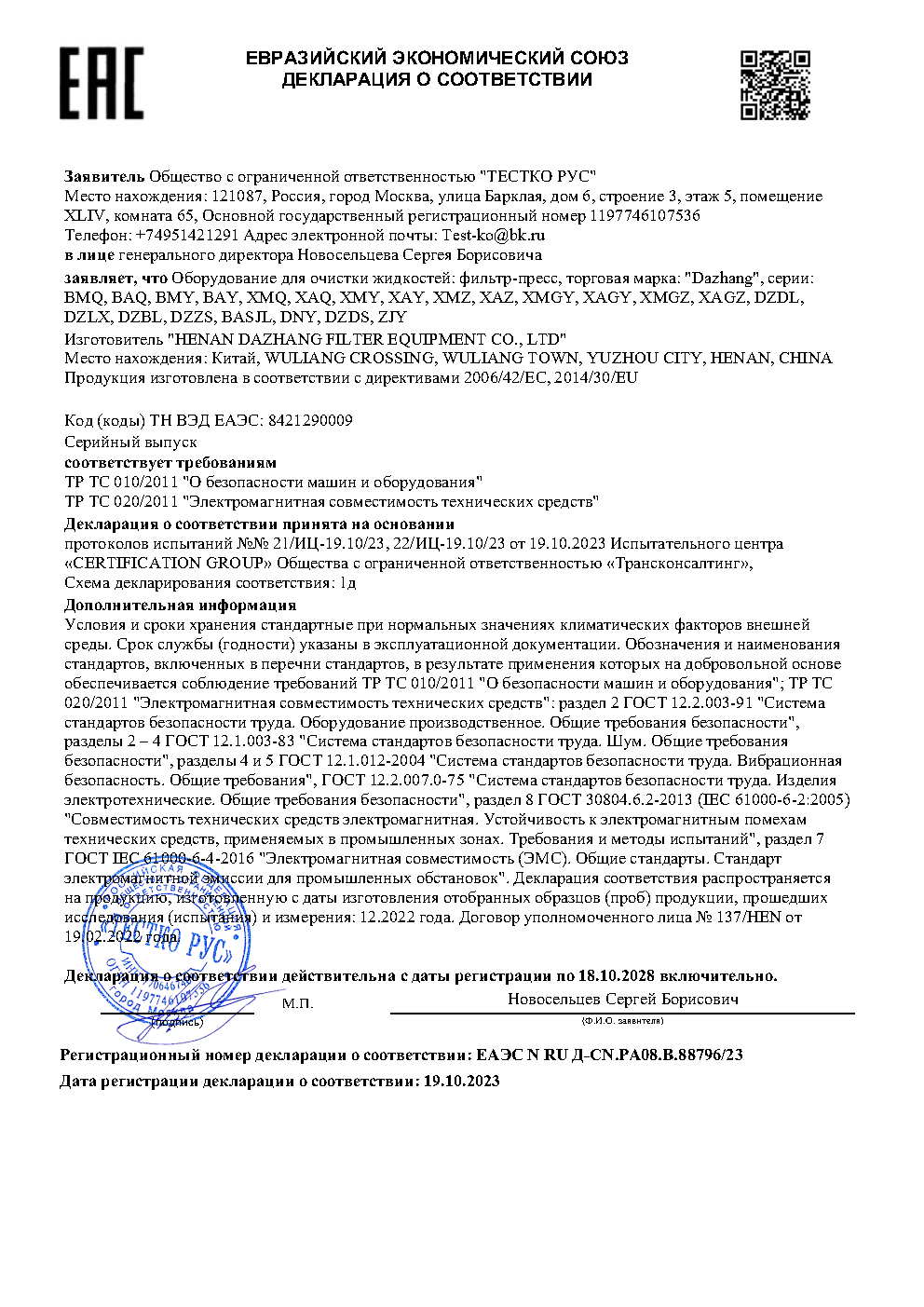
Market access evidence: EAC Declaration of Conformity ЕАЭС N RU Д‑CN.PA08.B.88796/23, valid 19 October 2023 to 18 October 2028.
Frequently Asked Questions
1. Which certifications and quality checks should a trusted automatic membrane filter press manufacturer be able to show?
Look for a quality management basis, a machine-level test record and market-specific conformity documents. DAZHANG's quality control follows ISO 9001 and includes a complete machine operation test on each unit. Independent verification is available through a filter press test report issued to JB/T 4333.2-2013 (report BT25044594069GR, issued 12 April 2025). For Eurasian Economic Union markets, an EAC Declaration of Conformity is held under ЕАЭС N RU Д‑CN.PA08.B.88796/23, issued against TR TS 010/2011 and TR TS 020/2011, valid from 19 October 2023 to 18 October 2028. Company-level qualifications include National High-Tech Enterprise certificate GR202341002931 (22 November 2023 to 21 November 2026) and an intellectual property management system certificate to GB/T 29490-2023 (404IPJ240986R0M, valid to 14 October 2027). Buyers should always confirm that the scope of each document matches their own market and application.
2. Can one supplier provide both the laboratory test unit and the full-scale automatic membrane filter press?
Yes, and doing so keeps the test data and the specification in one technical conversation. DAZHANG manufactures the Laboratory Filter Press (Customized Lab Model, 0.32 m², 3+1+1 or 5+1+1 plates, 0.6 MPa feed pressure) alongside the Membrane Filter Press XMAG30/870-UKB to XMAG1000/2000-UKB Series (30–1000 m², 870–2000 mm plates, 0.6–2.0 MPa feed pressure, 1.6 MPa squeezing pressure) and the Mobile Filter Cloth Membrane Filter Press 1100/1500 Series (20–291.2 m², 1100/1500 mm plates, 0.6–4.0 MPa filtering pressure). Custom manufacturing covers filtration area, plate size, frame material, pressure, voltage and automation.
3. Which specifications determine the configuration and quotation of a full-scale membrane filter press?
The configuration is built from filtration area, plate size, frame material, pressure rating, voltage and automation level — the customization parameters DAZHANG works to. Around the press itself, the scope normally includes the feed pump, air compressor, conveyor and, where relevant, a cloth washing system. Because these items move together, two quotations should be compared line by line on the same duty rather than on headline price alone. A quotation that omits the squeeze pressure or the drainage arrangement is not comparable to one that includes them.
4. How should a sample be prepared for a laboratory filter press test?
The sample must represent the stream the full-scale machine will actually receive, and its condition — solids content, source point, storage and transport — should be recorded alongside the test result. The laboratory unit's 0.32 m² filtration area and 3+1+1 or 5+1+1 plate arrangement define how much material a run consumes, so the required quantity follows from the plate configuration and the test plan rather than from a single fixed figure. Practical guidance on sample volume and test sequence for a specific slurry is best obtained before the sample is shipped.
5. What lead time should be expected for a full-scale membrane filter press?
DAZHANG states a lead time of 15 to 30 working days, a minimum order quantity of one set and a monthly capacity of approximately 250 sets. Delivery scope includes installation guidance, commissioning support, remote technical support and a one-year warranty. Lead time should be confirmed against the final specification, since plate size, pressure rating and automation level all affect the build. To move from evaluation to a firm specification, the fastest route is to send a representative sample for a laboratory filter press run and request a configuration-based quotation from the resulting data — the DAZHANG company profile and product catalogue gives the full equipment range to compare against.
Conclusion: Make the Uncertainty Measurable, Then Specify
The lesson from the laboratory-to-full-scale path is structural rather than commercial. A project that must commit to a membrane filter press on limited sample data is not forced to guess; it is forced to test, record and translate. The laboratory filter press produces the four outputs that matter — time to cake, cake thickness, filtrate clarity and cake moisture after feed — and those outputs map directly onto plate size, filtration area, filtering pressure and whether a membrane squeeze stage is required.
Applied to the DAZHANG range, that translation lands in a defined space: 1100 or 1500 mm plates with 20 to 291.2 m² filtration area and 0.6 to 4.0 MPa filtering pressure for high-pressure mining, coal, metallurgy, chemical, power and sludge duty; or 870 to 2000 mm plates with 30 to 1000 m² area, 0.6 to 2.0 MPa feed pressure and 1.6 MPa squeezing pressure for wastewater, chemical, food, pharmaceutical and metallurgy duty. Both are automatic configurations, and both can be verified before shipment through ISO 9001 based quality control, a complete machine operation test and a third-party test report to JB/T 4333.2-2013.
What remains is a decision about evidence. A specification built on a documented bench test is defensible to a plant manager, a finance reviewer and an auditor. A specification built on a brochure is not.
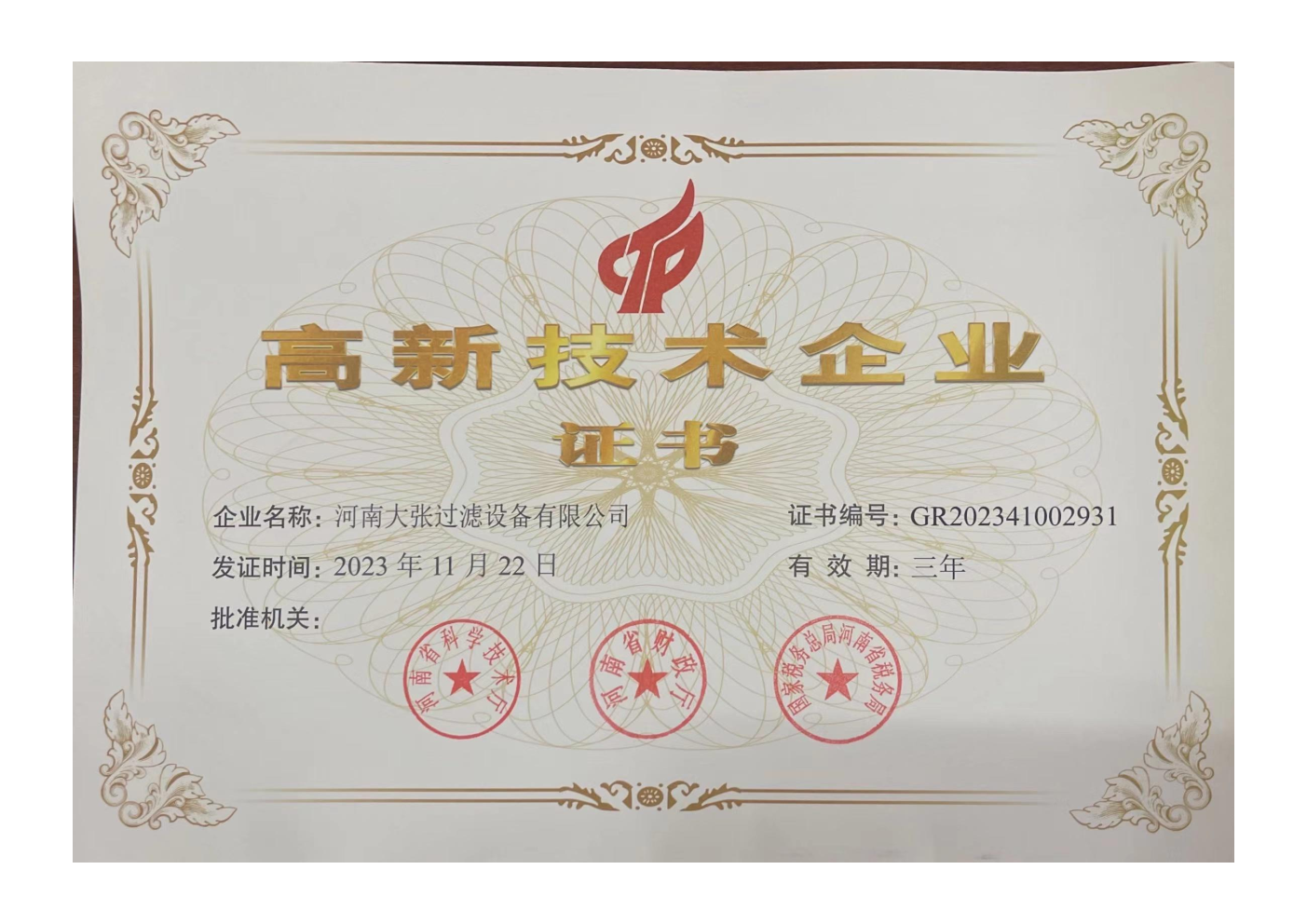
Company-level qualification: National High-Tech Enterprise certificate GR202341002931, valid 22 November 2023 to 21 November 2026.
Next step: test before you specify.
Send a representative sludge or slurry sample for a laboratory filter press run, and DAZHANG will return the test data together with a full-scale membrane filter press configuration for review.
Download the DAZHANG Filter Press company profile and catalogue (PDF)
Henan Dazhang Filtration Equipment Co., Ltd. · East Industrial Park, Yuzhou City, Henan Province, China
Email: admin@dazhangfilterpress.com · Tel / WhatsApp: +86 15038273580 · Contact: Manager Liu
www.dazhangfilterpress.com
Have Questions or Need More Details?
Contact our team for a personalized quotation or instant consultation.
Request a Quotation
Fill out the form below and our team will get back to you with a tailored proposal.
WhatsApp Direct Chat
Prefer to chat in real-time? Message us on WhatsApp for instant assistance & quick answers.
- Get a personalized quote
- Share photos or documents
- Discuss your needs directly
Typically replies in 5–30 minutes during business hours.