
Medical Wristband Compliance Essentials: Materials, Printing, and Healthcare Requirements
Medical wristband compliance is verified at four levels: material composition, printing method, in-use performance on the ward, and the documentation that travels with the shipment. Since the Court of Justice of the European Union ruled in Case C-427/24 that blank patient wristbands are not classified as medical devices under EU MDR 2017/745 (effective from 2 July 2026), compliance work has shifted toward the buyer's own specification — the exact material, the exact print method, and the exact evidence pack behind the item supplied. This guide sets out those requirement areas for hospitals, clinics and elderly-care institutions evaluating medical wristbands.
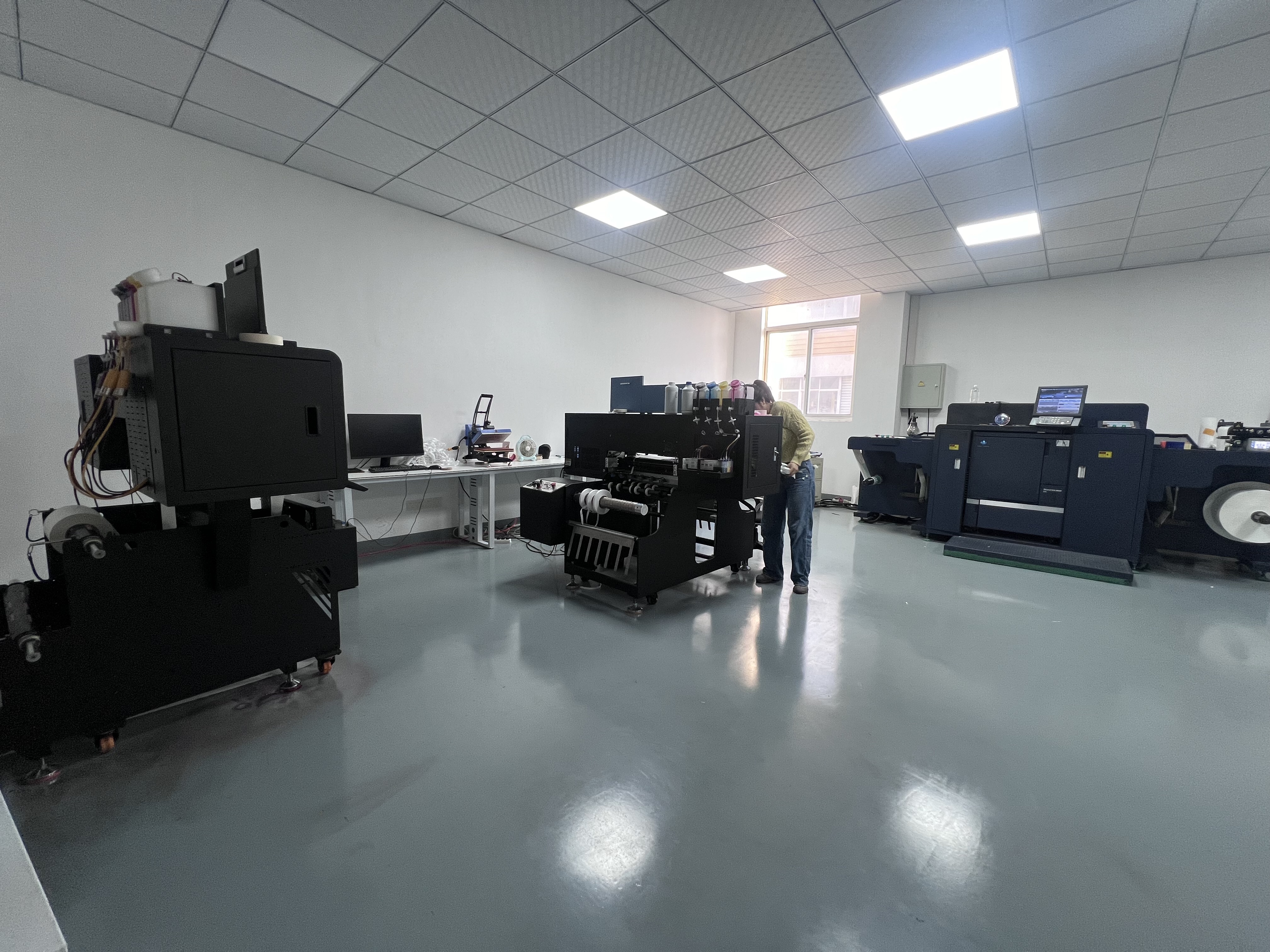
Printing method is one of the four compliance requirement areas buyers must verify before a wristband is approved for ward use.
Problem Definition: Why One “Certificate Request” Misses Most Compliance Risk
In most hospital procurement flows the compliance question arrives as a single line: send your certificates. That request conceals three separate verification problems, and each one produces a different type of failure.
1. Classification. A wristband that only carries identification data is treated differently from a product whose intended purpose is clinical. The Court of Justice of the European Union ruled in Case C-427/24 that blank patient wristbands are not classified as medical devices under EU MDR 2017/745, effective from 2 July 2026. The practical consequence is that a “medical device certificate” is often the wrong document to request. The relevant evidence is material-level compliance plus a written statement of intended purpose.
2. Physical mismatch. A direct thermal printer cannot produce a legible band from material that is not thermal-sensitive, and an ink-based process requires consumables that a ward printer does not carry. Where material and printer do not match, the failure appears at the bedside as unreadable patient data — a patient-safety issue rather than a paperwork issue.
3. Scope mismatch. A certificate can be genuine and still not cover the item in the box. The EU RoHS certificate of compliance issued for DDJOY-Medical Wristbands, for example, is drawn for paper wristband (certificate TST20250302350EC, Dongguan True Safety Testing Co., Ltd., issued 14 March 2025). Buyers ordering PVC, Tyvek or RFID constructions need to confirm which document actually applies. Verifying requirement areas instead of the existence of a PDF is what closes this gap.
Industry Background: A Growing Category With Moving Rules
The global patient identification wristbands market is projected to reach USD 576.1 million in 2025, according to Future Market Insights. A second commercial estimate places the same category at USD 1.61 billion for 2025 (Precedence Research). The gap is a methodology difference rather than a contradiction: one estimate counts blank patient ID wristbands, the other a broader identification-accessory definition that includes printed and system-integrated products. For buyers, that divergence is itself a compliance warning — the word “wristband” in a tender document does not have a single universal definition.
Regional demand is concentrated. North America held a 41% share of the patient identification wristbands market in 2025 (Precedence Research). Supply is split between large identification-technology groups and specialist manufacturers: Zebra Technologies reported net sales of USD 346 million for its Asset Intelligence & Tracking segment, which includes wristbands, in Q4 2023, while PDC Healthcare, a Brady Corporation brand, holds a projected 14–18% share of the patient identification wristbands market (Future Market Insights). The remainder of the category is served by specialist producers, which is why specification language — not brand familiarity — usually decides whether a shipment is accepted.
Three rule changes are driving current verification work:
- Classification. CJEU Case C-427/24 confirms that blank patient wristbands are not medical devices under EU MDR 2017/745, effective 2 July 2026. Compliance effort moves to materials, labeling and substance restrictions.
- Labeling symbols. ISO 15223-1:2021 Amendment 1 (2025) changes the authorized representative symbol from EC REP to EU-REP. Label artwork prepared against the older symbol set may need revision.
- Substance restrictions. RoHS 2.0 restricted-substance requirements under Directive (EU) 2015/863 and (EU) 2017/2102 amending Directive 2011/65/EU apply at material level and are tested against the IEC 62321 series.
Requirement Area 1 — Materials: What the Band Is Made Of
Material choice determines what a wristband can survive, how it is printed, and which compliance documents apply. Four material families are relevant in the medical wristband range supplied by DDJOY-Medical Wristbands, the medical wristband line of Shanghai Dingba Identification Co., Ltd., a Shanghai-based manufacturer founded in 2010 that produces wristbands and RFID products and exports to more than 100 countries.
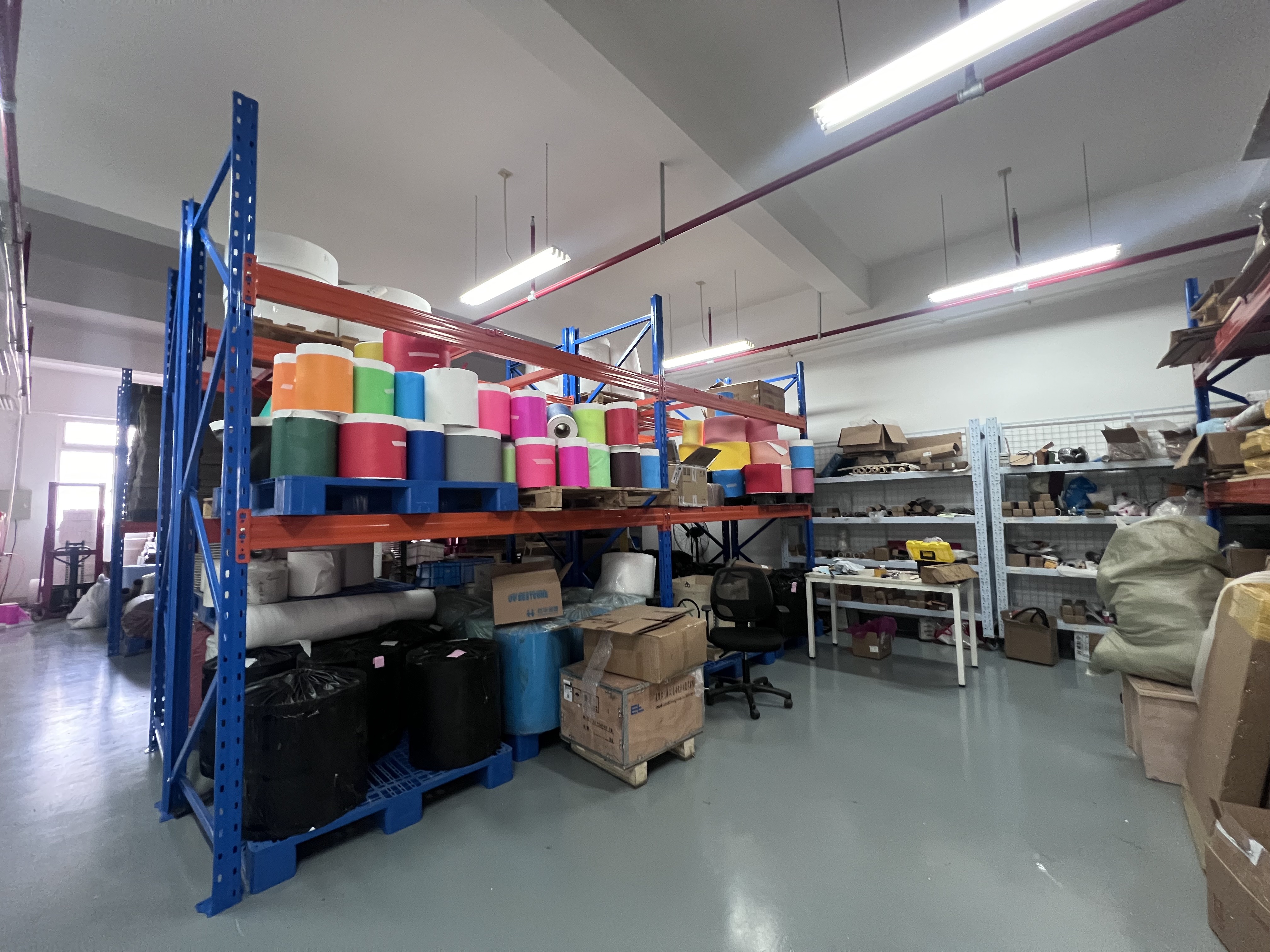
Raw material control: thermal-sensitive synthetic paper, PVC and Tyvek stock held for medical wristband production.
Thermal-sensitive synthetic paper
The medical thermal wristband is produced from thermal-sensitive synthetic paper at a stated size of 260 × 25 mm, listed as customizable, and is described with three verified features: water-resistant, tear-resistant, and patient information printable. Its stated application is hospitals, medical clinics, healthcare institutions and patient management. The verification point for buyers is that the material must be thermal-sensitive — that property is what makes ink-free printing possible, and it cannot be substituted by ordinary paper stock.
PVC
The PVC Patient ID Wristband is listed at 250 × 25 mm and 250 × 16 mm with printable patient information, durable construction and comfortable wear, and is specified for hospitals and elderly care institutions for patient identification. PVC is the material family specified in this range where a longer wearing period and repeated handling are expected. Two related PVC constructions are available: the PVC 1 or 2-layer wristband with a single or double layer structure and printable logo or text (250 × 25 mm / 250 × 16 mm), and the PVC+Tab wristband at 260 × 40 mm with a tab buckle design described as firm to wear and pattern printable.
Tyvek
The Tyvek wristband is offered at 250 × 19 mm and 250 × 25 mm, described as disposable, tear-resistant and waterproof, with clear printing. Its stated applications include hospitals, alongside exhibitions, events and ticketing. For single-use, infection-control-driven workflows, disposable construction plus tear and water resistance are the verified characteristics to check against ward reality.
RFID-capable constructions
The RFID wristband carries a built-in RFID chip with low frequency, high frequency or ultra-high frequency options and is readable and writable, in 250 × 25 mm / 250 × 16 mm and multiple specifications, using silicone, PVC, Tyvek or paper. Verification points are the chip frequency against the reader infrastructure already installed, and confirmation that the base material still meets the same durability and printing requirements as a non-RFID band.
Requirement Area 2 — Printing: Method, Legibility and Consumables
The medical thermal wristband is printed by direct thermal printing — the print head reacts with the thermal-sensitive coating on the material, so no ink, ribbon or toner is consumed at the point of issue. That is the operational reason thermal printing is used at admission desks, emergency departments and outpatient registration, where bands are produced on demand during registration.
Four printing checks belong in the specification:
- Confirm the ward printer is a direct thermal device, not a thermal-transfer unit requiring ribbons.
- Confirm the material is thermal-sensitive synthetic paper, since non-thermal stock will not image.
- Confirm the print area and band size; the thermal wristband is listed at 260 × 25 mm as a customizable dimension.
- Confirm legibility expectations against the stated water-resistant and tear-resistant performance, especially for barcode reads at the bedside.
For PVC constructions, printing is described as printable patient information plus printable logo, text or pattern. This means the buyer must state where print happens: at the factory as a pre-printed or personalized band, or at the hospital on demand. For RFID wristbands, “printing” extends to encoding, because the chip is readable and writable — the specification must therefore name the data fields to be written and re-written.
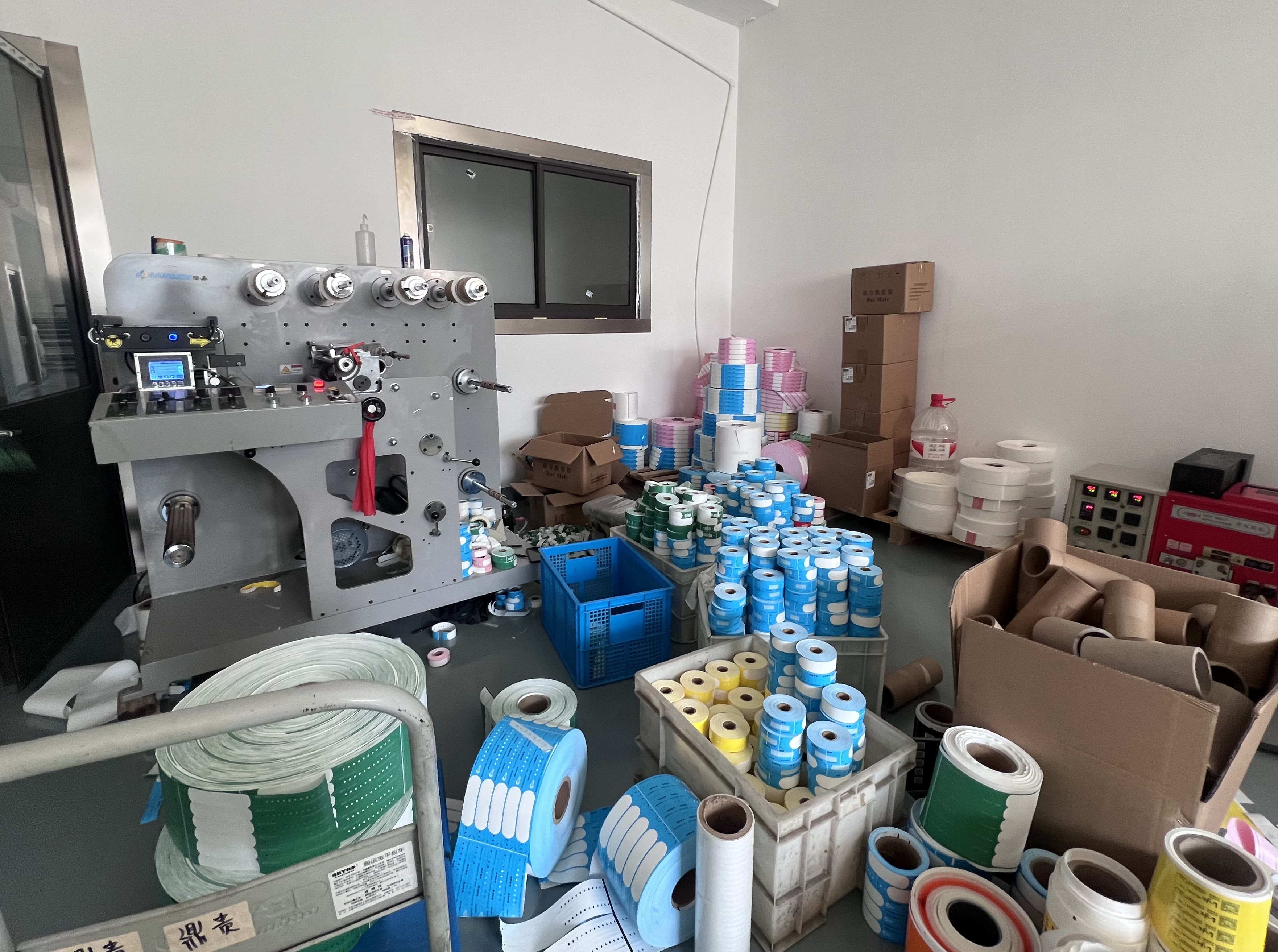
Die-cutting converts material into specified band dimensions — the step where size tolerances are fixed.
Requirement Area 3 — Healthcare Use Conditions
The scenario data behind the medical thermal wristband lists its working condition as indoor and outdoor normal-temperature environments, its function as patient identification and ward information management, its operation mode as wearing, its matched equipment as a direct thermal printer, and its special requirements as waterproof, tear-resistant, disposable and skin-safe. Those five statements are the checklist a hospital should translate into ward language:
- Water resistance — against bathing, hand hygiene, spills and fluid exposure during transfers.
- Tear resistance — against bed rails, clothing, equipment straps and routine handling.
- Disposable construction — where a band is issued to one patient for one episode of care.
- Skin contact — bands are worn continuously, so edge finish and comfort matter as much as print quality.
- Sizing — adult and pediatric sizing must be stated explicitly; the thermal band is offered at a customizable size, while PVC is listed at 250 × 25 mm / 250 × 16 mm.
In elderly care, the requirement profile changes. The PVC Patient ID Wristband is specified for hospitals and elderly care institutions, with durability and comfortable wear as its stated characteristics. Where residents wear a band continuously across a long admission or residential stay, comfort and durability become compliance-relevant properties rather than comfort features, because a band that is removed by the wearer stops delivering identification.
Requirement Area 4 — Documentation and Traceability
Documentation is the area where buyers most often assume coverage without checking scope. The verified documentation set for this range includes:
- EU RoHS Certificate (Certificate of Compliance) — certificate number TST20250302350EC, issued by Dongguan True Safety Testing Co., Ltd., market EU, scope paper wristband, compliance with RoHS 2.0 restricted-substance requirements under Directive (EU) 2015/863 and (EU) 2017/2102 amending Directive 2011/65/EU, tested against IEC 62321-1:2013, IEC 62321-2:2021, IEC 62321-3-1:2013, IEC 62321-4:2013/AMD1:2017, IEC 62321-5:2013, IEC 62321-6:2015, IEC 62321-7-1:2015, IEC 62321-7-2:2017 and IEC 62321-8:2017. Issue date 14 March 2025, expiry date 14 March 2099.
- Quality management — ISO 9001 certification, together with on-site verification from Alibaba and SGS, held by Shanghai Dingba Identification Co., Ltd.
- Quality control — 100% testing of products during production.
- Labeling currency — where EU labeling is used, label files should be reviewed against ISO 15223-1:2021 Amendment 1 (2025), which changed the authorized representative symbol from EC REP to EU-REP.
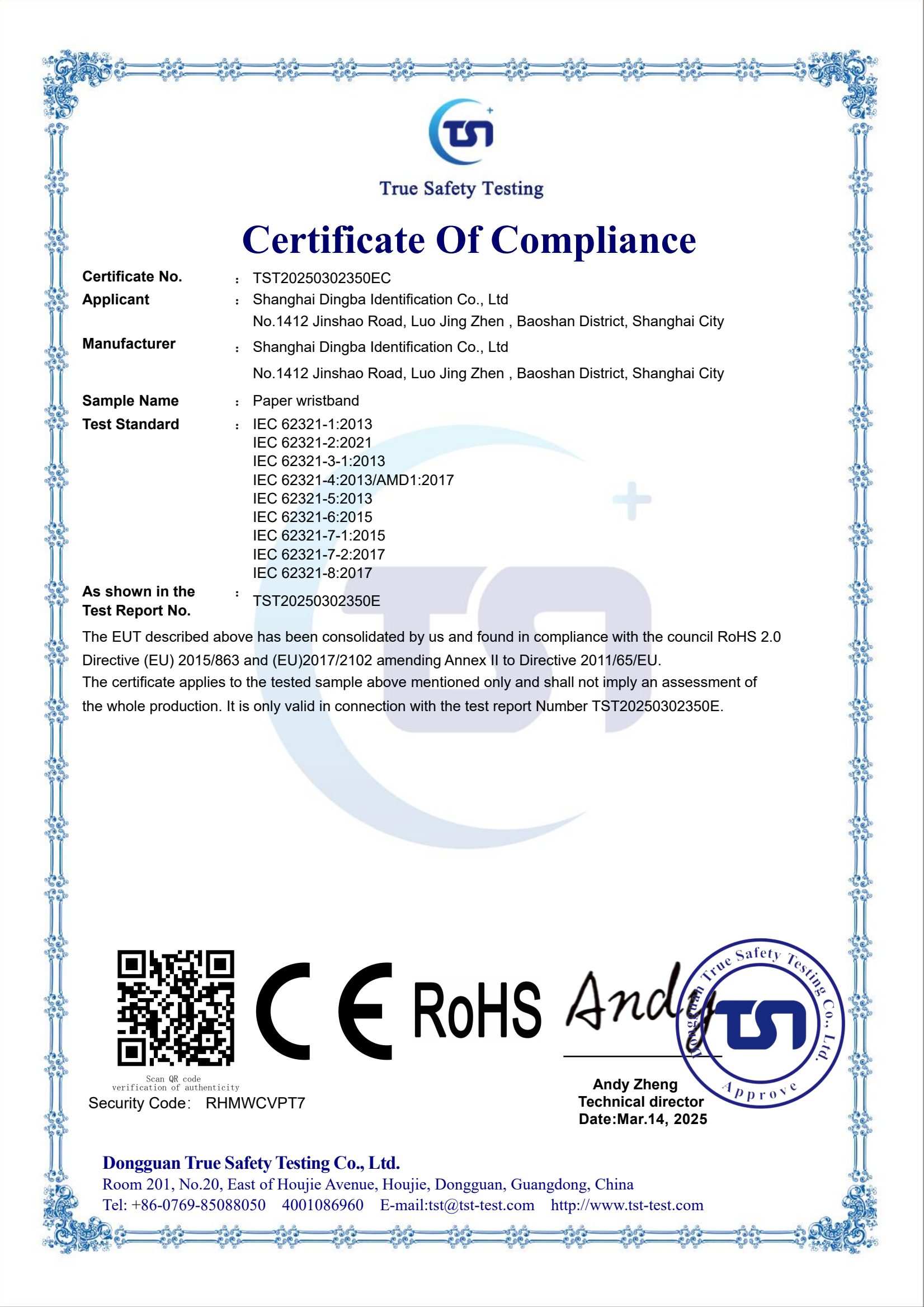
EU RoHS Certificate of Compliance TST20250302350EC — note that its scope reads paper wristband (issued by Dongguan True Safety Testing Co., Ltd.).
Step-by-Step: Verifying a Medical Wristband Specification
The sequence below turns the four requirement areas into a work order that a procurement team can execute before a full rollout.
- Step 1 — Write the intended purpose. State whether the band is used purely for identification or supports clinical documentation. This determines whether the MDR classification discussion applies at all, given that blank patient wristbands are not medical devices under CJEU Case C-427/24.
- Step 2 — Fix one material per line item. Thermal-sensitive synthetic paper, PVC, or Tyvek, or an RFID construction. Do not leave a single “wristband” line that can be filled with any material.
- Step 3 — Confirm the printing route. Direct thermal printing requires thermal-sensitive material and no ink or ribbon; PVC and Tyvek printing must be defined as factory printing or hospital printing.
- Step 4 — Define the performance envelope. Water resistance, tear resistance, disposable or reusable use, wear comfort, and the exact band size (250 × 25 mm, 250 × 16 mm, 260 × 25 mm, 250 × 19 mm or 260 × 40 mm depending on construction).
- Step 5 — Match documentation to the item. Check certificate scope, ISO 9001 status, on-site verification records, and the currency of labeling symbols.
- Step 6 — Validate before scale. Order the minimum quantity of 1,000 units, allow the standard 7–10 day lead time, and run a pilot with the actual ward printer before the full rollout. Production quality control covers 100% testing of products.
Use Cases: Where Each Requirement Set Applies
Different care settings produce different compliance priorities, and the material specification should follow the setting rather than the reverse.
Hospital admission and emergency departments. Volume is high and bands are produced during registration. Direct thermal printing on thermal-sensitive synthetic paper at 260 × 25 mm keeps the desk independent of ink and ribbons, while water resistance and tear resistance protect the printed patient data through transfers. This is the configuration specified for patient identification and ward information management with a matched direct thermal printer.
Nursing homes and elderly care institutions. Wear duration is longer and skin comfort becomes operationally important. The PVC Patient ID Wristband at 250 × 25 mm / 250 × 16 mm is specified for hospitals and elderly care institutions with durable, comfortable wear and printable patient information.
Isolation wards and intensive care. Single-use assumptions dominate. Tyvek wristbands at 250 × 19 mm / 250 × 25 mm are described as disposable, tear-resistant and waterproof with clear printing, and the scenario requirements for this type of patient-identification deployment list waterproof, tear-resistant, disposable and skin-safe properties.
Clinics and outpatient departments. Lower daily volumes, but the same printer constraint applies: printable thermal bands avoid consumable logistics at small registration points.
Data-capture and access-controlled areas. Where identification must be read electronically as well as visually, the RFID wristband provides a readable and writable chip in low frequency, high frequency or ultra-high frequency versions, in silicone, PVC, Tyvek or paper.
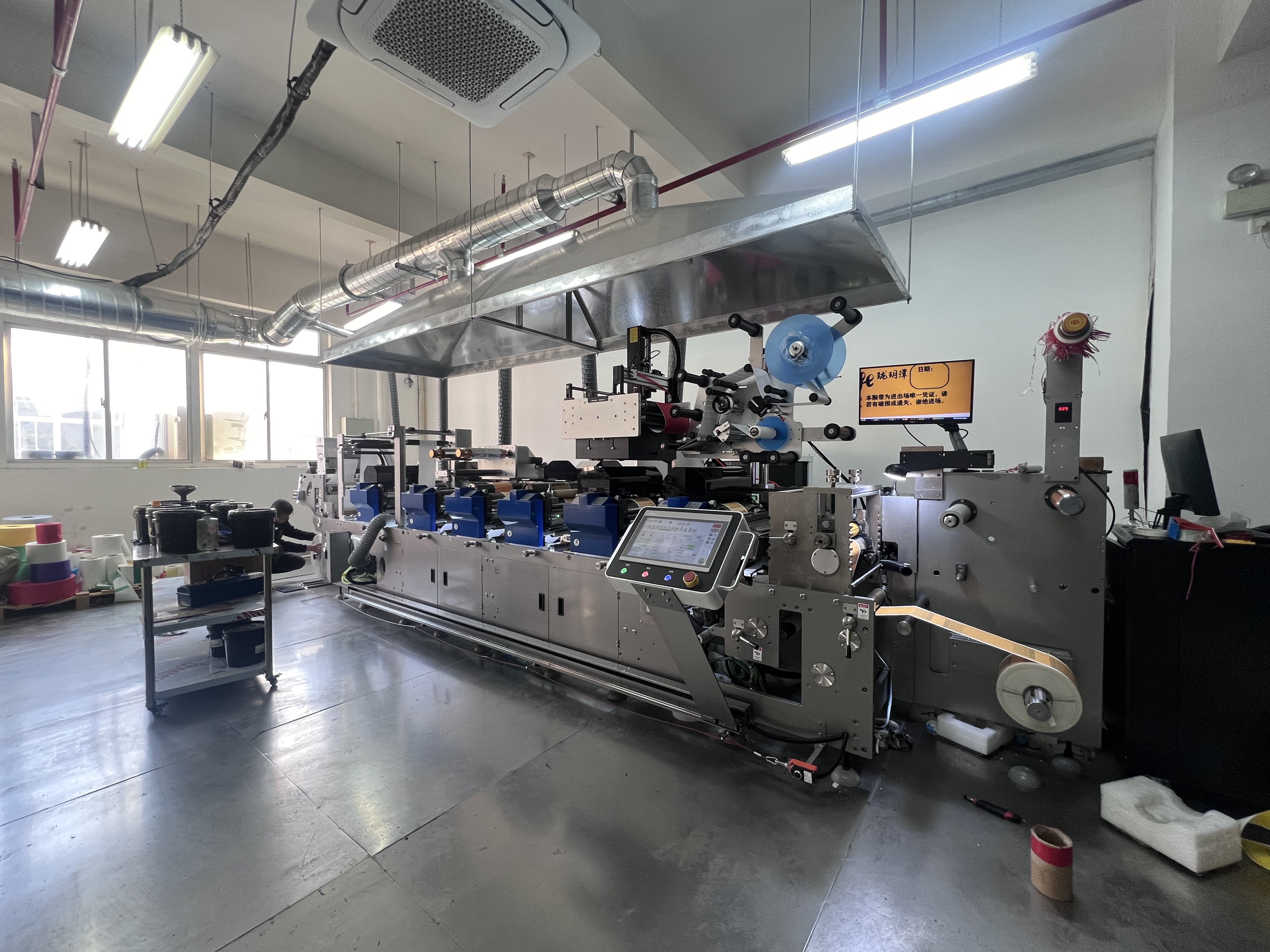
Surface printing capacity supports printed logo, text and pattern requirements on PVC and paper wristband constructions.
Comparison: Requirement Areas and Verified Reference Points
| Requirement area | What the buyer must verify | Verified reference point |
|---|---|---|
| Classification / intended purpose | Whether the band is claimed as a medical device, and for what purpose | Blank patient wristbands are not medical devices under EU MDR 2017/745 (CJEU Case C-427/24, effective 2 July 2026) |
| Material | Thermal-sensitive synthetic paper, PVC, Tyvek, or RFID construction with a defined base material | Thermal-sensitive synthetic paper; PVC; Tyvek; silicone / PVC / Tyvek / paper for RFID |
| Print method | Direct thermal without ink or ribbon, or factory pre-printing | Direct thermal printing on the medical thermal wristband; printable patient information, logo, text and pattern on PVC |
| Size | Stated and confirmed band dimensions, including pediatric sizing | 260 × 25 mm (customizable); 250 × 25 mm; 250 × 16 mm; 250 × 19 mm; 260 × 40 mm |
| Surface durability | Water and tear resistance matched to ward conditions | Water-resistant and tear-resistant (thermal, 260 × 25 mm); tear-resistant and waterproof with clear printing (Tyvek) |
| Wear comfort | Continuous-wear suitability, especially in elderly care | Durable and comfortable to wear (PVC Patient ID Wristband); firm to wear with tab buckle (PVC+Tab) |
| Data capture | Visual reading only, or read/write encoding | Built-in RFID chip with LF / HF / UHF options, readable and writable |
| Documentation | Certificate scope against the material actually ordered | EU RoHS certificate TST20250302350EC, scope paper wristband; ISO 9001; Alibaba and SGS on-site verification |
| Order and quality control | MOQ, lead time and inspection regime | MOQ 1,000 units; standard lead time 7–10 days; 100% testing of products |
Requirement verification matrix — every reference point is drawn from the product and certification data of DDJOY-Medical Wristbands.
| Material option | Verified sizes | Verified features | Stated application |
|---|---|---|---|
| Thermal-sensitive synthetic paper (medical thermal wristband) | 260 × 25 mm (customizable) | Direct thermal printing; water-resistant; tear-resistant; patient information printable | Hospitals, medical clinics, healthcare institutions, patient management |
| PVC (PVC Patient ID Wristband) | 250 × 25 mm / 250 × 16 mm | Printable patient information; durable; comfortable to wear | Hospitals, elderly care institutions (patient identification) |
| Tyvek | 250 × 19 mm / 250 × 25 mm | Disposable; tear-resistant; waterproof; clear printing | Hospitals (also exhibitions, events, ticketing) |
| Silicone / PVC / Tyvek / paper (RFID wristband) | 250 × 25 mm / 250 × 16 mm and multiple specifications | Built-in RFID chip, LF / HF / UHF optional; readable and writable | Medical; events; access control; logistics and warehousing; member management |
| PVC+Tab | 260 × 40 mm | Tab buckle design; firm to wear; pattern printable | Hospitals, events, concerts, nightclubs |
Material fit by verified product data — only stated features, sizes and applications are listed.
FAQ: Medical Wristband Compliance Questions Buyers Ask
Are patient wristbands classified as medical devices in the EU?
Blank patient wristbands are not classified as medical devices under EU MDR 2017/745. The Court of Justice of the European Union ruled accordingly in Case C-427/24, effective from 2 July 2026. For buyers, this means the verification route is material and labeling compliance rather than a medical device certificate: substance restrictions such as RoHS 2.0 (covered in this range by EU RoHS certificate TST20250302350EC, issued 14 March 2025 by Dongguan True Safety Testing Co., Ltd. for paper wristband), and labeling symbols kept current with ISO 15223-1:2021 Amendment 1 (2025), which replaced the EC REP symbol with EU-REP.
What material and printing capabilities should be verified before approval?
Confirm four capabilities in writing. First, that the thermal band uses thermal-sensitive synthetic paper so that direct thermal printing works without ink or ribbon, at a stated 260 × 25 mm size that is customizable. Second, that PVC patient ID bands provide printable patient information with durable, comfortable wear at 250 × 25 mm / 250 × 16 mm. Third, that Tyvek bands are disposable, tear-resistant and waterproof with clear printing at 250 × 19 mm / 250 × 25 mm. Fourth, for electronic identification, that the RFID wristband carries a readable and writable chip with low frequency, high frequency or ultra-high frequency options. Manufacturing capability supporting these specifications includes OEM production, ISO 9001 certification, and 100% testing of products.
What specification variables drive the cost of a medical wristband order?
Cost in this category is driven by specification choices rather than by a single unit price: the material family selected, the print method required (direct thermal printing removes ink and ribbon consumables from ward operations), whether logo or pattern printing is added, the wear structure chosen for PVC constructions (single or double layer, or the PVC+Tab buckle design at 260 × 40 mm), the RFID frequency option where an electronic chip is included, and the order quantity measured against a minimum order quantity of 1,000 units. Buyers comparing quotations should compare these variables line by line, because two offers at different prices are often not the same product.
Can samples and certificates be requested before a production order?
Yes. The practical sequence is to confirm the material and size specification first, then request samples of the exact construction for ward testing, and ask for the certificate copies that apply to that specific material — for example the RoHS certificate whose scope reads paper wristband. Sample and specification requests for DDJOY-Medical Wristbands can be routed through the manufacturer's contact channel, and the company catalogue is available for download at the DDJOY product catalogue.
What lead time applies, and can large medical orders be delivered on schedule?
The standard lead time is 7–10 working days, with a minimum order quantity of 1,000 units and 100% testing of products during production. Capacity for larger programmes is documented: a global event organizer deployed 120,000 custom printed wristbands for a music festival, with tamper-proof one-time closure, tear-resistant and waterproof material, full-colour custom printing and fast mass-order delivery, achieving 40% faster on-site check-in efficiency and zero counterfeit admission incidents. Medical buyers planning seasonal or multi-site rollouts should confirm volumes and delivery windows when the specification is confirmed.
Conclusion: Verify Requirement Areas, Not Just Certificates
Medical wristband compliance in 2026 is a specification exercise with four verifiable layers: material (thermal-sensitive synthetic paper, PVC, Tyvek or an RFID construction), printing (direct thermal without ink, or defined factory pre-printing), healthcare use conditions (water resistance, tear resistance, disposability, comfort and stated sizing), and documentation whose scope matches the item supplied. Because blank patient wristbands are not medical devices under EU MDR 2017/745, the buyer's written specification carries more compliance weight than it did before, and a certificate that does not name the ordered material provides very little protection.
Shanghai Dingba Identification Co., Ltd., founded in 2010 and operating a 10,000 m² facility with a five-engineer R&D team, produces the DDJOY-Medical Wristbands range for hospitals, clinics and elderly care institutions, with EU and USA as its main export markets. Buyers who want to close the four verification areas in one step can start from the published product data and the applicable certificate set.
Next Step: Specification Review, Samples and Certificate Set
Send your material, size, print method and durability requirements, and request the certificate set that applies to that exact construction.
Email: ddjoy02@163.com | Website: www.ddlf.com | WhatsApp: +86 13636648748
Catalogue download: DDJOY wristband product catalogue (PDF)

Have Questions or Need More Details?
Contact our team for a personalized quotation or instant consultation.
Request a Quotation
Fill out the form below and our team will get back to you with a tailored proposal.
WhatsApp Direct Chat
Prefer to chat in real-time? Message us on WhatsApp for instant assistance & quick answers.
- Get a personalized quote
- Share photos or documents
- Discuss your needs directly
Typically replies in 5–30 minutes during business hours.