
LED Display Compliance by Export Region: Scope-First Review
An LED display does not become compliant as a product category. It becomes documented for a defined configuration, in a defined market, against defined standards. A scope-first review starts from the market and the exact model, then works back to the certificate file — which is the opposite of how most buyers check compliance, and the reason mismatches stay hidden behind a certificate cover page.
The question "is this LED display CE certified?" cannot be answered as written. It needs three details: which market the screen is being placed in, which configuration is being bought (pixel pitch, cabinet, indoor or outdoor version, power arrangement), and which document the supplier is actually handing over. This guide sets out a review structure that keeps those three elements attached to each other, and uses DDW DISPLAY's supplied certification records and export footprint to show where a document stops being evidence and where project-level verification has to begin.
Why one certificate cannot travel across export markets
A compliance document is evidence about a defined product, assessed against a defined standard, for a defined jurisdiction. Change any one of the three and the evidence has to be re-examined rather than carried over. Three practical consequences follow for LED display buyers.
Jurisdictions regulate different things. Some market requirements centre on electromagnetic compatibility and electrical safety. Others add radio registration, national registration numbers, or scheme-specific marks. The position stated in the knowledge base behind this review is direct: the required certifications depend on the destination market, the product configuration and the project requirements. For the European market, the manufacturer should complete the required conformity assessment, maintain the relevant technical documentation, issue an EU Declaration of Conformity where applicable, and affix the CE marking in accordance with applicable EU legislation.
Documents are not interchangeable. A test report produced by a laboratory, a certificate of conformity issued by that laboratory, a supplier's declaration of conformity, and a national registration are four different instruments. A test report supports a technical claim. A declaration transfers responsibility for that claim to the party that signs it. A registration confirms that a specific model has been entered into a national database. Presenting one as if it were another is the most common documentation weakness in import files.
Scope is written on the document itself. Certificates name a product family, a series, or a single model. Sometimes they name a product that is not the product being purchased. A buyer who reads only the certificate title learns nothing about coverage; a buyer who reads the scope line learns almost everything.
Where DDW DISPLAY ships, and why the footprint shapes the question
DDW DISPLAY (Shenzhen DDW Technology Co., Ltd.) is an LED display manufacturer founded in 2012, operating a 10,000 ㎡ manufacturing facility and exporting more than 95% of its output to North America, Europe, the Middle East, Asia-Pacific, Latin America and Africa, with projects delivered in more than 120 countries and regions. The product range covers indoor fine-pitch COB LED displays, outdoor fixed LED displays, rental LED screens, XR virtual production LED walls, stadium LED displays, LED posters and commercial LED video walls.
That footprint explains why this article is organised by market instead of by product. A manufacturer shipping into six broad regions maintains documents for several regimes at once, and the useful buyer question is not "how many certificates do you have" but "which document covers the exact model, power configuration and destination on my purchase order". A supplier with a large export footprint is also a useful test case, because its file will contain both broad series-level records and narrow model-level records — and telling them apart is the skill this guide teaches.
The five layers of a compliance review
A compliance review for an LED display project has five layers. They are checked in order, because a failure at an earlier layer makes the later ones irrelevant.
Layer 1 — Market and responsible operator
Fix the destination market first, then identify who is responsible for placing the product on that market. In many regimes the importer or the in-market economic operator carries obligations that the overseas manufacturer cannot discharge on their behalf, including holding documentation and applying markings correctly. For a rental company buying screens that will travel between countries, the destination market is not a single country, and the review has to cover each market where the inventory will operate.
Layer 2 — Product scope binding
Bind the certificate to the configuration being purchased. For an LED display that means at minimum: series and model, pixel pitch, cabinet size and structure, indoor or outdoor version, brightness and power configuration, and the control system supplied. A rental cabinet sold with an outdoor power option is a different configuration from the same cabinet sold for indoor use, even when both carry the same series name. If the certificate scope is a series name, ask for the model list or technical file that sits behind that scope.
Layer 3 — Standards alignment
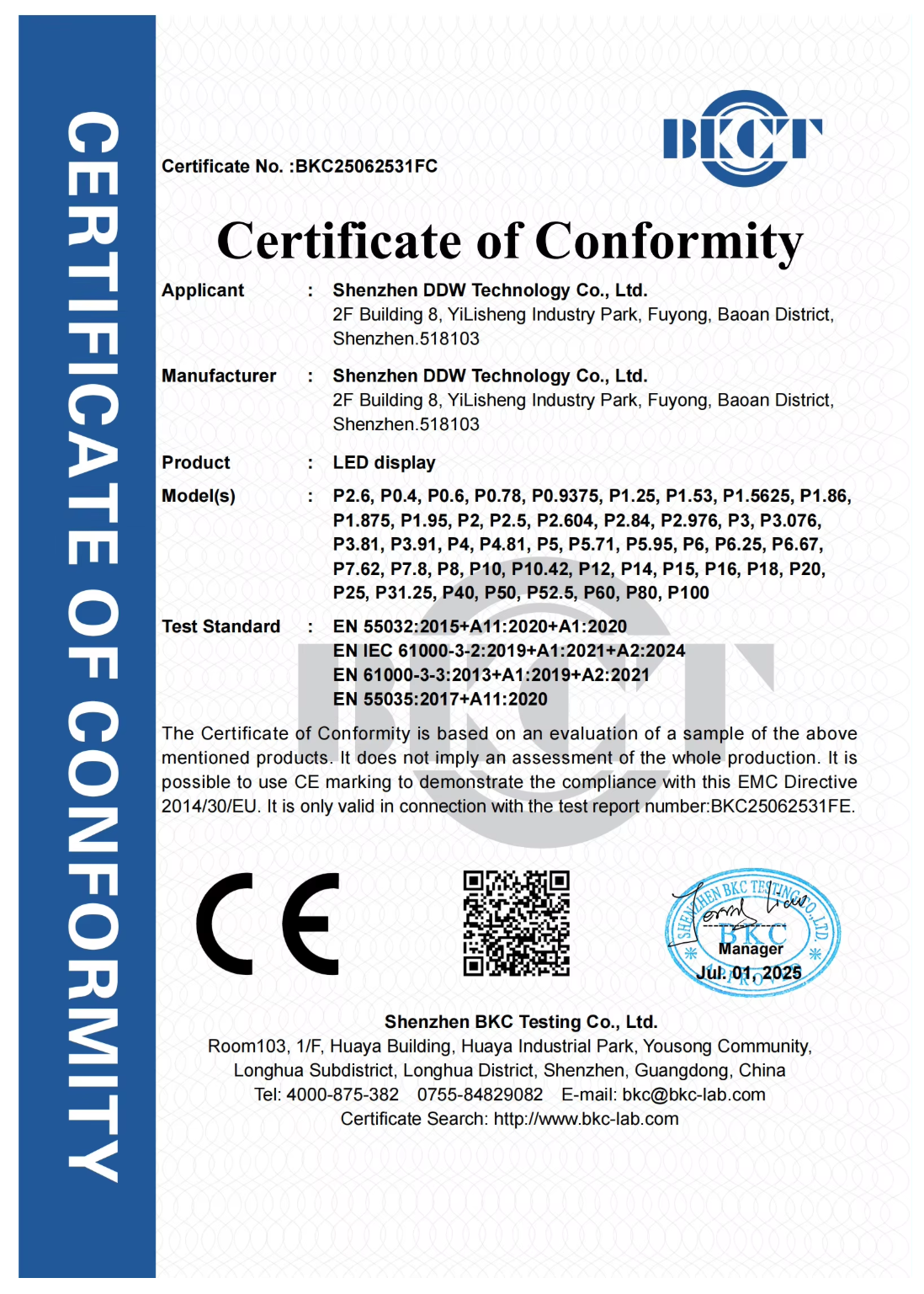
Check which standards are cited and which versions of them. Standards are amended, and an older citation is not automatically wrong — but it does need to be current for the market at the time of shipment. Read the citation as a technical statement: an EMC certificate citing EN 55032, EN IEC 61000-3-2, EN 61000-3-3 and EN 55035 is describing emissions and immunity for the product family, with harmonic and flicker requirements included. An electrical safety certificate citing EN IEC 62368-1:2020+A11:2020 is describing a different risk area under a different directive. Two documents, two purposes, neither replacing the other.
Layer 4 — Labeling and marking consistency
Labeling is where paperwork meets the physical product. Check that the nameplate model designation matches the model named in the certificate, that the electrical rating on the label matches the power configuration ordered, that serial or batch information allows the unit to be traced back to the shipment, and that any required marking is applied to the product rather than only printed on the carton. Photograph the nameplate of the first unit produced for your order and keep it with the compliance file; it is the cheapest verification step available and it catches relabeling errors before they ship.
Layer 5 — Documentation set and traceability
Assemble the full set, not the most impressive single page: the certificate or declaration, the underlying test report where one exists, the model list attached to a series-level scope, the declaration of conformity where the regime requires one, and the quality records that support the manufacturing claims in the quotation. Traceability matters as much as content — a document that cannot be tied to your order number, model and shipment date is difficult to defend later.
Reading DDW DISPLAY's supplied compliance records
The records supplied for this review illustrate all five layers, including the two most commonly confused points: series-level scope versus model-level scope, and product conformity versus management-system certification.
| Record and number | Market | Scope as written | Standards and issuing body | Validity |
|---|---|---|---|---|
| Certificate of Conformity, CE EMC — BKC25062531FC | EU / EEA | LED display | EN 55032:2015+A11:2020+A1:2020; EN IEC 61000-3-2:2019+A1:2021+A2:2024; EN 61000-3-3:2013+A1:2019+A2:2021; EN 55035:2017+A11:2020 — Shenzhen BKC Testing Co., Ltd. | Issued 1 July 2025; expires 1 July 2030 |
| Certificate of Conformity to Directive 2014/35/EU — HXTS2506230030001-1 | EU / EEA | LED display | EN IEC 62368-1:2020+A11:2020 — Shenzhen Huaxintong Testing Technology Service Co., Ltd. | Issued 27 June 2025; expires 27 June 2030 |
| EU RoHS 2.0 Certificate of Conformity — HXTS2506230030007-1 | EU / EEA | LED display, full series with multiple pitch sizes | Directive 2011/65/EU as amended by (EU) 2015/863/EU; IEC 62321 series — Shenzhen Huaxintong Testing Technology Service Co., Ltd. | Issued 27 June 2025 |
| Supplier's Declaration of Conformity, FCC — BKC25062532FC-R1 | USA | LED display | FCC Part 15 Subpart B; ANSI C63.4:2014 — Shenzhen BKC Testing Co., Ltd. | Issued 1 July 2025; expires 1 July 2030 |
| CSA Field Evaluation — 4937974-80039764-01 | Canada | Touch screen kiosks, model DDW-AD4301TK | DQD 502.32 — CSA Group Testing & Certification Inc. | Issued 8 April 2020; expires 8 April 2099 |
| KC R-R (Radio Equipment Registration) — R-R-Gtm-GTM-LDB43; R-R-Gtm-GTM-LDB32 | South Korea | Kiosk (advertising monitor), models GTM-LDB43 and GTM-LDB32 | Clause 3, Article 58-2 of the Radio Waves Act — National Radio Research Agency (RRA) | Issued 29 November 2019; expires 29 November 2099 |
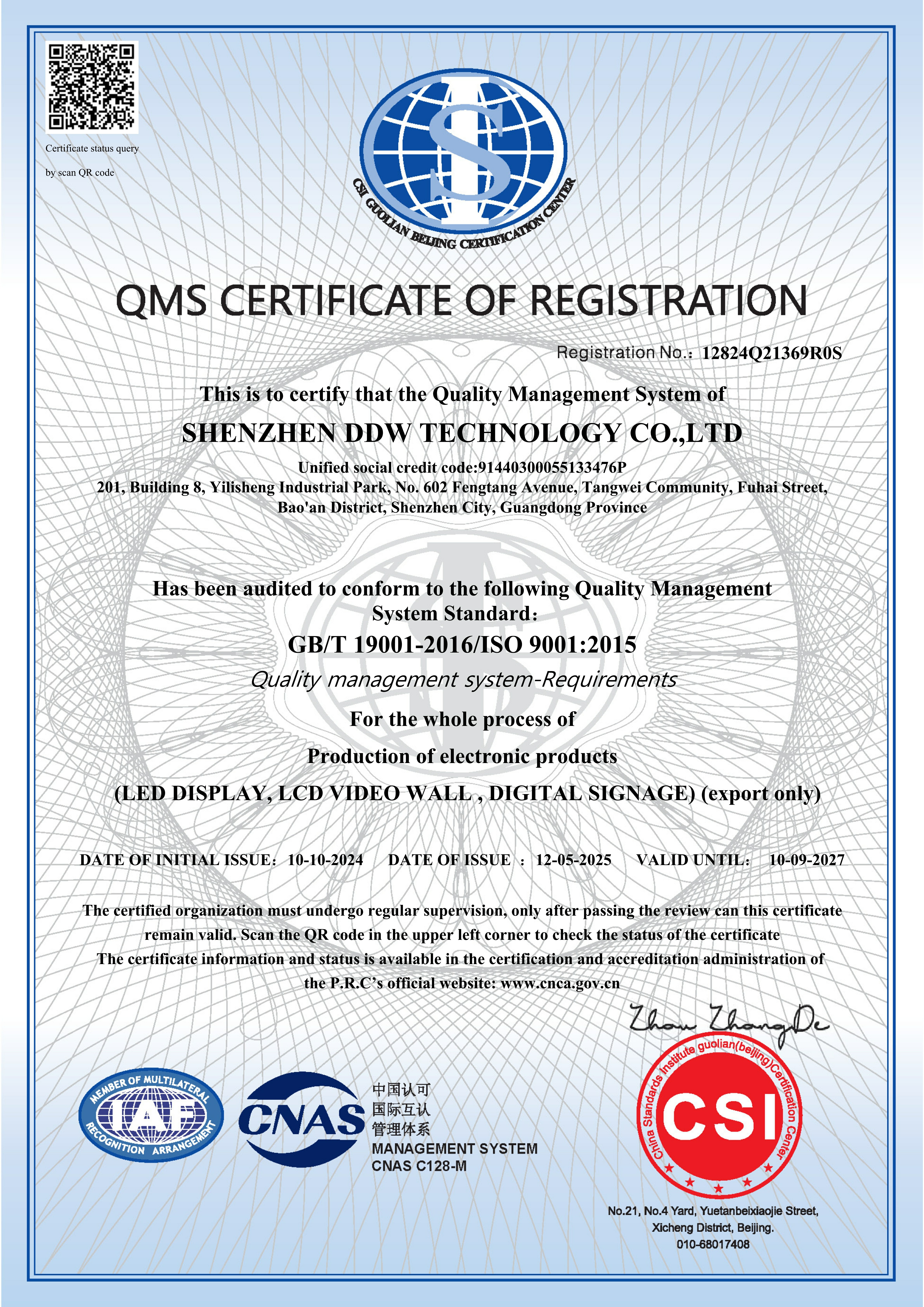
| ISO 9001 Quality Management System — 12824Q21369R0S | Global | Production of electronic products (LED display, LCD video wall, digital signage), export only | GB/T 19001-2016 / ISO 9001:2015 — China Standards Institute (Beijing) Certification Center | Issued 12 May 2025; expires 9 October 2027 |
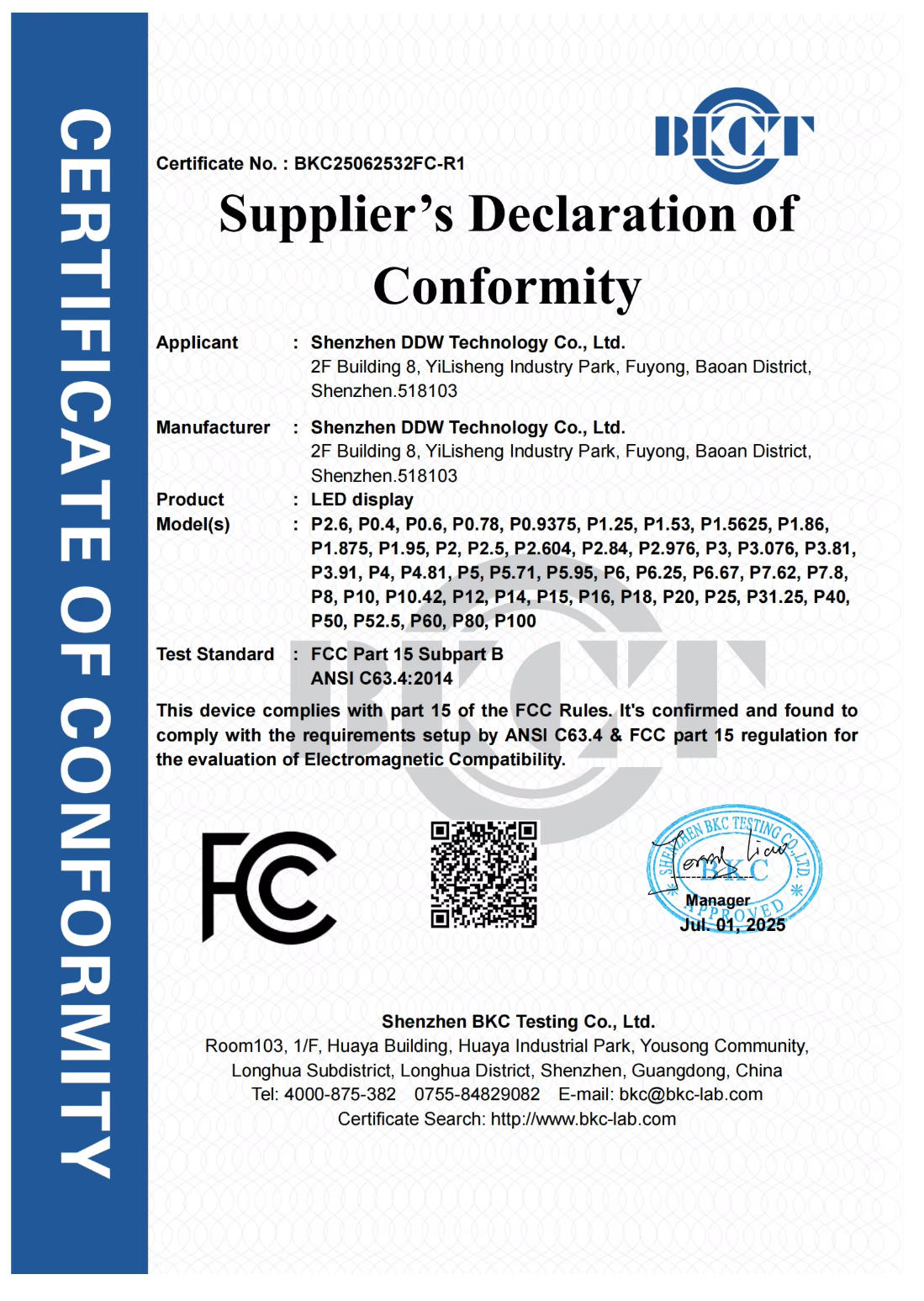
Four observations follow from the table, and each one applies to any supplier file, not only this one.
Two of the seven records are model-level, not series-level. The CSA field evaluation covers touch screen kiosk model DDW-AD4301TK. The KC registration covers kiosk models GTM-LDB43 and GTM-LDB32. Neither record covers the LED display series. That is not a defect in the file; it is how scope works. It does mean that a buyer who sees "CSA" or "KC" in a brochure and assumes coverage for an LED video wall has misread the document.
The EU evidence is deliberately split across three records. Electromagnetic compatibility, electrical safety under Directive 2014/35/EU, and hazardous-substance restriction are separate conformity questions and are documented separately. A single "CE certificate" claim that cannot be resolved into these parts is difficult to verify.
A management-system certificate is not product conformity evidence. ISO 9001 confirms that a quality management system has been certified for the production of LED display, LCD video wall and digital signage, export only. It supports the process claims a buyer will read elsewhere in the quotation — 100% product inspection, aging test, waterproof test, power safety test — but it does not establish that any individual display meets an EMC or safety standard.
Validity dates belong in the file. Product certificates in this set run to 2030 and the management-system certificate to 2027, which means a re-certification cycle falls inside the service life of most installations. For the RoHS record, confirm the expiry date printed on the issued document itself before filing it. Records not listed in the table should not be assumed to exist; where your market or specifier requires a scheme that is absent, confirm availability for the exact model before the order is placed.
A seven-step review you can run before the order
The sequence below turns the five layers into a workflow that a procurement or engineering team can complete before releasing a purchase order.
- Fix the destination market and the responsible operator. List every country where the screens will be installed or, for rental inventory, operated. Name the importer or in-market operator for each.
- Lock the configuration in writing. Series, model, pixel pitch, cabinet size, indoor or outdoor version, brightness, power configuration and control system. Ask the supplier to confirm this configuration list against the certificate scope in writing.
- Request the document set, not the document. Certificate or declaration, the test report behind it where available, the model list for a series-level scope, and the declaration of conformity for markets that require one.
- Read the standards column. Confirm which standard and which version each record cites, and check that the risk area it addresses matches the risk area you are relying on it for.
- Check issue and expiry dates against your shipment and installation dates. A certificate that expires during commissioning is a schedule problem, not a paperwork problem.
- Verify the issuer. Identify the testing body named on the document, and for national registrations identify the authority and registration number exactly as issued.
- Photograph the nameplate and archive the file. Match nameplate model and electrical rating to the certificate, then store the whole set against the order number, invoice and packing list so the same evidence can be produced in a later audit or tender.
Category triggers: where LED display types diverge
Different LED display categories raise different documentation questions, even when they sit under the same series-level certificate. The categories below are the ones most likely to need a separate conversation with the supplier.
Rental LED screens
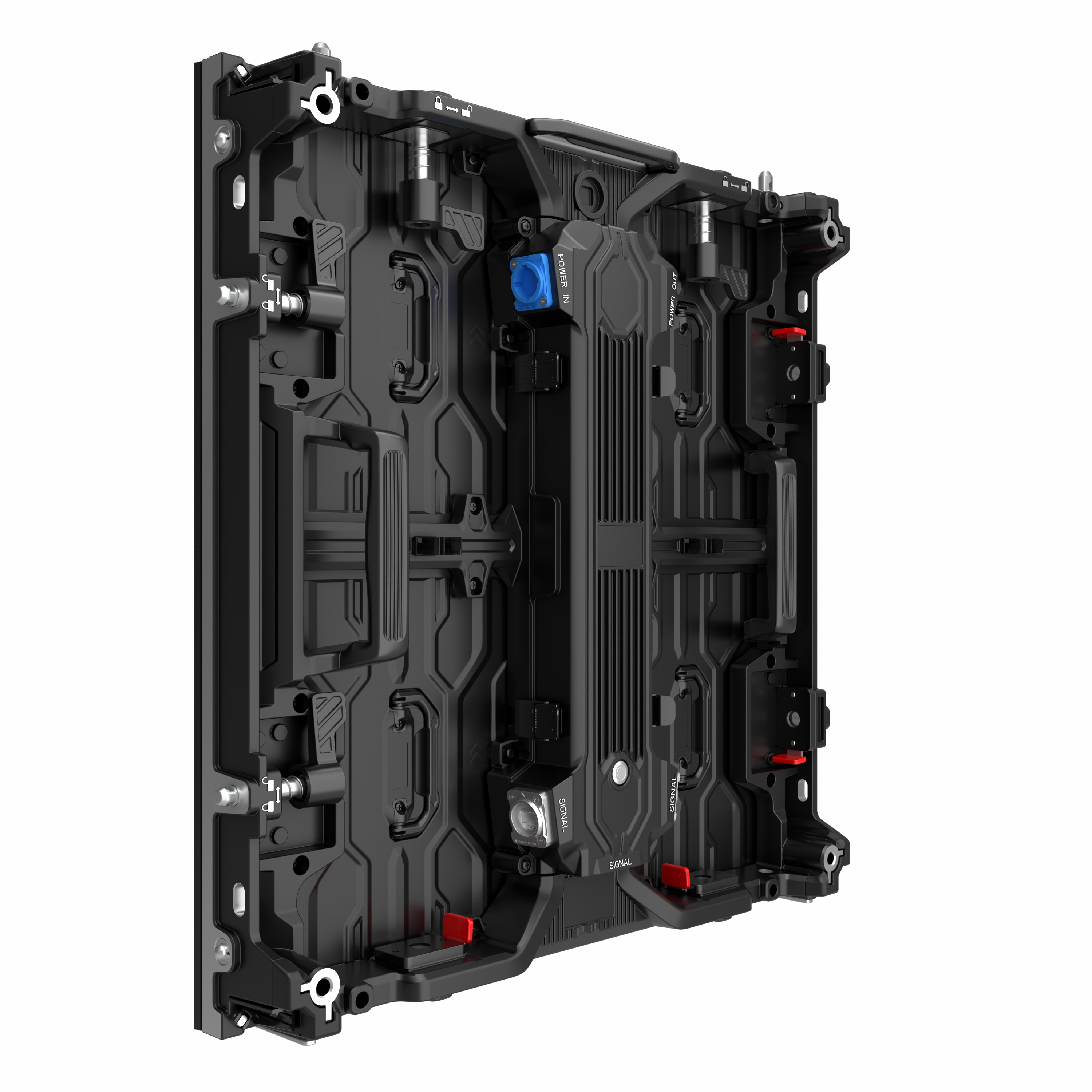
Rental inventory is transported, re-rigged and re-powered far more often than fixed installations, and it frequently crosses borders. The AXIS Series uses a 500 × 500 mm die-casting aluminium cabinet at 7.5 kg with indoor brightness of 1000–1200 cd/m² and outdoor brightness of 4000–5000 cd/m²; the AXIS Flex Series uses a 500 × 500 mm cabinet at 8.5 kg with a brightness range of 800–5000 cd/m² for curved configurations. Because indoor and outdoor versions of the same rental family can differ in power and cabinet arrangement, a rental buyer should confirm which versions were inside the tested configuration and keep that answer with the fleet records.
Outdoor fixed LED displays
Outdoor products add environmental exposure to the review. The DIP Series is rated IP65 with brightness of 8000–10000 cd/m², and the NOVA Series uses a 3.7 kg cabinet with IP65 protection front and rear and 5000–6000 nits. Environmental claims of this kind should be supported by the factory's waterproof test and by an IP rating that is stated for the exact cabinet, not for the series as a whole. Outdoor installation also raises structural and drainage questions that sit outside product certification but affect whether the installed screen performs as documented.
Indoor fine-pitch COB displays
Indoor fine-pitch products are usually reviewed for a different reason: they are installed in rooms where the buyer, the specifier and sometimes a tender committee will read the documentation. The QDCOB Series runs from P0.78 to P1.5625 with quantum dot COB packaging and front maintenance; the FU Series covers P1.56 to P3.91 with a 7680 Hz refresh rate, IP31 front and rear, and a 6.4 kg cabinet in the 1000 × 250 mm size. For this category, the compliance file usually needs to travel alongside a technical submittal, so document quality matters as much as document existence.
Transparent LED displays
Transparent screens are mounted on glass and in shop windows, which introduces a mounting and structural dimension to a review that is otherwise about electrical and electromagnetic conformity. The TI Series uses a 500 × 500 mm or 1000 × 1000 mm cabinet at 6.7 kg with 2500–4500 cd/m² brightness and a 3840 Hz refresh rate. Buyers should confirm that the mounting method specified for the project is the one the supplier has documented, since glass-mounted installations often involve the building owner as an additional approver.
Stadium perimeter LED displays
Sports venue projects combine long procurement cycles, public tender requirements and multiple approval parties. A delivered reference helps here: a 300 ㎡ SP PLUS Series P8 stadium perimeter LED display was installed for a sports venue operator in Qatar for perimeter advertising and event information. Buyers evaluating this category should ask for the documentation set that accompanied a comparable project, not only the certificate list, because tender files typically require the full chain.
XR and virtual production LED walls
Virtual production adds studio-specific requirements around flicker, camera performance and continuous operation. The ORBIT MIP Series uses Micro LED in Package technology with a 500 × 500 mm die-casting aluminium cabinet at 8 kg, 3000–4000 cd/m² brightness and a 7680 Hz refresh rate across P1.25 to P1.95. Studio operators usually need the compliance file to sit alongside camera and control-system documentation, so the review should be planned as part of the studio specification rather than after equipment selection.
Region-by-region documentation check
The table below separates what is already evidenced in the supplied file from what has to be confirmed project by project. The second column is not a statement of regional law; it records what the documents in this file address.
| Market | What the supplied records address | What to confirm per project |
|---|---|---|
| EU / EEA | CE EMC certificate covering EN 55032, EN IEC 61000-3-2, EN 61000-3-3 and EN 55035; certificate to Directive 2014/35/EU covering EN IEC 62368-1:2020+A11:2020; EU RoHS 2.0 certificate for the full LED display series | EU Declaration of Conformity naming the exact model; technical documentation held and available; marking and nameplate on the unit as shipped; whether the indoor or outdoor variant ordered was inside the tested configuration |
| USA | FCC Supplier's Declaration of Conformity to FCC Part 15 Subpart B, tested to ANSI C63.4:2014 | That the declaration names the model and the responsible party, and that a copy is retained in the project file rather than only in the quotation pack |
| Canada | CSA field evaluation for touch screen kiosk model DDW-AD4301TK only | Whether the LED display model and installation require certification or field evaluation for the intended site; the kiosk result cannot be carried across to a display series |
| South Korea | KC R-R registration for kiosk models GTM-LDB43 and GTM-LDB32 only | Whether the product being imported falls under registration, and if so, that registration is held for that model |
| Middle East, Asia-Pacific outside South Korea, Latin America, Africa | No market-specific record is included in the file supplied for this review | The applicable national requirement for each destination country, confirmed with the importer or authority, plus scheme-specific evidence requested for the exact model before the order is placed |
Reading the table correctly matters more than reading it quickly. A blank in the second column is not a finding of non-compliance; it means the supplied file does not contain a market-specific record for that destination, so the requirement has to be established for the project. Conversely, an entry in the second column does not automatically transfer to a different model, pitch or cabinet configuration.
Verification questions that expose weak documentation
Most documentation failures are visible within a short exchange. The questions below are ordered from cheapest to most revealing, and a supplier with a well-organised file will answer all of them without escalation.
- Which exact model number and configuration does this certificate cover, and can you send the attached model list?
- Which standard and which version of that standard is cited, and is it current for my market at the date of shipment?
- Was the indoor or outdoor variant that I am ordering part of the tested configuration?
- Is this document a certificate, a test report, or a declaration of conformity — and who signed it?
- What is the expiry date, and what happens to my file if it expires during commissioning?
- Can you send a photograph of the nameplate on the first unit built for my order?
- If my market needs a scheme that is not in your file, what is required to obtain it for this model, and how does that affect the schedule?
A supplier who answers these in writing is giving you a usable compliance file. A supplier who responds with a folder of cover pages and no scope statements is giving you a research task.
Cost, schedule and what belongs in the purchase order
Compliance work carries cost even when it is invisible in a quotation. Testing for an additional market, re-testing a changed power configuration, translating and notarising documents, and holding spare parts that match a documented bill of materials all consume money and calendar time. The practical approach is to make the split explicit at quotation stage: which certificates are supplied as standard with the model, which are supplied only on request, and which would require new testing for your configuration or destination.
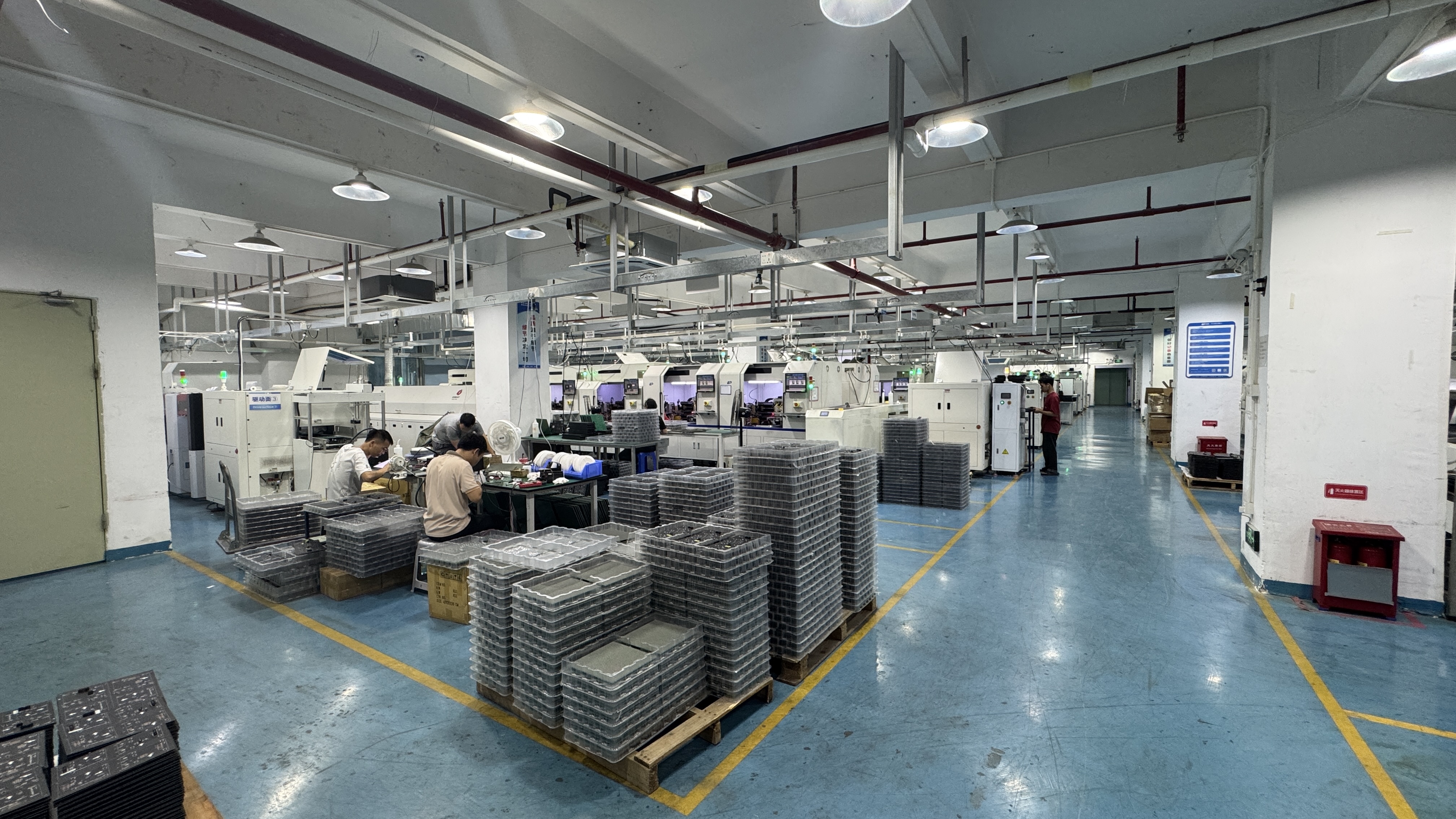
Schedule deserves the same treatment. DDW DISPLAY quotes 15–30 days lead time for standard products, with customised projects depending on product design, quantity and technical requirements, and accepts project-based orders from a single unit. If a scheme has to be added for your market, ask how that interacts with the quoted lead time before the delivery date is committed, rather than after the purchase order is signed. Monthly production capacity of 8,000 ㎡ is the kind of figure that should be read together with the quality-control scope it supports: 100% product inspection, aging test, module testing, brightness and colour calibration, waterproof test and power safety test before shipment.
Three clauses are worth writing into the order: the exact configuration and certificate numbers that apply to it; the document set to be delivered with the shipment, including nameplate photographs; and the after-sales route — remote technical support, installation guidance, troubleshooting support, warranty service and spare parts supply — since a compliance file is only useful if the product it describes can be maintained in the same configuration.
Frequently asked questions
What certifications should a buyer look for when importing an LED display?
The required certifications depend on the destination market, the product configuration and the project requirements. For international projects, buyers commonly evaluate CE, FCC, RoHS, ETL, EMC and related safety requirements: CE and EMC are commonly considered for European-market compliance, FCC is relevant to electromagnetic compatibility requirements in the United States, and RoHS addresses restrictions on certain hazardous substances. Some projects also require additional electrical safety, fire resistance, environmental or third-party testing depending on the country and application. Confirm which certifications apply to the specific model and market, and request the corresponding certificates or test reports before ordering.
Are CE and RoHS certificates enough for a rental LED screen sold into the EU?
They answer different questions, and in DDW DISPLAY's file the EU evidence is split across three records: a CE EMC certificate of conformity citing EN 55032, EN IEC 61000-3-2, EN 61000-3-3 and EN 55035; a certificate to Directive 2014/35/EU citing EN IEC 62368-1:2020+A11:2020; and an EU RoHS 2.0 certificate covering the full LED display series. For a rental screen, also confirm that the cabinet, power configuration and indoor or outdoor version you are buying fall inside the tested scope, that an EU Declaration of Conformity is issued for the model, and that the nameplate matches. Rental inventory moves between venues, so the configuration documented at purchase is the one to keep on file.
Does a certificate issued for one model cover other models or configurations?
Only if the document says so. In the file reviewed here, the CSA field evaluation names touch screen kiosk model DDW-AD4301TK, and the KC registration names kiosk models GTM-LDB43 and GTM-LDB32; neither covers the LED display series. By contrast, the EU and US records state "LED display" as their scope, and the RoHS record states full series with multiple pitch sizes. Where a scope is written at series level, ask for the model list or technical documentation that supports it before treating the document as coverage for your specific order.
How do I verify that a manufacturer's certificate matches my order?
Compare four fields: the model or series named on the document against the model on your purchase order; the standards cited against the risk area you are relying on the document for; the issue and expiry dates against your shipment and commissioning dates; and the issuer against the body that actually tested the product. Then add the physical check that paperwork cannot replace — a photograph of the nameplate on the first unit produced for your order, showing the same model designation and electrical rating. If any of the four fields cannot be matched, treat the document as unverified until the supplier resolves it in writing.
Do outdoor and indoor versions of the same LED display need different compliance evidence?
They should be reviewed as separate configurations, because the cabinet, sealing and power arrangement differ. Outdoor models in the DDW DISPLAY range state environmental protection explicitly — the DIP Series lists IP65 with 8000–10000 cd/m² brightness, and the NOVA Series lists IP65 front and rear with 5000–6000 nits — while the indoor FU Series lists IP31 front and rear. Waterproof testing and power safety testing are part of the pre-shipment inspection scope. Ask whether the specific indoor or outdoor variant you are ordering was inside the tested configuration, and confirm that the IP rating quoted applies to that cabinet rather than to the series generally.
Does adding a certification for a new market change cost and lead time?
It can, and the effect should be stated before the order rather than discovered after it. Additional testing, re-testing of a changed configuration, document translation and notarisation all consume time and budget. Ask the supplier to separate three categories in writing: certificates supplied as standard with the model, certificates supplied on request, and schemes that would require new testing for your configuration or destination. DDW DISPLAY quotes 15–30 days for standard products, with customised projects depending on design, quantity and technical requirements, so any additional compliance step should be priced and scheduled against that baseline before the delivery date is committed.
How do I obtain certificate copies and product documentation for a specific model?
Request the document set by model, not by company, and name the destination market at the same time. A useful request lists the series and model, pixel pitch, indoor or outdoor version, cabinet and power configuration, the destination country, and the document types required by your tender or importer. DDW DISPLAY supplies certification records, quality-control documentation and model specifications for the product lines in this article, and the 2026 LED display catalogue gives an overview of the range before a model-level request is made.
Conclusion: compliance is a matched set, not a certificate count
The reliable test of an LED display compliance claim is not how many certificates a supplier can list, but whether each document names the market, the product and the standard that your project actually depends on. Series-level records such as the EU EMC, Directive 2014/35/EU and RoHS certificates, and the US FCC declaration, do real work — but only once they are matched to the model and configuration on the purchase order. Model-level records such as the CSA field evaluation and the KC registration show the other half of the picture: a certificate can be entirely valid and still say nothing about the screen you are buying.
Review in this order and the rest follows: fix the destination market, lock the configuration, bind the document scope, check standards and versions, confirm labeling on the physical unit, and archive the set against the order. Where a market-specific record is missing, the honest next step is a written question to the supplier, not an assumption in the tender file. Buyers who run that sequence end up with a compliance file they can defend to an importer, a specifier or an auditor — and a clearer view of which supplier actually understands their own documentation.
Next step: send DDW DISPLAY the model, configuration and destination market for your project, and request the certificate set that applies to it.
2026 LED display catalogue: download the DDW LED Display catalog
Company website: www.ddw.net
Have Questions or Need More Details?
Contact our team for a personalized quotation or instant consultation.
Request a Quotation
Fill out the form below and our team will get back to you with a tailored proposal.
WhatsApp Direct Chat
Prefer to chat in real-time? Message us on WhatsApp for instant assistance & quick answers.
- Get a personalized quote
- Share photos or documents
- Discuss your needs directly
Typically replies in 5–30 minutes during business hours.