Rental LED Screen 101: Understanding Stage LED Video Walls as a Display Category
A rental LED screen is a modular LED video wall engineered to be assembled, dismantled, transported and rebuilt many times over, rather than installed once and left in place. That single design intent explains most of the specification decisions you will meet as an event planner, AV technician or production newcomer: lightweight die-casting aluminum cabinets, a common 500 × 500 mm cabinet geometry, quick hanging and stacking installation, and separate indoor and outdoor versions chosen by viewing distance, weather exposure and camera requirements.
This guide is an entry-level explainer for the rental LED display category itself. It covers what “rental-grade” actually means, the five terms that dominate every rental LED screen specification — pixel pitch, cabinet size, IP rating, brightness and refresh rate — and how DDW DISPLAY’s A Series, D Series and AFLEX Series rental LED displays map onto real event scenarios. It is a category primer, not a purchasing checklist.
Problem Definition: Why a Rental LED Screen Is a Different Product Category
Most confusion about this category comes from the fact that a rental LED screen and a fixed LED screen use the same LED technology and can look identical at a trade show. The difference is not in the pixels. It is in the mechanical and electrical design around them.
For an event production team, that distinction turns into three practical questions that a display must answer before it can be called rental-grade:
- Can it survive repeated transport? Cabinets must hold their dimensional accuracy after many load-ins and load-outs, which is why rental cabinets are typically die-casting aluminum rather than welded steel frames.
- Can the wall be built quickly by a small crew? Modular cabinet sizes, quick-lock connections and standardised rigging points matter more than raw peak brightness in a load-in window measured in hours.
- Can it be serviced between shows? Front and rear maintenance access lets technicians replace a module or a power supply without dismantling the whole wall — a requirement when the same screen is on tour.
The category boundary is therefore operational, not technical. A display intended to sit on a building facade for years and a display intended to travel to thirty venues in a season can share a pixel pitch and still be entirely different products.
Industry Background: Why Stage LED Video Walls Keep Growing
Stage and event display demand sits inside a large and still-expanding LED display market. The global LED display market is projected to reach USD 20.73 billion in 2026 and USD 26.98 billion by 2031, according to Mordor Intelligence’s LED display market forecast.
Within that total, the rental segment has its own trajectory. One secondary industry estimate places the global rental LED display market at approximately USD 5 billion in 2020, growing toward more than USD 8 billion by 2027. That figure originates from secondary reporting rather than a primary dataset, so it is best read as a directional indicator rather than a precise market measurement. The direction, however, is consistent with what production companies experience: more events, more screens per event, and higher audience expectations for image quality.
Three structural shifts shape what rental LED displays now have to do:
- Finer pixel pitches moved indoors. Rental ranges now start at P1.56 and P1.95, which lets a stage screen sit closer to the audience and stay sharp on camera.
- Outdoor events became year-round. Festivals, sports events and public activations extend the rental calendar beyond indoor venues, raising the importance of IP-rated waterproof construction and high brightness.
- Stage design became less rectangular. Curved and flexible rental cabinets allow the screen to follow a set design instead of forcing the set design around a rectangle.
For newcomers, the practical consequence is that “rental LED screen” is now an umbrella term covering several sub-configurations, and the specification language used to describe them is worth learning early.
Detailed Solution: The Anatomy of a Rental-Grade Display
Every rental LED screen specification is built from the same small set of parameters. Understanding these five terms is enough to read most product documentation in this category with confidence.
1. Die-casting Aluminum Cabinets
The cabinet is the structural unit of a rental LED screen — the frame that holds the LED modules, the power supply and the receiving card, and that locks to the next cabinet in the wall. In the A Series and D Series rental LED displays, the cabinet material is die-casting aluminum; the AFLEX Series flexible rental LED display also uses a die-casting aluminum cabinet.
Die-casting aluminum matters for a simple reason: repeated assembly is a mechanical stress test. A cabinet that deforms slightly will show visible seams where it meets its neighbour. Precision-moulded aluminum cabinets keep cabinet-to-cabinet alignment stable across many build cycles, while keeping weight low enough for a small crew to handle. As a reference point, the AFLEX Series 500 × 500 mm cabinet weighs 7.5 kg.
2. Pixel Pitch
Pixel pitch is the distance between the centres of two adjacent LED pixels, expressed in millimetres. It is the parameter that most directly determines how close the audience can stand before individual pixels become visible.
In DDW’s rental range, the D Series covers P1.56, P1.95, P2.604, P2.97 and P3.91; the A Series covers P2.5, P2.604, P2.97 and P3.91; and the AFLEX Series flexible rental display covers P1.56, P1.95, P2.604, P2.976 and P3.91. Smaller numbers mean higher pixel density, a shorter minimum viewing distance and usually a higher cost per square metre — which is why the smallest available pitch is not automatically the right choice for a stage.
3. Cabinet Size and Modular Geometry
A stage LED video wall is not one panel; it is a matrix of identical cabinets. Cabinet size therefore determines the resolution of your layout planning: screen dimensions are built by combining whole cabinets, not by cutting one to fit.
The 500 × 500 mm cabinet is the common building block across the A Series, D Series and AFLEX Series. The A Series additionally offers a 500 × 1000 mm cabinet, and the AFLEX Series uses 250 × 250 mm modules inside its 500 × 500 mm cabinet. Because these three series share the same 500 × 500 mm footprint, they can be planned with the same layout logic, even though their mechanical behaviour differs.
4. Brightness and IP Rating
Brightness is measured in nits (or cd/m²) and describes how much light the screen produces. Indoor rental screens typically operate in the 700–1,500 nit range, because a dark venue needs far less light output than a sunlit stage. Outdoor rental screens must overcome ambient daylight, which pushes them into the thousands of nits.
In DDW’s rental configurations, the AFLEX Series is rated at 700 nits for the indoor version and 4200–5000 nits for the outdoor version. The A Series outdoor version reaches up to 4500–5000 nits, and the D Series outdoor version up to 5000 nits.
IP rating describes protection against dust and water ingress. The first digit covers solids and the second covers liquids, so a higher second digit means better water resistance. Outdoor versions of the A Series and D Series carry an IP65 rating, and the AFLEX Series is rated IP65 for its outdoor version and IP31 for its indoor version. IP65 is the specification that allows a rental screen to be used outdoors, but only alongside correct cabinet sealing, cable protection and drainage at the installation stage.
5. Refresh Rate and Gray Scale
Refresh rate is how many times per second the screen redraws its image, expressed in hertz. The audience does not usually notice it; the camera does. A low refresh rate produces horizontal banding and flicker on video, which is why screens used in broadcast, live streaming or any production with cameras need a high refresh rate.
The D Series reaches up to 7680 Hz. The A Series and the AFLEX Series run at 3840 Hz, with the AFLEX Series specified at 14-bit gray scale. Gray scale describes how many brightness steps each colour channel can display, which affects how smoothly gradients and dark scenes render — a relevant detail for stage content with soft lighting transitions.
6. Hanging and Stacking Installation
Rental LED screens are installed in two principal ways, and most rental cabinets support both.
- Hanging means the wall is suspended from a truss or rigging structure above the stage. It frees the stage floor and allows the screen to fly in and out during a show.
- Stacking means cabinets are built upward from a ground support structure or base, which is common where rigging points are unavailable or where the screen must sit directly on the stage.
The A Series, D Series and AFLEX Series are all specified for hanging and stacking installation, and all three offer front and rear maintenance access for the A and D Series cabinets.
Indoor vs Outdoor Rental Configurations
The indoor-or-outdoor decision is made before pixel pitch is finalised, because it determines the cabinet sealing, the brightness class and the price tier you are looking at.
- Indoor rental LED screen. Chosen for controlled lighting, close viewing distances and permanent power and rigging infrastructure. Lower brightness is sufficient, and the emphasis shifts to fine pixel pitch, colour accuracy and quiet, low-heat operation.
- Outdoor rental LED screen. Chosen where the screen is exposed to daylight, rain, dust and temperature swings. IP65-rated outdoor versions and high brightness become mandatory, and the trade-off is a heavier, more heavily sealed cabinet.
- Flexible and curved rental LED screen. A sub-category for stage designs that are not flat. The AFLEX Series supports both indoor and outdoor use with its 500 × 500 mm die-casting aluminum cabinet, allowing a single screen family to serve different event environments.
Step-by-Step Breakdown: How a Stage LED Video Wall Comes Together
For an event planner new to LED screens, the build process follows a predictable sequence. Each step narrows the specification rather than expanding it.
- Define the stage geometry and the closest audience position. The nearest seat, not the furthest, drives the pixel pitch decision. Distance also determines how much of the screen will be read as texture rather than image.
- Select the pixel pitch from that distance. Close-viewing indoor work points toward fine pitch configurations such as P1.56 or P1.95; medium-distance stage work typically sits comfortably in the P2.6–P3.91 band.
- Decide the indoor or outdoor version. If the screen is exposed to weather, the outdoor version with its IP65 rating and higher brightness class is the starting point, not an upgrade.
- Lay out the wall in whole cabinets. Working in 500 × 500 mm increments across the A, D and AFLEX Series produces the achievable screen width and height, and therefore the final resolution.
- Choose hanging or stacking. Hanging suits venues with truss capacity and a flying set; stacking suits ground-supported stages, unrigged halls and installations where the screen sits on the deck.
- Plan the control chain. A rental screen is fed by a media player or control computer, a video processor, a sending box and receiving cards inside the cabinets. This chain determines how content is switched, scaled and synchronised during the show.
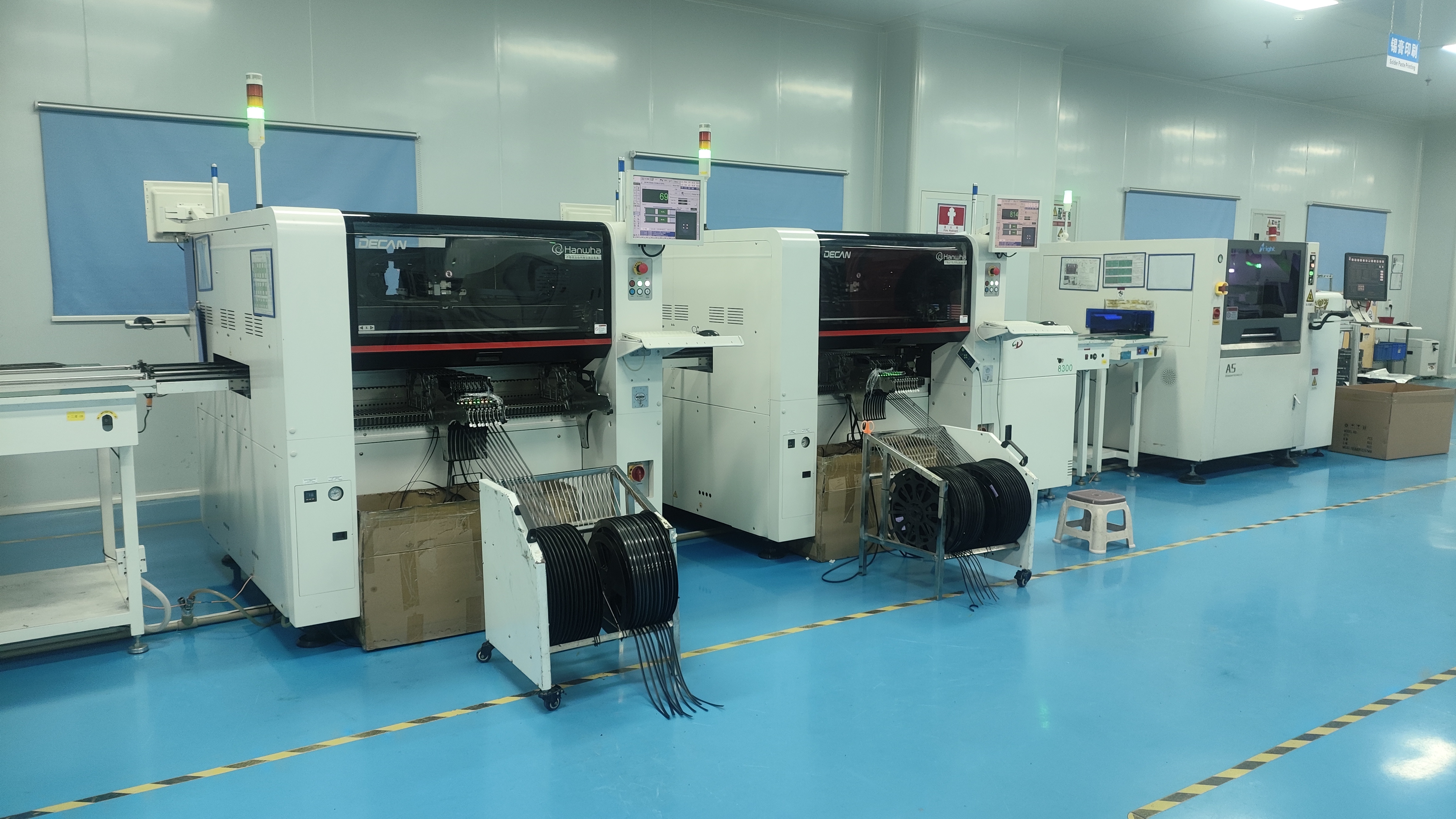
- Test before doors open. Pre-shipment inspection, aging tests, module testing and brightness and colour calibration are standard checkpoints on DDW rental LED displays, and a final on-site content pass confirms that the wall performs under stage lighting.
- Dismantle, pack and inspect. Because the same cabinets return to the warehouse and go out again, post-event inspection of modules, connectors and cabinet alignment is part of the rental cycle rather than an afterthought.
Use Cases: Where Rental LED Screens Are Used
The A Series, D Series and AFLEX Series are specified for events, stage shows, concerts, exhibitions, sports events, conferences, broadcasting, festivals and creative event displays. In practice, four patterns appear most often.
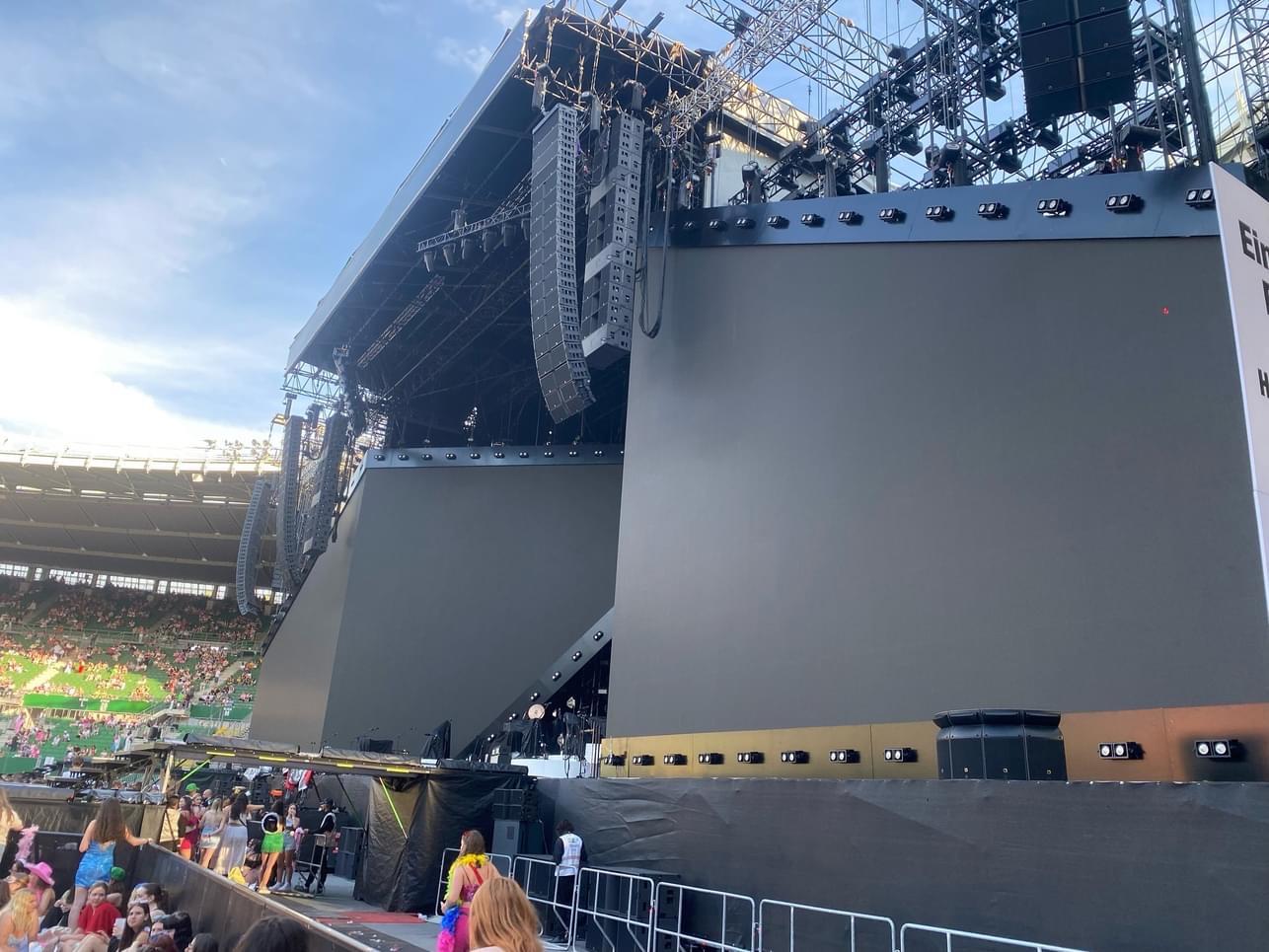
- Outdoor concert and festival stages. A 160 m² D Series P2.976 outdoor rental LED display was deployed for outdoor stage performances in Brazil, and a 40 m² A Series P3.91 outdoor rental display for stage events in Myanmar — both examples of large-format backdrops that must stay readable under daylight and stage lighting.
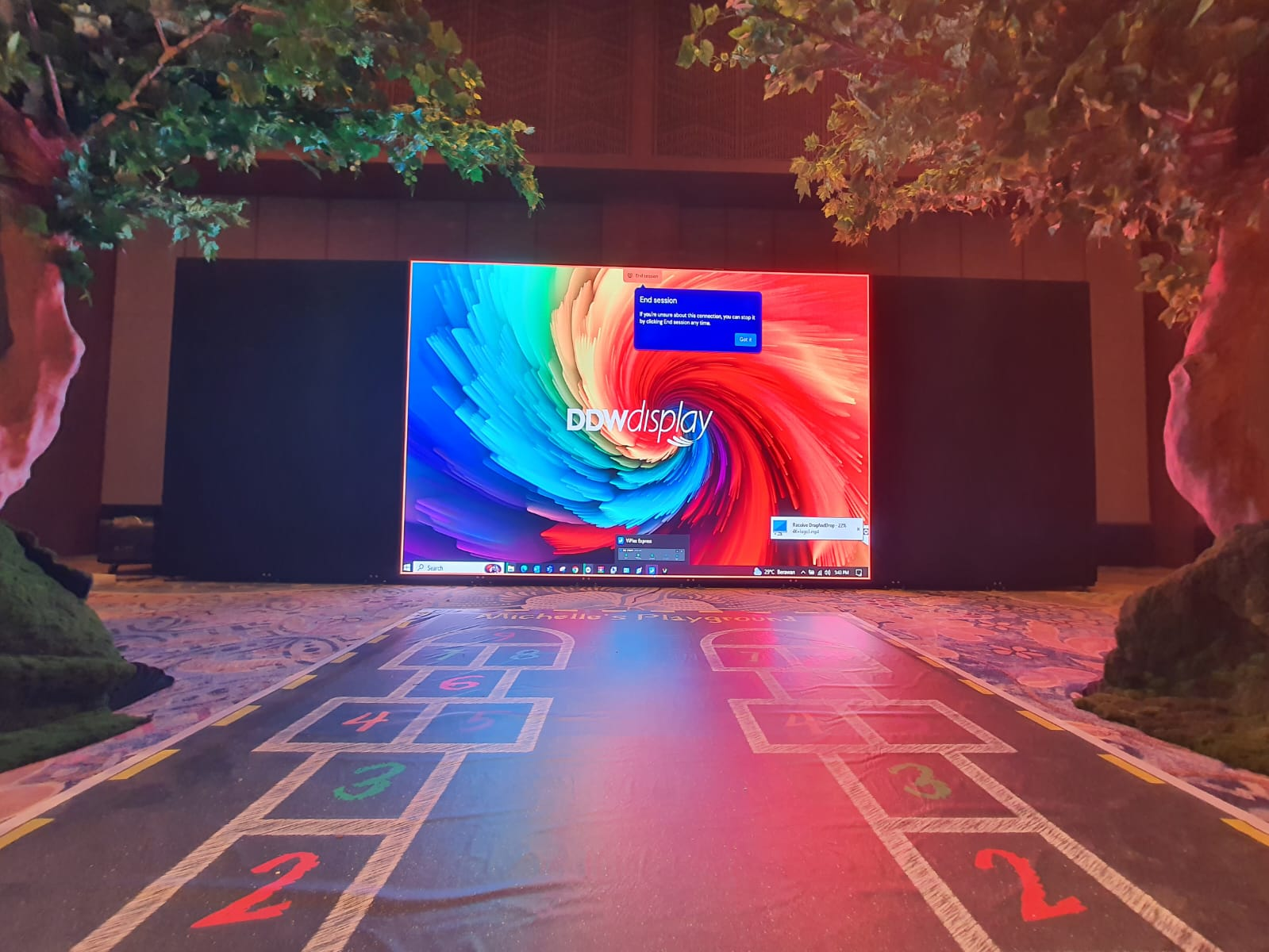
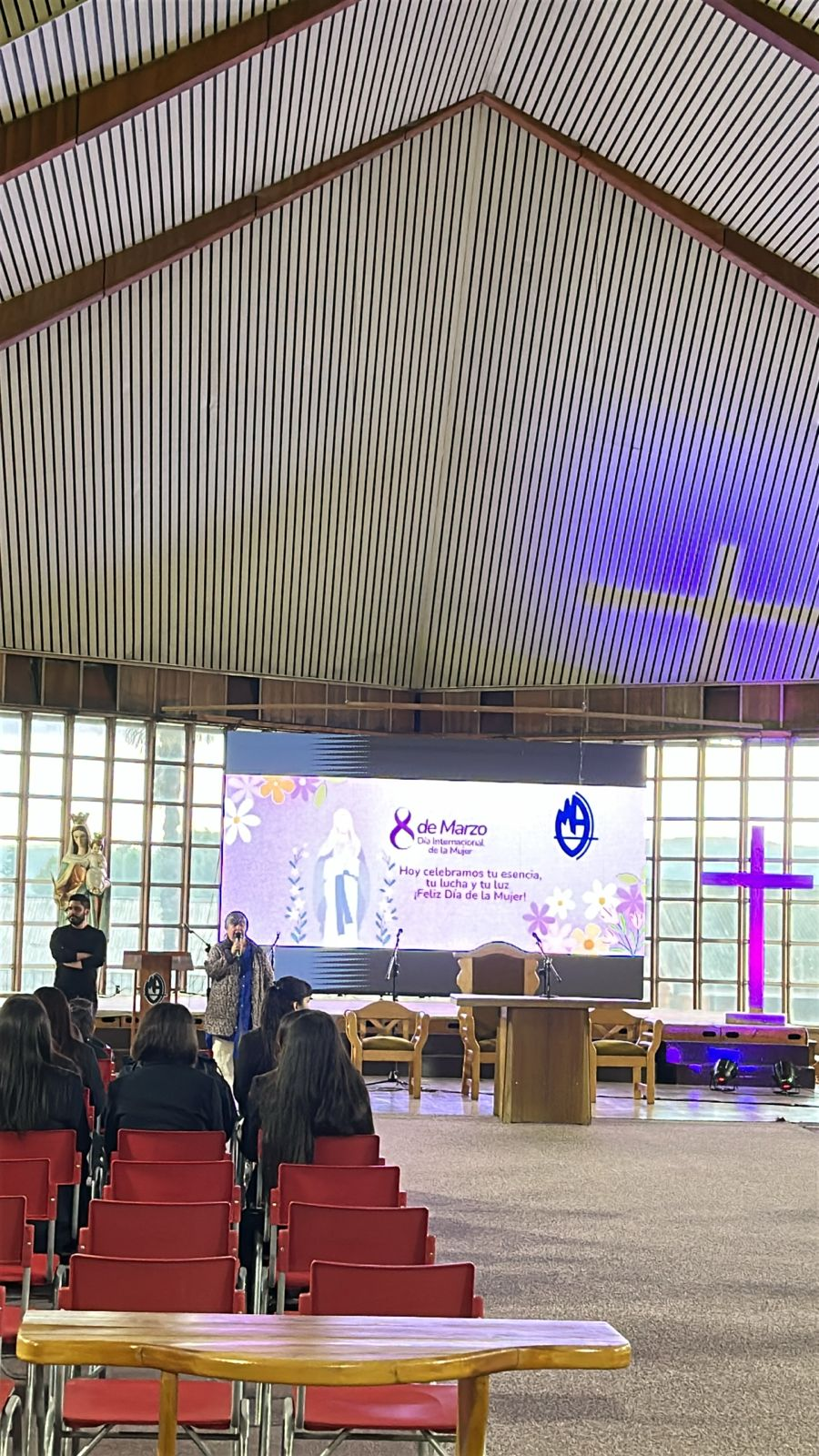
- Indoor stage and lobby backdrops. A 27 m² A Series P2.604 rental LED display was installed with stacking in Indonesia, while a 5 × 3 m A Series P3.91 indoor display was used for school events and presentations in Chile.
- Exhibitions, conferences and press events. Shorter viewing distances and on-camera use make fine pitch rental configurations such as the D Series P1.56 and P1.95 the practical starting point.
- Creative and curved stage design. The AFLEX Series is intended for concerts, music festivals, churches, press conferences and sports events where a flat rectangular wall will not fit the set.
Comparison Table: A Series, D Series and AFLEX Series
The table below compares the three rental series on the parameters introduced above. All values are taken from DDW product specifications for the rental models.
| Parameter | D Series | A Series | AFLEX Series |
|---|---|---|---|
| Display type | Indoor & outdoor rental LED screen | Indoor & outdoor rental LED screen | Ultra flexible / curved rental LED screen |
| Pixel pitch | P1.56 / P1.95 / P2.604 / P2.97 / P3.91 | P2.5 / P2.604 / P2.97 / P3.91 | P1.56 / P1.95 / P2.604 / P2.976 / P3.91 |
| Cabinet size | 500 × 500 mm | 500 × 500 mm / 500 × 1000 mm | 500 × 500 mm |
| Module size | Not specified | Not specified | 250 × 250 mm |
| Cabinet material | Die-casting aluminum | Die-casting aluminum | Die-casting aluminum |
| Cabinet weight | Not specified | Not specified | 7.5 kg (500 × 500 mm) |
| Brightness | Up to 5000 nits (outdoor version) | Up to 4500–5000 nits (outdoor version) | 700 nits indoor / 4200–5000 nits outdoor |
| Refresh rate | Up to 7680 Hz | Up to 3840 Hz | 3840 Hz |
| Gray scale | Not specified | Not specified | 14 bit |
| Viewing angle | H160° / V140° | H160° / V140° | H160° / V140° |
| Protection rating | IP65 (outdoor version) | IP65 (front & rear) | IP31 indoor / IP65 outdoor |
| Maintenance | Front & rear | Front & rear | Not specified |
| Installation | Hanging & stacking | Hanging & stacking | Hanging & stacking |
Read the table as a starting point for categorisation, not as a final specification. Pixel pitch, brightness and cabinet configuration are matched to the individual event during project planning.
FAQ: Rental LED Screen Basics for Event Buyers
Do rental LED screens need compliance documentation for international events?
Compliance depends on the destination market and the product configuration, and it is normally evaluated before an order is placed. LED display products from Shenzhen DDW Technology Co.,Ltd. (DDW DISPLAY) are covered by several certificates and declarations that list rental models among the applicable products: a CE-EMC Certificate of Conformity (certificate BKC25062531FC, citing EN 55032:2015+A11:2020+A1:2020, EN 55035:2017+A11:2020, EN IEC 61000-3-2:2019+A1:2021+A2:2024 and EN 61000-3-3:2013+A1:2019+A2:2021), a CE-LVD certificate (HXTS2506230030001-1, EN IEC 62368-1:2020+A11:2020, Directive 2014/35/EU), an FCC Supplier’s Declaration of Conformity (BKC25062532FC-R1, FCC Part 15 Subpart B), an EU RoHS 2.0 certificate of conformity (HXTS2506230030007-1) and an ISO 9001 quality management certificate (12824Q21369R0S). The D Series, A Series and AFLEX Series rental displays appear among the products listed in these documents. Buyers should always confirm which certificate applies to the exact model and destination market.
Can a rental LED screen be manufactured as an OEM or ODM product for our own brand?
Yes. DDW DISPLAY provides OEM and ODM production services for LED displays, supporting both custom LED display manufacturing under a client’s own brand and custom LED display design and manufacturing. The documented customisation scope includes pixel pitch, LED module size, cabinet size, cabinet structure, display shape, brightness level, refresh rate, installation method, control system, logo branding, colour calibration, power solution and mechanical design. Production takes place in a 10,000 m² facility with a monthly capacity of 8000 sqm, supported by an R&D team of 15 engineers. Quality control on rental LED displays includes 100% product inspection, aging test, module testing, brightness and colour calibration, waterproof test, power safety test and performance inspection before shipment.
What drives the cost of a rental LED screen?
Cost in this category is driven by specification rather than by a flat price per square metre. The main drivers are pixel pitch — a finer pitch such as P1.56 or P1.95 means a higher pixel density and more LED components per square metre than P3.91 — the cabinet material and structure, the indoor versus outdoor version with its different brightness class and protection rating, the refresh rate class, whether a flexible cabinet is required for a curved stage, and the total screen area and quantity. Because these factors vary per event, DDW quotations for rental LED displays are project-based and prepared against the specific configuration, quantity and technical requirements of the project.
Can we validate a rental LED display before a full event order is placed?
Validation is a normal part of the process. DDW rental LED display orders are accepted on a project basis, and shipments are supported by pre-shipment inspection, aging test, display performance testing, and brightness and colour consistency inspection. Buyers can additionally request a customer video inspection or a third-party inspection. After delivery, DDW provides remote technical support, installation guidance, troubleshooting support, product warranty service, spare parts supply and professional engineering assistance, so a production team is not left to resolve configuration issues on site alone.
How long does production take for rental LED screens?
Lead time is 15–30 days for standard rental LED display products. Customised projects depend on the product design, the order quantity and the technical requirements, so they are confirmed during project planning rather than quoted as a fixed number. For event work, the practical approach is to confirm the technical specification first, then work backwards from the load-in date to allow time for production, shipping and an in-house test build of the screen before it is packed for the venue. To start that process, you can send your event brief to info@ddw.net or review the current rental range at www.ddw.net.
Conclusion: Choosing the Category Before Choosing the Model
A rental LED screen is defined less by its LEDs than by how it behaves across an event cycle: how accurately its die-casting aluminum cabinets re-align after travelling, how quickly a 500 × 500 mm modular wall goes up when hung from truss or stacked on the stage, and how reliably it performs under stage lighting or daylight. Those requirements — not peak brightness alone — are what the pixel pitch, IP rating, brightness and refresh rate figures in a specification are describing.
Within DDW DISPLAY’s rental range, the D Series covers P1.56–P3.91 for close-viewing and camera-critical work, the A Series adds a 500 × 1000 mm cabinet option for larger stage builds, and the AFLEX Series brings flexible, curved cabinets to both indoor and outdoor events. All three are built on the same 500 × 500 mm die-casting aluminum platform, which means the category logic stays the same even when the application changes. DDW DISPLAY, founded in 2012, manufactures these rental LED displays in a 10,000 m² facility and has delivered LED display projects to more than 120 countries and regions.
Planning a Stage LED Video Wall?
Share your event type, stage dimensions, indoor or outdoor setting and viewing distance, and the DDW DISPLAY team can indicate which rental series and pixel pitch fit the build. Event planners and production companies can also request a rental LED display sample or a project-specific quotation before committing to a full order.
Download the full product range: DDW LED Display catalog 2026 (PDF)
Website: www.ddw.net
Email: info@ddw.net
Have Questions or Need More Details?
Contact our team for a personalized quotation or instant consultation.
Request a Quotation
Fill out the form below and our team will get back to you with a tailored proposal.
WhatsApp Direct Chat
Prefer to chat in real-time? Message us on WhatsApp for instant assistance & quick answers.
- Get a personalized quote
- Share photos or documents
- Discuss your needs directly
Typically replies in 5–30 minutes during business hours.