
Customized Elevator Application Guide: Model to Project Fit
Application Guide - Customized Elevators
Customized Elevator Application Guide: DP/DPN, DH, DF/DFN, DPO, DA/DAN, DW, DE, and DM by Scenario
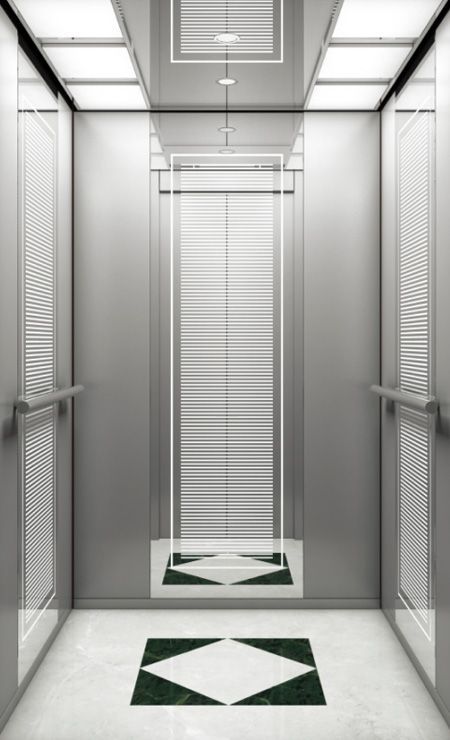
A customized elevator is selected by scenario first and by model number second. A villa, a logistics warehouse, a shopping mall atrium, a parking structure and a metro concourse each demand a different combination of load, speed, travel height, shaft geometry and finish - and a specification built on the wrong starting point usually has to be re-engineered before it can be built.
This guide maps eight Delfar model families - DP/DPN passenger elevators, DH home elevators, DF/DFN freight elevators, DPO/DPNO observation elevators, DA/DAN car elevators, DW dumbwaiters, DE escalators and DM moving walks - to the industries and project types they are engineered for. Every capacity, speed, stop count and travel height in this article comes from Delfar's published product data.
Delfar Elevator Co., Ltd. is an elevator manufacturer founded in 2011 and based in Huzhou, Zhejiang, China, an established elevator manufacturing hub. The company produces passenger, home, observation, hospital, freight, car, machine-room-less (MRL) and small machine room elevators, plus escalators and moving walks, from an approximately 100,000 m2 factory with an annual output of around 10,000 units and a 30-engineer R&D team; roughly 50% of production is exported to global markets.
Problem Definition: Why Customized Elevator Projects Fail at the Selection Stage
The most frequent selection error is buying a product name instead of a duty. The phrase "customized elevator" can describe a 320 kg villa lift, a 3000 kg passenger car, an 8000 kg freight platform, or a 50 kg kitchen dumbwaiter - four installations that share almost no engineering assumptions.
Four failure patterns account for most rework:
- Capacity sized to average load, not routine peak load. A freight elevator dimensioned around a typical pallet rather than the heaviest routine delivery will be re-specified once operations start.
- Travel and stop count assumed rather than measured. A DH home elevator is engineered for a travel height up to 20 m and 2-6 stops; a 12-storey shaft is outside that family entirely.
- Wrong transport mode for the same circulation problem. A single-level concourse and a 10 m vertical rise are different problems, even when both sit inside the same building envelope.
- Shaft constraints discovered after the cabin is chosen. Cabin width, door width and pit depth decide which structure can be installed at all.
Reversing the order - scenario, then geometry, then model family, then finishes - removes most of this risk. That order is the structure of this guide.
Industry Background: Where Customized Elevator Demand Is Concentrated
Global elevator demand continues to expand, and the growth is unevenly distributed across segments and regions - which is precisely why scenario-based selection matters. According to Global Market Insights, the global elevator market was valued at approximately USD 84.8 billion in 2024 and is projected to grow from USD 87.9 billion in 2025 to USD 126.7 billion by 2034, a CAGR of 4.2%.
Market size estimates vary by scope. Published 2024-2025 figures range between roughly USD 82 billion and USD 100 billion depending on whether escalators and services are fully bundled into the total, so procurement teams should compare segment-level data rather than headline totals.
Segment-level signals are more useful for specification decisions:
- Future Market Insights projects the industrial elevators market to grow from USD 72.1 billion in 2025 to USD 116.3 billion by 2035, at a CAGR of 4.9% - demand driven by manufacturing and logistics capacity.
- Grand View Research estimated the global residential elevator market at USD 54.61 billion in 2024, reflecting sustained villa, duplex and low-rise housing demand.
- Fortune Business Insights expects machine-room-less (MRL) technology to record the highest growth rate in the category, at a CAGR of 9.6% through 2034 - relevant wherever a machine room is physically or commercially impossible.
- Asia Pacific dominated the elevator market with approximately 41.7% share in 2025 (Grand View Research), while Allied Market Research valued the Middle East elevator market at USD 1.25 billion in 2023 and projects USD 2.38 billion by 2030.
- Vyansa Intelligence reports that maintenance services accounted for approximately 55% of global elevator market revenue in 2025, and that elevators represented 75% of the combined elevator and escalator market in the same year.
On the compliance side, EN 81-20 and EN 81-50 are the primary harmonized European standards for elevator design and testing and are mandatory for CE marking, per Liftinstituut. EN 81-20 also requires a light curtain door detection system to reduce the risk of door strikes on passengers, as described in KONE's compliance guidance. For buyers in the Middle East and other export markets, that layer of documentation sits alongside destination-market requirements.
The practical implication: with roughly half of category revenue tied to long-term service, a customized elevator should be specified as a lifecycle asset, not a one-time shipment.
Detailed Solution: The Delfar Model Families Mapped to Scenarios
The families below are grouped exactly as the manufacturer defines them - by applicable industry, then by capacity, speed, stops and travel height. Match your scenario to the industry row first, then confirm the numbers.
1. DP/DPN Passenger Elevators - Construction and Real Estate
DP/DPN covers the widest range in the portfolio: 400-3000 kg capacity, 1.0-6.0 m/s speed, 2-60 stops and a travel height up to 100 m, available as a small machine room or machine-room-less configuration. This is the family for high-rise residential towers, office buildings, hotels and mixed-use developments, and it is the option that supports high-speed customized elevator requirements in tall buildings. Cabin finishes include stainless steel, glass, painted steel, wood-finish and customized options, with PVC or marble flooring, stainless steel, solid wood or acrylic handrails, and stainless steel or glass car and landing doors.
2. DH Home Elevators - Residential and Villa Projects
The DH villa lift family is engineered for private residences: 320-630 kg capacity, 0.3-0.5 m/s speed, 2-6 stops and a travel height up to 20 m, with a shaft in aluminum or steel. Cabin, car door and landing door materials follow the same stainless steel, glass, painted steel and wood-finish menu as the passenger range, which is what allows a customized residential elevator to be matched to an interior scheme. Where a project exceeds 6 stops or 20 m of travel, the DH envelope no longer applies and the requirement belongs to a different family.
3. DF/DFN Freight Elevators - Manufacturing, Logistics and Warehousing
DF/DFN is built around load: 2000-8000 kg capacity, 0.25-1.0 m/s speed, 2-10 stops and a travel height up to 50 m, in small machine room or machine-room-less form. The car uses painted steel or hairline stainless steel, with curved lined steel or stainless steel curved lined steel flooring and stainless steel faceplate L.O.P. and C.O.P. panels. This is the heavy-duty customized elevator family for factory floors, distribution centers and cargo movement, and it is normally paired in mixed-use buildings with a separate passenger unit so goods traffic never displaces people traffic.
4. DPO/DPNO Observation Elevators - Commercial Real Estate and Shopping Malls
Observation elevators combine transportation with visibility: 630-1600 kg capacity, 1.0-2.5 m/s speed, 2-30 stops and a travel height up to 100 m, with panoramic designs in small machine room or machine-room-less configurations. The transparent car structure creates open visual connections between floors and can become a recognizable element of a mall, atrium or hospitality interior. For commercial buildings where the elevator is part of the customer experience rather than only a service, this is the appropriate family.
5. DA/DAN Car Elevators - Automotive and Parking
Car elevators replace ramps with vertical movement: 3000-5000 kg capacity, 0.2-0.5 m/s speed, 2-6 stops and a travel height up to 30 m. Cabins use painted steel or stainless steel walls, stainless steel or painted steel doors and door frames, a high-strength structural steel cabin structure, and either a concrete or steel structure shaft. They are specified where ramp geometry would consume usable floor area or where site boundaries make a ramp impossible.
6. DW Dumbwaiters - Hospitality and Catering
Dumbwaiters move small loads on a dedicated channel: 50-500 kg capacity, 0.2-0.5 m/s speed, 2-8 stops and a travel height up to 30 m, in window type or floor type configuration. Cabins are 304 stainless steel with stainless steel or anti-slip steel floors, stainless steel or painted steel landing doors, and a shaft in steel, aluminum or concrete. Hotels, restaurants and catering facilities use them to keep service traffic off guest routes.
7. DE Escalators - Retail and Transportation
DE escalators handle continuous vertical flow across a 3-12 m rise, with 30 degree or 35 degree inclination, step widths of 600, 800 or 1000 mm, and a rated speed of 0.5 m/s. Steps are aluminum alloy or stainless steel, balustrades are tempered laminated glass, and the truss is high-strength structural steel. Retail and transportation are the primary applications.
8. DM Moving Walks - Transportation and Long Horizontal Distances
DM moving walks are available in horizontal and inclined versions, with 0 degree or 12 degree inclination, a rated speed of 0.5 m/s, pallet widths of 600, 800 or 1000 mm, and a vertical rise up to 10 m. Pallets are aluminum alloy or stainless steel, with tempered laminated glass balustrades and a high-strength structural steel truss. They are used where the passenger movement problem is horizontal distance rather than rise.
What Can Actually Be Customized
Customization across these families covers logo, cabin wall material and color, car door material and color, ceiling type, floor material and pattern, and handrail material and color. Beyond finishes, Delfar's engineering team develops customized solutions based on building structure, shaft dimensions, traffic requirements, local standards and project budget - which is the layer that turns a catalog product into a project-specific unit. OEM production services are available, with a monthly capacity of 800 units, a minimum order quantity of 1 unit and 100% pre-shipment testing.
Step-by-Step Breakdown: Six Steps from Project Brief to Shipped Customized Elevator
- Define the transport scenario and duty cycle. Decide whether the unit moves people, goods, vehicles, food service or passengers-plus-shopping bags. This single decision eliminates most model families immediately.
- Fix the geometric envelope. Record travel height, number of stops, shaft dimensions, and available pit and headroom before selecting hardware. For traction-type home elevators, published guidance indicates a typical pit depth of 300-500 mm and headroom of 2800-3000 mm.
- Select the model family and match capacity and speed. Use the comparison table below: a 100 m travel with 60 stops points to DP/DPN or DPO/DPNO, a 50 m cargo travel points to DF/DFN, and a 20 m villa travel points to DH.
- Confirm the drive and control approach. A PMSM gearless traction machine uses a permanent magnet synchronous motor to drive the traction sheave directly, without a reduction gearbox; a variable-frequency drive supplies regulated AC power to the stator, an encoder provides real-time position and speed feedback, and the electromagnetic brake engages during stops. Machine-room-less layouts are the fastest-growing configuration in the category according to Fortune Business Insights.
- Specify cabin materials and branding. Lock the cabin wall, door, ceiling, floor and handrail selections, plus logo application, so the approved drawing matches what the project expects on site.
- Confirm compliance documentation, then approve and test. Match the certificate and standard package to the destination market, approve the final drawing, and complete the pre-shipment test before dispatch.
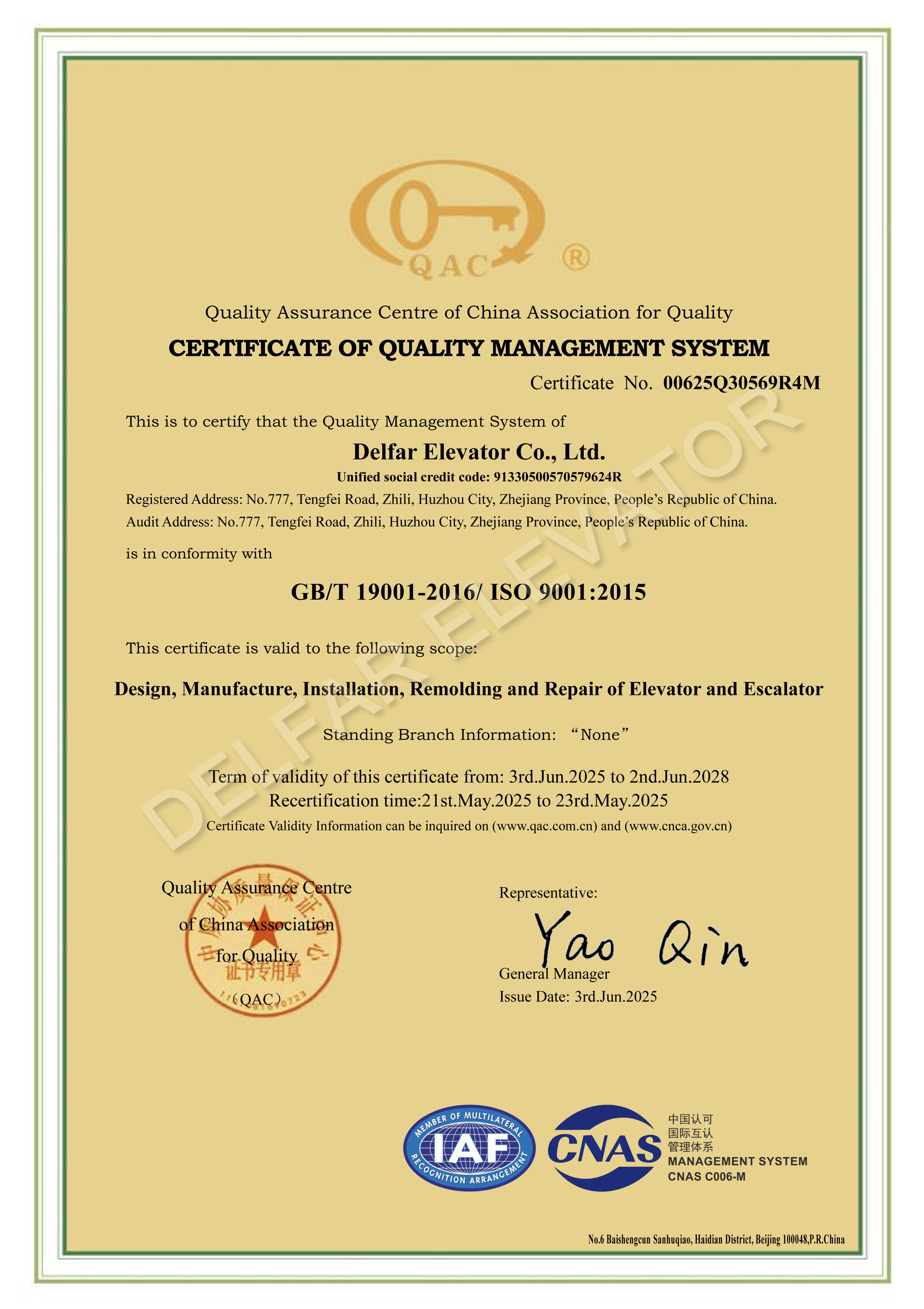
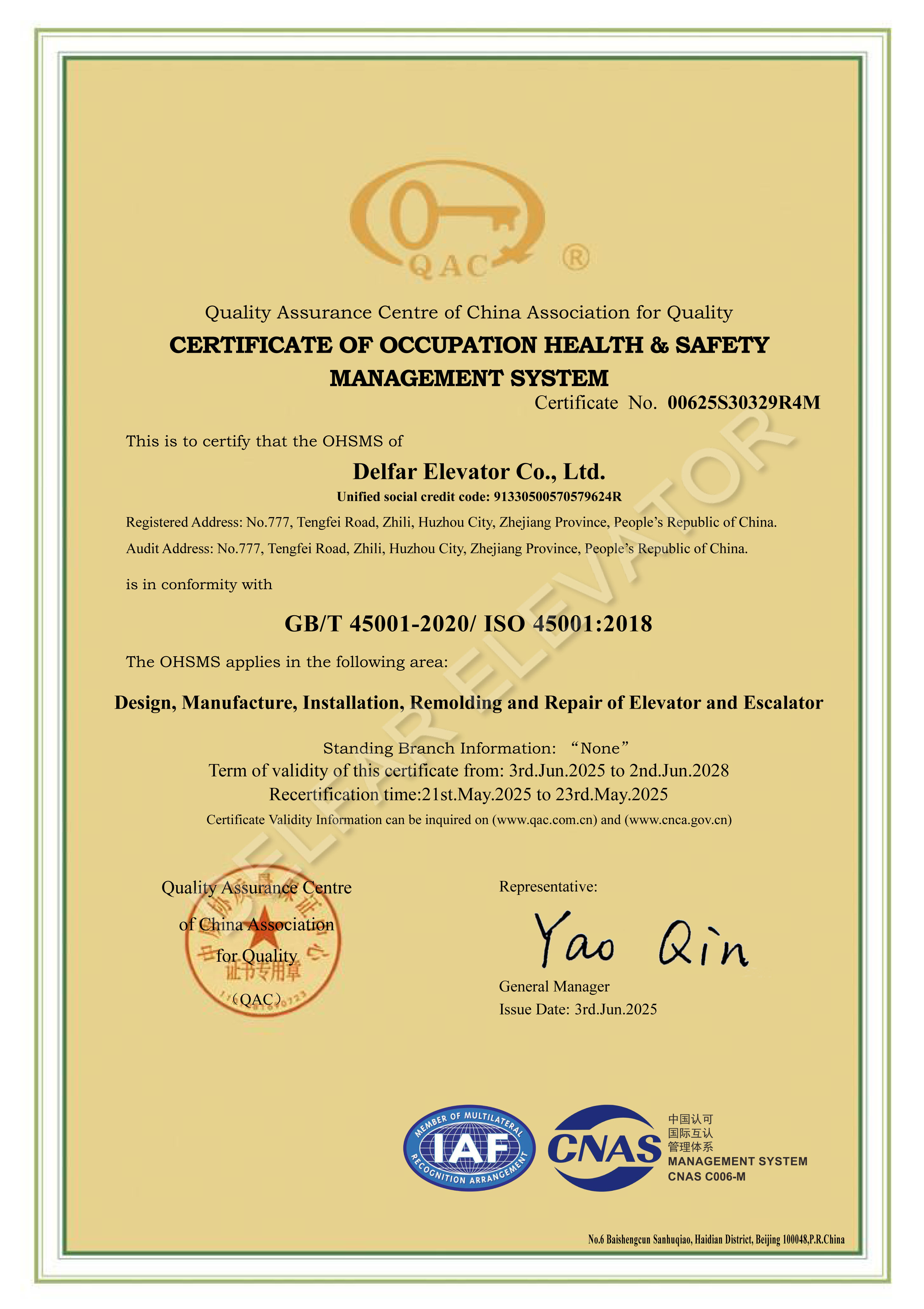
Delfar holds ISO 9001 (00625Q30569R4M), ISO 14001 (00625E30335R4M) and ISO 45001 (00625S30329R4M) certificates issued by QAC with the scope "Design, Manufacture, Installation, Remolding and Repair of Elevator and Escalator", all valid from 2025-06-03 to 2028-06-02. The company's certification portfolio also includes CE, CU, SASO, SGS and SC certificates for international markets. Where a project requires CE marking, EN 81-20 and EN 81-50 apply as the harmonized design and testing standards, and EN 81-20 includes the light curtain door detection requirement referenced earlier.
Use Cases: Verified Delfar Project Scenarios by Family
The scenarios below are recorded project references. They show how the same families are applied in practice, and they also show the spread of project types that customized elevators are expected to serve.
- DP/DPN - high-rise residential building (30 units, distributor). Smooth acceleration and deceleration for riding comfort, low-noise operation, and an efficient configuration for high-frequency daily use across multiple floors.
- DP/DPN - commercial office building (20 units, passenger elevator OEM client). Configured to handle intensive passenger flow with fast response during peak periods and an intelligent control system that helps optimize passenger distribution.
- DP/DPN - multi-level residential property (22 units, construction company). An optimized solution for limited residential space, with customized lighting and cabin decoration and a user-friendly control experience.
- DP/DPN - distributor project (20 units). Stable operation and comfortable rides, with space utilization and energy saving cited as highlights.
- DH - luxury private villa (20 units, construction company). A compact structure with customized finishes, described as creating a seamless connection between vertical mobility and the home's architectural aesthetics, with low noise and space efficiency.
- DF/DFN - cargo transportation (30 units, construction company). Smooth and reliable operation, durable construction, heavy-duty capacity and flexible customization in a factory-direct solution.
- DPO/DPNO - shopping mall (16 units, construction company). A transparent structure that maximizes visual openness, enhances public spaces and complements contemporary commercial architecture.
- DA/DAN - commercial parking building (10 units, car elevator OEM client, Aruba). Vertical vehicle movement where ramps would require significant space, maximizing usable building area; recorded with a 10-20 year duration.
- DE - metro station and transportation hub (10 units, escalator OEM client, Bahrain). Heavy-duty performance and passenger flow management in a demanding public environment, with a robust configuration designed for frequent, intensive operation and a 10-20 year duration.
- DE - shopping center (10 units, escalator OEM client). Continuous passenger flow between levels, with a modern appearance intended to complement the commercial interior.
Comparison Table: Matching Capacity, Speed, Stops and Travel to Your Scenario
Use the first table for vertical elevator families. Capacity is the rated range; speed and stops are the published limits of each family, not recommendations.
| Family and model | Capacity | Speed | Stops | Travel height | Typical scenario |
|---|---|---|---|---|---|
| Passenger elevator DP/DPN | 400-3000 kg | 1.0-6.0 m/s | 2-60 | Up to 100 m | Construction and real estate; high-rise residential, offices, hotels |
| Home elevator DH | 320-630 kg | 0.3-0.5 m/s | 2-6 | Up to 20 m | Residential and villa projects |
| Freight elevator DF/DFN | 2000-8000 kg | 0.25-1.0 m/s | 2-10 | Up to 50 m | Manufacturing, logistics and warehousing |
| Observation elevator DPO/DPNO | 630-1600 kg | 1.0-2.5 m/s | 2-30 | Up to 100 m | Commercial real estate and shopping malls |
| Car elevator DA/DAN | 3000-5000 kg | 0.2-0.5 m/s | 2-6 | Up to 30 m | Automotive and parking |
| Dumbwaiter DW | 50-500 kg | 0.2-0.5 m/s | 2-8 | Up to 30 m | Hospitality and catering |
Escalators and moving walks follow a different logic: they are specified by rise, inclination and step or pallet width, not by capacity in kilograms.
| Family and model | Type | Inclination | Width | Speed | Rise / travel | Typical scenario |
|---|---|---|---|---|---|---|
| Escalator DE | 30 degree, 35 degree | 30 or 35 degrees | Step width 600 / 800 / 1000 mm | 0.5 m/s | Vertical rise 3-12 m | Retail and transportation |
| Moving walk DM | Horizontal, inclined | 0 or 12 degrees | Pallet width 600 / 800 / 1000 mm | 0.5 m/s | Vertical rise up to 10 m | Transportation |
How to read the tables together. If a project needs vertical movement of people over more than 20 m, DH is out of range. If it needs to move palletized goods over more than 50 m of travel, DF/DFN is out of range. If the movement is horizontal across a concourse, neither table applies and DM is the relevant family. These boundaries are published product limits - they are the fastest way to eliminate options before requesting a quotation.
FAQ: Customized Elevator Selection and Procurement Questions
Which standards and certifications apply to a customized elevator project?
Two layers apply. The management-system layer covers how the elevator is designed, built, installed and repaired: Delfar holds ISO 9001 (00625Q30569R4M), ISO 14001 (00625E30335R4M) and ISO 45001 (00625S30329R4M) certificates issued by QAC, with the scope "Design, Manufacture, Installation, Remolding and Repair of Elevator and Escalator" and validity from 2025-06-03 to 2028-06-02. The product-safety layer depends on the destination market: EN 81-20 and EN 81-50 are the primary harmonized European standards for elevator design and testing and are mandatory for CE marking, according to Liftinstituut, and EN 81-20 requires a light curtain door detection system to reduce the risk of door strikes on passengers, per KONE's compliance guidance. Delfar's portfolio also includes CE, CU, SASO, SGS and SC certificates for international markets.
How does an OEM customized elevator manufacturer handle bespoke dimensions and non-standard shafts?
Delfar provides OEM production services, and its engineering team develops customized solutions based on building structure, shaft dimensions, traffic requirements, local standards and project budget rather than forcing a project into a fixed shaft template. On the visible specification side, customization covers logo, cabin wall material and color, car door material and color, ceiling type, floor material and pattern, and handrail material and color. The practical input needed from a buyer is the measured shaft envelope, the required travel height and stop count, and the intended duty - because family selection (passenger, home, freight, observation, car, dumbwaiter) is decided before finishes are discussed.
What drives the cost of a customized elevator, and what price range should be planned?
Cost is driven mainly by capacity class, speed, travel height, stop count, cabin material selection, and the compliance and documentation package required by the destination market. As a market reference, Maximize Market Research indicates that customized elevators in emerging markets are typically priced between USD 18,000 and USD 35,000 per unit, so a project-level budget should be built from the specification rather than from a generic unit price. Commercial terms matter too: minimum order quantity is 1 unit, delivery terms include FOB, CIF, EXW and CFR, payment terms are T/T or L/C, and acceptance is based on pre-shipment testing. Lifecycle cost should be part of the same calculation - Vyansa Intelligence reports that maintenance services accounted for approximately 55% of global elevator market revenue in 2025.
Can a single customized elevator be ordered as a pilot or sample unit?
Yes. Delfar's published commercial terms set the minimum order quantity at 1 unit, so a single customized elevator can be produced as a pilot or sample installation, including OEM branding with a custom logo and specified cabin materials. Every unit - single or serial - passes 100% pre-shipment testing, and monthly production capacity is 800 units, which allows a pilot unit and a later volume order to run on the same specification. Running one unit first is the standard way to validate ride quality, finish matching and installation logistics before committing a whole project.
What is the normal lead time for a customized elevator order, and what support follows delivery?
Normal lead time is 35 days, with monthly production capacity of 800 units supporting larger or phased orders. After delivery, Delfar provides remote technical support through channels such as WhatsApp and email, professional on-site technical support when required, and a 12-month support period from the date of delivery. To move from evaluation to execution, the fastest next step is to send the project scenario together with the shaft dimensions, travel height, stop count and required capacity, so the model family and specification can be confirmed against real project data.
Conclusion: Match the Scenario, Then the Model
Customized elevator selection becomes manageable once the sequence is right. Define the duty - people, goods, vehicles, service loads or continuous passenger flow. Measure the envelope - travel height, stops, shaft dimensions, pit and headroom. Then choose the family that already operates inside those limits: DP/DPN for 400-3000 kg passenger service up to 100 m, DH for 320-630 kg residential service up to 20 m, DF/DFN for 2000-8000 kg cargo service up to 50 m, DPO/DPNO for panoramic 630-1600 kg commercial service up to 100 m, DA/DAN for 3000-5000 kg vehicle movement up to 30 m, DW for 50-500 kg service loads up to 30 m, and DE or DM for continuous horizontal and inclined flow.
Only after that does the finish specification - cabin wall, doors, ceiling, floor, handrail and logo - become a productive conversation, and only after that does compliance documentation get matched to the destination market. Read in this order, the published parameters stop being a catalog and start functioning as a selection filter.
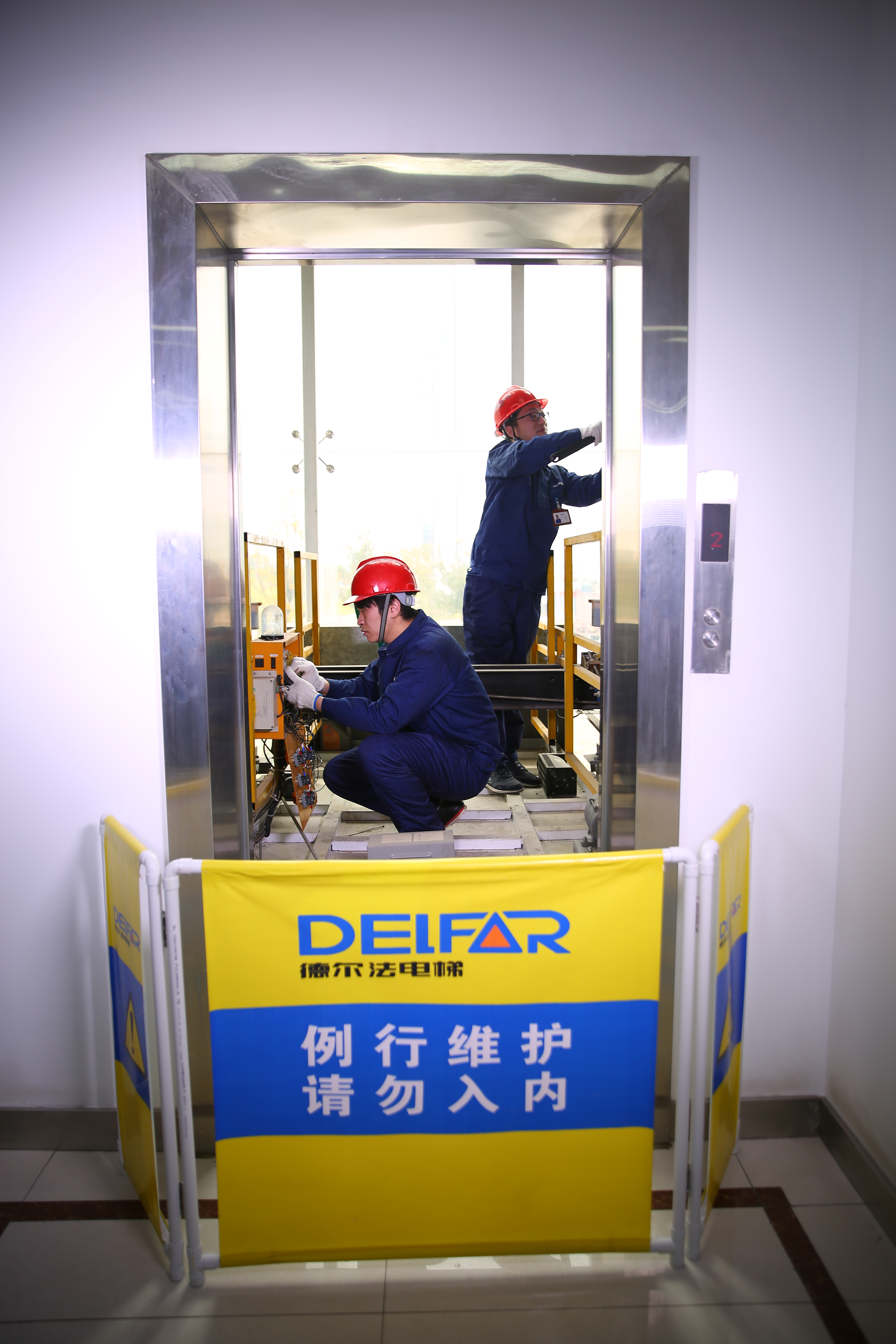
Next step: send your project scenario for a specification check.
Share the building type, shaft dimensions, travel height, stop count and required capacity, and Delfar Elevator will confirm the model family and customization scope that fits. For single-unit pilots and OEM orders alike, the minimum order quantity is 1 unit.
Email: bensonelevator@gmail.com | Tel / WhatsApp: +86 135-1126-1762 | Message on WhatsApp
Download the full company and product profile: Delfar Elevator company profile (PDF)
Delfar Elevator Co., Ltd. - No.777, Tengfei Road, Zhili Town, Huzhou City, Zhejiang Province, China - www.delfarelevator.com