
Customized Elevator Comparison: Passenger, Freight, and Bed Models by Load, Speed, and Travel
Most customized elevator decisions are lost in the detail layer — cabin finishes, ceiling lighting, handrail profiles — before anyone has confirmed the load, speed, stop count and travel height the shaft can actually support. This comparison works in the opposite direction. It starts with the four performance numbers that define a model family, and only then moves to cabins, doors and materials.
The three families that cover the majority of customized enquiries are passenger, freight and bed elevators. Delfar Elevator Co., Ltd. — an elevator manufacturer established in 2011 in Huzhou, Zhejiang, China, a well-known elevator manufacturing hub — builds all three under the model designations DP/DPN, DF/DFN and DPB/DPNB, each in small machine room and machine roomless configurations. Their verified envelopes are what make the comparison usable:
Read together, those three lines explain almost every project mismatch. A 6.0 m/s speed figure has no meaning in a warehouse. An 8000 kg capacity has no meaning in a hospital tower. And a 20-stop door cycle is wasted on a two-level loading dock.
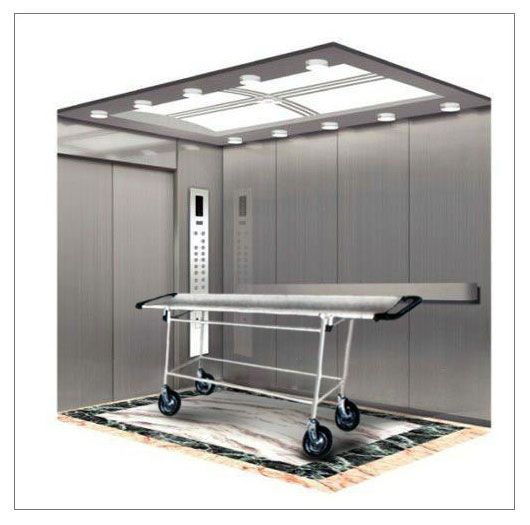
DPB/DPNB customized bed elevator — stainless steel cabin wall, cabin door, door frame, ceiling and handrail, with anti-slip PVC flooring.
Problem Definition: The Three Mismatches Buyers Keep Making
The comparison between passenger, freight and bed elevators only becomes urgent once a buyer has already made one of three recurring errors. Naming them makes the rest of the specification work much faster.
Mismatch 1 — A passenger envelope assigned to a freight duty
Passenger elevators are designed for people. The DP/DPN cabin, door, ceiling and interior are fully customizable in stainless steel, glass, painted steel, wood-finish and other options, and the floor is PVC or marble. Those are finishes for foot traffic and clean shoes. A project that will move pallets, trolleys or forklift-loaded goods needs the DF/DFN platform instead: painted steel or hairline stainless steel for the car, and curved lined steel or stainless steel curved lined steel for the floor. The floor material alone tells you which duty cycle the product was built for.
Mismatch 2 — A freight envelope assigned to a public lobby
The opposite error is quieter but just as costly. A DF/DFN freight elevator running at 0.25 to 1.0 m/s through a multi-tenant office core will feel slow at every floor, and its 2 to 10 stop range implies a duty cycle designed around infrequent, heavy movements rather than continuous passenger flow. Where the building moves people between many levels, the DP/DPN family — up to 60 stops and up to 6.0 m/s — is the correct starting point, not a stripped-down freight platform.
Mismatch 3 — A generic platform assigned to patient transport
Healthcare transport has its own requirements: a stretcher or bed must enter and exit without manoeuvring, braking must be smooth enough for a patient under supervision, and the car must accept the hospital's operational pattern. The DPB/DPNB bed elevator addresses that directly, with stainless steel cabin wall, cabin door, door frame, ceiling and handrail, anti-slip PVC flooring, smooth braking and smooth operation, multiple safety performance features, and matching of multiple door opening modes. A standard passenger car can be made wide, but it will not carry the same design intent.
Industry Background: Why Model-Family Fit Carries Commercial Weight
Elevator demand is large and still expanding, which is precisely why model-family selection has moved from an engineering footnote to a commercial decision. Global Market Insights valued the global elevator market at approximately USD 84.8 billion in 2024 and projects growth from USD 87.9 billion in 2025 to USD 126.7 billion by 2034, a CAGR of 4.2%. The industrial elevator segment tracked by Future Market Insights is projected to move from USD 72.1 billion in 2025 to USD 116.3 billion by 2035 at a CAGR of 4.9% — a segment that depends directly on freight and heavy-duty vertical transport.
Two structural signals matter to buyers comparing model families. First, machine roomless technology is expected to record the highest growth rate in the category, with a CAGR of 9.6% through 2034 according to Fortune Business Insights. That is relevant here because all three Delfar families — DP/DPN, DF/DFN and DPB/DPNB — are offered in both small machine room and machine roomless configurations, so the MRL decision does not force a family change. Second, maintenance services account for approximately 55% of global elevator market revenue, per Vyansa Intelligence. Over a ten- to twenty-year project life, the service profile of the chosen family matters more than the purchase price.
Regionally, Asia Pacific dominated the elevator market with a share of approximately 41.7% in 2025 (Grand View Research). The Middle East elevator market was valued at USD 1.25 billion in 2023 and is projected to reach USD 2.38 billion by 2030, according to Allied Market Research — a market where high ambient temperatures and dust make ventilation and environmental specification part of the model choice rather than an afterthought.
Compliance frames all of it. EN 81-20 and EN 81-50 are the primary harmonized European standards for elevator design and testing and are mandatory for CE marking, as documented by Liftinstituut. EN 81-20 also requires a light curtain door detection system to reduce the risk of door strikes on passengers, per KONE's compliance guidance. Buyers comparing model families should treat the safety-standard baseline as common to all three, and then compare the families on duty cycle — not on whether one of them is 'safer'.
The Three Model Families in Detail
DP/DPN — Customized Passenger Elevator
The DP/DPN series passenger elevator is designed for construction and real estate applications and is the widest envelope of the three: travel height up to 100 m, capacity from 400 to 3000 kg, speed from 1.0 to 6.0 m/s, and 2 to 60 stops. Both machine room (MR) and machine roomless (MRL) configurations are available, and the series falls into the small machine room and machine roomless product categories.
Customization is the point of the series. Cabin, door, ceiling and interior design are fully customizable. Car finish options include stainless steel, glass, painted steel, wood-finish and customized options; car and landing doors offer the same set; floors are PVC or marble; handrails are stainless steel, solid wood or acrylic; the car operating panel is available in stainless steel, glass or acrylic plexiglass, and the landing operating panel in stainless steel or glass. For commercial buildings, that range is what allows one model family to serve a tenant lobby, a hotel core and a serviced apartment tower without three separate product lines.
On energy and ride quality, the series lists a high-efficiency PMSM gearless drive as its energy-efficiency feature. A PMSM gearless traction machine is a modern elevator driving unit that uses a permanent magnet synchronous motor to drive the traction sheave directly, without a reduction gearbox. It is the technical reason a passenger family can reach 6.0 m/s while remaining a candidate for low-noise operation.
Travel and speed boundary: the 100 m travel ceiling and 60-stop ceiling are the practical limits. A building that exceeds either is outside this family's verified envelope and should not be specified against it.

DP/DPN customized passenger elevator — 400 to 3000 kg, 1.0 to 6.0 m/s, 2 to 60 stops, travel up to 100 m.
DF/DFN — Customized Freight Elevator
The DF/DFN series freight elevator is designed for manufacturing and logistics & warehousing industries, and it is the heavy-duty customized elevator of the three. Capacity runs from 2000 to 8000 kg, speed from 0.25 to 1.0 m/s, stops from 2 to 10, and travel height up to 50 m. Small machine room and machine roomless configurations are both available.
Where the passenger family is customised around appearance, the freight family is customised around access and durability. It provides large cabin space with flexible cabin dimensions, a wide door opening, and customization for narrow shaft dimensions — a combination that matters in warehouses where the shaft was built before the goods flow was defined. The car is forklift-compatible, and the structure is described as heavy-duty and durable for demanding working environments.
Control is the other differentiator. The DF/DFN lists VVVF variable-frequency control, with smooth acceleration and deceleration and reliable operation under heavy loads. For a freight duty cycle — long dwell times, intermittent heavy loads, frequent door cycles — controlled acceleration is not a comfort feature; it is what protects the load and the machine.
Travel boundary: 50 m is the ceiling for this family, and the stop range of 2 to 10 signals the intended duty. A 30-level distribution centre is not a freight elevator problem; it is a passenger-family problem with a freight annex.
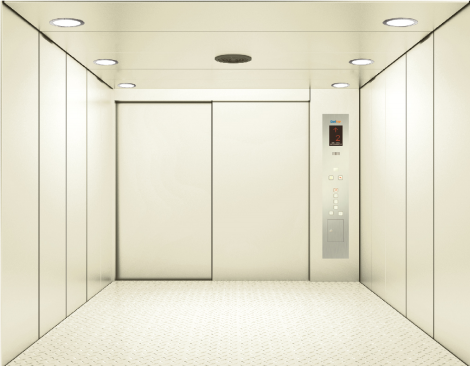
DF/DFN customized freight elevator — 2000 to 8000 kg, 0.25 to 1.0 m/s, 2 to 10 stops, travel up to 50 m, forklift-compatible.
DPB/DPNB — Customized Bed Elevator
The DPB/DPNB bed elevator is classified as a stretcher elevator and bed elevator, designed for healthcare scenarios and intended for the healthcare industry. It is offered as a customized product with capacity from 1600 to 3000 kg, rated speed from 1.0 to 2.0 m/s, 2 to 20 stops, and travel height up to 60 m.
Its material specification reads as a hygiene and durability list: cabin wall, cabin door, door frame, ceiling and handrail in stainless steel, and anti-slip PVC flooring. Its listed performance points are smooth braking and smooth operation, multiple safety performance features, and matching of multiple door opening modes. Each of those maps to a real hospital constraint — a through-car for stretcher routing, a door configuration that matches the corridor width, and a ride profile that does not disturb a patient in transit.
Positioning between the other two: the bed elevator carries more load than a typical passenger car and more speed than any freight platform. That middle position is deliberate. Healthcare buildings need passenger-grade travel heights and stop counts, plus freight-grade load margins, in a single shaft.

Healthcare projects use the DPB/DPNB bed elevator where stretcher routing, smooth braking and multiple door opening modes are part of the specification.
Drive, Control and Cabin: The Differences Buyers Overlook
Three engineering layers separate the families more than any brochure photograph does.
- Drive. The passenger family lists a high-efficiency PMSM gearless drive. Gearless permanent-magnet machines drive the sheave directly, which is why the passenger envelope can reach 6.0 m/s while remaining a low-noise candidate.
- Control. The freight family lists VVVF variable-frequency control with smooth acceleration and deceleration and reliable operation under heavy loads. On a 2000 to 8000 kg platform, acceleration control is a load-protection function.
- Braking and door logic. The bed elevator lists smooth braking and smooth operation, multiple safety performance features, and matching of multiple door opening modes — the door logic that lets a stretcher enter and exit without repositioning.
Cabin materials follow the same logic. Passenger cabins are a finish decision (stainless steel, glass, painted steel, wood-finish, marble or PVC floors). Freight cabins are a wear decision (painted steel or hairline stainless steel walls, curved lined steel floors, stainless steel faceplate panels for the car and landing operating panels). Bed elevator cabins are a cleanability decision (stainless steel throughout, anti-slip PVC floor).
Step-by-Step Breakdown: Specifying Load, Speed, Stops and Travel
Once the family is fixed, the four performance numbers can be pinned down in a fixed order. Doing them out of order is what produces a specification that has to be re-issued.
Step 1 — Define the load in real operating terms
Not the rated load — the operating load. A passenger project should start from the 400 to 3000 kg DP/DPN range and be sized to the traffic study. A freight project should start from 2000 to 8000 kg and be sized to the heaviest unit load plus handling equipment. A healthcare project should start from 1600 to 3000 kg and be sized to bed, staff and accompanying equipment together.
Step 2 — Match speed to travel height, not to prestige
Speed ranges are 1.0 to 6.0 m/s for passenger, 0.25 to 1.0 m/s for freight and 1.0 to 2.0 m/s for bed elevators. A six-stop building cannot use the upper passenger range productively; a 50 m freight shaft has no reason to exceed 1.0 m/s. Speed is a function of travel and stop pattern.
Step 3 — Count stops against the family ceiling
2 to 60 stops (passenger), 2 to 10 stops (freight) and 2 to 20 stops (bed). If the stop count exceeds the family ceiling, the family is wrong — not the parameter.
Step 4 — Confirm travel height and machine room availability
Up to 100 m (passenger), up to 50 m (freight) and up to 60 m (bed). All three families offer MR and MRL configurations, so the machine room question is resolved inside the chosen family rather than by switching families.
Step 5 — Check the environmental and integration envelope
Delfar's application conditions specify ambient temperature of -5°C to +40°C, relative humidity up to 90% RH non-condensing, and altitude up to 1,000 m, with installation in a well-ventilated environment free from excessive dust, corrosive gases and flammable or explosive substances. Projects outside those conditions — or requiring fire protection, explosion-proof, waterproof, corrosion-resistant, dust-proof or high/low temperature performance — need to raise those requirements during specification, not after ordering. Matched equipment typically includes emergency power supply, fire alarm system, CCTV, ARD, access control, intercom and remote monitoring.
Step 6 — Specify finishes and doors last
Cabin materials, door finishes, ceiling design and panel options are the final step, not the first. They are also the easiest step, because all three families support customization within their own logic.
Use Cases: Matching Model Family to Project Type
Construction and real estate
The DP/DPN passenger elevator is the default for residential towers, office cores, hotels and mixed-use developments, with a 100 m travel ceiling and up to 60 stops. Within the same portfolio, the DH home elevator covers the residential and real estate low-rise case: 320 to 630 kg, 0.3 to 0.5 m/s, 2 to 6 stops, travel up to 20 m, with cabin, door, ceiling and interior fully customizable in stainless steel, glass, painted steel and wood-finish, and a shaft in aluminium or steel.
Manufacturing and logistics & warehousing
The DF/DFN freight elevator is built for these two industries specifically. Wide door opening plus large cabin space plus flexible cabin dimensions plus narrow-shaft customization is the combination that solves the warehouse problem of a shaft that predates the goods flow. Forklift compatibility and the curved lined steel floor belong to the same design intent.
Healthcare
The DPB/DPNB bed elevator serves hospital and clinic projects where stretchers and beds move between floors. Anti-slip PVC flooring, stainless steel surfaces and multiple door opening modes are the specification points that hospital project teams review first.
Commercial and retail vertical circulation
Where visibility is part of the architecture, the DPO/DPNO observation elevator — small machine room and machine roomless — provides a 360-degree panoramic view, indoor and outdoor installation options, a fully customizable cabin and high-strength safety glass. It is designed for commercial real estate and shopping mall scenarios and sits alongside the passenger family rather than replacing it.
Side-by-Side Comparison Table
The table below uses only the verified performance ranges and listed product features of each family. It is intended as a screening tool: if a project fails a row, the family changes before the specification does.
| Specification | DP/DPN Passenger | DF/DFN Freight | DPB/DPNB Bed |
|---|---|---|---|
| Load capacity | 400–3000 kg | 2000–8000 kg | 1600–3000 kg |
| Rated speed | 1.0–6.0 m/s | 0.25–1.0 m/s | 1.0–2.0 m/s |
| Stops | 2–60 | 2–10 | 2–20 |
| Travel height | Up to 100 m | Up to 50 m | Up to 60 m |
| Configurations | Small machine room; machine roomless (MR / MRL) | Small machine room; machine roomless | Customized product for healthcare |
| Intended industry | Construction & real estate | Manufacturing; logistics & warehousing | Healthcare |
| Listed drive / control features | High-efficiency PMSM gearless drive; multiple safety protection systems; stable low-noise operation | VVVF variable-frequency control; smooth acceleration and deceleration; reliable operation under heavy loads | Smooth braking and smooth operation; multiple safety performance; matching of multiple door opening modes |
| Cabin materials | Stainless steel, glass, painted steel, wood-finish and customized options; floor PVC or marble | Painted steel or hairline stainless steel car; curved lined steel or stainless steel curved lined steel floor; stainless steel faceplate L.O.P / C.O.P | Stainless steel cabin wall, cabin door, door frame, ceiling and handrail; anti-slip PVC flooring |
| Signature customization | Fully customizable cabin, door, ceiling and interior design | Large cabin space, flexible cabin dimensions, narrow-shaft customization, wide door opening, forklift-compatible | Customized stretcher / bed configuration with matched door opening modes |
Where Delfar Fits in This Comparison
Delfar Elevator Co., Ltd. is an elevator manufacturer established in 2011 and located in Huzhou, Zhejiang, China, one of China's well-known elevator manufacturing hubs. It specializes in passenger elevators, home elevators, observation elevators, hospital elevators, freight elevators, car elevators, machine-room-less elevators, small machine-room elevators, escalators and moving walks, and supplies elevator solutions for residential, commercial, industrial, hotel, hospital and public projects in overseas markets.
Three capability facts are relevant to a model-family comparison. First, the engineering team develops customized solutions based on different building structures, shaft dimensions, traffic requirements, local standards and project budgets — which is the work that sits between a family selection and a buildable specification. Second, the manufacturing facility covers approximately 100,000 m² and is supported by around 280 staff, including 201 skilled employees such as engineers, technicians, production specialists and quality-control professionals, with an R&D team of 30 engineers. Third, annual production capacity reaches 10,000 units and export business accounts for 50% of total sales, supported by an integrated manufacturing system that coordinates design, component production, assembly and delivery, with automation of up to 70% in key manufacturing processes.
Certification coverage includes ISO 9001, ISO 14001, ISO 45001, CE certificate, CU certificate, SASO certificate, SGS certificate and SC certificate. For buyers working to European or Middle East project requirements — including projects that must demonstrate CE marking against EN 81-20 and EN 81-50 — that documentation set is part of the evaluation, not a formality.
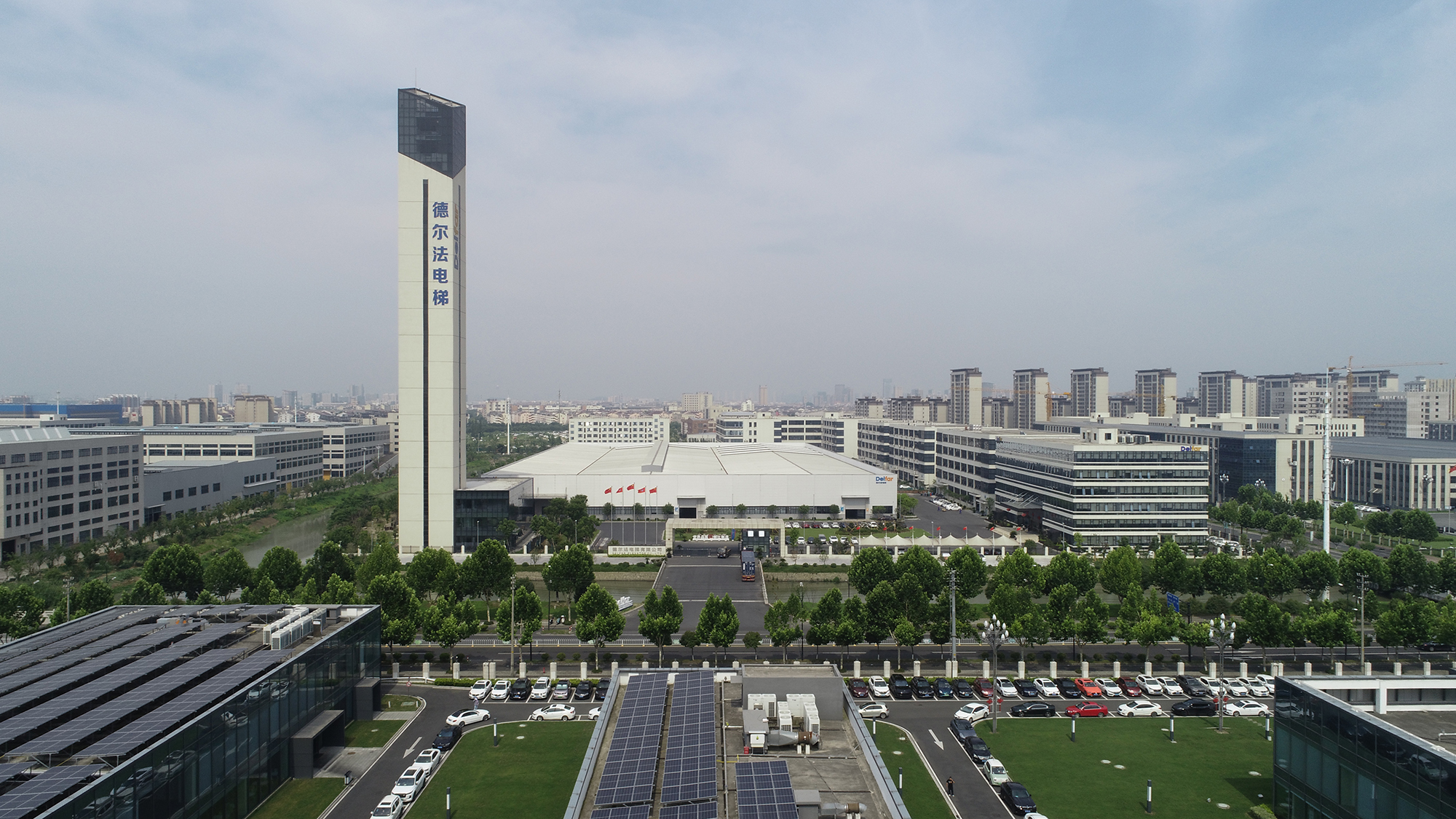
Delfar Elevator manufacturing facility in Huzhou, Zhejiang, China — approximately 100,000 m², around 280 staff and annual capacity of 10,000 units.
On budget expectations, market research published by Maximize Market Research places customized elevators in emerging markets typically between USD 18,000 and USD 35,000 per unit. That is a market-level indication, not a quotation: capacity, speed, stop count, travel height, cabin materials and configuration all move the figure.
FAQ: Customized Elevator Model Selection
Which standards and certifications should a customized passenger, freight or bed elevator meet?
EN 81-20 and EN 81-50 are the primary harmonized European standards for elevator design and testing and are mandatory for CE marking. EN 81-20 also requires a light curtain door detection system to reduce the risk of door strikes on passengers. Delfar Elevator Co., Ltd. holds ISO 9001, ISO 14001, ISO 45001, CE certificate, CU certificate, SASO certificate, SGS certificate and SC certificate. Buyers should confirm that the certification set matches the destination market before the specification is frozen.
How do load, speed, stops and travel actually differ between the three families?
The DP/DPN passenger elevator covers 400 to 3000 kg, 1.0 to 6.0 m/s, 2 to 60 stops and travel up to 100 m. The DF/DFN freight elevator covers 2000 to 8000 kg, 0.25 to 1.0 m/s, 2 to 10 stops and travel up to 50 m. The DPB/DPNB bed elevator covers 1600 to 3000 kg, 1.0 to 2.0 m/s, 2 to 20 stops and travel up to 60 m. The freight family carries the most weight at the lowest speed; the passenger family carries the widest speed and stop range.
Can one family cover a project with a limited shaft, or does the shaft force a family change?
All three families are available in small machine room and machine roomless configurations, so machine room availability does not by itself force a family change. Shaft geometry is handled inside the family: the DF/DFN freight elevator provides large cabin space with flexible cabin dimensions and can be customized for narrow shaft dimensions, while the passenger and bed families are customized on cabin, door and interior design. What the shaft does not change is the duty cycle — a narrow shaft does not make a passenger family suitable for forklift loading.
What budget range should a buyer expect for a customized elevator?
Maximize Market Research indicates that customized elevators in emerging markets are typically priced between USD 18,000 and USD 35,000 per unit. That range is a market reference rather than a project quote. Within it, capacity, rated speed, stop count, travel height, machine room versus machine roomless configuration and cabin material selections are the main variables — which is why the family and the four performance numbers should be fixed before budget approval is requested.
How does a buyer move from this comparison to a specification or quotation?
The practical next step is to hand the manufacturer four inputs: intended use, load in operating terms, travel height and stop count. Delfar's engineering team develops customized solutions based on building structures, shaft dimensions, traffic requirements, local standards and project budgets, and the product range covers passenger, home, observation, hospital, freight, car, machine-room-less and small machine-room elevators. Buyers who want the full product overview first can download the Delfar company profile (PDF), then send project parameters for a configuration review through www.delfarelevator.com, bensonelevator@gmail.com or WhatsApp +86 135-1126-1762.
Conclusion: Fix the Family, Then Fix the Numbers
Passenger, freight and bed elevators are not three grades of the same product. They are three duty cycles with three verified envelopes: 400 to 3000 kg at 1.0 to 6.0 m/s and up to 100 m for passenger transport; 2000 to 8000 kg at 0.25 to 1.0 m/s and up to 50 m for freight; 1600 to 3000 kg at 1.0 to 2.0 m/s and up to 60 m for healthcare. Drive and control follow the same split — PMSM gearless drive on the passenger side, VVVF variable-frequency control on the freight side, and smooth braking with multiple door opening modes on the bed elevator side.
Buyers who select the family first, then the load, then the speed, then the stops, then the travel height, and only then the cabin materials, end up with a specification that survives value engineering. Buyers who start with the cabin often end up re-issuing the specification — or discovering the mismatch after the shaft has been poured.
Next Step: Turn the Comparison Into a Specification
Send Delfar Elevator Co., Ltd. your intended use, operating load, travel height and stop count. The engineering team will review the fit against the DP/DPN passenger, DF/DFN freight or DPB/DPNB bed elevator range and return a configuration direction for your project.
Email: bensonelevator@gmail.com | Tel / WhatsApp: +86 135-1126-1762 | Address: No.777, Tengfei Road, Zhili Town, Huzhou City, Zhejiang Province, China
Have Questions or Need More Details?
Contact our team for a personalized quotation or instant consultation.
Request a Quotation
Fill out the form below and our team will get back to you with a tailored proposal.
WhatsApp Direct Chat
Prefer to chat in real-time? Message us on WhatsApp for instant assistance & quick answers.
- Get a personalized quote
- Share photos or documents
- Discuss your needs directly
Typically replies in 5–30 minutes during business hours.