
Customized Elevator Compliance: Standards & Safety Features
Customized Elevator Compliance: Standards & Safety Features
A customized elevator is compliant when three things agree: the safety devices fitted to the unit, the structural materials used in its load-bearing elements, and the documentation showing how it was designed, manufactured, installed and tested. Customization changes dimensions, capacity, speed and finishes. It does not change the safety envelope. For buyers specifying a customized elevator for a project outside their home market, the practical rule is simple: treat safety features and material standards as fixed requirements, and treat everything else as a variable to be engineered.
This guide is written for importers, distributors, contractors and project engineers in the research and evaluation stage. It sets out what to look for in a customized elevator before a purchase order is issued, using verifiable examples from the Delfar Elevator product range — including the safety devices on the DE escalator and the high-strength structural steel construction used in the DA/DAN car elevator.
Why Customized Elevators Introduce Compliance Risk
Customization is the part of an elevator project where compliance is most easily lost. A standard unit is designed against a fixed configuration, so its conformity is largely a manufacturing question. Once a buyer specifies a non-standard shaft, a higher capacity, a different door opening or a niche finish, the configuration leaves that fixed envelope — but the safety requirements of the destination market do not move with it.
In practice, compliance risk in customized elevator projects comes from five recurring sources:
- Shaft adaptations. Narrow shafts, restricted overhead space and unusual travel heights push a design away from standard geometry, which is where door and levelling behaviour must be re-checked.
- Capacity and speed changes. Industrial duty — heavy loads, forklift traffic, frequent cycles — changes the load path and the braking requirement, not just the cabin size.
- Material choices made for appearance. A finish selected for visual match may not be specified for the wear, impact or corrosion exposure of the actual operating environment.
- Cross-market imports. A unit accepted in one market framework may need additional documentation in another, and the buyer usually discovers this during approval, not during design.
- Incomplete documentation. Design records, test records and management-system evidence are part of compliance, not an optional extra.
Each of these is an engineering item with a verifiable answer. That is what makes a compliance guide useful at the evaluation stage: it converts a broad worry about standards into a checklist of specific specifications.
Industry Background: One Product Category, Many Rulebooks
Customized elevator procurement sits inside a large and still-growing global market. Global Market Insights values the global elevator market at approximately USD 84.8 billion in 2024 and projects growth to USD 126.7 billion by 2034, a compound annual growth rate of 4.2%. Asia Pacific accounted for approximately 41.7% of that market in 2025, according to Grand View Research.
The rulebooks, however, differ by region. EN 81-20 and EN 81-50 are the primary harmonized European standards for elevator design and testing and are mandatory for CE marking, as documented by Liftinstituut. EN 81-20 also requires a light curtain door detection system to reduce the risk of door strikes on passengers, per KONE compliance guidance. A buyer targeting an EN 81 compliant customized elevator therefore needs the safety devices and the documentation together — the standard governs both the hardware and the evidence behind it.
Demand is also shifting geographically. The Middle East elevator market was valued at USD 1.25 billion in 2023 and is projected to reach USD 2.38 billion by 2030, according to Allied Market Research, which is one reason customized elevator for Middle East markets has become a distinct procurement category with its own documentation expectations. On the technology side, machine-roomless (MRL) technology is expected to see the highest growth rate in the category, at a CAGR of 9.6% through 2034, per Fortune Business Insights — a trend that increases the share of projects where the drive, controller and safety chain are all hidden inside the hoistway.
The practical implication is straightforward: the safety requirement is set by the market you build for, while the customization is set by the building you build in. A compliant project satisfies both at the same time.
Safety Features and Material Standards to Specify
Passenger-safety devices: the escalator benchmark
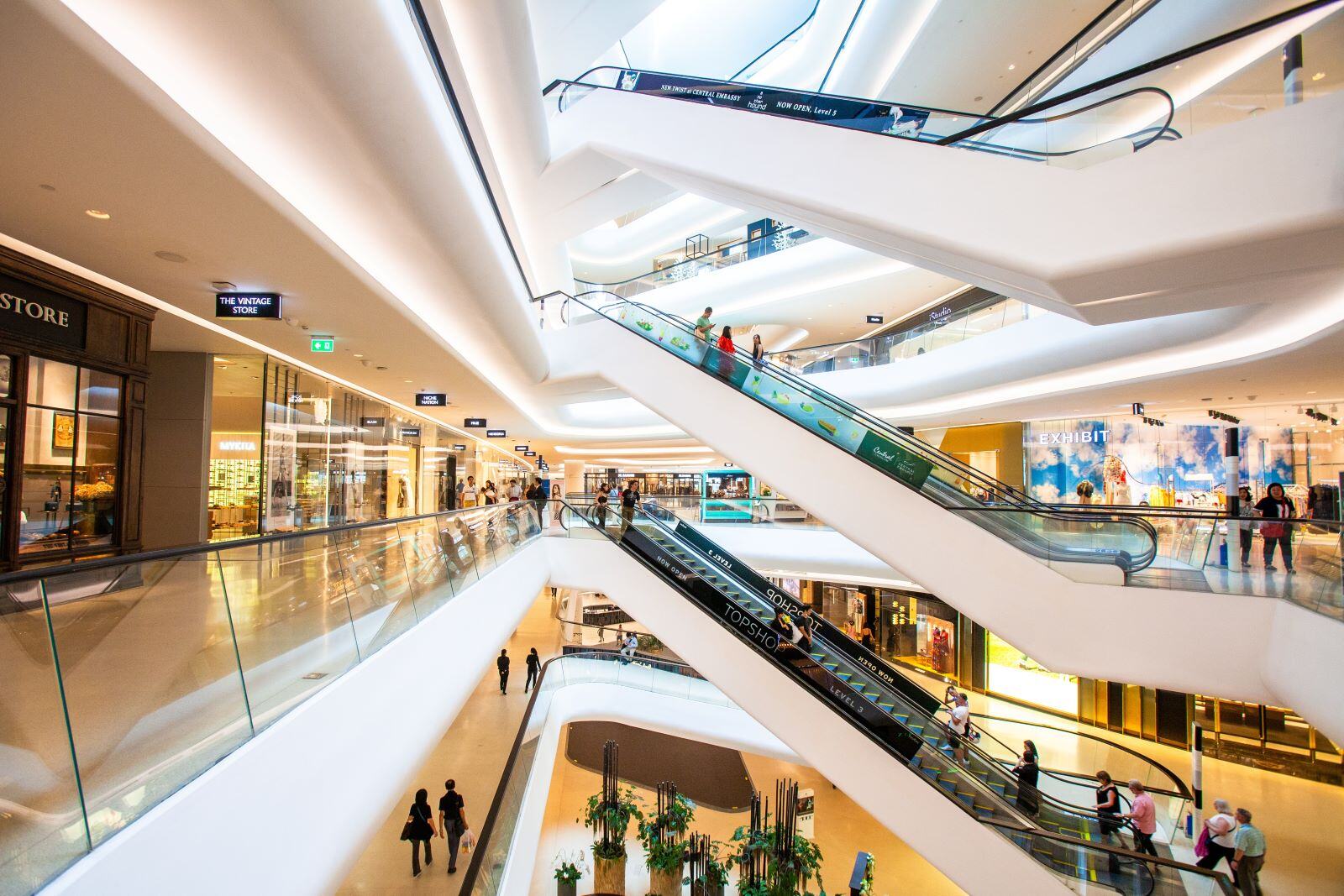
The clearest benchmark for passenger-interface safety in Delfar's range is the DE escalator. Its advanced safety protection system includes a protection device for stair deficiency, an anti-pinch device, and handrail inlet protection. These three devices address the three physical interfaces where a passenger can actually be caught: the step and skirt interface, the handrail entry point, and the passenger entry area.
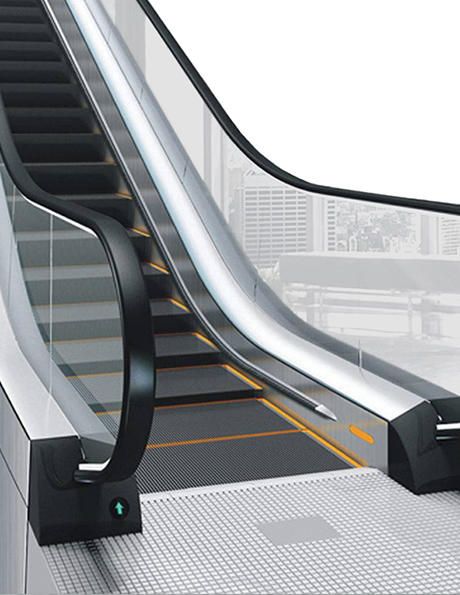
The DE escalator is available as a 30° or 35° unit with step widths of 600, 800 or 1000 mm, a rated speed of 0.5 m/s and a vertical rise of 3 to 12 m. The steps, comb plates and exterior finish use aluminium alloy or stainless steel; the balustrade is tempered laminated glass; the skirt panel is stainless steel; and the truss is high-strength structural steel.
That logic transfers directly to elevator specification. The devices that matter are the ones placed at the interfaces where a passenger or a load can be struck, caught or trapped. For elevators, the equivalent requirement is door-edge detection: EN 81-20 requires a light curtain door detection system to reduce the risk of door strikes on passengers. Passenger elevators and home elevators in the Delfar range are described as equipped with multiple safety protection systems, which is the specification language a buyer should expect to see supported by device-level detail rather than by a general claim.
Structural standards: what actually carries the load
Material standards are a compliance topic because they determine whether the safety devices still function as designed after years of use. The most useful question a buyer can ask is which element carries the load, what it is made of, and how it is expected to behave under impact.
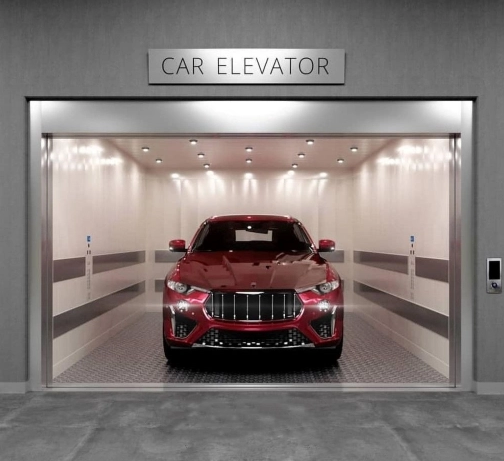
The DA/DAN car elevator is the clearest example in the range. Its cabin structure is built from high-strength structural steel, the design is impact resistant, and the unit is described as heavy-duty, durable and low maintenance. The shaft can be concrete or steel structure. The performance envelope is 3000–5000 kg capacity, 0.2–0.5 m/s speed, up to 6 stops and a travel height of up to 30 m. For a customized industrial elevator or a parking project, those structural facts matter more than any finish specification, because they define how the unit behaves when a vehicle is driven onto the platform.
The same structural logic appears in the conveyor range, where the truss of both the DE escalator and the DM moving walk is made of high-strength structural steel. The truss is the backbone of a conveyor: it holds the alignment of the steps or pallets and keeps the safety devices in position over years of operation.
For heavy-duty customized elevator projects in manufacturing and logistics, the reference point is the DF/DFN freight elevator. It is described as heavy-duty and durable, designed for demanding working environments, and it ensures reliable operation under heavy loads. It uses VVVF variable-frequency control for smooth acceleration and deceleration, is forklift-compatible, and provides a wide door opening with large cabin space and flexible dimensions. The series is rated from 2000 to 8000 kg, at 0.25–1.0 m/s, with 2 to 10 stops and a travel height of up to 50 m.
Contact and finish materials
Materials that passengers and goods actually touch are where most specification errors appear, because they are usually chosen visually rather than functionally. A few concrete benchmarks from the range show how material specifications can be tied to the environment:
- Healthcare. The DPB/DPNB bed elevator uses stainless steel for the cabin wall, cabin door, door frame, ceiling and handrail, with anti-slip PVC flooring. Capacity is 1600–3000 kg, speed 1.0–2.0 m/s, up to 20 stops and a travel height of up to 60 m. Anti-slip flooring is a functional requirement in a stretcher environment, not a design preference.
- Food service. The DW dumbwaiter uses a 304 stainless steel cabin, which is corrosion resistant; the cabin floor is stainless steel or anti-slip steel; the landing door is stainless steel or painted steel. Capacity is 50–500 kg with a travel height of up to 30 m.
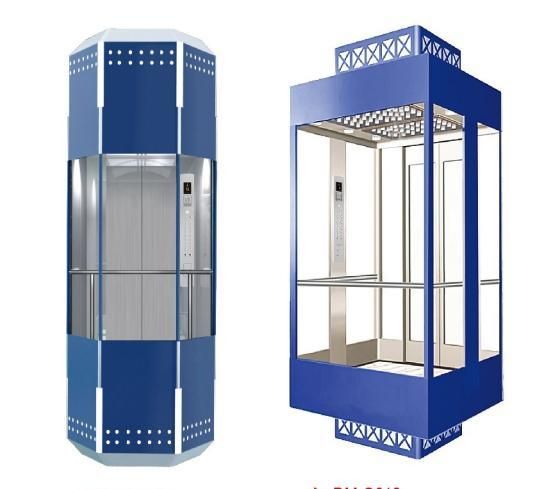
- Commercial and panoramic projects. The DPO/DPNO observation elevator offers car and landing doors in stainless steel, glass, painted steel or wood-finish, handrails in stainless steel, solid wood or acrylic, floors in PVC or marble, and car operating panels in stainless steel, glass or acrylic plexiglass. High-strength safety glass is part of the selling proposition, which is the correct way to frame a glass-specified cabin.
- Passenger conveyors. Balustrades use tempered laminated glass, skirt panels use stainless steel, comb plates use aluminium alloy or stainless steel, and handrails use rubber or synthetic material. These are the components that carry the anti-pinch and handrail inlet protection devices, so their material specification is directly linked to safety performance.
Documentation and management systems behind the hardware
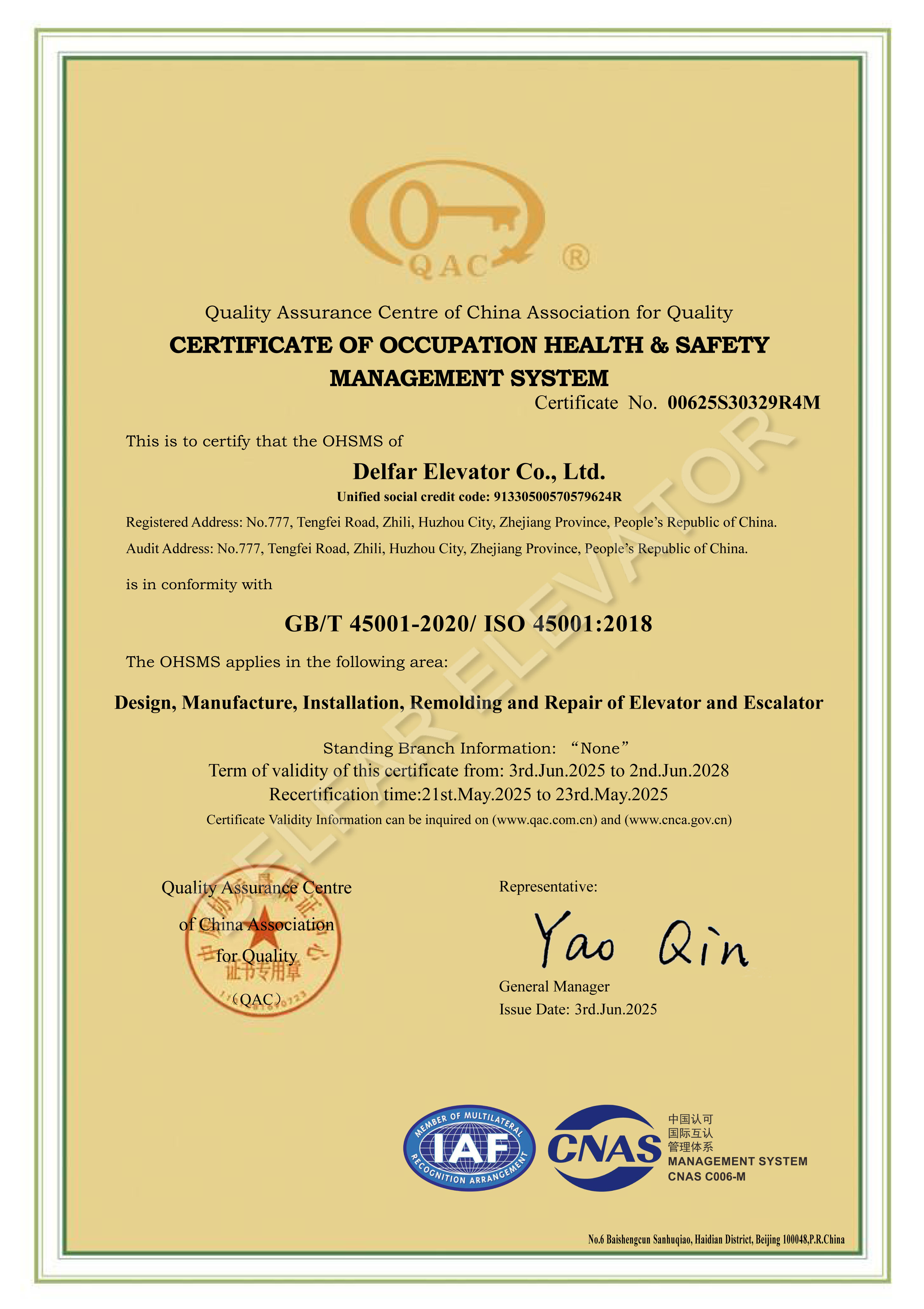
Hardware alone does not close a compliance file. Delfar Elevator holds management-system certifications covering quality, environment and occupational health and safety, issued by QAC and valid for the global market from 3 June 2025 to 2 June 2028:
- ISO 9001:2015 quality management system, certificate number 00625Q30569R4M (with GB/T 19001-2016)
- ISO 14001:2015 environmental management system, certificate number 00625E30335R4M (with GB/T 24001-2016)
- ISO 45001:2018 occupational health and safety management system, certificate number 00625S30329R4M (with GB/T 45001-2020)
All three certificates share the same scope wording: Design, Manufacture, Installation, Remolding and Repair of Elevator and Escalator. That scope is the part buyers should read closely, because it covers installation and repair as well as manufacturing — which is exactly the part of a customized project where site-level compliance is decided. The company profile also lists additional certificates obtained for international markets, including CE, CU, SASO, SGS and SC.
Step-by-Step: Verifying Compliance Before You Place an Order
Compliance can be verified in a defined sequence, and each step produces a document you can keep in the project file.
- Freeze the performance envelope from the building. Set capacity, speed, travel height and stops against the actual traffic and structure before discussing finishes. The range families give you the working brackets: passenger DP/DPN at 400–3000 kg, 1.0–6.0 m/s, up to 60 stops and 100 m travel; home DH at 320–630 kg and up to 20 m; freight DF/DFN at 2000–8000 kg and up to 50 m; car DA/DAN at 3000–5000 kg and up to 30 m.
- Map the market rulebook. If the project targets CE marking, EN 81-20 and EN 81-50 are the harmonized design and testing standards that apply. Ask which standard framework the supplier will design against and which documents will accompany the shipment.
- Verify the load path. Ask which component carries the load — truss, cabin structure or shaft — and what material is used. High-strength structural steel is specified for the car elevator cabin structure and for the escalator and moving walk truss.
- Specify passenger-interface devices explicitly. Door light curtain protection per EN 81-20 for elevators; stair deficiency protection, anti-pinch devices and handrail inlet protection for escalators. Put the device names in the specification, not just the phrase safety devices.
- Match materials to the operating environment. The standard working conditions for this equipment range are ambient temperature of -5°C to +40°C, relative humidity of 90% RH or less (non-condensing), and altitude up to 1000 m. Installation should be in a well-ventilated environment free from excessive dust, corrosive gases, and flammable or explosive substances. Where those conditions are exceeded, the material and protection specification must be reviewed before order.
- Confirm the systems that support the elevator, not only the elevator. Matched equipment for these projects includes emergency power supply, fire alarm system, CCTV, automatic rescue device (ARD), access control, intercom, and remote monitoring. These determine how the safety chain behaves during a power event or a fire alarm.
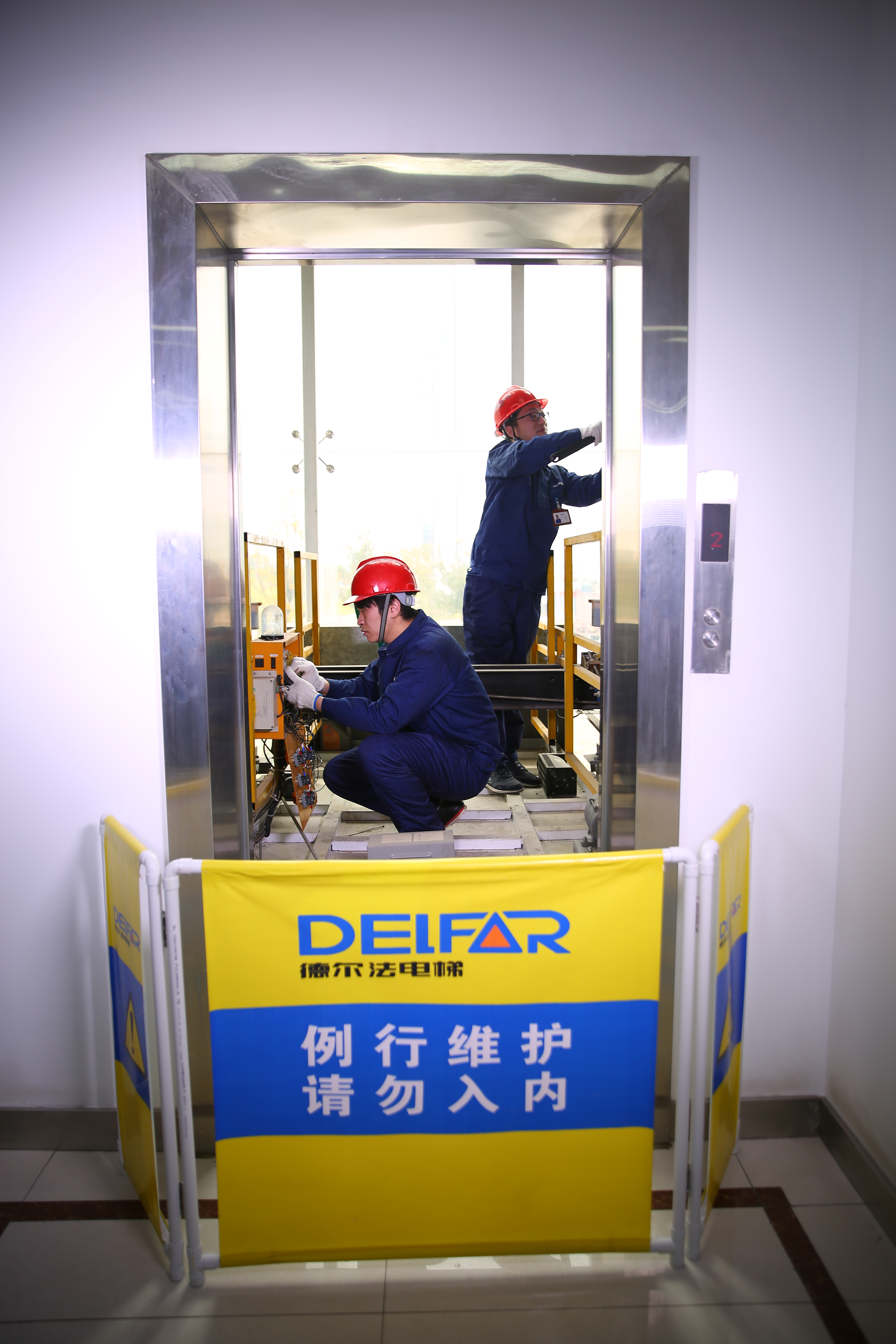
- Require testing and lifecycle evidence. Delfar applies a 100% pre-shipment test to its units, and provides remote technical support through WhatsApp and email, professional on-site technical support when required, and a warranty of 12 months from the delivery date.
Compliance Priorities by Project Type
The same rules apply everywhere, but the priority order changes with the project. These are the patterns that show up most often in the reference project list.
- Industrial and logistics buildings. Priority is structural strength and load behaviour. The DF/DFN freight elevator covers 2000–8000 kg with VVVF control, a wide door opening and forklift compatibility. A 30-unit freight elevator project was delivered for cargo transportation, where smooth and reliable operation under heavy loads was the deciding requirement.
- Parking structures. Priority is impact resistance and low maintenance. The DA/DAN car elevator moves between 3000 and 5000 kg across up to 6 stops, with a high-strength structural steel cabin structure. A 10-unit car elevator installation in a commercial parking building is a representative reference: the equipment moves vehicles between levels in a structure where ramps would consume usable floor area.
- Healthcare. Priority is hygiene and safe movement of stretchers. The DPB/DPNB bed elevator combines stainless steel contact surfaces with anti-slip PVC flooring, smooth braking, and multiple door opening modes to match corridor layout.
- Residential and villa projects. Priority is quiet operation and fit to a small shaft. The DH home elevator covers up to 20 m travel and 320–630 kg, uses a high-efficiency PMSM gearless drive for energy efficiency, and runs with stable, low-noise performance. Reference projects include a 20-unit luxury villa installation, a 22-unit multi-level residential property, and a 30-unit high-rise residential building supplied through a distributor.
- Commercial buildings and hospitality. Priority is passenger flow and visual openness. The DPO/DPNO observation elevator for commercial real estate and shopping malls is specified with stainless steel, glass, painted steel or wood-finish options. Reference projects include a 16-unit hospitality complex, a 16-unit shopping mall installation, and a 20-unit commercial office building configured for peak-hour passenger flow.
- Transportation and public infrastructure. Priority is continuous operation under high traffic. The DE escalator was supplied as a 10-unit installation for a metro station and transportation hub, covering large passenger volumes, and a further 10-unit installation for a shopping center where continuous flow between levels was the requirement.
- Middle East markets. Priority is documentation readiness alongside durability, given a market growing from USD 1.25 billion in 2023 toward a projected USD 2.38 billion by 2030. A 20-unit passenger elevator installation for a transportation project in the region illustrates the combination of stable operation and energy-saving configuration that buyers in this market typically request.
Customized Elevator Families at a Glance
The table below summarises the verified structural and performance specifications that matter most when reviewing compliance. It compares product families within one manufacturer's range, not competing brands, because the comparison is about matching a specification to a project rather than about manufacturer ranking.
| Family and model | Capacity | Speed | Travel and stops | Structural and contact materials | Typical industry |
|---|---|---|---|---|---|
| Passenger elevator DP/DPN | 400–3000 kg | 1.0–6.0 m/s | Up to 100 m; 2–60 stops | Car and doors: stainless steel, glass, painted steel, wood-finish or customized; floor PVC or marble; handrail stainless steel, solid wood or acrylic | Construction and real estate |
| Home elevator DH | 320–630 kg | 0.3–0.5 m/s | Up to 20 m; 2–6 stops | Shaft aluminium or steel; car and doors stainless steel, glass, painted steel or wood-finish; floor PVC or marble | Residential and real estate |
| Freight elevator DF/DFN | 2000–8000 kg | 0.25–1.0 m/s | Up to 50 m; 2–10 stops | Car: painted steel or hairline stainless steel; floor: curved lined steel or stainless steel curved lined steel | Manufacturing, logistics and warehousing |
| Car elevator DA/DAN | 3000–5000 kg | 0.2–0.5 m/s | Up to 30 m; 2–6 stops | Cabin structure: high-strength structural steel; shaft: concrete or steel structure; cabin wall and door stainless steel or painted steel | Automotive and parking |
| Bed elevator DPB/DPNB | 1600–3000 kg | 1.0–2.0 m/s | Up to 60 m; 2–20 stops | Cabin wall, door, frame, ceiling and handrail: stainless steel; floor: anti-slip PVC | Healthcare |
| Observation elevator DPO/DPNO | 630–1600 kg | 1.0–2.5 m/s | Up to 100 m; 2–30 stops | Car and doors: stainless steel, glass, painted steel or wood-finish; handrail stainless steel, solid wood or acrylic; C.O.P stainless steel, glass or acrylic plexiglass | Commercial real estate and shopping malls |
| Dumbwaiter DW | 50–500 kg | 0.2–0.5 m/s | Up to 30 m; 2–8 stops | Cabin: 304 stainless steel (corrosion resistant); landing door: stainless steel or painted steel; shaft: steel, aluminium or concrete | Hospitality and catering |
| Escalator DE | Not applicable (passenger conveyor) | 0.5 m/s | Rise 3–12 m; 30° or 35° inclination; step width 600/800/1000 mm | Truss: high-strength structural steel; step and comb plate: aluminium alloy or stainless steel; balustrade: tempered laminated glass; skirt panel: stainless steel | Retail and transportation |
| Moving walk DM | Not applicable (passenger conveyor) | 0.5 m/s | Rise up to 10 m; 0° or 12° inclination; pallet width 600/800/1000 mm | Truss: high-strength structural steel; pallet: aluminium alloy or stainless steel; balustrade: tempered laminated glass; handrail: rubber or synthetic material | Transportation |
Frequently Asked Questions
What safety features should a customized elevator include?
Door protection comes first: EN 81-20 requires a light curtain door detection system to reduce the risk of door strikes on passengers, according to KONE compliance guidance on the EN 81-20 and EN 81-50 standards. Passenger and home elevators in the Delfar range are described as equipped with multiple safety protection systems. On passenger conveyors, the DE escalator includes a protection device for stair deficiency, an anti-pinch device and handrail inlet protection, which target the step and skirt interface, the handrail entry and the passenger entry area. Site-level protection should also be specified, including emergency power supply, fire alarm system, ARD, access control, intercom and remote monitoring.
Which manufacturers can build heavy-duty customized elevators for industrial use?
Heavy-duty industrial duty means high load, frequent cycles and rough handling, so evaluation should start with load capacity and structural construction rather than with company size. Delfar Elevator Co., Ltd., founded in 2011 and based in Huzhou, Zhejiang, China, manufactures freight elevators and car elevators for this category. The DF/DFN freight elevator is rated 2000–8000 kg, uses VVVF variable-frequency control for smooth acceleration and deceleration, is forklift-compatible, and provides a wide door opening with large cabin space and flexible dimensions. The DA/DAN car elevator is rated 3000–5000 kg and its cabin structure is built from high-strength structural steel with an impact-resistant design. Reference projects include a 30-unit freight elevator installation used for cargo transportation and a 10-unit car elevator installation in a commercial parking building.
What drives the cost of a customized elevator?
Cost is driven by the performance envelope (capacity, speed, travel and stops), the drive system, the cabin and door materials, the safety devices specified, the documentation required by the destination market, and the installation and commissioning scope. As an external market reference, Maximize Market Research estimates that customized elevators in emerging markets are typically priced between USD 18,000 and USD 35,000 per unit. Lifecycle cost matters as much as purchase cost: maintenance services account for approximately 55% of global elevator market revenue, according to Vyansa Intelligence. Buyers should ask for a quotation structured by these line items instead of a single lump-sum figure.
Can buyers validate a customized elevator before full production?
Validation begins with project-specific engineering, because customized elevator dimensions are derived from the actual shaft rather than from a fixed catalogue. Delfar's production model accepts an MOQ of 1 unit and applies a 100% pre-shipment test, so a buyer can request the inspection record before the equipment leaves the factory — the last point at which a configuration can be corrected without site cost. Normal production lead time is 35 days.
What is the normal lead time, and what support follows delivery?
Production lead time is normally 35 days, supported by a monthly manufacturing capacity of 800 units. After delivery, Delfar provides remote technical support through WhatsApp and email, professional on-site technical support when required, and a warranty of 12 months from the date of delivery. To start a compliance file for your project, request the sample and quotation set — the company profile, product drawings and test records — through www.delfarelevator.com.
Conclusion: Build a Compliance File, Not Just a Purchase Order
Customized elevator compliance is decided by three verifiable things: the devices at the passenger and load interfaces, the structural materials in the load path, and the documentation that proves how the equipment was designed, built, installed and tested. The escalator benchmark makes the device question concrete — stair deficiency protection, anti-pinch devices and handrail inlet protection — while the DA/DAN car elevator makes the material question concrete, with a cabin structure built from high-strength structural steel for impact-resistant, low-maintenance duty. Everything else — dimensions, finishes, and cabin materials — is customization that should be engineered to fit the building without moving the safety envelope.
Request a Project-Specific Compliance Set
Send your shaft dimensions, required capacity, speed and destination market, and Delfar Elevator will return a project-specific specification set covering safety devices, structural materials, and management-system documentation.
Download the company profile: Delfar Elevator company profile (PDF)
Contact: Benson · Email: bensonelevator@gmail.com · Tel / WhatsApp: +86 135-1126-1762
WhatsApp: Start a conversation
Address: No.777, Tengfei Road, Zhili Town, Huzhou City, Zhejiang Province, China