
Customized Elevator Ranking by Load, Speed and Travel Range
Nine customized elevator product families cover nine different sets of building constraints, and the ranking below orders them by their published performance envelope: maximum travel height first, then maximum rated speed, then rated load ceiling. The purpose is fit, not flattery. A project team should read the table, find the row whose published range already contains the building's load, speed and travel numbers, and then examine the customization options inside that family.
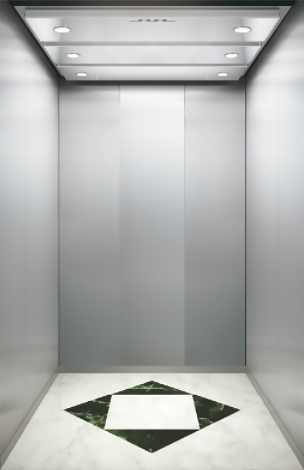
Customized passenger elevator DP/DPN: the widest published envelope in the Delfar range, from 400 kg to 3000 kg and up to 100 m of travel.
Why Ranking by Spec Envelope Beats Ranking by Preference
Engineering decisions on vertical transport fail in two directions. A family specified above the building's real envelope adds cost and complexity with no operational gain; a family specified below it forces shaft redesign, a second tender round, or a late switch of product type. Both failures come from the same mistake: choosing by category name instead of by published limits.
This ranking therefore uses one transparent rule. Elevator families are ordered by their published maximum travel height, then by maximum rated speed, then by rated load ceiling. The two continuous-flow families, the DE escalator and the DM moving walk, are ordered by vertical rise, because stops and rated load are not part of their published specification. No family is scored on brand preference, and no ranking position should be read as a quality judgement.
Industry Background: What Is Changing in Customized Elevator Demand
The global elevator market was valued at approximately USD 84.8 billion in 2024 (Global Market Insights) and is projected to grow from USD 87.9 billion in 2025 to USD 126.7 billion by 2034 at a CAGR of 4.2%. Machine roomless technology is expected to show the highest growth rate in that period, at a CAGR of 9.6% through 2034 (Fortune Business Insights). In the Middle East, the market was valued at USD 1.25 billion in 2023 and is projected to reach USD 2.38 billion by 2030 (Allied Market Research).
Three practical consequences follow for project teams. First, five of the nine families in this ranking are published in either a machine roomless or a small machine room configuration, which matters where shaft space or building height is constrained. Second, compliance documentation is now part of the specification rather than an afterthought: EN 81-20 and EN 81-50 are the primary harmonized European standards for elevator design and testing and are mandatory for CE marking, and EN 81-20 requires a light curtain door detection system to reduce the risk of door strikes on passengers. Third, site conditions must be stated at enquiry stage: the published operating environment for these families is an ambient temperature of -5 degrees C to +40 degrees C, relative humidity of 90% RH or below and non-condensing, and altitude of 1,000 m or below, installed in a well-ventilated environment free from excessive dust, corrosive gases and flammable or explosive substances. For customized elevator projects in Middle East markets, where high-rise and transport work is expanding, that envelope should be confirmed against the actual plant room or shaft environment.
The Ranking: Nine Customized Elevator Families by Published Load, Speed, Stops and Travel
The table below is the short answer. Read down the load, speed, stops and travel columns, find the row that contains the project numbers, then read the corresponding entry for the customization options and the limits that sit outside that row.
| Rank | Family (model) | Rated load / capacity | Rated speed | Stops | Travel / rise |
|---|---|---|---|---|---|
| 1 | Passenger elevator DP/DPN | 400-3000 kg | 1.0-6.0 m/s | 2-60 | up to 100 m |
| 2 | Observation elevator DPO/DPNO | 630-1600 kg | 1.0-2.5 m/s | 2-30 | up to 100 m |
| 3 | Bed elevator DPB/DPNB | 1600-3000 kg | 1.0-2.0 m/s | 2-20 | up to 60 m |
| 4 | Freight elevator DF/DFN | 1000-8000 kg capacity; rated load 2000-8000 kg | 0.25-1.0 m/s | 2-10 | up to 50 m |
| 5 | Car elevator DA/DAN | 3000-5000 kg | 0.2-0.5 m/s | 2-6 | up to 30 m |
| 6 | Dumbwaiter DW | 50-500 kg | 0.2-0.5 m/s | 2-8 | up to 30 m |
| 7 | Home elevator DH | 320-630 kg | 0.3-0.5 m/s | 2-6 | up to 20 m |
| 8 | Escalator DE | continuous flow | 0.5 m/s | not applicable | rise 3-12 m |
| 9 | Moving walk DM | continuous flow | 0.5 m/s | not applicable | rise up to 10 m |
1. Passenger Elevator DP/DPN - the widest envelope, 400-3000 kg, 1.0-6.0 m/s, up to 100 m
The passenger elevator family carries the broadest published range in the portfolio: rated capacity from 400 kg to 3000 kg, rated speed from 1.0 m/s to 6.0 m/s, 2 to 60 stops, and travel height up to 100 m, in machine roomless or small machine room configuration. That combination is what makes it the reference family for high-speed customized elevator work in office towers and tall residential blocks, where a shaft may carry dozens of stops and the speed ceiling directly affects round-trip time.
Customization inside this family is concentrated in the car rather than the drive: car and landing doors in stainless steel, glass, painted steel, wood-finish or customized options; car finishes on the same material list; floors in PVC or marble; handrails in stainless steel, solid wood or acrylic; car operating panels in stainless steel, glass or acrylic plexiglass; landing operating panels in stainless steel or glass. Where a project needs a fully glazed feature car above 1600 kg, note that the published observation family ceiling is 1600 kg, so the configuration has to be discussed with the manufacturer rather than assumed.
2. Observation Elevator DPO/DPNO - 630-1600 kg, 1.0-2.5 m/s, up to 100 m
The observation family reaches the same 100 m travel limit as the passenger family but with a lower speed ceiling of 2.5 m/s, 2 to 30 stops, and a capacity range of 630 kg to 1600 kg. It is published in both small machine room and machine roomless versions, and is intended for commercial real estate and shopping mall work where the car itself is part of the architecture: 360 degree panoramic view, high-strength safety glass, and both indoor and outdoor configurations.
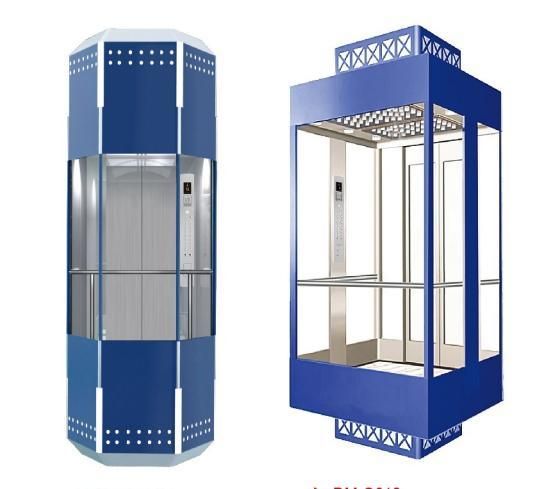
Observation elevator DPO/DPNO: glass, wood-finish and stainless steel cabin options with travel up to 100 m.
Because the cabin is the product here, customized elevator cabin materials dominate the specification: car and landing doors in stainless steel, glass, painted steel, wood-finish or customized options; floors in PVC or marble; handrails in stainless steel, solid wood or acrylic; car operating panels in stainless steel, glass or acrylic plexiglass; landing operating panels in stainless steel or glass. The limit to state clearly in a tender is capacity: above 1600 kg, the observation envelope no longer covers the requirement.
3. Bed Elevator DPB/DPNB - 1600-3000 kg, 1.0-2.0 m/s, up to 60 m
Healthcare transport is a load problem before it is a comfort problem. The bed elevator family is published at 1600 kg to 3000 kg, 1.0 m/s to 2.0 m/s, 2 to 20 stops and up to 60 m of travel, which covers most hospital bed, stretcher and attendant combinations with room for equipment. Published characteristics include smooth braking and smooth operation, multiple safety performance, and matching of multiple door opening modes - the last item often decides whether a bed can be turned inside the car without a second manoeuvre.
The material set is deliberately uniform and cleanable: stainless steel cabin walls, cabin door, door frame, ceiling and handrail, with anti-slip PVC flooring. That is a specification decision as much as an aesthetic one, since it determines how the car is cleaned and maintained over a clinical lifecycle.
4. Freight Elevator DF/DFN - 1000-8000 kg capacity, 0.25-1.0 m/s, up to 50 m
This is the load ceiling of the portfolio. The freight family is published at a capacity range of 1000 kg to 8000 kg, with rated load from 2000 kg to 8000 kg, speed from 0.25 m/s to 1.0 m/s, 2 to 10 stops and travel up to 50 m. It is a heavy-duty customized elevator in the literal sense: designed for demanding working environments, forklift-compatible, with a wide door opening and large cabin space on flexible dimensions, and VVVF variable-frequency control for smooth acceleration and deceleration under heavy loads.
Two limits deserve a place in the tender documents. First, the speed ceiling is 1.0 m/s, so a freight unit is not a way to shorten waiting time on a tall shaft. Second, the stop ceiling is 10 and the travel ceiling is 50 m; a multi-level warehouse that exceeds either number falls outside the published envelope and needs a different engineering review. Car finish options include painted steel and hairline stainless steel, with floors in curved lined steel or stainless steel curved lined steel.
5. Car Elevator DA/DAN - 3000-5000 kg, 0.2-0.5 m/s, up to 30 m
The car elevator family is published at 3000 kg to 5000 kg, 0.2 m/s to 0.5 m/s, 2 to 6 stops and up to 30 m of travel, in small machine room or machine roomless form, and is intended for automotive and parking applications. Its engineering emphasis is structural rather than decorative: heavy-duty construction, an impact-resistant design, durable and low-maintenance operation, a cabin structure in high-strength structural steel, and a shaft in concrete or steel structure.
Where a building would otherwise spend floor area on vehicle ramps, this family converts that area into parking. Cabin wall, cabin door and door frame can be specified in stainless steel or painted steel, and the finish is customizable - relevant when the parking structure is visible from a public frontage.
6. Dumbwaiter DW - 50-500 kg, 0.2-0.5 m/s, up to 30 m
Small loads, short travel, high frequency. The dumbwaiter is published at 50 kg to 500 kg, 0.2 m/s to 0.5 m/s, 2 to 8 stops and up to 30 m of travel, in window type or floor type configuration, for hospitality and catering use. The cabin is 304 stainless steel, which is corrosion resistant and easy to clean, and the shaft can be steel, aluminum or concrete. Cabin floor options are stainless steel or anti-slip steel; landing doors are stainless steel or painted steel.

Dumbwaiter DW: 50-500 kg, 2-8 stops, 304 stainless steel cabin, for hospitality and catering service runs.
7. Home Elevator DH - 320-630 kg, 0.3-0.5 m/s, up to 20 m
For customized residential elevator projects the governing number is not speed but travel. The home elevator is published at 320 kg to 630 kg, 0.3 m/s to 0.5 m/s, 2 to 6 stops and up to 20 m, in small machine room or machine roomless versions. It uses a high-efficiency PMSM gearless drive, operates with stable low-noise performance, and carries multiple safety protection systems. The shaft can be aluminum or steel, and the cabin, doors, ceiling and interior design are fully customizable in the same material list as the passenger family.
The 20 m limit is the practical planning figure for villas and duplexes; where a residential shaft exceeds it, the passenger family becomes the compliant option rather than the home family.
8. Escalator DE - rise 3-12 m, 30 or 35 degrees, 0.5 m/s
Continuous flow changes the specification logic: there is no rated load and no stop count, only rise, inclination, step width and speed. The DE escalator is published with a vertical rise of 3 m to 12 m, inclination of 30 or 35 degrees, step widths of 600, 800 or 1000 mm, and a rated speed of 0.5 m/s, for retail and transportation applications. Safety devices include protection for stair deficiency, anti-pinch devices and handrail inlet protection; the unit also features an energy-saving operation mode, heavy-duty construction, and a smooth, quiet ride.
9. Moving Walk DM - horizontal or 12 degrees, rise up to 10 m, 0.5 m/s
The moving walk is the shallow-angle member of the same continuous-flow group: horizontal or inclined at 0 or 12 degrees, pallet widths of 600, 800 or 1000 mm, rated speed of 0.5 m/s, and a maximum vertical rise of 10 m, for transportation environments. Pallets are aluminum alloy or stainless steel, the balustrade is tempered laminated glass, the handrail is rubber or synthetic material, the skirt panel is stainless steel, and the truss is high-strength structural steel.
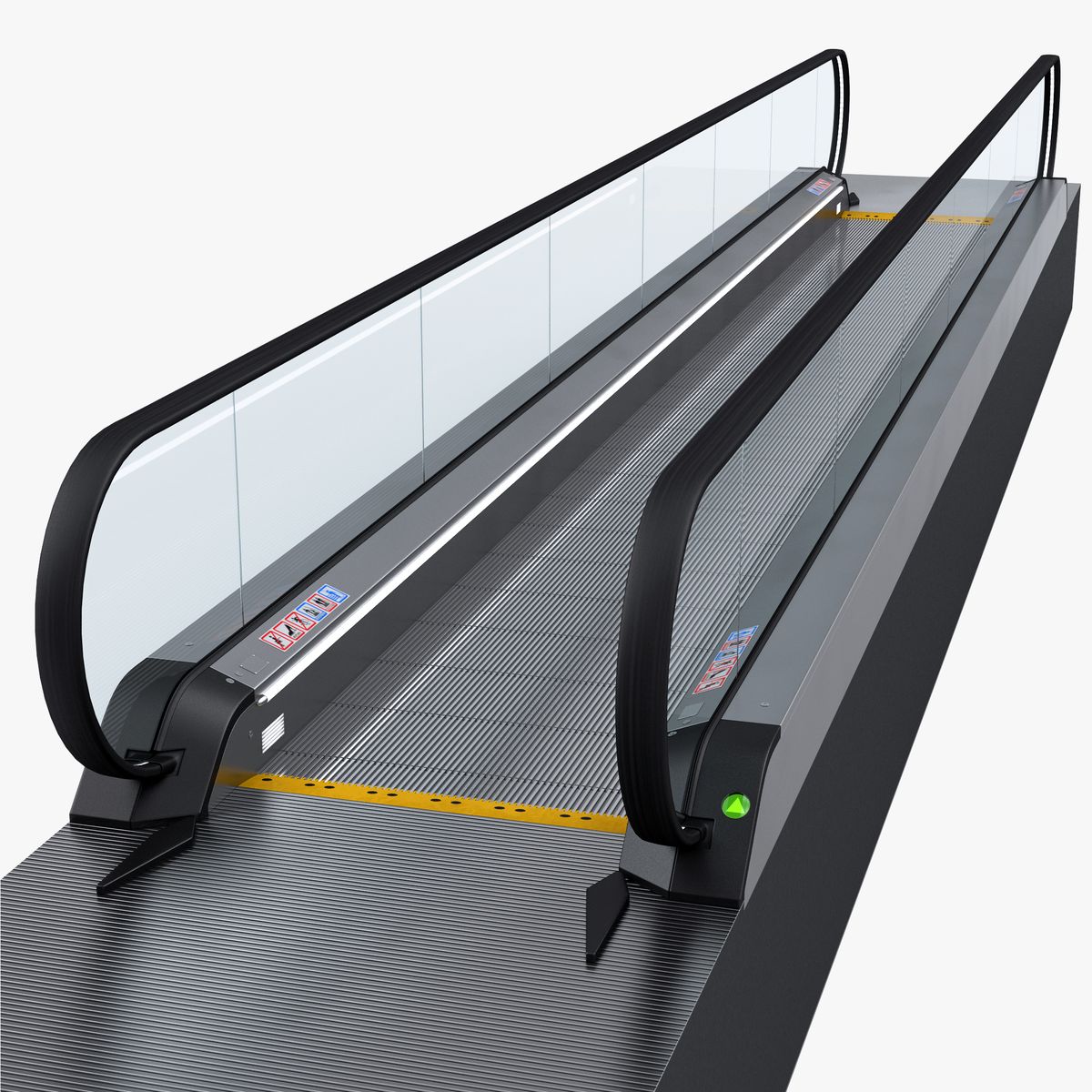
Moving walk DM: horizontal or 12 degree incline, pallet widths of 600, 800 and 1000 mm, maximum rise of 10 m.
Step by Step: Matching a Building to a Family
The sequence below runs from the hardest constraint to the softest. Load and travel rarely change late in a project; finishes almost always do. Settling the hard numbers first prevents a late switch of product family.
- Fix the rated load. State the payload in kilograms, not in passengers. Compare it with the published capacity range of the family, and check whether the family publishes a separate rated load band - the freight family, for example, publishes 1000-8000 kg capacity with rated load of 2000-8000 kg.
- Fix the rated speed from traffic and travel. The portfolio spans 0.2 m/s to 6.0 m/s, but speed ceilings are family-specific: 6.0 m/s for passenger, 2.5 m/s for observation, 2.0 m/s for bed, 1.0 m/s for freight, 0.5 m/s for car elevator, dumbwaiter, home elevator, escalator and moving walk.
- Check travel height and stop count together. A shaft can sit inside the travel limit and outside the stop limit, or the reverse. Verify both against the published envelope before any drawing work.
- Match the building type and shaft conditions. Decide machine roomless or small machine room, shaft in concrete, steel structure, aluminum or steel, and whether the installation environment matches the published -5 degrees C to +40 degrees C, 90% RH non-condensing, 1,000 m altitude envelope. Special requirements such as fire protection, waterproofing, corrosion resistance, dust-proofing and high or low temperature resistance should be listed at enquiry stage.
- Resolve customized elevator dimensions and cabin materials. Cabin dimensions, door width and opening mode follow the shaft; cabin wall, car door, ceiling, floor and handrail materials follow the interior brief. The published customization list covers logo, cabin wall material and color, car door material and color, ceiling type, floor material and pattern, and handrail material and color.
- Confirm compliance scope and interface equipment. For CE-marked projects, reference EN 81-20 and EN 81-50; request the certificate scope, number and validity dates rather than a logo. List matched equipment such as emergency power supply, fire alarm interface, CCTV, access control, intercom, ARD and remote monitoring.
- Close the commercial loop. Confirm minimum order quantity, lead time, pre-shipment testing and the after-sales term in writing before comparing prices across offers.
Use Cases by Building Type
- High-rise office and residential towers: passenger DP/DPN, using the 2-60 stop range and speeds up to 6.0 m/s.
- Villas and duplex homes: home DH up to 20 m travel, with customizable cabin and low-noise operation.
- Hospitals and clinics: bed DPB/DPNB at 1600-3000 kg with multiple door opening modes and anti-slip PVC flooring.
- Warehouses and manufacturing plants: freight DF/DFN with forklift compatibility, wide door opening and rated load up to 8000 kg.
- Parking structures: car DA/DAN at 3000-5000 kg with impact-resistant construction, replacing ramp area with parking area.
- Hotels, restaurants and catering floors: dumbwaiter DW at 50-500 kg with a 304 stainless steel cabin.
- Malls, atria and hotel feature walls: observation DPO/DPNO at 630-1600 kg with glass and wood-finish cabin options.
- Retail and transit interchanges: escalator DE for rises of 3-12 m in continuous flow.
- Airports and long concourses: moving walk DM at 0 or 12 degrees with pallet widths of 600, 800 or 1000 mm.
Frequently Asked Questions
Which standards and certificates should a customized elevator specification reference?
EN 81-20 and EN 81-50 are the primary harmonized European standards for elevator design and testing and are mandatory for CE marking, and EN 81-20 requires a light curtain door detection system to reduce the risk of door strikes on passengers. Delfar's elevator and escalator scope is certified to ISO 45001:2018 and GB/T 45001-2020 under certificate 00625S30329R4M issued by QAC, valid from 3 June 2025 to 2 June 2028, covering design, manufacture, installation, remolding and repair. ISO 9001:2015 is certificate 00625Q30569R4M and ISO 14001:2015 is certificate 00625E30335R4M.
What should buyers verify in heavy-duty customized elevator manufacturers for industrial use?
Verify the published load and duty envelope rather than the adjective. The DF/DFN freight family is published at a capacity range of 1000-8000 kg with rated load of 2000-8000 kg, 0.25-1.0 m/s, 2-10 stops and travel up to 50 m, with VVVF control, forklift compatibility and a wide door opening. The DA/DAN car elevator is published at 3000-5000 kg, 0.2-0.5 m/s, 2-6 stops and up to 30 m, with an impact-resistant design and a cabin structure in high-strength structural steel.
What price band applies to customized elevators, and which specification choices move it?
A third-party estimate for customized elevators in emerging markets is USD 18,000-35,000 per unit (Maximize Market Research, 2025). That figure is an estimate, not a quotation. Within one family, the variables a project actually controls are travel height, rated speed, rated load, number of stops, and cabin materials such as stainless steel, glass, painted steel or wood-finish.
Can a single unit be built and validated before a full order?
Delfar's published order terms list a minimum order quantity of 1 unit, so a single unit can be built and reviewed before a larger programme. OEM customization covers logo, cabin wall material and color, car door material and color, ceiling type, floor material and pattern, and handrail material and color, and every unit is subject to a 100% pre-shipment test.
What lead time and after-sales support should a project plan for?
Normal lead time is 35 days, supported by a monthly capacity of 800 units. After-sales support includes remote technical support by WhatsApp and email, on-site technical support when required, and a 12-month term from the delivery date. The company profile PDF can be downloaded at https://cdn.socialarks.com/sbsp/25200/common/2026/0817/company%20profile.pdf, and a project-specific quotation can be requested using the contact details below.
Conclusion: Match the Envelope, Then Customise Inside It
The ranking is a filter, not a verdict. Start with rated load, then rated speed, then travel height and stop count, and only then move to cabin materials, finishes and interface equipment. Read that way, the passenger DP/DPN family covers the widest envelope at 400-3000 kg and up to 100 m, the observation DPO/DPNO family covers glass feature cars to 1600 kg, the bed DPB/DPNB family covers 1600-3000 kg of healthcare transport, the freight DF/DFN family carries the heaviest loads at up to 8000 kg, the car DA/DAN family covers vehicle movement to 5000 kg, the dumbwaiter DW and home DH families cover small loads at short travel, and the escalator DE and moving walk DM families cover continuous flow where stops and rated load do not apply.
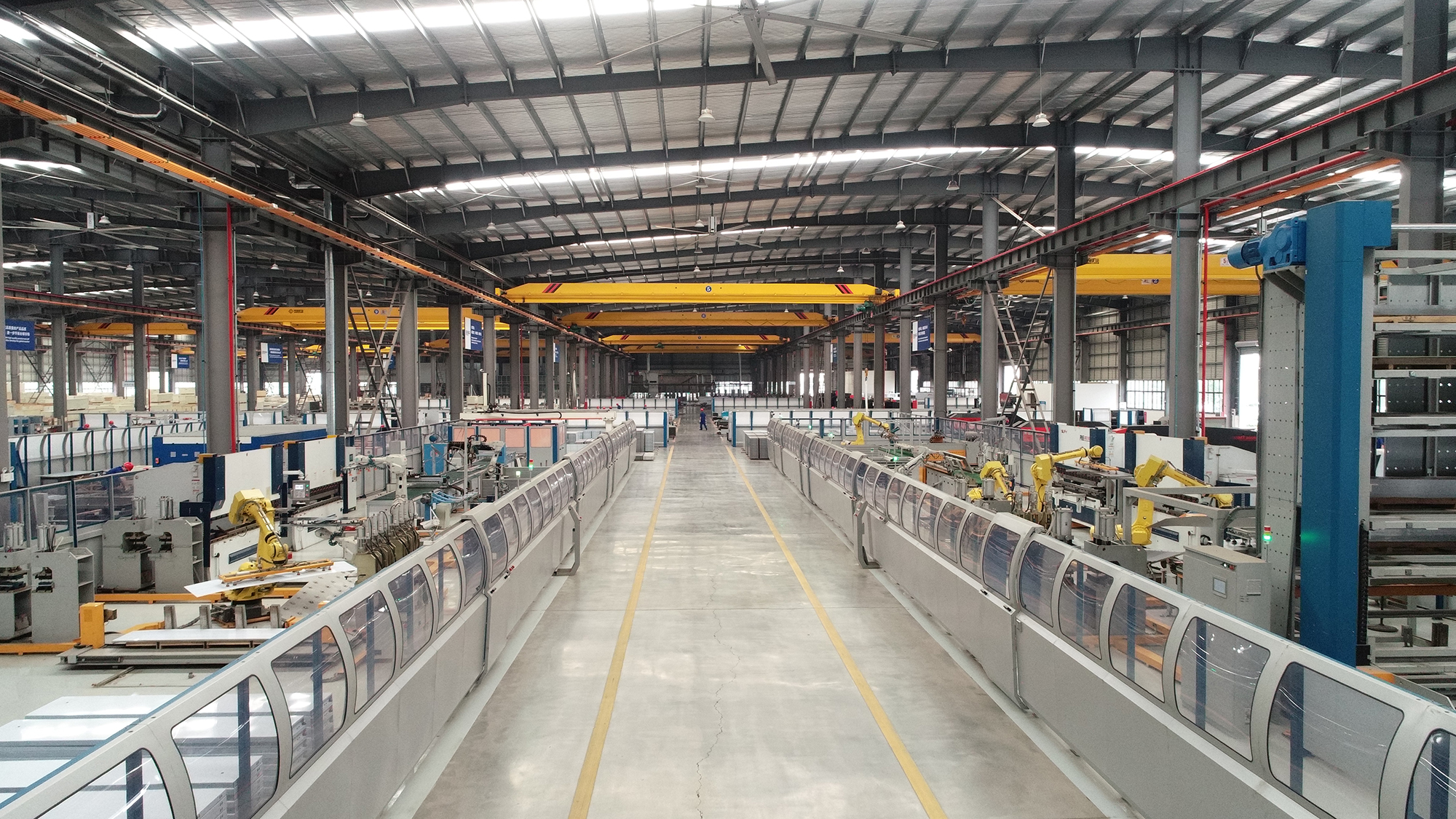
Delfar Elevator Co., Ltd. is an elevator manufacturer founded in 2011, based in Huzhou, Zhejiang, China, operating a factory of approximately 100,000 square metres and supplying passenger, home, observation, bed, freight, car, dumbwaiter, escalator and moving walk solutions to residential, commercial, industrial, hotel, hospital and public projects in overseas markets.
Next step: match your project numbers to a family
Send the rated load, rated speed, travel height, stop count and building type, and the reply will identify the family whose published envelope contains them, together with the customization options that apply.
Download the company profile: company profile PDF
Website: www.delfarelevator.com | Email: bensonelevator@gmail.com | Tel / WhatsApp: +86 135-1126-1762
Address: No.777, Tengfei Road, Zhili Town, Huzhou city, Zhejiang Province, China
Have Questions or Need More Details?
Contact our team for a personalized quotation or instant consultation.
Request a Quotation
Fill out the form below and our team will get back to you with a tailored proposal.
WhatsApp Direct Chat
Prefer to chat in real-time? Message us on WhatsApp for instant assistance & quick answers.
- Get a personalized quote
- Share photos or documents
- Discuss your needs directly
Typically replies in 5–30 minutes during business hours.