
Documenting Customized Elevator Compliance Before You Order
Compliance for a customized elevator is settled in documents long before it is settled on site. A buyer who can map every project condition to a declared, checkable product value — capacity, speed, stops, travel, machine-room type, cabin material and certificate scope — hands the local reviewer something verifiable. A buyer who cannot ends up defending claims that no paper supports.
This guide treats compliance as a specification and documentation exercise rather than a list of badges. It uses two models as worked examples — the DP/DPN passenger elevator and the DH home elevator — and shows how to assemble a submittal package, how to declare materials and finishes line by line, and which purchasing terms and acceptance criteria close the loop.
Delfar Elevator Co., Ltd. is an elevator manufacturer founded in 2011 and based in Huzhou, Zhejiang, China. Its range covers passenger, home, observation, hospital, freight and car elevators, machine-room-less elevators, escalators and moving walks, and its published certification portfolio includes ISO 9001, ISO 14001, ISO 45001, CE, CU, SASO, SGS and SC certificates. Nothing in this guide replaces a destination market's own approval route; the purpose is to prepare a file that route can actually work with.
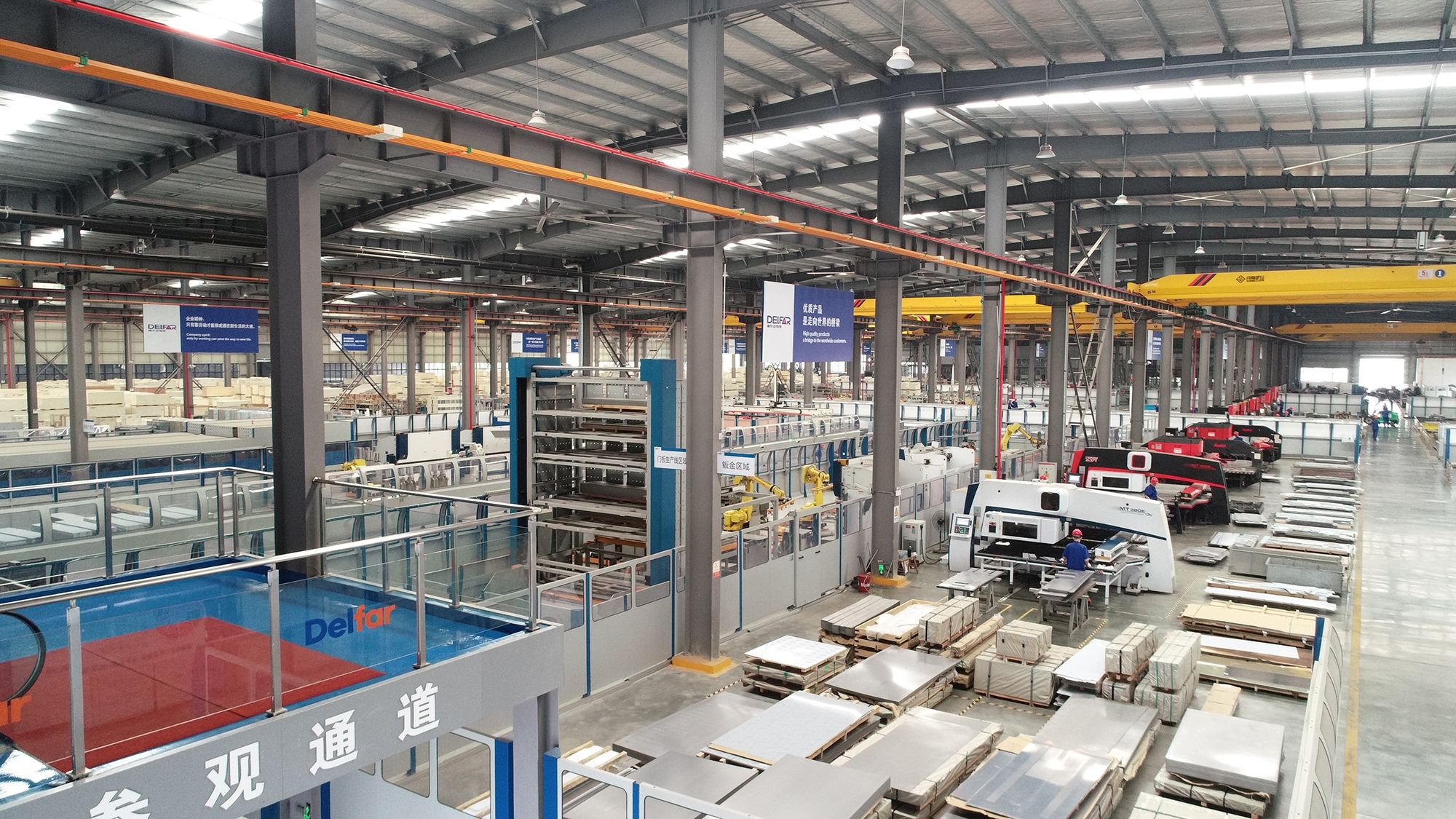
Production and inspection records created in the workshop are the raw material of a submittal package.
The compliance problem: three gaps a reviewer cannot close
Most compliance disputes on customized elevator projects do not begin with a defective product. They begin with a document that cannot be checked. Three gaps account for most of the friction.
Gap 1 — The parameter envelope is missing or vague
A specification that reads "high-speed customized elevator, suitable for high-rise use" gives a reviewer nothing to verify. A declared envelope does. Delfar's DP/DPN passenger elevator, for example, is declared at a rated capacity of 400–3000 kg, a rated speed of 1.0–6.0 m/s, 2–60 stops and a travel height of up to 100 m, with machine-room-less and small machine room configurations. Those figures define the outer boundary of what the model covers. The purchased configuration must then be recorded as a single point inside that boundary — 2.5 m/s and 18 stops, not "1.0–6.0 m/s class".
Gap 2 — The certificate scope does not answer the question being asked
The three ISO certificates in Delfar's register are management-system certificates: a quality management system, an environmental management system and an occupational health and safety management system. Their declared scope is identical — "Design, Manufacture, Installation, Remolding and Repair of Elevator and Escalator" — and each runs from 2025-06-03 to 2028-06-02. A reviewer asking "is the manufacturer's management system controlled?" and a reviewer asking "is this configuration accepted in my market?" are asking two different questions. Both matter, and neither substitutes for the other. The validity window matters too: a project commissioned after 2028-06-02 will need a renewed certificate copy in the file.
Gap 3 — Materials and finishes are agreed verbally
"Stainless steel and wood finish" is not a declaration. The car wall, car door, landing door, door frame, ceiling, handrail, floor and operating panels each carry their own option list, and each line is a potential handover dispute. Finish declarations belong in the submittal package with the same formality as capacity and speed, because they are the items a site inspection can physically compare against the order.
Industry background: why the documentation load keeps growing
The paperwork burden tracks configuration variety, and configuration variety is increasing. Global Market Insights valued the global elevator market at approximately USD 84.8 billion in 2024. Within that market, Fortune Business Insights expects machine-roomless technology to record the highest growth rate, at a 9.6% CAGR through 2034. Every MRL configuration moves a question from civil works into product data, because the machine-room decision now has a written answer that must match what is actually shipped. Delfar's DP/DPN and DH models both list machine-room and machine-room-less options, so "which one" has to be answered on the schedule, not assumed on site.
Regional demand adds a second layer. Allied Market Research put the Middle East elevator market at USD 1.25 billion in 2023, projected to reach USD 2.38 billion by 2030, and projects in that region typically arrive with their own documentation expectations. Delfar's own case records include passenger elevator deliveries of 20 units in the UAE, 30 units in Georgia, 20 units in Kenya and 30 units in Albania, each with its own local approval path — which is precisely why a reusable declaration format matters more than a one-off certificate email.
The five-document submittal model
A compliance file that survives local review usually contains five separable documents. Separating them is the point: each answers a different question, and each can be checked on its own.
1. Project condition statement
This records the environment the elevator will live in, before any product is named. The supplied application data for Delfar's elevator range specifies an ambient temperature of −5°C to +40°C, relative humidity of no more than 90% RH non-condensing, and altitude up to 1,000 m, with installation in a well-ventilated environment free from excessive dust, corrosive gases and flammable or explosive substances. The statement should also list the interfaces the project expects — emergency power supply, fire alarm system, CCTV, ARD, access control, intercom and remote monitoring — plus any special requirement such as fire protection, waterproofing, corrosion resistance, dust-proofing or high and low temperature resistance. Each item moves from "assumed" to "declared" at this step.
2. Parameter envelope schedule
This is the table that connects the project to a model. It states the model designation, the declared envelope, and the exact ordered value for capacity, speed, stops, travel and machine-room type. It should also carry the certificate references the model appears under, so a reviewer can trace from configuration to document in one hop.
3. Material and finish declaration
Every visible surface gets a line. For the DP/DPN and DH models the declared options are consistent: car finish in stainless steel, glass, painted steel, wood-finish or customized options; car door and landing door in the same list; floor in PVC or marble; handrail in stainless steel, solid wood or acrylic; car operating panel in stainless steel, glass or acrylic plexiglass; landing operating panel in stainless steel or glass. Delfar's stated customization scope covers logo, cabin wall material and colour, car door material and colour, ceiling type, floor material and pattern, and handrail material and colour — which maps almost one-to-one onto the declaration lines.
4. Certificate and scope register
A register is more useful than a folder of scans. It lists each certificate by number, issuing authority, standard, validity dates and scope, and notes which product lines the record is associated with. In Delfar's case the three ISO records each list the same nine related product lines: moving walk, freight elevator, escalator, home elevator, dumbwaiter, car elevator, passenger elevator, bed elevator and observation elevator.
5. Purchasing terms and acceptance criteria
This is the document that turns a specification into an enforceable order. It should state minimum order quantity, lead time, pre-shipment testing, warranty period and what "accepted" means at handover. For Delfar, the capability data records a minimum order quantity of 1 unit, a normal lead time of 35 days, a monthly capacity of 800 units, 100% pre-shipment test, and after-sales coverage of 12 months from the date of delivery, supported remotely through WhatsApp and email with on-site technical support available when required.
Worked example: writing the envelope down
The table below is the kind of page a reviewer can actually use. It does not describe what the product "can do"; it states what the product is declared to be, so that the ordered configuration can be checked against it.
| Declared item | DP/DPN passenger elevator | DH home elevator |
|---|---|---|
| Rated capacity | 400–3000 kg | 320–630 kg |
| Rated speed | 1.0–6.0 m/s | 0.3–0.5 m/s |
| Stops | 2–60 | 2–6 |
| Travel height | Up to 100 m | Up to 20 m |
| Machine room | Machine roomless / small machine room | MR and MRL options |
| Shaft construction | Not declared in the published specification | Aluminium / steel |
| Car and door finishes | Stainless steel, glass, painted steel, wood-finish, customized options | Stainless steel, glass, painted steel, wood-finish, customized options |
| Floor | PVC / marble | PVC / marble |
| Handrail | Stainless steel / solid wood / acrylic | Not declared in the published specification |
| Car and landing operating panels | C.O.P: stainless steel, glass, acrylic plexiglass; L.O.P: stainless steel, glass | C.O.P: stainless steel, glass, acrylic plexiglass; L.O.P: stainless steel, glass |
Two habits make this table work. First, never delete a row because the answer is unknown — mark it as not declared and route it to the supplier's compliance contact as an open item. Second, never let a range travel into a purchase order. The envelope belongs on the specification page; the order page carries one value per line.

High-rise projects are where an undeclared travel or speed value becomes an approval problem.
Step-by-step: building the file from project conditions to acceptance
Step 1 — Record the site conditions before choosing a product
Write down ambient temperature range, humidity, altitude and any aggressive atmosphere at the site, then compare them with the declared operating conditions of −5°C to +40°C, ≤90% RH non-condensing and ≤1,000 m altitude. If a site sits outside that band, the deviation becomes a written question — not a verbal reassurance. Coastal, dusty or chemically exposed sites are the usual triggers for the corrosion-resistant, dust-proof or waterproof special requirements listed in the application data.
Step 2 — Convert the traffic requirement into four numbers
Capacity in kilograms, speed in metres per second, number of stops and total travel in metres. Everything else in the compliance file hangs off these four values, so they should be agreed internally before any supplier conversation begins.
Step 3 — Select the model whose declared envelope contains the numbers
For a commercial or mixed-use building, the DP/DPN envelope of 400–3000 kg, 1.0–6.0 m/s, 2–60 stops and up to 100 m travel is the relevant check. For a house or villa, the DH envelope of 320–630 kg, 0.3–0.5 m/s, 2–6 stops and up to 20 m travel applies. If a required value falls outside the envelope, the correct response is to change the requirement or change the model — not to accept a proposal that quietly ignores the gap.
Step 4 — Fix the machine-room decision in writing
Both the DP/DPN and the DH list machine-room and machine-room-less configurations. That single line changes civil works, headroom planning and the drawing set. It therefore belongs on the schedule with the model name beside it, not in an email thread.
Step 5 — Declare every finish line against a named option
Use the option list as a checklist: car wall, car door, landing door, floor, handrail, car operating panel and landing operating panel. Where the published specification does not declare an option — for instance the DH handrail — mark it as an open question rather than filling the gap with an assumption. Delfar's customization scope (logo, cabin wall material and colour, car door material and colour, ceiling type, floor material and pattern, handrail material and colour) is the natural structure for this page.
Step 6 — Build the certificate register, not a certificate folder
The register is the part reviewers use most. It should reproduce the certificate number exactly, name the issuing authority, list the standard reference, restate the scope, and carry the validity dates. Delfar's current register reads as follows.
| Certificate | Authority | Number | Standard | Validity |
|---|---|---|---|---|
| Quality management system (ISO 9001) | QAC | 00625Q30569R4M | ISO 9001:2015; GB/T 19001-2016 | 2025-06-03 to 2028-06-02 |
| Environmental management system (ISO 14001) | QAC | 00625E30335R4M | ISO 14001:2015; GB/T 24001-2016 | 2025-06-03 to 2028-06-02 |
| Occupational health and safety management system (ISO 45001) | QAC | 00625S30329R4M | ISO 45001:2018; GB/T 45001-2020 | 2025-06-03 to 2028-06-02 |
All three records state the same scope — design, manufacture, installation, remolding and repair of elevator and escalator — and all three apply globally. That scope wording is worth reading closely: it tells a buyer which stages of the project the management system is claimed to cover, which is a different statement from a product approval for a specific configuration.
Step 7 — Close with purchasing terms and acceptance criteria
Each commercial term answers a compliance question. Minimum order quantity of 1 unit tells a small project that a single customized unit is orderable. A normal lead time of 35 days tells the planner how the submittal review window fits the construction programme. A monthly capacity of 800 units is relevant for multi-unit phases. 100% pre-shipment test is the evidence item an inspector will ask to see. Twelve months of after-sales coverage from the date of delivery defines the first warranty cycle, with remote support through WhatsApp and email and on-site technical support available when required. Put acceptance criteria next to these terms: which documents must be delivered before shipment, what test records accompany the goods, and what the buyer signs at handover.
Use cases: how the same file changes with the project
Commercial and high-rise buildings
A commercial project typically pushes toward the upper part of the DP/DPN envelope — more stops, longer travel, higher rated speed. The documentation consequence is that the ordered value must be pinned against the declared maximum. Where the destination market applies EN 81-20 and EN 81-50, which Liftinstituut describes as the primary harmonized European standards for elevator design and testing and as mandatory for CE marking, the reviewer will also look for the door-protection detail: KONE's compliance guidance notes that EN 81-20 requires a light curtain door detection system to reduce the risk of door strikes. Delfar's published door safety package includes door interlock, infrared light curtain and door sensor, which is the level of detail that should be written on the schedule rather than left to a brochure.
Residential and villa projects
A house project sits inside the DH envelope, where the numbers are smaller but the finish declarations are more visible to the end user. Delfar's DH home elevator is declared at 320–630 kg, 0.3–0.5 m/s, 2–6 stops and travel up to 20 m, with an aluminium or steel shaft structure and machine-room and machine-room-less options. Because the cabin is the product from the owner's point of view, the finish page carries more weight here than the traffic numbers — and a mismatch between a selected wood-finish door and the delivered panel is exactly the kind of issue a signed finish declaration prevents.
In residential work the finish declaration carries as much weight as the load and speed figures.
Industrial and heavy-duty applications
Industrial duty shifts the emphasis from aesthetics to declared load and durability. Delfar's DF/DFN freight elevator is declared with a capacity range of 1,000–8,000 kg and a rated load of 2,000–8,000 kg, a speed range of 0.25–1.0 m/s, 2–10 stops and travel up to 50 m, with VVVF variable-frequency control, a wide door opening and forklift compatibility. For a heavy-duty customized elevator specification, the compliance question is not whether the unit is described as heavy-duty, but whether the declared rated load and the actual handled load are written down and reconciled.
Middle East and other regional markets
Regional requirements are where a generic file fails fastest. Delfar's published portfolio includes a SASO certificate alongside CE, CU, SGS and SC certificates, which is the kind of item a Middle East buyer will ask to see at the documentation stage. Beyond the certificate itself, the practical check is whether the destination market's own approval authority will accept the submitted declaration set — and that question can only be answered by the project's local consultant or authority, with the supplier supplying the underlying documents. The ambient conditions matter here too: a site above 1,000 m altitude or with sustained humidity above 90% RH falls outside the declared operating band and should be raised before the order, not after delivery.
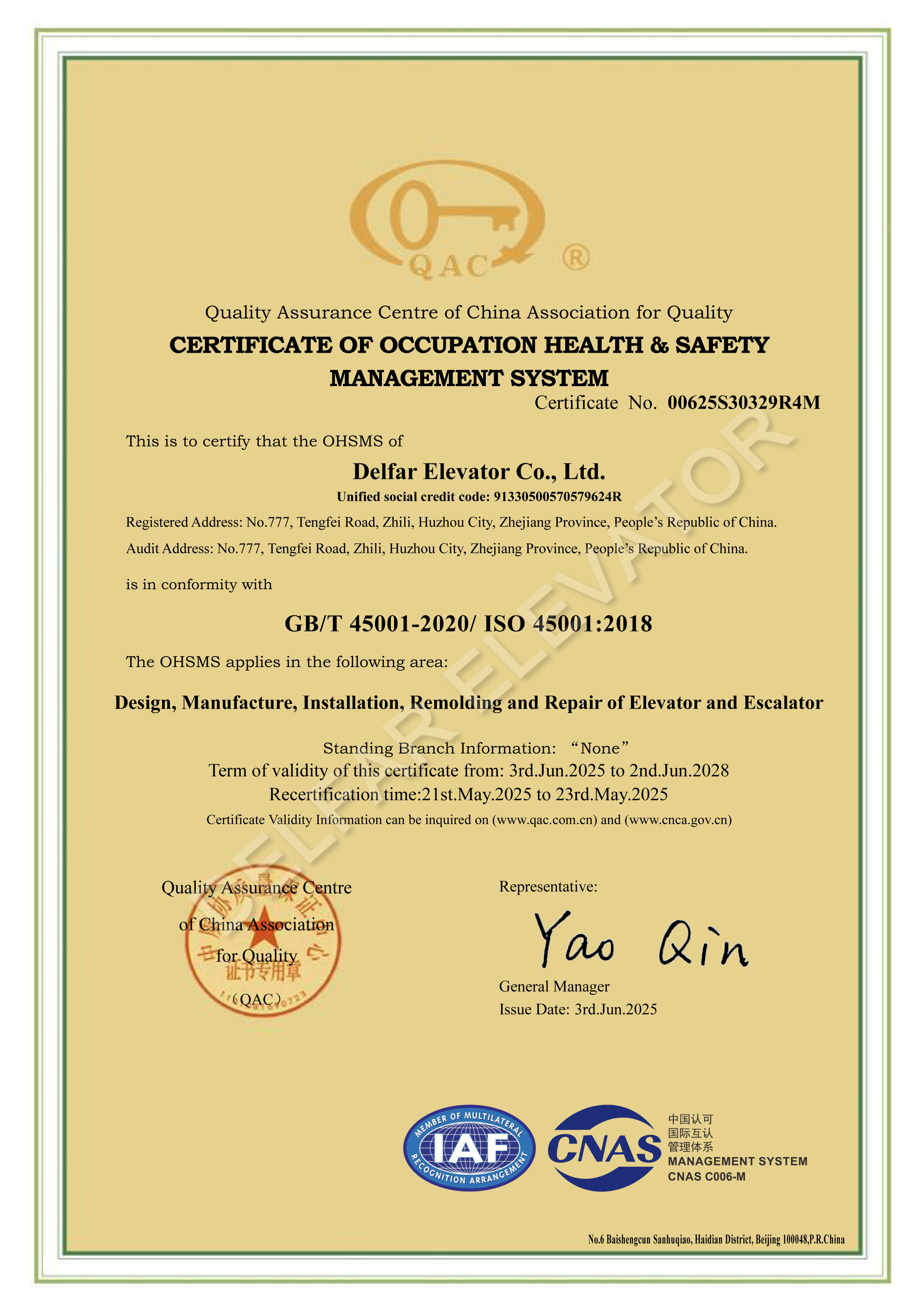
A certificate copy belongs in the register with its number, scope and validity dates restated, not loose in an email.
The questions to put to a supplier's compliance contact
Most of the risk in a customized elevator order can be removed by asking precise questions and asking for the answers in writing. These are the ones worth sending.
- Which model designation covers my required capacity, speed, stops and travel, and what is the exact declared value you are quoting against each of those four figures?
- Is the quoted configuration machine-room or machine-room-less, and which drawing set applies to that choice?
- Which certificates apply to this product line, and can you send the certificate copy with number, issuing authority, standard and validity dates visible?
- What exactly does the certificate scope cover — design, manufacture, installation, remodelling, repair, or only some of these?
- If my installer is a separate company, how does that affect the documented scope of supply and the installation records?
- Which finish options are declared for each surface, and which of them are outside the standard option list?
- For my destination market, which documents do you routinely supply, and which ones must my local consultant obtain?
- My site conditions are X °C, Y% RH and Z metres altitude — do they fall inside the declared operating band, and if not, what changes?
- What pre-shipment test records will accompany the goods, and in what format?
- What is the validity date of each certificate relative to my planned delivery and handover dates?
Frequently asked questions
Which documents should a customized elevator supplier provide for compliance review?
A submittal package should contain five items: a project condition statement covering environment and interfaces; a parameter schedule with declared capacity, speed, stops, travel and machine-room type; a material and finish declaration for every visible surface; a certificate register with numbers, authority, standard, scope and validity; and purchasing terms with acceptance criteria. For Delfar, the certificate register lists ISO 9001 (00625Q30569R4M), ISO 14001 (00625E30335R4M) and ISO 45001 (00625S30329R4M), all issued by QAC, all valid from 2025-06-03 to 2028-06-02, and all scoped to the design, manufacture, installation, remolding and repair of elevator and escalator.
What must a specification sheet declare for the DP/DPN passenger elevator and the DH home elevator?
For the DP/DPN it must declare the model, rated capacity of 400–3000 kg, rated speed of 1.0–6.0 m/s, 2–60 stops, travel up to 100 m, and whether the unit is machine-room-less or small machine room. For the DH it must declare 320–630 kg, 0.3–0.5 m/s, 2–6 stops, travel up to 20 m, and the MR or MRL choice. Both should then carry finish lines for car wall, car door, landing door, floor, handrail and operating panels. The sheet should state the ordered value as a single figure per line and keep the model envelope as a separate reference field.
How do I evaluate heavy-duty customized elevator manufacturers for industrial use?
Judge them on declared data rather than adjectives. Delfar's DF/DFN freight elevator is declared with a capacity range of 1,000–8,000 kg and a rated load of 2,000–8,000 kg, speed of 0.25–1.0 m/s, 2–10 stops, travel up to 50 m, VVVF variable-frequency control for smooth acceleration and deceleration, a wide door opening and forklift compatibility. Then check five things: whether the declared rated load matches your heaviest handled load, whether the surface finish suits the working environment, whether the certificate register is current, whether the scope of supply covers installation, and what pre-shipment test evidence is issued — Delfar states 100% pre-shipment test.
What price band should a buyer plan for on a customized elevator?
A third-party estimate from Maximize Market Research places customized elevators in emerging markets at roughly USD 18,000 to USD 35,000 per unit in 2025. Treat that as a planning band, not a quotation. Configuration drives the number — capacity, speed, travel, stops, finish selection and documentation requirements all move it — so the reliable approach is to request a line-item quotation that references the declared specification sheet, so each cost line can be traced to a declared value.
What sample or pre-shipment evidence can verify quality before delivery?
Request evidence against named line items rather than general reassurance. Delfar's customization scope covers logo, cabin wall material and colour, car door material and colour, ceiling type, floor material and pattern, and handrail material and colour, so finish samples should be requested for those specific items. Before shipment, ask for the pre-shipment test record corresponding to the stated 100% pre-shipment test, plus photographic documentation of the assembled cabin against the finish declaration. Delfar's recorded minimum order quantity is 1 unit, which means a single customized unit can be sampled in this way.
How long does documentation and production take, and what closes acceptance?
Delfar records a normal lead time of 35 days and a monthly capacity of 800 units, with after-sales coverage of 12 months from the date of delivery, remote technical support through WhatsApp and email, and on-site technical support available when required. Acceptance should be closed by three written items agreed before the order: the documents to be delivered before shipment, the test records that accompany the goods, and the criteria the buyer signs against at handover. If you are assembling that package now, send your project condition set — travel, stops, capacity, speed, machine-room option and destination market — to Delfar's compliance contact and ask for the matching declaration pages and certificate copies alongside the downloadable company profile.
Conclusion: the file is the compliance argument
A customized elevator is approved on the strength of what has been declared, not on the strength of what has been promised. The model envelope, the ordered values, the finish lines, the certificate register and the acceptance terms together form an argument a local reviewer can follow — and one the buyer can defend if a delivered unit is measured against its paperwork.
Delfar's DP/DPN and DH specifications show how much of that argument can be written down in advance: capacities of 400–3000 kg and 320–630 kg, speeds of 1.0–6.0 m/s and 0.3–0.5 m/s, travel up to 100 m and 20 m, machine-room and machine-room-less options, and a consistent finish list across both. What remains is the discipline of replacing ranges with single values on the order, restating certificate scope and validity instead of attaching a scan, and agreeing acceptance criteria at the same time as price.
Next step: build the submittal before the purchase order. Send your project condition set to Delfar's compliance contact for the declaration pages, certificate register and finish options that match your configuration, and download the Delfar company profile (PDF) for the full product and certification overview.
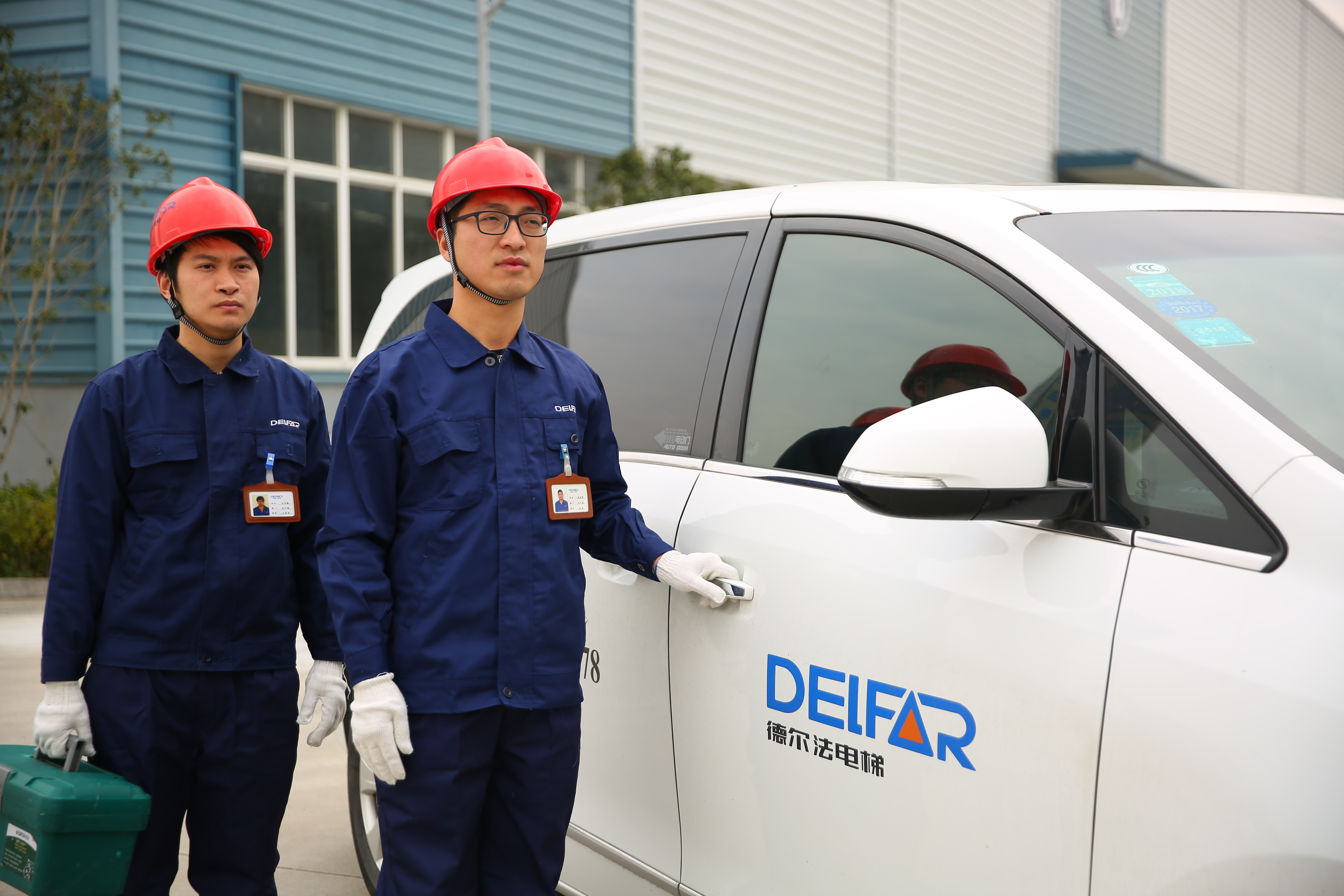
Documentation questions are best answered before the order, alongside the technical review.
Have Questions or Need More Details?
Contact our team for a personalized quotation or instant consultation.
Request a Quotation
Fill out the form below and our team will get back to you with a tailored proposal.
WhatsApp Direct Chat
Prefer to chat in real-time? Message us on WhatsApp for instant assistance & quick answers.
- Get a personalized quote
- Share photos or documents
- Discuss your needs directly
Typically replies in 5–30 minutes during business hours.