
Freight Elevator vs. Car Elevator: Customized Vertical Transport for Logistics and Parking
Two buyers send the same sentence in a request for quotation: “We need a heavy-duty customized elevator.” One runs a distribution warehouse and moves palletised goods on a forklift. The other is building a multi-level car park and moves passenger vehicles between decks. They should not receive the same machine, the same shaft drawing, or the same quotation.
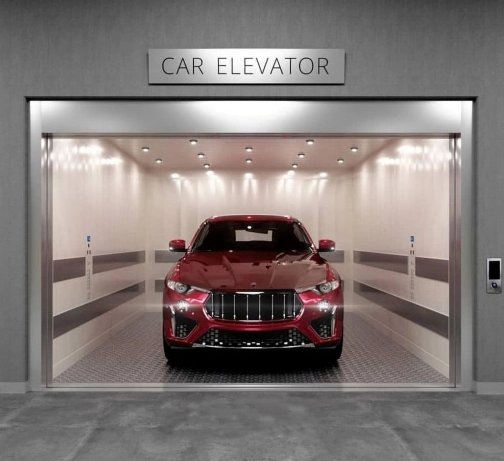
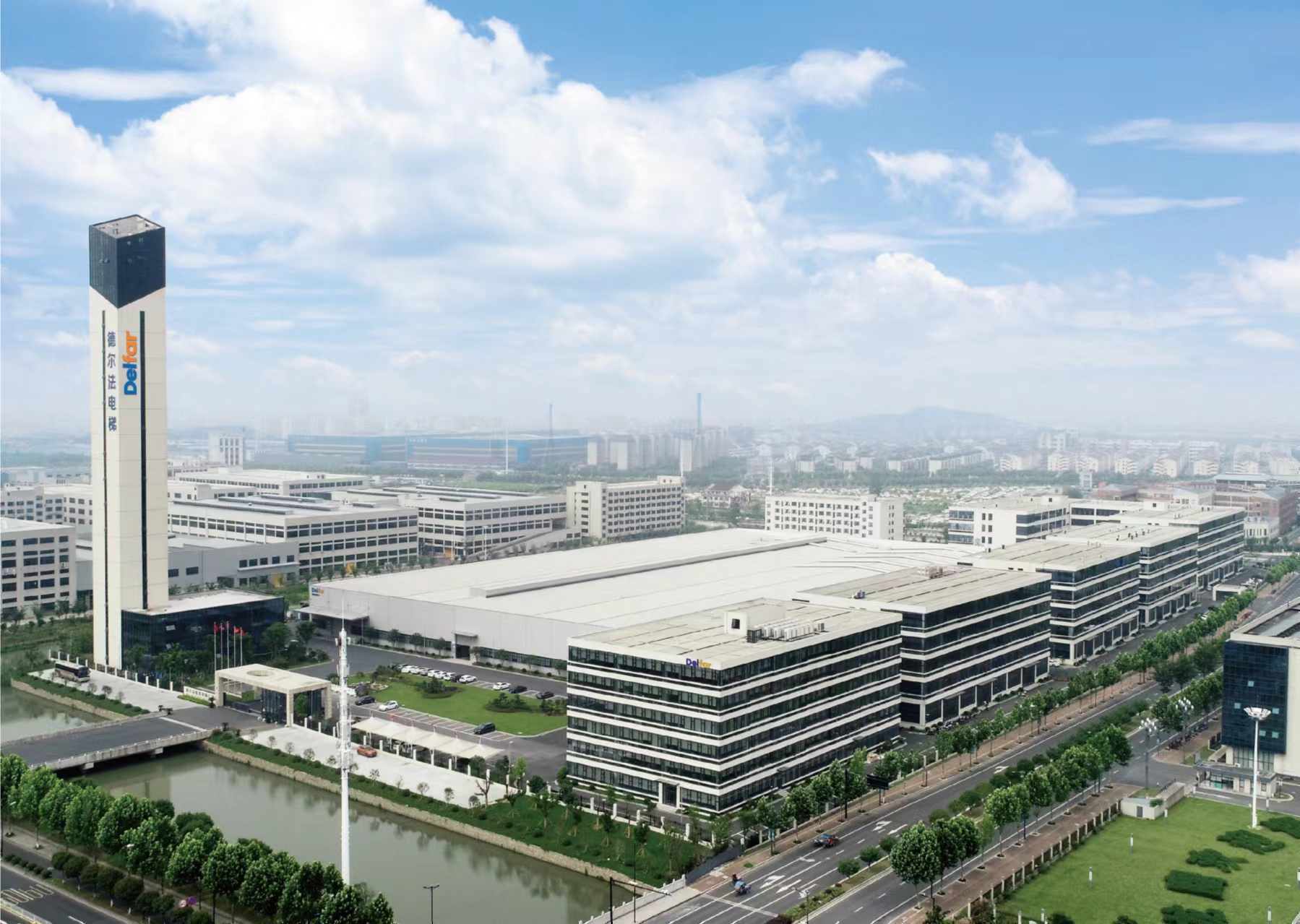
Delfar Elevator Co., Ltd. is an elevator manufacturer founded in 2011 in Huzhou, Zhejiang, China, producing passenger, home, observation, hospital, freight, car and machine-roomless elevators, escalators and moving walks, with a factory of approximately 100,000 m², an annual output of 10,000 units, and management systems certified to ISO 9001, ISO 14001 and ISO 45001. Its product catalogue already separates the two duties described above: the DF/DFN customized freight elevator for manufacturing and logistics & warehousing, and the DA/DAN customized car elevator for automotive & parking. This guide compares those two lines as specification decisions — capacity, speed, stops, travel, duty profile, impact exposure and compliance — so that a buyer at research-to-evaluation stage can convert a building brief into a technically defensible configuration.
The short answer. Choose the DF/DFN freight elevator when the load arrives on a pallet, in a cart, or on a forklift, when the shaft must serve 2–10 stops and up to 50 m of travel, and when capacity must reach 2000–8000 kg at 0.25–1.0 m/s with VVVF variable-frequency control. Choose the DA/DAN car elevator when the load is a vehicle that drives in and parks on the platform, when travel stays within 30 m and 2–6 stops, and when the cabin must absorb rolling and impact loads at 3000–5000 kg and 0.2–0.5 m/s. The two ranges overlap between 3000 kg and 5000 kg; load interface, not capacity, is what separates them.
Problem Definition: Why “Heavy-Duty” Is Not a Specification
A customized industrial elevator is only as correct as the constraints written into its data sheet. Freight and car duty load the same steel structure in fundamentally different ways, and three constraints decide the machine before price is ever discussed.
1. The load interface
Freight moves in units that are lifted, rolled or driven on by a forklift or pallet truck; that is why the DF/DFN range is published as forklift-compatible with a wide door opening and a large cabin with flexible dimensions. A car arrives on its own wheels, under its own power, and stops inside the cabin with the driver and passengers still inside the enclosure. The relevant figures are platform footprint, kerb weight plus occupants, entry and exit clearance, and the ability of the cabin structure to resist repeated impact from tyres, suspension movement and misjudged entry.
2. The travel envelope
Freight elevators in warehouses serve mezzanines, production floors and dispatch levels, which is why DF/DFN is published up to 50 m travel with 2–10 stops. Vehicle elevators usually link a limited number of parking decks, reflected in the DA/DAN figures of up to 30 m travel and 2–6 stops. A tender that specifies 45 m of travel for a car elevator is not ambitious; it is outside the published envelope of the product line and will force either a redesign request or a change of concept.
3. Speed against the handling cycle
Speed follows the cycle time of the operation, not the prestige of the building. DF/DFN is published at 0.25–1.0 m/s, DA/DAN at 0.2–0.5 m/s. For freight, a faster machine pays back when a forklift and an operator are waiting at each landing; for vehicle parking, the loading and unloading of the car itself dominates the cycle, so extra speed adds little.
Industry Background: Why Both Configurations Are Growing
Demand for customized industrial elevators is being pushed by warehouse densification and by urban parking constraints at the same time. Future Market Insights projects the industrial elevators market to grow from USD 72.1 billion in 2025 to USD 116.3 billion by 2035, a compound annual growth rate of 4.9%. Fortune Business Insights expects machine-roomless (MRL) technology to record the highest growth rate in the elevator sector, at a CAGR of 9.6% through 2034 — relevant to both product lines, since DF/DFN and DA/DAN are each offered in small-machine-room and machine-roomless versions.
Lifecycle planning deserves equal weight at evaluation stage. Vyansa Intelligence data cited in 2025 puts maintenance services at approximately 55% of global elevator market revenue, which means the specification that is cheapest to install is not automatically the cheapest to own. For Gulf and wider regional projects, Allied Market Research values the Middle East elevator market at USD 1.25 billion in 2023, projected to reach USD 2.38 billion by 2030; a customized elevator for Middle East markets has to be reviewed against heat, dust and humidity rather than against a temperate-climate default.
Detailed Solution: DF/DFN Freight vs. DA/DAN Car
DF/DFN customized freight elevator
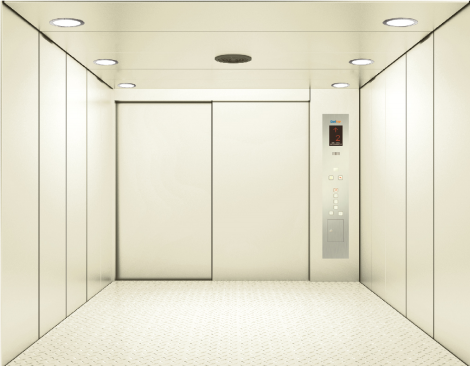
The DF/DFN is Delfar’s freight platform, offered as a small-machine-room freight elevator and a machine-roomless freight elevator. Published parameters are a travel height of up to 50 m, 2–10 stops, a speed range of 0.25–1.0 m/s and a rated capacity of 2000–8000 kg. The car is available in painted steel or hairline stainless steel, with a floor in curved lined steel or stainless steel curved lined steel, and stainless steel faceplates for the landing and car operating panels. The line is described as heavy-duty and durable for demanding working environments, forklift-compatible, with a wide door opening and a large cabin with flexible dimensions, and it can be customized with dimensions for narrow shafts. VVVF variable-frequency control provides smooth acceleration and deceleration and reliable operation under heavy loads.
DA/DAN customized car elevator
The DA/DAN is Delfar’s vehicle platform, offered as a small-machine-room car elevator and a machine-roomless car elevator. Published parameters are a travel height of up to 30 m, 2–6 stops, a speed range of 0.2–0.5 m/s and a rated capacity of 3000–5000 kg. The cabin structure is high-strength structural steel; cabin walls, cabin doors and door frames are available in painted steel or stainless steel, and the shaft can be concrete or steel structure. The design is described as heavy-duty and impact resistant, durable and low maintenance, with customizable finish.
What customization actually changes
Both lines sit inside Delfar’s OEM programme, which covers logo, cabin wall material and colour, car door material and colour, ceiling type, floor material and pattern, and handrail material and colour. In practice this is where customized elevator cabin materials become a project decision rather than a cosmetic one: a warehouse cabin needs a floor and wall finish that survives pallet and trolley contact, while a parking cabin needs surfaces that tolerate vehicle exhaust, tyre marks and washdown.
Step-by-Step Breakdown: Converting a Brief into a Configuration
Step 1 — Define the load interface before the capacity class
Write down what physically enters the cabin. For freight: pallet dimensions, maximum pallet weight, forklift or pallet-truck type, and whether the truck enters the cabin or stops at the sill. For vehicles: vehicle length, width, height, kerb weight plus the number of occupants, and the turning path from the approach apron into the cabin. Only then map the result onto a capacity class — 2000–8000 kg for DF/DFN, 3000–5000 kg for DA/DAN.
Step 2 — Match travel height and stops to the building
Confirm the finished floor-to-floor distances and the number of served levels. DF/DFN covers up to 50 m and 2–10 stops; DA/DAN covers up to 30 m and 2–6 stops. If the brief exceeds the published envelope, resolve it at design stage — additional machine room, different product line, or split shafts — rather than during manufacturing.
Step 3 — Set speed against the handling cycle
Estimate the cycle: door open, load in, load secured, door close, travel, door open, load out. Freight operations with a forklift waiting at each landing justify the upper end of the 0.25–1.0 m/s DF/DFN range. Parking operations rarely do, because the vehicle movement dominates; the DA/DAN range of 0.2–0.5 m/s is sized for that reality. Neither line is a high-speed customized elevator: DF/DFN reaches 1.0 m/s and DA/DAN 0.5 m/s, so where speed is the dominant requirement, the conversation belongs with the passenger range, published at 1.0–6.0 m/s.
Step 4 — Lock customized elevator dimensions and door geometry
Customized elevator dimensions should be derived, not chosen. For freight, cabin width, depth and height follow pallet footprint plus forklift clearance, and the door opening must clear the widest load and the forks; DF/DFN is published with a wide door opening and flexible cabin dimensions, and can be dimensioned for narrow shafts where an existing building constrains the hoistway. For vehicles, the platform must accommodate the vehicle footprint with entry and exit margins, and the door width must clear mirrors and door swing. Ask for a dimensioned shaft drawing with the load envelope drawn inside it, and check it against the actual forklift or vehicle, not against a catalogue figure.
Step 5 — Specify cabin materials and impact protection
For DA/DAN, the impact-resistant design and high-strength structural steel cabin structure are the core of the specification, because vehicle loading delivers repeated point loads and rolling contact. For DF/DFN, the heavy-duty construction, painted steel or hairline stainless steel walls, and curved lined steel floor address abrasion from pallets and trolleys. Where the operation involves chemicals, washdown or food-grade hygiene, surface selection moves from preference to requirement.
Step 6 — Choose machine-room or machine-roomless configuration and matched equipment
Both lines offer small-machine-room and machine-roomless versions, which matters in retrofit projects where headroom is fixed. Machine-roomless configurations are also the segment Fortune Business Insights identifies as the fastest-growing technology in the market, at a 9.6% CAGR through 2034. At the same time, list the interfacing equipment the operation depends on: emergency power supply, fire alarm system, CCTV, parking system, automatic rescue device (ARD), access control, intercom and remote monitoring. A machine-roomless customized elevator saves space; the interfaces decide whether the installation actually works on the day the building opens.
Step 7 — Confirm compliance, environment and acceptance
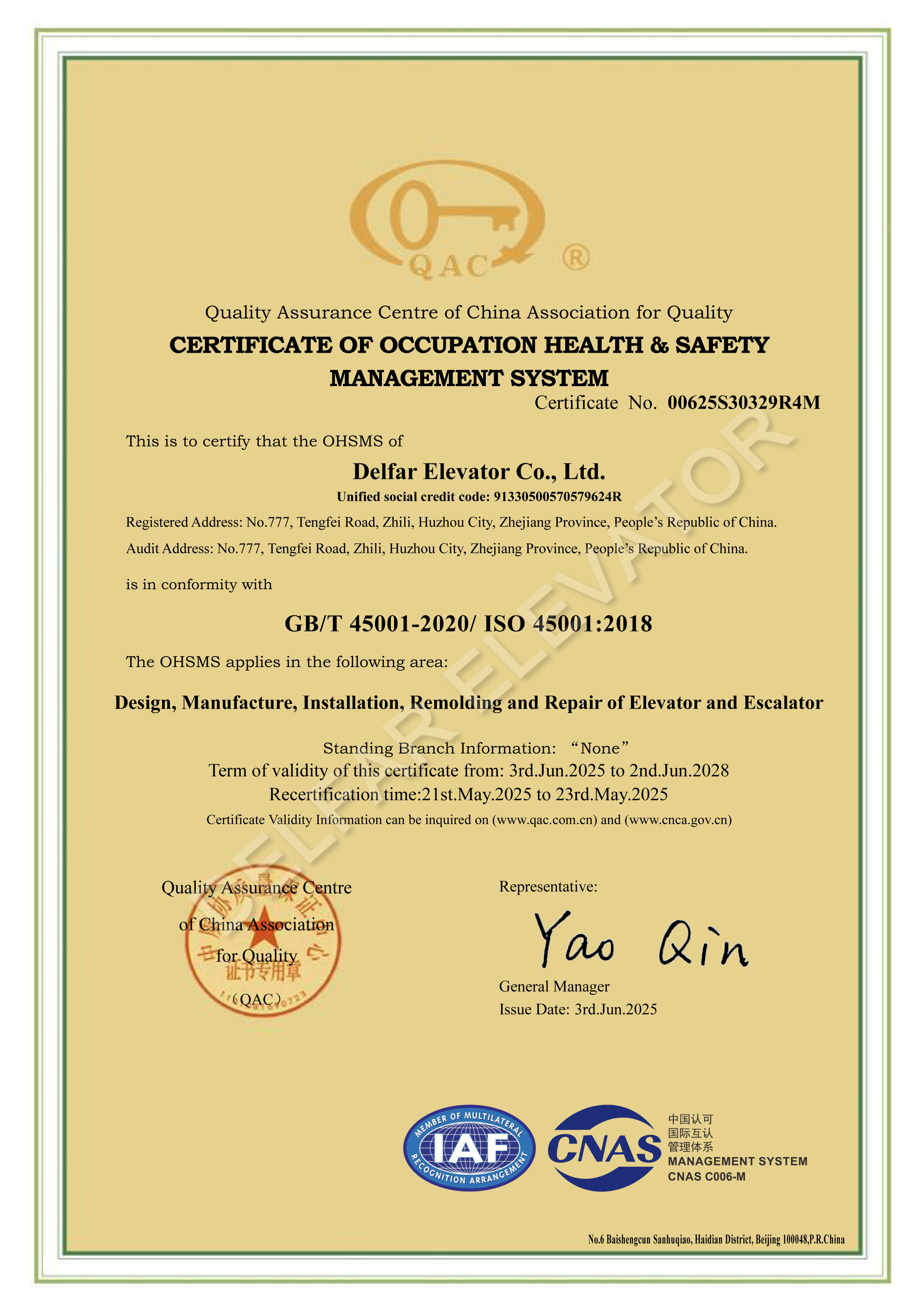
Compliance is a constraint, not a formality. EN 81-20 and EN 81-50 are the primary harmonised European standards for elevator design and testing and are mandatory for CE marking, and EN 81-20 requires a light curtain door detection system to reduce the risk of door strikes. Delfar’s approvals include CE alongside CU, SASO, SGS and SC certificates, and its management systems are certified to ISO 9001 (certificate 00625Q30569R4M), ISO 14001 (00625E30335R4M) and ISO 45001 (00625S30329R4M), all issued by QAC, valid from 2025-06-03 to 2028-06-02, with a scope covering design, manufacture, installation, remodelling and repair of elevators and escalators. The DF/DFN freight elevator and the DA/DAN car elevator are each covered by the ISO 45001:2018 and GB/T 45001-2020 certification.
Environment is the second half of this step. Delfar’s published application conditions specify ambient temperature of -5 °C to +40 °C, relative humidity of ≤90% RH non-condensing, and altitude of ≤1,000 m, with installation in a well-ventilated environment free from excessive dust, corrosive gases and flammable or explosive substances. Where a project exceeds these conditions, the special requirement list — fire protection, explosion-proof, waterproof, corrosion resistant, dust-proof, high/low temperature resistant — must be raised during technical review. For Middle East projects, dust and heat are the items that most often move a standard configuration into a customized one.
Comparison Table: DF/DFN and DA/DAN Side by Side
| Specification | DF/DFN customized freight elevator | DA/DAN customized car elevator |
|---|---|---|
| Primary application | Manufacturing; logistics & warehousing | Automotive & parking |
| Rated capacity | 2000–8000 kg | 3000–5000 kg |
| Rated speed | 0.25–1.0 m/s | 0.2–0.5 m/s |
| Stops | 2–10 | 2–6 |
| Travel height | ≤50 m | ≤30 m |
| Machine room options | Small machine room; machine roomless | Small machine room; machine roomless |
| Loading interface | Forklift-compatible; wide door opening; large cabin with flexible dimensions | Vehicle drive-in platform; impact-resistant heavy-duty construction |
| Cabin and materials | Car in painted steel or hairline stainless steel; floor in curved lined steel or stainless steel curved lined steel; stainless steel L.O.P and C.O.P faceplates | Cabin structure in high-strength structural steel; cabin wall, door and door frame in painted steel or stainless steel; shaft in concrete or steel structure |
| Notable customization | Dimensions customizable for narrow shafts; VVVF variable-frequency control | Customizable finish; durable, low-maintenance design |
| Certification position | ISO 45001:2018 / GB/T 45001-2020 (QAC 00625S30329R4M, valid 2025-06-03 to 2028-06-02) | ISO 45001:2018 / GB/T 45001-2020 (QAC 00625S30329R4M, valid 2025-06-03 to 2028-06-02) |
| Constraint to watch | Door width and cabin depth against pallet footprint; travel beyond 50 m | Impact protection, vehicle manoeuvring space; travel beyond 30 m |
Use Cases: Where Each Configuration Earns Its Place
Multi-level warehouse and dispatch centre
The DF/DFN fits where goods arrive on pallets, a forklift must enter or reach the cabin, and the shaft serves mezzanine, production and dispatch levels. The published combination — up to 8000 kg, wide door opening, forklift compatibility, VVVF control and up to 50 m travel — addresses the dominant risk in this setting: cycle disruption caused by a cabin or door that cannot take the real load envelope. A Delfar freight elevator project for cargo transportation, delivered as 30 units for a construction company, is described in Delfar’s case records with highlights of smooth and reliable operation, durable and robust construction, heavy-duty capacity, flexible customization and a factory-direct solution.
Commercial parking building
The DA/DAN fits where ramps would consume usable floor area. A Delfar car elevator OEM project of 10 units for a commercial parking building is recorded as enabling vehicles to move between parking levels while helping maximise the usable area of the building, with the elevator replacing vertical circulation that ramps would otherwise require. In that configuration the value is not speed but footprint: 3000–5000 kg, 0.2–0.5 m/s, up to 30 m and 2–6 stops, with an impact-resistant cabin.
Mixed-use developments
Buildings that combine basement parking, retail podiums and residential towers usually need more than one product line, and mixing them in a single specification is where errors enter. Vehicle movement stays with DA/DAN; palletised deliveries to retail or F&B tenancies go to DF/DFN; passenger and residential travel belongs to the passenger and home ranges, published at 1.0–6.0 m/s and 0.3–0.5 m/s respectively. Treating those as one “customized elevator” package produces compromise cabin geometry on every level.
Narrow-shaft retrofits
Existing buildings rarely offer an ideal hoistway. DF/DFN can be customized with dimensions for narrow shafts, which makes a freight retrofit feasible where a standard cabin would not enter the building. In vehicle retrofits, the binding constraint is usually the approach and turning path rather than the shaft itself, and it should be measured on site before the quotation is fixed.
Cost planning context
Maximize Market Research estimates that customized elevators in emerging markets are typically priced between USD 18,000 and USD 35,000 per unit, with the caveat that the band varies by capacity, finish, shaft works and compliance scope. Use it as an order-of-magnitude reference for budget conversations, not as a quotation for either line.
FAQ
Are the DF/DFN freight elevator and DA/DAN car elevator certified for international projects?
Both product lines are certified to ISO 45001:2018 and GB/T 45001-2020. The certification is issued by QAC under certificate number 00625S30329R4M, valid from 2025-06-03 to 2028-06-02, and Delfar’s management system certificates cover ISO 9001 (00625Q30569R4M), ISO 14001 (00625E30335R4M) and ISO 45001 (00625S30329R4M) with a scope of design, manufacture, installation, remodelling and repair of elevators and escalators. Delfar also holds CE, CU, SASO, SGS and SC certificates. For European Union acceptance, EN 81-20 and EN 81-50 are the primary harmonised standards and are mandatory for CE marking, and EN 81-20 requires a light curtain door detection system.
Can a heavy-duty customized elevator be adapted to a narrow shaft or an existing building?
Yes, within published limits. The DF/DFN freight elevator can be customized with dimensions for narrow shafts, and both DF/DFN and DA/DAN are offered in small-machine-room and machine-roomless versions, which helps where headroom is fixed. The limits that cannot be customized away are the published travel envelopes: up to 50 m and 2–10 stops for DF/DFN, up to 30 m and 2–6 stops for DA/DAN.
How should a buyer shortlist heavy-duty customized elevator manufacturers for industrial use?
Shortlist on verifiable specification, not on claimed strength. Require a written parameter sheet covering capacity, speed, stops and travel; confirm the load interface is engineered for the actual handling method — forklift compatibility and a wide door opening for freight, impact-resistant construction and a high-strength structural steel cabin for vehicles; check the certificate numbers and validity dates behind any compliance claim; and confirm the machine-room strategy fits the building. Delfar publishes these parameters for DF/DFN at 2000–8000 kg, 0.25–1.0 m/s, 2–10 stops and ≤50 m travel, and for DA/DAN at 3000–5000 kg, 0.2–0.5 m/s, 2–6 stops and ≤30 m travel.
What budget range applies to a customized freight or car elevator?
Maximize Market Research estimates customized elevators in emerging markets typically fall between USD 18,000 and USD 35,000 per unit. That figure is a market-level indicator and changes with rated capacity, travel height, number of stops, cabin materials, machine-room configuration, shaft works and the compliance scope required by the destination market. Buyers should request a project-specific quotation against a dimensioned shaft drawing.
Can samples or pre-shipment verification be arranged, and what is the lead time?
Delfar’s published capability data lists a minimum order quantity of 1 unit, 100% pre-shipment testing, a monthly capacity of 800 units and a normal lead time of 35 days. Remote technical support is provided through channels such as WhatsApp and email, professional on-site technical support is available when required, and the warranty period is 12 months from the date of delivery. Buyers evaluating either line can start with a specification review and a dimensioned proposal — the company profile and product documentation are available from Delfar Elevator Co., Ltd. through www.delfarelevator.com, or directly by email at bensonelevator@gmail.com and telephone or WhatsApp at +86 135-1126-1762.
Conclusion: Decide on the Load, Then on the Numbers
The freight-versus-car decision is settled by one question: does the load arrive on a pallet, or on wheels? If it arrives on a pallet, the DF/DFN platform supplies 2000–8000 kg, 0.25–1.0 m/s, 2–10 stops, up to 50 m travel, VVVF control, forklift compatibility, a wide door opening and dimensioning for narrow shafts. If it arrives on wheels, the DA/DAN platform supplies 3000–5000 kg, 0.2–0.5 m/s, 2–6 stops, up to 30 m travel, an impact-resistant design and a cabin structure in high-strength structural steel.
Everything after that is discipline: derive customized elevator dimensions from the real load envelope, choose machine-room or machine-roomless configuration against the building rather than the brochure, confirm certificate numbers and validity dates rather than accepting a compliance claim, and reconcile the specification with the published environmental envelope of -5 °C to +40 °C, ≤90% RH and ≤1,000 m altitude. Done in that order, the comparison stops being freight versus car and becomes a defensible technical file — the document a project team can actually build from.
Next Step: Turn Your Load Envelope into a Specification
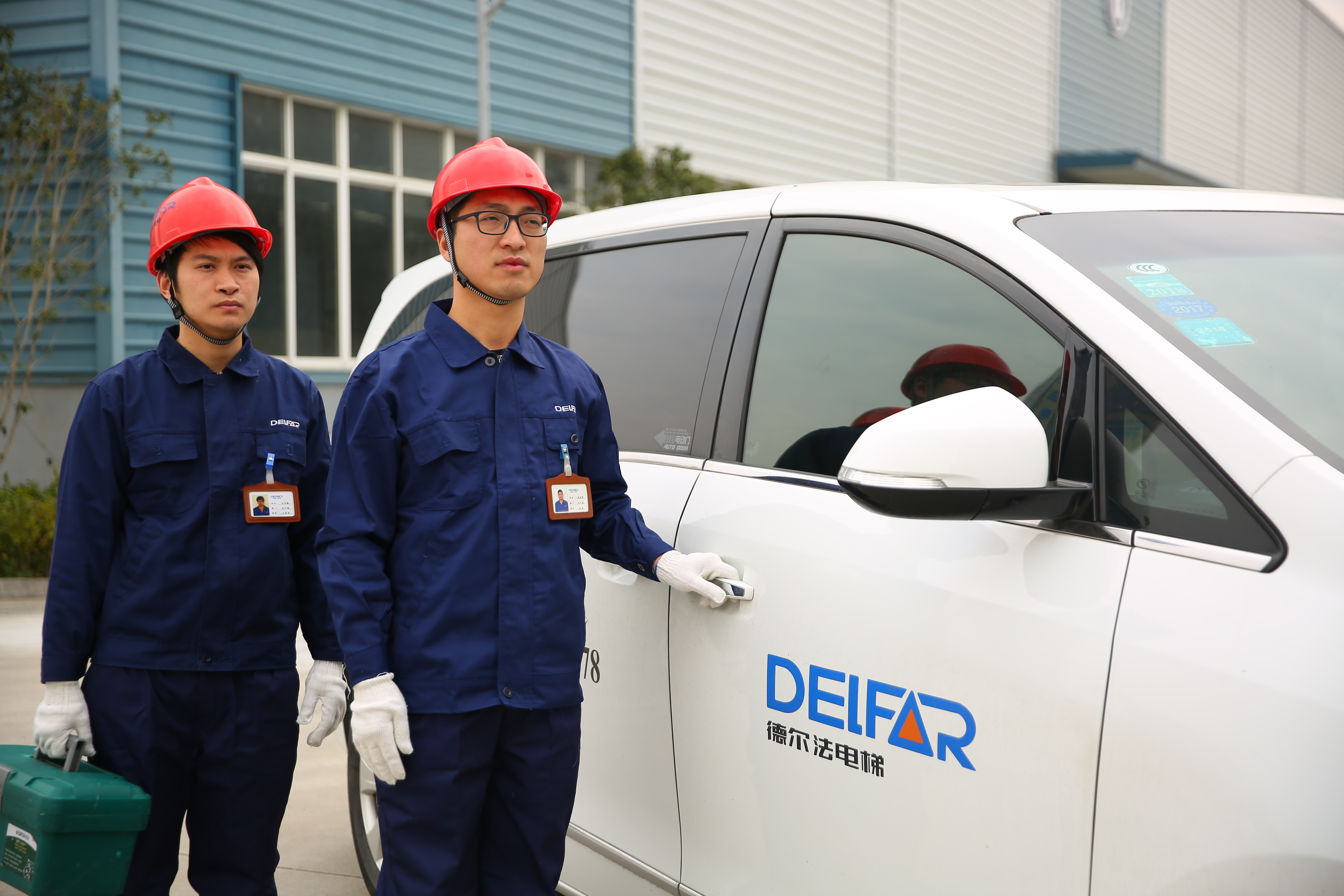
Send Delfar the load details — pallet dimensions and forklift type, or vehicle footprint and kerb weight — together with floor-to-floor heights, number of stops and shaft constraints. The technical team will confirm whether the DF/DFN freight elevator or the DA/DAN car elevator fits the published envelope, and return a dimensioned configuration for review.
Download the company profile and product documentation: Delfar Elevator company profile (PDF). For a specification review, quotation or sample-stage technical discussion, contact Delfar Elevator Co., Ltd. at www.delfarelevator.com, email bensonelevator@gmail.com, or WhatsApp +86 135-1126-1762. Factory address: No.777, Tengfei Road, Zhili Town, Huzhou City, Zhejiang Province, China.
Have Questions or Need More Details?
Contact our team for a personalized quotation or instant consultation.
Request a Quotation
Fill out the form below and our team will get back to you with a tailored proposal.
WhatsApp Direct Chat
Prefer to chat in real-time? Message us on WhatsApp for instant assistance & quick answers.
- Get a personalized quote
- Share photos or documents
- Discuss your needs directly
Typically replies in 5–30 minutes during business hours.