How to Build a Long-Term Customized Elevator OEM Partnership for Commercial Projects
Developers and contractors responsible for commercial buildings often need more than a one-time elevator purchase. They need an OEM partner that can deliver customized elevator dimensions, comply with project-specific codes such as EN 81 compliant customized elevator requirements, and support multiple phases of construction. A long-term customized elevator OEM relationship can simplify sourcing, protect schedule certainty, and improve consistency across different buildings. This article explains how such partnerships work, what to verify before signing, and what to expect during execution.
What "Long-Term Customized Elevator OEM" Actually Means
A long-term customized elevator OEM partnership is a structured relationship where an elevator manufacturer provides repeat, tailored elevator supply to a developer, contractor, or distributor over multiple projects. It is different from a single order because the manufacturer is expected to maintain consistent engineering quality, coordinate delivery across phases, and support the buyer from early design through commissioning and after-sales service. For the buyer, the benefit is lower coordination risk and fewer technical surprises on later projects. For the OEM, the benefit is predictable production planning and a deeper understanding of the buyer's building standards.
Why Commercial Building Projects Need an OEM Partnership Instead of a Single Purchase
Commercial buildings tend to have higher traffic, stricter safety requirements, and longer construction timelines than small residential projects. A typical high-rise office or hotel may require a high-speed customized elevator capable of 1.0–6.0 m/s, or a machine roomless customized elevator to reduce building-space requirements. Different towers in the same development may also need different capacities and cabin materials. Working with a manufacturer that can handle this range from the start reduces the need to re-qualify suppliers for each tower.
According to industry projections cited by Global Market Insights, the global elevator market is projected to grow from USD 87.9 billion in 2025 to USD 126.7 billion by 2034, with a CAGR of 4.2%. This long-term demand is one reason developers view elevator procurement as a strategic category rather than a transactional purchase. Maintenance services also account for roughly 55% of global elevator market revenue, which means that the OEM chosen at the equipment stage can influence long-term operating cost. For vertical transportation, elevator supply is effectively a building-level relationship that begins before the shaft is poured and continues after the certificate of occupancy.
What a Long-Term OEM Partner Must Provide
To support a commercial project pipeline, an OEM partner must provide four things. First, customized engineering: the ability to adapt elevator dimensions, speed, capacity, and door configurations to specific shafts. Second, manufacturing capacity: enough production volume and control to meet delivery schedules for multiple buildings. Third, compliance support: documentation and certification for target markets. Fourth, life-cycle service: guidance on installation, commissioning, maintenance, and after-sales issues. Without all four, a partnership is only a series of transactions.
What to Verify Before Selecting a Customized Elevator OEM
Before committing to a long-term relationship, buyers should verify the supplier's engineering depth, factory capability, certification status, and project references. These checks are especially important for manufacturers based in another country.
- Check engineering experience. Ask how the manufacturer handles non-standard shaft dimensions, unusual pit depths, and custom cabin materials. A manufacturer that only assembles standardized products cannot deliver true customization.
- Audit factory capability. Ideally, the manufacturer should control core processes such as cutting, forming, welding, machining, assembly, testing, and inspection in-house.
- Review certifications. For European projects, EN 81-20 and EN 81-50 are the primary harmonized standards for elevator design and testing and are mandatory for CE marking. For other regions, check local equivalents such as SASO for Saudi Arabia or CU for the Eurasian Customs Union. Manufacturers should provide the relevant certificate without being asked repeatedly.
- Ask about capacity and lead times. Annual output and current order load matter if you plan to order elevators for multiple projects. A manufacturer with an annual output of 10,000 units can usually provide steadier delivery than a smaller workshop, but the actual delivery schedule depends on configuration and production queue.
- Evaluate communication and service structure. A dedicated contact point for technical drawings, approval samples, and installation questions will save weeks across multiple projects.
Case Example: Delfar Elevator as a Long-Term OEM Partner
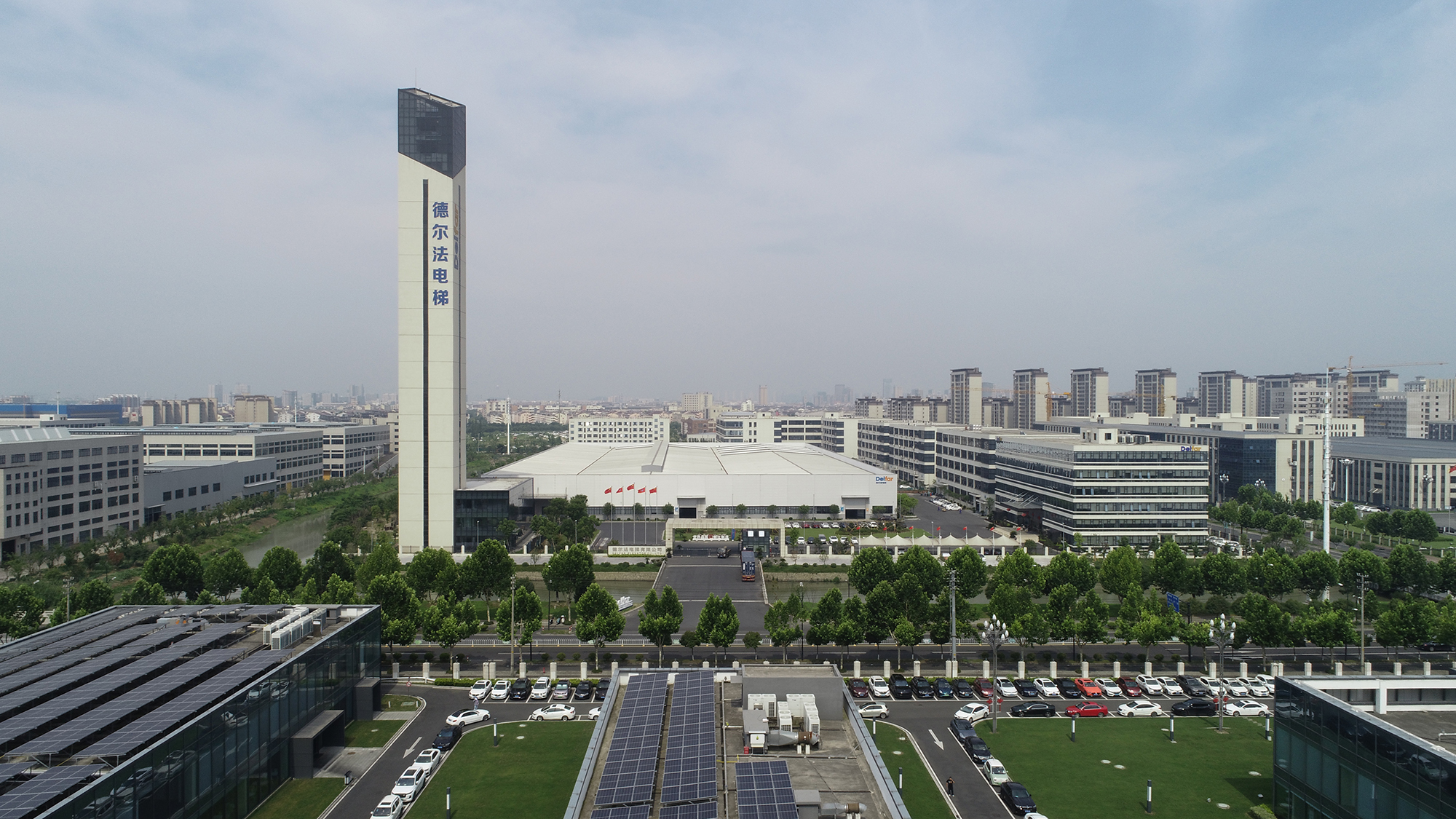
Delfar Elevator Co., Ltd. is an elevator manufacturer integrating R&D, manufacturing, sales, project support, and after-sales service. Headquartered in Huzhou, Zhejiang, China—one of China's well-known elevator manufacturing hubs—the company is positioned to support long-term OEM supply for residential, commercial, industrial, hotel, hospital, and public projects. Delfar established its operations in 2011 and now operates a factory covering approximately 100,000 m² with around 280 employees, including an R&D team of roughly 30 engineers. Annual production capacity is approximately 10,000 units, with about 50% of output exported to global markets.
For buyers, the most relevant part of Delfar's capability is its integrated manufacturing model. Advanced equipment supports precision cutting, forming, welding, machining, assembly, testing, and inspection, with automation reaching up to 70% in key manufacturing processes. This in-house control improves dimensional accuracy for customized elevator dimensions and allows the engineering team to develop solutions based on building structure, shaft dimensions, traffic requirements, local standards, and project budget.
Product Series That Support Commercial Projects
A commercial project may require multiple elevator types. The table below lists common building needs and Delfar product ranges relevant for OEM specifications. These are based on Delfar's published product parameters.
| Building Need | Product Type | Model Series | Typical Parameters |
|---|---|---|---|
| Passenger transport in office and commercial buildings | Passenger elevator | DP / DPN | Travel height ≤100 m; 2–60 stops; 1.0–6.0 m/s; 400–3000 kg |
| Hotels, lobbies, and viewing areas | Observation elevator | DPO / DPNO | Travel height ≤100 m; 2–30 stops; 1.0–2.5 m/s; 630–1600 kg |
| Logistics and freight within commercial buildings | Freight elevator | DF / DFN | Travel height ≤50 m; 2–10 stops; 0.25–1.0 m/s; 2000–8000 kg |
| Hospitals and medical centers | Bed elevator | DPB / DPNB | Travel height ≤60 m; 2–20 stops; 1.0–2.0 m/s; 1600–3000 kg |
| Parking facilities and car showrooms | Car elevator | DA / DAN | Travel height ≤30 m; 2–6 stops; 0.2–0.5 m/s; 3000–5000 kg |
| Villas and low-rise commercial spaces | Home / villa elevator | DH | Travel height ≤20 m; 2–6 stops; 0.3–0.5 m/s; 320–630 kg |
The machine roomless variants (marked by N in the model series) are particularly relevant for new commercial construction and renovation because removing a separate machine room reduces building-space requirements and can simplify structural design. A machine roomless customized elevator can also lower construction cost in projects where every usable floor area matters.
Cabin Materials and Interior Customization for Commercial Buildings
For commercial buildings, elevator cabin materials affect both the user experience and the long-term maintenance burden. Delfar offers a range of cabin and door finishes, including stainless steel, glass, painted steel, and wood-finish options, with floor choices such as PVC or marble. Stainless steel is the most common specification for commercial projects because it is durable, easy to clean, and resists wear in high-traffic environments. Glass or wood-finish panels are often selected for hotel lobbies and premium offices where the elevator interior is part of the interior design.
When ordering customized elevator cabin materials, buyers should specify not just the material type but also the grade, surface finish, and the areas of the car where the material will be applied. For example, a cargo-capable elevator may need painted steel walls with protective kick plates, while a hotel passenger elevator may require brushed stainless steel with a mirror-finished ceiling. Delfar's engineering team can adapt these details during the technical design phase.
Compliance: EN 81 and Regional Certifications
Compliance is the most common reason elevator projects encounter delays. Buyers should confirm early whether the manufacturer can provide CE marking under EN 81-20 and EN 81-50 for European-bound projects. EN 81-20 covers safety rules for the design and construction of passenger and goods passenger lifts, while EN 81-50 covers design rules, calculations, examinations, and tests. If the target market is the Middle East, additional regional certification such as SASO may be required for Saudi Arabia. The Middle East elevator market was valued at USD 1.25 billion in 2023 and is projected to reach USD 2.38 billion by 2030, so many manufacturers are actively bidding for work in that region. A buyer should request the specific certificates for the destination country, not just a general claim of "CE available."
Delfar reports holding ISO 9001, ISO 14001, ISO 45001, CE, CU, SASO, SGS, and SC certificates. For an OEM buyer, the relevant document is the one matching your project's destination and building type. It is normal to ask for the certificate number and to verify it with the issuing body or the supplier's provided documentation.
Heavy-Duty and High-Speed Configurations
Two configuration categories require extra attention in commercial projects: heavy-duty and high-speed elevators.
Heavy-Duty Customized Elevator
A heavy-duty customized elevator usually means higher capacity, reinforced car structure, more robust doors, and a traction system selected for frequent or intense use. Delfar offers freight elevators up to 8000 kg and car elevators up to 5000 kg, both suitable for different heavy-load scenarios. Freight elevators are used in logistics and warehousing; car elevators are used in parking facilities. When specifying a heavy-duty unit, buyers should consider the duty cycle, the nature of the load (forklift traffic, rolling loads, or vehicles), and whether the shaft can accommodate the required car depth and door width.
High-Speed Customized Elevator
A high-speed customized elevator in Delfar's passenger elevator series reaches 1.0–6.0 m/s, which is appropriate for mid-rise to high-rise commercial buildings. The global high-speed elevator market is estimated at approximately USD 77.9 billion in 2026, according to Dataintelo, but buyers should verify that data source before using it in a business case. High speed is not an independent feature: it must be matched to building height, traffic analysis, machine room or MRL configuration, and the quality of the shaft tolerances. A high-speed elevator in a poorly prepared shaft will not perform as expected.
Customized Elevator for Commercial Buildings: A Step-by-Step OEM Engagement Process
The following workflow is typical when engaging a customized elevator OEM for commercial projects. The exact sequence can vary by supplier, but the steps below give buyers a reliable framework.
- Submit building information and shaft drawings. The OEM needs to know building type, number of floors, shaft dimensions, pit depth, headroom, machine room availability, and expected traffic.
- Receive a preliminary layout and specification proposal. The engineering team proposes elevator dimensions, capacity, speed, door configuration, and cabin materials. This is the moment to compare against your building code and architectural constraints.
- Confirm compliance requirements. The buyer should state the destination country and expected certification. The OEM then confirms which certificates can be supplied.
- Review and approve shop drawings. After the commercial conditions are agreed, the OEM issues detailed shop drawings for approval. Approval should cover all dimensions, materials, and interfaces with the building.
- Production and inspection. During production, the buyer may request progress photos or a pre-shipment test. Delfar's procurement support includes pre-shipment testing as an acceptance option.
- Delivery and installation guidance. The OEM ships under the agreed incoterm, such as FOB, CIF, EXW, or CFR. Installation guidance and commissioning support follow.
- After-sales services and spare parts. A long-term OEM relationship provides a direct channel for spare parts, maintenance guidance, and future modernization planning.
Procurement Options for New and Existing OEM Partners
For buyers evaluating a new OEM relationship, Delfar's procurement conditions are relatively flexible. The minimum order quantity is one unit, which allows developers to trial a first elevator before committing to a larger project pipeline. Delivery methods include FOB, CIF, EXW, and CFR, and accepted payment terms are T/T and L/C. For long-term partners, these conditions can be discussed in the context of framework agreements covering multiple projects.
One important note: customized elevators in emerging markets are typically priced between USD 18,000 and USD 35,000 per unit according to Maximize Market Research. However, pricing for a specific project depends heavily on capacity, speed, travel height, cabin materials, and certification requirements. Buyers should treat that range only as a planning reference, not as a substitute for a detailed quotation.
What Maintenance and Life-Cycle Support Should Look Like
Maintenance is the largest long-term cost in elevator ownership. Industry data cited by Vyansa Intelligence indicates that maintenance services account for approximately 55% of global elevator market revenue. For an OEM buyer, this matters in two ways.
First, the supplier should document what maintenance is required for each component. A traction elevator requires maintenance of the traction machine, ropes, brake, encoder, and controller. The advantage of a PMSM gearless traction machine in Delfar's passenger elevators is that it eliminates the gearbox, which typically means fewer wearing parts and higher energy efficiency than conventional geared or hydraulic systems. A PMSM gearless traction machine is a modern elevator driving unit that uses a permanent magnet synchronous motor to directly drive the traction sheave without a reduction gearbox.
Second, the OEM should provide structured after-sales support. Delfar reports offering full-life-cycle elevator services, including pre-sales consultation, technical design, installation guidance, commissioning, maintenance support, and after-sales service. For a long-term partner, this means each project receives the same process, and the supplier accumulates knowledge about the buyer's building standards over time.
Comparing Traction vs. Hydraulic for Long-Term Value
Although hydraulic systems still lead the low-rise residential segment in North America, developers of commercial buildings usually choose traction elevators because of higher speeds, lower energy consumption, higher travel heights, and better suitability for high-traffic use. The table below summarizes the comparison developed by Delfar's engineering team.
| Factor | Hydraulic Elevator | Traction Elevator |
|---|---|---|
| Typical application | Low-rise, low-speed, low-traffic, heavy-load | Medium/high-rise; residential, hotels, offices, hospitals, commercial, high-traffic |
| Speed potential | Lower | Up to 3.3× higher speed |
| Energy consumption | Higher | About 28% lower energy consumption |
| Travel height | Limited to lower rise | Up to ~6× higher travel height |
| Space requirements | Simpler pit/headroom; can suit severe constraints | MRL option reduces building-space requirements |
| Maintenance | Hydraulic oil, pump, valves, seals, leakage risk | Traction machine, ropes, brake, encoder, controller |
For a long-term commercial partnership, traction elevators are generally the recommended direction because they align with requirements for speed, energy efficiency, ride comfort, and long lifecycle. Hydraulic elevators remain a niche choice for low-rise projects with extreme pit or headroom constraints.
Residential Elevator Projects Within a Commercial Developer's Portfolio
Many developers of commercial buildings also build residential towers, duplexes, and villas. In those cases, a single OEM can supply both the commercial passenger elevators and the customized residential elevator units. Delfar's home elevator model DH offers a travel height of up to 20 m, 2–6 stops, speeds of 0.3–0.5 m/s, and capacities of 320–630 kg. The shaft can be aluminum or steel, and the cabin can be finished in stainless steel, glass, painted steel, or wood-finish options. Traction home elevators are the primary choice for quiet, energy-efficient, and long-term stable performance. Hydraulic home elevators are recommended only for severe pit or headroom constraints. A long-term OEM can simplify procurement across both product categories.
Region-Specific Considerations: Customized Elevator for Middle East Markets
The Middle East is an important destination for customized elevator projects due to high-rise construction, hotels, shopping centers, and infrastructure development. A customized elevator for Middle East markets usually needs to address high ambient temperatures, dust conditions, and specific certification requirements such as SASO for Saudi Arabia. Elevator equipment should be selected with appropriate ventilation, enclosure ratings, and protective treatments for the local climate. Buyers should also confirm that the supplier has experience shipping to the region and can provide the required customs and conformity documentation.
Given that the Middle East elevator market is projected to grow from USD 1.25 billion in 2023 to USD 2.38 billion by 2030, regional demand remains strong across residential, commercial, and public infrastructure segments.
FAQ
What should a long-term customized elevator OEM agreement include?
A long-term customized elevator OEM agreement should include the product scope (elevator types, capacities, speeds, and cabin materials), applicable standards and certifications for each destination, a technical approval process, delivery terms and lead times, payment conditions, installation and commissioning support, spare-parts supply, and an after-sales service mechanism. It should also state which party handles local permits and how future engineering changes will be managed.
Can a customized elevator OEM supply both passenger elevators and residential or freight elevators for multi-phase projects?
Yes. An OEM with multiple product series can supply different elevator types from one factory. For example, Delfar offers passenger elevators (DP/DPN), home elevators (DH), freight elevators (DF/DFN), bed elevators (DPB/DPNB), car elevators (DA/DAN), observation elevators (DPO/DPNO), plus escalators and moving walks. This allows a developer to standardize maintenance and spare parts across a project portfolio.
What certifications are required for an EN 81 compliant customized elevator?
For European projects, EN 81-20 and EN 81-50 are the primary harmonized standards for elevator design and testing and are mandatory for CE marking. In practice, the manufacturer should provide the CE certificate for the specific elevator model and configuration. For other regions, buyers may need additional certificates such as SASO for Saudi Arabia or CU for the Eurasian Customs Union.
How should a developer verify the manufacturing capacity of a customized elevator supplier?
Developers should request the manufacturer's factory area, number of employees, engineering team size, annual production volume, and export ratio. They should also, if possible, audit the factory processes or review workshop documentation. For example, Delfar reports a factory area of approximately 100,000 m², about 280 employees, around 30 R&D engineers, annual output of about 10,000 units, and roughly 50% export ratio.
What is the typical lead time and ordering process for a customized commercial elevator?
Lead time depends on configuration, certification, and production queue, so manufacturers normally provide a delivery schedule after the technical design is approved. The ordering process begins with building and shaft information, followed by layout proposal, compliance confirmation, shop drawings, production, inspection, shipping, installation guidance, and commissioning. Buyers should not rely on generic lead times from industry reports; they should request a written schedule from the manufacturer for the specific project.
To start evaluating a long-term customized elevator OEM for your project pipeline, you can download the company profile and manufacturing overview below or contact Delfar directly for a technical consultation.