
OEM Customized Elevators: How Bespoke Dimensions Get Built
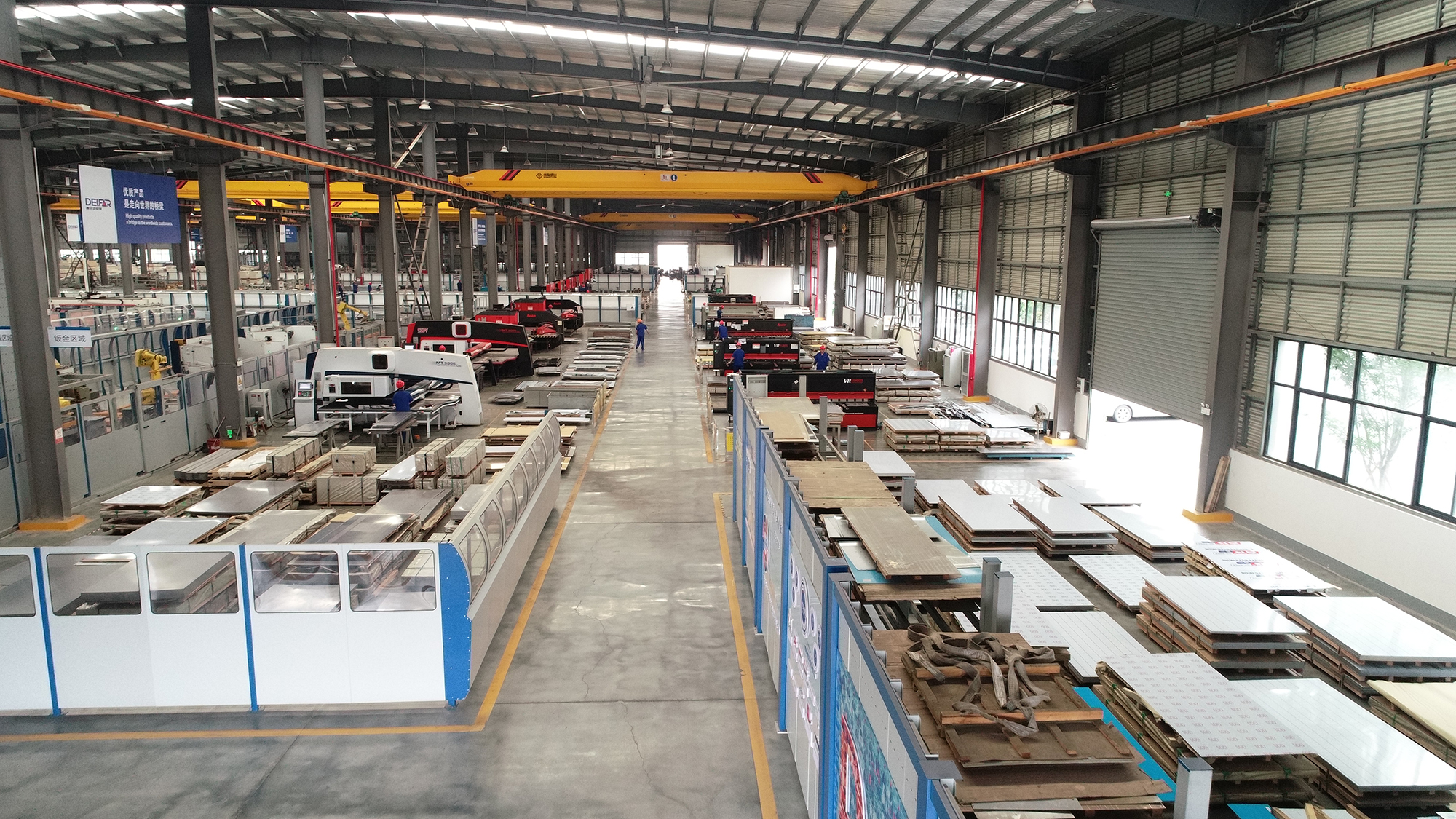
Delfar workshop — where customized elevator units are fabricated, assembled, and tested
A customized elevator OEM manufacturer is an elevator factory that designs, engineers, produces, tests, and delivers elevator units around a buyer's specific project conditions. These conditions include shaft dimensions, travel height, rated load, speed, door configuration, interior materials, and even the buyer's own brand identity. For developers, contractors, distributors, and equipment brands, the practical question is whether the manufacturer can deliver a customized elevator with the exact dimensions and configuration a project requires.
This article examines the OEM customized elevator capability of Delfar Elevator Co., Ltd., a China-based elevator manufacturer headquartered in Huzhou, Zhejiang. It explains what can be customized, how order execution works, which product ranges are available, and what compliance points matter for projects targeting markets such as the Middle East and Europe.
Why Standard Elevator Models Fall Short on Custom Projects
Standard elevator models are designed around average building conditions. A catalog unit assumes a specific shaft width, depth, headroom, and pit depth. In real projects, these assumptions often fail. Renovations and retrofits may encounter concrete shafts that cannot be changed. Industrial buildings may require reinforced car structures for heavy goods. Parking facilities need oversized cars to carry vehicles. Hotels, shopping malls, and private villas need cabin interiors that match the building's architectural identity rather than a factory default finish.
A customized elevator treats the project shaft and the application as the starting point of design. Instead of forcing the building to fit a standard product, the manufacturer adjusts the structural envelope, tailors the traction configuration, adapts door systems, and re-engineers interior layouts. This is why OEM capability matters in supplier evaluation: a manufacturer that can modify the product around the project has a different relationship with the buyer than a supplier that only offers fixed models.
The engineering process behind this is structured. Delfar Elevator describes its engineering approach as developing customized solutions based on different building structures, shaft dimensions, traffic requirements, local standards, and project budgets. This statement reflects how a professional OEM should enter a project: with building constraints first, then the elevator design.
The Customized Elevator Market: What the Data Says
Global and regional market trends support the demand for customized elevator solutions. The global elevator market was valued at approximately USD 84.8 billion in 2024, according to Global Market Insights, and is projected to grow from USD 87.9 billion in 2025 to USD 126.7 billion by 2034. The industrial elevator segment is forecast to expand from USD 72.1 billion in 2025 to USD 116.3 billion by 2035 at a CAGR of 4.9%, according to Future Market Insights. The residential elevator market was estimated at USD 54.61 billion in 2024 by Grand View Research.
Technology and regional signals also explain why customization matters. Machine-room-less (MRL) elevator technology is expected to record the highest growth rate among elevator segments, with a CAGR of 9.6% through 2034, according to Fortune Business Insights. MRL designs are frequently requested when building owners want to remove a dedicated machine room and maximize usable floor area. In the Middle East, the elevator market was valued at USD 1.25 billion in 2023 and is projected to reach USD 2.38 billion by 2030, according to Allied Market Research. High-rise modernization projects in the Middle East and Africa are expected to grow at a CAGR of 11% between 2024 and 2030, according to Roland Berger.
For buyers, the implication is direct: a standard product cannot cover every tower geometry, facade requirement, or local compliance framework. A reliable OEM manufacturer must be able to adapt engineering, production, and certification to the project rather than the other way around.
OEM Customized Elevator Capabilities at Delfar Elevator
Company Profile and Manufacturing Footprint
Delfar Elevator Co., Ltd. is a professional elevator manufacturer integrating research and development, manufacturing, sales, project support, and after-sales service. The company was founded in 2011 and is headquartered at No.777, Tengfei Road, Zhili Town, Huzhou City, Zhejiang Province, China. It specializes in passenger elevators, home elevators, observation elevators, hospital elevators, freight elevators, car elevators, machine-room-less elevators, small machine-room elevators, escalators, and moving walks.
The manufacturing base covers approximately 100,000 m², with production lines supporting precision cutting, forming, welding, machining, assembly, testing, and inspection. Annual output is approximately 10,000 units, and export sales account for about 50% of total production. The engineering team includes 30 engineers, and the company reports that up to 70% of key manufacturing processes are automated. Standardized operating procedures and 5S management are applied across the workshop environment.
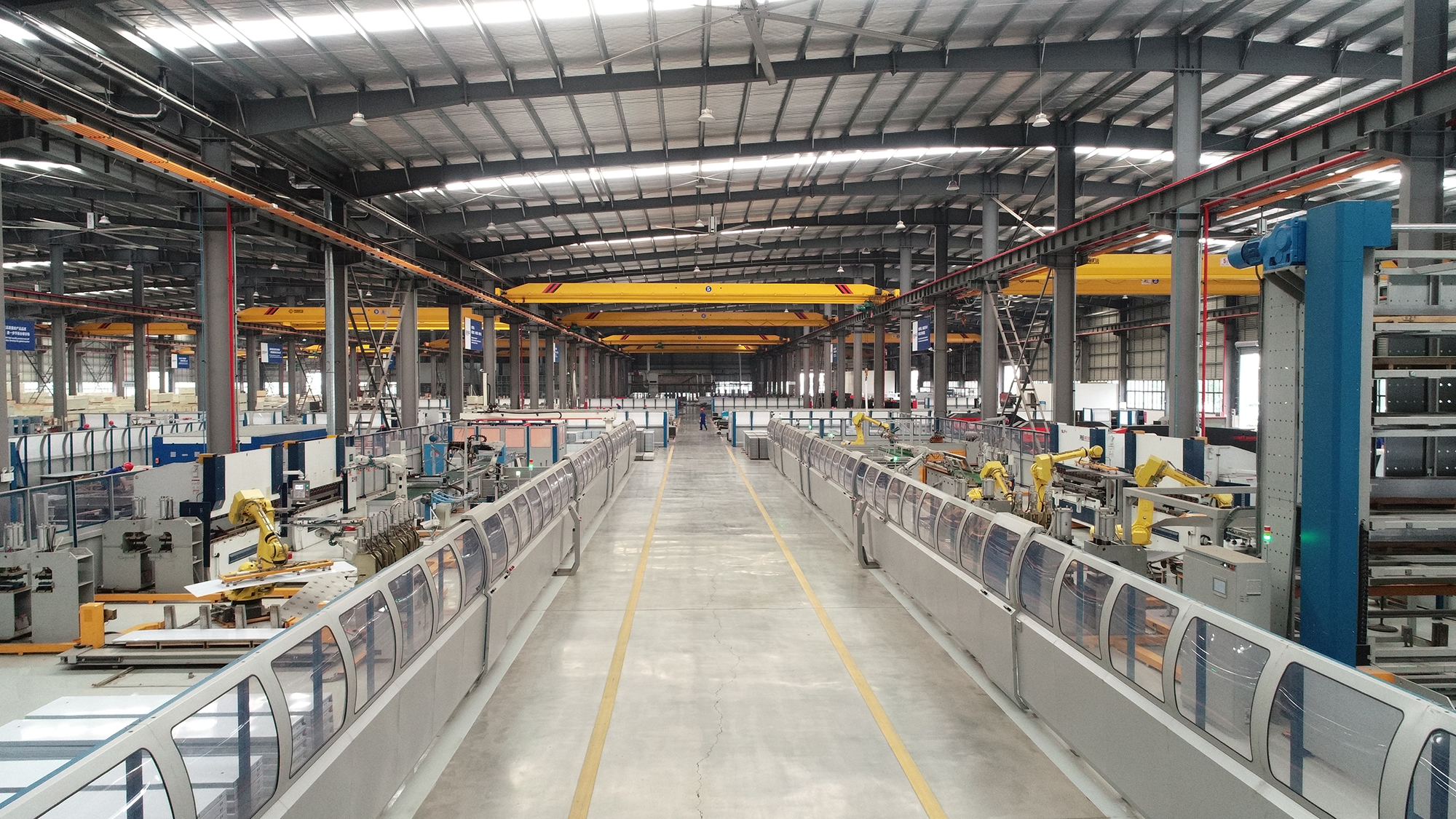
Delfar workshop — integrated manufacturing supports project-specific elevator production
Customization Options Covered by the OEM Program
Delfar's OEM program provides customization across the main visible components of an elevator cabin. The available customization items are logo, cabin wall material and color, car door material and color, ceiling type, floor material and pattern, and handrail material and color. This allows distributors, developers, and building owners to carry their brand identity and design language consistently through the interior.
Material options across product families include stainless steel, glass, painted steel, and wood-finish finishes for cabin walls and doors. Flooring options include PVC and marble. Operating panels can be configured in stainless steel, glass, or acrylic plexiglass. These choices apply to passenger elevators, home elevators, observation elevators, and other series offered by the company.
Engineering and Design Envelope
The OEM program covers multiple product families, which means one manufacturer can serve residential, commercial, industrial, logistics, hospitality, and healthcare projects. Both machine-room-less (MRL) and small machine-room configurations are available across the passenger, freight, and home elevator ranges. The passenger elevator series (DP/DPN) covers travel heights up to 100 m, 2 to 60 stops, speeds from 1.0 to 6.0 m/s, and rated loads from 400 to 3,000 kg. The home and villa elevator series (DH) covers travel heights up to 20 m, 2 to 6 stops, speeds of 0.3 to 0.5 m/s, and loads from 320 to 630 kg. The freight elevator series (DF/DFN) covers travel heights up to 50 m, 2 to 10 stops, speeds of 0.25 to 1.0 m/s, and loads from 2,000 to 8,000 kg.
For higher-speed requirements, the passenger elevator range supports speeds up to 6.0 m/s, which makes it suitable for mid-rise and high-rise commercial and residential towers. For heavy-duty industrial applications, the freight elevator range supports rated loads up to 8,000 kg. These figures represent the design envelope; the exact configuration is confirmed after the shaft survey and engineering review.
Quality, Certification, and Compliance
Quality and compliance are managed through ISO 9001, ISO 14001, and ISO 45001 certifications, each covering the design, manufacture, installation, remodeling, and repair of elevators and escalators. The company also holds CE, CU, SASO, SGS, and SC certificates. For buyers evaluating customized elevators, these certificates matter because the customized unit must satisfy the compliance framework of the destination market.
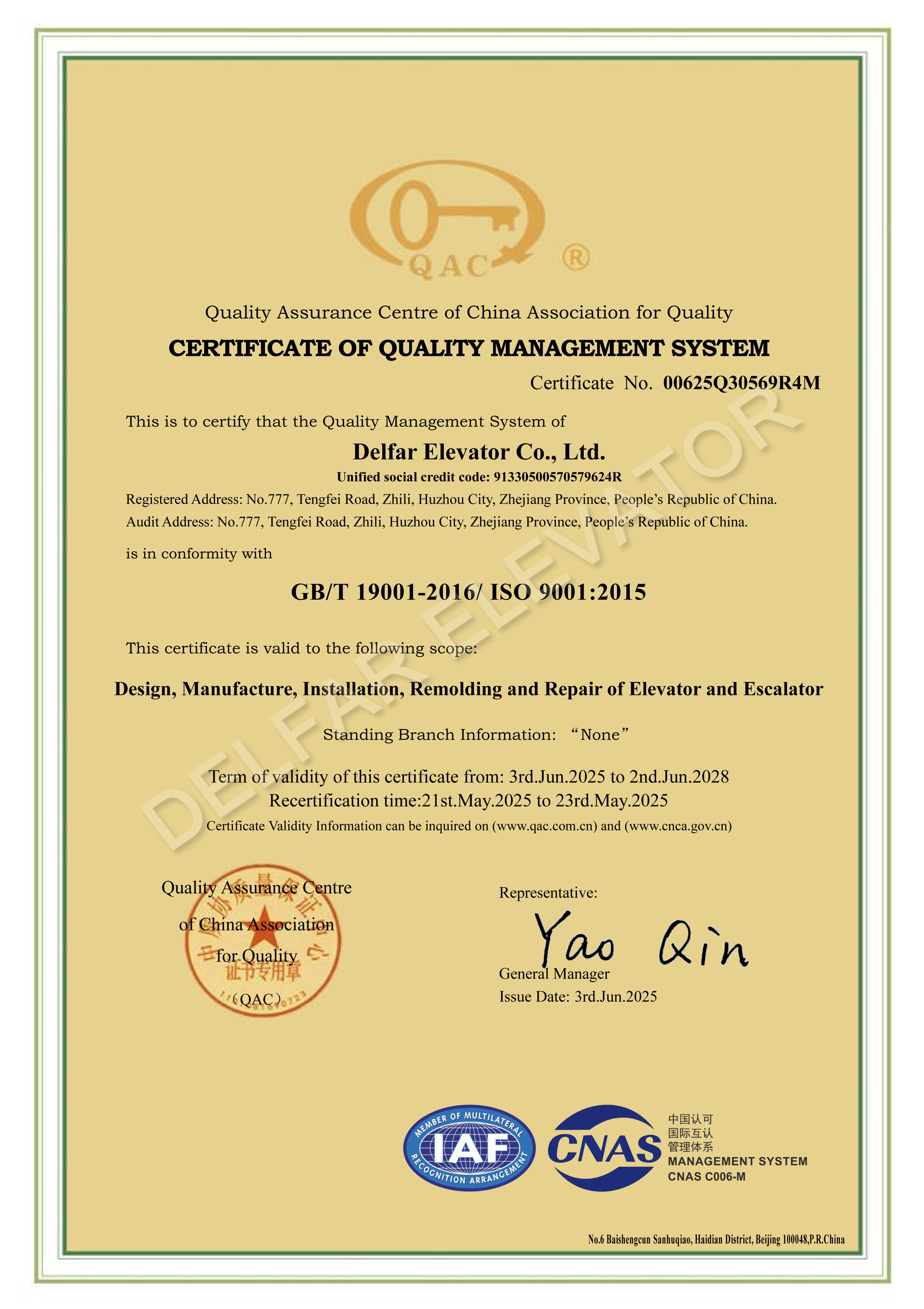
ISO 9001 quality management certificate — renewed June 2025
In the European context, EN 81-20 and EN 81-50 are the primary harmonized standards for elevator design and testing and are mandatory for CE marking. Delfar's CE certification covers the elevator product range. When a project specifies EN 81 compliance, the engineering team incorporates those requirements into the design and compliance review. For Middle East projects, the SASO certificate is directly relevant for elevator supply into Saudi Arabia and signals the company's experience with regional certification requirements.
Production, Testing, and After-Sales Model
Delfar's OEM production capacity is approximately 800 units per month, with a normal lead time of 35 days and a minimum order quantity of 1 unit. Every customized unit receives a 100% pre-shipment test before dispatch. After-sales support includes remote technical assistance through WhatsApp or email, on-site technical support when required, and a 12-month warranty counted from the date of delivery. The company also provides installation guidance, commissioning support, and maintenance support as part of its full-life-cycle service model.
Step-by-Step: How an OEM Customized Elevator Order Is Executed
The following six steps describe the typical workflow from project specification to delivered unit.
Step 1: Submit the Project Specification
The buyer sends the shaft drawing, building drawings, number of stops, travel height, required capacity, expected speed, door layout, cabin material preferences, target certifications, and branding requirements. This information defines the scope for the elevator design.
Step 2: Engineering Proposal and Design Review
Delfar's engineering team studies the shaft and usage conditions and prepares a customized proposal based on building structure, shaft dimensions, traffic requirements, local standards, and project budget. This is the stage where non-standard dimensions and special configurations are converted into drawings and component selections.
Step 3: Commercial Confirmation
The order is confirmed with a minimum order quantity of 1 unit. Payment is accepted by T/T or L/C. Delivery can be arranged under FOB, CIF, EXW, or CFR terms, depending on the buyer's logistics preference.
Step 4: Manufacturing and Production Scheduling
The unit is scheduled into production under a monthly capacity of approximately 800 units. Key manufacturing processes are automated at up to 70%, and standardized 5S management controls the workshop environment.
Step 5: Pre-Shipment Test and Inspection
Every customized elevator receives a 100% pre-shipment test before dispatch. This test is the acceptance point where the complete unit is verified before the order leaves the factory.
Step 6: Delivery and After-Sales Support
After delivery, the after-sales package includes remote technical support through WhatsApp or email, on-site technical support when required, and a 12-month warranty counted from the date of delivery. Installation guidance, commissioning support, and maintenance support are available through the full service lifecycle.
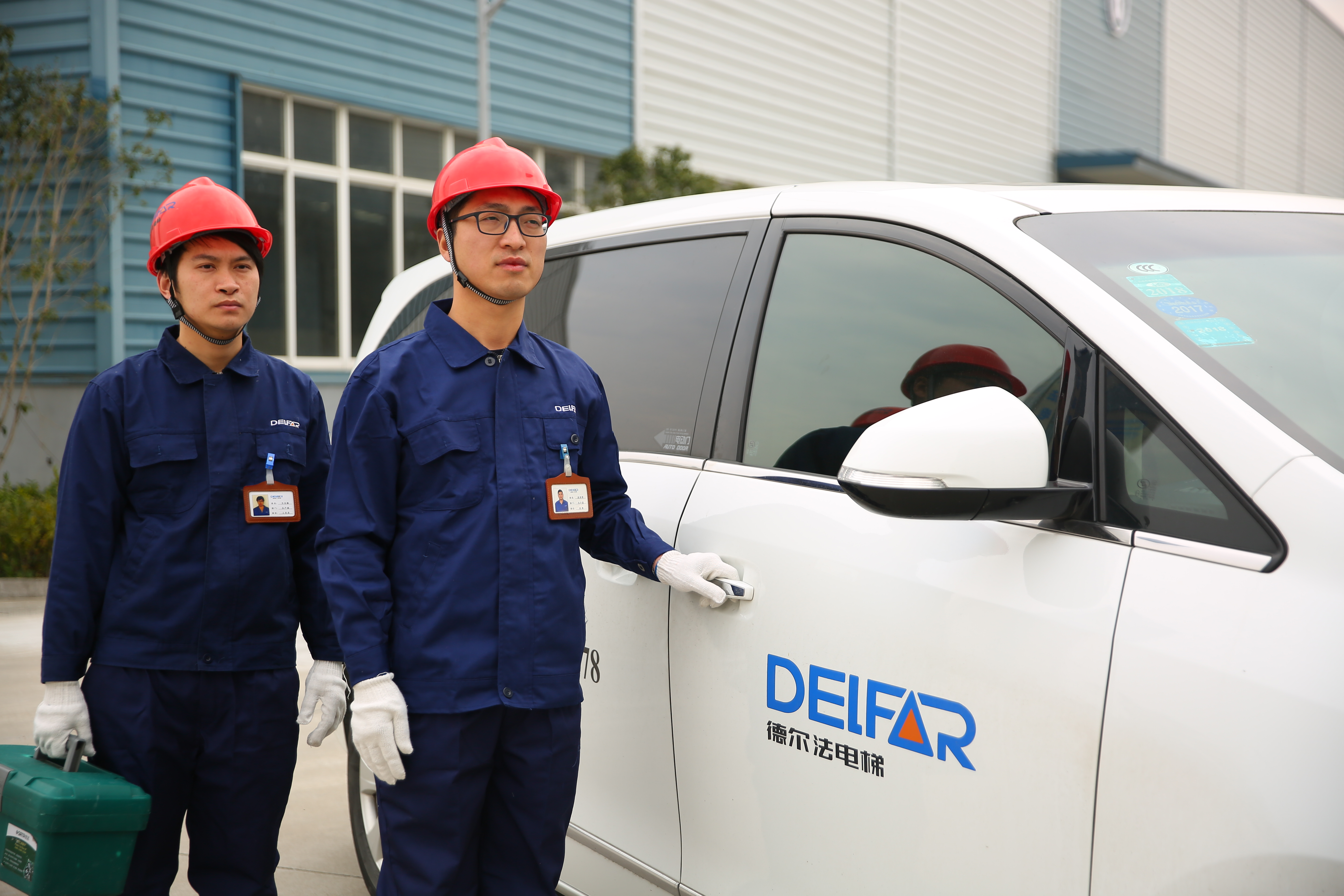
After-sales service — remote and on-site technical support
Customized Elevator Use Cases Across Project Types
The following project examples illustrate how customized elevator configurations are applied in different building types and operating conditions.
High-Rise Residential Building — Passenger Elevator, Albania
A distributor used 30 passenger elevator units for a high-rise residential building. The elevators provided smooth acceleration and deceleration, low-noise operation, and a cabin design coordinated with the building's interior style, delivering reliable performance for daily residential use.
Transportation Application — Passenger Elevator, UAE
A distributor used 20 passenger elevator units for transportation applications in the United Arab Emirates. The project focused on stable operation, comfortable rides, expanded space utilization, and energy saving.
Commercial Office Building — Passenger Elevator OEM, Angola
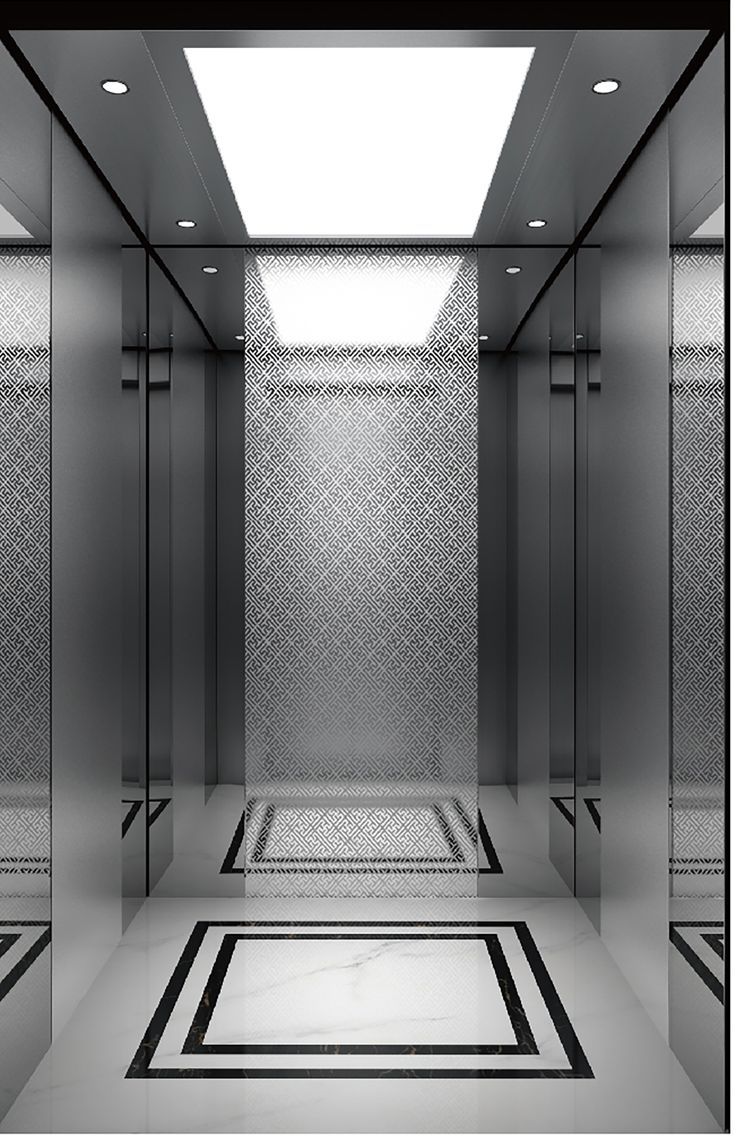
A passenger elevator OEM client used 20 units of the passenger elevator series for a commercial office building. The system was designed for a busy commercial environment, delivering efficient passenger transportation during peak hours. The combination of practical configuration and contemporary stainless-steel cabin styling supported both traffic efficiency and the building's image.
Metro Station / Transportation Hub — Escalator OEM, Bahrain
An escalator OEM client used 10 escalator units for a metro station and transportation hub in Bahrain. The system was designed for intensive operation, supporting large passenger volumes in a demanding public transportation environment. The highlight was heavy-duty performance combined with efficient passenger flow and operational reliability.
Shopping Mall — Observation Elevator, Bangladesh
A construction company used 16 observation elevator units for a shopping mall. The transparent structure created open visual connections between floors and became a recognizable visual element within the commercial environment. The configuration combined vertical transportation with architectural value.
Luxury Private Villa — Home Elevator, Brazil
A construction company used 20 home elevator units for a luxury private villa project. The compact structure and customized finishes created a seamless connection between vertical mobility and the home's architectural aesthetics. The project highlighted customized design, space efficiency, home comfort, and low-noise operation.
Commercial Parking Building — Car Elevator, Aruba
A car elevator OEM client used 10 units of the car elevator series for a commercial parking building. The elevator enabled vehicles to move between parking levels where traditional ramps would have consumed significant space, helping maximize usable building area. The project solved space constraints and limited vehicle accessibility while supporting efficient parking operations.
Residential Real Estate — Passenger Elevator, Georgia
A real estate developer used 30 passenger elevator units for a residential transportation application in Georgia. The project delivered stable operation and enhanced building value, with an elevator configuration focused on long lifespan, low noise, energy efficiency, and comfortable rides.
Georgia project — customized passenger elevator installation
Customized Elevator Configuration Range: Comparison by Series
The table below compares the configuration envelopes of Delfar's main elevator series. These values are used as the starting point for customization; final dimensions and specifications are confirmed after engineering review.
| Elevator Series | Model | Travel Height | Stops | Speed | Capacity | Typical Applications |
|---|---|---|---|---|---|---|
| Home / Villa Elevator | DH | ≤20 m | 2–6 | 0.3–0.5 m/s | 320–630 kg | Residential & Real Estate |
| Passenger Elevator | DP / DPN | ≤100 m | 2–60 | 1.0–6.0 m/s | 400–3,000 kg | Construction & Real Estate |
| Observation Elevator | DPO / DPNO | ≤100 m | 2–30 | 1.0–2.5 m/s | 630–1,600 kg | Commercial Real Estate / Shopping Mall |
| Bed Elevator | DPB / DPNB | ≤60 m | 2–20 | 1.0–2.0 m/s | 1,600–3,000 kg | Healthcare |
| Freight Elevator | DF / DFN | ≤50 m | 2–10 | 0.25–1.0 m/s | 2,000–8,000 kg | Manufacturing / Logistics & Warehousing |
| Car Elevator | DA / DAN | ≤30 m | 2–6 | 0.2–0.5 m/s | 3,000–5,000 kg | Automotive & Parking |
| Dumbwaiter | DW | ≤30 m | 2–8 | 0.2–0.5 m/s | 50–500 kg | Hospitality & Catering |
Customization also extends to interior materials. Cabin walls and doors can be supplied in stainless steel, glass, painted steel, or wood-finish options. Flooring can be configured in PVC or marble. Operating panels are available in stainless steel, glass, or acrylic plexiglass. For freight and car elevators, the car structure is built from high-strength structural steel, and floor protection uses curved lined steel or stainless steel curved lined steel.
FAQ: OEM Customized Elevator Manufacturer for Bespoke Dimensions
Q1: Does Delfar Elevator supply EN 81 compliant customized elevators for Middle East or EU projects?
Delfar Elevator Co., Ltd. holds CE certification as well as ISO 9001, ISO 14001, ISO 45001, CU, SASO, SGS, and SC certificates. In the European regulatory framework, EN 81-20 and EN 81-50 are the primary harmonized standards for elevator design and testing and are mandatory for CE marking. When a project specifies EN 81 compliance, Delfar's engineering team incorporates those requirements into the design and compliance review for the customized configuration. The company also holds a SASO certificate, which is relevant for elevator projects in Saudi Arabia and the wider Middle East market.
Q2: What dimensions and configurations can be customized for an elevator order?
Customization covers logo, cabin wall material and color, car door material and color, ceiling type, floor material and pattern, and handrail material and color. The overall design envelope includes passenger elevators with travel heights up to 100 m, speeds from 1.0 to 6.0 m/s, and capacities from 400 to 3,000 kg; freight elevators from 2,000 to 8,000 kg; car elevators from 3,000 to 5,000 kg; and home elevators from 320 to 630 kg. The final dimensional layout is confirmed after the shaft and project conditions are reviewed by the engineering team.
Q3: What is the minimum order quantity and how are payments structured?
The minimum order quantity is 1 unit, which makes customized elevator sourcing feasible for single-building projects and pilot orders. Payment is normally accepted by T/T or L/C. Delivery terms can be arranged under FOB, CIF, EXW, or CFR. According to market research data, customized elevators in emerging markets are typically priced between USD 18,000 and USD 35,000 per unit, but the final price depends on specifications, materials, travel height, stops, and project scope.
Q4: Can pre-shipment inspection or sample units be arranged before full delivery?
Customized elevators are manufactured to order rather than held as standard stock, so a physical sample unit is not the normal mechanism. Instead, Delfar applies a 100% pre-shipment test to every unit before dispatch. Buyers can use this test as the acceptance point for the completed configuration. Remote technical support is available through WhatsApp or email, and an on-site technical support visit can be discussed when the project requires deeper validation.
Q5: What is the typical lead time for a customized elevator order?
Delfar's normal production lead time is 35 days, supported by a monthly capacity of approximately 800 units. After shipment, the after-sales package includes remote technical support through WhatsApp or email, on-site technical support when required, and a 12-month warranty counted from the date of delivery. To get a project-specific lead time and budget estimate, the most direct path is to send the shaft drawing and preliminary specifications to the Delfar team before order confirmation.
Conclusion and Next Steps
Customized elevator procurement is an engineering-driven process. Buyers evaluating an OEM supplier should verify four areas: manufacturing capability, engineering depth, certification coverage, and after-sales execution. These areas determine whether a non-standard shaft dimension, a heavy-duty load requirement, a high-speed specification, or a branded cabin interior can be delivered without compromising compliance or reliability.
Delfar Elevator Co., Ltd. operates a 100,000 m² manufacturing facility in Huzhou, Zhejiang, with an engineering team of 30 engineers, an annual output of approximately 10,000 units, and about 50% of production exported to global markets. Its OEM customization program covers branding, cabin materials, doors, ceilings, floors, and handrails, with a minimum order quantity of 1 unit and a normal lead time of 35 days. Certification coverage includes ISO 9001, ISO 14001, ISO 45001, CE, CU, SASO, SGS, and SC, supporting customized elevator projects in compliance-sensitive markets.
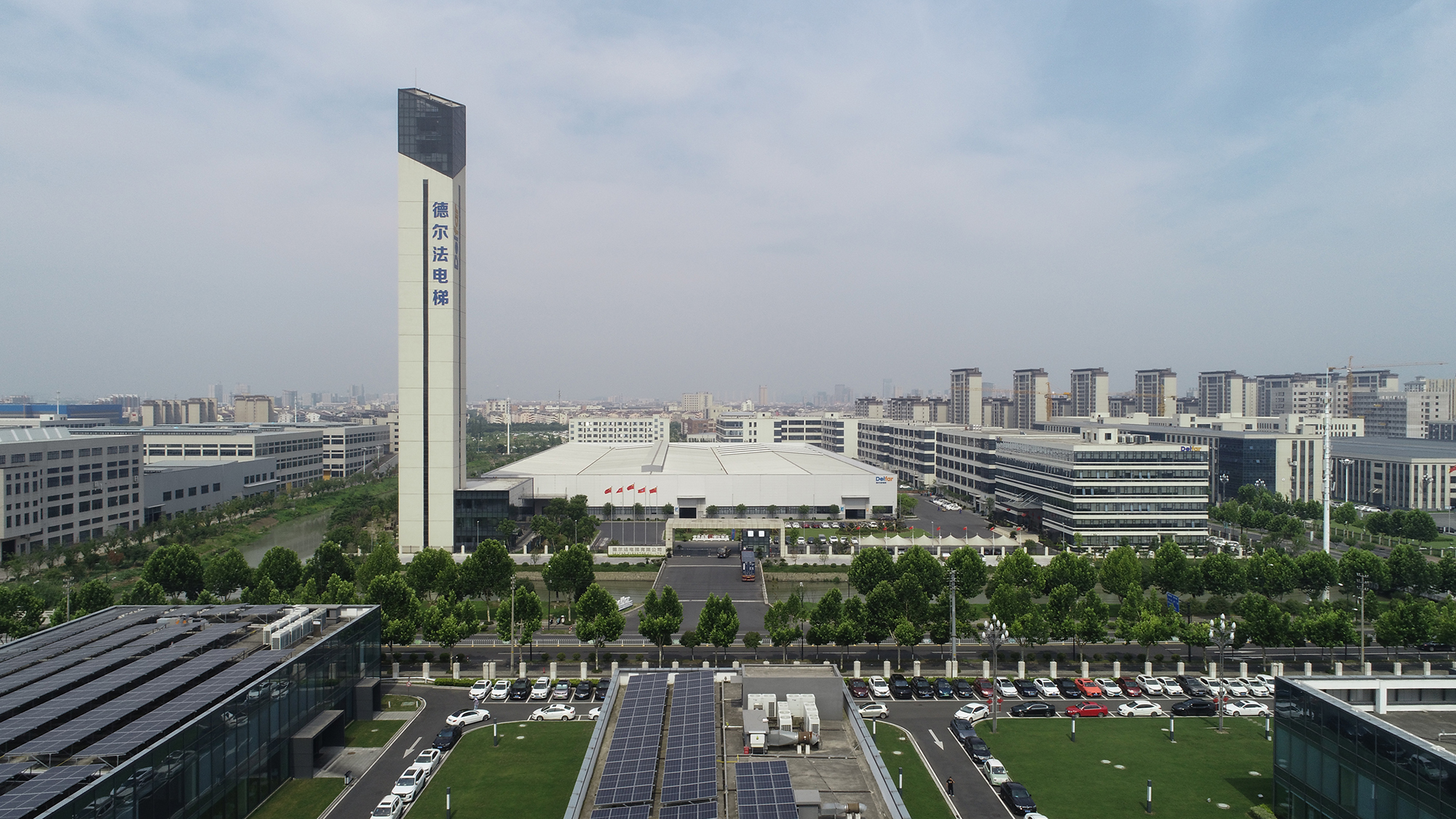
Delfar factory — complete elevator manufacturing base
Planning a project with non-standard elevator requirements? Download the Delfar company profile to review manufacturing capabilities, product ranges, and certification documents. To discuss a bespoke elevator configuration, contact Benson at bensonelevator@gmail.com or via WhatsApp at +86 135-1126-1762. Learn more at www.delfarelevator.com.