
Supplier Evaluation: Customized Elevator Capability Checks
A customized elevator manufacturer should be verified against eight documented points: model range, parameter envelope, drive and control architecture, cabin customization scope, certification, manufacturing and quality control, commercial terms, and after-sales support. Anything a supplier cannot produce in writing — a certificate number, a specification limit, a capacity figure, a lead time — is a marketing statement rather than a capability. Delfar Elevator Co., Ltd., founded in 2011 and located in Huzhou, Zhejiang, China, is a professional elevator manufacturer that integrates R&D, manufacturing, sales, project support and after-sales service, and whose published model data is used below as a worked example of what each check should look like when it is answered properly.
This guide is written for the evaluation stage of a purchase, when a shortlist of suppliers already exists and the remaining question is which one can actually build the project. It treats capability as evidence, not reputation, and it applies the same checks to every supplier on the list.
Why customized elevator capability is difficult to verify
Customized elevator procurement fails most often at the point where the specification meets the factory. Two suppliers can quote the same wording — machine-room-less, customized cabin, stainless steel finish, suitable for a residential tower — while only one of them has the engineering platform, tooling, inspection regime and certificates to deliver it. The buyer sees identical documents and assumes identical capability.
The reason is structural. In a standardized purchase, the specification describes a product that exists. In a customized purchase, the specification describes a product that does not exist yet, and the supplier's capability is the only guarantee that it will. Capability therefore has to be read from four kinds of artifacts:
- Platform evidence — a product range with published parameters, because customization usually means adapting an existing platform rather than inventing a new one.
- Boundary evidence — the stated limits of each platform, such as maximum travel height, capacity and speed, which determine whether the project is inside or outside what the factory can build.
- Compliance evidence — certificates with numbers, issuing bodies, scope statements and validity dates, not logos on a brochure cover.
- Delivery evidence — capacity, lead time, pre-shipment testing and warranty terms recorded in writing.
The most common evaluation error is to treat breadth of range as a marketing claim instead of a technical one. A manufacturer offering passenger, freight and home platforms is not simply offering more products; it is demonstrating that its design, forming, welding, machining, assembly and testing processes can support different load classes, different drive configurations and different shaft conditions. That is what buyers are really purchasing when they buy a customized elevator.
Industry background: what the market context says about supplier selection
The global elevator market was valued at approximately USD 84.8 billion in 2024 and is projected to grow from USD 87.9 billion in 2025 to USD 126.7 billion by 2034, a compound annual growth rate of 4.2%, according to Global Market Insights. Growth of that scale is not generated by one product category or one region, which is precisely why multi-platform suppliers have an advantage in customized work.
Three structural signals matter for supplier evaluation.
First, machine-room-less technology is the fastest-growing configuration. Fortune Business Insights projects MRL technology to record the highest growth rate in the category, at a CAGR of 9.6% through 2034. For buyers, this means the ability to supply machine-room-less and small-machine-room variants of the same platform — rather than a single fixed layout — is now a baseline capability rather than a differentiator.
Second, demand is concentrated but not uniform. Grand View Research reports that Asia Pacific dominated the elevator market with a share of approximately 41.7% in 2025, while North America accounted for 12.7% in 2024. Allied Market Research values the Middle East elevator market at USD 1.25 billion in 2023, projected to reach USD 2.38 billion by 2030, and Roland Berger expects high-rise modernizations in the Middle East and Africa to grow at a CAGR of 11% between 2024 and 2030. A supplier serving Middle East markets needs certificates such as SASO in addition to CE, and needs project experience in high-ambient-temperature environments. The residential segment alone was estimated at USD 54.61 billion globally in 2024 by Grand View Research, confirming that home and villa elevators are a serious volume category rather than a niche.
Third, the money follows the service life. Maintenance services account for approximately 55% of global elevator market revenue, according to Vyansa Intelligence. A supplier evaluation that stops at the equipment price therefore evaluates less than half of the real cost. Customized elevators in emerging markets are typically priced between USD 18,000 and USD 35,000 per unit, based on Maximize Market Research figures for 2025 — a range that is narrow compared with the lifecycle cost of ownership.
On the compliance side, EN 81-20 and EN 81-50 are the primary harmonized European standards for elevator design and testing and are mandatory for CE marking, as documented by Liftinstituut. EN 81-20 also requires a light curtain door detection system to reduce the risk of door strikes on passengers, according to KONE's compliance guidance. These are the reference points against which any claim of EN 81 compliant customized elevator supply should be tested.
The eight capability checks
Check 1 — Model range and application coverage
A customized elevator supplier should be able to show distinct platforms for distinct duty cycles. Delfar's portfolio covers passenger elevators (DP/DPN), home or villa elevators (DH), observation elevators (DPO/DPNO), bed and stretcher elevators (DPB/DPNB), freight elevators (DF/DFN), car elevators (DA/DAN), dumbwaiters (DW), escalators (DE) and moving walks (DM). Each range maps to a different industry: construction and real estate for passenger units, residential for home units, manufacturing and logistics for freight, healthcare for bed units, automotive and parking for car elevators, and retail and transportation for escalators and moving walks.
When evaluating a supplier, ask for the same mapping. A supplier whose entire range is one passenger platform will be forced to push your project into that platform, whatever your shaft, load or traffic profile requires.
Check 2 — Parameter envelope: capacity, speed, travel and stops
Numbers, not adjectives, define the envelope. Delfar's passenger range DP/DPN covers 400–3000 kg capacity, 1.0–6.0 m/s speed, travel height up to 100 m and 2–60 stops. The freight range DF/DFN covers 2000–8000 kg, 0.25–1.0 m/s, up to 50 m and 2–10 stops. The home range DH covers 320–630 kg, 0.3–0.5 m/s, up to 20 m and 2–6 stops. Observation elevators DPO/DPNO span 630–1600 kg at 1.0–2.5 m/s up to 100 m, while car elevators DA/DAN handle 3000–5000 kg at 0.2–0.5 m/s up to 30 m.
The check is straightforward: send the project brief and require the supplier to place the model inside its published limits in writing. A quotation that promises 80 m of travel from a 20 m home platform, or 6 m/s from a 1.0 m/s freight platform, has failed the check regardless of price.
Check 3 — Drive and control architecture
Drive configuration determines ride quality, levelling accuracy, energy use and service life, and it is the part of the specification buyers most often leave to the supplier. A PMSM gearless traction machine is a modern elevator driving unit that uses a permanent magnet synchronous motor to drive the traction sheave directly, without a reduction gearbox. It serves as the primary power source for passenger, hospital and freight elevators, moving the car and counterweight through rope friction while an encoder provides real-time position and speed feedback and an electromagnetic brake engages at each stop. The variable-frequency drive supplies regulated AC power to the stator to create the rotating magnetic field, which is the mechanism behind variable voltage variable frequency (VVVF), or variable-frequency drive, control.
For the DP/DPN passenger range and the DF/DFN freight range, buyers should require the supplier to state the drive and control configuration in writing rather than accepting a general statement about smooth operation. A practical evaluation checklist for this check includes the drive system type, rated capacity and speed, traction ratio, safety gear compliance, control system response, ride comfort in terms of vibration and noise, and EN 81 or CE certification status. Suppliers that can answer all of these from documentation are structurally different from those that answer only the first.
Check 4 — Cabin, door and finish customization scope
Customization should be an enumerated list, not a promise. Delfar's customization fields are logo, cabin wall material and colour, car door material and colour, ceiling type, floor material and pattern, and handrail material and colour. Material options across the passenger and observation ranges include stainless steel, glass, painted steel and wood-finish, with floors in PVC or marble, handrails in stainless steel, solid wood or acrylic, car operating panels in stainless steel, glass or acrylic plexiglass, and landing operating panels in stainless steel or glass.
Freight and bed ranges take a different finish logic: painted steel or hairline stainless steel car walls for the DF/DFN range, with a curved lined steel or stainless steel curved lined floor, and all-stainless-steel cabins for the DPB/DPNB bed elevator range with anti-slip PVC flooring. Home elevators add shaft options in aluminium or steel. A supplier that can distinguish these finish systems across ranges is demonstrating engineering depth; one that offers the same panel list for every product is not.
Check 5 — Certification and standards readiness
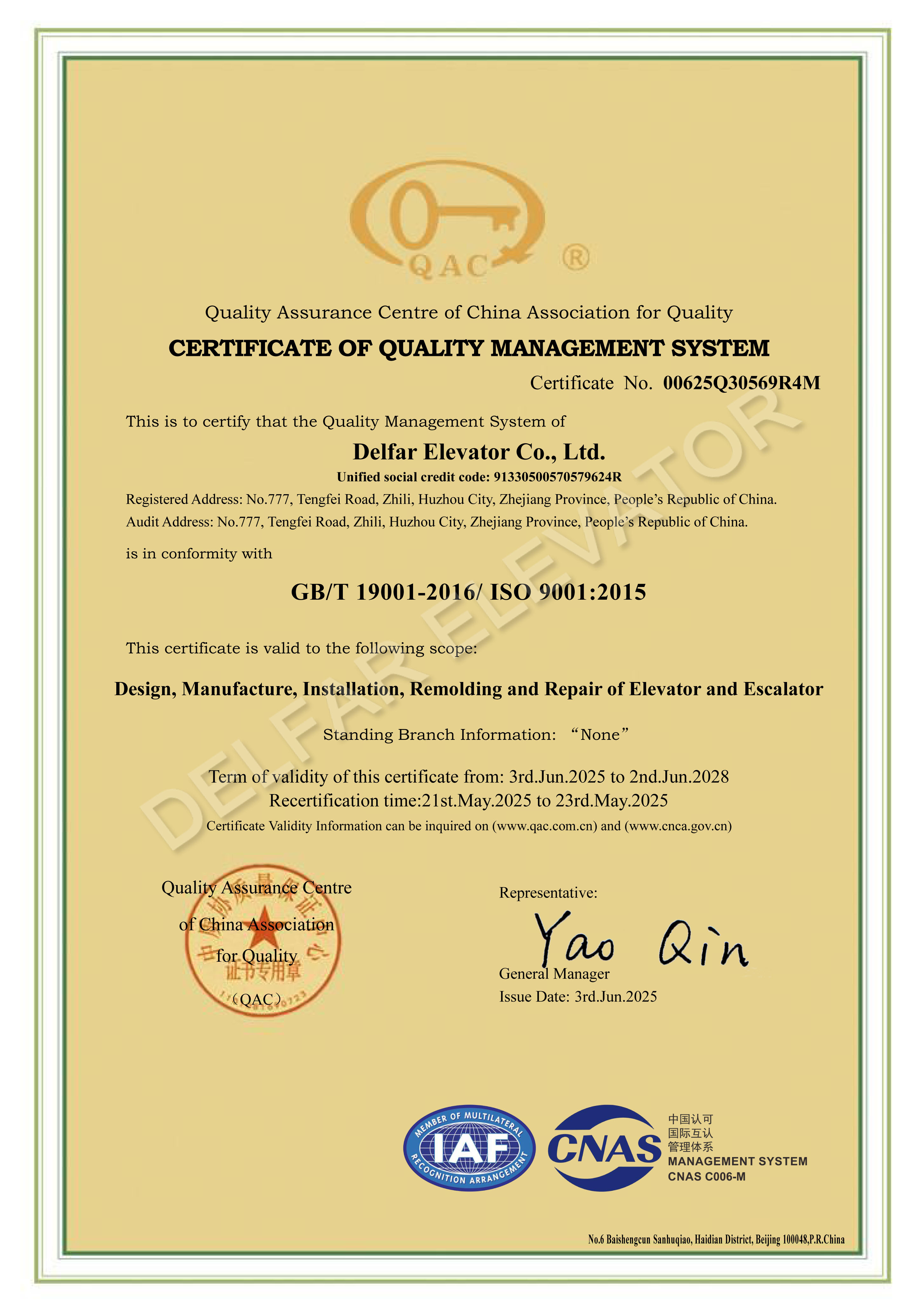
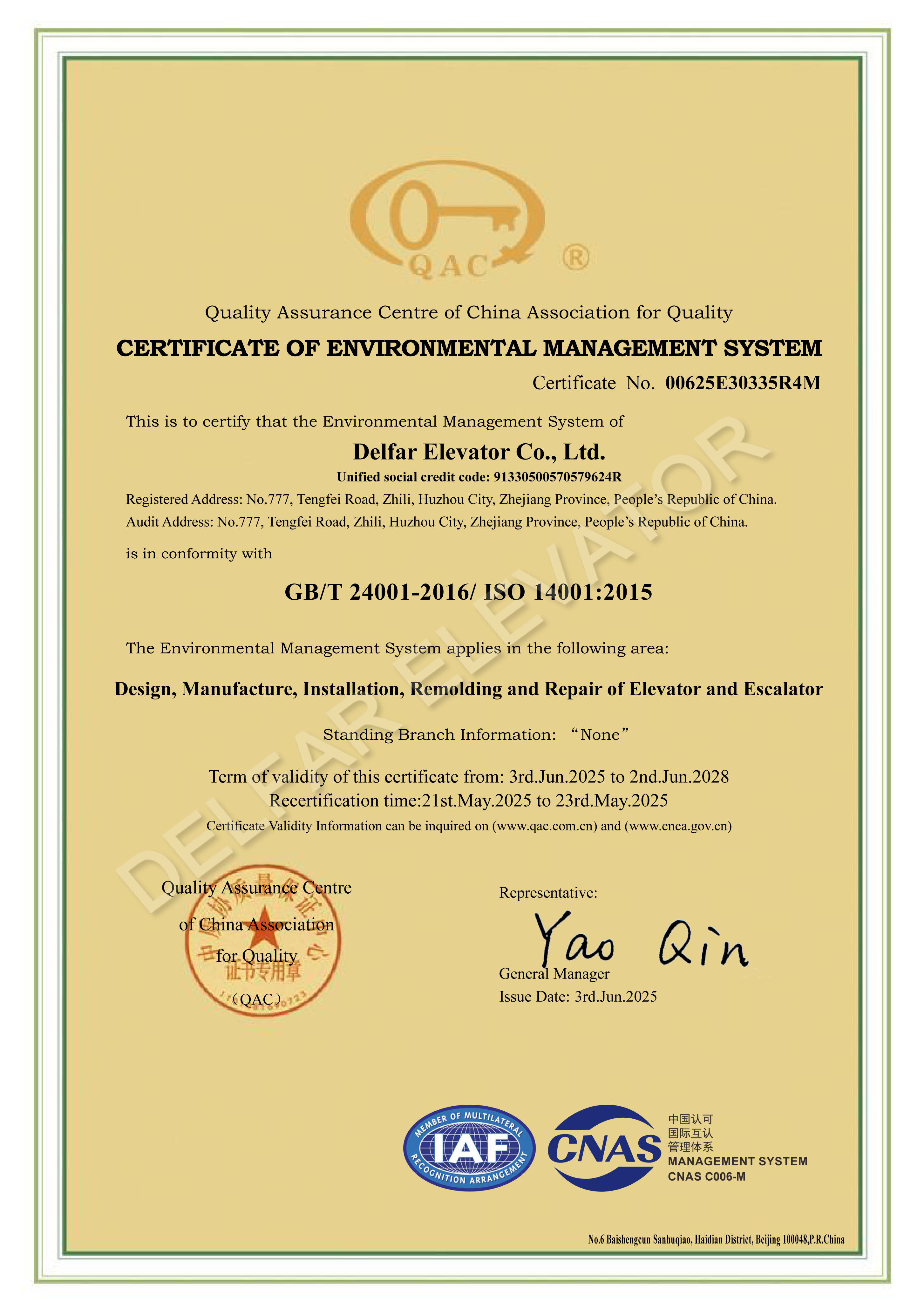
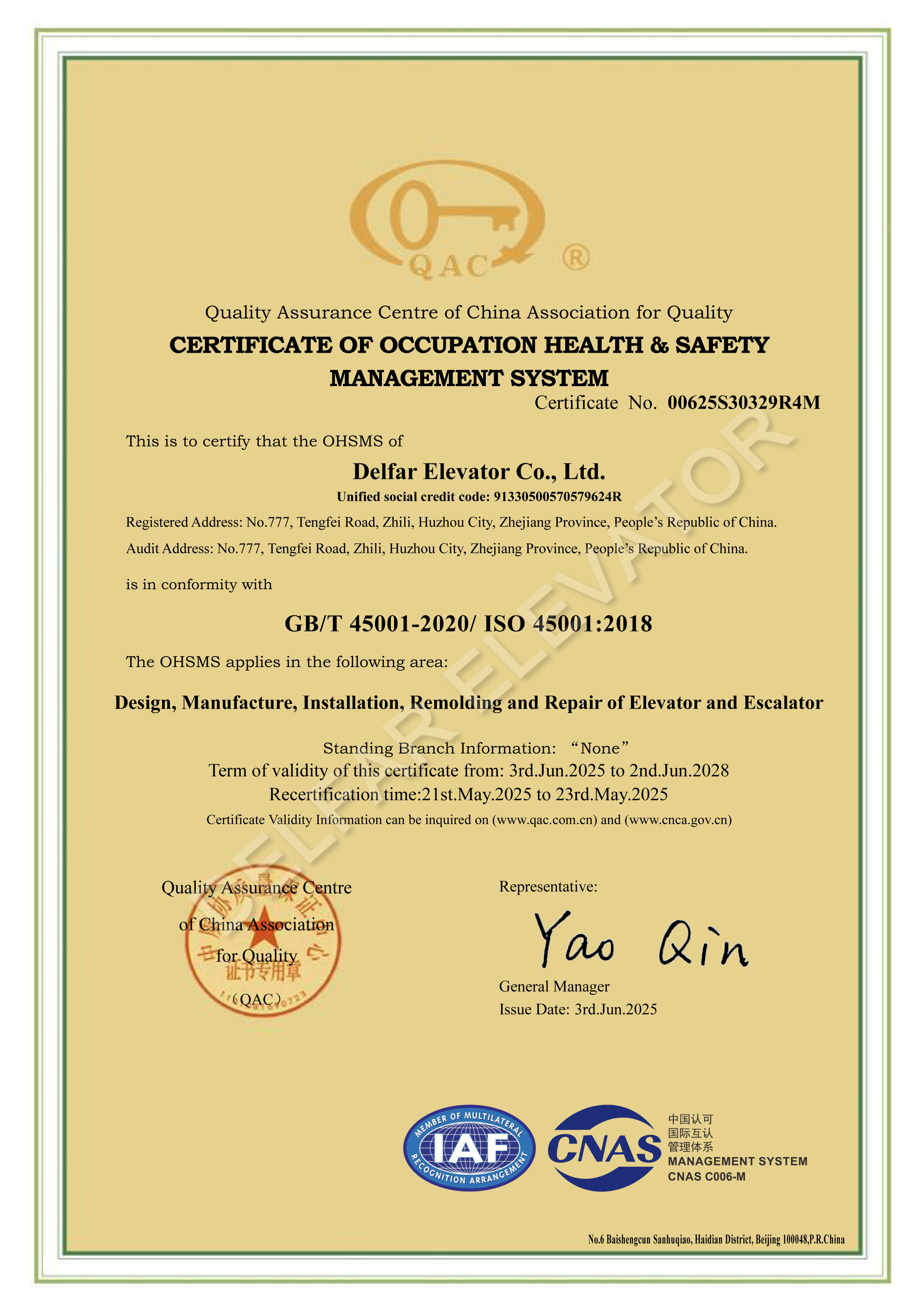
Certificates are verifiable objects and should be treated as such: request the number, the issuing authority, the scope, and the issue and expiry dates. Delfar holds ISO 9001 certificate 00625Q30569R4M, ISO 14001 certificate 00625E30335R4M and ISO 45001 certificate 00625S30329R4M, all issued by QAC on 3 June 2025 and valid until 2 June 2028. The declared scope in each case is the design, manufacture, installation, remoulding and repair of elevators and escalators, which is broader than a manufacturing-only certificate and matters when the supplier is also expected to support installation and modernization.
The company also states CE, CU, SASO, SGS and SC certificates among its industry recognitions. For projects in the Middle East, SASO is the certificate to confirm for Saudi-bound shipments, while EN 81-20 and EN 81-50 remain the reference standards for CE-marked European projects, with light curtain door detection as a required safety feature under EN 81-20.
Check 6 — Manufacturing system, capacity and quality control
Customization is a manufacturing question before it is a design question. Delfar's factory covers approximately 100,000 m² and supports precision cutting, forming, welding, machining, assembly, testing and inspection, with production automation reaching up to 70% in key manufacturing processes, standardized operating procedures and 5S management. Monthly capacity is 800 units, and the company reports annual output of 10,000 units supported by a 30-engineer R&D team. Every product undergoes 100% pre-shipment testing.
Capacity figures should always be read together with the test regime. A supplier with 800 units per month and a documented 100% pre-shipment test is making a different statement from a supplier quoting the same output without a defined inspection gate.
Check 7 — Commercial terms: MOQ, lead time and pricing logic
Commercial terms reveal whether a supplier is set up for project business. Delfar operates an OEM production mode with a minimum order quantity of one unit and a normal lead time of 35 days, serving global export markets that account for roughly 50% of its business. A one-unit MOQ with a defined standard lead time indicates a supplier accustomed to mixed-project scheduling rather than a single high-volume line.
On price, the reference band for customized elevators in emerging markets is USD 18,000 to USD 35,000 per unit according to Maximize Market Research. Use that band to sanity-check quotations, and then test what sits inside it: cabin materials, drive configuration, control system, door type and certification scope. Two quotations at the same unit price can carry very different content.
Check 8 — After-sales and lifecycle support
Because maintenance services account for approximately 55% of global elevator market revenue, after-sales terms are a commercial feature, not a courtesy. Delfar provides remote technical support through channels such as WhatsApp and email, professional on-site technical support when required, and a 12-month warranty from the date of delivery, backed by a service structure that runs from pre-sales consultation and technical design through installation guidance, commissioning and maintenance support.
Ask every shortlisted supplier the same three questions: who answers a fault call in my time zone, what is covered in the warranty period and when does it start, and how are spare parts supplied after the warranty ends. Vague answers here predict expensive years later.
Step-by-step: running the verification
- Write a one-page project brief. Record travel height, number of stops, required capacity, required speed, shaft type and dimensions, finish direction, destination market and applicable standard. This document is the benchmark every supplier answer is measured against.
- Request a model-to-brief mapping. Require each supplier to name the platform and confirm that the brief sits inside its published limits for capacity, speed, travel and stops — in writing.
- Request the drive and control configuration. Get the traction machine type, control architecture, safety gear compliance and levelling performance stated on paper rather than described verbally.
- Request certificates with scope and dates. Collect certificate numbers, issuing bodies, scope statements and validity periods for quality, environmental and occupational health and safety management systems, plus product certifications applicable to the destination market.
- Request manufacturing, capacity and quality-control evidence. Confirm factory size, monthly capacity, lead time and the pre-shipment test regime, and check that the stated lead time is compatible with the delivery schedule.
- Confirm customization scope and commercial terms. List the customizable items (logo, cabin and door materials and colours, ceiling, floor, handrail) and lock the MOQ, lead time and warranty start date into the order documentation.
- Validate with an order or sample run. Apply the 100% pre-shipment test as the acceptance gate, and record the warranty period as running from the date of delivery.
Use cases: what verified capability looks like in delivery
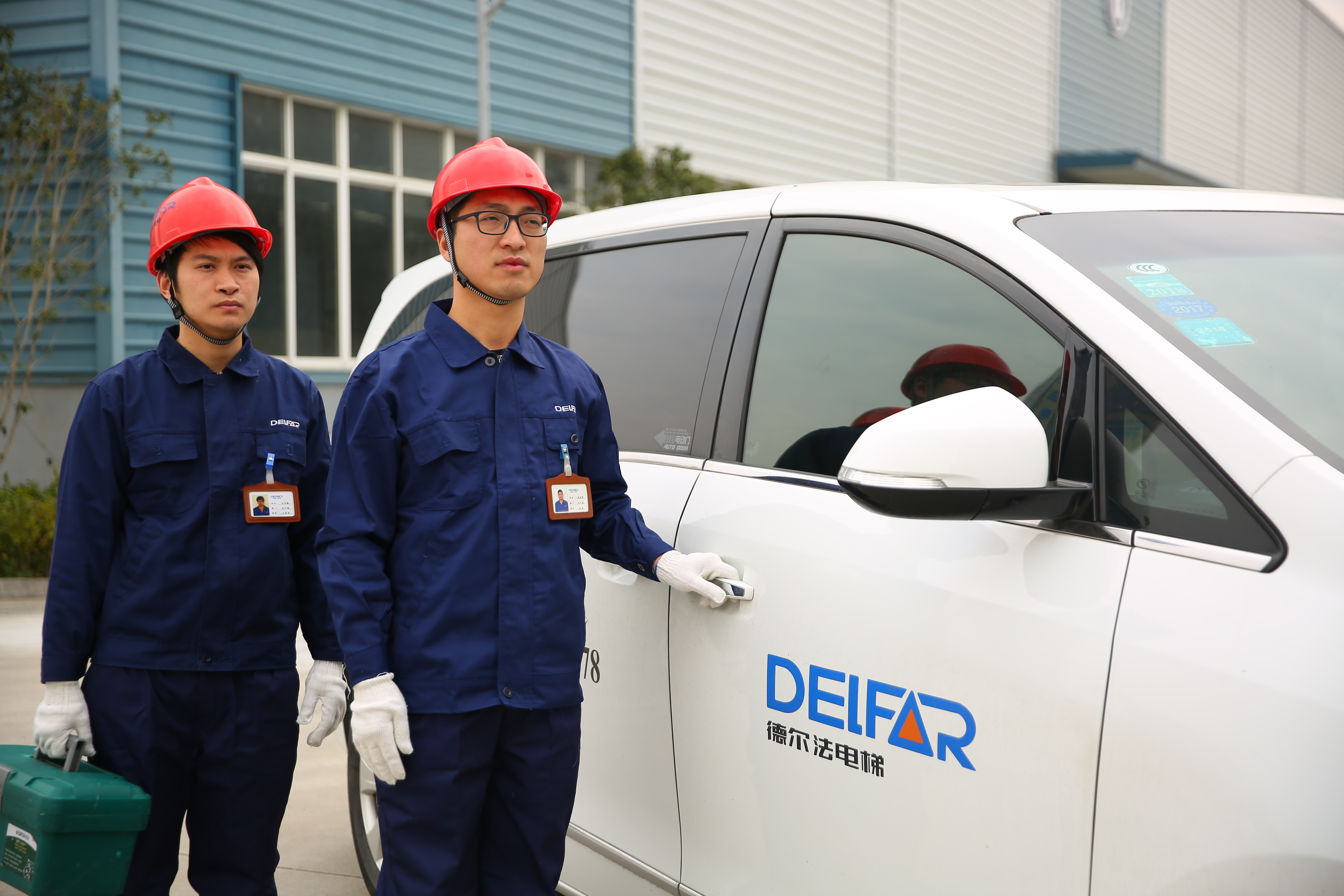
Documented project records are the fastest way to test whether a supplier's claimed range translates into installed units. The following references come from Delfar project records and illustrate different platforms, clients and duty cycles.
- High-rise residential (Albania): 30 units of the DP/DPN passenger elevator supplied to a distributor client, designed for a 10–20 year service life, with smooth acceleration and deceleration, low-noise operation and a modern cabin design.
- Luxury private villas (Brazil): 20 units of the DH home elevator supplied to construction company clients, connecting vertical mobility with the architectural aesthetics of the home through compact structure and customized finishes, with low noise as a stated highlight.
- Commercial office building (Angola): 20 units of the DP/DPN passenger elevator for a passenger elevator OEM client, configured for intensive passenger flow and fast response during peak periods, with an intelligent control system supporting passenger distribution.
- Cargo transportation (Barbados): 30 units of the DF/DFN freight elevator supplied to a construction company client, with heavy-duty capacity and recorded highlights of flexible customization and a factory-direct solution.
- Commercial parking building (Aruba): 10 units of the DA/DAN car elevator for a car elevator OEM client, used where conventional vehicle ramps would consume significant space.
- Shopping mall (Bangladesh): 16 units of the DPO/DPNO observation elevator installed by a construction company client, combining vertical transportation with a transparent architectural feature.
- Metro station and transportation hub (Bahrain): 10 units of the DE escalator for an escalator OEM client, configured for frequent and intensive operation in a demanding public transport environment.
- Transportation projects (United Arab Emirates and Kenya): 20 units each of the DP/DPN passenger elevator supplied to distributor clients, with recorded highlights of stable operation, comfortable rides, space utilization and energy saving.
- Real estate development (Germany): 30 units of the DP/DPN passenger elevator supplied to a real estate developer client, with long lifespan, low noise, energy saving and enhanced building value as the recorded outcomes.
Comparison table: mapping model ranges to project fit
Use the table below as a reference framework for evaluating any customized elevator supplier's range. The parameters are Delfar's published specifications and can be requested in the same format from every supplier on a shortlist.
| Model | Product line | Travel height | Stops | Speed | Capacity | Typical application |
|---|---|---|---|---|---|---|
| DP/DPN | Passenger elevator (small machine room / machine-room-less) | ≤ 100 m | 2–60 | 1.0–6.0 m/s | 400–3000 kg | Construction and real estate, commercial buildings, residential towers |
| DH | Home, villa and villa lift (small machine room / machine-room-less) | ≤ 20 m | 2–6 | 0.3–0.5 m/s | 320–630 kg | Residential and real estate, private villas, low-rise homes |
| DF/DFN | Freight elevator (small machine room / machine-room-less) | ≤ 50 m | 2–10 | 0.25–1.0 m/s | 2000–8000 kg | Manufacturing, logistics and warehousing |
| DPO/DPNO | Observation and panoramic elevator | ≤ 100 m | 2–30 | 1.0–2.5 m/s | 630–1600 kg | Commercial real estate, shopping malls |
| DPB/DPNB | Bed and stretcher elevator | ≤ 60 m | 2–20 | 1.0–2.0 m/s | 1600–3000 kg | Healthcare facilities |
| DA/DAN | Car elevator (small machine room / machine-room-less) | ≤ 30 m | 2–6 | 0.2–0.5 m/s | 3000–5000 kg | Automotive and parking |
| DW | Dumbwaiter (window type / floor type) | ≤ 30 m | 2–8 | 0.2–0.5 m/s | 50–500 kg | Hospitality and catering |
| DE | Escalator (30° / 35°) | Vertical rise 3–12 m | — | 0.5 m/s | Step width 600/800/1000 mm | Retail and transportation |
| DM | Moving walk (horizontal / inclined) | Vertical rise ≤ 10 m | — | 0.5 m/s | Pallet width 600/800/1000 mm | Transportation |
Two practical readings follow from the table. First, a supplier covering both DP/DPN and DH can serve a mixed-use development without splitting the order across two factories. Second, a supplier covering DF/DFN and DA/DAN can support industrial and parking projects where heavy-duty platforms, rather than passenger platforms, define the technical requirement.
Frequently asked questions
1. What compliance evidence should a customized elevator manufacturer provide for an export project?
Request certificate numbers, issuing bodies, scope statements and validity dates rather than logos. For CE-marked European projects, EN 81-20 and EN 81-50 are the primary harmonized standards for elevator design and testing and are mandatory for CE marking, and EN 81-20 requires a light curtain door detection system to reduce the risk of door strikes on passengers. Delfar's management system certificates are ISO 9001 (00625Q30569R4M), ISO 14001 (00625E30335R4M) and ISO 45001 (00625S30329R4M), all issued by QAC on 3 June 2025 and valid until 2 June 2028, with a declared scope covering the design, manufacture, installation, remoulding and repair of elevators and escalators. The company also states CE, CU, SASO, SGS and SC certificates, which is relevant for Middle East destinations where SASO is commonly required.
2. How wide should a customized elevator manufacturer's model range be?
Wide enough to match the project's duty cycle, not simply wide. A practical benchmark is a supplier covering passenger elevators such as DP/DPN (400–3000 kg, 1.0–6.0 m/s, up to 100 m, 2–60 stops), home elevators such as DH (320–630 kg, 0.3–0.5 m/s, up to 20 m, 2–6 stops) and freight elevators such as DF/DFN (2000–8000 kg, 0.25–1.0 m/s, up to 50 m, 2–10 stops), with observation, bed, car elevator, dumbwaiter, escalator and moving walk ranges available for other building types. Range breadth backed by monthly capacity of 800 units, a 100,000 m² factory and a 30-engineer R&D team indicates an integrated manufacturing base rather than an assembly or trading operation.
3. What does a customized elevator cost, and what drives the price?
As a reference band, customized elevators in emerging markets are typically priced between USD 18,000 and USD 35,000 per unit, based on 2025 figures from Maximize Market Research. The variables inside that band are the ones worth negotiating: drive and control configuration, cabin and door materials, ceiling and floor finishes, handrail type, and the certification scope required by the destination market. Because maintenance services account for approximately 55% of global elevator market revenue according to Vyansa Intelligence, unit price should always be assessed alongside warranty length — 12 months from the date of delivery is the term Delfar provides — and the cost of spare parts and service over the elevator's life.
4. Can a customized elevator be validated before full production?
Validation starts with documentation rather than hardware: a model-to-brief mapping that places the project inside published parameter limits, a written drive and control configuration, and certificates with verifiable numbers and dates. On the manufacturing side, Delfar operates an OEM production mode with a minimum order quantity of one unit and applies 100% pre-shipment testing as the quality-control gate, which means acceptance criteria can be defined before shipment rather than assumed at handover. Buyers handling multiple units or repeat projects should treat that first order as the validation run and document the results.
5. Which customized elevator manufacturers should be shortlisted, and what lead time is realistic?
Shortlist suppliers that pass all eight checks in writing: published model ranges with parameter limits, a stated drive and control architecture, an enumerated customization scope, verifiable certificates with scope and validity dates, documented manufacturing capacity and quality control, clear commercial terms, and defined after-sales support. Realistic lead time depends on platform and order size; Delfar quotes a normal lead time of 35 days and a monthly capacity of 800 units, supported by remote technical support through WhatsApp and email, on-site technical support when required, and a 12-month warranty from the date of delivery. Buyers who want to run this evaluation on a live project can download the Delfar company profile and request a model-to-brief mapping, quotation or sample-order discussion through the contact details below.
Conclusion
Verifying a customized elevator manufacturer is a documentation exercise, not a trust exercise. Model range proves the supplier can adapt a platform to your building; the parameter envelope proves your project is inside what the factory can build; drive and control architecture determines ride quality and lifecycle behaviour; the customization list proves the finish you specified is producible; certificates with numbers and validity dates prove compliance; capacity, testing and lead time prove deliverability; commercial terms prove the supplier is set up for project business; and after-sales terms protect the years after handover.
Delfar Elevator Co., Ltd. works through these same checks with its own documented data: nine product ranges from the DP/DPN passenger elevator to the DM moving walk, ISO 9001, ISO 14001 and ISO 45001 certificates issued by QAC and valid to 2 June 2028, a 100,000 m² manufacturing base with monthly capacity of 800 units and 100% pre-shipment testing, an MOQ of one unit, a 35-day normal lead time, and a 12-month warranty from the date of delivery. Buyers evaluating other suppliers can apply the same list and expect the same standard of written evidence.
Next step
Send your project brief — travel height, stops, capacity, speed, shaft type, finish direction and destination market — and Delfar will return a model-to-brief mapping, the applicable parameter limits and a quotation. Sample-order discussions and the full company profile are available on request.
QuotationModel-to-brief mappingSample orderCompany profile PDF
Delfar Elevator Co., Ltd. — No.777, Tengfei Road, Zhili Town, Huzhou City, Zhejiang Province, China. Website: www.delfarelevator.com · Contact: Benson · Email: bensonelevator@gmail.com · Tel / WhatsApp: +86 135-1126-1762 · Message us on WhatsApp · Download the company profile
Have Questions or Need More Details?
Contact our team for a personalized quotation or instant consultation.
Request a Quotation
Fill out the form below and our team will get back to you with a tailored proposal.
WhatsApp Direct Chat
Prefer to chat in real-time? Message us on WhatsApp for instant assistance & quick answers.
- Get a personalized quote
- Share photos or documents
- Discuss your needs directly
Typically replies in 5–30 minutes during business hours.