Online vs UV Inkjet Printer: Choosing Line Coding for Smart Manufacturing
On a smart manufacturing line, the choice between an online inkjet printer and a UV-capable inkjet printer is settled by four variables that can all be checked before an order is placed: the printing content, the working environment, the printing speed and the substrate material. The DEMIN L10 and S10 online printers are built for small, dense, high-frequency codes — 2–12.7 mm print height, 300–600 dpi, up to 120 m/min, triggered from a photoelectric sensor through a DB9 sensor interface. The DEMIN P70 is a piezoelectric machine for wider codes and less forgiving substrates — 5–72 mm print height, 2–15 mm print distance, 180 dpi, 1–100 m/min, with one printhead that runs water-based, UV or oil-based ink.
DEMIN (Quanzhou Demin Spraying Code Technology Co., Ltd.) is an inkjet printer manufacturer founded in 2017, operating a 3,000 m² factory with 150 employees and an annual output of 10,000 units. Both machines below belong to that range, and both print a single color at a time from a six-color ink set: red, yellow, blue, green, black and white.
Why "Online" and "UV" Get Confused in a Line Specification
The two words describe different dimensions of the same purchase. "Online" describes how the printer is mounted and triggered: it sits on the conveyor, receives a signal from a photoelectric sensor and prints without an operator — which is why the L10 and S10 are specified with a DB9 sensor interface and a modular body described as compatible with various production-line installations. "UV" describes the ink and the curing step: the P70 accepts water-based, UV and oil-based inks, and a UV job adds curing hardware to the line rather than to the printer alone.
A specification that names only one dimension leaves the other uncontrolled. A buyer who asks for "a UV printer" without stating print height and content may receive a 180 dpi machine where 600 dpi was expected. A buyer who asks for "an online printer" without stating substrate and print size may receive a 12.7 mm print window on a product that needs 72 mm.
DEMIN's own selection guidance reduces the decision to four confirmations — printing content, working environment, printing speed and substrate materials — and each of the four maps to a published number on both machines. That is what makes a genuine head-to-head possible, and it is also the reason this comparison is built on specification sheets rather than on marketing claims.
Smart Manufacturing Raises the Bar for the Coding Station
China's National Press and Publication Administration defines smart manufacturing of printing as the deep integration of new-generation information and communication technology with advanced manufacturing technology, running through design, production, management and service, with self-perception capability (industry standard document, 2022). A coding station that prints only when an operator presses a button does not meet that description; a station that is triggered by a sensor and exposes its status through a data interface does.
The commercial context explains why the choice matters at volume. Global Market Insights values the industrial inkjet printer segment at USD 5.6 billion in 2025, and within that segment food and beverage accounts for 26% of revenue — consistent with the dominant job on most lines, which is date, batch and lot coding on packaging. Grand View Research separately reports USD 45.2 billion for 2025 across all inkjet printers, including consumer and desktop units. The two figures describe different scopes and should not be averaged, substituted or presented as a single number.
An academic description of the IIoT equipment layer classifies production equipment — industrial robots and sensors — as one category within a smart factory architecture (arXiv preprint, 2023). A line-integrated coder belongs to that layer, which is why interface choice (DB9 sensor input, USB, RS232, Ethernet) deserves the same attention as print quality during evaluation.
The Two Configurations in Published Terms
Online configuration: DEMIN L10 and S10
The L10 and S10 share the same published parameter set. Both are 3.5 kg units in a cast aluminium alloy body with a 7-inch capacitive touch screen, 300–600 dpi resolution, 2–12.7 mm print height, 2–5 mm optimal print distance and a rated printing speed of 120 m/min. Power is DC16.8V 3A, and the external interfaces are a DB9 sensor interface and USB. Printable content covers Chinese and English characters, QR codes, barcodes, serial numbers and logos, in 29 languages. The listed applications are the food industry, packaging manufacturing, production and manufacturing, and the medical industry.
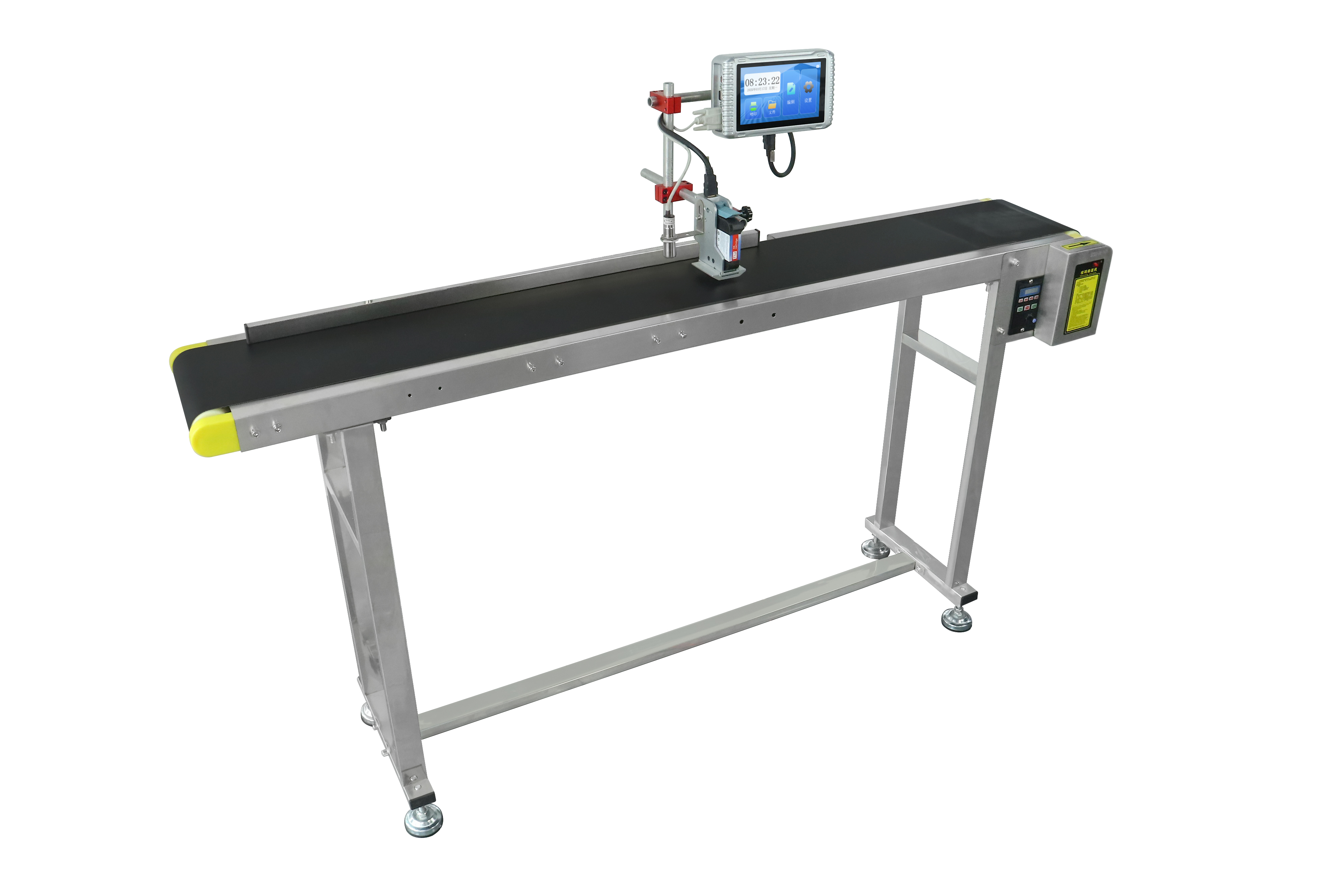
Two engineering details matter for round-the-clock operation. The first is ink control: DEMIN lists a reliable ink volume calculation as a design feature that significantly reduces ink consumption, which changes consumable cost per shift rather than purchase price. The second is the modular body, which lets the print head be bracketed to an existing conveyor instead of requiring a dedicated station.
UV-capable configuration: DEMIN P70 and P70 Pro
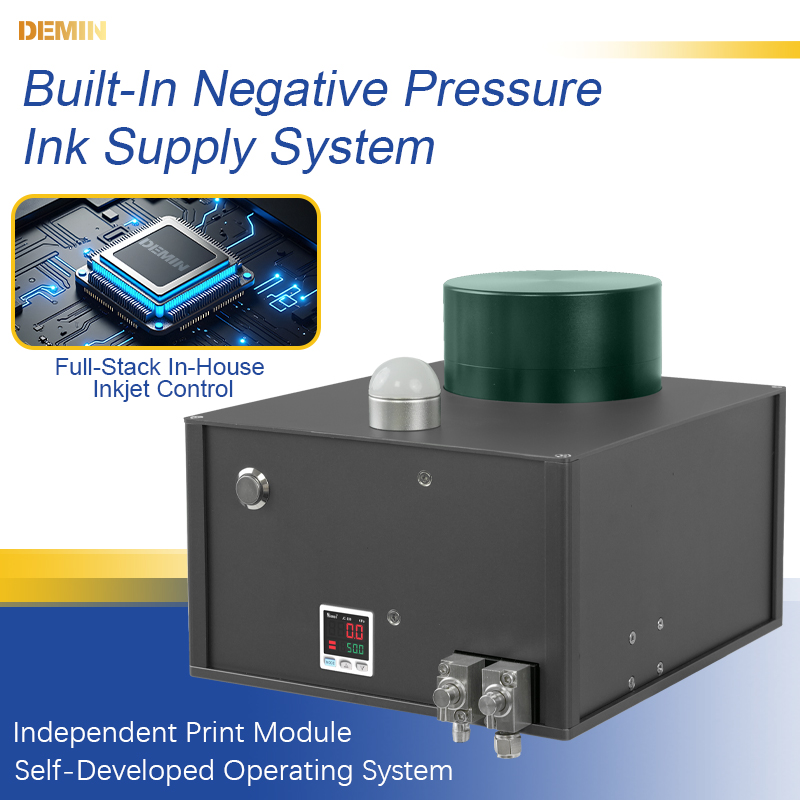
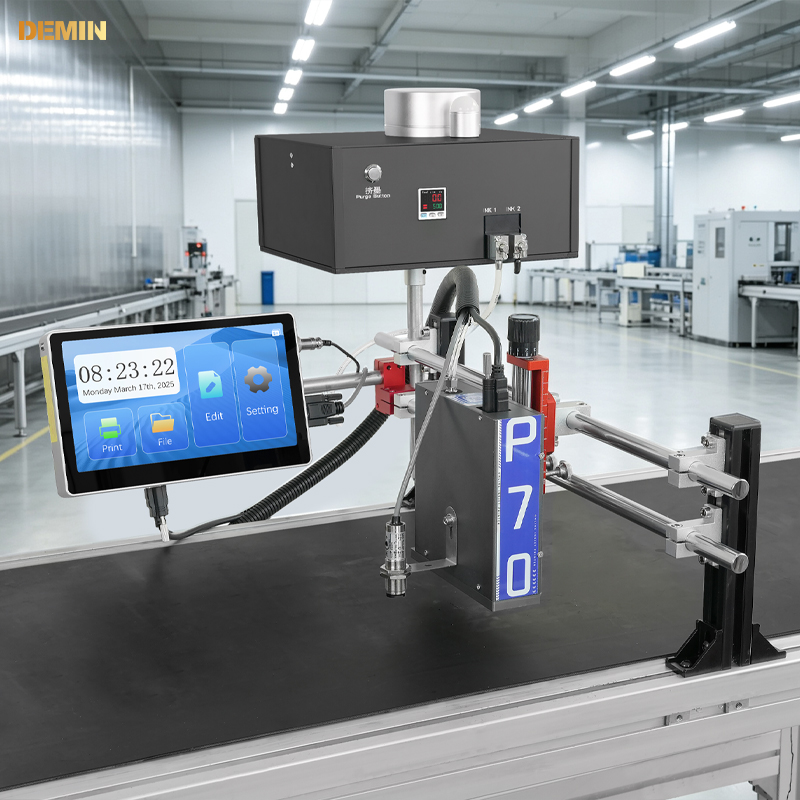
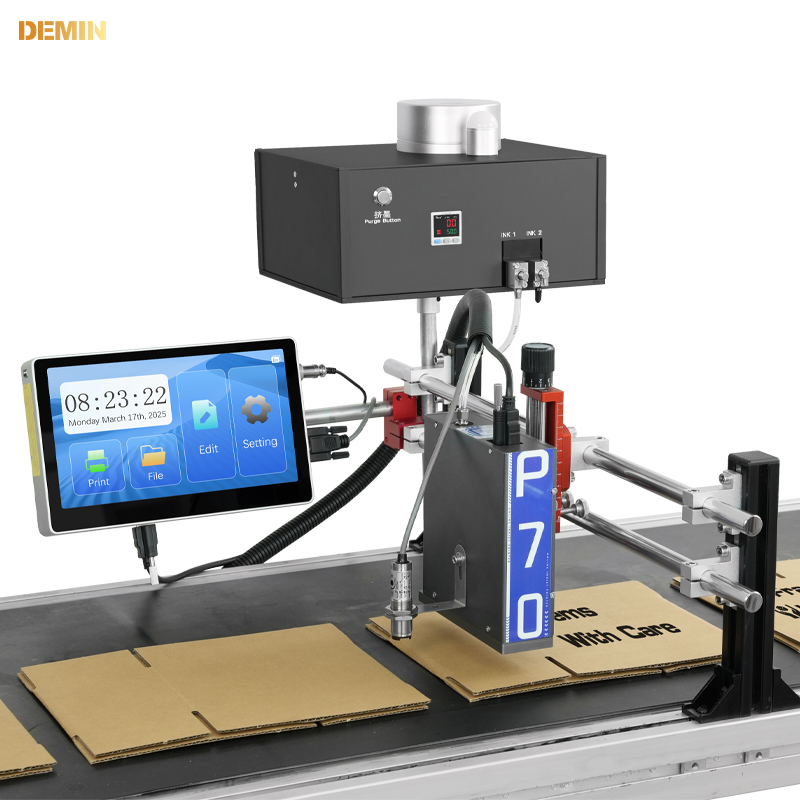
The P70 is a piezoelectric inkjet printer built around a Seiko 510 printhead with 510 nozzles, a firing frequency of 8.29 kHz and a 35 picoliter drop size, fed by a negative-pressure ink supply system. Published performance is 1–100 m/min, 180 dpi, 5–72 mm print height and 2–15 mm print distance, controlled from a 10-inch capacitive touch screen at 20 W power consumption. Its operating environment is 0–50°C and 10–90% RH, and its interfaces are RS232, USB, DB9 and Ethernet (IP). It accepts water-based, UV and oil-based inks and prints text, images, serial numbers, QR codes, barcodes, dates and tables in 30 languages. Listed substrates include boards, cartons, pipes, cables, metals and plastics.
The P70 Pro runs the same platform to a Seiko 1020 printhead at 360 dpi in a stainless-steel body, and DEMIN offers bulk OEM customization on that model. Where UV ink is used, curing hardware becomes part of the line rather than an accessory: in DEMIN's documented carton-packaging deployment, the matched equipment list runs conveyor belt, packaging production line, photoelectric sensor and UV curing lamp set.
Six Checks That Decide the Configuration
Both machines print variable data, but the published content lists differ. The L10 and S10 cover Chinese and English characters, QR codes, barcodes, serial numbers and logos. The P70 covers text, images, serial numbers, QR codes, barcodes, dates and tables — the wider list matters when a line needs a shipping table or a graphic element, not just a date string.
The supported material list for DEMIN printers covers carton, plastic, metal, glass, wood, woven fabric and other materials. The P70 extends that to boards, pipes and cables within its 2–15 mm print distance. Ink chemistry decides how the mark behaves on each of these: the P70 runs water-based, UV and oil-based inks, while the standard ink set across the platform is six colors — red, yellow, blue, green, black and white. The L10 and S10 parameter sheets additionally list an invisible ink option.
The L10 and S10 are rated to 120 m/min; the P70 to 1–100 m/min. Rated speed is a ceiling, not a promise at every content level. At 72 mm print height the P70 is laying down far more data per product than the L10 does at 12.7 mm, so the number to compare is the speed required at the height and content you actually print, not the highest figure on the datasheet.
Print height and print distance together decide whether the head can be mounted where the product actually passes. The L10 and S10 offer 2–12.7 mm height at 2–5 mm optimal distance; the P70 offers 5–72 mm height at 2–15 mm distance. A wider distance tolerance buys installation freedom on uneven or curved products; a narrower one demands tighter mechanical control but supports higher resolution, since the L10 and S10 reach 300–600 dpi against the P70's 180 dpi.
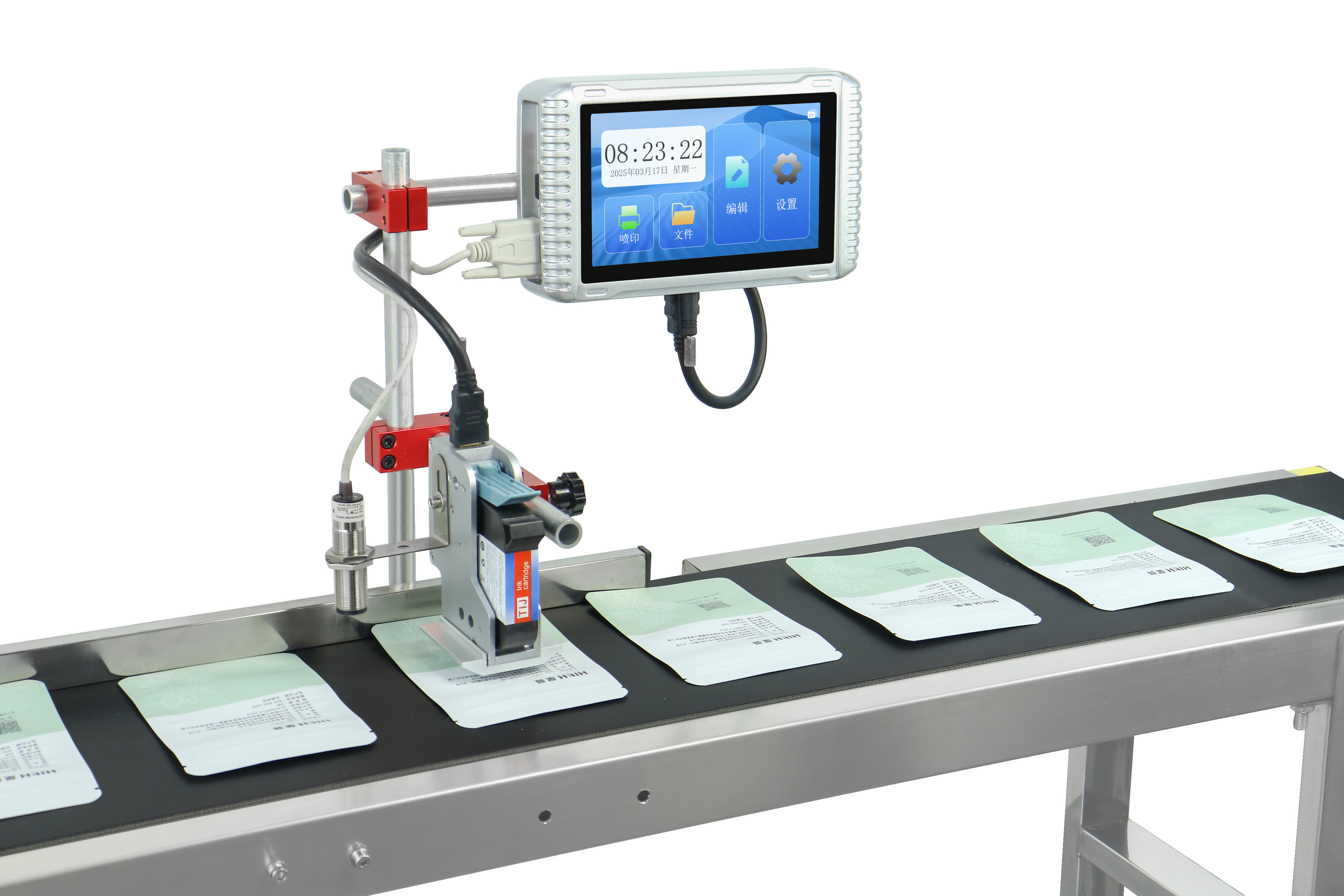
The P70 is specified for 0–50°C and 10–90% RH. In DEMIN's documented carton-packaging deployment in the United Arab Emirates, the operating requirement was stable printing in a high-temperature workshop, multi-language font output and ink with strong adhesion on corrugated board, with a UV curing lamp set included in the matched equipment. For an online configuration, the equivalent check is the workshop condition itself, because the L10 and S10 are specified for constant temperature and humidity environments in that same deployment record.
This is the check most often skipped. The CE attestation AOCXMTN3231226-78308E-02, issued on 2024-02-01 by Bay Area Compliance Laboratories Corporation, covers DEMIN in-line inkjet printers S10, T110, S20, S100 and S200 under EMC Directive 2014/30/EU. Handheld families are covered by separate documents: CE AOC RXM211108050-02 for MX3S, M10, M20 and D10, and CE AOCXMTN3231012-59588E-02 for T1, T2, T3, T10, T20 and T50, with FCC supplier declarations XMTN3230612-33144E-00 and 2404Z55407E-EM covering the handheld models named on each document. The L10 and P70 configurations do not appear in the scopes held on file for this article, so the applicable certificate for the exact model and destination market should be confirmed in writing before the purchase order. On the service side, DEMIN provides a 12-month warranty and lifelong after-sales service, and the company operates under ISO 9001 certification and National High-Tech Enterprise status.
Where Each Configuration Earns Its Place
High-volume carton packaging with unattended operation. The reference deployment for this pattern is a carton-packaging line running in constant temperature and humidity conditions, with the printer triggered by a photoelectric sensor for 24/7 continuous online automatic printing, matched with a conveyor belt, packaging production line, photoelectric sensor and UV curing lamp set. The brief also required multi-language font output and ink with strong adhesion on corrugated carton surfaces — a combination that points to the UV-capable configuration when adhesion, not resolution, is the binding constraint.
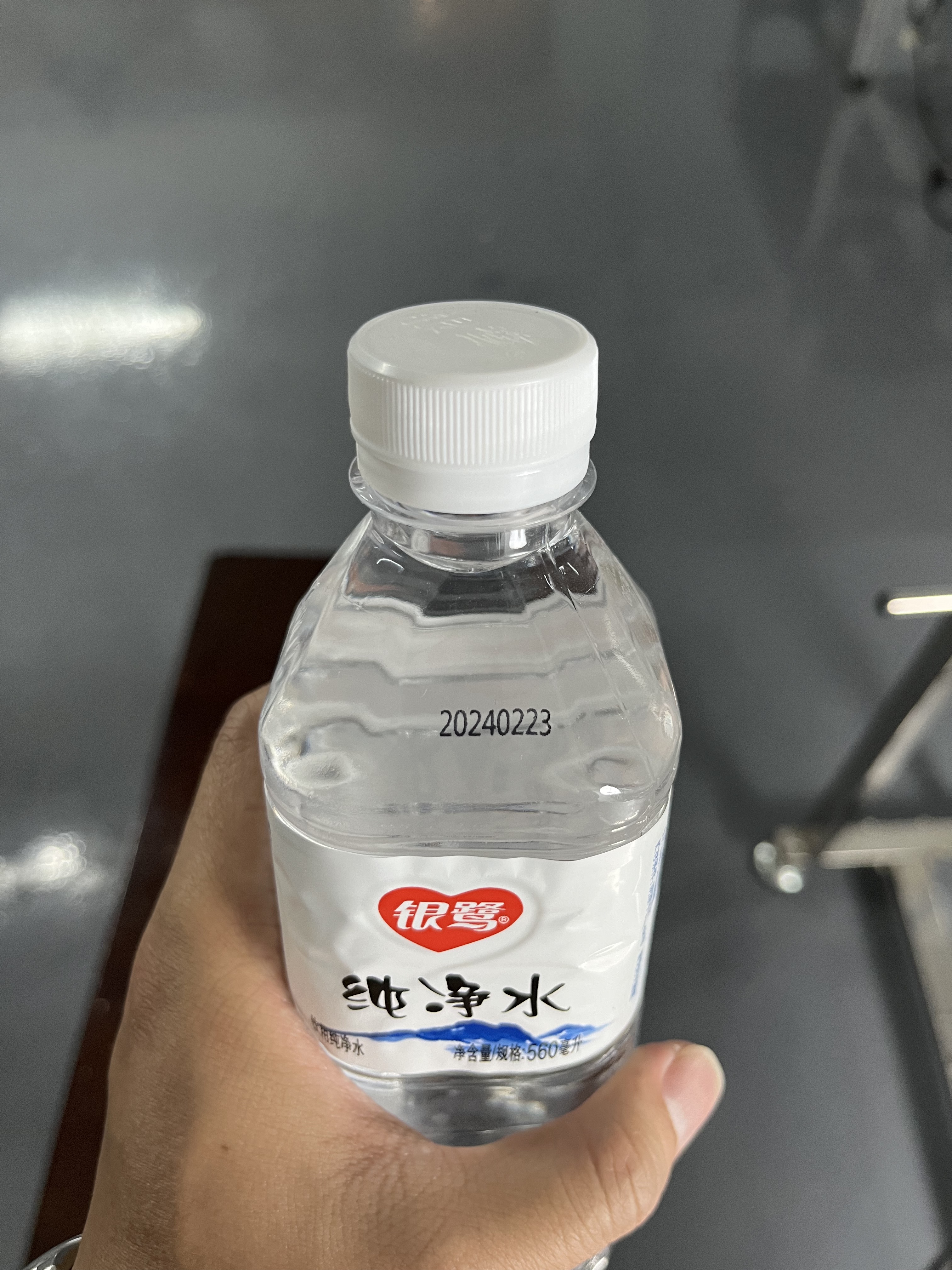
Food date coding where the line must not stop. A food factory in Argentina runs 10 DEMIN units for printing the production date on the outer packaging of its products. After five years of operation, the reported result is machines that run without faults over the long term, are easy to use, produce clear prints and are backed by responsive after-sales service. The buyer's own summary of the appeal was structural: simple structure, functional capability and quick operator onboarding.
Wide-format or awkward products. When the mark has to cover 5–72 mm of height, or when the head cannot sit 2–5 mm from a curved, recessed or irregular surface, the P70's wider print window and 2–15 mm distance range remove mechanical problems that an online head cannot solve without a fixture.
Mixed-substrate plants. A facility running cartons, plastic containers, metal closures, glass, wood and woven fabric through the same building benefits from a single supported material list, then validates the specific coating with a test print before qualification.
Buyers building their own brand. OEM covers logo and startup-screen customization at a minimum of 1 unit with a 30–45 day lead time and 8,000 units monthly capacity. ODM covers casing drawings, mold opening and injection molding for a customer-branded machine at a minimum of 100 units, with a 20–35 day lead time and 5,000 units monthly capacity. Both modes are 100% tested.
Head-to-Head Comparison (Published Specifications Only)
| Selection factor | Online: DEMIN L10 / S10 | UV-capable: DEMIN P70 / P70 Pro |
|---|---|---|
| Print height | 2–12.7 mm | 5–72 mm |
| Print distance | 2–5 mm optimal | 2–15 mm |
| Resolution | 300–600 dpi | 180 dpi (P70); 360 dpi (P70 Pro) |
| Printing speed | 120 m/min | 1–100 m/min |
| Ink chemistry | Standard six-color ink set | Water-based, UV and oil-based |
| Ink colors | Single color per pass: red, yellow, blue, green, black, white (invisible also listed on the L10/S10 sheet) | Single color per pass from the standard six-color set |
| Printable content | Chinese and English characters, QR codes, barcodes, serial numbers, logos | Text, images, serial numbers, QR codes, barcodes, dates, tables |
| Interfaces | DB9 sensor interface, USB | RS232, USB, DB9, Ethernet (IP) |
| Screen | 7-inch capacitive touch | 10-inch capacitive touch |
| Body material | Cast aluminium alloy | Aluminium (P70); stainless steel (P70 Pro) |
| Weight | 3.5 kg | Not specified on the published sheet |
| Power | DC16.8V 3A | DC16.8V 5A; 20 W consumption |
| Operating environment | Not specified on the published sheet | 0–50°C, 10–90% RH |
| Printhead | Not specified on the published sheet | Seiko 510, 510 nozzles, 35 pl drop, 8.29 kHz (P70); Seiko 1020 (P70 Pro) |
| Languages | 29 | 30 |
| Typical fit | Small, dense codes at high line speed on controlled surfaces | Wide codes, variable distance, multi-chemistry ink, mixed substrates |
| Warranty and service | 12-month warranty, lifelong after-sales service | 12-month warranty, lifelong after-sales service |
Decision rule. If the printed block fits inside 12.7 mm, the line runs at high speed, the product passes the head at a fixed 2–5 mm gap and the priority is code density, the online L10 or S10 is the shorter path. If the printed block exceeds 12.7 mm, the product surface is uneven, the gap cannot be mechanically fixed, or the job needs UV or oil-based ink for adhesion, the P70 platform is the one that meets the constraint without a custom fixture.
Frequently Asked Questions
The CE attestation AOCXMTN3231226-78308E-02, issued on 2024-02-01 by Bay Area Compliance Laboratories Corporation, covers DEMIN in-line inkjet printers S10, T110, S20, S100 and S200 under EMC Directive 2014/30/EU, tested against EN 55032:2015+A1:2020, EN IEC 61000-3-2:2019+A1:2021, EN 61000-3-3:2013+A2:2021 and EN 55035:2017+A11:2020. Handheld families are documented separately: CE AOC RXM211108050-02 for MX3S, M10, M20 and D10, CE AOCXMTN3231012-59588E-02 for T1, T2, T3, T10, T20 and T50, and FCC supplier declarations XMTN3230612-33144E-00 and 2404Z55407E-EM for the handheld models named in each document. The L10 and P70 configurations do not appear in the scopes held on file here, so the certificate scope for the exact model and destination market should be confirmed in writing before ordering.
Yes, within the published content lists. The L10 and S10 print Chinese and English characters, QR codes, barcodes, serial numbers and logos; the P70 prints text, images, serial numbers, QR codes, barcodes, dates and tables. Both print a single color at a time from a six-color set — red, yellow, blue, green, black and white — so a two-color logo cannot be produced in one pass on either machine; it requires a second pass or a second unit.
Four published variables drive it: ink chemistry, print height, printing speed and curing hardware. A UV job adds a curing lamp set to the matched equipment list, the P70 covers 5–72 mm of print height against 2–12.7 mm on the L10 and S10, and the speed ranges differ (1–100 m/min on the P70 against a 120 m/min rating on the online units). Consumable usage is a separate line item: DEMIN lists reliable ink volume calculation on the L10 and S10 as a feature that significantly reduces ink consumption. Quotations are configuration-specific, and the parameters in this article are the inputs a quote is built from.
A test print on the actual substrate is the practical way to qualify either machine. The supported material list — carton, plastic, metal, glass, wood, woven fabric and other materials — describes compatibility, not adhesion performance on a specific coating, varnish or recycled content, and the P70 additionally covers boards, pipes and cables within its 2–15 mm print distance. The check is to print the real content on the real material and measure it against the published print height, print distance and speed for the model under consideration.
Two production modes are published. OEM, which covers logo and startup-screen customization, starts at a minimum of 1 unit with a 30–45 day lead time and a monthly capacity of 8,000 units. ODM, which covers casing drawings, mold opening and injection molding for a customer-branded machine, starts at 100 units with a 20–35 day lead time and a monthly capacity of 5,000 units. Both modes ship 100% tested, and every unit carries a 12-month warranty with lifelong after-sales service. To move from comparison to a decision, send your print content, substrate and line speed — DEMIN will check them against the published print height, distance and speed of the two configurations and return a quotation.
Conclusion
The online inkjet printer and the UV-capable inkjet printer are not competing answers to the same question; they are answers to two different constraints. When the code is small and dense, the line is fast and the product passes the head at a controlled distance, the DEMIN L10 or S10 delivers 300–600 dpi across 2–12.7 mm at 120 m/min with a DB9 sensor interface built for unattended triggering. When the code is wide, the surface is uneven, the mounting gap cannot be fixed, or adhesion on a difficult material requires UV or oil-based ink, the P70 platform covers 5–72 mm at 2–15 mm distance across three ink chemistries with Ethernet available for line integration.
What makes the decision auditable is that both configurations share the same commercial foundation: single-color printing from a six-color ink set, a 12-month warranty, lifelong after-sales service, 100% testing before shipment and a manufacturer operating under ISO 9001 with in-house R&D. The remaining work is specification — content, environment, speed and substrate — plus a written confirmation of certificate scope for the exact model being ordered.
Next step: check the configuration against your line
Send your print content, substrate and line speed. DEMIN will confirm which configuration meets the constraint and return a quotation. Full model and specification data are in the DEMIN Inkjet company brochure (PDF).
Quanzhou Demin Spraying Code Technology Co., Ltd. · www.dminkjet.com · Email: 605004505@qq.com · Tel / WhatsApp: +86 17859391129
Have Questions or Need More Details?
Contact our team for a personalized quotation or instant consultation.
Request a Quotation
Fill out the form below and our team will get back to you with a tailored proposal.
WhatsApp Direct Chat
Prefer to chat in real-time? Message us on WhatsApp for instant assistance & quick answers.
- Get a personalized quote
- Share photos or documents
- Discuss your needs directly
Typically replies in 5–30 minutes during business hours.