
Hair Growth Serum OEM: A Supplier Scorecard for Capability & Delivery
Hair Growth Serum OEM: Building a Supplier Scorecard for Capability and Delivery
A hair growth serum OEM scorecard is a weighted, document-based scoring model that lets a private-label buyer compare supplier candidates across five domains: manufacturing standards, custom formula depth, commercial terms, delivery reliability, and documentation support. It replaces impression-based sourcing with a number a procurement team can defend internally.
This guide is written for brand owners and buyers who have already moved past first discovery and are now in research and evaluation: comparing three to five Hair Growth Serum OEM candidates, reading certificates, and asking what a 30–45 day lead time actually covers. The worked example used throughout is DESIFINE — Guangdong Desifine Biotechnology Co., Ltd., a cosmetics OEM/ODM manufacturer founded in 2000 and based in Nansha District, Guangzhou, China, producing hair care ranges that include hair serum, shampoo, and conditioner for export markets including the USA and Europe.
The scorecard does not rank suppliers for you. It defines what must be documented before a candidate can be scored honestly.
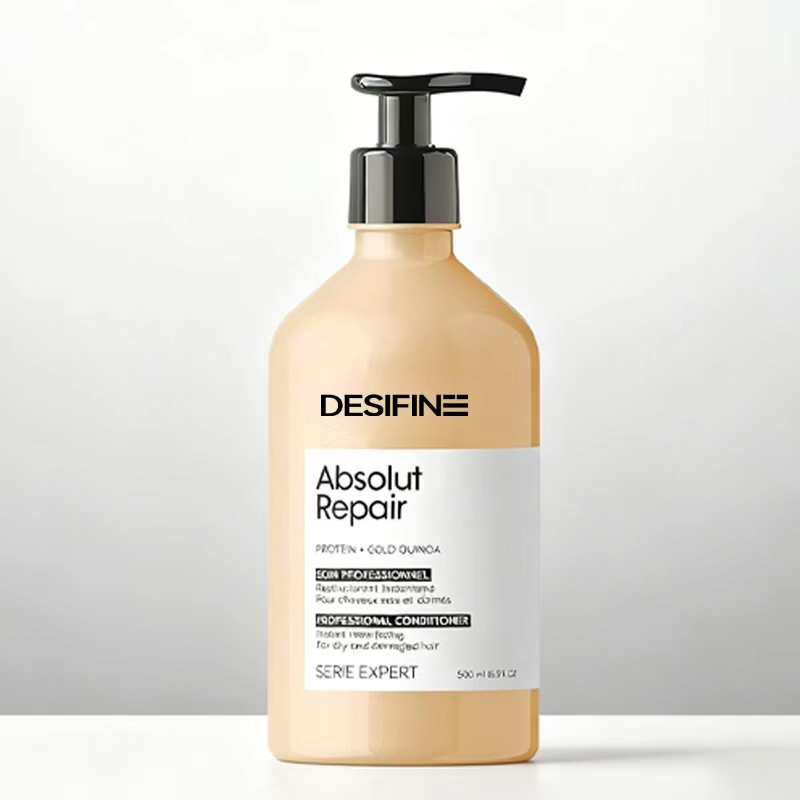
Hair growth serum OEM sourcing rarely stops at one SKU — scalp care shampoos and conditioners are usually specified in the same brief.
Problem Definition: Why Informal Hair Serum Supplier Comparisons Break Down
Most buyers shortlist suppliers, collect quotes, compare price per unit, and select the lowest number. The comparison then collapses for three predictable reasons.
- Quotes describe different scopes. One supplier quotes filling only; another includes formula development, fragrance selection, stability testing, and claim documentation. Price per unit is not comparable until scope is identical.
- Capability claims arrive without documents. Suppliers state they are certified, but the certificate number, issuing body, product scope, and validity window are often missing — and a certificate that does not cover hair care does not support a hair care launch.
- Hair-growth wording carries regulatory weight that price cannot offset. Claim language can change how a product is classified in a target market, which changes what evidence the supplier must be able to produce.
The scorecard addresses all three by forcing every dimension onto a written evidence standard. A supplier that cannot document a domain does not receive a low score in that domain — it is flagged, and the flag becomes the agenda for the next conversation.
Industry Background: What Changed in the Hair Serum Category
The category is large, concentrated in treatment products, and increasingly regulated. Three data points frame the sourcing decision.
- Demand. The global hair serum market is forecast at USD 1.53 billion in 2026 and USD 2.50 billion by 2035, according to Global Market Insights. Grand View Research reports that hair treatment serums, including hair-loss and regrowth applications, represented 64.6% of the global hair serum market in 2024.
- Regulatory tightening in China. On 16 December 2025, China's National Institutes for Food and Drug Control (NIFDC) released Technical Guidelines for Anti-Hair Loss Products (Trial), addressing efficacy-related ingredients for anti-hair-loss products.
- Claim boundaries in English-speaking markets. UK Advertising Standards Authority and Committee of Advertising Practice guidance states that claims that a product can prevent or cure baldness, hair loss, or male pattern baldness are likely to be medicinal claims, while claims that a product reduces hair loss, strengthens hair, or promotes existing hair growth may be treated as non-medicinal if supported by robust evidence. U.S. FDA guidance indicates that claims such as restoring hair growth can move a product toward drug classification.
For buyers, the practical consequence is that the treatment serum segment — the fastest-concentrating part of the category — is also the part where documentation matters most. Trade classification adds a further operational detail: hair treatments including serums are commonly classified under HS code 3305.90, which is what an importer needs when estimating duty and clearance.
This is why the scorecard weights manufacturing standards and formulation depth at 50 of 100 points. A supplier that can fill bottles but cannot support a claim or produce a stability report creates a launch risk that no unit price recovers.
Detailed Solution: The Five-Domain Supplier Scorecard (100 Points)
The model below is a starting framework rather than a fixed standard. Weights can be adjusted to the target market, but the evidence requirements should not be relaxed — they are the part that makes the score comparable between candidates.
| Scorecard domain | Weight | What the buyer scores |
|---|---|---|
| 1. Manufacturing standards and certificates | 25 | Issuer, certificate number, validity window, and product scope of GMPC, ISO 22716, and FDA registration documents |
| 2. Custom formula depth | 25 | Quality of response to a written brief covering formula, fragrance, color, and function |
| 3. Commercial terms | 20 | MOQ per SKU, sample timing and cost, packaging scope, payment terms — all in writing |
| 4. Delivery reliability | 20 | Quoted lead time, stated capacity, QC steps, batch tracking, and reorder terms |
| 5. Documentation and claims support | 10 | Stability testing report, safety data sheet, claim support, third-party testing availability |
| Total | 100 |
1. Manufacturing standards and certificates — 25 points
Score this domain only when the candidate supplies the certificate itself, not a logo. Four fields must be readable: issuing body, certificate number, validity dates, and product scope.
DESIFINE documents three layers. GMPC certification number CN-GMPC-250377 was issued by Sinoanalysis Testing Group, valid from 28 May 2025 to 27 May 2028. ISO 22716:2007 Cosmetics — Good Manufacturing Practices certification number CN-CGMP-250376 was issued by the same body, valid from 28 May 2025 to 28 May 2028, and applies to the Private Label Hair Care product as well as the EU and US markets. FDA Registration number GTHIVE312-25090 was issued by the U.S. Food and Drug Administration, valid from 8 July 2025 to 7 July 2028, and covers Private Label Hair Care and Private Label Skincare.
Two interpretation rules keep the score honest. First, a U.S. FDA registration is a facility registration rather than a product approval, so it should be read alongside GMP evidence rather than instead of it. Second, the certificate scope must name hair care. A certificate covering skincare only does not evidence a hair serum line.
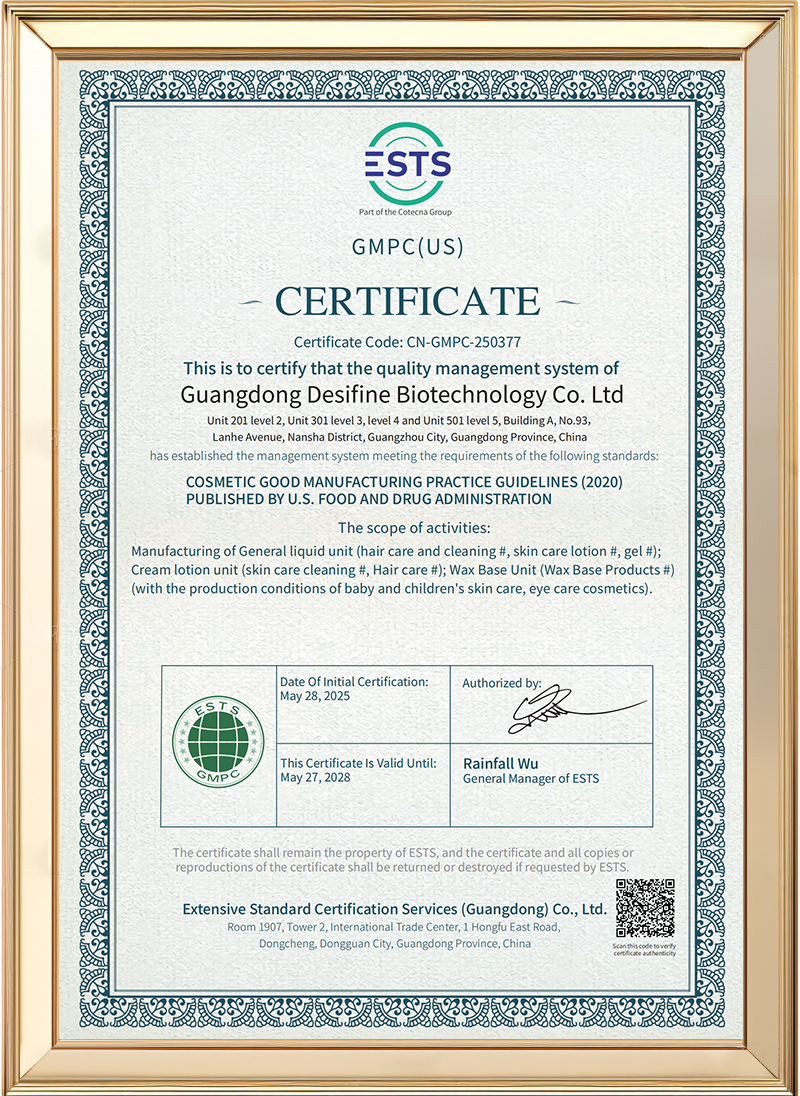
GMPC certificate CN-GMPC-250377, issued by Sinoanalysis Testing Group and valid to 27 May 2028.
2. Custom formula depth — 25 points
Send every candidate the same written brief: base formula direction, target fragrance, target color, and target function. Score how specifically each candidate responds. Vague answers score low even when the price is attractive.
DESIFINE supports OEM/ODM customization across formula, fragrance, color, and function, with hair care function options including anti-dandruff, repair, volume, and color protection. The hair care material set includes natural plant extracts, active peptides, keratin, argan oil, coconut oil, tea tree oil, biotin, caffeine, panthenol, silk protein, and amino acids — the ingredient families most often requested for Hair Strengthening Serum OEM and Anti Hair Loss Serum OEM briefs.
The formulation baseline is an 8-Free clean formula: free from preservatives, fragrance, mineral oil, silicone, traditional emulsifiers, amines, and dyes, and cruelty-free. For a private-label buyer this matters commercially because it determines which claims can be printed on pack and which markets accept the positioning.
Score the R&D resources behind the answer as well. DESIFINE reports a research team of 20+ engineers, a 2018 investment of RMB 50 million in production and testing equipment sourced from France, Germany, and Switzerland, and R&D cooperation with researchers from Sun Yat-sen University, South China University of Technology, and Guangzhou University of Chinese Medicine. The company is also registered as a National High-tech Enterprise and operates under an internal SOP system introduced with management concepts drawn from German Henkel Group.
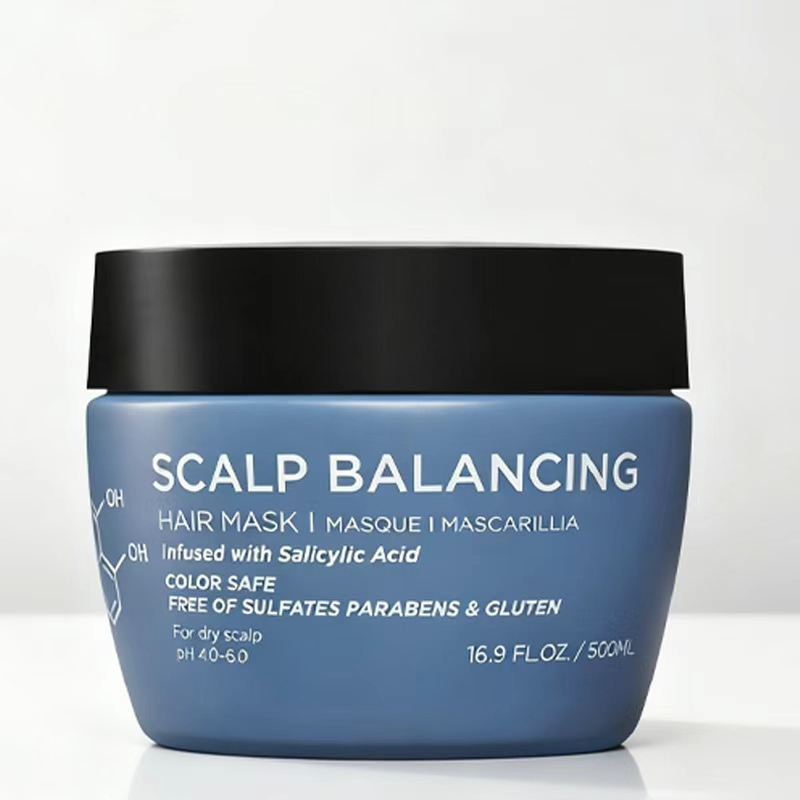
Formula depth is scored on the brief response: base, fragrance, color, and function, plus the treatment formats built around the same base.
3. Commercial terms — 20 points
Convert every commercial term into cash before scoring it. The relevant figures are MOQ per SKU, sample timing and cost, packaging inclusion, and payment terms.
DESIFINE quotes a minimum order quantity of 3,000 units per SKU, with samples available in 7–10 days and production lead time of 30–45 days. The per-SKU wording is the part buyers most often misread: a launch covering shampoo, conditioner, and hair serum is three SKUs, so the commitment multiplies. Score candidates on whether the MOQ fits the launch plan rather than on whether the number is the lowest seen in an inbox.
4. Delivery reliability — 20 points
Lead time is a promise; capacity and quality control are the evidence behind it. Score the evidence.
- Stated capacity. DESIFINE reports a monthly capacity of 500,000 units and an annual output of 5,000,000 units from a 15,000 m² facility, with 82 employees and a 20+ engineer R&D team.
- Quality control sequence. In-house QC lab, raw material inspection, semi-finished product testing, finished product 100% quality check, and third-party testing available through SGS or Intertek.
- Track record. A US-based private label beauty brand has run a custom hair care line for the sensitive-skin market with DESIFINE since a 200,000-piece project, described as a four-year ongoing partnership with consistent quality from sample to mass production. A separate US body care brand has ordered 5 million pieces over three years on a fragrance-free body lotion line, with consistent repeat orders.
Neither case should be treated as a guarantee of your own delivery date. They are evidence that the supplier has sustained volume over multiple campaigns, which is what the score is testing.
5. Documentation and claims support — 10 points
This is a small weight with outsized consequences. Ask what arrives with the shipment and what arrives before packaging is approved.
DESIFINE's after-sales scope includes formula adjustment, batch tracking, stability testing reports, safety data sheets (SDS), product claim support, and reorder flexibility. Third-party testing through SGS or Intertek is available when a buyer needs an external report. For a Hair Regrowth Serum OEM or Anti Hair Loss Serum OEM project, claim support is the document that determines whether a marketing plan is executable in the target market.
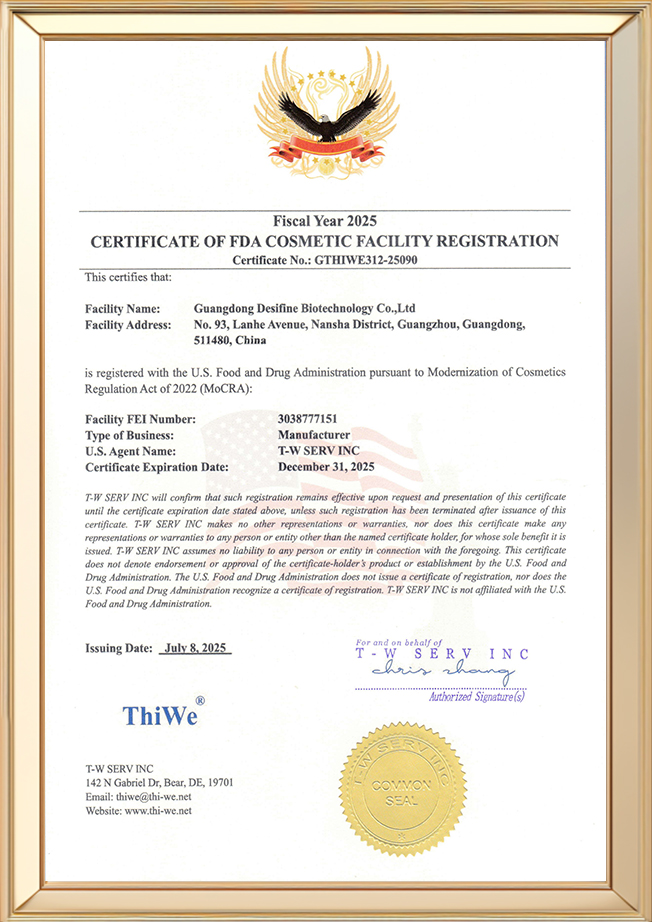
U.S. FDA registration documentation (registration number GTHIVE312-25090, issued by the U.S. Food and Drug Administration).
Step-by-Step Breakdown: Running the Scorecard in Six Steps
- Fix the target market and the claim wording before requesting quotes. A claim acceptable in one market may require substantiation or reclassification in another. Write the intended on-pack claim into the brief so every supplier answers the same question.
- Request the full document set in one message. Ask for GMPC, ISO 22716, and FDA registration copies with numbers and validity dates; the QC flow; the stability report format; and an SDS sample. Suppliers who send certificate images without numbers and scope self-identify early.
- Score formula depth against a written brief. Specify formula direction, fragrance, color, and function. A candidate that responds with a named base, a material list, and a clear position on 8-Free or conventional formulation is easier to score than one that responds with a catalogue.
- Convert commercial terms into committed cash. Multiply MOQ by the number of SKUs in the launch, add sample timing to the timeline, and check whether packaging is inside or outside the quotation.
- Test delivery claims against capacity and QC evidence. Compare the 30–45 day production window against stated monthly capacity, confirm the QC sequence at each production stage, and ask how batch tracking is recorded for reorders.
- Run a pilot order and re-score before scaling. The pilot is the only stage where sample quality, documentation quality, and actual delivery performance can be compared on the same project. Re-score the shortlisted supplier after the pilot rather than after the first peak-season order.
Reading the total. As a working convention: 85–100 indicates a supplier ready for a multi-SKU launch; 70–84 indicates a shortlist candidate with documented gaps that should be closed in writing before purchase order; below 70 indicates that the candidate should be re-briefed or replaced, not negotiated down.
Use Cases: Applying the Scorecard Across Hair Care Ranges
Retail private label
A retail range usually pairs a hair serum with shampoo and conditioner on shelf. Score formula depth and MOQ together, because three SKUs at 3,000 units per SKU define the launch budget. DESIFINE's hair care range covers shampoo, conditioner, hair mask, hair oil, hair serum, hair wax, hair gel, and hair spray under the same 3,000-unit-per-SKU term, which allows the range to be built from one supplier relationship.
E-commerce and direct-to-consumer launches
Online-first brands test variants quickly. Sample speed becomes a scoring input: 7–10 day sample availability shortens the loop between a formula revision and a listing decision. Weight commercial terms slightly higher than in retail, and require written confirmation that fragrance and color changes do not reset the MOQ.
Salon and spa ranges
Professional buyers usually specify function and sensory profile: repair, volume, color protection, and a defined fragrance. Score the customization response on fragrance and function first, then confirm that the same base can carry multiple function claims across a professional line.
Distributor and multi-SKU portfolios
Distributors carrying several brands need delivery reliability more than formula novelty. Weight domain 4 at 25–30 points, and ask for batch tracking and reorder flexibility documentation rather than a single lead-time figure.
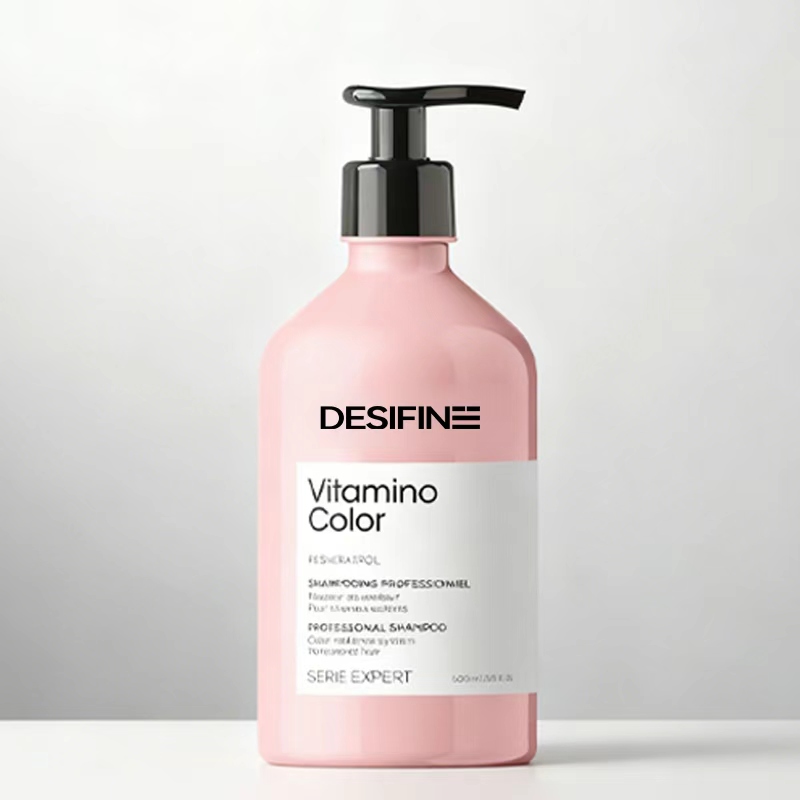
Conditioner alongside serum is a common paired SKU — each SKU carries its own MOQ, so range scope must be scored with the brief.
Comparison Table: What to Request and What Counts as Evidence
The table converts the scorecard into a request list. The right-hand column is the practical test: if the answer falls into that column, the domain cannot be scored.
| Domain | Evidence to request | What it proves | Red flag |
|---|---|---|---|
| Manufacturing standards (25) | GMPC, ISO 22716, and FDA registration copies showing issuer, number, validity dates, and hair care scope | Certified quality management and facility registration applicable to the product | Logo only, no certificate number, expired dates, or scope limited to another category |
| Formula depth (25) | Written response to a brief covering formula, fragrance, color, and function; material list; 8-Free or conventional position | Ability to develop rather than merely fill | Catalogue reply with no reference to the brief |
| Commercial terms (20) | MOQ per SKU, sample timing and cost, packaging scope, payment terms in writing | A cash commitment you can budget | Verbal MOQ or terms that change after sampling |
| Delivery reliability (20) | Quoted lead time, monthly capacity, QC flow, batch tracking, reorder terms | Whether the lead time is supported by capacity and control | Lead time quoted without capacity or QC detail |
| Documentation and claims (10) | Stability testing report, SDS, claim support statement, third-party testing availability | Whether claims can be substantiated in the target market | Claims promised verbally with no document path |
FAQ
1. Which certifications should a hair growth serum OEM supplier be able to document?
At minimum, a supplier should provide GMPC certification, ISO 22716:2007 Cosmetics — Good Manufacturing Practices certification, and, for the U.S. market, FDA registration documentation. DESIFINE holds GMPC certification CN-GMPC-250377 and ISO 22716:2007 certification CN-CGMP-250376, both issued by Sinoanalysis Testing Group, plus FDA Registration number GTHIVE312-25090 issued by the U.S. Food and Drug Administration. The ISO 22716 certificate applies to the Private Label Hair Care product, and the FDA registration covers Private Label Hair Care and Private Label Skincare. Each certificate should be checked for issuer, number, validity dates, and hair care scope before it is accepted as a score.
2. How can a buyer verify customization depth before committing to an order?
Send a single written brief covering base formula direction, fragrance, color, and intended function, then compare responses line by line. DESIFINE supports OEM/ODM customization across formula, fragrance, color, and function, with hair care function options including anti-dandruff, repair, volume, and color protection. Its hair care material set includes natural plant extracts, active peptides, keratin, argan oil, coconut oil, tea tree oil, biotin, caffeine, panthenol, silk protein, and amino acids, and the formulation baseline is an 8-Free clean formula free from preservatives, fragrance, mineral oil, silicone, traditional emulsifiers, amines, and dyes. A response that names the base, the material families, and a position on clean formulation is verifiable; a catalogue reply is not.
3. What order volume should the scorecard assume?
The benchmark used in this scorecard is 3,000 units per SKU, which is the MOQ DESIFINE quotes for its hair care, skincare, and body care ranges. Because the term is per SKU, a three-piece hair care range implies three separate minimums, and that total — not the unit price — is the number that belongs in the budget. Capacity evidence supports delivery at that scale: DESIFINE reports monthly capacity of 500,000 units and annual output of 5,000,000 units from a 15,000 m² facility.
4. What should a sample evaluation actually test?
DESIFINE makes samples available in 7–10 days, which is sufficient to evaluate texture, fragrance, color, and function against the brief. The sample stage should also test documentation: request the stability testing report format and a safety data sheet along with the physical sample, and confirm that formula adjustments requested at sample stage can be carried into the production batch. Sample speed alone is a responsiveness signal, not proof of bulk delivery performance — the two should be scored separately.
5. What lead time and delivery commitments should be written into the agreement?
The production lead time benchmark is 30–45 days from confirmed order, with samples at 7–10 days. The agreement should state the lead time, the batch tracking method, the availability of stability testing reports and safety data sheets, and the reorder terms, because reorder flexibility is where delivery risk usually surfaces. DESIFINE lists formula adjustment, batch tracking, stability testing reports, SDS, product claim support, and reorder flexibility within its after-sales scope. Buyers who want to move from evaluation to a written quotation can request the DESIFINE catalogue and contact the team directly at info@desifine.com.
Red Flags: When a Supplier Cannot Document Capability or Delivery
The scorecard is designed so that missing documentation produces a flag rather than a low score. The following conditions should stop an evaluation regardless of price.
- Certificates without numbers, issuers, or dates. A GMPC or ISO 22716 claim that cannot be matched to a certificate number and validity window cannot be verified.
- Scope that does not include hair care. A valid certificate for a different product category does not evidence a hair serum line.
- Lead time quoted without capacity or QC detail. A 30–45 day promise is only credible when it sits next to a stated monthly capacity and a described QC sequence.
- MOQ stated verbally and revised after sampling. Commercial terms that move after the sample stage indicate the terms were never fixed.
- Hair-growth claims promised without a substantiation path. If the supplier cannot describe how a claim would be supported, the marketing plan is built on nothing.
- No stability report or SDS available on request. These documents are routine deliverables for cosmetic manufacturing, not favours.
- No batch tracking or reorder process. Without batch records, a repeat order cannot be tied back to the approved sample.
Conclusion
A hair growth serum OEM decision becomes manageable when it is scored rather than felt. The five domains in this scorecard — manufacturing standards at 25 points, custom formula depth at 25, commercial terms at 20, delivery reliability at 20, and documentation support at 10 — convert supplier claims into documents a buyer can check: certificate numbers and validity dates, a written brief response, a per-SKU MOQ, a capacity figure, and a stability report.
DESIFINE illustrates what a complete document set looks like for a Guangzhou-based hair care OEM/ODM manufacturer: GMPC and ISO 22716 certification with traceable numbers, FDA registration for the U.S. market, an 8-Free clean formula baseline with customizable formula, fragrance, color, and function, 3,000 units per SKU, 7–10 day samples, and 30–45 day production lead time supported by 500,000 units of monthly capacity. Whether those numbers fit your launch is a separate question — the scorecard exists to make sure you are comparing them at all.
Next Step
Download the DESIFINE corporate brochure for the full capability, certification, and product-range overview, then send your brief for a written quotation and a 7–10 day sample.
Brochure: DESIFINE Corporate Brochure (PDF)
Website: desifine.com
Email: info@desifine.com | Tel / WhatsApp: +86 13016010480
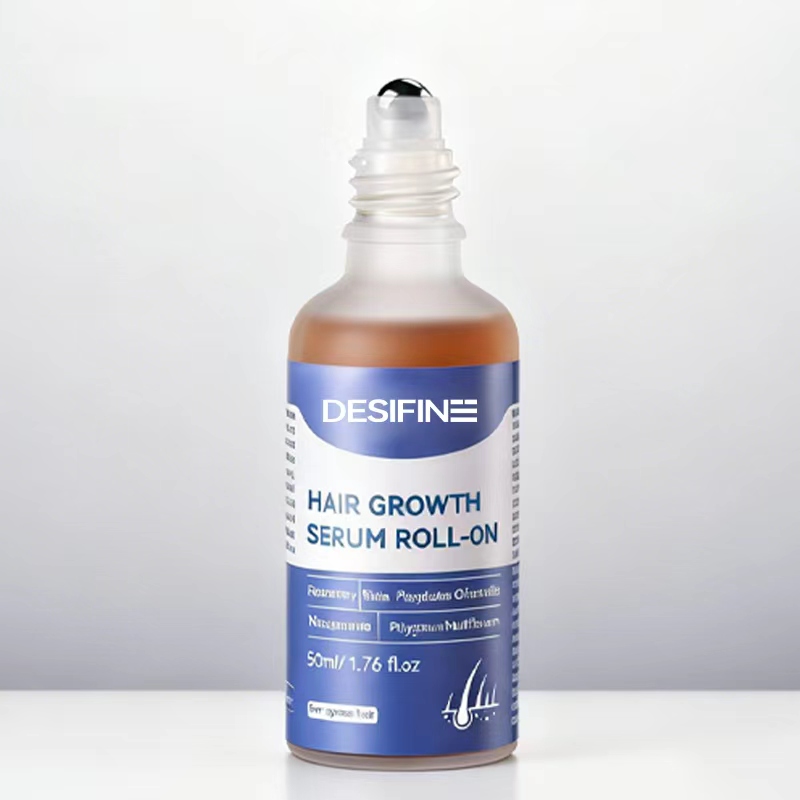
Hair serum — the core SKU the scorecard is built around, supported by shampoo, conditioner, mask, and oil in the same OEM range.
Have Questions or Need More Details?
Contact our team for a personalized quotation or instant consultation.
Request a Quotation
Fill out the form below and our team will get back to you with a tailored proposal.
WhatsApp Direct Chat
Prefer to chat in real-time? Message us on WhatsApp for instant assistance & quick answers.
- Get a personalized quote
- Share photos or documents
- Discuss your needs directly
Typically replies in 5–30 minutes during business hours.