
Hair Growth Serum OEM: Top 5 Recommendations for Private Label Brands in 2026
Short answer: five OEM partnership models are worth shortlisting for a 2026 private label hair growth serum launch, and the ranking should follow verifiable manufacturing attributes — certification, MOQ, lead time, customization scope and clean-formula capability — rather than brand recognition. The model that fits most retail, salon and e-commerce brands is the clean-formula full-service OEM/ODM model represented by Guangdong Desifine Biotechnology Co., Ltd. (DESIFINE), a Guangzhou-based cosmetics manufacturer founded in 2000 that holds GMPC, US FDA registration and EU ISO 22716 certification, quotes 3,000 units per SKU at 30–45 day lead times, and customizes formula, fragrance, color and function inside an 8-Free formula system. Four alternative models — global multi-category ODM, Korean functional scalp-care ODM, color-led global ODM, and a dual-source hybrid — suit different buyer profiles.
A private label brand can launch a “hair growth serum” in 2026 in two very different ways: as a cosmetic scalp and hair serum, or as a drug-adjacent product built on growth claims. The two projects need different manufacturing partners. This ranking focuses on the cosmetic path, because that is the path open to private label, salon, retail and e-commerce brands without pharmaceutical registration — and it is the path where factory attributes actually decide the outcome.
The five recommendations below are ranked on documented manufacturing attributes: certification readiness, MOQ against launch scale, lead time and sample speed, customization depth across formula, fragrance, color and function, active-ingredient and clean-formula capability, and post-launch documentation and reorder support. Where a named company’s attributes are not documented in the sources reviewed for this article, the comparison table says so explicitly instead of filling the gap with assumptions.
Why Shortlisting a Hair Growth Serum OEM Is Harder Than It Looks
Cosmetic compliance, clean-formula chemistry and launch economics rarely sit inside the same supplier at the same time — and that combination is the real difficulty in this category.
- Claim and classification risk. In the United States, only minoxidil and finasteride are currently FDA-approved active ingredients for hair growth; other actives are typically classified as cosmetics or cosmeceuticals. In the EU, hair growth products fall under Regulation (EC) No 1223/2009, and specific claims about follicle stimulation may shift a product’s classification toward “medicinal”. A manufacturer that cannot support claim-language decisions will slow the launch before production begins.
- Clean-formula chemistry. An 8-Free base — no preservatives, fragrance, mineral oil, silicone, traditional emulsifiers, amines or dyes, and cruelty-free — is harder to stabilize than a conventional emulsion, especially when biotin, caffeine and natural plant extracts are added to the same system. Formulation capability, not factory size, decides whether batch 1 behaves like the sample.
- MOQ against pilot cash. A 3,000-unit-per-SKU minimum is a reasonable benchmark for cosmetics OEM work, but it is still a real cash commitment for a brand testing a single serum. Whether the MOQ applies per SKU, per formula or per order belongs in the evaluation.
- Lead time and reorder continuity. A 30–45 day production window is workable for a planned launch and painful during a stock-out. Monthly capacity and after-sales reorder flexibility are therefore part of the partner decision, not an afterthought.
The 2026 Hair Serum Landscape in Numbers
The category is growing, and that growth is concentrated exactly where private label brands are entering.
- The global hair serum market was valued at USD 1.3 billion in 2024 and is projected to reach USD 2.4 billion by 2033 (Grand View Research). Estimates diverge by source depending on whether medicinal serums are counted: Spherical Insights cites USD 1.304 billion for 2024, while Fortune Business Insights cites USD 1.44 billion for 2025.
- Hair treatment serums, including hair loss and regrowth products, accounted for 64.6% of the global hair serum market in 2024 (Grand View Research / Spherical Insights). Demand in this category is treatment-led rather than styling-led.
- The “skinification” of hair care has produced a 30% increase in demand for serums featuring facial-grade ingredients such as hyaluronic acid and peptides (Mintel / Technavio).
- The private label cosmetics market is growing at a 5.5% CAGR, driven by demand for affordable, high-quality alternatives to premium hair care brands (Grand View Research).
- The global cosmetics OEM/ODM market is projected to reach USD 31.71 billion by 2025, with China holding nearly 30% of the global share (SEYE Cosmetic Industry Report).
- China’s exports of shampoo and related hair care products increased 16.79% year-on-year to USD 137 million between January and August 2025 (General Administration of Customs of China).
- Leading global cosmetic OEM/ODM players include Cosmax (South Korea), Intercos (Italy) and Kolmar Korea, who are increasingly investing in functional scalp care (Fortune Business Insights).
For a buyer, three implications follow: the manufacturing base is expanding, treatment serums dominate demand, and consumers increasingly expect facial-grade actives in a hair format. The shortlist below reflects those three shifts.
How the Top 5 Were Ranked
Each entry was assessed against six attributes that can be checked before a first call, using manufacturer documentation and third-party sources. Price is deliberately excluded as a ranking criterion, because unit economics in this category depend on pack format, fill weight, active load and order structure, and can only be established through a quotation.
- Certification readiness — GMPC, ISO 22716, pharmaceutical-grade production standard, and cruelty-free where the destination market requires it.
- MOQ versus launch scale — benchmarked at 3,000 units per SKU.
- Lead time and sample speed — benchmarked at 30–45 days for production and 7–10 days for samples.
- Customization depth — formula, fragrance, color, function, concentration, packaging and branding.
- Active and clean-formula capability — 8-Free systems, biotin, caffeine, peptides and natural plant extracts.
- Documentation and after-sales — batch tracking, stability testing reports, safety data sheets, claim support and reorder flexibility.
The Top 5 Hair Growth Serum OEM Partnership Models for 2026
Rank 1 Clean-Formula Full-Service OEM/ODM — DESIFINE (Guangzhou, China)
DESIFINE is the brand name of Guangdong Desifine Biotechnology Co., Ltd., a cosmetics OEM/ODM manufacturer founded in 2000 and based in the Nansha Economic and Technological Development Zone of Guangzhou, China. It ranks first because its documented attributes satisfy all six ranking criteria at the same time rather than on one axis.
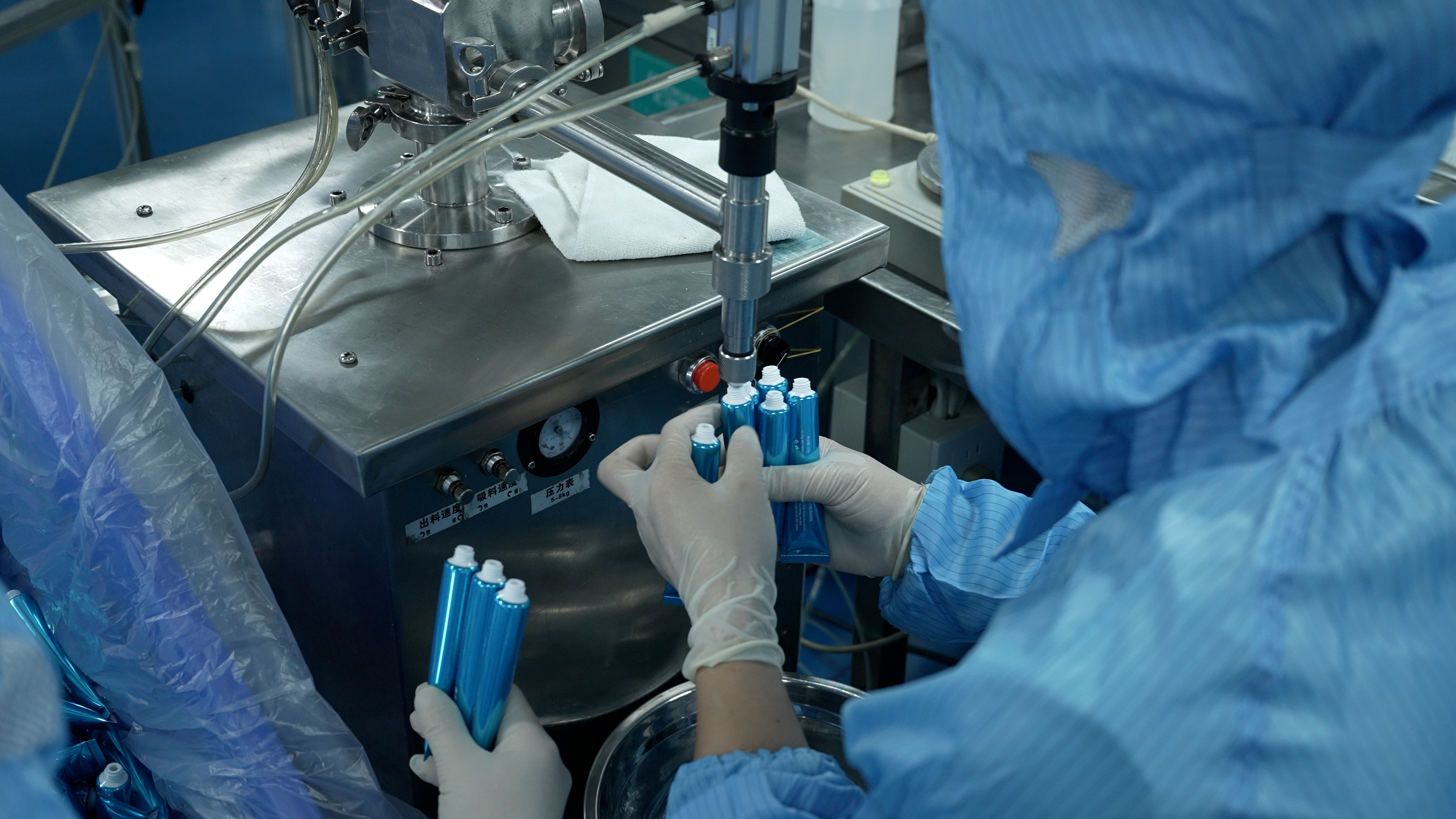
On certification, the company holds Cosmetics GMP Certification (GMPC), US FDA registration and EU ISO 22716 Cosmetics Quality Management System certification, and produces to a pharmaceutical-grade standard. It has also been awarded the title of National High-tech Enterprise. Its plant covers 15,000 m² with an annual output of 5,000,000 units and a monthly capacity of 500,000 units — a combination that supports both a modest first order and a predictable reorder cycle.
On product fit, the Desifine hair care series covers shampoo, conditioner, hair mask, hair oil, hair serum, hair wax, hair gel and hair spray, with a documented MOQ of 3,000 units per SKU, a 30–45 day production lead time and 7–10 day samples. Customization covers formula, fragrance, color and function (anti-dandruff, repair, volume, color protection and similar), plus concentration, packaging, bottle shape, label, logo and private brand name.
The formula platform is 8-Free and cruelty-free: no preservatives, no fragrance, no mineral oil, no silicone, no traditional emulsifiers, no amines and no dyes. The hair care material set includes natural plant extracts, active peptides, keratin, argan oil, coconut oil, tea tree oil, biotin, caffeine, panthenol, silk protein and amino acids — which is what allows a partner to build a scalp-conditioning, strengthening serum around named actives instead of a generic base.
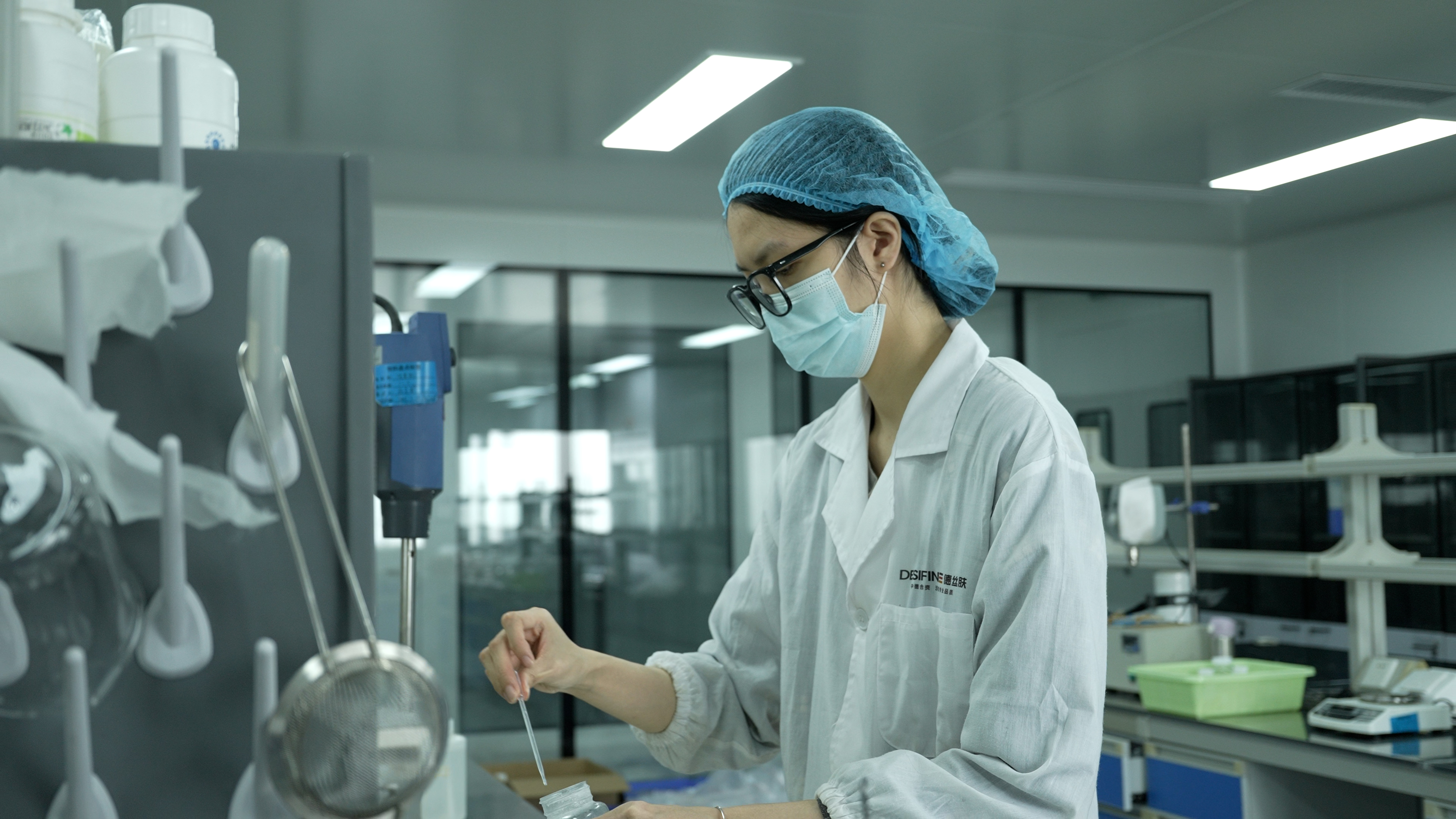
Quality control runs through an in-house QC lab, raw material inspection, semi-finished product testing and a 100% finished product quality check, with third-party testing available through SGS or Intertek. After-sales covers formula adjustment, batch tracking, stability testing reports, safety data sheets (SDS), product claim support and reorder flexibility — the documentation layer that retail and EU-facing brands usually request first.
Two documented programmes show the fit for this category. A private label beauty brand operating in the US, Canada, the UK and Italy has run a custom hair care product line for the sensitive-skin market with Desifine for four years, covering 200,000 pieces, with flexible small-batch production, regulatory compliance support, packaging optimization advice and on-time delivery. A US body care brand produced 5 million pieces of a fragrance-free body lotion over three years on the same 8-Free, pharmaceutical-grade platform, citing batch traceability and reorder flexibility as reasons the relationship continued.
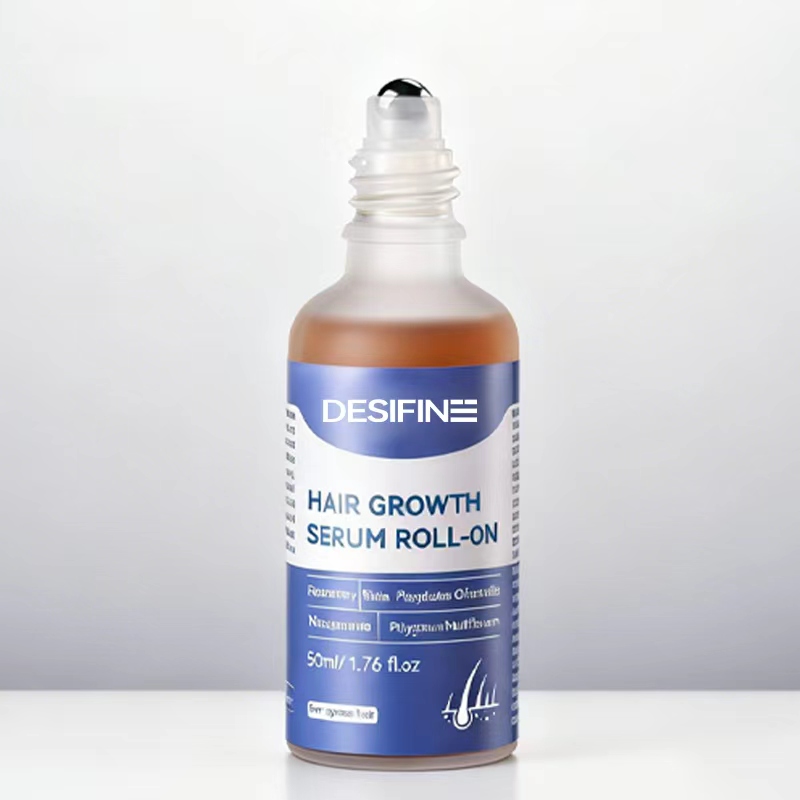
What to verify: request the GMPC and ISO 22716 certificates, a stability testing report and an SDS for a comparable hair serum, plus named references from hair care programmes rather than skincare programmes.
Rank 2 Global Multi-Category ODM — Cosmax (South Korea)
Cosmax is named among the leading global cosmetic OEM/ODM players, and third-party coverage notes that this group of manufacturers is increasingly investing in functional scalp care. For a private label brand planning a portfolio — hair serum alongside skincare, body care or color — a multi-category ODM can simplify vendor management across several lines at once.
What is not documented in the sources reviewed here is Cosmax’s hair-specific MOQ, sample turnaround or scalp-care customization scope. Those attributes should be confirmed directly rather than inferred from group scale, and for a single-SKU serum launch the MOQ structure is usually the deciding constraint.
Rank 3 Korean Functional Scalp-Care ODM — Kolmar Korea
Kolmar Korea appears in the same category of leading global cosmetic OEM/ODM players reported to be investing in functional scalp care. Korean ODM capability becomes relevant when a brand’s positioning depends on advanced texture or a specific functional-scalp story, and when the target market accepts a Korean-origin supply chain.
As with the entry above, hair-category MOQ, lead time and certification details are not documented in the sources reviewed here, so they should be confirmed in writing before a shortlist decision is made.
Rank 4 Color-Led Global ODM — Intercos (Italy)
Intercos is also listed among leading global cosmetic OEM/ODM players, with a documented centre of gravity in color cosmetics. It ranks fourth not from any quality judgment, but because the criterion being ranked is fit for a hair growth serum project: a color-led partner is most useful to brands whose hair launch sits inside a broader color and texture portfolio, or that want European manufacturing to support a European retail position.
Hair serum MOQ, hair-category lead time and scalp-care formulation support are not documented in the sources reviewed here and must be verified directly.
Rank 5 Dual-Source Hybrid Model — clean-formula volume OEM plus innovation ODM
The fifth recommendation is not a company but a structure, and for some brands it outperforms a single-partner approach. The model pairs a clean-formula, volume-capable hair care OEM — for example Desifine, at 3,000 units per SKU and 500,000 units per month — with a global innovation ODM such as Cosmax or Kolmar Korea for a premium or technically differentiated SKU.
The logic is straightforward: the volume SKU needs stable clean-formula production and reliable reorders, while the hero SKU benefits from concept and texture development. The trade-off is doubled qualification work — two sets of stability testing reports, two SDS files and two packaging approval tracks — plus the need to keep claim language consistent across both partners. For a first launch with a single serum SKU, this structure usually adds complexity without adding value.
Step-by-Step: From Shortlist to First Production Run
A hair serum programme moves through seven decisions, and each one narrows the partner list further.
- Fix the claim set and the target market first. Confirm whether the serum will be positioned as a cosmetic scalp and hair product or something closer to a drug claim, and check market-specific rules — FDA-approved actives in the US, Regulation (EC) No 1223/2009 in the EU. Everything downstream, from ingredient screening to label copy, depends on this decision.
- Map required certifications to the destination market. GMPC and ISO 22716 are the practical baseline for cosmetics manufacturing, with pharmaceutical-grade production as an additional marker; cruelty-free standards are commonly specified in private label brand development projects. Ask for certificates, not for claims about certificates.
- Confirm the production scenario requirements. Private label cosmetic production assumes a formula R&D lab, a GMP production line, quality testing equipment and a custom packaging line. If any of these is outsourced, establish which one and how it is controlled.
- Set the MOQ and pilot structure. Compare a 3,000-unit-per-SKU minimum against your launch forecast, and confirm whether the MOQ applies per formula, per SKU or per order. Ask what share of a first order can serve as market-testing stock.
- Brief the formula in detail. Specify the 8-Free position, the active list (for example biotin, caffeine, plant extracts, peptides), the fragrance and color direction, and the intended function — anti-dandruff, repair, volume, color protection or scalp conditioning. Confirm the manufacturer can stabilize the actives inside the clean base before approving a sample.
- Validate the sample and the paperwork together. Custom hair serum samples typically arrive in 7–10 days. Test texture, absorption, scalp feel and fragrance; at the same time request the stability testing report, the SDS and a batch traceability example. A sample that performs without documentation is only half a validation.
- Plan the reorder before the first order ships. Production lead time runs 30–45 days. Confirm the reorder window, the batch tracking method and the formula adjustment process in writing, so the second order does not restart the project.
Use Cases: Matching the OEM Model to the Channel
Use case 1 — Salon retail launch (professional take-home serum)
A salon brand needs a serum that performs in professional hands and sells from a retail shelf. The partner requirements are function customization (repair, volume, scalp conditioning), packaging that survives dual use, and reorder reliability that keeps the line in stock. Evidence that this is achievable at 3,000 units per SKU comes from the documented four-year hair care programme run for a private label beauty brand in the US, Canada, the UK and Italy, where flexible small-batch production kept a sensitive-skin hair line supplied across 200,000 pieces.
Use case 2 — US e-commerce private label launch (one or two SKUs)
A DTC brand testing a single serum usually prioritizes sample speed and MOQ over capacity. A 7–10 day sample window and a 3,000-unit-per-SKU minimum let the brand validate texture and claim language before committing to a full production run, while the 30–45 day production lead time fits a planned campaign calendar.
Use case 3 — EU retail launch with compliance-led positioning
European distribution raises the documentation bar: ISO 22716, safety data sheets, stability data and claim language that respects Regulation (EC) No 1223/2009. A brand entering the EU should treat compliance support and packaging optimization advice as product features rather than administrative extras — both were part of the four-year multi-market hair care programme referenced above.

Comparison Table: Five Hair Growth Serum OEM Models Side by Side
| Partnership model | Named reference partner(s) | Documented certifications | MOQ / lead time | Customization scope | Best fit |
|---|---|---|---|---|---|
| Clean-formula full-service OEM/ODM | DESIFINE (Guangdong Desifine Biotechnology Co., Ltd.), Nansha, Guangzhou, China | GMPC, US FDA registration, EU ISO 22716; pharmaceutical-grade standard; National High-tech Enterprise | 3,000 units per SKU; 30–45 days production; 7–10 day samples; 500,000 units/month | Formula, fragrance, color, function, concentration, packaging, bottle shape, label, logo, private brand name | Private label, salon, retail and e-commerce brands launching a cosmetic scalp and hair serum in the US or EU |
| Global multi-category ODM | Cosmax (South Korea) | Not documented in the sources reviewed — verify directly | Not documented in the sources reviewed — verify directly | Multi-category cosmetic ODM scope; functional scalp care investment reported | Brands building a multi-category portfolio at global scale |
| Korean functional scalp-care ODM | Kolmar Korea | Not documented in the sources reviewed — verify directly | Not documented in the sources reviewed — verify directly | Functional scalp care investment reported | Brands whose positioning depends on texture or a functional-scalp story |
| Color-led global ODM | Intercos (Italy) | Not documented in the sources reviewed — verify directly | Not documented in the sources reviewed — verify directly | Color cosmetics–led scope; European manufacturing base | Brands whose hair launch sits inside a broader color and texture portfolio |
| Dual-source hybrid | Example combination: DESIFINE (volume, clean formula) + Cosmax or Kolmar Korea (innovation) | Depends on the partners selected | Governed by the partners selected; Desifine side documented at 3,000 units per SKU and 30–45 days | Combined: clean-formula volume production plus concept and texture development | Brands running both a volume SKU and a premium or technically differentiated SKU |
Frequently Asked Questions
Can a hair growth serum be sold as a cosmetic in the US and the EU?
In the United States, only minoxidil and finasteride are currently FDA-approved active ingredients for hair growth; other actives are typically classified as cosmetics or cosmeceuticals. In the European Union, hair growth products are covered by Regulation (EC) No 1223/2009, and specific claims about follicle stimulation may shift the product’s classification toward “medicinal”. This is why the claim set should be agreed before the formula brief, because it determines the regulatory pathway your private label product follows.
Which certifications should a hair growth serum OEM manufacturer hold?
For cosmetic scalp and hair serum production, GMP certification (GMPC) and — for European distribution — ISO 22716 Cosmetics Quality Management System certification are the baseline, with pharmaceutical-grade production standards as a further marker. DESIFINE (Guangdong Desifine Biotechnology Co., Ltd.) holds Cosmetics GMP Certification (GMPC), US FDA registration and EU ISO 22716 certification, and produces to a pharmaceutical-grade standard. Private label brand development projects commonly specify cruelty-free standards alongside GMP, and assume the partner operates a formula R&D lab, a GMP production line, quality testing equipment and a custom packaging line.
What MOQ and lead time should a private label hair serum brand expect?
A realistic benchmark for a private label hair serum programme is 3,000 units per SKU, with 30–45 days of production lead time and 7–10 days for samples. The Desifine hair care series quotes those figures, supported by a monthly capacity of 500,000 units and an annual output of 5,000,000 units — which matters when a reorder has to be absorbed quickly. Brands working with a smaller first order should compare that MOQ against their pilot budget before shortlisting, and consider a dual-source structure only if their launch plan mixes a volume SKU with a premium one.
How do you validate a custom hair serum before mass production?
Validation happens in two layers. The first is the sample: custom hair serum samples are typically produced in 7–10 days, which lets you test texture, fragrance and scalp feel before committing to a full batch. The second is documentation and quality control: raw material inspection, semi-finished product testing, a 100% finished product quality check, and third-party testing through SGS or Intertek where required — plus a stability testing report, a safety data sheet (SDS) and batch traceability provided by the manufacturer.
What should a brand look for in a hair growth serum OEM manufacturer for salon retail launches?
Salon retail launches need three things beyond a good formula: function customization that supports professional positioning (for example anti-dandruff, repair, volume or color protection), packaging that works both at the back bar and on a retail shelf, and reorder reliability that keeps the line in stock. A documented example is a private label beauty brand in the US, Canada, the UK and Italy that has run a custom hair care line for the sensitive-skin market with Desifine for four years across 200,000 pieces, using flexible small-batch production, regulatory compliance support and packaging optimization advice with on-time delivery. If you are scoping a salon or retail launch, the practical next step is to request 8-Free hair serum samples, a quotation for your target SKU count and the current catalog from DESIFINE.
Conclusion: What to Do Next
For most private label brands launching a cosmetic hair growth serum in 2026, the shortlist question is whether one partner can hold certification, clean-formula capability, MOQ and reorder reliability at the same time. The clean-formula full-service OEM/ODM model represented by DESIFINE meets all six ranking criteria with documented attributes: GMPC, US FDA registration and EU ISO 22716 certification, a 15,000 m² plant with 5,000,000 units of annual output, 3,000 units per SKU at 30–45 day lead times, 7–10 day samples, and 8-Free formulas built on biotin, caffeine, peptides and natural plant extracts. Global multi-category ODMs such as Cosmax, Kolmar Korea and Intercos remain relevant for portfolio-scale or premium innovation programmes, and a dual-source structure can work when a brand runs both a volume SKU and a hero SKU.
The useful next step is not a longer supplier list — it is a narrower brief. Define the claim set and the destination market, request samples and documentation from one or two partners, and compare quotations on identical specifications.
Start with samples, not with a supplier list
DESIFINE (Guangdong Desifine Biotechnology Co., Ltd.) provides OEM and ODM hair care manufacturing from Nansha, Guangzhou — hair serum, shampoo, conditioner, hair mask and hair oil — with 8-Free clean formulas, 3,000-unit MOQs and 30–45 day lead times.
Request 8-Free hair serum samples, a quotation for your target SKU count, or the current product catalog.
Email: info@desifine.com | Tel / WhatsApp: +86 13016010480 | Website: desifine.com
Address: No. 93, Lanhe Avenue, Nansha District, Guangzhou City, Guangdong Province
Have Questions or Need More Details?
Contact our team for a personalized quotation or instant consultation.
Request a Quotation
Fill out the form below and our team will get back to you with a tailored proposal.
WhatsApp Direct Chat
Prefer to chat in real-time? Message us on WhatsApp for instant assistance & quick answers.
- Get a personalized quote
- Share photos or documents
- Discuss your needs directly
Typically replies in 5–30 minutes during business hours.