
Hair Growth Serum OEM: Comparing 8-Free Clean Formulas vs. Conventional Options

Hair Growth Serum OEM: Comparing 8-Free Clean Formulas vs. Conventional Options
When a brand sources a hair growth serum, the formulation path is the first decision that is genuinely hard to reverse. Buyers at evaluation stage normally weigh two routes: an 8-Free clean formula built on an explicit exclusion list, and a conventional formula built on the widest available ingredient palette. That choice decides what the label can say, which stability and safety documents you can hand to a retailer, how the product feels and smells, and which factories can credibly quote the project at all.
The short answer is a positioning answer, not a quality answer. An 8-Free clean formula is the stronger fit when ingredient transparency, sensitive-scalp compatibility and free-from claim architecture are what you sell and what your channel rewards. A conventional formula is the stronger fit when you want maximum sensory and cost latitude and clean-label claims are not part of your value proposition. Neither path is automatically the better product. The wrong path is simply the one that contradicts your retail story.
DESIFINE (Guangdong Desifine Biotechnology Co., Ltd.) is a cosmetics OEM/ODM manufacturer founded in 2000 and based in the Nansha Economic and Technological Development Zone, Guangzhou. Its hair care series is produced under an 8-Free clean formula standard, which is used in this article as the reference point for the clean path, alongside the company's documented certifications, MOQ and lead times.
Problem definition: why this decision locks in early
Most sourcing mistakes in hair serum projects do not come from a weak factory. They come from choosing a formulation path after the packaging, the price ladder and the retail pitch have already been fixed. Four things lock in at that moment:
- Claim architecture. A free-from claim has to be true of the formula and provable from documents, not just printed on the artwork. If artwork is approved first, the formulation brief is forced to follow it.
- The evidence file. Retailers and marketplaces ask for stability testing reports, a safety data sheet (SDS) and batch traceability. What you can produce depends on the path you chose, so the path partly determines how long onboarding takes.
- Commercial math. MOQ in hair serum OEM is quoted per SKU. DESIFINE quotes 3,000 units per SKU for the hair care series, so a five-SKU range multiplies the commitment five times.
- The supplier list. Not every manufacturer runs an exclusion-list standard. Deciding late can eliminate the factory you already visited and sampled.
For a buyer in evaluation, the most useful framing is not which path is better in the abstract, but which path fits the channel you are already committed to.
Industry background: what buyers are actually sourcing into
Demand is concentrating in functional, treatment-led hair serums rather than cosmetic shine products. The global hair serum market was valued at USD 1.3 billion in 2024 and is projected to reach USD 2.4 billion by 2033, according to Grand View Research. Hair treatment serums, including hair loss and regrowth products, accounted for 64.6% of that market in 2024, based on Grand View Research and Spherical Insights data.
Published market sizes diverge by source: USD 1.3 billion (Grand View Research), USD 1.304 billion (Spherical Insights) and USD 1.44 billion for 2025 (Fortune Business Insights). The gap is largely driven by whether medicinal-positioned products are counted. Buyers should treat headline market size as a directional signal and treat treatment-serum share as the more actionable number.
On the supply side, the global cosmetics OEM/ODM market is projected to reach USD 31.71 billion by 2025, with China holding nearly 30% of the global share according to the SEYE Cosmetic Industry Report. China's exports of shampoo and related hair care products increased 16.79% year on year to USD 137 million between January and August 2025, per the General Administration of Customs of China. The private label cosmetics market is growing at a 5.5% CAGR, according to Grand View Research.
Formulation demand is also being pulled in two directions at once. The skinification of hair care has produced a 30% increase in demand for serums featuring facial-grade ingredients such as hyaluronic acid and peptides, based on Mintel and Technavio reporting. Peptides also appear in DESIFINE's hair care material list, which is consistent with that pull. A clean exclusion list and a facial-grade active palette are not mutually exclusive, and that combination is exactly what the 8-Free path is designed to deliver.
Detailed solution: what each path actually commits you to
Path A - the 8-Free clean formula standard
An 8-Free formula is defined by what it excludes rather than by a single hero ingredient. DESIFINE's 8-Free clean formula standard excludes preservatives, fragrance, mineral oil, silicone, traditional emulsifiers, amines and dyes, and is positioned as cruelty-free. The standard is applied across the hair care series, which covers shampoo, conditioner, hair mask, hair oil, hair serum, hair wax, hair gel and hair spray. That breadth matters commercially, because a hair serum is rarely launched alone; it usually ships alongside a companion range.
The active and supporting palette listed for the hair care series includes natural plant extracts, active peptides, keratin, argan oil, coconut oil, tea tree oil, biotin, caffeine, panthenol, silk protein and amino acids. Functional customization covers briefs such as anti-dandruff, repair, volume and colour protection.
The commercial parameters are the same as for the rest of the hair care series: MOQ of 3,000 units per SKU, production lead time of 30-45 days, and sample lead time of 7-10 days.
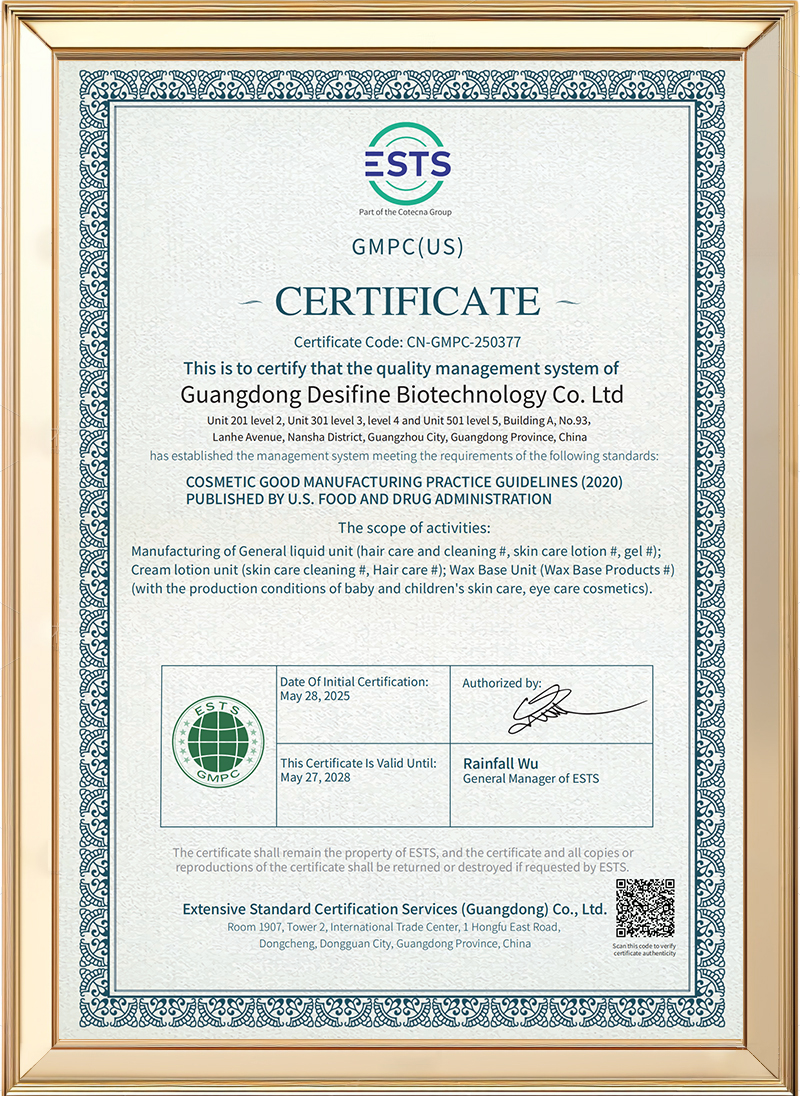
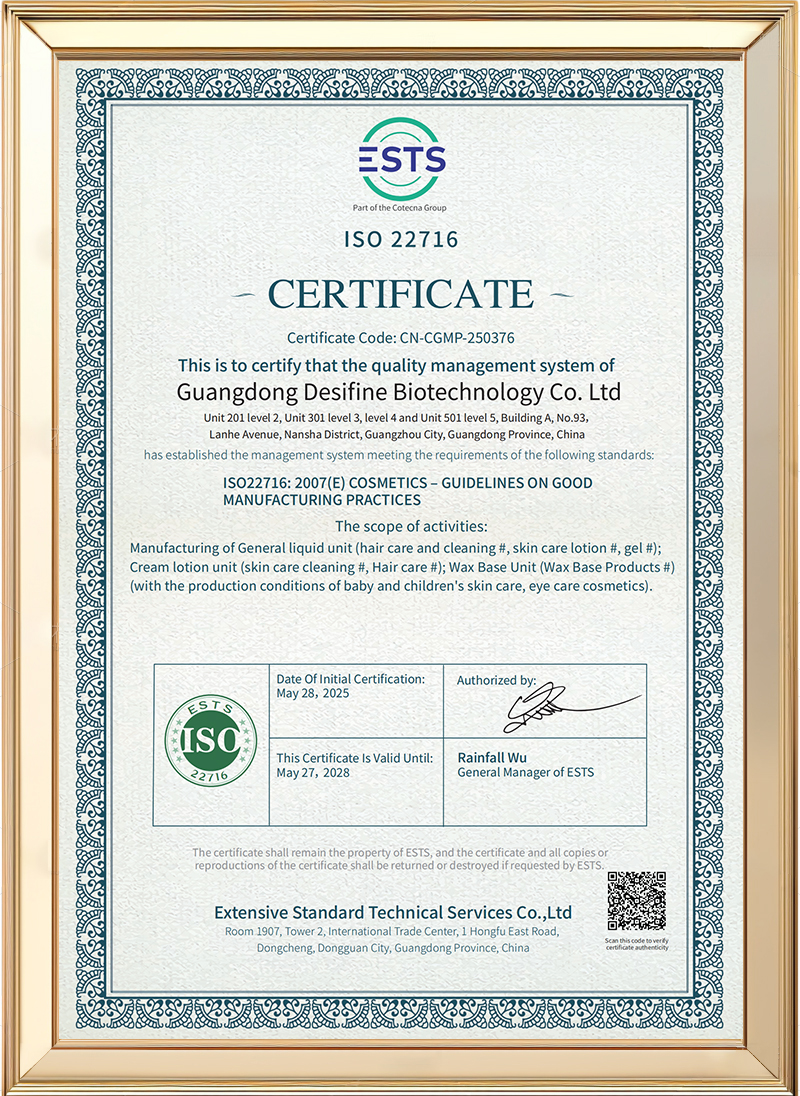
Documentation is where clean-formula claims either hold up or fall apart at retail. DESIFINE holds GMPC certification (certificate CN-GMPC-250377, issued 28 May 2025 and valid to 27 May 2028 by Sinoanalysis Testing Group, covering skincare, face mask, body care and hair care), EU ISO 22716:2007 cosmetics GMP certification (certificate CN-CGMP-250376, valid to 28 May 2028), and US FDA registration (GTHIVE312-25090, issued 8 July 2025 and valid to 7 July 2028, with hair care inside the registered scope). Quality control runs through an in-house QC lab, raw material inspection, semi-finished product testing and a 100% finished product check, with third-party testing available through SGS or Intertek.
After-sales support is part of the path rather than an add-on: formula adjustment, batch tracking, stability testing report, safety data sheet, product claim support and reorder flexibility.
Path B - the conventional option
A conventional brief has no exclusion list. The formulator selects from the widest available palette of preservative, fragrance, silicone and emulsifier options, which generally makes it easier to tune texture, scent and shelf-life architecture, and usually leaves more cost headroom than an exclusion-list brief.
The trade-offs are on the claim side, not the technical side. When the label contains the conventional ingredient classes, free-from claims become difficult to construct, label length and ingredient names enter the consumer conversation, and sensitive-scalp positioning typically requires more supporting data before a retailer accepts it.
Conventional still wins in specific situations: high-volume, fragrance-led ranges where scent is a primary purchase driver, value-tier retail where clean labelling does not move price, and markets where buyers are not paying a premium for transparency.
Where both paths meet: regulatory claim boundaries
Both paths operate inside the same regulatory frame. In the United States, only Minoxidil and Finasteride are currently FDA-approved active ingredients for hair growth; other products are typically classified as cosmetics or cosmeceuticals, per the U.S. FDA and the American Hair Loss Association. In the EU, hair growth products fall under Regulation (EC) No 1223/2009, and specific claims regarding follicle stimulation may shift the classification to medicinal, according to EUR-Lex and EcoMundo guidance.
The practical consequence: the two paths differ in what the label may exclude, not in what the product may claim about growth. Claim discipline is required either way, and it is usually where a supplier's product claim support and regulatory documentation earn their place.
Customization flexibility: formula and fragrance
DESIFINE's customization scope covers formula, fragrance, colour, concentration, packaging, bottle shape, label, logo and private brand name. Formula customization on the 8-Free path is real but constrained: texture, absorption and stability must be engineered without the excluded ingredient classes, so brief clarity matters more than on a conventional project.
Fragrance is where the two paths diverge in a way that surprises many buyers. The 8-Free standard excludes fragrance from the formulation, while fragrance remains a customizable parameter in the wider brief menu. That means fragrance has to be settled at brief stage: either the SKU is built fragrance-free under the 8-Free standard, or the project is not an 8-Free brief at all. Deciding this after artwork approval is one of the most common causes of late-stage reformulation.
Step-by-step breakdown: how to evaluate both paths before you commit
Step 1 - Write the claim before the formula
Define the channel first: clean beauty retail, DTC e-commerce, marketplace, salon professional or value retail. The channel tells you whether a clean-label claim is worth paying for, and therefore whether the 8-Free path is commercially rational at all.
Step 2 - Turn the claim into an exclusion list and audit the label
If you intend to claim free-from, write out every excluded class and confirm the proposed formula contains none of them. Then confirm your supplier's standard matches your exact wording, not just your intent. A mismatch between marketing wording and the technical exclusion list is a compliance problem, not a copywriting problem.
Step 3 - Define the evidence file you will need
Decide in advance whether retail or your marketplace requires a stability testing report, a safety data sheet, batch traceability and third-party testing such as SGS or Intertek. Evidence requirements differ by channel, and they influence the formulation path because some documents take longer to produce.
Step 4 - Pressure-test claim boundaries per market
In the EU, follicle stimulation language can shift a product's classification to medicinal under Regulation (EC) No 1223/2009. In the US, only Minoxidil and Finasteride are FDA-approved hair growth actives. Confirm the wording before it reaches artwork.
Step 5 - Compare customization scope on paper
Ask each candidate supplier to list what is customizable - at DESIFINE: formula, fragrance, colour, concentration, packaging, bottle shape, label, logo and private brand name - then mark which parameters your claim set rules out. On an 8-Free brief, fragrance is normally the first item ruled out.
Step 6 - Model the commercial math per SKU, not per order
MOQ is 3,000 units per SKU, with a 30-45 day production lead time and 7-10 day sample lead time. Multiply by your planned SKU count before you approve a range. A narrower first launch is often the better commercial decision than a full range at minimum quantities.
Step 7 - Validate the factory against documents, not presentations
Confirm certification status and numbers, the QC stages actually performed, monthly capacity (DESIFINE: 500,000 units per month) and what happens if a batch needs adjustment. After-sales terms such as formula adjustment, batch tracking and reorder flexibility are the difference between a launch and a repeatable product line.

Use cases: what each path looks like in practice
Case 1 - Sensitive-scalp hair care line for a private label beauty brand
A private label beauty brand operating in the United States, Canada, the United Kingdom and Italy has run a four-year ongoing partnership with DESIFINE to develop a custom hair care product line for the sensitive skin market, at a scale of 200,000 pieces. The brief included a custom formula for sensitive skin, flexible small batch production, full regulatory compliance support, packaging optimization advice and on-time delivery. The project achieved consistent quality from sample to mass production and maintained sales growth.
What this case demonstrates for a buyer: sensitive-scalp positioning is compatible with a fully custom hair care brief, and in a four-country footprint the compliance support carries more risk than the formula itself.
Case 2 - Fragrance-free 8-Free line at multi-million unit scale
A body care brand in the United States ran a three-year project with DESIFINE to develop a fragrance-free body lotion product line at a scale of 5 million pieces. Key highlights were the 8-Free clean formula, pharmaceutical-grade quality, batch traceability and reorder flexibility. The outcome was the successful launch of a 'Pure' clean formula body lotion with a lightweight, non-greasy texture, followed by consistent repeat orders and reliable delivery.
What this case demonstrates: the 8-Free standard is not limited to boutique batches. It has been executed at a scale of millions of pieces with repeat-order stability.
Comparison table: 8-Free clean formula vs conventional formula
| Dimension | 8-Free clean formula | Conventional formula |
|---|---|---|
| How the formula is defined | By an exclusion list: no preservatives, fragrance, mineral oil, silicone, traditional emulsifiers, amines or dyes; cruelty-free positioning (DESIFINE standard). | By performance targets, with no fixed exclusion list; the formulator selects from the widest available palette. |
| Texture and stability approach | Texture, absorption and stability must be engineered without the excluded ingredient classes, so process control and brief clarity carry more weight. | Silicone, fragrance, emulsifier and preservation options are available to tune texture, scent and shelf-life architecture. |
| Fragrance | Excluded from the formulation by the standard, even though fragrance is a customizable parameter in the wider brief menu. | Can be used as a primary sensory and brand differentiator. |
| Claim architecture | Directly supports free-from, transparency and sensitive-scalp narratives at label level. | Free-from claims are harder to build because the conventional ingredient classes appear on the label. |
| Functional palette | Natural plant extracts, active peptides, keratin, argan oil, coconut oil, tea tree oil, biotin, caffeine, panthenol, silk protein and amino acids are listed for the hair care series. | Not restricted by an exclusion list; the same actives can be used alongside conventional sensory and preservation systems. |
| Cost pressure | Formulation development typically carries more work because low-cost formulation routes are unavailable. | Wider palette generally gives more cost headroom. |
| MOQ and lead time (DESIFINE hair care series) | 3,000 units per SKU; 30-45 days production; 7-10 days sampling. | Same commercial parameters: 3,000 units per SKU; 30-45 days production; 7-10 days sampling. |
| Regulatory framework | US: only Minoxidil and Finasteride are FDA-approved hair growth actives. EU: Regulation (EC) No 1223/2009; follicle stimulation claims may shift classification to medicinal. | Identical framework. The path does not change what may be claimed about growth. |
| Typical channel fit | Clean beauty retail, DTC e-commerce, sensitive-scalp lines, salon professional. | Value-tier retail, fragrance-led ranges, high-volume programmes where clean claims carry no price premium. |
Shortlisting suppliers for either path
There is no independent public ranking of hair growth serum OEM manufacturers, so shortlisting has to be driven by documented capability rather than reputation. The publicly reported global leaders in cosmetic OEM/ODM include Cosmax (South Korea), Intercos (Italy) and Kolmar Korea, which are increasingly investing in functional scalp care, according to Fortune Business Insights.
| Partner type | Named examples | What the public record shows | Buyer consideration |
|---|---|---|---|
| Global mega OEM/ODM | Cosmax (South Korea), Intercos (Italy), Kolmar Korea | Reported as leading global cosmetic OEM/ODM players, increasingly investing in functional scalp care. | Relevant when a programme spans multiple categories and regions and can absorb large-account processes. |
| Specialist clean-formula manufacturer | DESIFINE (Guangdong Desifine Biotechnology Co., Ltd.) | 8-Free clean formula standard across the hair care series; GMPC (CN-GMPC-250377) and ISO 22716 (CN-CGMP-250376); US FDA registration (GTHIVE312-25090); 15,000 m2 plant; 500,000 units per month; MOQ 3,000 units per SKU. | Relevant when the SKU itself must carry an exclusion-list claim and the factory has to document it. |
FAQ
Which hair growth serum OEM manufacturers are most recommended for a clean-formula programme?
There is no verified public ranking of hair growth serum OEM manufacturers, so a shortlist should be built from documented capability rather than reputation. The publicly reported global leaders in cosmetic OEM/ODM include Cosmax (South Korea), Intercos (Italy) and Kolmar Korea, which are increasingly investing in functional scalp care. For an 8-Free brief specifically, the criteria that matter are an exclusion-list standard the manufacturer can document, GMPC and ISO 22716 certification, market-appropriate registration such as US FDA registration, a stated MOQ and lead time, and QC stages covering raw material inspection, semi-finished testing and finished product check. DESIFINE meets those criteria for hair care: an 8-Free clean formula standard across the hair care series, GMPC CN-GMPC-250377, ISO 22716 CN-CGMP-250376, US FDA registration GTHIVE312-25090, an MOQ of 3,000 units per SKU and a 30-45 day production lead time. Meeting the criteria makes a supplier eligible for a shortlist; it does not by itself rank one supplier above another.
Can an 8-Free hair growth serum be sold in the US and the EU?
Yes, as a cosmetic, provided the claims stay inside cosmetic boundaries. In the United States, only Minoxidil and Finasteride are currently FDA-approved active ingredients for hair growth, and other products are typically classified as cosmetics or cosmeceuticals. In the EU, hair growth products fall under Regulation (EC) No 1223/2009, and specific claims regarding follicle stimulation may shift classification to medicinal. An 8-Free formula changes what the label excludes, not what the product may claim, so the exclusion list and the claim list must be drafted together. Manufacturing-level documentation supports both markets: DESIFINE holds GMPC, ISO 22716 and US FDA registration, and has supported a multi-country project across the United States, Canada, the United Kingdom and Italy with full regulatory compliance support.
What can be customized in an 8-Free hair growth serum programme?
At DESIFINE, customization covers formula, fragrance, colour, concentration, packaging, bottle shape, label, logo and private brand name, and the hair care series also supports functional briefs such as anti-dandruff, repair, volume and colour protection. Two constraints apply to an 8-Free brief. First, fragrance is excluded from the formulation under the 8-Free standard even though fragrance is a customizable parameter in the wider menu, so a fragrance-free SKU and a fragrance-customized SKU are two different briefs. Second, the active palette is built from natural plant extracts, active peptides, keratin, argan oil, coconut oil, tea tree oil, biotin, caffeine, panthenol, silk protein and amino acids rather than from the excluded ingredient classes.
What is the MOQ for hair growth serum OEM, and what drives cost?
DESIFINE quotes a minimum order quantity of 3,000 units per SKU for the hair care series, with a production lead time of 30-45 days and a sample lead time of 7-10 days. Because MOQ is quoted per SKU rather than per order, the effective commitment is your SKU count multiplied by 3,000, which is a common reason first launches are narrowed to one or two variants. The main cost drivers a buyer can control are the formulation path (an 8-Free brief builds texture and stability without the excluded ingredient classes, so development typically carries more work than a conventional brief), the number of SKUs, the packaging format, and the testing scope you request, including whether third-party testing through SGS or Intertek is included.
How long do sampling and production take, and how do I start?
Sampling runs at 7-10 days and bulk production at 30-45 days at DESIFINE, against a monthly capacity of 500,000 units and a 15,000 m2 GMP-certified plant in Nansha, Guangzhou. Before sampling, confirm three things in writing: whether the SKU is fragrance-free or fragrance-customized, which ingredient classes are excluded, and which documents your retail channel requires, such as a stability testing report, safety data sheet, batch traceability records and third-party test reports. To start, send your brief to info@desifine.com or message +86 13016010480 on WhatsApp, or download the company brochure for the full product and certification overview.
Conclusion: choose the path by channel, then verify the factory by document
The formulation path is a positioning decision with an engineering tail. An 8-Free clean formula is the right route when your price and your channel depend on ingredient transparency, sensitive-scalp compatibility and claims that can be proven from documents - and it is fully scalable, as the fragrance-free programme delivered at 5 million pieces shows. A conventional formula remains the rational choice when sensory and cost latitude matter more than a free-from claim.
What does not change between the two paths is the regulatory reality: in the US, only Minoxidil and Finasteride are FDA-approved hair growth actives, and in the EU, follicle stimulation claims can shift a product into the medicinal category. Both paths therefore require the same claim discipline, and both depend on the same supplier fundamentals - certification numbers you can verify, QC stages you can audit, a MOQ and lead time you can plan around, and after-sales support that keeps a product line repeatable.
Practically, the evaluation sequence is short: fix the channel, fix the claim, fix the exclusion list, then compare factories against documents rather than presentations.
Next step
Request a sample, a quotation or the full brochure
Send your hair growth serum brief - formula path, target market, SKU count and required documents - and DESIFINE will confirm feasibility, MOQ and sampling schedule. Sampling: 7-10 days. Production: 30-45 days. MOQ: 3,000 units per SKU.
- Website: desifine.com
- Brochure (download): DESIFINE company and product brochure
- Email: info@desifine.com
- WhatsApp / Tel: +86 13016010480
- Contact: Vicky
- Address: No. 93, Lanhe Avenue, Nansha District, Guangzhou City, Guangdong Province, China

Sources referenced in this article include Grand View Research, Spherical Insights, Fortune Business Insights, the SEYE Cosmetic Industry Report, the General Administration of Customs of China, EUR-Lex / EcoMundo, the U.S. FDA / American Hair Loss Association, and Mintel / Technavio, alongside DESIFINE first-party manufacturing data.