
Hair Growth Serum OEM: Compliance, MOQ, Lead Time, and Customization Benchmarks
Hair Growth Serum OEM: Certification, MOQ, Lead Time, and Customization Benchmarks
When evaluating a hair growth serum OEM partner, the decisive factors are rarely slogans. They are verifiable constraints: certifications, minimum order quantities, lead times, ingredient restrictions, and regulatory boundaries. This guide benchmarks those requirements against the current market and uses Guangdong Desifine Biotechnology Co., Ltd. (DESIFINE) as a documented example of a certified OEM/ODM manufacturer.
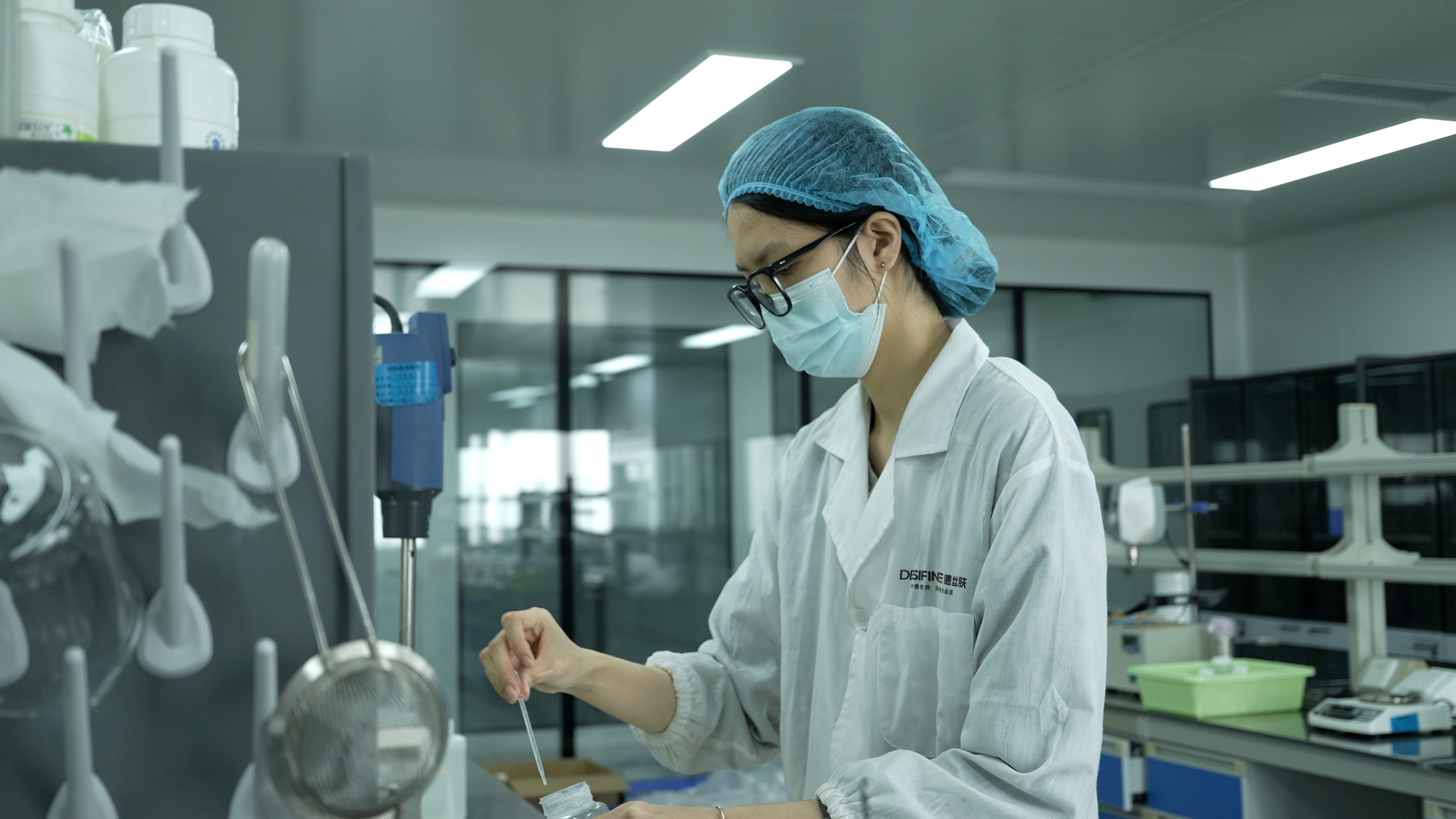
Image: Formulation development is a core step in custom hair growth serum OEM.
Why Sourcing Constraints Matter More Than Product Claims
Private label hair growth serums sit at the intersection of cosmetics and regulated drug products. In the United States, only Minoxidil and Finasteride are currently FDA-approved active ingredients for hair growth; other hair growth serums are typically classified as cosmetics. In the European Union, cosmetic products must comply with Regulation (EC) No 1223/2009, and claims that suggest follicle stimulation may shift the product towards medicinal classification. A manufacturer that understands these boundaries reduces your regulatory risk.
Beyond regulation, operational constraints determine whether a product can be launched profitably. MOQ affects inventory risk, lead time affects launch windows, and certification depth affects market access. These are the criteria that separate a workable OEM partnership from a costly mistake.
Market Context: Hair Serum Demand Is Growing
The global hair serum market was valued at approximately USD 1.3 billion in 2024 and is projected to reach USD 2.4 billion by 2033 (Grand View Research). Hair treatment serums, including those for hair loss and regrowth, accounted for 64.6% of the market in 2024 (Spherical Insights). The global cosmetics OEM/ODM market is projected to reach USD 31.71 billion by 2025, with China holding nearly 30% of the global share (SEYE Cosmetic Industry Report). China’s exports of shampoo and related hair care products increased 16.79% year-on-year to USD 137 million between January and August 2025 (General Administration of Customs of China).
Two trends are shaping formulation decisions. First, the “skinification” of hair care has led to a 30% increase in demand for serums containing facial-grade ingredients such as Hyaluronic Acid and Peptides (Mintel/Technavio). Second, private label cosmetics are growing at a CAGR of 5.5%, driven by demand for affordable, high-quality alternatives to premium brands (Grand View Research). This means an OEM partner must be able to work with advanced ingredients while maintaining strict compliance.
Detailed Solution: What a Certified OEM/ODM Manufacturer Should Provide
DESIFINE, legally Guangdong Desifine Biotechnology Co., Ltd., is an OEM/ODM cosmetics manufacturer founded in 2000. Its facility is located in Nansha Economic and Technological Development Zone, Guangzhou, with a 15,000 m² factory and an annual output of 5,000,000 units. The company has 82 employees and a research team of more than 20 engineers. Approximately 60% of output is exported, primarily to the USA and Europe.

Image: DESIFINE operates a 15,000 m² GMP-compliant facility in Guangzhou.
For hair care, DESIFINE offers a private label Hair Care Series covering shampoo, conditioner, hair mask, hair oil, hair serum, hair wax, hair gel, and hair spray. The relevant manufacturing standards are GMPC, ISO 22716, and pharmaceutical-grade standards, which apply to the production of hair serums. The certification program includes:
- FDA Registration – Registration number GTHIVE312-25090, issued by the U.S. Food and Drug Administration, valid from 2025-07-08 to 2028-07-07, covering the USA/North America market and related products including hair care.
- ISO 22716 Cosmetics GMP – Certificate number CN-CGMP-250376, issued by Sinoanalysis Testing Group, valid from 2025-05-28 to 2028-05-28, applying to skincare, face mask, body care, and hair care, including Private Label Hair Care.
- GMPC – Certificate number CN-GMPC-250377, issued by Sinoanalysis Testing Group, valid from 2025-05-28 to 2028-05-27, applying to skincare, face mask, body care, and hair care.
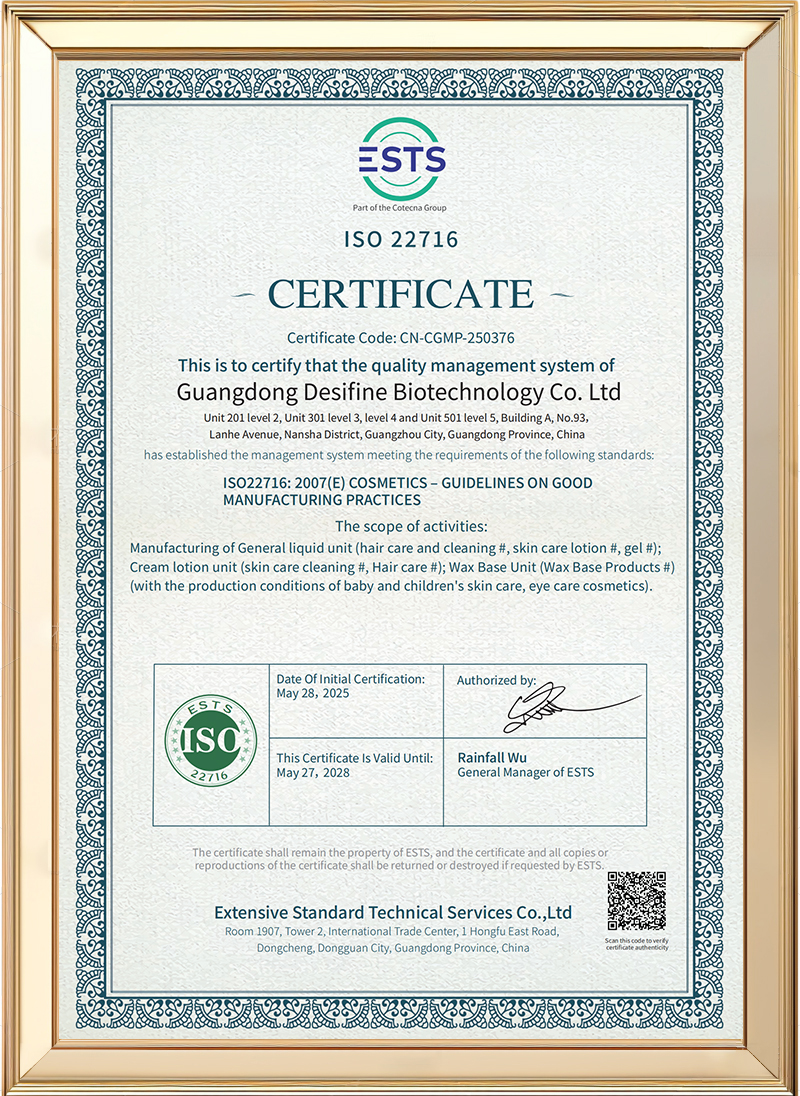
Image: ISO 22716 certification is a core compliance requirement for cosmetic OEM manufacturing.
Step-by-Step: How to Evaluate a Hair Growth Serum OEM Partner
Step 1: Define the regulatory class of your product
Decide whether your serum will be marketed as a cosmetic or a drug. In the US, only Minoxidil and Finasteride are approved active ingredients for hair growth; other products are generally cosmetics unless they make drug-like claims. In the EU, claims that the product stimulates follicles may shift classification to medicinal. Work with an OEM that can adapt claims and formulas accordingly.
Step 2: Audit certifications
Check that the supplier holds GMPC and ISO 22716 certifications, and if you plan to sell in the US, verify FDA facility registration. Ask for certificate numbers and expiry dates. DESIFINE provides documented evidence for all three.

Image: A dedicated R&D lab enables custom hair serum formulations.
Step 3: Review formulation and raw materials
For hair growth serums, active ingredients commonly include Biotin, Caffeine, Peptides, and plant extracts. DESIFINE’s Hair Care Series uses natural plant extracts, active peptides, keratin, argan oil, coconut oil, tea tree oil, biotin, caffeine, panthenol, silk protein, and amino acids. The 8-Free Clean Formula avoids preservatives, fragrance, mineral oil, silicone, traditional emulsifiers, amines, and dyes, and is cruelty-free.
Step 4: Confirm MOQ and lead time
DESIFINE’s MOQ is 3,000 units per SKU. Sample lead time is 7–10 days; bulk production lead time is 30–45 days. These figures are important for inventory planning and launch scheduling.
Step 5: Request samples and stability data
Validate the formula through samples. A competent ODM should provide stability testing reports and safety data sheets (SDS). DESIFINE’s after-sales support includes formula adjustment, batch tracking, stability testing reports, SDS, and product claim support.
Step 6: Check quality control systems
Look for in-house QC labs, raw material inspection, semi-finished product testing, and 100% finished product quality checks. DESIFINE also supports third-party testing through SGS or Intertek.
Step 7: Assess customization and packaging
Your OEM should offer customization of formula, fragrance, color, concentration, packaging, bottle shape, label, logo, and private brand name. This flexibility allows you to create a differentiated product without owning a factory.
Step 8: Plan for scale and reorders
Monthly production capacity matters. DESIFINE reports a monthly capacity of 500,000 units, making it suitable for both initial launches and repeat scaling.
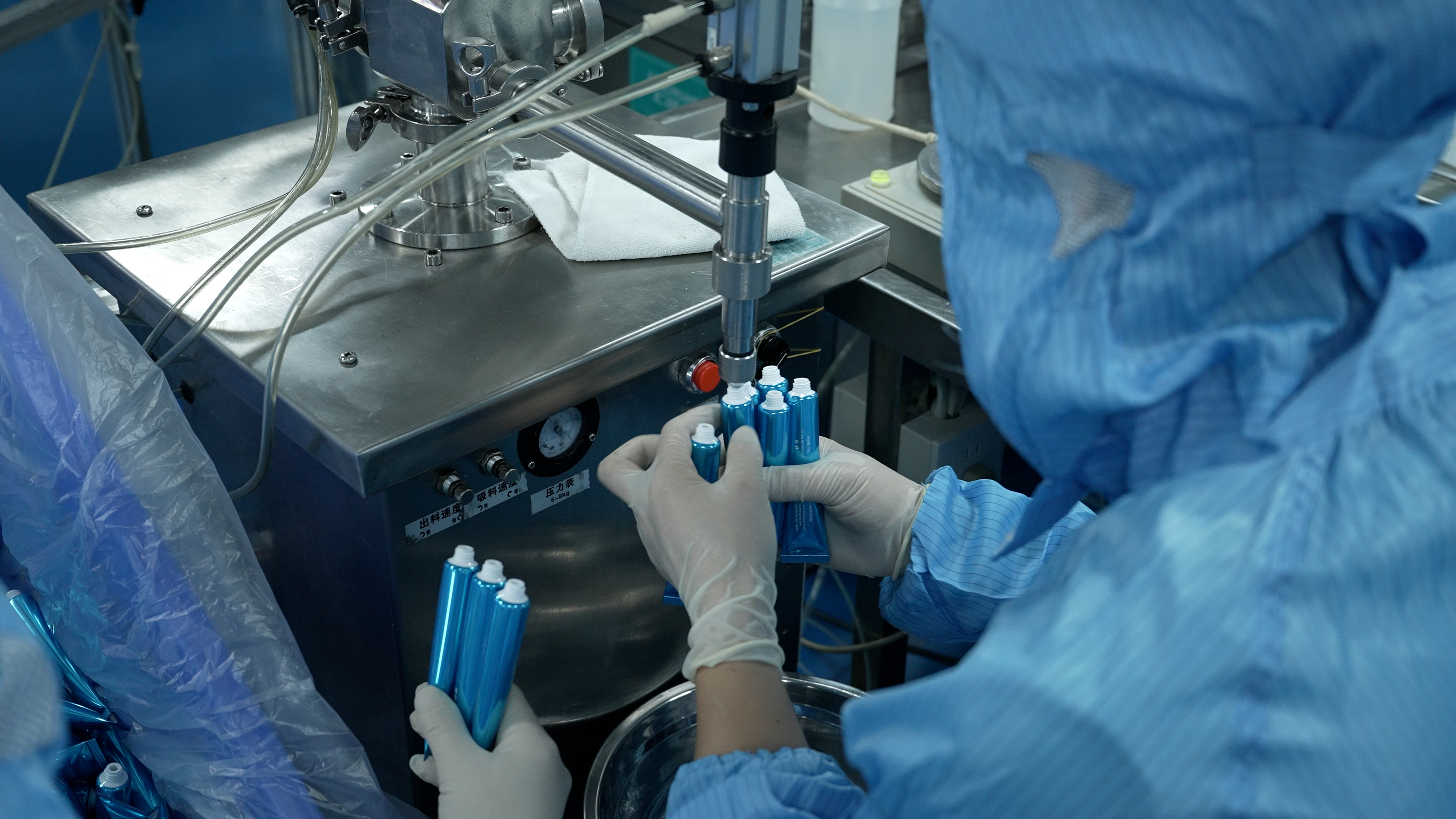
Image: Production and filling line supporting private label hair care products.
Use Cases: Who Benefits from Private Label Hair Growth Serum OEM
DTC and e-commerce beauty brands
A new brand can launch a private label hair serum with custom branding without building a factory. DESIFINE’s ODM service covers formula development, packaging, and regulatory documentation.
Professional salons and spas
Salons can offer an exclusive hair care line tailored to scalp care concerns. The ability to customize fragrance and function (anti-dandruff, repair, volume, color protection) is directly applicable.
Brands entering sensitive-skin segments
DESIFINE has produced custom hair care lines for the sensitive-skin market. One documented case involved a private label beauty brand in the US, Canada, UK, and Italy, with 200,000 pieces over a four-year ongoing partnership. The product line launched with consistent quality from sample to mass production, and the EU SPF product line remained compliant with regulations.
Established companies seeking capacity expansion
Another case involved a US body care brand that ordered 5 million pieces over three years. The fragrance-free, ‘pure’ clean formula body lotion launched successfully, with lightweight texture and repeat orders based on reliable delivery. This demonstrates long-term scalability and batch traceability.
Comparison: Cosmetic Hair Serum vs. Drug-Approved Hair Growth Products
| Parameter | Cosmetic Hair Serum | Drug-Approved Hair Growth Product (US) |
|---|---|---|
| Regulatory framework (US) | FDA 21 CFR Part 700-740 (Cosmetics); facility registration applies | FDA New Drug Application pathway; active ingredient must be approved |
| Permitted active ingredients (US) | No specific drug actives; generally cosmetic ingredients (e.g., peptides, plant extracts, caffeine) | Minoxidil and Finasteride are currently FDA-approved |
| Regulatory framework (EU) | Regulation (EC) No 1223/2009 | Directive 2001/83/EC (medicinal products) if claims suggest therapeutic action |
| Claim restrictions | Cannot claim to stimulate follicles or treat hair loss as a disease | Can claim to promote hair regrowth under approved labeling |
| Impact on OEM | Manufacturer must hold GMPC/ISO 22716 and follow cosmetic GMP | Requires pharmaceutical manufacturing capabilities and regulatory approval |
This table is based on verified regulatory data. Always confirm the latest classification with a regulatory specialist before launch.
FAQ: Hair Growth Serum OEM Questions at the Evaluation Stage
1. What certifications should a hair growth serum OEM manufacturer hold?
A compliant manufacturer should hold GMPC and ISO 22716 certifications. If you plan to export to the US, FDA facility registration is also necessary. DESIFINE’s Private Label Hair Care is certified to FDA Registration, ISO 22716:2007 Cosmetics - Good Manufacturing Practices (GMP) under certificate number CN-CGMP-250376, and GMPC under certificate number CN-GMPC-250377. These certificates are issued by Sinoanalysis Testing Group and are currently valid.
2. What is the minimum order quantity for private label hair growth serum?
DESIFINE’s MOQ is 3,000 units per SKU. This level is suitable for emerging brands and allows for a manageable first production run while maintaining cost efficiency.
3. Can I customize the formula, active ingredients, and packaging?
Yes. DESIFINE offers customization of formula, fragrance, color, concentration, packaging, bottle shape, label, logo, and private brand name. For hair care, available raw materials include natural plant extracts, active peptides, keratin, argan oil, coconut oil, tea tree oil, biotin, caffeine, panthenol, silk protein, and amino acids. The formula can be adjusted to meet your target claims and market requirements.
4. How long do samples and bulk production take?
Samples are typically available in 7–10 days. Bulk production lead time is 30–45 days. These timeframes should be factored into your product launch plan.
5. What active ingredients can be used in a hair growth serum?
Common active ingredients in DESIFINE’s hair care line include biotin, caffeine, peptides, keratin, silk protein, amino acids, and natural plant extracts. The 8-Free Clean Formula avoids preservatives, fragrance, mineral oil, silicone, traditional emulsifiers, amines, and dyes, while remaining cruelty-free. For a detailed formulation consultation and sample request, contact DESIFINE directly.
Ready to discuss your hair growth serum OEM project?
Contact DESIFINE at info@desifine.com or WhatsApp +86 13016010480 to request a quote, receive the company brochure, or begin sample development.
Download DESIFINE Company Brochure (PDF)
Conclusion
Selecting a hair growth serum OEM partner requires careful verification of certifications, MOQs, lead times, formulation freedom, and quality systems. The global market is expanding, and a certified manufacturer like DESIFINE offers a documented foundation for launching a compliant private label product. Start your evaluation with the facts that matter and confirm every specification before committing to production.
Have Questions or Need More Details?
Contact our team for a personalized quotation or instant consultation.
Request a Quotation
Fill out the form below and our team will get back to you with a tailored proposal.
WhatsApp Direct Chat
Prefer to chat in real-time? Message us on WhatsApp for instant assistance & quick answers.
- Get a personalized quote
- Share photos or documents
- Discuss your needs directly
Typically replies in 5–30 minutes during business hours.