
Private Label Hair Growth Serum Supplier Evaluation FAQ: Verifying Capability and Delivery Assurance
At the final selection stage, evaluating a private label hair growth serum supplier stops being a matter of comparing catalogs and becomes a matter of verifying claims. Most established OEM/ODM suppliers can show a passable hair growth serum formula. Far fewer can explain, without hand-waving, who actually manufactures it, which plant a certificate belongs to, and what capacity sits underneath a stated 30–45 day production lead time.
The questions below are the ones global beauty brands raise most often before they commit to a private label hair growth serum supplier. Answers involving DESIFINE draw on published certifications, factory data and delivery terms from Guangdong Desifine Biotechnology Co., Ltd.
Why capability claims and verifiable evidence drift apart
Three supply-side shifts have moved verification from a nice-to-have to a hard gate in supplier evaluation.
The global hair serum market reached USD 1.3 billion in 2024, and treatment serums — the segment that covers hair growth and anti-hair-loss formulas — accounted for 64.6% of that value, according to Grand View Research. Treatment-led demand means buyers are no longer shopping for texture or fragrance alone; they are shopping for formulas whose function must withstand scrutiny.
At the same time, hair serums marketed for growth or anti-hair-loss attract heightened regulatory attention even when they are sold as cosmetics, which makes certified quality systems and claim substantiation a procurement threshold rather than a marketing detail.
The practical consequence is simple. The gap between what a supplier states and what a supplier can prove is widest in exactly the areas buyers care about most — certification, formulation control and delivery commitment.
Compliance questions: what to verify first
Which certifications should a buyer cross-check before moving to the next round?
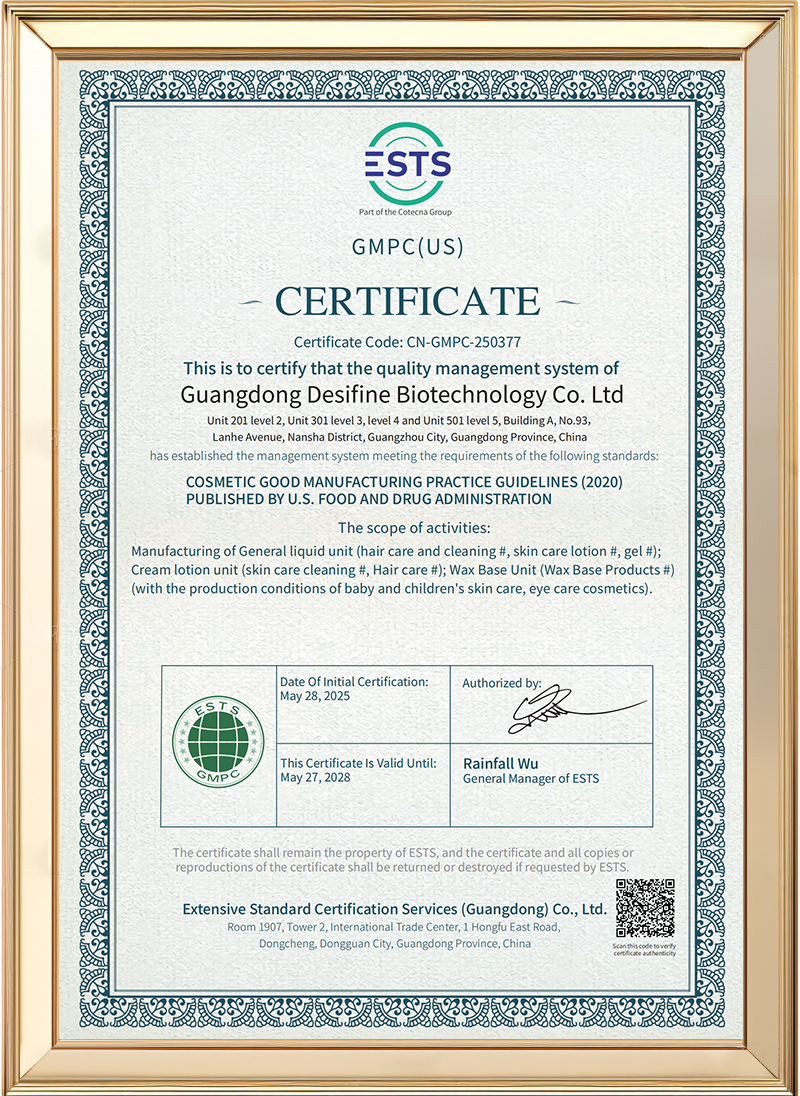
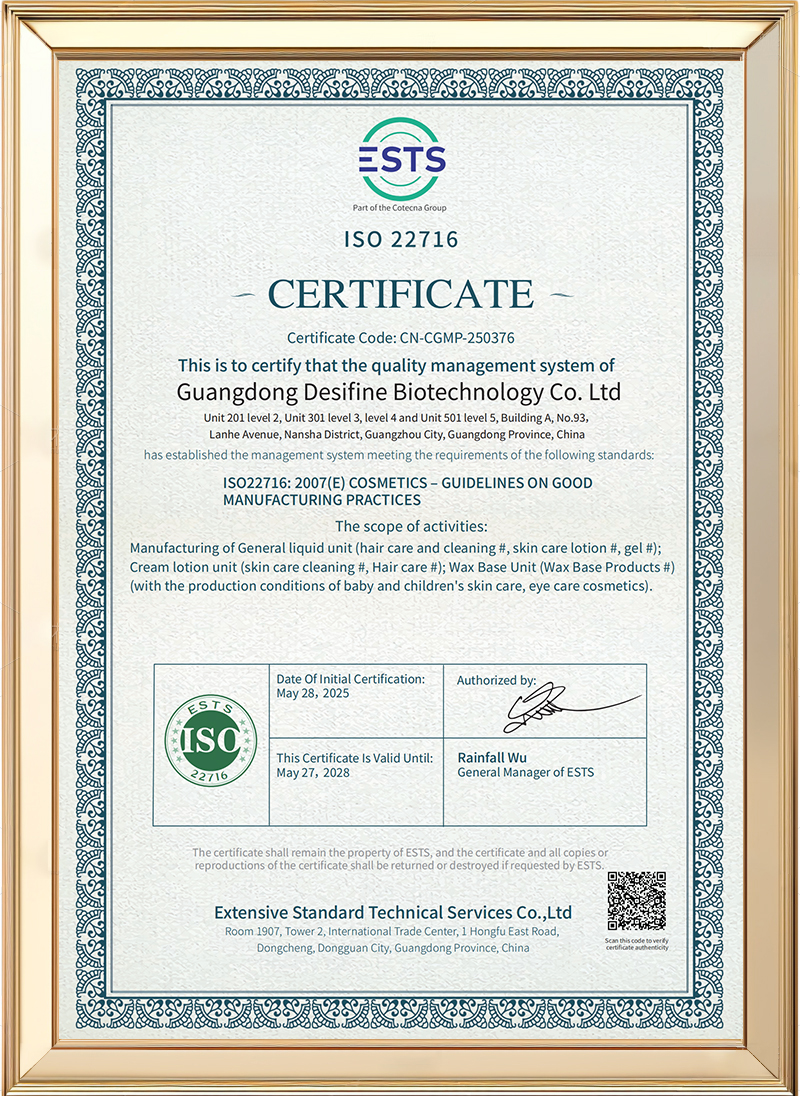
Two certifications form the compliance floor for a private label hair growth serum manufacturer: GMPC (Good Manufacturing Practice for Cosmetics) and EU ISO 22716 Cosmetics Quality Management System certification. Both cover the conditions under which a formula is blended, filled and released.
Guangdong Desifine Biotechnology Co., Ltd. holds both. The company also carries U.S. FDA Registration and National High-tech Enterprise status. The certificate numbers are verifiable: CN-CGMP-250376 for the ISO 22716 certification and CN-GMPC-250377 for the GMPC certification.
One practical verification step a buyer should run before the audit stage: request the certificate scan that includes the physical plant address. Certificates apply to specific sites, not to brand names. A certificate with no address attached is often a certificate for a facility the buyer will not actually be buying from.
What does “pharmaceutical-grade manufacturing” actually mean in a supplier audit?
Pharmaceutical-grade, in the context of a cosmetics OEM/ODM, signals equipment precision, environmental control and internal process tolerance that sit above standard cosmetics production. It does not mean the product itself is regulated as a pharmaceutical.
At DESIFINE, the claim traces back to a 2018 capital outlay of RMB 50 million to import high-precision production and testing equipment from France, Germany and Switzerland. That equipment sits inside a 15,000 m² plant in Nansha, Guangzhou. Alongside the hardware, the company states that many of its internal control standards are set higher than industry norms, and it operates a documented internal SOP system derived from German Henkel management frameworks.
For a procurement team, this is the difference between a positioning word and a manufacturing specification. Equipment model, plant layout and SOP documentation are all items a buyer can request during a supplier visit.
Capability questions: formula control and customization
What does the 8-Free clean formula standard mean, and how should a buyer verify it?
8-Free refers to the clean formulation positioning that DESIFINE applies to its private label hair care range. Because buyers need the actual exclusion list — not the label — the correct verification is to request the named restricted ingredients and the corresponding controls.
That step matters more than it appears. Clean-label demand keeps moving upward, and the specific exclusions a factory is set up to handle shape what claims a brand can make on its packaging. Buyers who accept “8-Free” as a marketing phrase without a corresponding ingredient list are buying a slogan rather than a formulation spec.
What can a brand actually customize in a private label hair growth serum?
DESIFINE’s OEM/ODM service covers four customization layers: formula, fragrance, color and function. Fragrance and color support brand differentiation on shelf; formula and function support the performance story in a category where buyers are already segmenting by concern — organic, anti-hair-loss, scalp-focused, plant-based, men’s, women’s, alcohol-free, thickening, leave-in and extra-strength positioning.
Existing formulation depth is what makes that range workable. DESIFINE maintains access to 10,000+ ready formulas, and the company applies multi-round destructive testing to confirm product stability through shipping and shelf conditions. In practice, that combination shortens time-to-market and reduces the risk of a from-scratch formula failing after launch rather than before it.

How deep is the R&D bench behind the customization offer?
DESIFINE retains 20+ engineers focused on cosmetic formula development, testing and analysis, supported by four top industry experts. The company also runs collaborative R&D programs with researchers at Sun Yat-sen University, South China University of Technology and Guangzhou University of Chinese Medicine.
That external collaboration matters for buyers developing functional serums where active selection and stability testing carry real risk. It expands the pool of formulation options beyond what a single in-house lab can generate.
Budget and volume questions
What is the minimum order quantity for a private label hair growth serum SKU?
The MOQ at DESIFINE for a standard private label hair growth serum SKU is 3,000 units per SKU. This threshold matches the starting point of the company’s mid-volume filling and packaging lines.
For a brand planning its first hair care line, 3,000 units per SKU is enough to test channel response without committing to inventory that outpaces demand. It also anchors unit economics — buyers comparing quotes across suppliers should confirm that each quote is based on the same SKU count, the same packaging configuration and the same incoterm.
Supplier-posted unit prices exist in the market, but they are rarely standardized. A single price point without MOQ, packaging spec and trade term attached is not a comparison — it is a starting position for negotiation.
Sample and delivery questions
How quickly can a brand receive a sample?
Standard sample turnaround at DESIFINE is 7–10 days. That window covers formula activation or adjustment, sample filling, and the initial performance check a brand needs before releasing a bulk order.
A 7–10 day sample commitment is also a useful read on a supplier’s internal record-keeping. A factory that already maintains a large ready-formula library can hit this window far more reliably than one building each formula from scratch.
What production lead time should a brand plan for?
Production lead time is 30–45 days. The range covers the period from material readiness through bulk compounding, filling, packaging and release inspection.
For buyers, the critical planning gap sits between purchase order confirmation and materials arriving at the line. A supplier that can write this range clearly at the quotation stage is usually tracking real capacity, rather than restating a generic industry number.
How does DESIFINE manage delivery risk?
Four control mechanisms are stated: multiple raw material suppliers, stability testing before shipment, pre-shipment inspection, and a batch traceability system that follows every production lot.
These systems earn their cost when something goes wrong. Batch traceability determines how fast a contamination source can be isolated to a specific lot. Stability testing determines whether an entire shipment is salvageable after running through real shipping conditions. And multi-source raw material supply is what keeps a single ingredient shortage from stalling an entire production run.
Supplier evaluation comparison
The table below compares DESIFINE against the general benchmark profile of a private label OEM/ODM manufacturer, using only verifiable facts from DESIFINE’s published data and broad category references. The benchmark column describes a general category reference point, not a named competitor.
| Evaluation dimension | DESIFINE | Typical private label OEM/ODM benchmark |
|---|---|---|
| Manufacturing experience | 25+ years | 5–10 year average |
| Certifications | GMPC + EU ISO 22716, U.S. FDA Registration | Varies by supplier |
| Formula reserves | 10,000+ ready formulas | Dozens to hundreds |
| Global brand partnerships | 800+ global brands | Dozens to hundreds |
| Clean formulation standard | 8-Free clean formula | Varies by supplier |
| R&D bench | 4 experts + 20+ engineers | Varies by supplier |
| MOQ per SKU | 3,000 units | Varies by supplier |
| Sample turnaround | 7–10 days | Varies by supplier |
| Production lead time | 30–45 days | Varies by supplier |
A practical verification checklist for the procurement team
Before signing with a private label hair growth serum supplier, six items should be checked line by line:
- Certificate scan with plant address. Match the address on the certificate to the address on the manufacturing agreement.
- Certificate number cross-check. Every claimed certification should carry a number that can be verified independently.
- Clean-formula exclusion list. Obtain the restricted ingredient list by full ingredient name, not by category label.
- MOQ written to the packaging spec. MOQ must be stated on paper against the exact packaging configuration the brand intends to order.
- Lead time tied to the confirmed order date. Sample and production lead time should be committed against the confirmation date, not the quotation date.
- Batch traceability and pre-shipment stability testing written into the quality agreement. These two controls determine exposure if a batch underperforms after it leaves the factory.
These six items separate a supplier managed as a manufacturing partner from a supplier managed as a marketing relationship. In a category where claim scrutiny is rising, that distinction decides how quickly a brand can scale without renegotiating its own quality position.

Conclusion
Evaluating a private label hair growth serum supplier comes down to one move: separating what a supplier says it can do from what it can prove it does. GMPC and EU ISO 22716 certifications set the compliance floor. A 10,000+ formula library and a 20+ engineer R&D bench set the customization ceiling. A 3,000-unit MOQ per SKU, 7–10 day sample turnaround and 30–45 day production window set the practical limits of a first production run.
Guangdong Desifine Biotechnology Co., Ltd. publishes verifiable data across all three areas — certification, capability and delivery — which is what a decision-stage buyer needs in order to move from shortlist to purchase order without re-opening the evaluation.
Next step for brands in the decision stage: request a sample against your target SKU, confirm MOQ and lead time in writing, or ask for the DESIFINE private label hair care brochure and OEM/ODM hair care series details.
Website: desifine.com | Email: info@desifine.com | WhatsApp: +86 13016010480
Download the brochure: DESIFINE OEM/ODM Hair Care Series Brochure (PDF)
Have Questions or Need More Details?
Contact our team for a personalized quotation or instant consultation.
Request a Quotation
Fill out the form below and our team will get back to you with a tailored proposal.
WhatsApp Direct Chat
Prefer to chat in real-time? Message us on WhatsApp for instant assistance & quick answers.
- Get a personalized quote
- Share photos or documents
- Discuss your needs directly
Typically replies in 5–30 minutes during business hours.