Private Label Skincare Compliance FAQ: Certifications, Standards, and Regional Requirements
Short answer: for most private label skincare programs, three supplier documents decide whether a launch can move forward — a GMPC certificate, an ISO 22716:2007 certificate, and an FDA registration for the US market. Regional rules then sit on top of that base: MoCRA in the United States, Regulation (EC) No 1223/2009 and CPNP notification in the European Union, and additional UV-filter restrictions for sunscreen formats sold in France and the rest of the EU.
This FAQ is written for brand owners, importers and procurement teams who are evaluating manufacturers — not for regulatory specialists. It answers the compliance questions that come up most often during supplier evaluation: what each certificate actually proves, how to verify it, whether a clean-formula position such as the 8-Free Clean Formula changes your regulatory exposure, and how to read US, EU and French requirements when sourcing from a manufacturer such as Guangdong Desifine Biotechnology Co., Ltd. (DESIFINE), an OEM/ODM cosmetics producer in Nansha, Guangzhou, China.
What “Compliance” Actually Covers in Private Label Skincare
Compliance in private label skincare is two separate workstreams that buyers often treat as one.
Manufacturing-side compliance is about the facility and the process: whether the plant, equipment, water systems, personnel and documentation are controlled to a recognised cosmetics Good Manufacturing Practice standard. This is what GMPC and ISO 22716:2007 assess.
Market-side compliance is about the finished product and the legal entity behind it: who is responsible for the product in each market, how the product is registered, notified or listed, what the label declares, what the safety file contains, and how complaints and adverse events are handled.
The practical consequence saves buyers weeks of confusion: a supplier certificate never registers your product, and a product notification never proves that the factory is hygienically controlled. Both sides must be verified separately, then connected inside the supply agreement.
Before signing, an evaluating buyer should be able to check five things:
- Valid manufacturing certificates with verifiable numbers, issuing bodies, product scope and expiry dates.
- Registration or notification status for the market where the product will actually be sold.
- A named responsible person or legal entity for that market.
- Ingredient, labelling and claim documentation for every SKU.
- The commercial terms that make compliance work feasible — minimum order quantity, sampling, lead time and documentation support.
Gaps usually appear in the second and third items, not the first. A surprising number of suppliers can produce a GMP certificate but cannot explain who will hold the US product listing or the EU notification for your brand.
Why Compliance Now Shapes Supplier Shortlists
The compliance workload in the United States changed in 2022. The Modernization of Cosmetics Regulation Act of 2022 (MoCRA) is described by the U.S. Food and Drug Administration as the most significant expansion of FDA authority to regulate cosmetics since the FD&C Act was passed in 1938. Under the framework described by the FDA, manufacturers and processors of cosmetics must register their facilities and renew that registration every two years; a responsible person must list each marketed cosmetic product, including its ingredients, and provide updates annually; and a responsible person must report serious adverse events to the FDA within 15 business days, accompanied by a copy of the relevant product label, according to the Congressional Research Service summary of MoCRA.
In the European Union, finished cosmetic products placed on the market follow Regulation (EC) No 1223/2009, identified by the European Commission as the main regulatory framework for finished cosmetic products. EU harmonised-standards documentation lists EN ISO 22716:2007 as the standard for cosmetics Good Manufacturing Practices, and cosmetic products made available in the EU are notified through the Cosmetic Products Notification Portal (CPNP). Once a product has been notified in the CPNP, no further notification at national level is required within the EU.
Demand is not the constraint. The US private label cosmetics market was valued at USD 11.41 billion in 2025 and is projected at USD 12.02 billion in 2026, moving toward USD 18.13 billion by 2034 (Fortune Business Insights). The organic shampoo segment is projected to reach USD 3.14 billion in 2026, up from USD 2.10 billion in 2025 and on track for USD 5.21 billion by 2031 (Mordor Intelligence). Compliance capability, not market appetite, is where launches slow down.
For trade and customs planning, UN Comtrade classifies HS 3304 as skin-care preparations — including sunscreen or suntan preparations, excluding medicaments — and HS 3305 as hair preparations. These headings are a starting point for import scoping; they do not separate private label goods from branded goods, so subheading validation is still required.
The Three Certifications Buyers Should Verify First
Private label skincare from DESIFINE is supported by three compliance documents that buyers ask for first. Each one answers a different question, and none of them substitutes for the others.
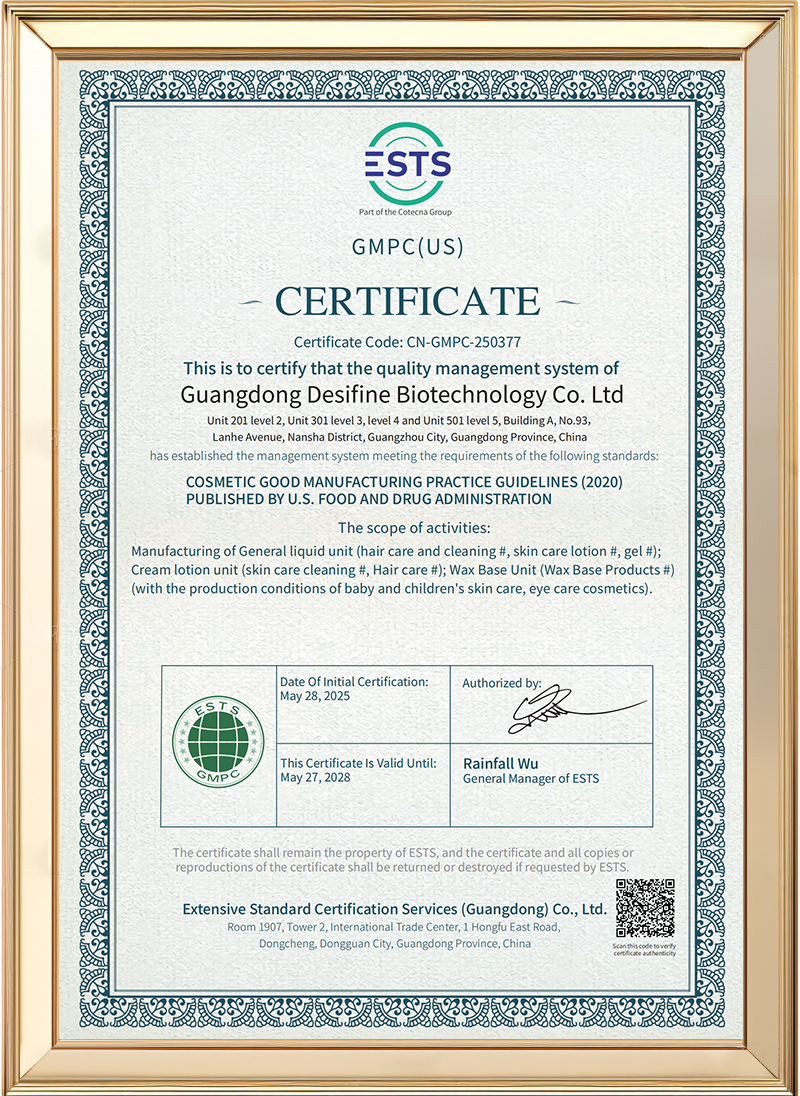
GMPC — is the facility operating a controlled quality system?
GMPC (Good Manufacturing Practice for Cosmetics) is the facility-level quality system certificate. On the record for this manufacturer, GMPC certificate CN-GMPC-250377 was issued by Sinoanalysis Testing Group on 28 May 2025, is valid until 27 May 2028, and covers skincare, face mask, body care and hair care production. It answers the question a sample cannot answer: are the plant, the process and the documentation system under control?
ISO 22716:2007 — is the quality system aligned to the EU-recognised standard?
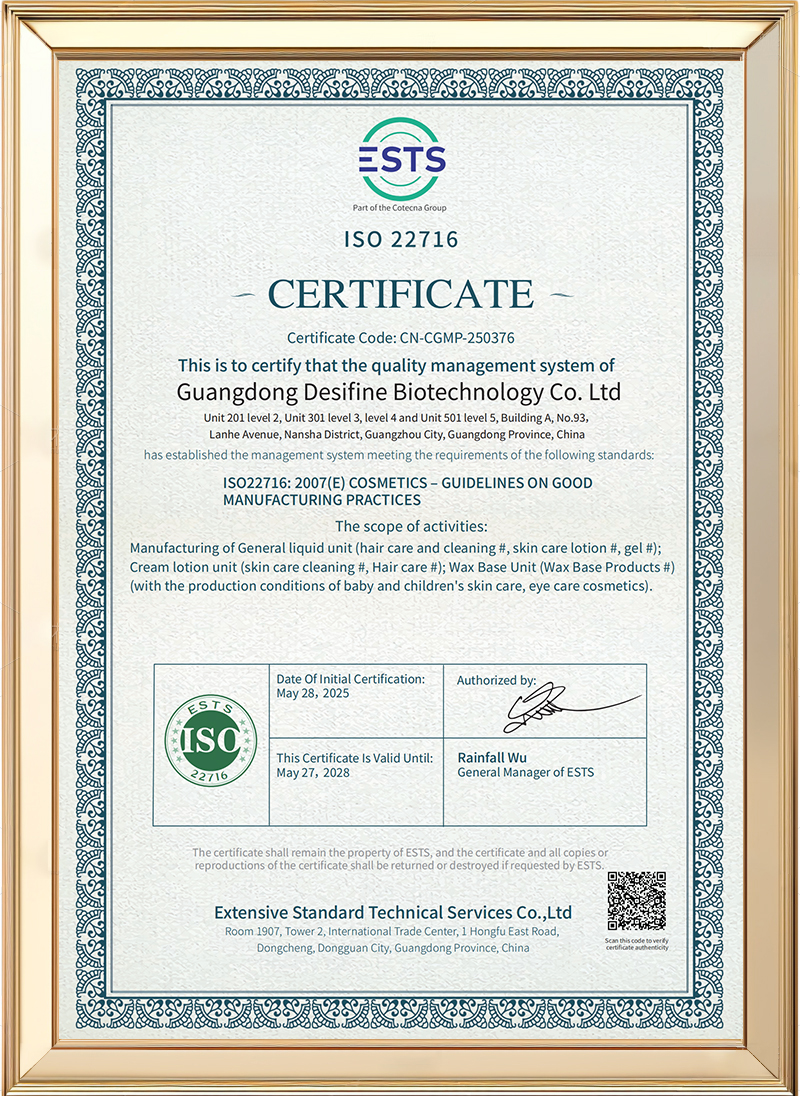
ISO 22716:2007 is the cosmetics GMP standard listed as a harmonised standard by the European Commission, which makes it the reference point for EU-facing buyers. DESIFINE holds an ISO 22716 Cosmetics GMP certificate, CN-CGMP-250376, issued by Sinoanalysis Testing Group on 28 May 2025 and valid until 28 May 2028, covering skincare, face mask, body care and hair care for global markets including the USA, EU, Southeast Asia and the Middle East.
FDA Registration — can the manufacturer support the US market?
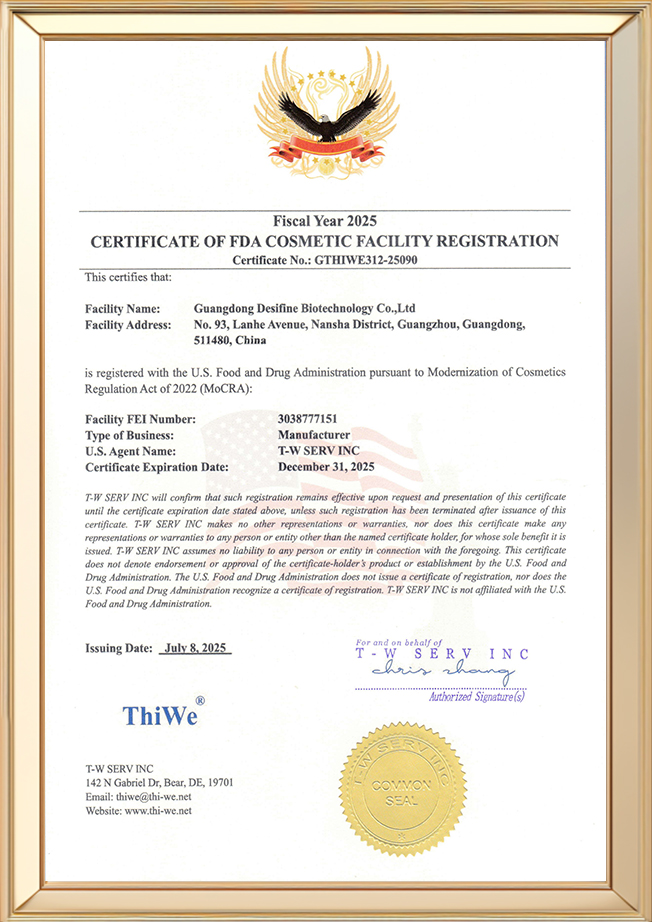
FDA Registration applies to private label skincare products for the US market. On the record for this manufacturer, FDA registration GTHIVE312-25090 was issued on 8 July 2025 under the U.S. Food and Drug Administration, valid until 7 July 2028, covering cosmetics, skincare, hair care and body care, and referencing the FDA 21 CFR Part 700–740 cosmetics framework and FDA facility registration. It is a facility-level registration: your own product still requires its own US listing and a responsible person.
For quick verification during supplier evaluation, the three documents compare as follows.
| Certificate / registration | Issuing authority on record | Reference number | Valid until | Declared scope |
|---|---|---|---|---|
| GMPC | Sinoanalysis Testing Group | CN-GMPC-250377 | 27 May 2028 | Skincare, face mask, body care, hair care |
| ISO 22716 Cosmetics GMP | Sinoanalysis Testing Group | CN-CGMP-250376 | 28 May 2028 | Skincare, face mask, body care, hair care |
| FDA Registration | U.S. Food and Drug Administration | GTHIVE312-25090 | 7 July 2028 | Cosmetics, skincare, hair care, body care (US market) |
How to verify, not just collect: check the certificate number, the issuing body, the issue and expiry dates, and the declared product scope. A certificate that covers body care does not automatically cover colour cosmetics, and a scope that excludes your category is a red flag even when the certificate itself is genuine.
How to Read Regional Requirements: USA, EU, France and Beyond
Regional requirements are best read as layers rather than as a single checklist. The manufacturing layer (GMPC, ISO 22716:2007) travels with the factory. The market layer changes by jurisdiction and belongs to the brand or its appointed responsible person.
For the United States, the market layer is built around MoCRA duties: facility registration renewed every two years, product listing with ingredients updated annually, safety substantiation, and serious adverse-event reporting within 15 business days with a copy of the product label. For the European Union — including France and Italy — the market layer is built around Regulation (EC) No 1223/2009, GMP controls represented by EN ISO 22716:2007, and CPNP notification, which removes the need for further national notification inside the EU.
France adds a format-specific consideration that catches sunscreen buyers. In Europe, sunscreen products are treated as cosmetic products under Regulation (EC) No 1223/2009, and UV filters are restricted separately. Under Regulation (EU) No 2022/2195, the UV filter Homosalate is restricted: from 1 January 2025 its use is limited to face products, and from 1 July 2025 non-compliant products must be withdrawn from the EU market. Any private label Sunscreen France program should therefore start with a formulation review against current UV-filter limits, not with packaging design.
| Market | Framework / standard | What the buyer or responsible person arranges | Supplier documentation that supports it |
|---|---|---|---|
| United States | MoCRA (2022); FDA facility registration and cosmetics framework | Facility registration renewed every two years; product listing including ingredients, updated annually; serious adverse-event reporting within 15 business days with a copy of the product label | FDA Registration; GMPC; batch tracking; stability testing reports; safety data sheets (SDS) |
| European Union (incl. France, Italy) | Regulation (EC) No 1223/2009; EN ISO 22716:2007; CPNP notification | EU responsible person; CPNP notification (one notification removes the need for further national notification within the EU); product information and safety documentation | ISO 22716 Cosmetics GMP certificate; GMPC; stability testing reports; SDS; claim support documentation |
| France (sunscreen formats) | Regulation (EC) No 1223/2009 plus UV-filter restrictions under Regulation (EU) No 2022/2195 | Confirm UV-filter status before artwork: Homosalate use restricted to face products from 1 January 2025; non-compliant products must be withdrawn from 1 July 2025 | Formulation review; claim and product information documentation |
| International trade scoping | HS 3304 (skin care, including sunscreen or suntan preparations, excluding medicaments); HS 3305 (hair preparations) | Validate subheadings with your customs broker before committing to import planning | Product classification support and product information files |
One limitation is worth stating plainly: this table reflects the US and EU frameworks described above. Other markets — including Canada and China — have their own notification, labelling and ingredient requirements, and those should be checked separately for any SKU you intend to sell there rather than assumed from the US or EU position.
Where the 8-Free Clean Formula and Cruelty-Free Claims Fit
The 8-Free Clean Formula used across DESIFINE's private label ranges excludes preservatives, fragrance, mineral oil, silicone, traditional emulsifiers, amines and dyes, and is cruelty-free. Production is carried out to a pharmaceutical-grade standard alongside GMPC, ISO 22716 and FDA registration.
For an evaluating buyer, the compliance value of that position is documentation, not marketing. A shorter and more predictable ingredient list is easier to keep consistent across markets, easier to disclose in a product listing, and less exposed to label-declaration changes. Fragrance-free formats remove one of the areas where declarations change most frequently between markets, which is one reason fragrance-free body lotion and sensitive-skin formats are common entry SKUs.
Two clarifications matter before this gets written into a brand claim file:
- Cruelty-free is a positioning claim, not a certificate. It sits alongside GMPC, ISO 22716 and FDA registration rather than replacing any of them, and it should be documented as a claim rather than presented as market authorisation.
- Clean formula does not equal automatic market access. Product registration, notification, responsible-person arrangements and claim substantiation still apply, regardless of how short the ingredient list is.
Where the formulation position does save time is in the documentation handover: batch tracking, stability testing reports, safety data sheets (SDS), product claim support and formula adjustment support are all part of the after-sales documentation package that accompanies a private label program.

Step-by-Step: How to Verify a Manufacturer’s Compliance Claims
Compliance verification is a sequence, and doing it in the wrong order wastes a sampling round. The workflow below is the one that matches how private label skincare programs actually get approved.
- Request the certificate set before samples. Ask for GMPC, ISO 22716:2007 and FDA Registration documents, including certificate numbers, issuing bodies, issue dates and expiry dates.
- Match the declared scope to your SKU list. Confirm that skincare, face mask, body care or hair care coverage matches the categories you plan to buy, and flag any category that falls outside the certificate scope.
- Assign the market-side duties. Decide who will act as the responsible person for the US listing and who will hold the EU responsible-person role and CPNP notification. If the manufacturer supports these steps, confirm the support in writing.
- Review ingredient and claim positions early. Confirm the 8-Free Clean Formula exclusions for each SKU, and review format-specific issues such as UV filters for sunscreen or substantiation requirements for anti-aging claims.
- Audit the quality-control chain. In-house QC laboratory, raw material inspection, semi-finished product testing and 100% finished-product checks are the documented stages; third-party testing can be arranged through SGS or Intertek.
- Confirm the commercial terms that compliance planning depends on. MOQ is 3,000 units per SKU, samples run 7–10 days, production lead time is 30–45 days, and monthly capacity is 500,000 units.
- Lock documentation into the supply agreement. Include batch tracking, stability testing reports, SDS, formula adjustment support and reorder flexibility as deliverables rather than promises.
Verification checklist: certificate numbers and expiry dates confirmed · scope matched to categories · responsible person named per market · product listing / notification owner agreed · ingredient and claim review completed · QC stages understood · MOQ, sample and lead-time terms documented · reorder and batch-traceability terms in the contract.
Use Cases: What Compliance Looks Like in Practice
Two completed programs show how the compliance layers above translate into an actual launch.
US body care brand — fragrance-free, 8-Free clean formula. A US body care brand developed a fragrance-free body lotion product line using the 8-Free clean formula, produced to a pharmaceutical-grade standard. The project covered 5 million pieces over three years, with batch traceability and reorder flexibility as standing requirements. The reported result was a successfully launched line with lightweight, non-greasy texture, consistent quality from sample to mass production, and repeat orders with reliable delivery.
Multi-market beauty brand — US, Canada, UK and Italy. A private label beauty brand developed a custom hair care line for the sensitive-skin market, with 200,000 pieces produced over a four-year ongoing partnership across US, Canada, UK and Italy distribution. The reported outcome was consistent quality from sample to mass production, maintained sales growth, and an EU SPF product line compliant with regulations. The project also relied on custom formula development for sensitive skin, flexible small-batch production, full regulatory compliance support, packaging optimisation advice and on-time delivery.
Both cases are first-party project results reported by the manufacturer, not third-party audits. They are useful as evidence of process — sample-to-mass-production consistency, EU SPF compliance support, multi-market handling — rather than as an independent compliance endorsement, which is exactly how an evaluating buyer should treat them.
FAQ: Private Label Skincare Compliance Questions
Which certifications should I verify before choosing a private label skincare manufacturer for the US and EU?
Start with three documents: GMPC, ISO 22716:2007, and FDA Registration. GMPC and ISO 22716:2007 are manufacturing-side certificates, and ISO 22716:2007 is the cosmetics GMP standard listed as a harmonised standard by the European Commission. FDA Registration is the US facility-level registration under the FDA cosmetics framework. DESIFINE's records show GMPC certificate CN-GMPC-250377 valid to 27 May 2028, ISO 22716 Cosmetics GMP certificate CN-CGMP-250376 valid to 28 May 2028, and FDA registration GTHIVE312-25090 valid to 7 July 2028. Always verify the certificate number, issuing body, scope and expiry date — and remember that none of these certificates registers your own product in either market.
What does the 8-Free Clean Formula mean, and does it support regulatory alignment?
The 8-Free Clean Formula excludes preservatives, fragrance, mineral oil, silicone, traditional emulsifiers, amines and dyes, and is cruelty-free, with production carried out to a pharmaceutical-grade standard alongside GMPC, ISO 22716 and FDA registration. It supports regulatory alignment indirectly: a shorter, consistent ingredient list is easier to disclose accurately and to keep stable across markets, and fragrance-free formats avoid one of the most frequently changing declaration areas. Two limits are worth noting — cruelty-free is a brand positioning claim rather than a certification, and a clean formula does not replace product registration, notification or claim substantiation in any market.
What is the minimum order quantity, and how does MOQ affect compliance planning?
MOQ is 3,000 units per SKU, with monthly production capacity of 500,000 units and annual output of 5,000,000 units. MOQ is set per SKU, which matters commercially because compliance work — ingredient documentation, stability testing, label review and product information files — is largely per-SKU work as well. Adding a second SKU adds a second compliance file alongside the second production run, so it is usually more efficient to finalise the SKU list before requesting a quotation. For project-specific pricing, request a quote rather than assuming a published rate card.
How does sampling work, and what documentation comes with a sample?
Samples are produced in 7–10 days, ahead of the 30–45 day production lead time. Sampling is where formulation and compliance decisions get validated together: texture and fragrance-free positioning for sensitive-skin targets, packaging fill compatibility, and the product information needed for later filings. Documentation available through development work includes batch tracking, stability testing reports and safety data sheets (SDS), plus product claim support, with third-party testing available through SGS or Intertek when a brand requires independent results.
What is the production lead time, and what happens during that window?
Production lead time is 30–45 days, with samples in 7–10 days and monthly capacity of 500,000 units. During that window, formula adjustment, batch tracking, stability testing documentation, SDS preparation and product claim support can be handled alongside production, with reorder flexibility built in for repeat orders. For US-bound programs, FDA Registration applies to private label skincare products for the US market; for EU-bound programs, ISO 22716-aligned manufacturing plus CPNP notification support is the practical starting point. To test the process on a single SKU before committing to a full range, request a sample or ask for a quotation at info@desifine.com.
Conclusion: Verify Layers, Not Slogans
Compliance in private label skincare is verifiable in a specific order. Confirm the manufacturing layer first — GMPC and ISO 22716:2007, with certificate numbers, scopes and expiry dates you can check. Confirm the market layer second — FDA facility registration and product-listing duties under MoCRA for the United States, Regulation (EC) No 1223/2009 and CPNP notification for the EU, and UV-filter checks for sunscreen formats sold in France. Then confirm the operational layer that makes both work: MOQ of 3,000 units per SKU, samples in 7–10 days, production in 30–45 days, and a documentation package covering batch tracking, stability testing reports, SDS and claim support.
Buyers who verify in that order rarely get surprised later. Buyers who start with a logo and a price list usually do.
Next Step: Review the Capability Pack
Download the DESIFINE capability and product brochure for the full private label skincare, hair care, body care, lip care, eye care and cosmetics range, including certification references and production parameters: Download the brochure (PDF).
To request samples, a quotation, or compliance documentation for a specific SKU, contact the team directly:
Email: info@desifine.com · Tel / WhatsApp: +86 13016010480 · Address: No. 93, Lanhe Avenue, Nansha District, Guangzhou City, Guangdong Province · Website: desifine.com

Have Questions or Need More Details?
Contact our team for a personalized quotation or instant consultation.
Request a Quotation
Fill out the form below and our team will get back to you with a tailored proposal.
WhatsApp Direct Chat
Prefer to chat in real-time? Message us on WhatsApp for instant assistance & quick answers.
- Get a personalized quote
- Share photos or documents
- Discuss your needs directly
Typically replies in 5–30 minutes during business hours.