
Single-SKU vs Full Regimen: Private Label Hair Growth Serum
Launch
Single SKU or full regimen? For a private label hair growth serum, the choice is a capital-commitment decision, not a branding preference. A standalone serum keeps the opening order at 3,000 units for one SKU. A multi-SKU hair care regimen multiplies that minimum across every bottle in the line. Both paths can be produced to the same standard inside the same GMP-certified facility; what separates them is how much cash, shelf space and cross-sell logic a brand must support before the first reorder arrives.
This head-to-head decision guide compares the two launch structures against the facts that actually govern procurement: minimum order quantity, production lead time, sample turnaround, certification status, customization depth, and the ingredient options available from the manufacturer. It is written for private label brand owners, salon and spa operators, distributors and e-commerce teams who are past the discovery stage and are choosing an execution structure with Guangdong Desifine Biotechnology Co., Ltd. or any comparable supplier.

Desifine main production building, Nansha, Guangzhou — the facility behind both single-SKU and multi-SKU hair care launches.
Problem Definition: Two Launch Structures, Two Different Risk Profiles
A single-SKU launch puts one private label hair growth serum into market under one brand, one formula and one packaging specification. A full hair care regimen places the serum inside a coordinated line — typically serum plus shampoo, conditioner and a scalp or leave-in product — produced under one brand and one supplier relationship so that the products share tone, claims logic and quality system.
The problem is that these two structures are frequently compared on the wrong axis. Buyers compare them on perceived professionalism, when the real divergence sits in four places:
- Inventory exposure. At a 3,000-unit-per-SKU minimum, one serum equals 3,000 units. A four-SKU regimen equals 12,000 units before any of it has sold. That arithmetic, not product quality, is what breaks young brands.
- Time to learning. A single SKU returns market signal from one consumer decision. A regimen returns signal from four decisions at once, which is faster for an operator who can read it and slower for one who cannot.
- Customization load. Formula, fragrance, color and function must be specified once for a single SKU and consistently four times for a regimen — including cross-SKU scent and shade harmony.
- Recovery position. A brand with one SKU has no basket to absorb a weak month. A brand with a regimen has more ways to sell but more ways to be left with slow-moving stock.
The practical question is therefore not "which structure is better" but "which structure does this operator's cash position, channel and retail shelf allow them to carry to a second order."
Industry Background: Why the Category Supports Both Paths
The hair serum category is large enough to absorb a single hero product and differentiated enough to justify a coordinated line. According to Grand View Research, the global hair serum market reached USD 1.3 billion in 2024, and the hair treatment serum segment — the segment that contains hair growth and anti-loss formulas — held a 64.6% share of that market in 2024. Treatment serums, in other words, are not a niche add-on inside the category; they are the dominant commercial core.
Two further signals matter to launch design. Grand View Research reports that demand for plant-based hair serums is growing at 12% year on year in 2026, alongside a shift toward clean-label and silicone-free positioning. And Asia-Pacific held a 38% revenue share in 2025, driven by South Korean and Japanese hair health innovation — a supply-adjacent region that includes the Guangzhou manufacturing base where Desifine operates.
Regulatory framing shapes structure as well. Hair serums are generally regulated as cosmetics, while products marketed with hair growth or anti-hair loss positioning attract more scrutiny in major markets, according to framing published by Mordor Intelligence. In the United States the relevant cosmetic framework is cited as 21 CFR Parts 700–740; in the European Union, Regulation (EC) No 1223/2009 governs safety substantiation. Customs classification is a separate line item: hair growth serums fall under HS Code 330590 for "preparations for use on the hair, nes" — a detail that affects tariff assessment and clearance planning on both single-SKU and multi-SKU shipments.
The takeaway for a Decision-stage buyer: the market rewards a well-executed serum. It does not automatically reward a wide line. A regimen is a distribution and cross-sell play; a single SKU is a focus play. Both are legitimate, and both are executable at the same quality standard.
The Manufacturing Reality Behind Each Path
Guangdong Desifine Biotechnology Co., Ltd. is a cosmetics OEM/ODM manufacturer founded in 2000 and located in the Nansha Economic and Technological Development Zone, Guangzhou, China. The company operates a 15,000 m² plant with 82 employees and produces skincare, face masks, body care, hair care, anti-aging and lip care products, with a 60% export ratio concentrated on the USA and Europe. For a private label hair growth serum project, three capability facts matter most: rated monthly production capacity of 500,000 units, a 3,000-unit-per-SKU minimum order quantity, and a typical production lead time of 30–45 days.

Desifine's 15,000 m² GMP-certified facility in Nansha, Guangzhou — rated at 500,000 units per month.
Those three numbers set the boundary conditions for both launch structures. A single serum at 3,000 units consumes a small fraction of one month's rated output. A four-SKU regimen at the same per-SKU minimum consumes 12,000 units — still modest against monthly capacity, but four times the working capital for the buyer. The constraint in a regimen launch is commercial, not industrial.
Customization depth: where the two paths actually diverge
Desifine supports customization of formula, fragrance, color and function. Ingredient directions available for private label hair growth serum development include active peptides, biotin, caffeine, keratin and argan oil. The company holds more than 10,000 formula reserves and works with a 20+ engineer R&D team, and its clean-formula positioning is built on an 8-Free Clean Formula base.
In a single-SKU launch, those four customization dimensions are decided once. In a regimen, they are decided once per SKU and then reconciled across the line: the shampoo, conditioner and scalp tonic must sit in the same fragrance family, the same color logic and a coherent functional story as the serum. That reconciliation work — not the serum itself — is the hidden cost of the regimen route, and it is the reason buyers should specify the full line before the first sample is submitted rather than after.
Quality governance applies equally to both. Desifine holds Cosmetics GMP Certification (GMPC), US FDA Registration and EU ISO 22716 Cosmetics Quality Management System Certification, and operates a documentation system covering multiple raw material suppliers, stability testing before shipment, pre-shipment inspection and batch traceability. For a private label brand, that means the difference between a one-SKU and a four-SKU launch is administrative volume, not a different tier of manufacturing.
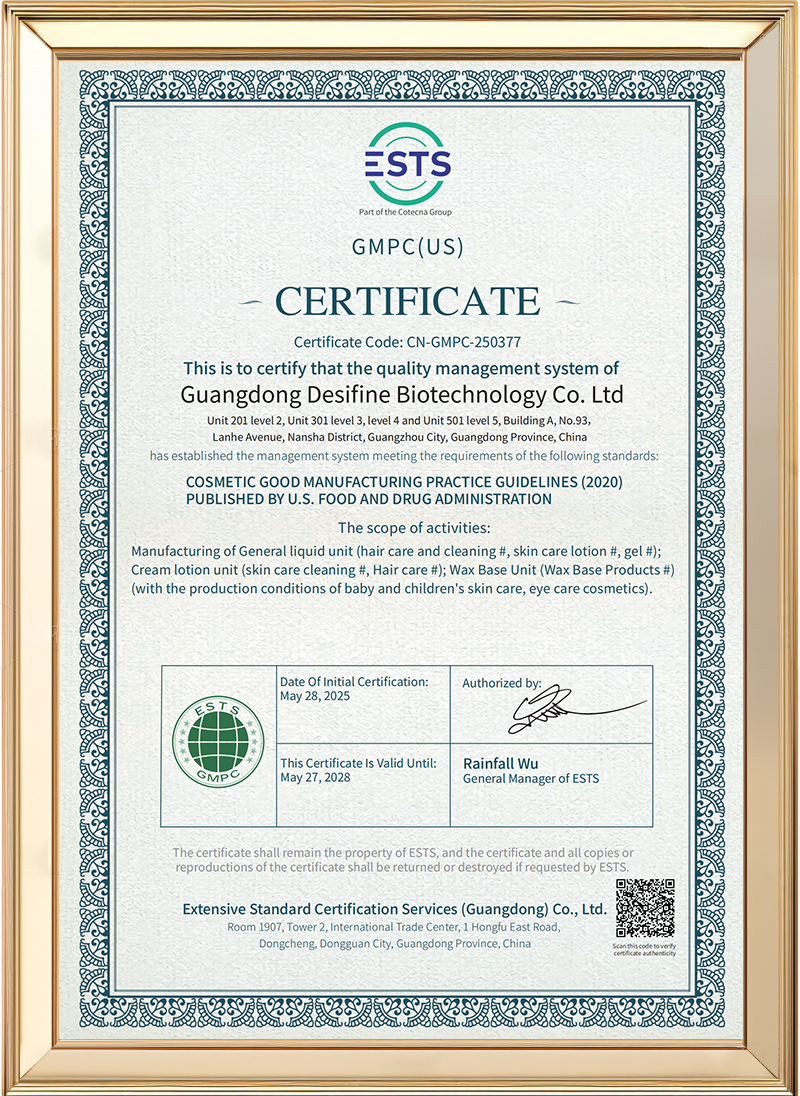
GMPC Certificate — Guangdong Desifine Biotechnology Co., Ltd., Cert No: CN-GMPC-250377.
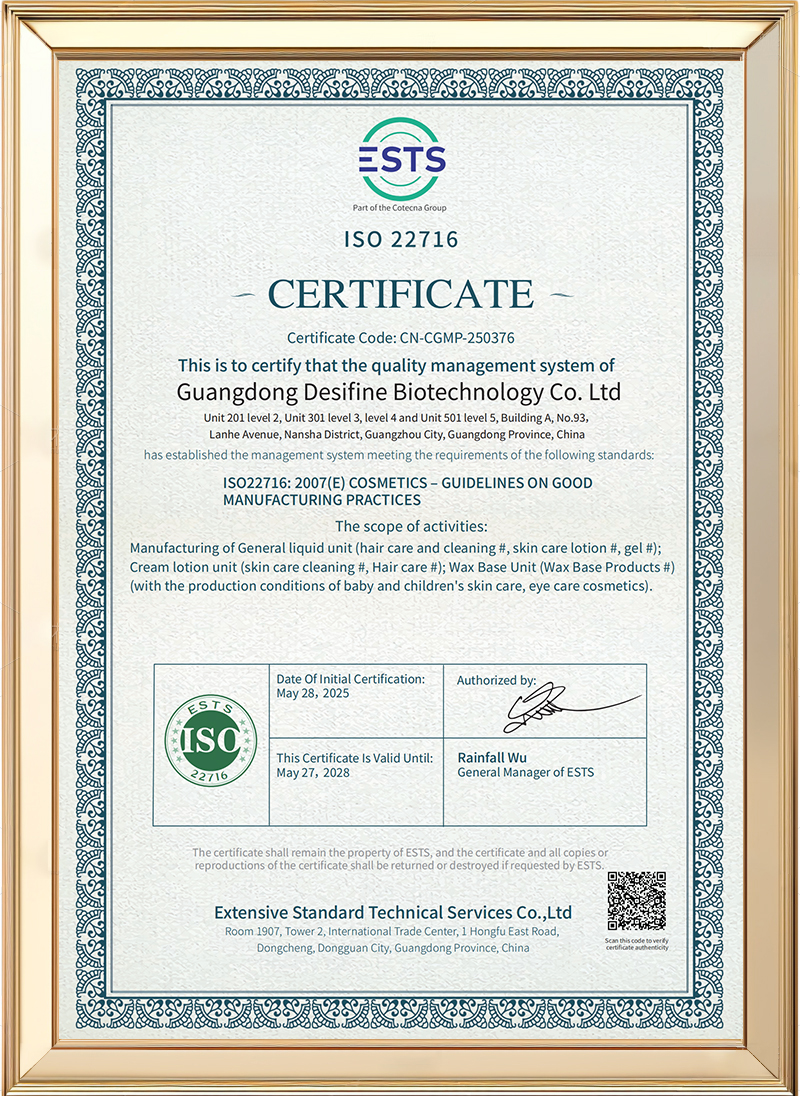
EU ISO 22716 Cosmetics Quality Management System Certificate — Cert No: CN-CGMP-250376.
Step-by-Step Breakdown: Choosing and Executing the Right Structure
Execution-stage buyers do not need more comparison; they need a sequence. This is the six-step path that converts a launch decision into a purchase order.
- Fix the launch structure against cash, not ambition. Multiply 3,000 units by the number of SKUs you intend to carry. If a four-SKU line requires 12,000 units and your channel cannot absorb a first shipment of that size within one sell-through cycle, start with the single serum and add SKUs at the reorder.
- Define the claim before the formula. Growth and anti-loss positioning draws more scrutiny than plain cosmetic hair care in major markets. Confirm the claim language your market accepts, then brief the formula to support it. Doing this in reverse produces a formula that cannot be marketed.
- Submit samples and validate texture, scent and function. Sample turnaround at Desifine is 7–10 days. For a regimen, submit the serum first, approve it, then brief the remaining SKUs against the approved serum so the line stays consistent. Sample confirmation is a formal acceptance criterion before mass production begins.
- Lock customization specifications in writing. Formula, fragrance, color and function — per SKU. For the serum, also confirm the active direction: peptides, biotin, caffeine, keratin or argan oil, or a defined blend, and confirm whether the base follows the 8-Free Clean Formula positioning.
- Schedule production against the 30–45 day window. Plan the shipment date backwards from that window, not forwards from the purchase order. A regimen can be produced as staged runs rather than one compressed block, which spreads cash outflow and lets retail partners accept the line progressively.
- Agree acceptance and payment terms before production. Standard terms at Desifine are a 30% deposit with 70% balance before shipment, payable by T/T or L/C at sight, with FOB Guangzhou, CIF or DDP delivery. Acceptance criteria are pre-shipment inspection, sample confirmation before mass production, a third-party testing report from SGS or Intertek, and a batch quality certificate.
Use Cases: Which Structure Fits Which Operator
Category: Independent brand, first hair care launch. A single private label hair growth serum is the correct structure. One formula, one fragrance, one claim, 3,000 units, 30–45 days to production. The brand learns which ingredient story — caffeine, peptide, biotin, keratin or argan oil — converts before committing further capital. This is also the structure that keeps a private label men hair growth serum or private label women hair growth serum launch cleanly segmented by audience without doubling inventory.
Category: Salon and spa. A regimen fits better. Salons sell routines, not products, and a serum that arrives alongside a matching shampoo and scalp tonic supports in-chair recommendations and retail attachment. The 3,000-unit-per-SKU minimum is manageable at multi-location scale, and the 500,000-unit monthly capacity removes supply ceiling concerns on a growing line.
Category: E-commerce and marketplace brand. Start single-SKU, then build the regimen as a bundle. A private label leave-in hair growth serum or private label hair thickening serum performs as a standalone listing with its own reviews; once one listing has traction, the same reviews and brand assets support adjacent SKUs. Bundling a serum with a matching shampoo at that point raises average order value without raising the entry price of any single item.
Category: Distributor or regional importer. The regimen is usually the stronger commercial structure because distributors sell a brand block to retailers, not a single bottle. Two practical checks apply: confirm HS Code 330590 classification and documentation on every SKU line, and confirm batch traceability across the whole shipment so a claim or quality query can be resolved at SKU level.
Category: Clean-positioning brand. Either structure works, provided the base is settled early. A private label organic hair growth serum or private label plant based hair growth serum line should confirm the 8-Free Clean Formula base and the plant-derived active direction before fragrance and color are specified, because those are the specifications most likely to conflict with a clean-label claim.
Comparison Table: Single-SKU Launch vs Full Hair Care Regimen
| Decision dimension | Single-SKU serum launch | Full hair care regimen |
|---|---|---|
| Minimum order quantity | 3,000 units for one SKU | 3,000 units per SKU — 12,000 units for a four-SKU line |
| Production lead time | 30–45 days typical | 30–45 days per production run; SKUs can be staged |
| Sample turnaround | 7–10 days | 7–10 days per formula submitted |
| Customization scope | Formula, fragrance, color and function on one SKU | Same four dimensions on every SKU, plus cross-SKU scent and color consistency |
| Ingredient options | Active peptides, biotin, caffeine, keratin, argan oil | Same options, allocated across serum and companion SKUs |
| Quality system | GMPC (CN-GMPC-250377), EU ISO 22716 (CN-CGMP-250376), US FDA Registration | Same certifications applied to multiple formulations |
| Capacity headroom | 500,000 units per month at Desifine | Same rated capacity; a 12,000-unit opening order is a small share of one month's output |
| Commercial terms | 30% deposit, 70% before shipment; T/T or L/C at sight; FOB Guangzhou, CIF or DDP | Same terms applied per SKU or per consolidated purchase order |
| Acceptance criteria | Sample confirmation, pre-shipment inspection, SGS/Intertek report, batch certificate | Same criteria, with batch traceability maintained across SKUs |
| Market logic | One claim, one hero benefit, fastest market learning | Treatment serums held a 64.6% share of the hair serum market in 2024; a regimen monetizes more of the routine |
| Primary risk | Single point of failure; no basket to absorb a weak month | Working capital locked across several SKUs; slow movers linger |
| Best fit | New brand, tight cash, test-and-scale model | Salon and spa, distributors, established e-commerce brands |
All figures reflect stated Desifine order terms and unit economics, or third-party market data attributed in the text. Unit-count arithmetic is derived directly from the 3,000-unit-per-SKU minimum.
Frequently Asked Questions
1. Do GMPC and ISO 22716 certification cover the marketing claims for a hair growth serum?
No. GMPC certification (Cert No: CN-GMPC-250377), EU ISO 22716 certification (Cert No: CN-CGMP-250376) and US FDA Registration are facility and quality-system credentials. They confirm that the product is manufactured under an audited quality management system; they do not approve a specific growth or anti-loss claim in a specific market. Hair serums are generally regulated as cosmetics, while hair growth and anti-hair loss positioning attract more scrutiny in major markets. Buyers should treat certification as a supplier-qualification requirement and claim wording as a separate, market-by-market legal review.
2. Can one manufacturer support a single serum SKU now and a full regimen later?
Yes, when the manufacturer holds both the formula library and the capacity. Desifine works from more than 10,000 formula reserves with a 20+ engineer R&D team, produces at a rated 500,000 units per month, and supports customization of formula, fragrance, color and function across hair care categories including serums, shampoos and scalp care. That combination is what allows a brand to launch one serum at the 3,000-unit minimum and add companion SKUs at reorder without changing supplier, quality system or brand tone.
3. What is the real minimum inventory commitment for each structure?
Desifine's minimum order quantity is 3,000 units per SKU. A single serum therefore requires 3,000 units; a four-SKU regimen requires 12,000 units across the line. Payment terms are a 30% deposit with 70% balance before shipment, by T/T or L/C at sight, with FOB Guangzhou, CIF or DDP delivery available. For budgeting context only, HODM Cosmetics publicly posts a hair serum price range of USD 1.62–2.10 per unit, but that figure is not a comparable benchmark: unit basis, order quantity, packaging and incoterms are not stated, so buyers should request a quotation tied to their own SKU count, packaging and delivery term rather than budgeting against a posted range.
4. How long does sampling take, and what must be approved before mass production?
Sample turnaround is 7–10 days. For a single SKU, one approved sample closes the loop. For a regimen, the practical sequence is to approve the serum sample first, then brief the remaining SKUs against it so fragrance, color and texture stay consistent across the line. Sample confirmation is a formal acceptance criterion before mass production, alongside pre-shipment inspection, a third-party testing report from SGS or Intertek, and a batch quality certificate.
5. How long is production lead time, and how should a regimen launch be scheduled?
Typical production lead time is 30–45 days, and that window applies to each production run. A single-SKU launch schedules one run. A regimen launch should be planned as staged runs against the same 30–45 day window, so that cash outflow and retail intake are spread across SKUs rather than compressed into one shipment. Stability testing before shipment and batch traceability are maintained in both structures. To move from decision to execution, request a sample and a quotation for your intended SKU count by emailing info@desifine.com or calling +86 13016010480, and download the Desifine product and capability brochure before your first briefing call.
Conclusion
The head-to-head result is conditional, and that is the useful answer. A single-SKU private label hair growth serum is the lower-risk execution path: 3,000 units, one formula, one fragrance, one claim, 30–45 days to production, and a clean read on which ingredient story the market accepts. A full hair care regimen is the higher-ceiling path: four times the opening inventory at the same per-SKU minimum, but a basket that supports salon recommendations, distributor sell-in and bundle economics — in a category where treatment serums held 64.6% of a USD 1.3 billion market in 2024.
Both paths run through the same quality system. GMPC, EU ISO 22716 and US FDA Registration apply identically whether you order one SKU or six; the difference is administrative volume, not manufacturing tier. What changes is your cash exposure, your customization workload and your route to a second order. Decide those three things first, then brief the formula — and the launch structure will follow from the numbers rather than from the pitch deck.
Next step: validate your launch structure with a sample
Tell Desifine how many SKUs you intend to carry and which ingredient direction — active peptides, biotin, caffeine, keratin or argan oil — fits your positioning. Samples are returned in 7–10 days against a 3,000-unit-per-SKU minimum.
Email: info@desifine.com | Tel / WhatsApp: +86 13016010480 | desifine.com
Address: No. 93, Lanhe Avenue, Nansha District, Guangzhou City, Guangdong Province, China
Have Questions or Need More Details?
Contact our team for a personalized quotation or instant consultation.
Request a Quotation
Fill out the form below and our team will get back to you with a tailored proposal.
WhatsApp Direct Chat
Prefer to chat in real-time? Message us on WhatsApp for instant assistance & quick answers.
- Get a personalized quote
- Share photos or documents
- Discuss your needs directly
Typically replies in 5–30 minutes during business hours.