
Top-Ranked Private Label Skincare Product Lines for 2026: Recommendations for Emerging Brands

DESIFINE OEM/ODM manufacturing facility in Nansha, Guangzhou, where the ranked private label skincare product lines are developed and produced.
For a new beauty brand, the first product-line decision matters more than the logo, the packaging, or even the unit price. It decides how much working capital is locked into inventory, how fast the brand reaches the market, and how easily the range can be extended later. This guide ranks the three strongest private label skincare product lines for emerging brands inside the DESIFINE OEM/ODM portfolio for 2026: Lip Care (tints and oils), Eye Care (patches and serums), and Body Care (scrubs and sunscreens).
The ranking is based on customization flexibility, format and ingredient innovation potential, and the entry barrier a new brand actually faces at 3,000 units per SKU. DESIFINE, the trading name of Guangdong Desifine Biotechnology Co., Ltd., is a cosmetics OEM/ODM manufacturer founded in 2000 in Nansha, Guangzhou. It operates a 15,000 m² GMP-certified plant, runs a 20+ engineer R&D team, and exports to markets including the USA and Europe, with exports representing about 60% of output (desifine.com).
The Problem: Which Product Line Should an Emerging Brand Launch First?
A new brand rarely fails because it picked the wrong fragrance. It fails because it picked a product line that consumes cash, requires compliance documentation it did not plan for, or cannot be reordered profitably. Most private label programs start at a minimum order quantity of 3,000 units per SKU, so a brand launching three formats is committing to three separate inventory positions before a single unit is sold.
That is why the first line should be judged on three practical questions: how many customization axes the manufacturer can genuinely deliver, how much format innovation is still available within the line, and how heavy the compliance or testing burden is for a first-time buyer. A line that scores well on all three lets an emerging brand differentiate without spreading its budget too thin.
Industry Background: Why Product-Line Selection Matters in 2026
The private label model is no longer a fallback for small brands. According to Grand View Research, the global private label cosmetics market was estimated at USD 10.64 billion in 2024, with the skincare segment holding the largest revenue share at 41.70%. A separate field study cited for the U.S. market suggests that approximately 70% of skincare brands there use private label manufacturing rather than in-house production, which reflects how normalized outsourced formulation has become.
China remains a major supply base for that demand. According to ChoZan / NMPA data, China's cosmetics and personal-care exports reached USD 7.2 billion (51.2 billion yuan) in 2024, an 11.9% year-on-year increase. The Observatory of Economic Complexity (OEC) identifies the United States as the primary destination, accounting for USD 743 million in 2024, followed by Hong Kong and the UK. Buyers searching for private label skincare USA, private label skincare Canada, private label skincare Italy, or private label Sunscreen France are effectively sourcing against the same set of compliance and customization questions.
Compliance sets the floor for any line. EU Regulation (EC) 1223/2009 mandates that all cosmetic products comply with Good Manufacturing Practices based on the harmonized ISO 22716 standard. A manufacturer's GMP and registration status therefore shapes which product lines a new brand can realistically launch first, especially where sun protection or anti-aging claims are involved.
How These Three Product Lines Were Ranked
Each line was assessed against criteria that can be traced back to documented portfolio attributes rather than opinion:
- Customization depth — the number of documented customization axes the line supports (formula, fragrance, color, texture, finish, and functional options).
- Ingredient innovation potential — whether the line can carry active ingredients such as peptides, hyaluronic acid, or retinol.
- Format innovation headroom — whether the category still has room for distinguishable formats, such as tints and oils in lip care or patches and serums in eye care.
- Entry barrier for a new brand — the practical cost, sampling, and regulatory load a first-time buyer faces.
All three lines share the same baseline commercial terms: a minimum order quantity of 3,000 units per SKU, a lead time of 30–45 days, and a sample lead time of 7–10 days.
Rank #1 — Lip Care: Tints and Oils
Lip Care ranks first for emerging brands because it combines the widest documented customization surface with the lowest first-order exposure per format. The line covers lip balm, lip scrub, lip mask, lip oil, lip gloss, lip tint, lip treatment, lip plumper, and lip conditioner, all produced under the same 8-Free Clean Formula platform.
Why It Ranks #1: Customization Depth
The lip care line documents seven distinct customization axes: formula, flavor, color, texture, finish (matte, glossy, or tinted), an SPF option, and a plumping effect. Few categories in cosmetics give a new brand that many independent levers to differentiate with. A single tinted lip oil can be defined by flavor, shade depth, gloss level, and plumping behaviour, which allows several SKUs to be built from one base formula.
Ingredient and Format Innovation Potential
Documented lip care materials include shea butter, coconut oil, jojoba oil, vitamin E, beeswax, plant extracts, hyaluronic acid, peptides, and oils such as rosehip, argan, and almond, along with fruit extracts and sugar for scrubs. Hyaluronic acid and peptides support the plumping positioning, while the oil and balm formats address the occlusive, comfort-driven textures that dominate the tint-and-oil trend. The format itself is the innovation space: a tint, an oil, and a treatment can occupy three different price points inside one compact product line.
Rank #2 — Eye Care: Patches and Serums
Eye Care ranks second. It carries a higher perceived value than lip care and directly serves the anti-aging private label skincare demand, but it also asks more of a new brand in formulation and testing. The line includes eye cream, eye gel, eye serum, eye balm, eye patch, eyelash serum, eye primer, under-eye treatment, dark circle corrector, and anti-wrinkle eye care.
Why It Ranks #2: Actives and Texture Control
The eye care line is customizable by formula, texture (cream, gel, serum, or balm), target concern, and active ingredients. Target concerns are documented as dark circles, puffiness, fine lines, wrinkles, and hydration. This is one of the few lines where the manufacturer lists retinol as an available active, alongside peptides, hyaluronic acid, caffeine, vitamin C, vitamin E, niacinamide, collagen, ceramides, bakuchiol, and green tea extract.
That active spread is the innovation engine for the line. A patch format delivers actives through a different mechanism than a serum, and a serum allows a higher active load than a cream. For an emerging brand, that means two or three eye SKUs can be positioned as distinct technologies — a depuffing patch, a retinol serum, and a peptide cream — from the same formulation platform. The trade-off is that retinol and anti-wrinkle positioning usually demand more careful claim support and stability documentation than a basic lip balm, which is why eye care sits behind lip care for a first launch.
Rank #3 — Body Care: Scrubs and Sunscreens
Body Care ranks third, but it is the line with the strongest repeat-purchase economics. The documented range covers body lotion, body oil, body wash, body scrub, body cream, hand care, foot care, neck care, deodorant, sunscreen, tanning gel, oil and mousse, hair removal cream, and intimate care. Documented materials include retinol, niacinamide, vitamin C, hyaluronic acid, shea butter, aloe vera, coconut oil, and jojoba oil.
Why It Ranks #3: Volume and Repeat Demand, Higher Compliance Load
Body scrubs are low-risk entry formats built on natural materials and sugar or exfoliating textures. Sunscreens, by contrast, carry the heaviest regulatory burden of the three lines because SPF products require documented regulatory support in the destination market. The manufacturer has demonstrated that capability: a private label beauty brand client operating across the United States, Canada, Great Britain, and Italy developed a custom hair care line for the sensitive-skin market through the same platform, and the engagement included an EU SPF product line compliant with regulations.
That record is why body care ranks third for a first launch but first for expansion. A new brand can open with a body scrub that needs no SPF documentation, then extend into sunscreen once the label, claims, and packaging are proven. Buyers searching for private label Sunscreen France or a private label organic shampoo and hair growth serum range are essentially looking for the same manufacturer capability: one partner who can carry both low-barrier and high-compliance formats.

Formula R&D and testing underpin the customization depth of all three ranked product lines.
The Shared Differentiator: The 8-Free Clean Formula
Every ranked line — lip, eye, and body — can be produced on the same 8-Free Clean Formula base. The 8-Free specification excludes preservatives, fragrance, mineral oil, silicone, traditional emulsifiers, amines, and dyes, and it is cruelty-free. For an emerging brand, this matters for three reasons.
- Clean positioning without redevelopment. The 8-Free base applies across all three lines and all six product families, so a brand can make a single clean-formula claim across an entire range.
- Sensitive-skin suitability built in. Removing fragrance and traditional emulsifiers is a documented reason the manufacturer has served sensitive-skin briefs for private label beauty brand clients in North America and Europe.
- Consistency across SKUs. A shared base reduces the risk that a lip tint, an eye serum, and a body lotion behave differently from one another on the shelf or in stability testing.
The 8-Free Clean Formula is produced at pharmaceutical-grade standard and is covered by the plant's GMPC, ISO 22716, and FDA registration scope, which includes skincare, face mask, body care, and hair care. That combination is what allows a single clean-formula story to sit behind a multi-line private label skincare launch.
Step-by-Step Breakdown: From Product-Line Brief to Launch
The evaluation-to-execution path for any of the three ranked lines follows the same sequence. Documented terms apply at each step.
- Select the line and hero format. Choose lip tint or oil, eye patch or serum, or body scrub or sunscreen as the flagship SKU. This determines the claims the brand must support.
- Lock the formula brief. Define actives (retinol, peptides, hyaluronic acid, niacinamide, vitamin C, and others as documented for the line) and confirm the 8-Free Clean Formula requirement.
- Request samples. Sample lead time is 7–10 days.
- Confirm customization. Options include formula, fragrance, color, concentration, packaging, bottle shape, label, logo, and private brand name, with line-specific options such as lip finish and flavor, eye texture and target concern, and sunscreen SPF.
- Verify compliance documents. Confirm GMPC, ISO 22716, and FDA registration, and request the stability testing report and safety data sheet (SDS) for the chosen formula.
- Approve the pre-production sample and place the order. The minimum order quantity is 3,000 units per SKU.
- Mass production. Production lead time is 30–45 days, with monthly capacity of 500,000 units.
- Quality control and shipping. Quality control includes an in-house QC lab, raw material inspection, semi-finished product testing, 100% finished-product inspection, and optional third-party testing through SGS or Intertek.
Use Cases: How Emerging Brands Have Used These Lines
Body Care — U.S. Fragrance-Free Body Lotion Line
A body care brand client in the United States launched a fragrance-free body lotion line on the 8-Free Clean Formula base. Over a three-year relationship, 5 million pieces were produced. The client's stated result was a lightweight, non-greasy texture with consistent repeat orders and reliable delivery. The supporting factors were pharmaceutical-grade quality, batch traceability, and reorder flexibility. For a new brand, this is the clearest evidence that the body care line can sustain volume without losing texture consistency.
Adjacent Custom Program — North America and Europe
A private label beauty brand client working across the United States, Canada, Great Britain, and Italy developed a custom line for the sensitive-skin market, producing 200,000 pieces within a four-year ongoing partnership. Quality remained consistent from sample to mass production, and the engagement included an EU SPF product line compliant with regulations, flexible small-batch production, full regulatory compliance support, packaging optimization advice, and on-time delivery. This is the reference point for brands planning a private label sunscreen line for European markets.
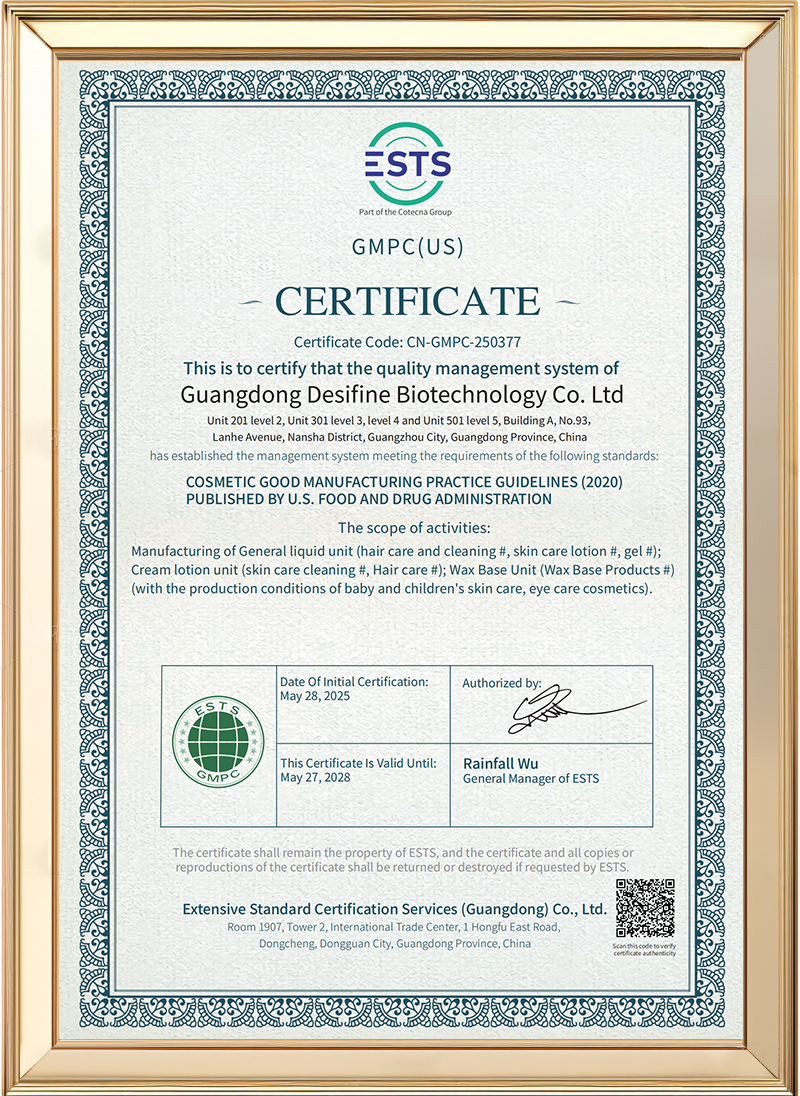
GMPC certification (Cert No: CN-GMPC-250377) issued to Guangdong Desifine Biotechnology Co., Ltd.
Comparison Table: The Three Product Lines Side by Side
| Dimension | Lip Care (Tints & Oils) | Eye Care (Patches & Serums) | Body Care (Scrubs & Sunscreens) |
|---|---|---|---|
| Documented formats | Lip balm, scrub, mask, oil, gloss, tint, treatment, plumper, conditioner | Eye cream, gel, serum, balm, patch, eyelash serum, primer, dark circle corrector | Body scrub, sunscreen, lotion, oil, wash, cream, hand/foot/neck care |
| Customization axes | Formula, flavor, color, texture, finish, SPF option, plumping effect | Formula, texture (cream/gel/serum/balm), target concern, active ingredients | Formula, texture, actives, sunscreen SPF support |
| Documented actives / materials | Shea butter, coconut oil, jojoba oil, vitamin E, beeswax, hyaluronic acid, peptides, rosehip/argan/almond oils | Peptides, retinol, hyaluronic acid, caffeine, vitamin C, niacinamide, collagen, ceramides, bakuchiol | Retinol, niacinamide, vitamin C, hyaluronic acid, shea butter, aloe vera, coconut oil |
| Base formula | 8-Free Clean Formula | 8-Free Clean Formula | 8-Free Clean Formula |
| MOQ | 3,000 units per SKU | 3,000 units per SKU | 3,000 units per SKU |
| Lead time | 30–45 days (sample 7–10 days) | 30–45 days (sample 7–10 days) | 30–45 days (sample 7–10 days) |
| Compliance scope | GMPC, ISO 22716, FDA registration | GMPC, ISO 22716, FDA registration | GMPC, ISO 22716, FDA registration; SPF regulatory documentation applies |
| Recommended rank for a first launch | #1 | #2 | #3 |
FAQ
Are these private label skincare product lines compliant for the US and EU markets?
The manufacturing facility holds three relevant credentials: GMPC certification (Cert No: CN-GMPC-250377, issued 2025-05-28, valid to 2028-05-27), ISO 22716 cosmetics GMP certification (Cert No: CN-CGMP-250376, issued 2025-05-28, valid to 2028-05-28), and U.S. FDA Registration (Cert No: GTHIVE312-25090, issued 2025-07-08, valid to 2028-07-07) covering cosmetics, skincare, hair care, and body care. EU Regulation (EC) 1223/2009 requires cosmetic products to comply with GMP based on the harmonized ISO 22716 standard, which the ISO 22716 certification addresses. SPF-containing sunscreen formats require additional regulatory documentation, which the manufacturer has supported in EU markets.
What can actually be customized across Lip Care, Eye Care, and Body Care?
Core customization covers formula, fragrance, color, concentration, packaging, bottle shape, label, logo, and private brand name. Line-specific options add lip finish, flavor, SPF, and plumping effect for lip care; texture and target concern for eye care; and sunscreen SPF support plus scrub textures for body care. All three lines can be built on the 8-Free Clean Formula.
What is the minimum order quantity and how does budget planning work?
The minimum order quantity is 3,000 units per SKU, and production lead time is 30–45 days. Monthly production capacity is 500,000 units. Payment terms are 30% deposit with 70% balance before shipment, via T/T or L/C at sight. Delivery terms available include FOB Guangzhou, CIF, and DDP.
How does the sampling process work before committing to a product line?
Sampling uses a 7–10 day sample lead time, and a sample is confirmed before mass production begins. Formula, texture, and finish can be adjusted at the sample stage, and the manufacturer provides flexibility for formula adjustment and reorder after launch. Third-party testing through SGS or Intertek is available if the brand requires an independent report.
What is the production lead time, and how does a brand start an order?
Production runs 30–45 days after sample approval, under monthly capacity of 500,000 units. Acceptance criteria include pre-shipment inspection, sample confirmation before mass production, optional third-party testing reports, and a batch quality certificate. To move from evaluation to execution, a brand can request a sample or a quote for a chosen line — Lip Care, Eye Care, or Body Care — and review the manufacturer's full capability and product catalogue at the DESIFINE product brochure.
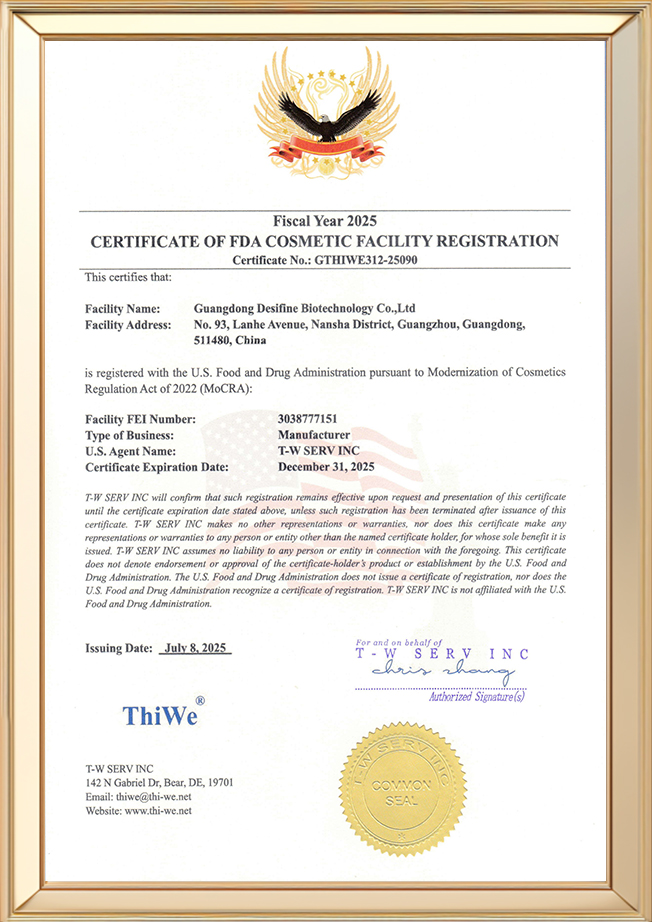
U.S. FDA Registration (Cert No: GTHIVE312-25090) covering cosmetics, skincare, hair care, and body care.
Conclusion and Next Step
For an emerging brand in 2026, the three top-ranked private label skincare product lines are Lip Care (tints and oils), Eye Care (patches and serums), and Body Care (scrubs and sunscreens). Lip Care ranks first because it offers the deepest documented customization surface — formula, flavor, color, texture, finish, SPF, and plumping — at the lowest first-order exposure. Eye Care ranks second for its active-led innovation potential, including retinol, peptides, and hyaluronic acid. Body Care ranks third for a first launch because of the SPF compliance load, but first for expansion because of its repeat-purchase economics and demonstrated volume.
The thread connecting all three is the 8-Free Clean Formula, produced at pharmaceutical-grade standard and backed by GMPC, ISO 22716, and FDA registration. That shared base lets a new brand make one clean-formula claim across a whole range instead of rebuilding the story line by line.
To move forward, request a sample or a quote for the product line you intend to launch first. Contact the DESIFINE team directly by email at info@desifine.com or by phone and WhatsApp at +86 13016010480. The facility is located at No. 93, Lanhe Avenue, Nansha District, Guangzhou City, Guangdong Province.

Request a sample, a quote, or the full product catalogue to begin your private label skincare product line for 2026.
Have Questions or Need More Details?
Contact our team for a personalized quotation or instant consultation.
Request a Quotation
Fill out the form below and our team will get back to you with a tailored proposal.
WhatsApp Direct Chat
Prefer to chat in real-time? Message us on WhatsApp for instant assistance & quick answers.
- Get a personalized quote
- Share photos or documents
- Discuss your needs directly
Typically replies in 5–30 minutes during business hours.