
Which Private Label Hair Growth Serum Should Your Brand Launch?
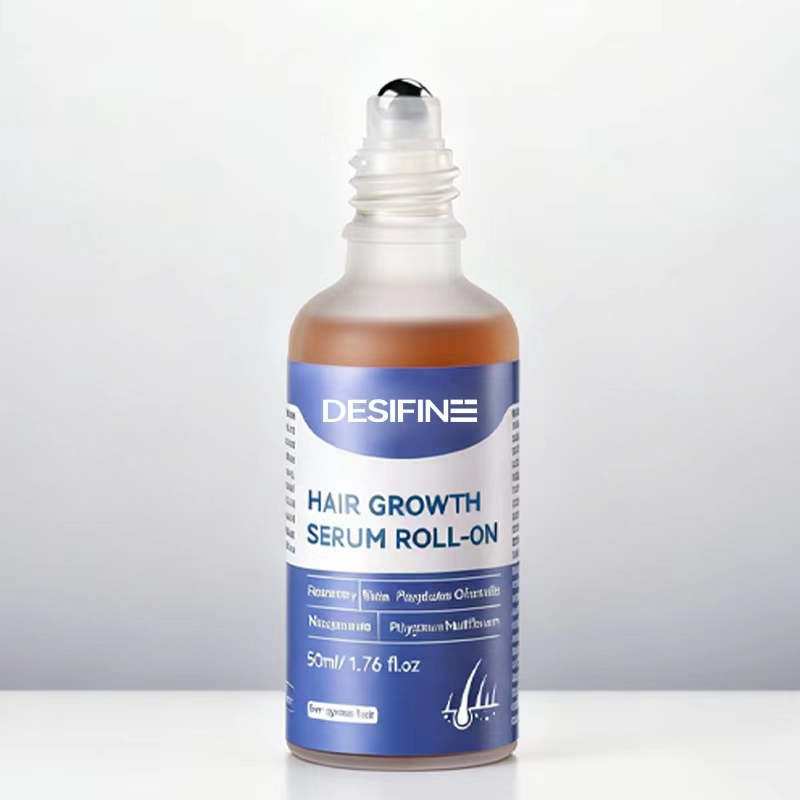
Choosing a private label hair growth serum is not just about finding a good formula. It is about finding the right formula for your target market, your claim strategy, and your production plan. This guide is written for buyers in the research and evaluation stage who are narrowing down a supplier and a product direction. It uses DESIFINE—a Guangzhou-based OEM/ODM cosmetics manufacturer with a 15,000 m² GMP-certified facility—as a concrete benchmark for what a capable partner should offer.
By the end of this article, you will have a practical framework to evaluate a private label hair growth serum project: how to match formulation choices to audience expectations, which compliance and certification questions to ask, and how to turn manufacturer capabilities into a launch-ready plan.
Why “Best Private Label Hair Growth Serum” Depends on Your Project
Many private label buyers start with a search for the “best” hair growth serum. But the most effective product for a brand is defined by project constraints, not by a detached ranking. A serum developed for the EU market must satisfy different regulatory documentation requirements than one aimed at the US market. A plant-based brand targeting clean-beauty consumers may prioritize 8-Free formulas. A men’s grooming line may need different positioning and packaging. None of these decisions can be made from a generic best-seller list.
Common mistakes in supplier research include:
- Selecting a formula before confirming whether the manufacturer can support the target market’s regulatory documentation.
- Assuming a single ingredient cocktail will appeal equally to men, women, and diverse demographic groups.
- Underestimating the importance of stability testing, safety data sheets, product claim support, and batch traceability.
- Focusing only on price while ignoring MOQ flexibility, lead time, and quality-control systems.
For a project to succeed, every decision should flow from the intended use case. This is where the concept of scenario fit becomes more valuable than a generic product comparison.
Market Signal: Demand Is Broad—and Specific
Third-party market data helps explain why private label brands are entering the hair growth serum category with targeted positioning. The global hair serum market was estimated at USD 1,320.1 million in 2024, with hair treatment serums accounting for 64.64% of the share. The broader hair growth supplement and treatment market is projected to reach USD 11.58 billion by 2030, growing at a CAGR of 6.15%. Both figures come from Grand View Research.
Consumer interest in clean and organic positioning is equally visible. According to Credence Research, the organic hair care market was valued at USD 10,242.1 million in 2024, driven by demand for plant-based, non-toxic formulations. This explains why many private label buyers search for terms such as “private label organic hair growth serum” or “private label plant based hair growth serum” rather than only a generic anti-hair-loss product.
Demographic pressure is another signal. In the United States, approximately 70% of men and 40% of women are affected by androgenetic alopecia, according to Grand View Research. That prevalence supports continued demand for non-invasive topical serums across both male and female segments. Meanwhile, Asia Pacific dominated the hair growth treatment market in 2023 with a 45.71% revenue share, and the hair thickener serum market is estimated to grow at a CAGR of 8.2% from 2025 to 2035, reaching USD 3.1 billion.
These numbers point to one conclusion: the market is large, but it is fragmented. Successful buyers do not launch a generic serum; they launch a serum built for a clearly defined scenario.
A Project-Fit Framework for Private Label Hair Growth Serum
The following six factors form a practical framework for evaluating any private label hair growth serum project. Each factor is grounded in the buyer’s project needs and in supplier capabilities that can be verified.
1. Regulatory Destination
Your target market determines the compliance documents you will need. In the EU, cosmetic products must comply with Regulation (EC) No 1223/2009, which requires a Product Information File (PIF) and a Cosmetic Product Safety Report (CPSR). In the US, FDA registration and GMP compliance are common expectations. A private label manufacturer should be able to demonstrate its own certifications and provide documentation that supports downstream compliance.
DESIFINE, for example, has obtained Cosmetics GMP Certification (GMPC), US FDA Registration, and EU ISO 22716 Cosmetics Quality Management System Certification. These are standard credentials for a supplier that serves private label brands in the US and Europe. Buyers should ask whether the manufacturer can produce stability testing reports, safety data sheets (SDS), and product claim support documents.
2. Claim Type and Formulation Direction
The claim you want to communicate strongly influences the formulation direction. A brand searching for “private label anti hair loss serum” may need active ingredients commonly associated with scalp stimulation, such as caffeine, biotin, peptides, or amino acids. A brand searching for “private label scalp hair growth serum” may prioritize a leave-on, scalp-focused texture. “Private label hair thickening serum” could focus on volume and fiber strength rather than only growth claims.
DESIFINE’s hair care development program covers shampoo, conditioner, hair mask, hair oil, hair serum, hair wax, hair gel, and hair spray. The company’s customization options include formula, fragrance, color, and concentration. Its raw material list for hair care includes natural plant extracts, active peptides, keratin, argan oil, coconut oil, tea tree oil, biotin, caffeine, panthenol, silk protein, and amino acids. These are the building blocks that allow a supplier to move a brand brief in a specific direction.
3. Target Consumer and Positioning
Men and women may respond to different claims, packaging languages, and dispensing formats. A men’s line might use a stronger, minimal design and a scalp-focused message. A women’s line may emphasize perceived hair softness and growth support. A clean-beauty brand may avoid certain synthetic ingredients altogether.
DESIFINE’s 8-Free Clean Formula is defined as no preservatives, no fragrance, no mineral oil, no silicone, no traditional emulsifiers, no amines, no dyes, and cruelty-free. This positioning aligns with the growing demand for “private label organic hair growth serum” and “private label plant based hair growth serum.” The manufacturer can also customize packaging, bottle shape, label, and logo, which makes it possible to create a distinct identity without changing the core production line.
4. Customization and Documentation
A private label project is rarely a simple white-label repackaging. Buyers usually need a partner that can adjust texture, concentration, fragrance, packaging, and label design. Equally important is the documentation that supports brand claims and market entry. DESIFINE’s after-sales support includes formula adjustment, batch tracking, stability testing report, safety data sheet (SDS), product claim support, and reorder flexibility.
This is especially relevant for buyers entering markets where the distributor or retailer requests proof of safety and stability. A partner that can provide these documents reduces the buyer’s regulatory risk and speeds up the go-to-market process.
5. Production Scalability
Startup brands and established companies have different scale requirements. A brand testing a new market may want a lower MOQ and a faster path to small-batch production. A large brand may need reliable mass-production capacity and consistent repeat orders.
DESIFINE’s stated MOQ is 3,000 units per SKU, with a monthly capacity of 500,000 units. Lead time is 30–45 days, and samples typically take 7–10 days. This range is useful for a brand that wants to validate a product before committing to a large volume. Buyers should compare these numbers with their own demand forecasts and promotional calendars.
6. Quality Systems and Testing
Quality control is not a single test at the end of the line. It is a system that covers raw materials, semi-finished products, and finished goods. DESIFINE operates an in-house QC lab and follows a process of raw material inspection, semi-finished product testing, and 100% finished-product checks. Third-party testing is available through SGS or Intertek when needed.
For a private label hair growth serum, this level of control is important because topical products interact with sensitive scalp skin. Consistent viscosity, pH, microbial limits, and active-ingredient concentration affect both safety and user experience.
From Brief to Bulk: Six Steps for Selecting a Serum Partner
Use the following sequence to move from an abstract idea to a workable private label serum project.
- Define the destination and claim. Write down the target country, the intended claim (for example, scalp care, thickening, or anti-hair-loss support), and the regulatory documents your market expects.
- Select the formulation direction. Choose between plant-based, organic, anti-hair-loss, scalp-focused, thickening, leave-in, or extra-strength positioning. Map this direction to ingredients and textures.
- Verify certifications. Ask for GMPC, US FDA registration, ISO 22716, and any other applicable certification copies. For EU entry, confirm support for PIF and CPSR.
- Check customization and documentation. Confirm your ability to adjust formula, fragrance, color, concentration, packaging, bottle shape, label, and logo. Request a list of available documentation, including SDS and stability reports.
- Review MOQ, lead time, and capacity. Ensure the supplier’s minimums and production speed match your first order and scale-up plan. A 3,000-unit MOQ is relevant for market testing.
- Plan for after-sales support. Ask about batch tracking, reorder flexibility, formula adjustment, and product claim support. This determines whether the partnership can grow with your brand.
How Different Brands Approach a Private Label Hair Growth Serum
The scenario-based approach becomes clearer with concrete use cases.
Clean-Beauty Startup Launching an Organic / Plant-Based Serum
A startup may target US and EU customers who avoid synthetic preservatives, silicones, and dyes. For this project, the formula direction should prioritize plant extracts and natural oils within a clean-label system. DESIFINE’s 8-Free Clean Formula and cruelty-free positioning fit this scenario. The startup benefits from low MOQ, custom packaging, and documentation that helps the brand communicate a credible clean story.
Men’s Grooming Brand Expanding Into Scalp Treatment
A men’s brand may want a lightweight, leave-in scalp serum positioned for daily use. With roughly 70% of U.S. men affected by androgenetic alopecia, demand is substantial. The manufacturer should be able to provide a non-greasy texture, fragrance customization, and packaging suited to men’s retail shelves. DESIFINE’s hair care customization allows brands to move across categories because the production line already includes serums, oils, and styling liquids.
EU-Focused Brand Needing PIF / CPSR Support
For EU entry, the brand must comply with Regulation (EC) No 1223/2009, including a Product Information File and Cosmetic Product Safety Report. DESIFINE’s ISO 22716 certification and third-party testing options provide a practical starting point. The buyer should request the relevant PIF/CPSR documents from the supplier before contract signing.
E-Commerce Brand Testing With a Small First Batch
A new e-commerce brand may want to validate a product concept before a large production run. With an MOQ of 3,000 units per SKU and sample lead time of 7–10 days, DESIFINE’s model supports this test-and-iterate approach. The brand can start with one SKU, collect consumer feedback, then scale up with the same formulation and packaging system.
Supplier Capability Checklist: What to Benchmark Before You Commit
The following table connects the most common buyer concerns to DESIFINE’s published capabilities. Use it as a checklist when comparing private label hair growth serum partners.
| Focus Area | Questions to Ask | DESIFINE Capability |
|---|---|---|
| Clean formula | Can you produce a preservative-free, cruelty-free, clean-label serum? | 8-Free Clean Formula: no preservatives, fragrance, mineral oil, silicone, traditional emulsifiers, amines, dyes, cruelty-free |
| Certifications | What GMP and market-registration certificates do you hold? | GMPC, US FDA Registration, EU ISO 22716 Certification |
| Customization | Can you customize formula, packaging, and brand identity? | Formula, fragrance, color, concentration, packaging, bottle shape, label, logo, private brand name |
| Quality control | How do you maintain batch consistency? | In-house QC lab, raw material inspection, semi-finished testing, 100% finished-product check, third-party testing via SGS/Intertek |
| Production scale | What is the minimum order and monthly capacity? | MOQ 3,000 units per SKU; monthly capacity 500,000 units; lead time 30–45 days; sample 7–10 days |
| Documentation | Can you support market-entry documentation and claim substantiation? | Stability testing report, SDS, product claim support, batch tracking, formula adjustment |
Frequently Asked Questions
Is a private label hair growth serum from DESIFINE compliant with EU and US regulations?
DESIFINE holds Cosmetics GMP Certification (GMPC), US FDA Registration, and EU ISO 22716 certification. For EU entry, brands must also meet Regulation (EC) No 1223/2009, which requires a Product Information File and a Cosmetic Product Safety Report. Buyers should request the corresponding documentation from DESIFINE for their specific product. Third-party testing through SGS or Intertek can further support compliance work.
Can DESIFINE customize a private label hair growth serum for my brand?
Yes. DESIFINE’s customization includes formula, fragrance, color, concentration, packaging, bottle shape, label, logo, and private brand name. This means a brand can build its own identity rather than selling a generic white-label product. The hair care series covers shampoo, conditioner, hair mask, hair oil, hair serum, hair wax, hair gel, and hair spray, giving brands room to create a coherent product family.
What is the minimum order quantity and capacity?
DESIFINE’s MOQ is 3,000 units per SKU, and its monthly production capacity is 500,000 units. This range works for both small-batch market testing and larger scale-up programs. The actual cost per unit depends on formulation, packaging, and customization choices, so a product-specific quote is recommended.
How quickly can I receive samples and start production?
Sample lead time is typically 7–10 days, while full production lead time is 30–45 days. The production timeline depends on formula complexity, packaging availability, and order volume. For a private label hair growth serum project, these times allow brands to move rapidly from concept to shelf if the formulation is well prepared.
What after-sales support is included with a private label serum order?
DESIFINE’s after-sales support includes formula adjustment, batch tracking, stability testing report, safety data sheet (SDS), product claim support, and reorder flexibility. These services help brands manage ongoing quality, respond to retailer questions, and maintain a consistent supply chain. For a product-specific timeline or quote, request a sample or contact DESIFINE directly—the team can also share the full company brochure.
The Right Fit Is a Process, Not a Guess
The ideal private label hair growth serum for your brand is not necessarily the one with the longest ingredient list or the biggest marketing story. It is the one that fits your regulatory destination, your target consumer, your claim, and your supplier’s ability to execute. A manufacturer with clean-label options, certified production, flexible MOQ, and solid documentation can turn a product idea into a launch-ready reality.
DESIFINE offers OEM/ODM hair care development backed by a 15,000 m² factory, an in-house R&D team, GMPC and ISO 22716 certifications, and a track record of supporting global private label brands. Buyers who evaluate their own project against the framework in this article will be better prepared to choose the right partner.

Ready to evaluate a formula for your market? Download the DESIFINE company brochure to review manufacturing capabilities, certifications, and customization options.
Download DESIFINE Brochure
Email: info@desifine.com
WhatsApp: +86 13016010480
Have Questions or Need More Details?
Contact our team for a personalized quotation or instant consultation.
Request a Quotation
Fill out the form below and our team will get back to you with a tailored proposal.
WhatsApp Direct Chat
Prefer to chat in real-time? Message us on WhatsApp for instant assistance & quick answers.
- Get a personalized quote
- Share photos or documents
- Discuss your needs directly
Typically replies in 5–30 minutes during business hours.