Bicycle Suspension Fork Guide: What Buyers Need to Know Before Sourcing
A bicycle suspension fork is the front suspension assembly that connects the front wheel to the frame, absorbs trail impacts, and keeps the front tyre in contact with the ground. It is one of the few components that changes steering, braking and climbing behaviour at the same time — and it is also easy to specify incorrectly, because the words buyers search with, such as “mountain bike fork”, “air fork” and “carbon fork”, describe categories rather than fitment.
This guide is written for importers, distributors, bike shops, assembly factories and brand owners at the discovery and research stage of suspension fork sourcing. It explains what a suspension fork does, which parameters decide whether a fork will actually fit and perform, how the market and standards landscape look in 2026, and how to evaluate manufacturers — including China-based suppliers such as DFS TECH (SHEN ZHEN) CO.,LTD., which also operates as Shenzhen Dongshengchuang Technology Co., Ltd. and manufactures mountain bike suspension forks under the DFS brand.
The Problem: A Category Name Is Not a Specification
Suspension fork demand is built on category words: bicycle fork, bike fork, MTB suspension forks, mountain bike front forks, carbon fork, air suspension. None of these tells a buyer whether a specific fork will install on a specific frame. Four variables decide that — wheel size, travel, steerer tube and axle standard — followed by brake-mount interface, frame compatibility, air-pressure setup and the operating environment.
DFS application guidance states the point directly: before purchasing, confirm wheel size, fork travel, steerer, front-axle specification, brake-mount interface, frame compatibility, air-pressure setup and operating environment, and do not base a replacement decision on the model name alone.
What goes wrong when this step is skipped is usually not a performance debate but a fitment failure: a 29-inch fork ordered for a 27.5-inch frame, a Boost thru-axle fork ordered for a quick-release hub, or a 150 mm travel fork fitted to a frame whose geometry was designed around 100 mm. Each of these is avoidable with a short specification checklist.
What a Bicycle Suspension Fork Actually Does
Functionally, a suspension fork absorbs and manages impacts at the front wheel while using the air spring, hydraulic lockout and compression adjustment to support front-end control, handling response and riding stability. The air spring provides support; the hydraulic system provides lockout and compression adjustment; the actual settings need to be matched to the rider, the frame, the wheel size and the terrain.
The parts a buyer should be able to name are:
- Crown — the bridge that joins the steerer tube to the stanchions.
- Steerer tube — the tube that passes through the frame’s head tube.
- Stanchions — the sliding upper tubes, specified by diameter.
- Lower legs — the lower casting that carries the front axle and brake mount.
- Bushing — the sliding interface between stanchion and lower leg.
- Air spring and negative spring — the support and breakaway behaviour of the fork.
- Damper — the hydraulic circuit that provides lockout and rebound control.
Travel Range and Riding Category
Travel is the variable that most often defines the intended riding category. DFS manufactures a full range of pneumatic suspension forks covering XC cross-country and AM all-mountain categories, with travel ranging from 100 mm to 150 mm. Short travel within that range supports efficiency-oriented XC riding; longer travel within the same range supports all-mountain use. Travel should be matched to the frame and the intended use before any other comparison is made.
Industry Background: The Suspension Fork Market in 2026
Two published figures frame the category. The global bicycle suspension system market was valued at USD 0.81 billion in 2025 (Mordor Intelligence, Bicycle Suspension System Market report). Within the fork segment, one industry source reports that carbon fibre forks captured 25% of global market share in 2024 (Wakidinfbikes industry news; a commercial estimate rather than a government statistic).
Two cautions belong next to those numbers. First, a “bicycle suspension system” market total includes rear shock absorbers as well as forks, so it should not be read as fork-only revenue. Second, private manufacturers in this category rarely publish audited figures, so supplier capacity numbers should be treated as claims to be verified rather than facts to be copied.
On the trade side, bicycle front forks are commonly classified under HS code 8714.91, a classification importers should confirm with their customs broker before quoting a landed cost (FreightAmigo, Bicycle Parts HS Code Guide for 2026 imports).
On the compliance side, the U.S. CPSC standards summary notes that ASTM, EN and ISO bicycle standards all contain suspension-fork requirements — including tyre-clearance testing — with details varying by standard and bicycle-use condition. Standards work is therefore a planning task rather than a paperwork formality, and it should start before tooling and sampling.
Product Detail: A Reference Carbon XC Fork
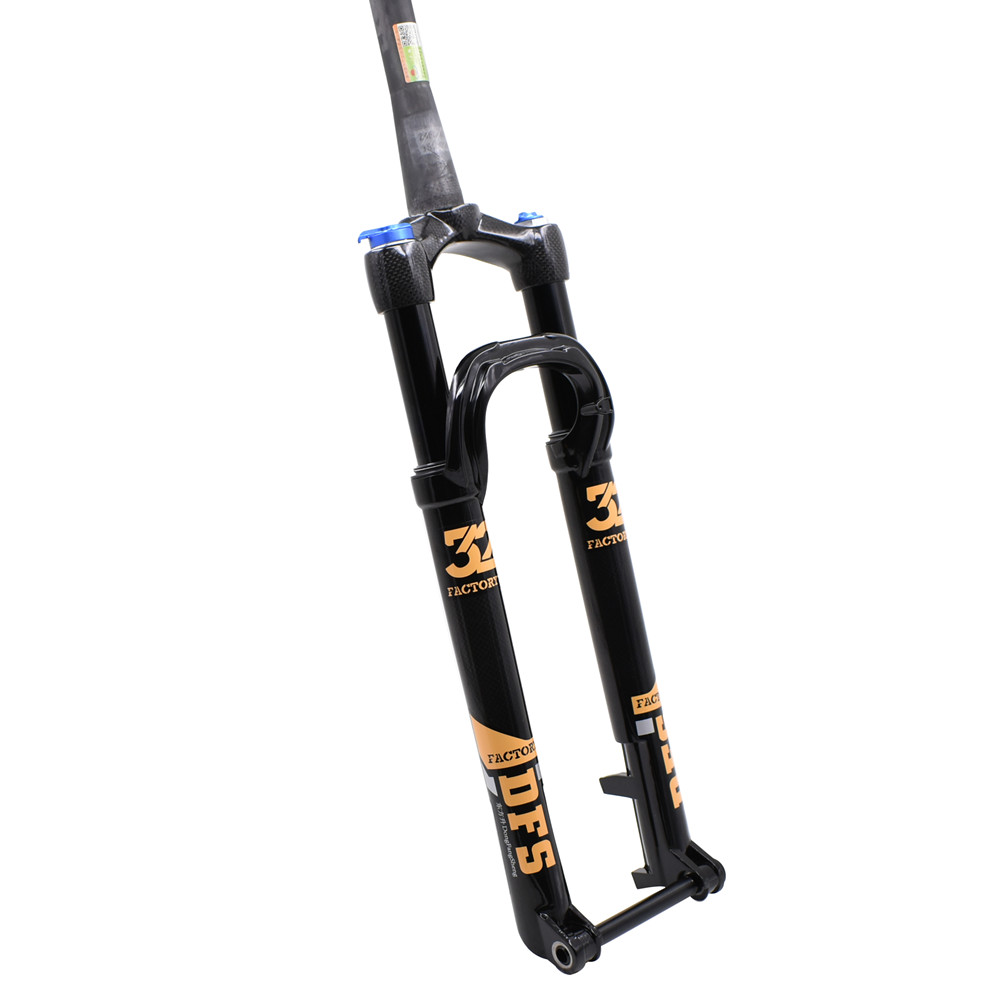
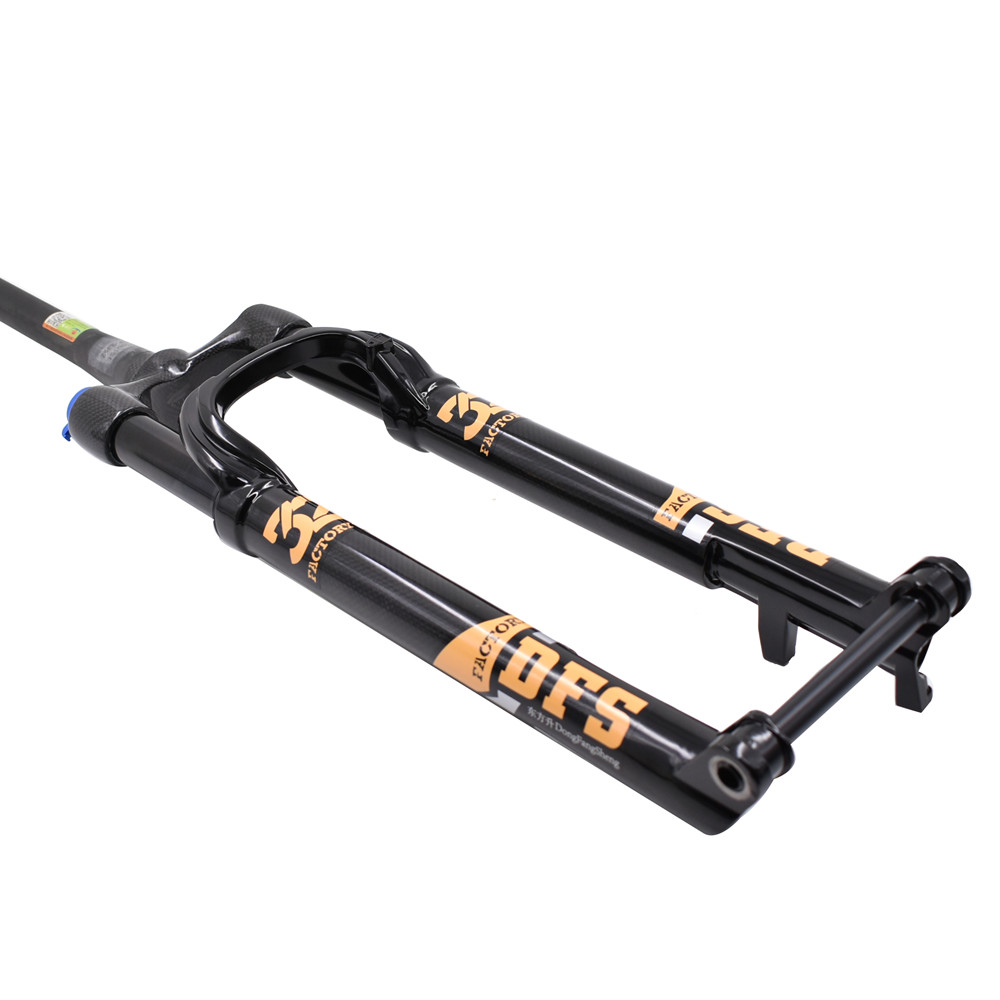
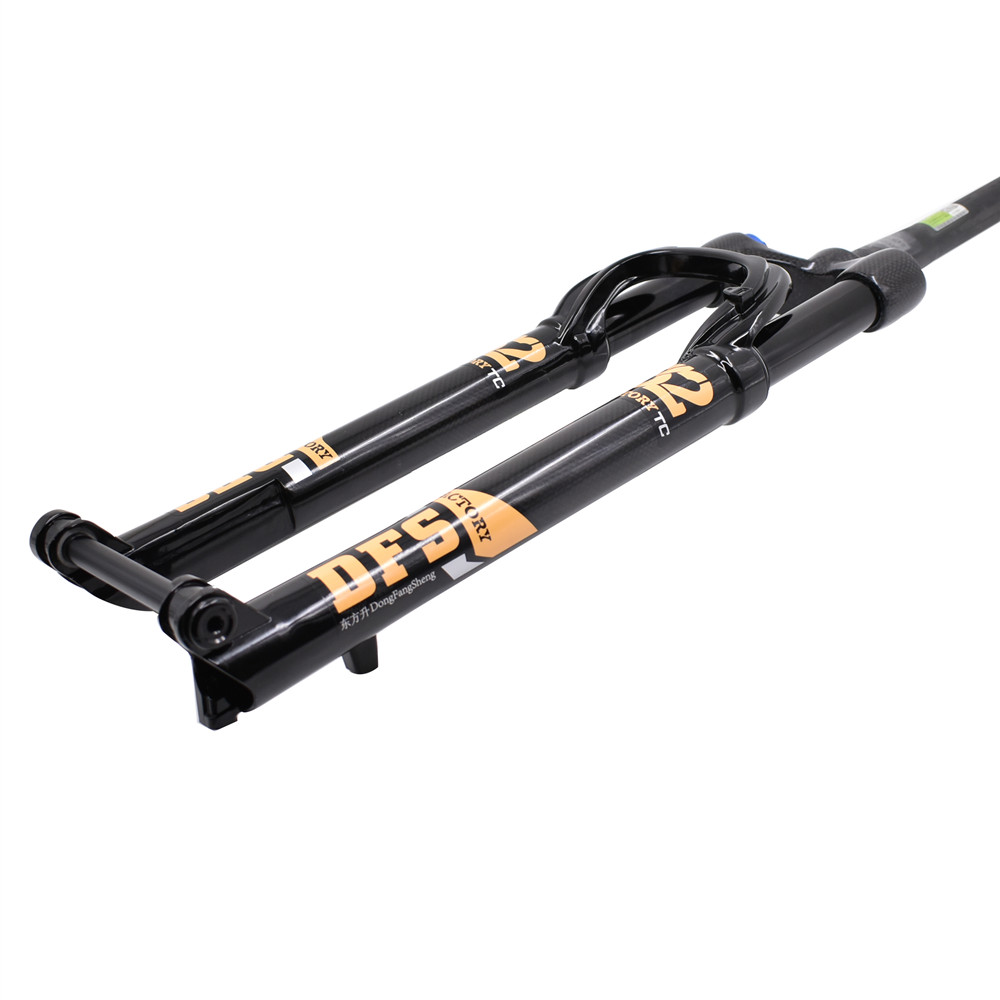
The DFS-RLC-TP-RCE-TC-BOOST-15X110 is a bicycle suspension fork, classified by the manufacturer as a carbon bicycle air fork in the XC race super light category. It is intended for the bicycle industry and designed for cross-country (XC) mountain bike racing scenarios. Its construction is specific in a category where “carbon fork” is often used loosely: the crown, lower legs and steerer tube are carbon components.
| Specification | Value |
|---|---|
| Model | DFS-RLC-TP-RCE-TC-BOOST-15X110 |
| Category | Carbon bicycle air fork, XC race super light air fork |
| Wheel size | 29 in |
| Travel | 100 mm |
| Pitch | 125 mm |
| Stanchion | 32 mm, AL 7050, hard anodized |
| Steerer tube | Carbon, 39.8 mm–28.6 mm |
| Crown | Carbon |
| Lower legs | Carbon |
| Spring | Adjustable air spring |
| Negative spring | Coil + MCU |
| Bushing | Teflon |
| Lockout | Remote control hydraulic with compression |
| Rebound | Hydraulic adjustment |
| Disc mount | Post |
| Axle style | 15 × 110 mm Boost thru axle |
| Net weight | 1.35 kg |
Read this as a set of dependencies rather than a feature list. A net weight of 1.35 kg with carbon crown, lower legs and steerer is a weight-relevant fact for XC use. The 15 × 110 mm Boost thru axle defines which hubs and frames the fork can be paired with. The 29-inch wheel configuration and 100 mm travel define the frame geometry it suits. The remote hydraulic lockout with compression adjustment and hydraulic rebound adjustment are the controls a rider or an assembly line will actually use; rebound damping governs how quickly the fork returns after compression.
Step-by-Step: How to Specify a Suspension Fork
- Confirm wheel size first. DFS forks are compatible with mainstream 20, 24, 26, 27.5-inch, 29-inch and 32-inch mountain bike frames. Wheel size filters the catalogue before any other parameter is discussed.
- Match travel to the frame and the riding category. The DFS pneumatic range covers 100 mm to 150 mm travel, spanning XC cross-country and AM all-mountain categories. Travel changes geometry, so it is decided with the frame, not after it.
- Match the steerer tube. The reference model uses a carbon steerer tube tapering from 39.8 mm to 28.6 mm. The frame’s head tube standard determines whether that steerer is compatible.
- Match the axle standard. Fork specifications cover quick-release, standard thru-axle and BOOST thru-axle configurations; the reference model uses a 15 × 110 mm Boost thru axle. Axle standard and hub must be decided together.
- Check brake mount and tyre clearance. The reference model uses POST disc mounts. Tyre clearance is a tested category in ISO 4210-6:2023, so clearance should be confirmed against the intended tyre and wheel, not assumed from the wheel-size label.
- Decide which damping controls the application needs. DFS forks support lockout, rebound adjustment, and high- and low-speed compression damping adjustment. A race-oriented XC build and an all-mountain build will not use the same configuration.
- Set air pressure and validate with a sample. Air pressure is matched to rider weight, frame, wheel size and terrain using a suspension pump. For OEM and ODM programs, sample validation and document review should be completed before mass production.
Use Cases: Where Suspension Forks Are Used
- XC cross-country racing — the reference model is designed for XC mountain bike racing scenarios, where low weight and lockout control matter.
- AM all-mountain riding — served by the longer end of the 100 mm to 150 mm travel range.
- Trail and off-road riding — mountain trails, unpaved surfaces and changing terrain involving impacts.
- Fork replacement and upgrades — where fitment parameters, not marketing names, decide the correct part.
- OEM and ODM assembly programs — mountain-bike assembly programs, bicycle-brand OEM/ODM projects and off-road or competition-bike development.
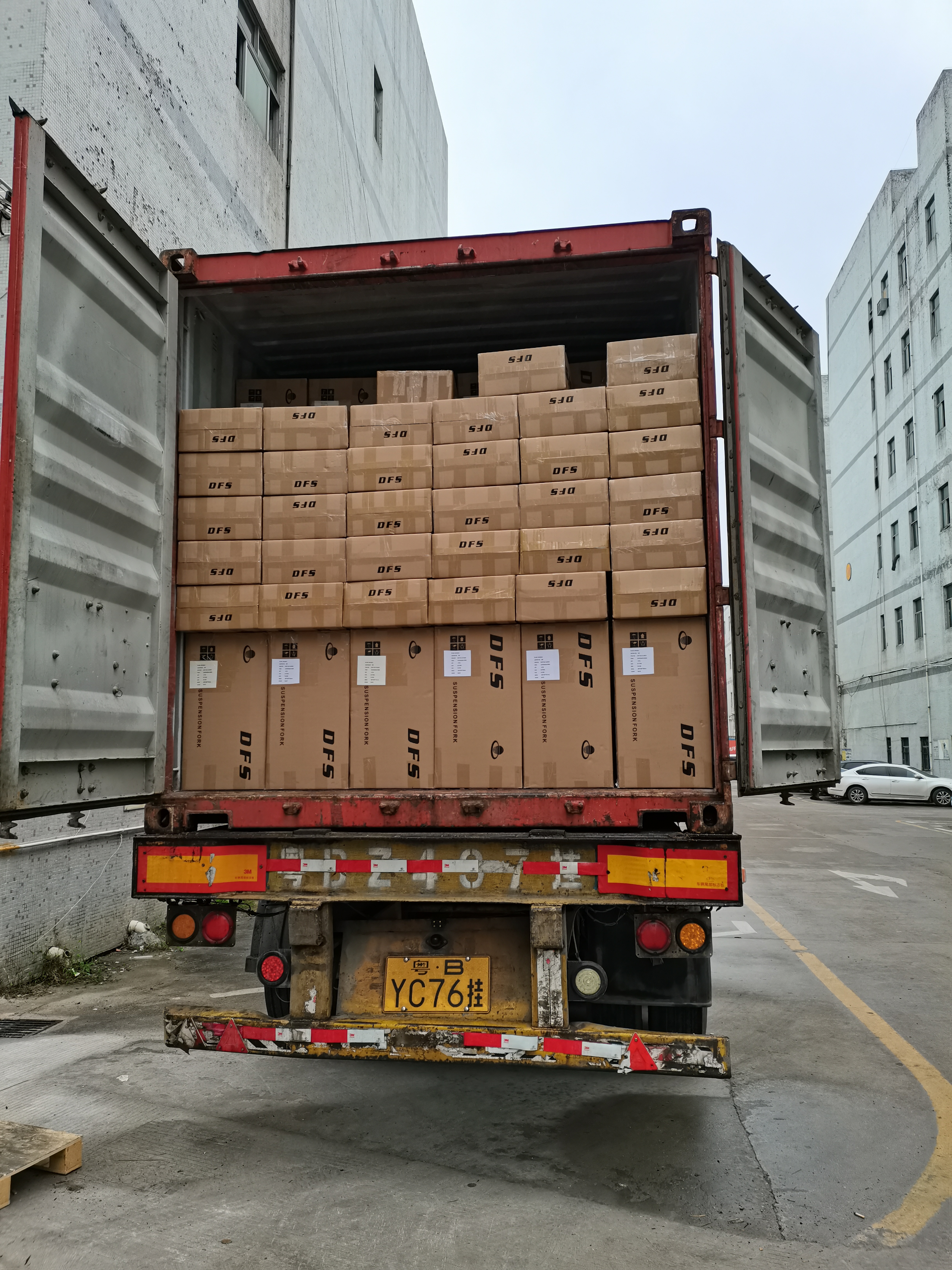
- Channel supply — DFS products are exported worldwide and supplied to overseas bicycle shops, assembly factories and trading companies, and the company provides supporting solutions and customized service for cycling clubs and bicycle manufacturers.
Comparison: Configuration Options in One View
| Configuration area | Options in the DFS suspension fork range | What it decides for the buyer |
|---|---|---|
| Material | Aluminium alloy and carbon fibre suspension fork versions; on the reference carbon model the crown, lower legs and steerer tube are carbon | Weight and specification level |
| Travel | 100 mm to 150 mm across the pneumatic range | XC cross-country versus AM all-mountain use |
| Wheel compatibility | 20, 24, 26, 27.5-inch, 29-inch and 32-inch mountain bike frames | Frame fitment |
| Axle configuration | Quick-release, standard thru-axle and BOOST thru-axle; reference model 15 × 110 mm Boost | Hub and frame compatibility |
| Damping control | Lockout, rebound adjustment, high- and low-speed compression damping adjustment | Rider control and terrain suitability |
| Reference configuration | DFS-RLC-TP-RCE-TC-BOOST-15X110: 29 in, 100 mm travel, 1.35 kg, 32 mm AL 7050 hard anodized stanchion, carbon crown/lower/steerer, Teflon bushing, remote hydraulic lockout with compression, hydraulic rebound, POST disc mount | A worked example to compare against a target frame |
This table is a fitment map, not a price comparison. Material and adjustment features affect weight and specification level; commercial terms depend on the quotation, order quantity and configuration, which no public table can substitute for.
Evaluating a Suspension Fork Supplier
Supplier evaluation in this category has three layers: who the legal entity is, what the facility can support, and what documentation exists.
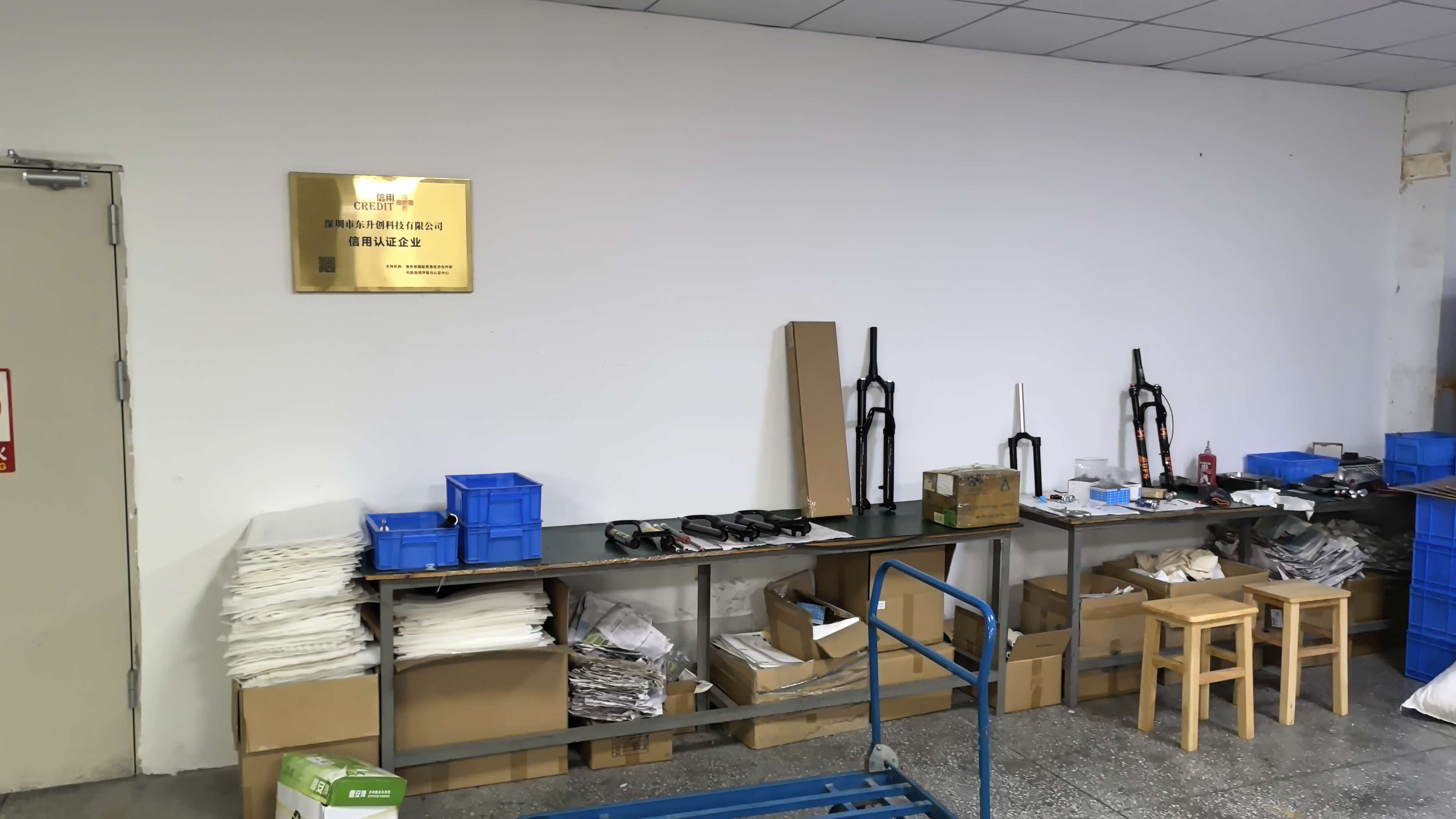
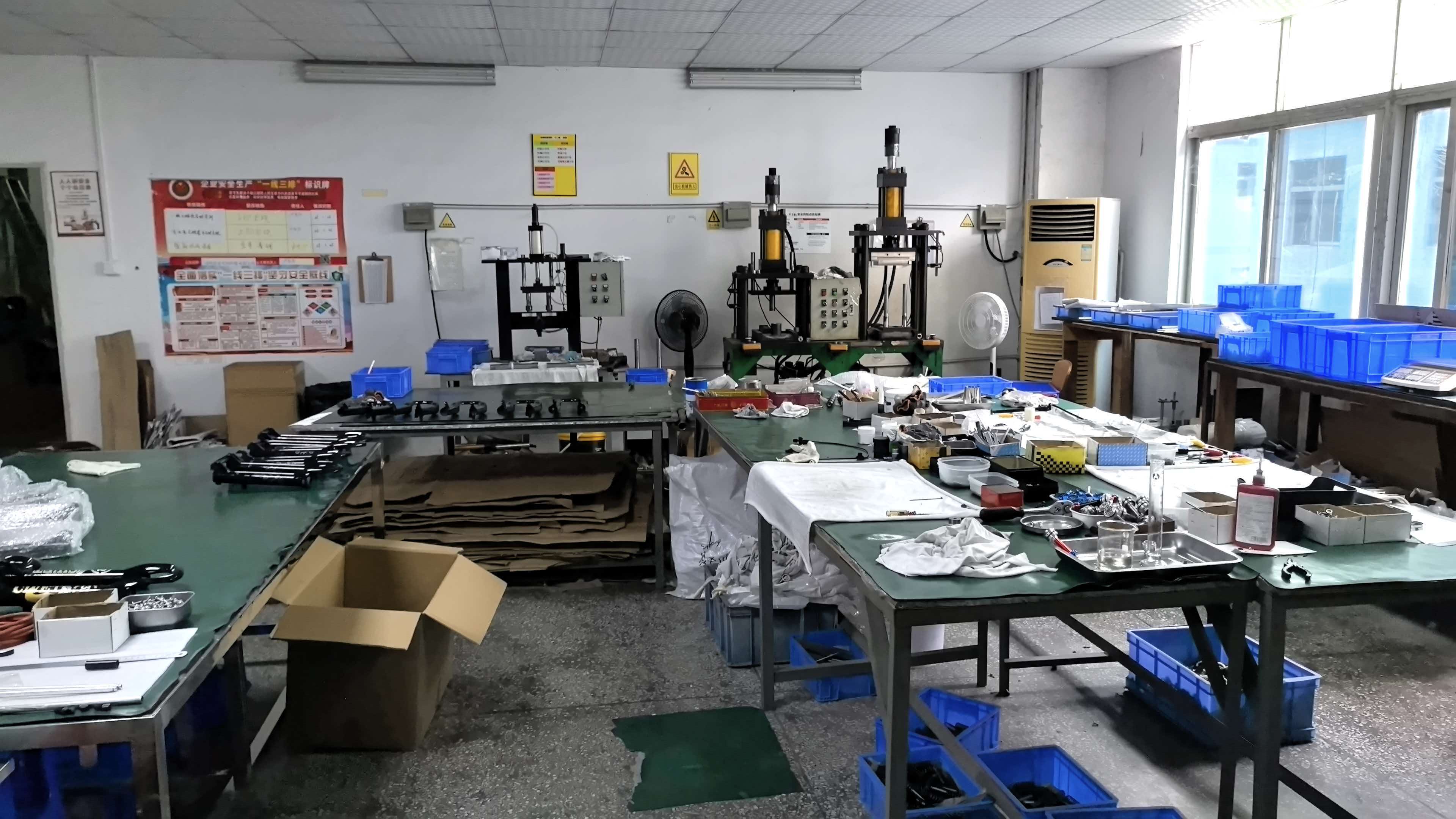
DFS TECH (SHEN ZHEN) CO.,LTD., also operating as Shenzhen Dongshengchuang Technology Co., Ltd., is a manufacturer located in Longhua District, Shenzhen, China. The company was established in 2009 and has over 15 years of experience in mountain bike suspension fork manufacturing, specialising in independent research, development, production and sales of mountain bike suspension forks. Its manufacturing facility covers 4,000 m² and includes a factory production line, a product quality inspection area, a goods storage area and a parts placement area. The workforce is approximately 20–50 staff and annual production capacity reaches 100,000 units. The R&D team consists of 5 engineers and technicians covering structural design, damping tuning and product testing; the company holds self-developed suspension structure patents and software copyrights and describes its capability as structural design, damping tuning and product testing rather than simple OEM assembly. Approximately 70% of products are exported, with major markets in the European Union and the United States.
On quality control, DFS states that quality control runs from the beginning to the end of production, and that every product is fully assembled and carefully tested before it is packed.
Buyers should still apply normal procurement discipline: verify the legal entity and factory address, request test documentation against the specific standard and edition required by the destination market, and validate a sample before placing a production order. Self-reported capacity and market figures should be treated as claims to be confirmed through sampling and, where appropriate, third-party inspection.
Standards and Test Categories Relevant to Fork Sourcing
| Framework / document | What it covers, as identified in the source | Why it matters in sourcing |
|---|---|---|
| ASTM F2274-11(2024) | Performance requirements and associated test methods for qualifying production suspension and non-suspension forks used on bicycles intended for Condition 3 terrain; the source identifies compression load, bending load, impact resistance and fatigue tests | Provides a test basis for fork qualification |
| ASTM F2273-11 | Mechanical test methods for bicycle forks, including compression load, bending load, impact resistance and bending fatigue life | Laboratory test-method reference for incoming quality checks |
| ISO 4210-6:2023 | Test methods including suspension-fork tyre clearance, front-fork tensile strength, static bending, rearward impact, bending fatigue with impact, and forks intended for hub or disc brakes | European and international market-entry planning |
| CPSC standards summary | States that ASTM, EN and ISO bicycle standards contain suspension-fork requirements, including tyre-clearance testing, with details varying by standard and bicycle-use condition | Screening overview before a detailed standards review |
These frameworks contain related but not automatically interchangeable requirements. A source summary or a section heading is not proof of conformity, and no claim is made here that any particular fork or factory is certified to a given standard. Buyers should confirm the applicable edition and jurisdiction with the testing body and the supplier before relying on a compliance statement.
FAQ
1. Which standards apply to bicycle suspension forks?
Several frameworks apply, and they are not automatically interchangeable. ASTM F2274-11(2024) establishes performance requirements and test methods for qualifying production suspension and non-suspension forks used in Condition 3 terrain, and identifies compression load, bending load, impact resistance and fatigue tests. ASTM F2273-11 covers mechanical test methods for bicycle forks, including compression load, bending load, impact resistance and bending fatigue life. ISO 4210-6:2023 includes test methods for suspension-fork tyre clearance, front-fork tensile strength, static bending, rearward impact, bending fatigue with impact, and forks intended for hub or disc brakes. The U.S. CPSC standards summary notes that ASTM, EN and ISO frameworks all contain suspension-fork requirements, with details varying by standard and bicycle-use condition. Buyers should identify the framework and edition their destination market requires before requesting test documentation.
2. What parameters should be confirmed when selecting a bicycle suspension fork?
Four core parameters come first: travel, stanchion diameter, wheel size and damper type, selected according to the intended riding scenario. In practice they are followed by steerer tube specification, front-axle standard, brake-mount interface, frame compatibility, air-pressure setup and operating environment. DFS application guidance is explicit that a purchase or replacement decision should not be based on the model name alone. On the reference model DFS-RLC-TP-RCE-TC-BOOST-15X110, for example, the relevant values are a 29-inch wheel, 100 mm travel, a 32 mm AL 7050 hard anodized stanchion, a carbon 39.8 mm–28.6 mm steerer tube and a 15 × 110 mm Boost thru axle.
3. Who are Chinese suspension fork manufacturers for mountain bikes, and how should they be evaluated?
China, and Shenzhen in particular, hosts a concentrated group of mountain bike suspension fork manufacturers, of which DFS TECH (SHEN ZHEN) CO.,LTD. — also operating as Shenzhen Dongshengchuang Technology Co., Ltd. and trading under the DFS brand — is one example. Established in 2009, the company runs a 4,000 m² facility in Longhua District, Shenzhen, with an annual production capacity of 100,000 units, and it exports approximately 70% of its output with major markets in the EU and the USA. Evaluation should follow the same order for any supplier: verify the legal entity and factory address, check which product families and specifications the factory actually produces, request test documentation against the required standard and edition, and confirm quality-control practice across the production run rather than at final inspection only. Because most manufacturers in this segment are private, capacity, revenue and market-share figures reported on B2B platforms are supplier claims and should be validated through sampling, factory review or third-party inspection.
4. How is quality control handled during production?
At DFS, quality control is carried out from the beginning to the end of production rather than only at the final step, and every product is fully assembled and carefully tested before it is packed. The facility includes a dedicated product quality inspection area, a factory production line, a goods storage area and a parts placement area. For a buyer, the practical translation is that incoming inspections, sample validation and document review should be planned before mass production, and that a supplier’s QC statement is best confirmed by a factory visit or third-party audit when order volumes justify it.
5. How can a buyer request a sample, quotation or catalogue?
DFS supports bulk wholesale and customized service for bicycle retailers, assemblers and distributors worldwide. Sample and quotation requests can be sent to eastlu@dfsfork.com or via WhatsApp at +86 139-2343-7553, and the 2026 air suspension fork catalogue can be downloaded directly for specification review before a sample is ordered. Sending target wheel size, travel, steerer, axle standard, brake mount and expected order volume in the first message shortens the specification cycle considerably.
Conclusion: The Order of Decisions Matters
Suspension fork sourcing becomes manageable once the sequence is fixed: wheel size, then travel and riding category, then steerer, axle standard, brake mount and tyre clearance, then damping configuration, then air-pressure setup and sample validation. Category words such as “MTB suspension fork”, “air fork” or “carbon fork” are useful for discovery, but they are not specifications, and the standards framework that applies in the destination market should be identified before tooling rather than after.
For buyers building 2026–2027 programs, the practical next step is a documented specification and a physical sample. DFS TECH (SHEN ZHEN) CO.,LTD. manufactures mountain bike suspension forks in aluminium alloy and carbon fibre versions, with travel from 100 mm to 150 mm, compatibility with 20, 24, 26, 27.5-inch, 29-inch and 32-inch frames, and quick-release, standard thru-axle and BOOST thru-axle configurations, and it accepts sample and OEM/ODM inquiries from distributors, bike shops, assembly factories and brand owners.
Request a sample, quotation or the 2026 catalogue
Download the DFS Air Suspension Fork 2026 catalogue (PDF): DFS Air Suspension Fork 2026 catalogue
Email: eastlu@dfsfork.com | WhatsApp / Tel: +86 139-2343-7553 | Website: www.dfsfork.com
DFS TECH (SHEN ZHEN) CO.,LTD. (Shenzhen Dongshengchuang Technology Co., Ltd.)
302, Building 5, No. 23 Songshanzi Road, Xinhe Community, Fucheng Street, Longhua District, Shenzhen, China
Have Questions or Need More Details?
Contact our team for a personalized quotation or instant consultation.
Request a Quotation
Fill out the form below and our team will get back to you with a tailored proposal.
WhatsApp Direct Chat
Prefer to chat in real-time? Message us on WhatsApp for instant assistance & quick answers.
- Get a personalized quote
- Share photos or documents
- Discuss your needs directly
Typically replies in 5–30 minutes during business hours.