DFS Suspension Fork Manufacturer: Deep-Dive Company Analysis
DFS DONGFANGSHENG — legally registered as DFS TECH (SHEN ZHEN) CO.,LTD. and also operating as Shenzhen Dongshengchuang Technology Co., Ltd. — is a Chinese mountain bike suspension fork manufacturer founded in 2009 and based in Longhua District, Shenzhen. It develops, produces and sells air suspension forks, carbon forks and aluminum alloy forks for XC cross-country and AM all-mountain riding, with travel from 100 mm to 150 mm and compatibility across 20-inch to 32-inch mountain bike frames. Approximately 70% of its output is exported, and the European Union and the United States are its stated main markets.
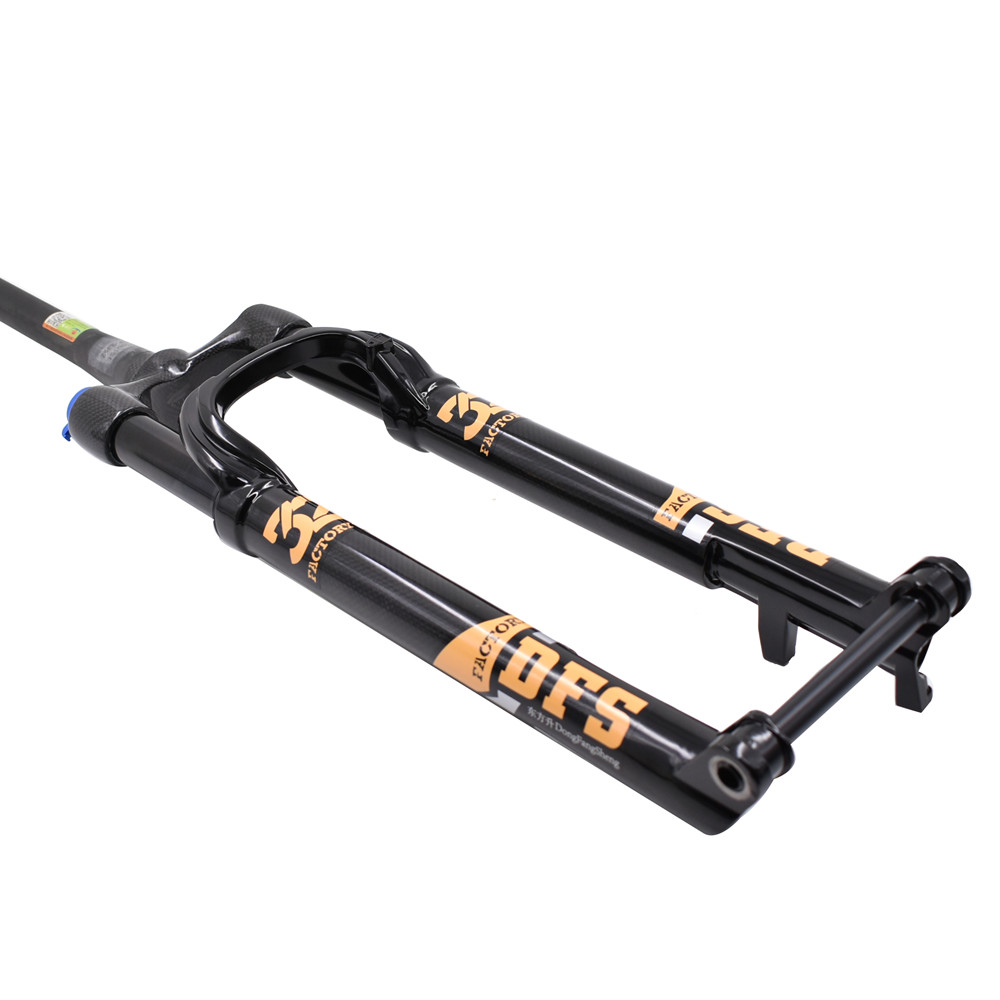
DFS mountain bike suspension fork — the company's core product category, covering air, carbon and aluminum alloy platforms from 100 mm to 150 mm travel.
This analysis is written for importers, distributors, bicycle brand owners and procurement engineers who are in the discovery and research phase of sourcing a suspension fork. It examines what DFS manufactures, how the company is structured, what evidence exists for its manufacturing and R&D capability, and where the gaps in public verification sit — because a supplier profile is only useful if it separates verified facts from claims that still need to be checked.
Problem Definition: Why Manufacturer-Level Evaluation Is the Real Bottleneck
When a buyer searches for Chinese suspension fork manufacturers for mountain bikes, the results mix three very different types of supplier: trading companies that resell without owning production equipment, assembly workshops that bolt together purchased components, and manufacturers that control structural design, damping tuning and testing in-house. All three describe themselves with the same words — suspension fork manufacturer, air fork supplier, OEM/ODM support — so the label alone carries almost no information.
The practical consequence is that a purchasing decision made on a website and a price list, without a structural way to read manufacturing capability, tends to surface problems late: specification mismatches at sampling, inconsistent damping behaviour across batches, or test documentation that cannot be mapped to the standards the destination market actually applies.
Two structural facts make this harder in the suspension fork category specifically.
First, the product is safety-relevant and standards-linked. A suspension fork is not a cosmetic part. Its structural behaviour is defined by test methods and performance requirements that differ across ASTM, EN and ISO frameworks, and those frameworks are not automatically interchangeable.
Second, specification language is loose in the market. “Mountain bike fork” is a category label, not a specification. Wheel size, travel, steerer dimension, axle standard and brake mount each change the actual part, and a fork that fits one frame may be entirely incompatible with another.
This analysis therefore evaluates DFS DONGFANGSHENG against a fixed set of procurement criteria — product range, technical capability, manufacturing evidence, quality control process, export record and customization support — and states clearly which items are supported by documented product information and which remain open verification items.
Industry Background: The Suspension Fork Market and Standards Layer in 2026
The global bicycle suspension system market — covering forks and shock absorbers — was valued at USD 0.81 billion in 2025, according to market research published by Mordor Intelligence. Within that market, material mix is shifting: carbon fiber forks accounted for roughly 25% of the global fork market in 2024, based on the industry market reporting reviewed for this analysis. The direction of the shift matters more than the figure itself — carbon platforms and refined damping sit in the premium part of the market, which is where suppliers compete on engineering rather than on assembly cost.
The standards layer that defines a suspension fork specification
Compliance requirements for suspension forks are set at framework level and then applied per market and per bicycle use condition. Three frameworks dominate the documents a buyer will be asked to review.
| Framework | Document | Coverage relevant to forks |
|---|---|---|
| ASTM (United States) | ASTM F2273-11 | Mechanical test methods for bicycle forks, including compression load, bending load, impact resistance and bending fatigue life. |
| ASTM (United States) | ASTM F2274-11(2024) | Performance requirements and associated test methods for qualifying designs of suspension and nonsuspension production forks intended for Condition 3 terrain. |
| ISO (international) | ISO 4210-6:2023 | Frame and fork test methods, including suspension-fork tyre clearance, front-fork tensile strength, static bending, rearward impact, bending fatigue with impact, and forks intended for hub or disc brakes. |
| Comparative | U.S. CPSC bicycle standards summary | ASTM, EN and ISO bicycle standards all contain suspension-fork requirements, including tyre-clearance testing; details vary by standard and by bicycle use condition. |
A second practical layer is trade classification. Bicycle front forks are classified under HS code 8714.91, which is the code a buyer's customs broker will typically work from when calculating duties and preparing import documentation.
The procurement implication is straightforward: the useful unit of comparison between suspension fork suppliers is not the brand name, but the combination of travel range, wheel-size compatibility, axle standard, damping feature set, material and documented test evidence. The sections below examine DFS on exactly those dimensions.
Company Overview: DFS DONGFANGSHENG at a Glance
DFS is a specialist manufacturer rather than a general bicycle-parts trader. The company was established in 2009 and has more than 15 years of experience in mountain bike suspension fork manufacturing, with a business scope covering independent research, development, production and sales of suspension forks. In addition to its DFS brand, the company states that it owns the independent brands CIVET and ROLL.
| Item | Detail |
|---|---|
| Legal entity | DFS TECH (SHEN ZHEN) CO.,LTD., also operating as Shenzhen Dongshengchuang Technology Co., Ltd. |
| Brand | DFS DONGFANGSHENG (in-house brands: DFS, CIVET, ROLL) |
| Founded | 2009 — more than 15 years in mountain bike suspension fork manufacturing |
| Headquarters / facility | Longhua District, Shenzhen, China |
| Facility address | 302, Building 5, No. 23 Songshanzi Road, Xinhe Community, Fucheng Street, Longhua District, Shenzhen, China |
| Manufacturing area | 4,000 m² |
| Workforce | Approximately 20–50 employees |
| Annual production capacity | Approximately 100,000 suspension forks per year |
| R&D team | 5 engineers and technicians |
| Core business | Independent research, development, production and sales of mountain bike suspension forks |
| Main products | Suspension forks, air forks and carbon forks for mountain bikes |
| Export share | Approximately 70% of products exported |
| Main markets | European Union and United States |
| Website | www.dfsfork.com |
The profile that emerges is a focused, mid-sized operation: a 4,000 m² facility, a workforce in the 20–50 range and an annual capacity of roughly 100,000 units. Scale matters here for a specific reason. An operation of this size is generally suited to mid-volume programs and custom OEM/ODM work, where specification changes can be handled with direct engineering contact, rather than to very large contract-manufacturing volumes where capacity has to be booked far in advance. Buyers planning seasonal peaks should discuss capacity timing early.
Core Products and Solutions
The product range is built around pneumatic (air) suspension forks, supported by carbon fiber and aluminum alloy versions. Two riding categories are addressed: XC cross-country and AM all-mountain. Within that scope the company publishes a travel range of 100 mm to 150 mm, frame compatibility for 20, 24, 26, 27.5-inch, 29-inch and 32-inch mountain bike frames, and three axle configurations — quick-release, standard thru-axle and BOOST thru-axle.
Damping features are consistent across the range: all forks support lockout, rebound adjustment, and high-speed and low-speed compression damping adjustment.
- XC cross-country builds are served by shorter-travel, weight-focused options — carbon fiber versions are the lightest configuration in the range.
- All-mountain builds are served by the longer end of the 100–150 mm travel band within the same platform family.
- Multi-frame-size brands can specify a single supplier across several wheel standards (20-inch through 32-inch) and all three axle systems, which reduces supplier count and simplifies spare-parts planning.
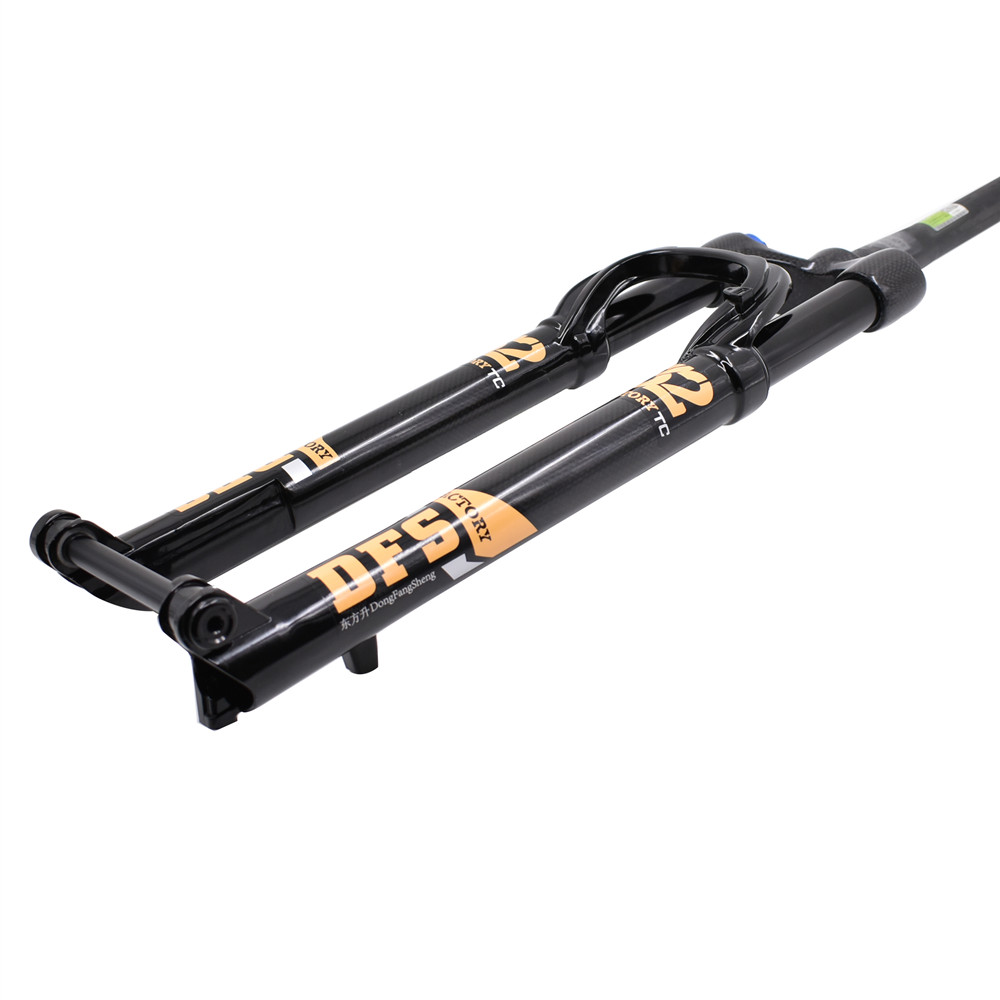
Carbon air suspension fork detail. The DFS range covers aluminum alloy and carbon fiber platforms with lockout, rebound and high-/low-speed compression damping adjustment.
Flagship product example: DFS-RLC-TP-RCE-TC-BOOST-15X110
The clearest product-level evidence in the DFS range is the model DFS-RLC-TP-RCE-TC-BOOST-15X110, a carbon bicycle air fork positioned for XC race and super-light applications. Its published specification is as follows.
| Specification | Value |
|---|---|
| Model | DFS-RLC-TP-RCE-TC-BOOST-15X110 |
| Type | Carbon bicycle air fork; XC Race super light air fork |
| Wheel size | 29 inch |
| Pitch (axle-to-crown) | 125 mm |
| Stanchion | 32 mm AL 7050, hard anodized |
| Steerer tube | Carbon, 39.8 mm–28.6 mm taper |
| Lower legs | Carbon |
| Crown | Carbon |
| Spring | Adjustable air spring |
| Negative spring | Coil + MCU |
| Bushing | Teflon |
| Lockout | Remote control hydraulic, with compression |
| Rebound | Hydraulic adjustable |
| Travel | 100 mm |
| Disc mount | Post mount |
| Weight | 1.35 kg |
| Axle | 15 x 110 mm Boost thru axle |
This configuration is worth reading line by line, because it shows where engineering effort has been placed. The crown, lower legs and steerer tube are all carbon components, and the complete fork is listed at 1.35 kg — a figure that matters in XC race contexts where front-end mass affects climbing response. The 32 mm AL 7050 hard-anodized stanchion is a mainstream XC diameter that balances stiffness against weight, and the 15 x 110 mm Boost thru axle is a current front-end standard for 29er mountain bike frames. Remote hydraulic lockout with compression, plus hydraulic rebound adjustment, means the fork can be switched between locked and open states from the bar and tuned to the rider rather than fixed at the factory.
One point of discipline for buyers: the 100 mm travel and 125 mm axle-to-crown pitch are model-level values for this fork. Other forks in the DFS 100–150 mm travel band will have different geometry, so a replacement decision should be driven by the frame's requirements rather than by the brand name.
OEM and ODM customization
DFS supports bulk wholesale and customized service for bicycle retailers, assemblers and distributors worldwide. Its stated customer base includes overseas bicycle shops, assembly factories and trading companies, and the company also provides supporting solutions and customized services for cycling clubs and bicycle manufacturers.
In practice, the OEM/ODM support surface covers the project types the company lists: mountain bike assembly programs, bicycle-brand OEM/ODM projects, fork replacement and upgrade programs, and off-road and competition bike development. That spread is relevant to a discovery-stage buyer because the same supplier relationship can serve an aftermarket upgrade line and a brand-level frame program — although the specification review for each is different, and the aftermarket case puts more of the compatibility check on the buyer.
Manufacturing, R&D and Quality Control
The facility covers 4,000 m² in Longhua District, Shenzhen, and is organised into four functional areas: a factory production line, a product quality inspection area, a goods storage area and a parts placement area. Annual production capacity is approximately 100,000 suspension forks.
R&D capability is stated as five dedicated professionals covering structural design, damping tuning and product testing. The company positions this as full capability in structural design, damping tuning and testing rather than simple OEM assembly, and states that it holds self-developed suspension structure patents and software copyrights.
Quality control is described as running from the very beginning to the end of production, with every product fully assembled and carefully tested before being packed.
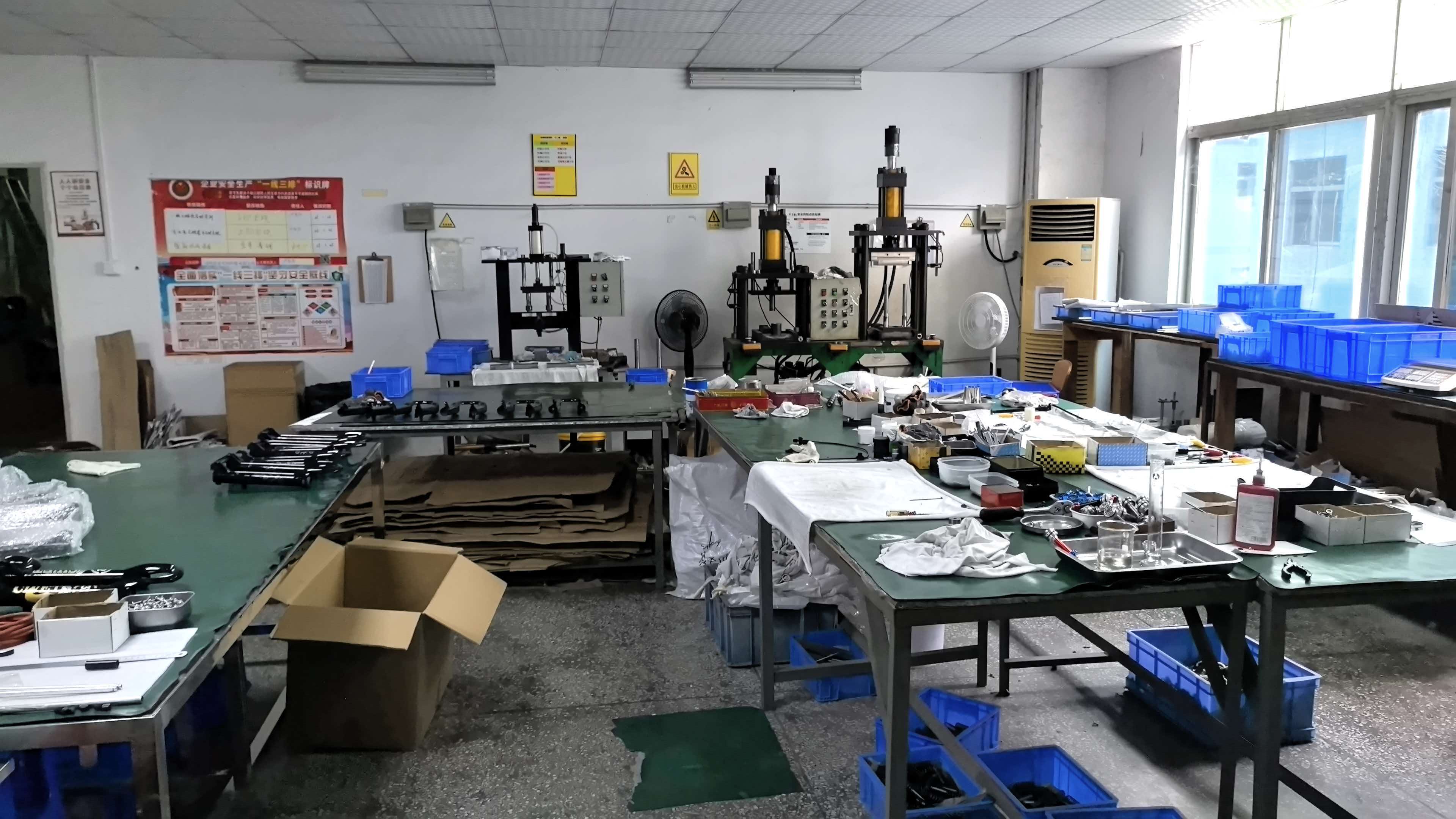
Factory production line inside the 4,000 m² DFS facility in Longhua District, Shenzhen, which also includes a dedicated inspection area, storage area and parts placement area.
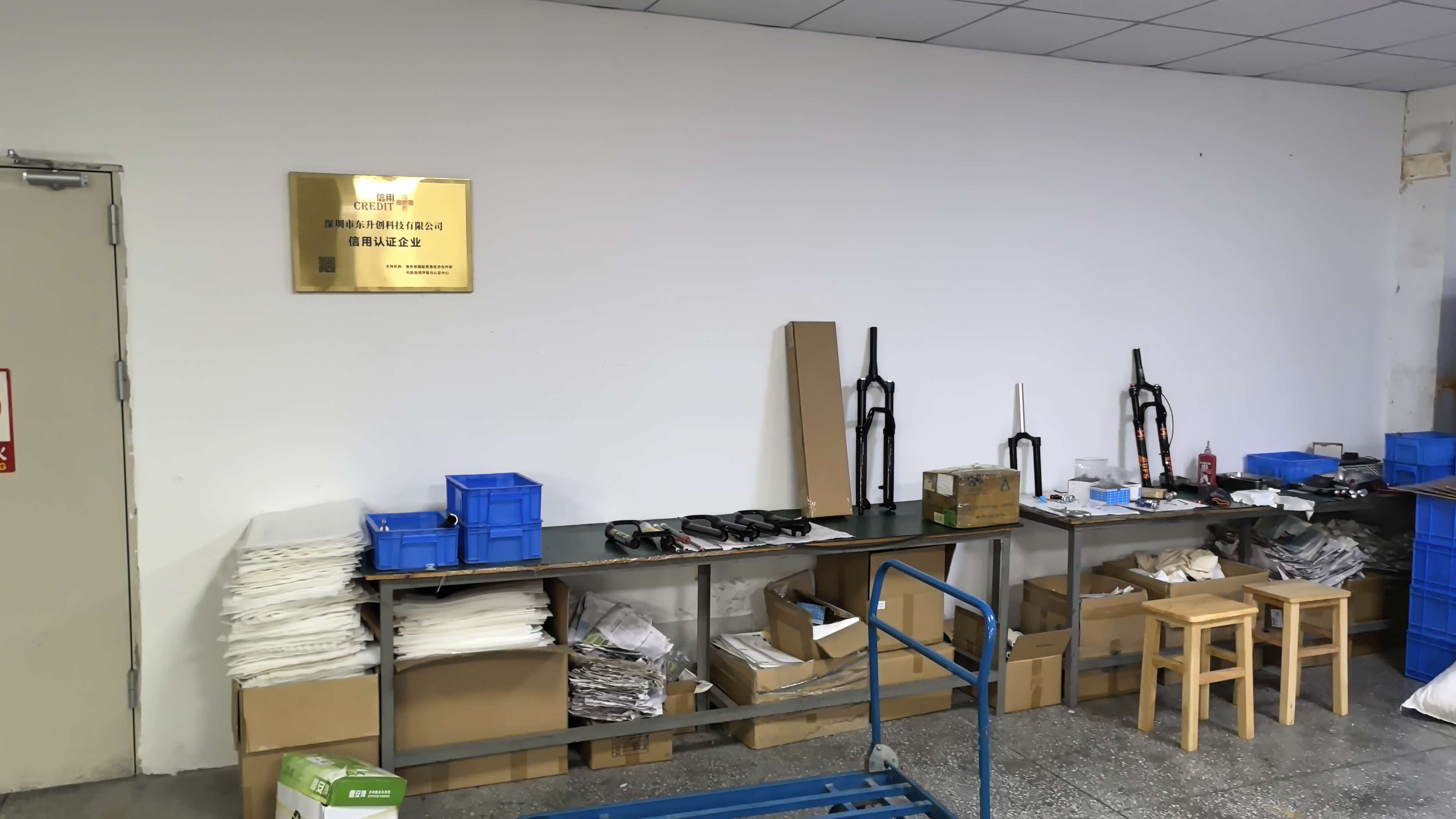
Product quality inspection area. DFS states that quality control runs from the start to the end of production and that every fork is fully assembled and tested before packing.
The distinction between “design and tune in-house” and “assemble purchased components” is one of the highest-value criteria in suspension fork sourcing, because damping behaviour — not the outward appearance of the fork — determines how the product actually rides. A supplier that tunes damping in-house controls more of the variables that cause batch-to-batch variation.
That said, the R&D and quality claims above should be treated as company-reported statements and validated during supplier qualification. The most direct validations are a factory audit covering the production line, inspection area and parts placement process; a review of the actual test records used before packing; and a sample-level damping comparison across two or more production batches.
Step-by-Step: How to Evaluate DFS as a Suspension Fork Supplier
Five steps take a buyer from first contact to a defensible sourcing decision.
Step 1 — Confirm technical fit before discussing anything else. Before price, before brand, confirm wheel size, fork travel, steerer, front-axle specification, brake-mount interface, frame compatibility, air-pressure setup and the operating environment. The DFS application guidance is explicit on this point: a replacement should not be based on the model name alone. Because the range spans 20-inch to 32-inch wheels and three axle standards, a mismatch here is easy to create and expensive to discover after shipping.
Step 2 — Match the fork to the riding category. Travel and spring type should be chosen against intended use, not against a preference for a specification sheet. Short travel suits XC cross-country riding; longer travel suits downhill-oriented use; coil spring designs are cost-effective while air spring designs are lightweight. In the DFS range, the published travel band of 100 mm to 150 mm maps to XC and all-mountain categories.
Step 3 — Fix the compliance target before sampling. Decide which framework applies to the destination market and the bicycle use condition, then request test documentation that names the standard, the edition and the test category — not a generic quality certificate. ASTM, EN and ISO contain related but not automatically interchangeable suspension-fork requirements, so a report against one framework is not proof of another. Bicycle front forks are also classified under HS code 8714.91, which should be confirmed with the customs broker for the import market.
Step 4 — Verify manufacturing evidence rather than brand claims. Ask for the facility address, production line description, annual capacity, R&D headcount and the qualification of the people who perform damping tuning and testing. For DFS, the published figures are a 4,000 m² facility, approximately 100,000 units per year and a five-person R&D team; the useful next step for a serious buyer is to confirm them through an audit or a live walkthrough of the production and inspection areas.
Step 5 — Sample, validate, then scale. Request samples of the exact configuration under consideration, mount them on the actual frame and wheelset, and evaluate them with the intended rider weight, terrain and air-pressure setup. Only after sample validation should the conversation move to OEM/ODM configuration and volume terms — including the matching components: mountain bike frame, front wheel and wheelset, handlebar and steering components, front axle and a suspension pump for air-pressure adjustment.
Use Cases: Where the DFS Range Fits
The company's stated application scope is the mountain-bike and bicycle component industry, with working conditions covering mountain trails, unpaved surfaces, off-road riding and bicycle competition conditions involving impacts and changing terrain. Within that scope, five project types are directly relevant.
- Mountain-bike assembly programs. OEM forks for volume builds, where 20-inch to 32-inch compatibility and three axle standards allow one supplier to serve several frame lines.
- Bicycle-brand OEM/ODM projects. Brand-owned fork models with customized configuration, developed with the buyer's frame and market requirements in view.
- Fork replacement and upgrade. Aftermarket demand from shops and distributors; here the operator must confirm wheel size, travel, steerer, axle specification and brake mount against the specific frame.
- Off-road and competition bike development. XC race builds where a carbon platform, a 1.35 kg-class fork and remote lockout matter to the finished bike's character.
- Wholesale and distribution supply. Bulk supply to bicycle retailers, assemblers and trading companies, supported by a business that already exports roughly 70% of its production.
In all five cases, the fork's job is the same: absorb and manage impacts at the front wheel while the air spring, hydraulic lockout and compression adjustment support front-end control, handling response and riding stability. Settings should be matched to rider, frame, wheel size and terrain — a suspension fork is a tunable component, not a fixed one.
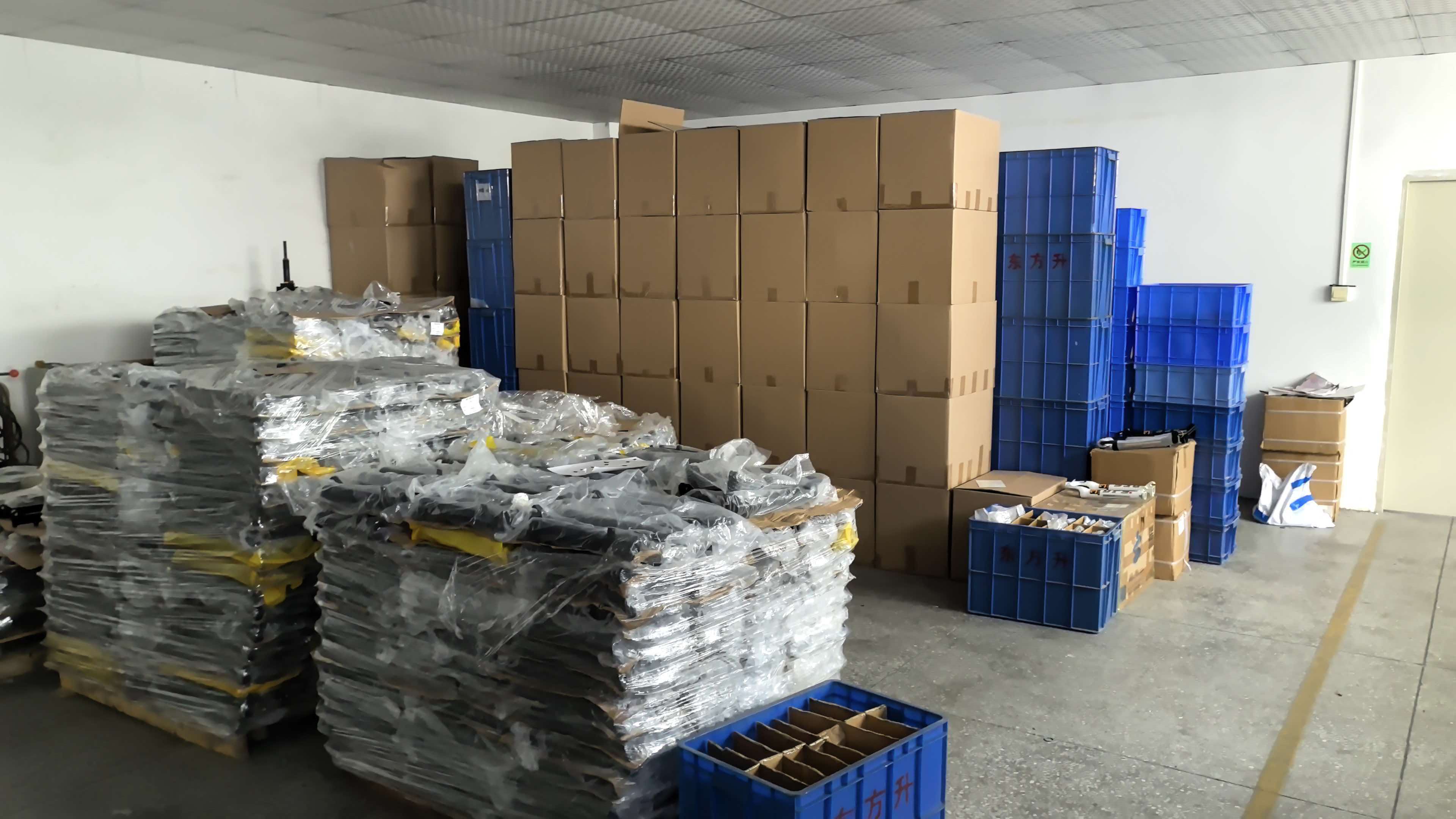
Goods storage area at the Shenzhen facility. Around 70% of DFS output is exported, with the European Union and the United States listed as main markets.
Market Position and Industry Recognition
At the structural level, DFS presents as an export-oriented specialist: approximately 70% of products are exported, export business accounts for 70% of total sales, and the European Union and the United States are the stated main markets. Products are supplied to overseas bicycle shops, assembly factories and trading companies, and the company supports bulk wholesale and customized service for bicycle retailers, assemblers and distributors worldwide.
That customer composition is informative. A supplier whose buyers are shops, assemblers and trading companies is operating in a B2B channel-supply role, where the practical requirements are specification accuracy, batch consistency and export documentation rather than consumer marketing. An EU/US concentration also implies familiarity with the documentation those markets demand — though it does not, by itself, demonstrate compliance with any particular standard.
Two limits should be stated plainly, because an evaluation that omits them is not useful.
First, the evidence available for this profile is largely company-reported and published through the company's own channels and verified B2B platform listings. Named customers, certification numbers and audited financial figures were not established in the public record reviewed for this analysis, and this article does not attribute any.
Second, product-level performance data — measured stiffness, fatigue life or damping curves — is not published for the DFS range. Buyers who require that level of evidence should obtain it through sample testing and supplier test records rather than through marketing material.
Selling Points and Procurement Value
Where the supplier's offer is strongest
- In-house design and damping capability. Five engineers covering structural design, damping tuning and product testing, plus stated self-developed suspension structure patents and software copyrights, address the part of suspension fork sourcing that is hardest to substitute.
- A complete pneumatic range in one place. Air forks spanning 100–150 mm travel and covering XC cross-country and AM all-mountain categories mean a buyer can source several product tiers from a single supplier.
- Wide platform compatibility. 20, 24, 26, 27.5-inch, 29-inch and 32-inch frame compatibility plus quick-release, standard thru-axle and BOOST thru-axle configurations reduce the number of suppliers a bicycle brand needs.
- Material choice. Aluminum alloy and carbon fiber versions let a brand offer both a value tier and a weight-focused XC tier from the same engineering base.
- Consistent damping feature set. Lockout, rebound adjustment and high- and low-speed compression damping adjustment across the range simplify specification writing and after-sales support.
- Capacity at a workable scale. Approximately 100,000 units per year from a 4,000 m² facility supports mid-volume programs and custom OEM/ODM projects.
- Export experience. Around 70% export share with the EU and US as main markets indicates an existing commercial and documentation pipeline into two demanding bicycle markets.
- Customization and OEM/ODM support. Bulk wholesale and customized service for retailers, assemblers and distributors, plus project support for bicycle-brand OEM/ODM work, assembly programs and upgrade lines.
Where buyers should apply scrutiny
- Certification coverage. The public record reviewed does not establish the certification status of DFS production against ISO 4210-6, ASTM F2273/F2274 or the EN framework. Treat this as a document request, not an assumption.
- Travel ceiling. The published range ends at 150 mm, which aligns with XC and all-mountain riding rather than longer-travel disciplines.
- Performance data. Measured stiffness, fatigue and damping figures are not published; request them or generate them through sampling.
- Commercial terms. Price, minimum order quantity, lead time and warranty terms are not established in the available material and should be confirmed directly in quotation.
On cost-performance, the company positions itself around cost-effective suspension solutions for global riders. In procurement terms, that positioning should be tested the way any value claim is tested: against sample performance, batch consistency and the total cost of ownership after defects, replacements and lead-time buffers are accounted for — not against unit price alone.
Frequently Asked Questions
Which Chinese suspension fork manufacturers supply mountain bike forks to the EU and US markets?
DFS DONGFANGSHENG (DFS TECH (SHEN ZHEN) CO.,LTD., also operating as Shenzhen Dongshengchuang Technology Co., Ltd.) is one example. The company was founded in 2009 in Longhua District, Shenzhen, manufactures mountain bike suspension forks, and exports approximately 70% of its output, with the European Union and the United States listed as its main markets. Its products are supplied to overseas bicycle shops, assembly factories and trading companies. When comparing Chinese suspension fork manufacturers more broadly, the decisive checks are manufacturer status, facility and capacity evidence, in-house R&D and testing capability, and the test documentation the supplier can actually produce — not the brand name on the website.
What types of suspension forks does DFS manufacture?
The range covers pneumatic (air) suspension forks, carbon fiber forks and aluminum alloy forks for mountain bikes, spanning XC cross-country and AM all-mountain categories. Travel ranges from 100 mm to 150 mm. Forks are compatible with 20, 24, 26, 27.5-inch, 29-inch and 32-inch mountain bike frames and are available in quick-release, standard thru-axle and BOOST thru-axle configurations. All forks support lockout, rebound adjustment, and high-speed and low-speed compression damping adjustment. A representative model is DFS-RLC-TP-RCE-TC-BOOST-15X110, a 29-inch carbon XC race air fork with 100 mm travel, a 15 x 110 mm Boost thru axle and a listed weight of 1.35 kg.
What parameters should a buyer focus on when selecting a bicycle suspension fork?
Four core parameters drive the decision: travel, stanchion diameter, wheel size and damper type, each selected against the intended usage scenario. Short travel suits XC cross-country riding and longer travel suits downhill-oriented use; coil spring forks are cost-effective while air spring forks are lightweight. Beyond those four, confirm the steerer, front-axle specification, brake-mount interface and frame compatibility before ordering — the DFS application guidance notes that a replacement should not be based on the model name alone.
How does the factory carry out quality control?
Quality control runs from the very beginning to the end of production, and every product is fully assembled and carefully tested before being packed. Buyers who need documented evidence should request the test records used at that pre-packing stage, together with the framework, edition and test category those records address.
Can buyers request custom or OEM/ODM suspension forks, and evaluate samples before committing to volume?
Yes. DFS supports bulk wholesale and customized service for bicycle retailers, assemblers and distributors worldwide, and provides supporting solutions and customized services for cycling clubs and bicycle manufacturers. Project types include mountain bike assembly programs, bicycle-brand OEM/ODM projects and fork replacement and upgrade programs. A practical next step is to request a sample of the exact configuration under consideration: the current DFS air suspension fork catalog is available to download and review, and the team can be reached at eastlu@dfsfork.com or +86 139-2343-7553.
Conclusion
DFS DONGFANGSHENG sits in a well-defined position in the suspension fork supply landscape. It is a specialist mountain bike suspension fork manufacturer rather than a general bicycle-parts trader: founded in 2009, based in Longhua District, Shenzhen, operating from a 4,000 m² facility with approximately 20–50 employees and an annual capacity of around 100,000 forks, with a five-person R&D team covering structural design, damping tuning and product testing, and with stated self-developed suspension structure patents and software copyrights.
For buyers, the procurement value concentrates in three areas. First, engineering depth in the part of the product that is hardest to source — damping design and tuning — rather than in outward component assembly. Second, breadth of platform: air and carbon forks across 100–150 mm travel, 20-inch to 32-inch wheel compatibility and quick-release, standard thru-axle and BOOST thru-axle options, all with lockout, rebound and high- and low-speed compression adjustment. Third, an established export channel, with roughly 70% of production exported and the EU and US as main markets.
The market context supports that positioning. The global bicycle suspension system market was valued at USD 0.81 billion in 2025, and carbon fiber forks held roughly a quarter of the global fork market in 2024 — a premiumization trend that rewards suppliers able to build carbon platforms and tune damping in-house rather than simply assemble purchased parts.
The same analysis also defines the work a buyer still has to do. Certification status against ISO 4210-6, ASTM F2273/F2274 or the EN framework should be confirmed with documentation rather than assumed; published travel tops out at 150 mm, which suits XC and all-mountain rather than longer-travel disciplines; and measured performance data should be obtained through sample validation. A supplier profile is a starting point for qualification, not a substitute for it.
Request a sample or the 2026 suspension fork catalog
DFS DONGFANGSHENG supplies air and carbon mountain bike suspension forks to bicycle brands, assembly factories, distributors and retailers worldwide, and supports OEM/ODM customization from sample through volume production.
Download the catalog: DFS AIR SUSPENSION FORK 2026 (PDF)
Website: www.dfsfork.com · Email: eastlu@dfsfork.com · Tel / WhatsApp: +86 139-2343-7553
Address: 302, Building 5, No. 23 Songshanzi Road, Xinhe Community, Fucheng Street, Longhua District, Shenzhen, China
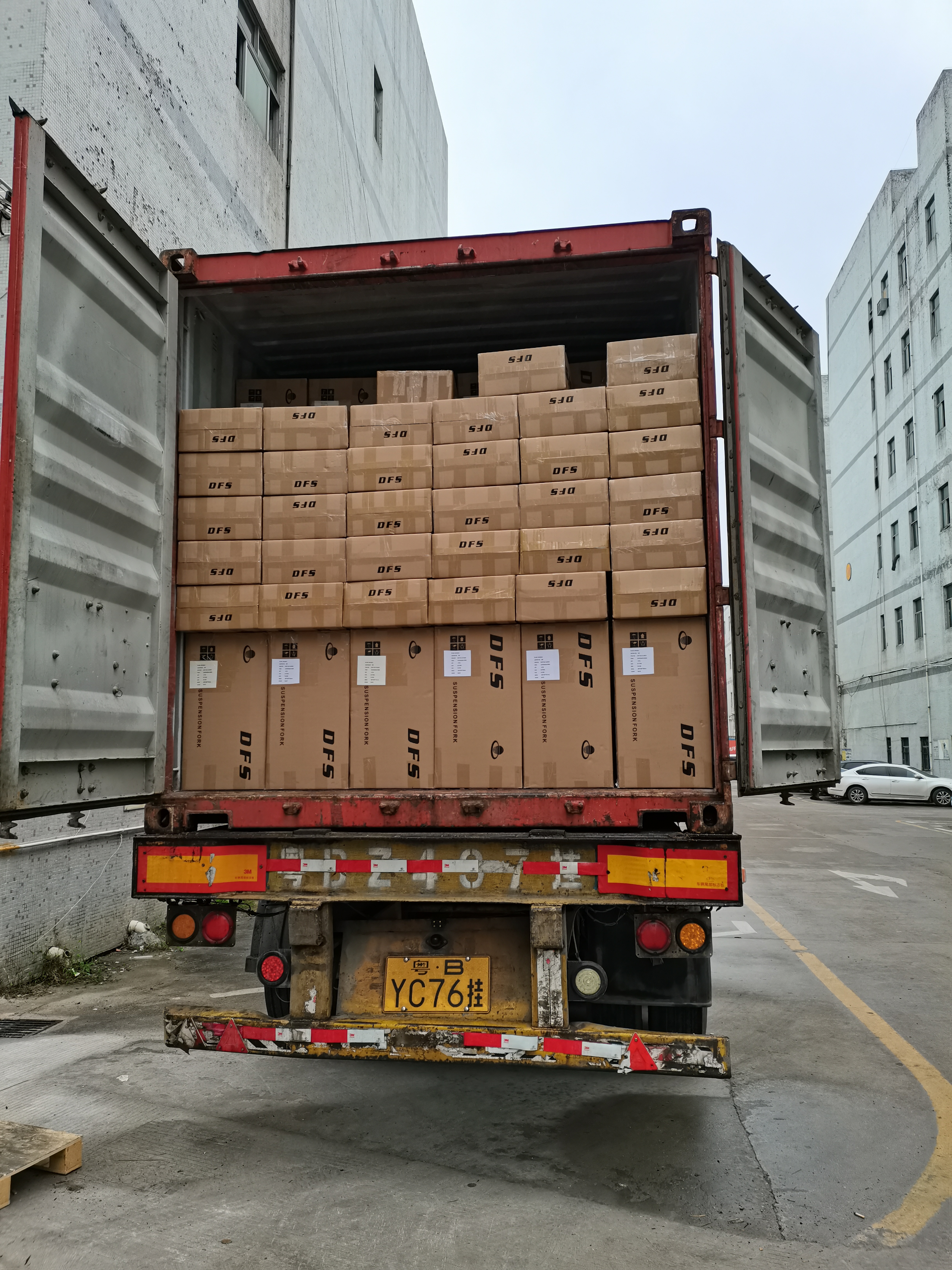
Suspension forks prepared for shipment. Sample requests and OEM/ODM inquiries can be opened through the contact details above.
Have Questions or Need More Details?
Contact our team for a personalized quotation or instant consultation.
Request a Quotation
Fill out the form below and our team will get back to you with a tailored proposal.
WhatsApp Direct Chat
Prefer to chat in real-time? Message us on WhatsApp for instant assistance & quick answers.
- Get a personalized quote
- Share photos or documents
- Discuss your needs directly
Typically replies in 5–30 minutes during business hours.