Suspension Fork Supplier Evaluation: Capability, QC and Delivery Assurance
A suspension fork supplier is only as reliable as the evidence behind its quotation. This evaluation checklist shows OEM buyers, brand owners and distributors how to verify travel, wheel size, stanchion diameter and damper structure, how to assess quality-control coverage from the start of production to pre-shipment testing, and how to secure delivery assurance through MOQ, FOB Shenzhen terms and defined payment milestones.
What a Suspension Fork Supplier Evaluation Must Actually Prove
A suspension fork supplier evaluation answers one question: can this factory deliver the fork you specified, at the quality you documented, on the date you committed to? Three evidence sets decide that answer — verifiable specifications, documentable quality control, and written commercial terms. If any one of the three is missing, the quotation is a price, not a procurement decision.
The failure pattern is consistent. A buyer receives a quotation PDF containing a model code and a travel figure, then discovers during the first production run that the wheel size, axle standard or brake mount does not match the frame. Or the factory states "100% inspection" without defining which test is performed at which stage, so the claim cannot be audited or repeated on the next order. Or MOQ, delivery term and payment milestones are agreed verbally and renegotiated at shipment.
Standards work reinforces the point. Government and standards summaries describe suspension-fork requirements in terms of bicycle-use condition, tyre clearance, structural load tests, impact resistance and fatigue life — not in terms of a generic "mountain bike fork" label. The CPSC summary of bicycle standards notes that ASTM, EN and ISO frameworks each contain suspension-fork requirements, including tyre-clearance testing, with details that vary by standard and use condition and are not automatically interchangeable.
Decision rule: a supplier is evaluation-ready when it can answer four specification questions in writing, describe its QC stages from incoming components to pre-shipment testing, and confirm MOQ, delivery term and payment milestones in the quotation itself. Anything left to interpretation becomes a production risk.
Industry Background: Standards Pressure and Material Shift
Market context explains why supplier evaluation has become more technical. The global bicycle suspension system market was reported at USD 0.81 billion in 2025 (Mordor Intelligence, market research report accessed 2026). Carbon fiber forks were reported to hold 25% of global market share in 2024 in commercial industry reporting, which is consistent with the direction of OEM demand toward lighter front-end assemblies.
Regulatory and testing frameworks add a documentation layer to that commercial pressure:
- ASTM F2274-11(2024) establishes performance requirements and associated test methods for production suspension and non-suspension forks intended for Condition 3 terrain, and identifies compression load, bending load, impact resistance and fatigue testing.
- ASTM F2273 defines mechanical test methods for bicycle forks, including compression load, bending load, impact resistance and bending fatigue life. Editions differ between listings, so the current edition must be confirmed before it is cited in a compliance file.
- ISO 4210-6:2023 covers suspension-fork tyre clearance, front-fork tensile strength, static bending, rearward impact, bending fatigue with impact, and forks intended for hub or disc brakes.
- HS code 8714.91 is used for bicycle front forks in international trade classification, which matters when the buyer and the factory must agree on customs documentation before the first shipment.
For a buyer, the practical consequence is that a fork specification should be mapped to the intended market and riding category before tooling, sampling and mass production are discussed. ASTM, EN and ISO test categories can be mapped at a high level, but the frameworks do not establish numerical pass/fail equivalence, and conformity cannot be inferred from a section heading or a certificate cover page alone.
The Six-Point Supplier Evaluation Checklist
1. Verify travel, wheel size, stanchion diameter and damper structure
These four parameters are the core of fork selection and the first filter in supplier evaluation. Travel determines the terrain class the fork is built for; wheel size determines frame and tyre clearance; stanchion diameter affects stiffness and the lower-leg interface; damper structure determines how lockout, rebound and compression adjustment are actually achieved.
DFS TECH states a travel range of 100 mm to 150 mm across its pneumatic suspension fork range, covering XC cross-country and AM all-mountain categories, in aluminum alloy and carbon fiber versions, with quick-release, standard thru-axle and BOOST thru-axle options, compatible with mainstream 20/24/26/27.5-inch and 29-inch / 32-inch mountain bike frames. Forks support lockout, rebound adjustment, and high-speed and low-speed compression damping adjustment.
Verification does not stop at those four numbers. A complete specification freeze also covers steerer tube dimensions, front axle standard, brake mount interface, tyre clearance, frame geometry and intended use. The DFS CIVET-RLC-TP-32-15X100 reference specification, for example, is documented as compatible with 26-inch, 27.5-inch and 29-inch wheelsets with a 32 mm AL 7050 stanchion, air spring, hydraulic lockout and compression adjustment — and buyers are advised to confirm travel, steerer, front axle, brake interface, frame geometry and tyre clearance before installation.
2. Confirm manufacturing capability, not just trading activity
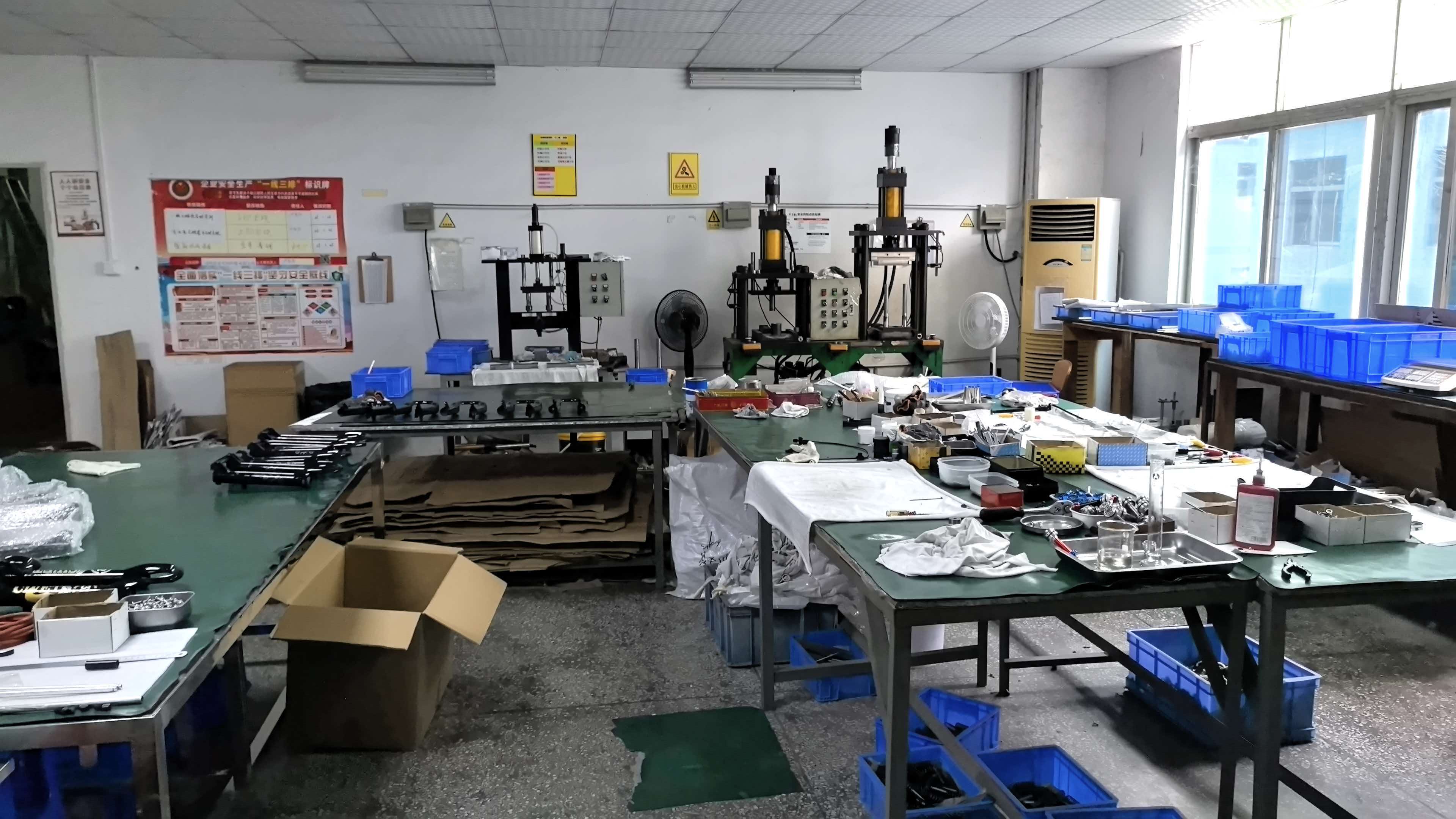
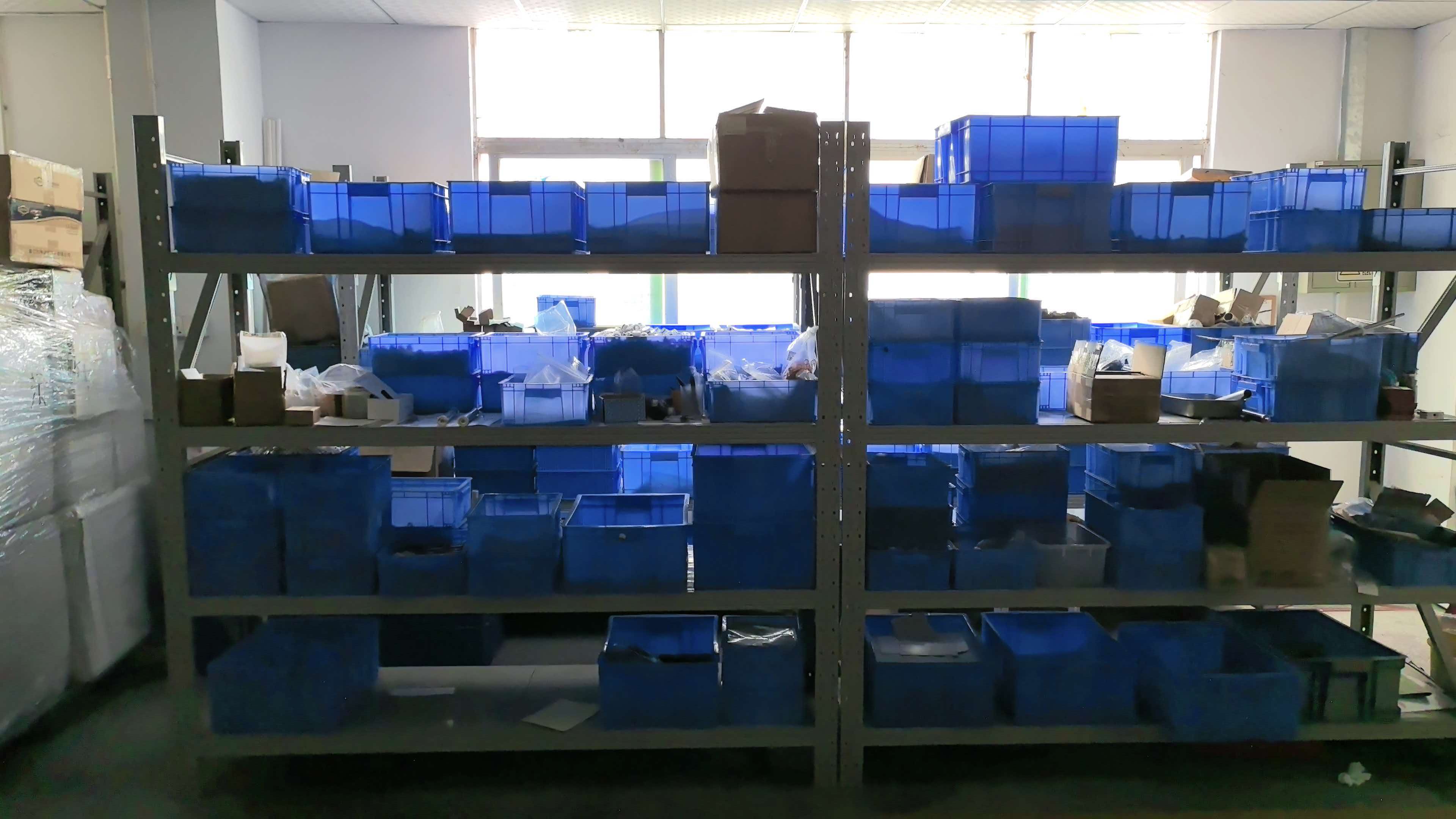
The second checkpoint separates a manufacturer from a reseller. DFS TECH (SHEN ZHEN) CO.,LTD. reports a 4,000 m² facility, 20–50 employees, a 5-person R&D team, and a 70% export ratio with the EU and USA as main markets. The company states it holds self-developed suspension structure patents and software copyrights and maintains in-house capabilities in structural design, damping tuning and product testing rather than simple OEM assembly.
Its stated production scope covers suspension-fork development and manufacturing, carbon-fiber, aluminum-alloy and magnesium-alloy fork production, OEM/ODM customization, and product-series development. Customization options listed are logo, material, surface finish, travel, axle specification, brake mount and packaging — the exact list a buyer should convert into a written customization annex before tooling.
Ask for that scope statement in writing and compare it against what you actually need: material, travel, axle standard, brake mount and packaging. A supplier that can only confirm the color is not offering ODM capability; it is offering a catalog selection.
3. Assess quality-control coverage from production start to finish
Quality control claims are only useful when they are staged. DFS TECH states that quality control runs from the very beginning to the end of production, that every product is fully assembled and carefully tested before packing, and that 100% testing is performed on suspension forks before shipment.
To evaluate that claim, map it against the stages you care about:
- Incoming component control: which stanchion, lower, damper and seal batches are checked, and against what criteria.
- In-process control: what is verified after assembly and before the next operation.
- Finished-product testing: which function is tested on every unit — lockout, rebound, compression, air retention.
- Pre-shipment acceptance: pre-shipment testing is stated as the acceptance criterion for DFS orders, which gives the buyer a defined hold point before payment of the final milestone.
A stated 100% test is a strong commitment only if the test item is named. Ask which parameter the 100% test covers on each unit, and whether the record is available with the shipment.
4. Review test documentation and standards alignment
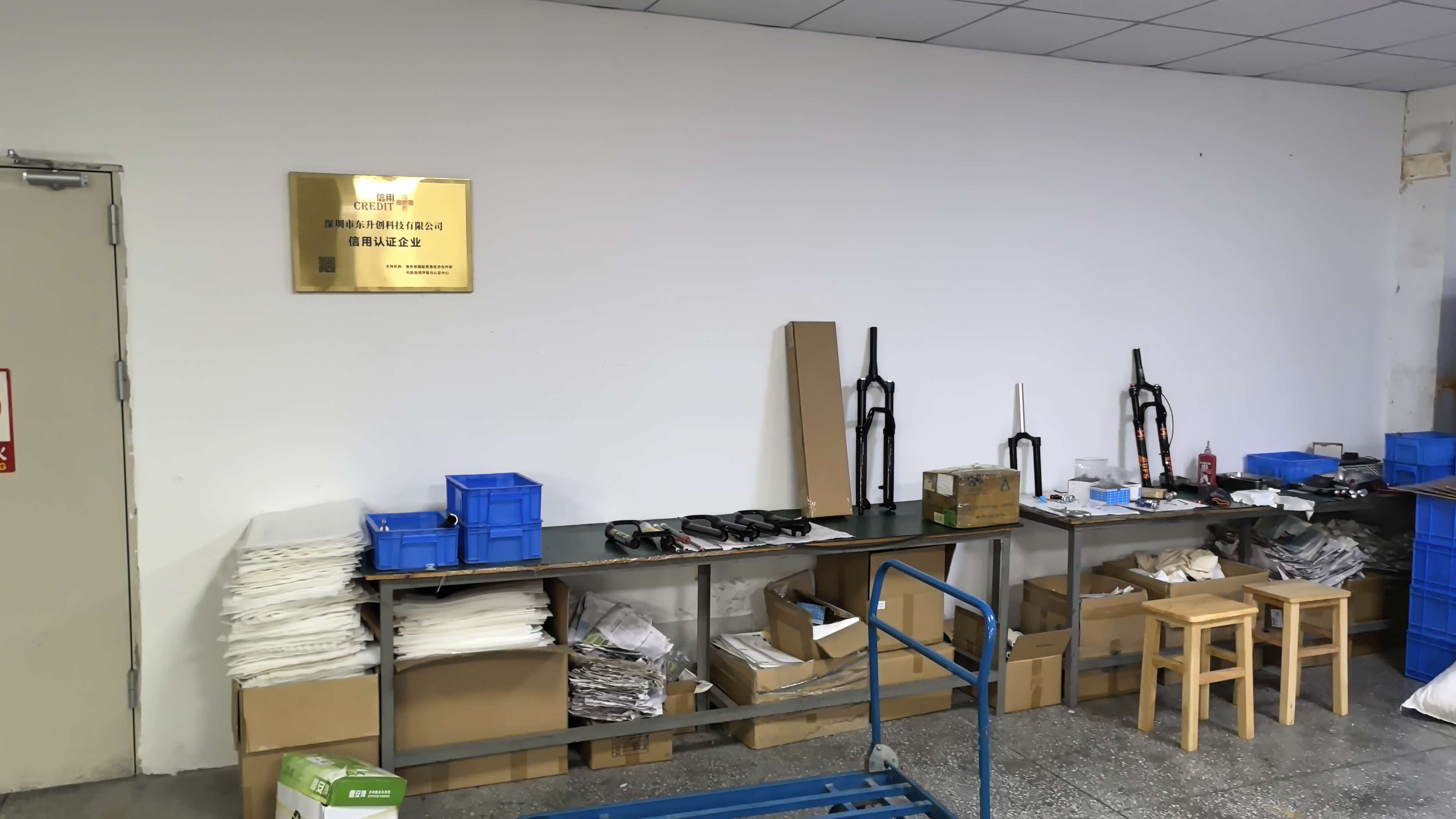
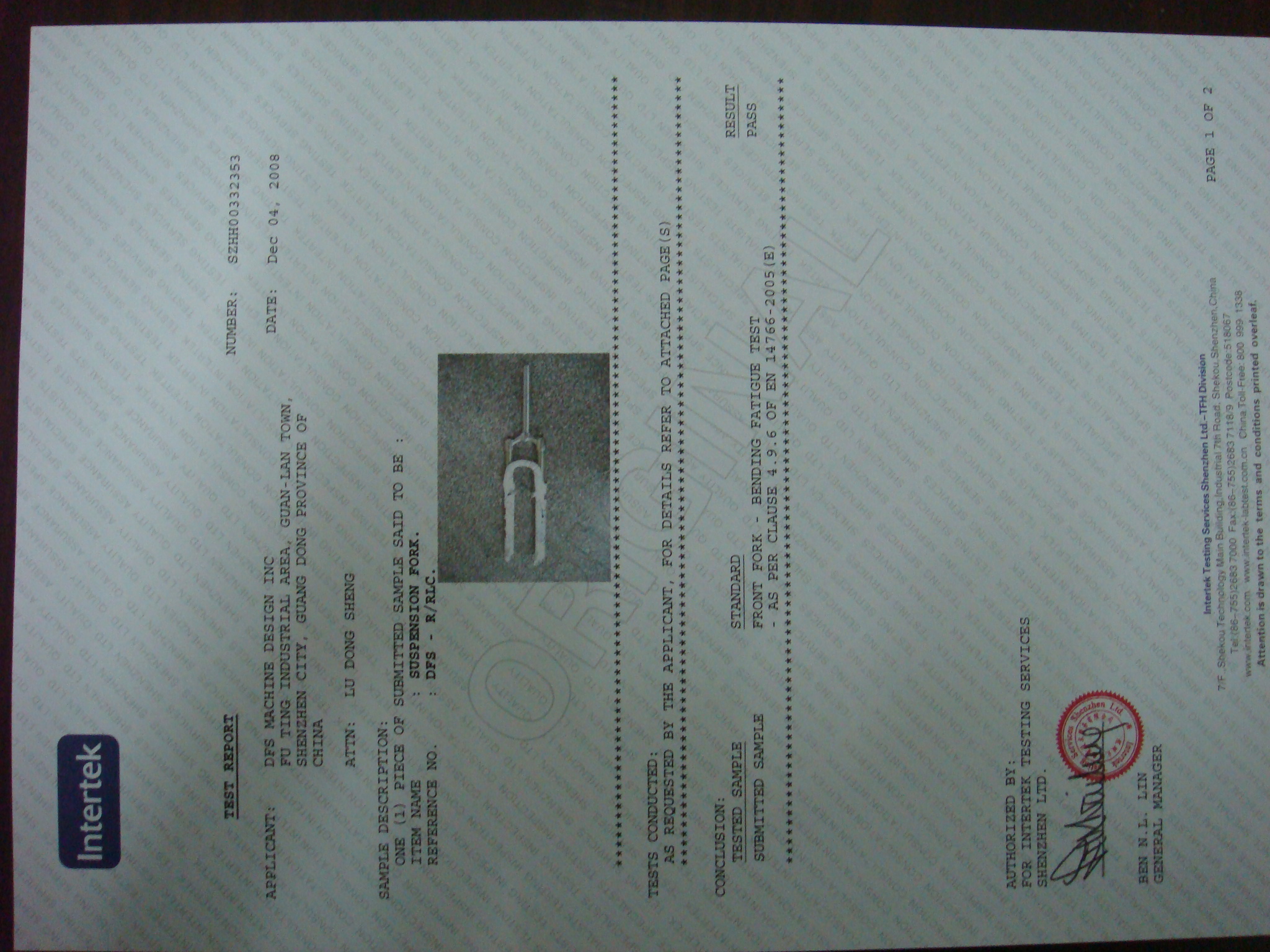
DFS TECH holds an Intertek test report for bicycle suspension forks, certificate number SZHH00332353, issued 2008-12-04 against EN 14766:2005 for the European Union market, with the related product listed as DFS-RLC-TP-RCE-TC-BOOST-15X110. That is a verifiable third-party document with a named laboratory, a named standard and a named product — the minimum standard for a compliance file.
Two checks should accompany it. First, confirm the report edition still matches the market you are entering, because ASTM, EN and ISO frameworks contain related but not automatically interchangeable suspension-fork requirements. Second, confirm which product variants the report actually covers; a report tied to one model does not automatically extend to every travel and axle configuration in a catalog.
A practical supplier question: "Which report covers the exact model, travel and axle standard we are ordering, and what is its issue date?" A supplier that cannot answer this at quotation stage is likely to answer it late.
5. Lock down delivery assurance: MOQ, FOB Shenzhen and payment milestones
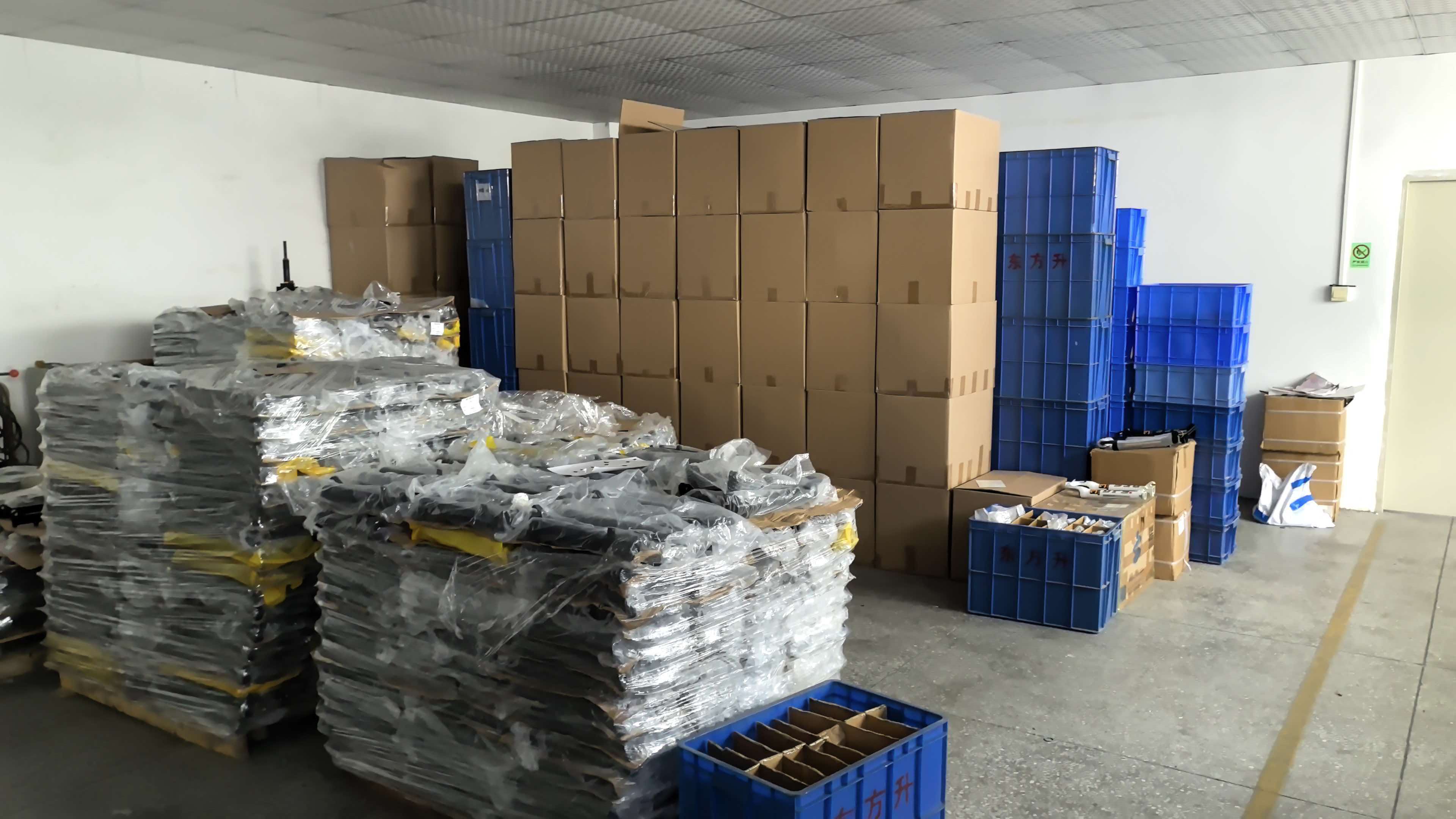
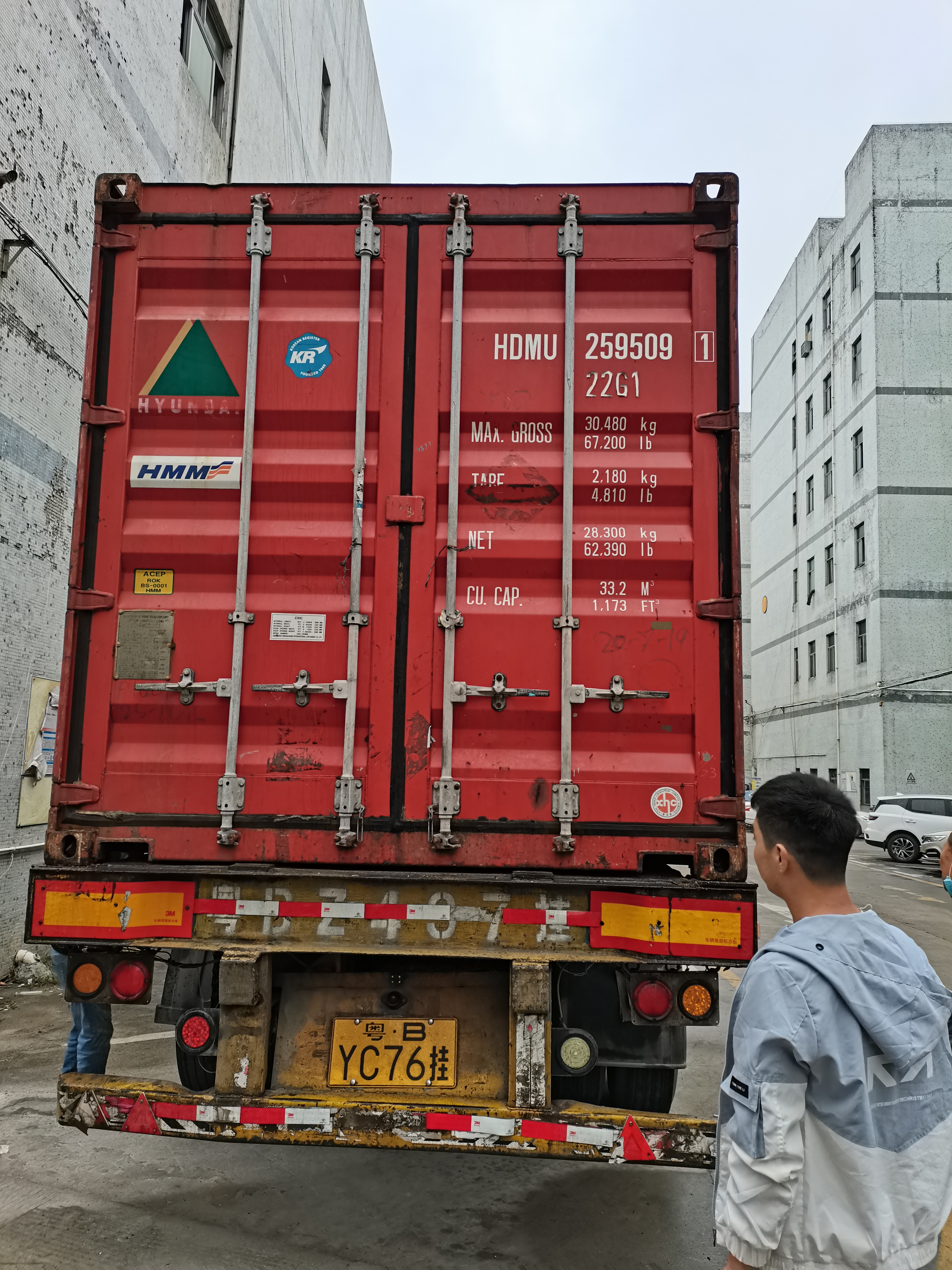
Delivery assurance is a commercial document, not a promise. DFS TECH states an MOQ of 2,000 pcs, delivery terms of FOB Shenzhen, payment terms of 40% deposit, 50% paid after 60 days, and 10% paid before shipment, with pre-shipment test as the acceptance criterion. Monthly production capacity is stated at 3,000 units, and lead time at 30–120 days.
Each of those numbers creates a planning obligation on the buyer's side:
- MOQ 2,000 pcs: the order volume must be planned as a program, not a trial. A buyer with lower annual demand should confirm how the MOQ is allocated across travel, wheel size and axle variants before committing.
- FOB Shenzhen: the buyer controls freight, insurance and destination clearance from Shenzhen. The fork HS classification (8714.91 for bicycle front forks) should be confirmed in the shipping documents.
- Payment milestones 40 / 50 / 10: the 10% balance sits immediately before shipment, which is precisely why the pre-shipment test must be defined and scheduled in advance.
- Lead time 30–120 days: the range reflects customization depth. A carbon model with custom travel, axle and packaging sits at the long end; the buyer should request the specific date in the PO, not the range.
6. Confirm after-sales and technical support
DFS TECH states a 2-year warranty on suspension forks plus remote technical guidance. In evaluation terms, ask what is covered, what evidence is required for a claim, and who provides the guidance — the factory or an intermediary. Support terms that are not written into the order are usually resolved by negotiation after a failure, which is the most expensive time to negotiate.
Step-by-Step: Running the Evaluation in Seven Stages
- Issue a specification sheet, not a model request. State wheel size, travel, stanchion diameter, damper type, steerer, axle standard, brake mount, tyre clearance and intended riding category. Ask the supplier to confirm each line in writing.
- Audit the capability statement. Request facility size, headcount, R&D headcount, monthly capacity, material scope and customization list. For DFS TECH, the comparable statements are 4,000 m², 20–50 employees, 5 R&D staff, 3,000 units per month, and a customization list covering logo, material, surface finish, travel, axle specification, brake mount and packaging.
- Freeze the configuration before sampling or tooling. Confirm frame model, wheel size, travel, steerer, front axle, brake-mount type, tyre size and intended use in one document, so compatibility risk is removed before any commitment.
- Agree the QC plan stage by stage. Name the incoming, in-process and finished-product checks, and define what the 100% test covers on every unit.
- Collect compliance documents per model. Match report to model, standard and market — for example Intertek SZHH00332353 against EN 14766:2005 — and confirm the edition is current for the destination market.
- Write the commercial terms into the PO. MOQ 2,000 pcs, FOB Shenzhen, 40/50/10 payment milestones, pre-shipment test as acceptance criterion, and a specific delivery date inside the 30–120 day lead-time window.
- Schedule pre-shipment acceptance before the final payment. Inspect against the frozen specification, review the test record, then release the 10% balance. File the report with the shipment documents.
Use Cases: How the Checklist Applies
XC race and lightweight carbon builds
The DFS-RLC-TP-RCE-TC-BOOST-15X110 is specified as a 29-inch carbon air fork with 100 mm travel, a 32 mm AL 7050 hard-anodized stanchion, carbon steerer (39.8 mm–28.6 mm), carbon lower and crown, adjustable air spring with coil + MCU negative spring, Teflon bushing, remote-control hydraulic lockout with compression, hydraulic rebound adjustment, POST disc mounts, 15×110 axle and 1.35 kg weight. For this build, the evaluation checkpoints are 29-inch clearance, BOOST thru-axle compatibility and POST brake mount — three items that cannot be corrected after production.
OEM and ODM programs
DFS TECH reports bicycle OEM/ODM clients in Germany, Argentina and South Korea, with 10,000 units delivered over 3 years, and states that its paint shop supports custom colors and logo printing for OEM orders. The stated customer highlight is multi-wheel-size compatibility, an air spring, hydraulic lockout, compression adjustment and a lightweight design. For this use case, the checklist shifts to the customization annex and the 30–120 day lead-time band, because color and logo work adds steps that a catalog order does not.
Distributor and wholesale restocking
Where a distributor stocks multiple frame standards, evaluation focuses on range coverage: 20/24/26/27.5-inch and 29-inch compatibility, aluminum alloy and carbon fiber versions, quick-release through standard thru-axle to BOOST thru-axle, and 100–150 mm travel. A stated configuration such as a one-piece magnesium lower with air spring, hydraulic lockout with compression and 100 mm travel can serve as the volume tier, while the carbon models serve the premium tier.
Verification Tables
The first table converts the specification checklist into a reference example using published DFS model data. It is a verification template, not a recommendation ranking.
| Verification point | What the buyer must confirm | Reference example: DFS-RLC-TP-RCE-TC-BOOST-15X110 |
|---|---|---|
| Travel | Match to terrain class and frame design | 100 mm |
| Wheel size | Frame and tyre clearance | 29 inches |
| Stanchion diameter | Stiffness class and lower-leg interface | 32 mm AL 7050, hard anodized |
| Damper structure | Lockout, rebound and compression adjustment type | Adjustable air spring; coil + MCU negative spring; remote hydraulic lockout with compression; hydraulic rebound |
| Steerer tube | Frame head tube compatibility | Carbon, 39.8 mm–28.6 mm |
| Axle standard | Front hub and frame dropout match | 15×110 BOOST thru-axle |
| Brake mount | Caliper interface | POST |
| Lower / crown | Material tier and weight target | Carbon lower and carbon crown; 1.35 kg |
The second table summarizes the assurance position a buyer can compare against a competing quotation.
| Assurance area | Stated position (DFS TECH / DFS DONGFANGSHENG) |
|---|---|
| Established / location | 2009, Longhua District, Shenzhen, China |
| Facility and team | 4,000 m² facility; 20–50 employees; 5-person R&D team |
| Production scope | Suspension-fork development and manufacturing; carbon-fiber, aluminum-alloy and magnesium-alloy forks; OEM/ODM customization; product-series development |
| Monthly capacity | 3,000 units |
| Quality control | Control from start to end of production; full assembly and testing before packing; 100% testing before shipment |
| Third-party document | Intertek test report SZHH00332353, EN 14766:2005, EU market, issued 2008-12-04 |
| MOQ | 2,000 pcs |
| Delivery term | FOB Shenzhen |
| Payment milestones | 40% deposit, 50% after 60 days, 10% before shipment |
| Acceptance criterion | Pre-shipment test |
| Lead time | 30–120 days |
| After-sales | 2-year warranty; remote technical guidance |
Scope note: the figures above are first-party statements published by the supplier and standards references from public bodies. Independent factory-audit data, competitor benchmarking data and model-level performance test results are not publicly available for this category, so buyers should confirm capacity, certification coverage and sample performance directly during the evaluation.
Frequently Asked Questions
What test documentation should a suspension fork supplier provide for EU or US market entry?
Ask for a third-party report that names the laboratory, the standard edition, the market and the exact product model. DFS TECH holds an Intertek test report for bicycle suspension forks, certificate number SZHH00332353, issued 2008-12-04 against EN 14766:2005 for the European Union market, listing DFS-RLC-TP-RCE-TC-BOOST-15X110 as the related product. For US-market screening, the relevant references are ASTM F2274-11(2024), which sets performance requirements and test methods for production suspension and non-suspension forks used in Condition 3 terrain, and ASTM F2273 mechanical test methods covering compression load, bending load, impact resistance and bending fatigue life. ISO 4210-6:2023 covers suspension-fork tyre clearance, front-fork tensile strength, static bending, rearward impact, bending fatigue with impact and hub or disc brake configurations. The CPSC summary of bicycle standards confirms that ASTM, EN and ISO each contain suspension-fork requirements with details that vary by standard and use condition, so a report must be matched to your destination market and edition rather than accepted as a general certificate.
How can buyers identify Chinese suspension fork manufacturers with in-house testing capability?
Look for evidence that testing and tuning sit inside the factory rather than at a trading intermediary. Concrete signals include self-developed suspension structure patents and software copyrights, a named in-house R&D function, and stated capabilities in structural design, damping tuning and product testing. DFS TECH (SHEN ZHEN) CO.,LTD. reports these in-house capabilities along with a 5-person R&D team, 4,000 m² of facility space and 20–50 employees, and states that its quality control runs from the beginning to the end of production with 100% testing before shipment. A second signal is whether the supplier can describe what the 100% test actually checks — lockout, rebound, compression and air retention — and whether the test record travels with the shipment. Manufacturers that can only describe final visual inspection are usually assembly operations rather than fork developers.
What MOQ, delivery term and payment milestones apply to a DFS suspension fork order?
DFS TECH states an MOQ of 2,000 pcs and delivery terms of FOB Shenzhen. Payment terms are 40% deposit, 50% paid after 60 days, and 10% paid before shipment, with pre-shipment test defined as the acceptance criterion. Monthly production capacity is stated at 3,000 units and lead time at 30–120 days, so a buyer should plan the order as a program with a confirmed delivery date inside that window rather than a single spot purchase below the MOQ threshold. Because the final 10% falls due before shipment, the pre-shipment test should be scheduled and its scope agreed in the purchase order.
Which specifications must be confirmed before a sample or first production run?
Confirm four core parameters first — travel, wheel size, stanchion diameter and damper structure — then close the compatibility items: steerer tube dimensions, front axle standard, brake-mount interface, tyre clearance, frame geometry and intended riding use. Replacement decisions should never be made on the model name alone. For a 29-inch carbon build, for example, the DFS-RLC-TP-RCE-TC-BOOST-15X110 specification fixes 100 mm travel, a 32 mm AL 7050 stanchion, a carbon 39.8 mm–28.6 mm steerer, a 15×110 BOOST thru-axle, POST disc mounts and 1.35 kg weight, so each of those becomes a pass/fail line in the sample check. Supplying the frame model, wheel size, travel, steerer, front axle, brake-mount type, tyre size and intended use in one document removes most compatibility risk before tooling starts.
What lead time and capacity should buyers plan for?
DFS TECH states a monthly capacity of 3,000 suspension fork units and a lead time of 30–120 days. The low end generally reflects standard configurations and the high end reflects deeper customization — the stated customization scope covers logo, material, surface finish, travel, axle specification, brake mount and packaging, and OEM paint work for custom colors and logo printing adds further steps. Buyers should request a specific ship date in the purchase order, align it with the pre-shipment test and the 10% pre-shipment payment milestone, and keep the 2-year warranty and remote technical guidance terms referenced in the same document. To start an evaluation, share your frame specification and target volumes through www.dfsfork.com or request the current air suspension fork catalog via the DFS air suspension fork brochure.
Conclusion
A suspension fork supplier evaluation succeeds when it produces three written artefacts: a frozen specification covering travel, wheel size, stanchion diameter and damper structure plus the compatibility items; a QC plan that names the checks performed from production start to pre-shipment testing; and a commercial annex fixing MOQ, FOB Shenzhen delivery terms and payment milestones against a pre-shipment acceptance criterion. Everything else — brand familiarity, catalog breadth, price positioning — is secondary to those three documents.
For DFS TECH (SHEN ZHEN) CO.,LTD., the published positions a buyer can test against this checklist include a 4,000 m² facility in Shenzhen established in 2009, 3,000 units per month of capacity, carbon-fiber, aluminum-alloy and magnesium-alloy fork production, OEM/ODM customization across logo, material, surface finish, travel, axle specification, brake mount and packaging, 100% pre-shipment testing, an Intertek report under EN 14766:2005, MOQ 2,000 pcs, FOB Shenzhen delivery, 40/50/10 payment milestones, a 30–120 day lead time and a 2-year warranty with remote technical guidance. Verify each one against your own specification before the order, and the evaluation stops being a comparison of quotations and becomes a supply decision.
Next Step: Evaluate DFS Against Your Specification
Send your frame model, wheel size, travel, steerer, front axle, brake-mount type and target volume, and the DFS team will confirm specification compatibility, MOQ allocation, lead time and payment milestones in writing before any tooling commitment.
Website: www.dfsfork.com | Catalog: DFS AIR SUSPENSION FORK 2026 (PDF) | Email: eastlu@dfsfork.com | WhatsApp: +86 139-2343-7553
Have Questions or Need More Details?
Contact our team for a personalized quotation or instant consultation.
Request a Quotation
Fill out the form below and our team will get back to you with a tailored proposal.
WhatsApp Direct Chat
Prefer to chat in real-time? Message us on WhatsApp for instant assistance & quick answers.
- Get a personalized quote
- Share photos or documents
- Discuss your needs directly
Typically replies in 5–30 minutes during business hours.