How to Audit a PVC Foam Board Supplier: Certifications, Variants, and Manufacturing Scope
Auditing a PVC foam board supplier is a documentation exercise before it becomes a price negotiation. Suppliers worth approving can demonstrate four things: certificate numbers you can verify independently, a product range broad enough to prove material expertise, a manufacturing footprint that matches the volumes you plan to buy, and usage records you can interrogate. This guide sets out how to check each of those four pillars, using the documented record of Zibo Dingtian Plastics Co., Ltd. — a PVC foam board manufacturer founded in 2004 in the Zichuan Economic Development Zone, Zibo City, Shandong, China — as a worked example of what an auditable supplier file looks like.
The short answer: an audit-ready PVC foam board supplier should hand over (1) an ISO 9001:2015 certificate with a number, scope and validity window, (2) EU-market test reports for REACH and RoHS, (3) a variant matrix covering foam structure, density, thickness and finish, (4) monthly tonnage, lead time and MOQ in writing, and (5) at least one reference application you can question. Dingtian publishes all five, including ISO 9001 certificate 06924Q10470RO, SGS test reports for REACH and RoHS, a product range from 1 mm to 35 mm in thickness, and 4,200 tons of monthly capacity.
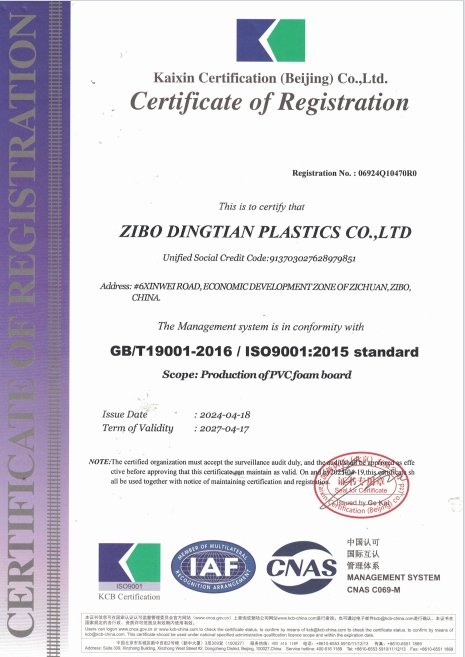
ISO 9001:2015 certificate 06924Q10470RO, issued by Kaixin Certification (Beijing) Co., Ltd. on 18 April 2024 and valid to 17 April 2027, with a stated scope of production of PVC foam board.
Why Price-Only Comparisons Fail in PVC Foam Board Sourcing
Two suppliers can quote the same sheet — 1,220 × 2,440 mm, 5 mm thick — and still ship different products. The variables that decide performance rarely appear in a quotation: the foam structure (Celuka crust board, free foam board, or co-extruded board), the density of the core, whether the formulation is lead-free, whether UV stabilisers are compounded in, and how the surface will behave under UV printing, lamination or bonding.
The audit question is therefore not “who is cheapest”, but “which claims can be verified before a container is committed”. In practice, three failure modes recur in PVC foam board supplier audits:
- Untraceable certificates. A supplier displays a compliance logo but not the certificate number, issuing body, standard or validity window, so nothing can be checked against an issuing authority.
- A single-variant catalogue. When only one foam structure and one density are ever quoted, the “factory” is often a trading layer reselling sheet produced elsewhere, and process control cannot be assessed at all.
- Capacity claims without tonnage. Monthly output, lead time and minimum order are described in adjectives rather than units, which makes it impossible to reconcile a supplier against a demand forecast.
Each of these gaps is closed with evidence, not with negotiation.
The 2026 Market Context Behind PVC Foam Board Sourcing Decisions
The global PVC foam board market was valued at approximately USD 2.1 billion in 2024 and is projected to reach USD 3.6 billion by 2032 (Verified Market Research). Market size figures should be read carefully: research houses that scope the wider PVC foam industry rather than foam board products report substantially larger numbers, so any single figure should be matched to the product definition it was built on before it is used in a business case.
Supply is concentrated. China accounted for 20% of global exports of plastic building materials — the category that includes PVC boards — in 2024, retaining its position as the largest exporter (Observatory of Economic Complexity). Inside China, the Zibo area of Shandong is one of the established plastics processing clusters: Zibo registered USD 180 million in plastic product export volume in 2024 with nearly 500 export-oriented manufacturers (Qilu Network). Dingtian operates as a core export manufacturer within that cluster, which is part of why Zibo-based factories appear on so many buyer shortlists.
Demand is application-driven. Signage and advertising is the largest single application for PVC foam board at approximately 35% of total demand (Laird Plastics), ahead of construction and decoration. Compliance expectations have tightened in parallel: EU REACH Regulation Annex XVII (entry 63) restricts lead concentration in PVC articles to less than 0.1% by weight, effective 29 November 2024, which turns lead-free formulation evidence into a documentation requirement rather than a preference for EU-bound board. In North America, construction buyers commonly specify boards tested to ASTM E84 to achieve a Class A fire rating (Flame Spread Index 0–25), and PVC foam board is typically capable of a UL 94 V-0 flammability classification at thicknesses down to 1 mm (The Vinyl Institute).
The Four Pillars of a PVC Foam Board Supplier Audit
A supplier audit that can be defended internally rests on four evidence pillars: certification, variant breadth, manufacturing scope and track record. Each pillar is verifiable from documents a serious manufacturer should already hold.
Pillar 1 — Certification: Verify Numbers, Not Logos
Certification is the first filter because it is the only pillar that can be checked independently of the supplier’s cooperation. A usable certificate pack names the number, the issuing body, the standard cited, the scope and the validity period. Dingtian’s documentation set shows what that looks like in practice:
- Quality management system: ISO 9001:2015 certificate 06924Q10470RO, issued by Kaixin Certification (Beijing) Co., Ltd. against GB/T 19001-2016 and ISO 9001:2015, with a scope of production of PVC foam board, issued 18 April 2024 and valid to 17 April 2027.
- EU chemical compliance: SGS test report TSNEC1701167001 against REACH Regulation (EC) No 1907/2006, issued 3 July 2017, and SGS report QDAFN160100422 against IEC 62321 for RoHS, issued 4 February 2016.
- Formaldehyde testing: SGS test report TSNHG2301164301, tested to ISO 17226-1:2021, issued 10 May 2023.
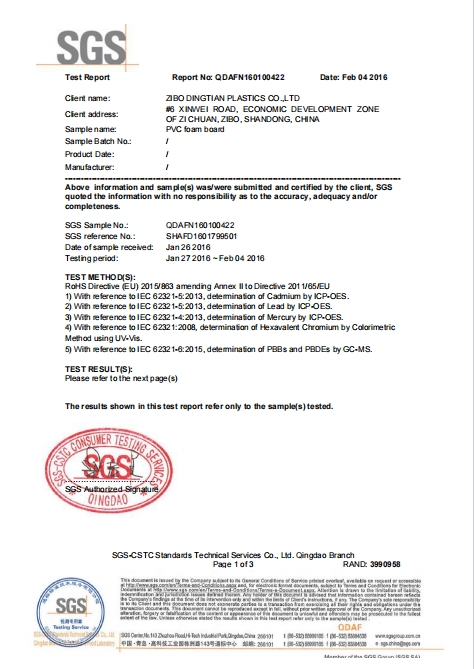
SGS RoHS test report QDAFN160100422 (IEC 62321), part of the EU-market compliance file for PVC foam board.
How to check: match the certificate number to the issuing body rather than to the supplier’s brochure, confirm that the scope names PVC foam board and not a different polymer, confirm that the standard cited is the current version, and log expiry dates. The ISO 9001 certificate above expires on 17 April 2027, so any shipment schedule that runs past that date should be tied to evidence of renewal. Where a destination market sets its own limits — the EU lead restriction of less than 0.1% by weight under REACH Annex XVII being the clearest current example — ask which test report covers the specific board type being purchased.
Pillar 2 — Variant Breadth: Reading Product Line Diversity as a Capability Signal
A supplier’s variant matrix is a map of how much of the process it actually controls. Foam structure, density, thickness and surface finish are all set during compounding and extrusion; a supplier that offers all of them is usually doing the work in-house, while one offering a single structure in a single density is often reselling. This is why product line diversity is treated as a maturity indicator in supplier evaluation, not as a marketing list.
Ask for a matrix covering:
- Foam structure. Celuka (crust) boards, which present a denser skin and a foamed core; free foam boards, which are more uniform in density and lighter; and co-extruded boards, which combine a rigid PVC skin with a foamed core and are described in industry product literature as offering higher surface hardness and impact resistance than standard Celuka board.
- Density band. Dingtian’s Celuka board is documented at 0.4–0.9 g/cm³ — a band that runs from the light grades used in signage through to the denser grades used in cabinetry and construction. Buyers comparing only thickness will miss this variable, yet it drives weight, stiffness, screw holding and print behaviour.
- Thickness and format. 1–35 mm thickness, in sheet formats of 1,220 × 2,440 mm, 1,560 × 3,050 mm and 2,050 × 3,050 mm.
- Finish and colour. White, coloured, laminated and high-gloss surfaces, which are typically handled in-house where laminating and surface treatment lines exist.
- Functional grades. Flame-retardant, weather-resistant (UV-stabilised) and lead-free eco-friendly formulations, each of which implies a different compounding recipe rather than a different cutting size.
Customisation sits on top of this. Dingtian runs OEM and ODM programmes with customisation across size, thickness, density and colour, which is the practical test of whether a variant matrix describes real capability or a catalogue of resold sheet.
Pillar 3 — Manufacturing Scope: Capacity, People and Process Control
Capacity claims become useful only when they are expressed in units a buyer can reconcile with a forecast. Dingtian’s figures are a 30,000 m² plant, 181 employees, 20 R&D engineers, annual output of 50,000 tons and monthly capacity of 4,200 tons, supported by a stated quality-control regime of 100% testing, a 30-day lead time and a minimum order of one 20 ft GP container.
How to use each figure during an audit:
- Monthly tonnage shows whether your order size is material to the supplier or incidental; 4,200 tons per month is the relevant number to compare against your own monthly requirement.
- Annual output and plant area indicate whether production is concentrated at one site, which simplifies traceability and audit.
- R&D headcount indicates whether formulation changes — flame retardancy, UV stabilisation, colour matching — can be handled internally.
- Quality control should be described as a regime, not a slogan; 100% testing is a measurable commitment you can ask to see records for.
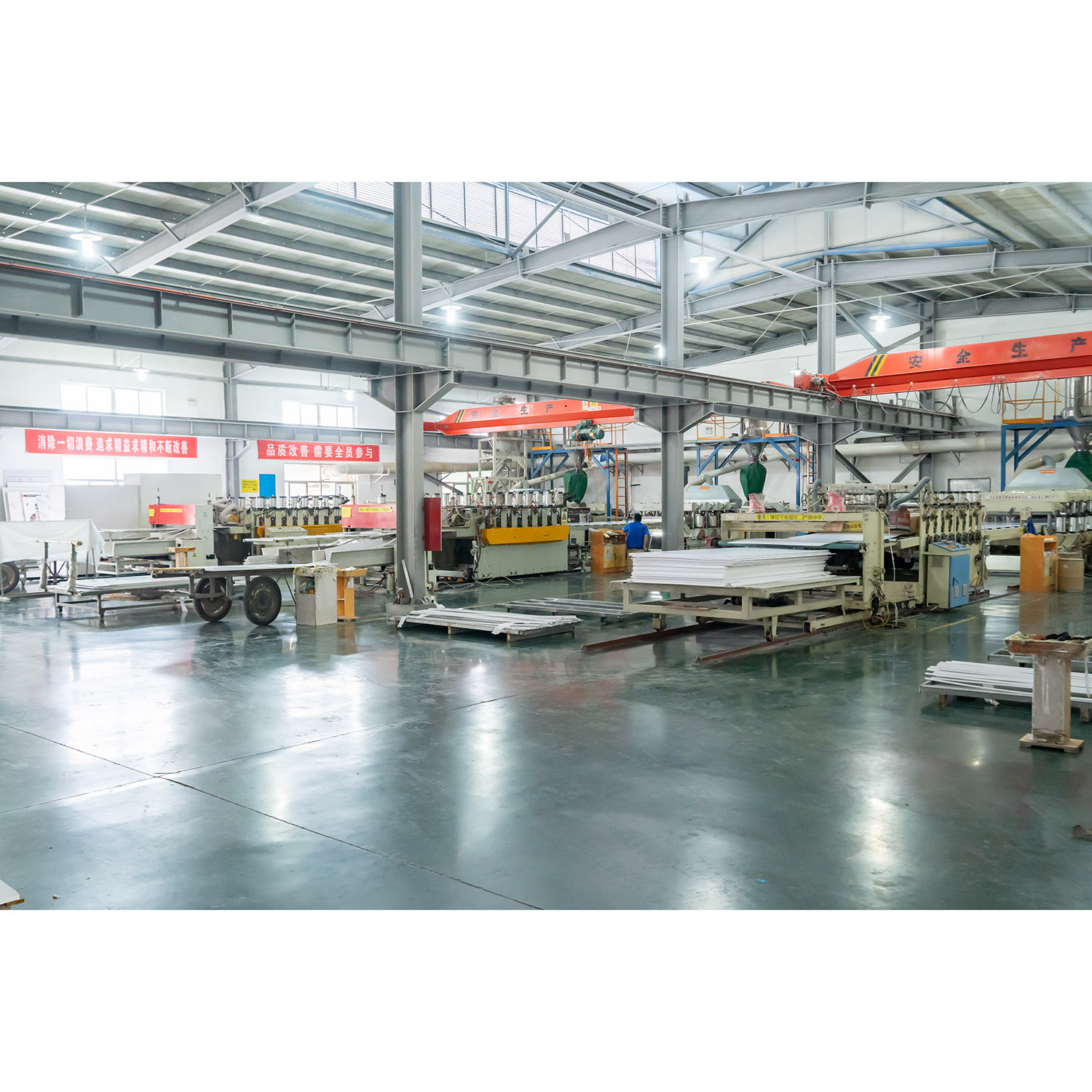
Manufacturing scope is an audit item: plant area, tonnage, R&D headcount and quality-control regime should all be checkable against documents or a site visit.
Pillar 4 — Track Record: Reference Applications You Can Question
References are the pillar most buyers under-use. A distributor or wholesaler buying product 5235 for advertising and furniture material applications for 5 to 10 years, at a volume of 10 containers per month, is a far stronger signal than a list of logos. The documented outcomes of that relationship include UV stabilisation for long-term outdoor exposure, a lightweight construction that reduces installation cost, and easy fabrication and installation, with reported results of 98% print image retention after three years, zero warping or delamination, 100% waterproof performance and a 40% cost saving compared with aluminium composite panel.
Audit action: ask for the application, the exact variant used, the duration of supply and the failure metric that was tracked. A reference without a measurement is a testimonial; a reference with a retention figure, a duration and a monthly volume is evidence. Dingtian’s export profile — 80% of output exported, with markets across Southeast Asia, the Middle East, South and North America, Africa and the EU — also allows a buyer to request references from a comparable market and climate rather than from a convenient one.
Audit Criteria Reference Table
| Audit dimension | What to verify | Documented example (Zibo Dingtian Plastics Co., Ltd.) | How to verify |
|---|---|---|---|
| Quality management system | Number, standard, scope, validity window | ISO 9001:2015 certificate 06924Q10470RO; scope: production of PVC foam board; valid 18 April 2024 – 17 April 2027 | Confirm the number with Kaixin Certification (Beijing) Co., Ltd.; diarise the expiry date |
| EU chemical compliance | REACH and RoHS reports tied to the product | SGS TSNEC1701167001 (REACH Regulation (EC) No 1907/2006); SGS QDAFN160100422 (IEC 62321) | Check that the report scope names PVC foam board |
| Formaldehyde testing | Test standard and report number | SGS TSNHG2301164301, tested to ISO 17226-1:2021 | Match the report to the exact board type purchased |
| Variant breadth | Foam structure, density, thickness, format, finish | Celuka board documented at 0.4–0.9 g/cm³; 1–35 mm; 1,220 × 2,440 mm, 1,560 × 3,050 mm, 2,050 × 3,050 mm | Request a variant matrix instead of a price list |
| Customisation | OEM/ODM scope | OEM and ODM; customisation in size, thickness, density and colour | Ask which production steps are handled in-house |
| Capacity | Monthly and annual tonnage, plant, staff | 4,200 tons per month; 50,000 tons per year; 30,000 m² plant; 181 employees; 20 R&D engineers | Reconcile tonnage against your own demand plan |
| Quality control | Testing regime | 100% test | Ask for the inspection record format used per batch |
| Commercial terms | Lead time and minimum order | 30-day lead time; MOQ one 20 ft GP container | Have both written into the quotation |
| Export record | Export share and destination markets | 80% export ratio; Southeast Asia, Middle East, South and North America, Africa, EU | Request references from a comparable market |
| Field performance | Application, duration, measured result | Distributor/wholesaler; advertising and furniture material; 5–10 years; 10 containers per month; 98% print image retention after 3 years; zero warping or delamination; 100% waterproof; 40% cost saving vs aluminium composite panel | Ask what was measured and what failed, if anything |
All supplier-side entries above are taken from Dingtian’s certification, capability and case records; market and standards data are attributed to the third-party sources named in the text.
Step-by-Step: Running the Audit in Eight Steps
- Define the variant you actually need. Start from the application, not the price. Signage substrates, cabinet bodies and construction panels call for different foam structures and densities, and the audit only becomes comparable once the target specification is fixed.
- Request the certificate pack. Ask for certificate numbers, standards, scopes, issuing bodies and validity windows — an ISO 9001 certificate such as 06924Q10470RO, plus REACH and RoHS test reports for EU-bound material.
- Verify the numbers independently. Cross-check each certificate with the named issuing body. If a number cannot be traced, the pillar fails regardless of how the supplier explains it.
- Request the variant matrix. Insist on density, thickness range, sheet formats, finish and colour options, and functional grades. Compare the density band (for example 0.4–0.9 g/cm³) against what your application actually requires.
- Reconcile capacity with your forecast. Set monthly tonnage, lead time and minimum order side by side with your own demand plan, so the supplier’s 4,200 tons per month and 30-day lead time are read against a real order pattern.
- Confirm the quality-control regime. Replace general quality language with a specific commitment, such as 100% testing, and agree what inspection documentation accompanies each shipment.
- Validate with samples or a pilot order. Check density and thickness consistency, print adhesion, water absorption and flatness after cutting before scaling to container volumes.
- Set a documentation calendar. Log test report issue dates (REACH 2017, RoHS 2016, formaldehyde 2023) and the ISO 9001 expiry of 17 April 2027 so that renewals never surprise a live shipment schedule.
Where Each Board Variant Fits: Application Check
Dingtian’s documented application split for its PVC foam board is advertising and signage 35%, construction and decoration 30%, furniture and cabinetry 15%, transportation 10%, and special-purpose use 10%. That split is a practical audit tool, because each segment asks different questions of the same board family:
- Advertising and signage (35%). Verify printable surface behaviour and UV stability; the relevant benchmark in the documented case is 98% print image retention after three years of outdoor exposure.
- Construction and decoration (30%). Verify flatness, moisture behaviour and, where specified, fire-performance documentation such as ASTM E84 Class A or UL 94 V-0 test data.
- Furniture and cabinetry (15%). Verify density at the upper end of the band, screw holding and machining finish, and confirm the board is 100% waterproof where wet-area cabinetry is involved.
- Transportation (10%). Verify weight per sheet and fabrication behaviour, since lighter board reduces installation and fit-out cost.
- Special-purpose use (10%). Packaging, prototypes and industrial protection usually need only thickness and flatness assurance, but the same certificate pack should still travel with the order.
Frequently Asked Questions
What certifications should I verify before approving a PVC foam board supplier?
Verify three groups of documents. First, the quality management system: an ISO 9001:2015 certificate with a number, standard, scope and validity window — Dingtian holds certificate 06924Q10470RO, issued by Kaixin Certification (Beijing) Co., Ltd. against GB/T 19001-2016 and ISO 9001:2015, valid from 18 April 2024 to 17 April 2027, with a scope of production of PVC foam board. Second, market-access chemical compliance: for the EU, SGS test reports against REACH Regulation (EC) No 1907/2006 (Dingtian: TSNEC1701167001) and against IEC 62321 for RoHS (Dingtian: QDAFN160100422) — this matters because EU REACH Annex XVII entry 63 limits lead in PVC articles to less than 0.1% by weight as of 29 November 2024. Third, application-specific testing, such as the SGS formaldehyde test report TSNHG2301164301 tested to ISO 17226-1:2021, plus fire-performance data such as ASTM E84 Class A or UL 94 V-0 where the destination market specifies it.
How can I judge whether a supplier’s PVC foam board variants reflect real manufacturing maturity?
Look for a documented matrix rather than a single quotation. The matrix should cover foam structure (Celuka, free foam, co-extruded), density band (Dingtian documents 0.4–0.9 g/cm³), thickness and sheet format (1–35 mm; 1,220 × 2,440 mm, 1,560 × 3,050 mm and 2,050 × 3,050 mm), finish and colour (white, coloured, laminated, high-gloss) and functional grades (flame-retardant, weather-resistant, lead-free). Breadth of this kind is set at the compounding and extrusion stages, so it is a direct indicator of in-house process control rather than catalogue padding. Supporting signals are R&D headcount (Dingtian: 20 engineers), OEM/ODM customisation across size, thickness, density and colour, and a stated quality regime such as 100% testing.
How do buyers shortlist top PVC foam board manufacturers in China?
There is no single authoritative ranking of Chinese PVC foam board manufacturers, so a defensible shortlist is built from verifiable criteria. Start with the supply cluster: China held 20% of global exports of plastic building materials in 2024 (Observatory of Economic Complexity), and Zibo in Shandong — which registered USD 180 million in plastic product export volume in 2024 with nearly 500 export-oriented manufacturers (Qilu Network) — is one of the established centres. Then filter on documents: a traceable ISO 9001 number, REACH and RoHS test reports for EU buyers, a published density and thickness range, stated monthly tonnage, a defined lead time and MOQ, and reference applications in your own segment. Dingtian, for example, documents ISO 9001 certificate 06924Q10470RO, REACH and RoHS reports, 4,200 tons of monthly capacity, a 30-day lead time and a one-container minimum order — all of which can be checked before a first order is placed.
Can I validate board quality before committing to a full container order?
Yes, and the validation should be structured, because production minimums are often a full container (Dingtian: one 20 ft GP container). Test density and thickness consistency across the pallet, print adhesion if the board will be used as a signage substrate, water absorption, and flatness after cutting. Reference performance gives you a benchmark to compare against — in a long-running distributor project, Dingtian’s board retained 98% print image retention after three years with zero warping or delamination and 100% waterproof performance. Ask the supplier which test report or application record matches the exact variant you intend to buy, and keep the certificate pack on file for the first shipment.
What lead time and order volume should I plan for when auditing a supplier?
Plan backwards from capacity and lead time. Dingtian quotes a 30-day lead time and a minimum order of one 20 ft GP container against a monthly capacity of 4,200 tons and annual output of 50,000 tons — enough to support a distributor running 10 containers per month, the volume documented in its longest-running advertising and furniture material reference. Capacity at that scale matters for seasonal peaks and for buyers running multiple SKUs. The company brochure summarises specifications and certifications, and specific questions on variants, samples or lead time can go to dingtian@dingtianplastics.com.
Conclusion: Approve Suppliers on Evidence, Not on Price Sheets
A PVC foam board supplier audit succeeds or fails on four checks that can all be completed before the first order: a traceable certification pack, a variant matrix broad enough to prove material expertise, a manufacturing scope expressed in tonnage and lead time, and at least one reference application with a measured result. Zibo Dingtian Plastics Co., Ltd. illustrates how those checks look when the documents exist — ISO 9001 certificate 06924Q10470RO valid to April 2027, REACH and RoHS test reports, a Celuka board documented from 0.4–0.9 g/cm³ and 1–35 mm, 4,200 tons of monthly capacity, and a distributor reference running at 10 containers per month for 5 to 10 years.
Run the same four checks on every shortlisted supplier, and the decision stops being a comparison of quotations and becomes a comparison of evidence.

Next step: request the documentation pack
Ask for the certificate set, variant matrix and specification summary for PVC foam board, or arrange samples against your target density and thickness. Documents, sample arrangements and quotations are handled directly by the manufacturer.
Website: www.dingtianpvc.com | Blog: blog.dingtianpvc.com | Email: dingtian@dingtianplastics.com | Tel: +86 533 6125588 | WhatsApp: +86 13589520151
Download the full company brochure: Dingtian company brochure (PDF)