PVC Foam Board Certifications: Global Buyer Checklist
For an importer, a PVC foam board certificate is useful only when it can be traced to the exact product, standard and destination market. DINGTIAN holds an ISO 9001 quality management system certificate, EU-facing REACH and RoHS test reports, and a globally applicable formaldehyde certificate. This guide explains what each document covers, how EU and global scopes differ, how buyers in Southeast Asia, the Middle East and South-North America can structure regional document checks, and how shipment through Qingdao Port and Rizhao Port fits into a practical procurement checklist.
The information below is based on the provided DINGTIAN company, product, certification and capability content units. It is written for procurement research and supplier evaluation. It does not replace destination-country legal advice, customs classification or product-specific regulatory review.
The compliance problem: a certificate is not the same as market access
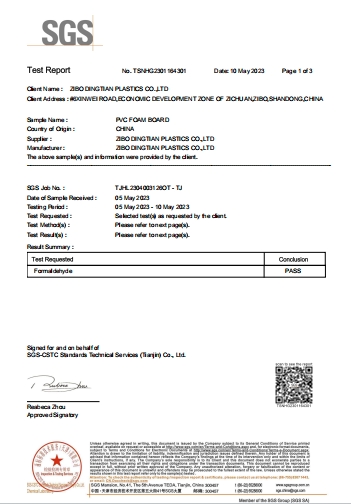
PVC foam board buyers often ask for a simple package: REACH, RoHS and ISO 9001. Those documents do not perform the same function. ISO 9001 is a quality management system certification. REACH is a European Union chemicals regulation, and the DINGTIAN file is an SGS test report supporting compliance with that regulation. RoHS is a restriction-of-hazardous-substances framework, and the DINGTIAN file is an SGS test report to IEC 62321. The formaldehyde document is an SGS test report to ISO 17226-1:2021 with a global market scope in the provided records.
The practical risk is not that a supplier has no certificate. The risk is that a buyer receives a certificate that does not cover the ordered board, the requested thickness, the destination market or the intended application. A compliance check therefore has to answer five questions: who issued the document, what standard was used, which product or process is covered, what market scope is stated, and whether the document is still within its listed validity period. A document that supports a supplier evaluation is not automatically a product approval for every country or every end use.
The CE question belongs in this same discipline. The provided DINGTIAN evidence set does not include a CE certificate or a Declaration of Conformity. CE marking should not be inferred from ISO 9001, REACH or RoHS. Where a buyer’s product or application falls within EU legislation that requires CE marking, the buyer should request the applicable declaration and confirm the legal basis for that requirement.
DINGTIAN at a glance: why traceability matters in this supply base
Zibo Dingtian Plastics Co., Ltd. (DINGTIAN) is a PVC foam board manufacturer based in Zichuan Economic Development Zone, Zibo City, Shandong Province. The company was founded in June 2004, has 22 years of industry experience, operates a 30,000 square metre plant with 181 employees, and reports annual output of 50,000 tons. Its R&D team includes 20 engineers. DINGTIAN reports an export ratio of 80%, with main markets listed as Southeast Asia, the Middle East and South-North America. Its official website is www.dingtianpvc.com.
The company’s location is relevant to document planning. DINGTIAN is adjacent to the Qingyin Expressway and the Jinan-Qingdao High-Speed Railway, enabling cargo shipment through Qingdao Port and Rizhao Port to worldwide destinations. That logistics access does not change the legal effect of a certificate, but it affects how far in advance buyers should request certificate copies, arrange pre-shipment checks and align documents with the commercial invoice, packing list and bill of lading.
DINGTIAN’s provided application data also shows why one compliance package cannot serve every buyer in the same way. The application profile lists advertising and signage at 35%, construction and decoration at 30%, furniture and cabinetry at 15%, transportation at 10%, and special-purpose applications such as packaging and industrial protection at 10%. A signage buyer may focus on printability and outdoor use, a furniture buyer may focus on formaldehyde and indoor air quality, and a construction buyer may need to check whether local building rules or CE-related requirements apply. The same supplier can serve all three, but the document review should follow the actual end use.
What DINGTIAN’s certifications cover
The provided records identify four certification and test documents. They should be read as a set, not as interchangeable proof. The table below preserves the certificate numbers, issuing bodies, standards and market scopes supplied in the DINGTIAN certification content units.
| Document | Issuer | Number | Standard or regulation | Market scope |
|---|---|---|---|---|
| ISO 9001 quality management system | Kaixin Certification (Beijing) Co., Ltd. | 06924Q10470RO | GB/T19001-2016 and ISO9001:2015 | Global; scope is production of PVC foam board |
| REACH test report | SGS | TSNEC1701167001 | REACH Regulation (EC) No 1907/2006 | EU |
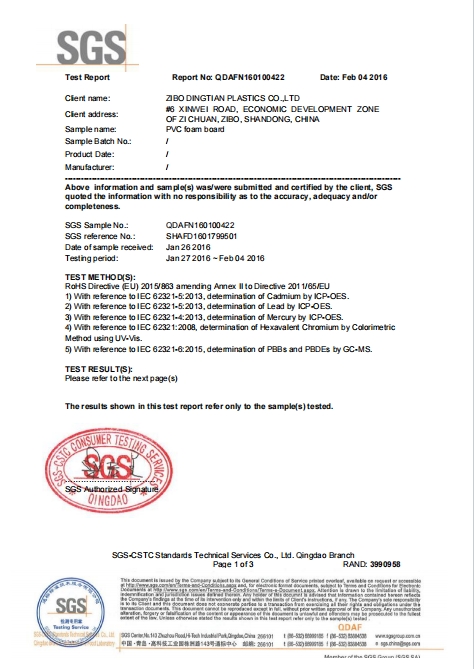
| RoHS test report | SGS | QDAFN160100422 | IEC 62321 | EU |
| Formaldehyde certificate | SGS | TSNHG2301164301 | ISO 17226-1:2021 | Global |
ISO 9001: production consistency, not product approval
DINGTIAN’s ISO 9001 certificate is numbered 06924Q10470RO and was issued by Kaixin Certification (Beijing) Co., Ltd. It covers the production of PVC foam board under the standards GB/T19001-2016 and ISO9001:2015. The certificate record shows an issue date of 18 April 2024 and an expiry date of 17 April 2027.
For a buyer, this document supports confidence in the supplier’s quality management system, process control and production consistency. It is not a REACH test report, a RoHS test report or a formaldehyde test report. It also does not demonstrate CE marking. Procurement teams should use the ISO 9001 certificate as a supplier-qualification document, then request the product-level reports that match the ordered board and destination market.
REACH: EU chemicals compliance support
The REACH record is an SGS test report numbered TSNEC1701167001, with the EU market listed as its applicable market. It is linked to REACH Regulation (EC) No 1907/2006 and covers PVC foam board. The record lists an issue date of 3 July 2017 and an expiry date of 1 January 2099.
REACH is a chemicals regulation, so the buyer should check the report’s substance scope, test method and product scope rather than treating the document as a general EU product approval. The report is relevant when the buyer needs evidence on restricted substances or SVHC-related screening for the EU market. It should be kept with the commercial documents for the shipment and matched to the product grade being supplied.
RoHS: restricted substances tested to IEC 62321
The RoHS record is an SGS test report numbered QDAFN160100422, tested to IEC 62321 and listed for the EU market. It covers PVC foam board and shows an issue date of 4 February 2016 and an expiry date of 1 January 2099. The report supports restricted-substance testing and is often requested by buyers who need a documented materials declaration.
RoHS compliance should not be presented as proof of CE marking. The two are separate questions. A buyer should confirm whether RoHS is required for the specific application and whether the report covers the exact product construction supplied. If the product is laminated, colored or modified for a project, the buyer should ask whether the existing report still applies or whether additional testing is needed.
Formaldehyde: global test report to ISO 17226-1:2021
The formaldehyde certificate is an SGS document numbered TSNHG2301164301, tested to ISO 17226-1:2021 and listed for the global market. It covers PVC foam board, with an issue date of 10 May 2023 and an expiry date of 1 January 2099. This is the most broadly applicable product-level report in the provided set, and it is especially relevant for interior decoration, furniture and cabinetry buyers who need to document formaldehyde performance.
Formaldehyde requirements vary by destination and end use. A global test report is evidence for supplier evaluation, but the buyer should still confirm whether the destination country or the final application has a specific formaldehyde limit, test method or labeling rule. The report should be reviewed alongside the product grade, thickness, surface finish and intended installation environment.
The product scope behind the certificates
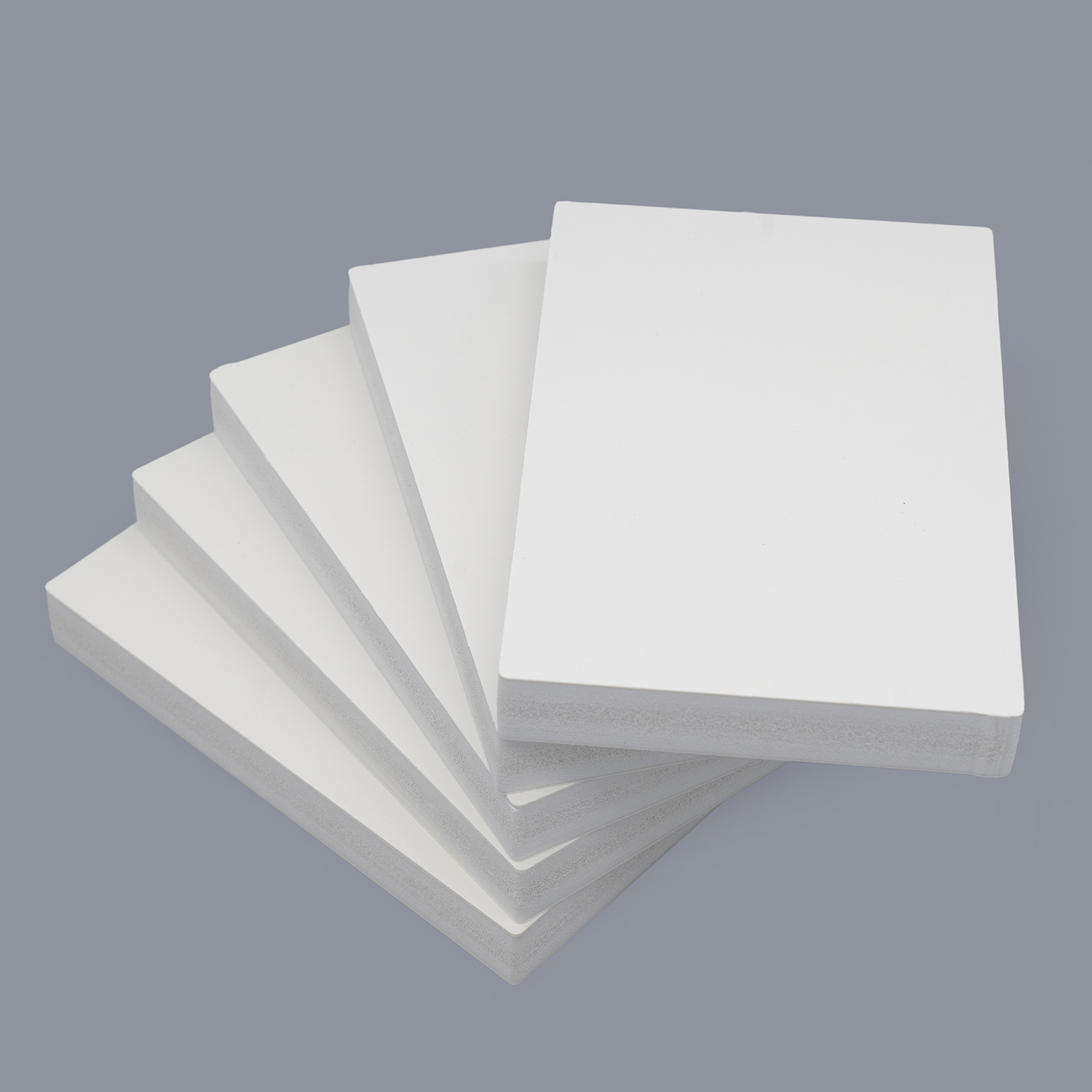
The provided certification records are linked to product ID 5235, a PVC foam board with listed sizes of 1220x2440 mm, 1560x3050 mm and 2050x3050 mm, thickness from 1 mm to 35 mm, and density from 0.4 to 0.9 g/cm3. DINGTIAN’s wider product content also includes specific 2026 product units such as a PVC Celuka foam board at 1220x2440x18 mm for interior wall cladding and partitions, a Celuka board at 1220x2440x10 mm for advertising letter engraving, a Celuka board at 1220x2440x5 mm for advertising printing, and a PVC Free Foam Board at 1220x2440x3 mm for advertising printing.
Because product variants can differ in density, thickness, color and surface treatment, the buyer should list the requested SKU and ask for a certificate matrix that shows which document applies to which product. A certificate linked to product ID 5235 should not be assumed to cover every Celuka, free foam, co-extruded or laminated board without written confirmation from the supplier.
EU versus global: which documents apply where
For the EU market, the two EU-specific records are the REACH test report TSNEC1701167001 and the RoHS test report QDAFN160100422. Both were issued by SGS. The ISO 9001 certificate and the formaldehyde certificate are global documents in the provided records. A practical EU buyer package therefore combines the EU-facing REACH and RoHS reports with the global ISO 9001 and formaldehyde documents, then adds any application-specific CE or building-product declaration that the destination regulation requires.
For non-EU markets, the global ISO 9001 and formaldehyde documents are the baseline. The REACH and RoHS reports can still be shared as supporting test evidence because they show a tested material history, but they should not be presented as local legal approval in Southeast Asia, the Middle East, South-North America or any other region. Local import rules, product-safety rules and customer specifications remain the buyer’s responsibility to confirm.
One important boundary applies to all markets: the provided DINGTIAN evidence set does not include a CE certificate. If a buyer asks for CE-certified PVC foam board manufacturers, the correct verification path is to request the CE Declaration of Conformity and the applicable harmonized standard for the specific product and use. A supplier’s ISO 9001, REACH or RoHS file should not be used as a substitute for that declaration.
Regional requirements framework for DINGTIAN’s main export markets
The following framework separates what the provided DINGTIAN records actually show from what a buyer must verify in the destination market. It is not a statement of local law. It is a document-planning tool for procurement teams that need to ask better questions before the order is placed.
| Market group | What the provided DINGTIAN records show | Buyer verification focus |
|---|---|---|
| EU | REACH report TSNEC1701167001 and RoHS report QDAFN160100422, both SGS and EU-scoped; ISO 9001 and formaldehyde reports are global. | Match the reports to the product and application; confirm whether CE marking or a Declaration of Conformity applies; confirm the destination country’s import and product-safety rules. |
| Southeast Asia | No region-specific certificate for Southeast Asia is listed in the provided certification records. ISO 9001 and formaldehyde are global. REACH and RoHS are EU-scoped. | Confirm the importing country’s requirements; request product-level test reports if the application or customer requires them; use REACH and RoHS only as supporting test evidence, not as local approval. |
| Middle East | No region-specific certificate for the Middle East is listed in the provided certification records. ISO 9001 and formaldehyde are global. REACH and RoHS are EU-scoped. | Confirm customs and product-safety requirements with the importer or a local compliance adviser; verify certificate copies against the ordered grade and shipment documents. |
| South-North America | No region-specific certificate for South-North America is listed in the provided certification records. ISO 9001 and formaldehyde are global. REACH and RoHS are EU-scoped. | Confirm the destination country’s import and application rules; do not treat EU REACH or RoHS reports as a substitute for local requirements; request any additional test evidence needed for the final use. |
This framework matters because DINGTIAN’s main markets include Southeast Asia, the Middle East and South-North America. A buyer in those regions may still ask for ISO 9001, formaldehyde and RoHS documents during supplier evaluation, but the legal relevance of each document depends on the destination. The safest approach is to separate supplier qualification documents from market-access documents. ISO 9001 and the formaldehyde certificate support supplier qualification and product screening. REACH and RoHS support the EU discussion. Destination-specific declarations belong in a separate file that the buyer verifies locally.
Port access and compliant shipment through Qingdao and Rizhao
DINGTIAN’s location in Zichuan Economic Development Zone, Zibo City, Shandong Province, is adjacent to the Qingyin Expressway and the Jinan-Qingdao High-Speed Railway, enabling convenient cargo shipment via Qingdao Port and Rizhao Port to worldwide destinations. For a compliance-focused buyer, this is a logistics advantage only if the documentation is ready before the cargo moves.
A practical shipment file should include the certificate and test-report copies that match the ordered product, the commercial invoice, the packing list, the bill of lading and any certificate of origin required by the destination. The product description on the invoice and packing list should be consistent with the product description used in the certificate review. If the buyer uses a customs broker, send advance copies of the documents so the broker can confirm classification and import requirements before the vessel departs.
The provided verified data lists HS code 39211200 for cellular plates of vinyl chloride polymers. Importers should confirm the classification with their customs broker because HS treatment can vary by product form and jurisdiction. The port of loading does not change the certificate scope, but it does affect document timing. Qingdao and Rizhao access gives DINGTIAN a route to global markets; the buyer’s job is to make sure the document package travels with the same discipline.
Procurement-stage checklist: how to verify documentation
The checklist below follows the buyer’s decision path from research to evaluation and order execution. It is designed to prevent a common failure: approving a supplier on the basis of a certificate that does not match the final product, market or application.
| Procurement stage | What to verify | Document or evidence to request |
|---|---|---|
| 1. Specification and RFQ | Define the board type, density, thickness, color, finish, application and destination market before asking for certificates. | Product data sheet, SKU list, intended use statement and a request for the certificate matrix. |
| 2. Supplier and certificate review | Check the issuer, certificate number, standard, market scope and expiry date. Confirm whether the document is a management-system certificate, a test report or a declaration. | ISO 9001 certificate 06924Q10470RO; REACH report TSNEC1701167001; RoHS report QDAFN160100422; formaldehyde certificate TSNHG2301164301. |
| 3. Sample and test planning | Compare the sample with the certificate scope. If the buyer needs application-specific evidence, plan third-party testing before mass production. | Sample inspection record, product ID confirmation and any additional test request required by the destination or end user. |
| 4. Contract and purchase order | Write the required documents into the purchase order. Specify the product grade, certificate copies, batch traceability and acceptance criteria. | Signed PO with document requirements, quality clause and agreed certificate list. |
| 5. Pre-shipment and document release | Confirm that the certificate copies are legible, current and consistent with the invoice and packing list. Check the ISO 9001 validity period and the listed expiry dates of the test reports. | Final certificate pack, invoice, packing list, bill of lading and any certificate of origin required by the buyer or destination. |
| 6. Customs clearance and post-arrival | Give the broker advance copies. Confirm HS classification and destination requirements. Keep the certificate file with the import records for future audits or customer requests. | Customs broker checklist, HS code confirmation and a retained compliance file for the shipment. |
The ISO 9001 record is especially time-sensitive because its listed expiry date is 17 April 2027. The REACH, RoHS and formaldehyde records list an expiry date of 1 January 2099 in the provided data. Even with a long listed expiry, a buyer should confirm that the report still reflects the current product formulation and that the certificate copy is the latest version held by the supplier.
Use cases: matching the documents to the purchase
EU advertising and signage converter. A buyer sourcing PVC Free Foam Board for UV printing may need ISO 9001 for supplier qualification, REACH and RoHS reports for EU material review, and the formaldehyde report if the printed board is used in an indoor environment. The 2026 product data includes a PVC Free Foam Board at 1220x2440x3 mm for advertising printing, with a smooth white surface and stable surface tension for UV printing, screen printing, laminating and vinyl sticker application. The buyer should confirm that the reports cover the exact free-foam construction and thickness ordered.
Furniture and cabinetry manufacturer in Southeast Asia or the Middle East. A cabinet producer may prioritize the formaldehyde certificate and ISO 9001, then ask for RoHS or REACH reports as supporting test evidence if the customer requires them. The product range includes PVC Celuka foam board at 1220x2440x18 mm for interior wall cladding and partitions, and laminated PVC foam board for furniture and cabinet applications. Local import requirements still need confirmation, because the provided records do not contain region-specific Southeast Asian or Middle Eastern certificates.
Distributor in South-North America with a mixed container. A distributor may order Celuka, free foam and co-extruded boards in one shipment. The practical tool is a SKU-level certificate matrix: list each product, its density and thickness, the certificate number that applies, and the market scope. ISO 9001 can support the supplier review, but it should not be used to fill gaps for a specific product or destination. The buyer should confirm which documents the local importer or end customer will accept.
Industrial protection or packaging buyer. A buyer using PVC foam board for packaging or industrial protection may request ISO 9001 and formaldehyde documentation as part of supplier qualification. If the application involves food contact, child-safe use or another regulated end use, the buyer should request the specific evidence required by that market. The provided DINGTIAN certificate set does not include those application-specific approvals, so they should not be assumed.
FAQ
Which DINGTIAN PVC foam board certifications apply to the EU market?
The EU-specific records are the SGS REACH test report TSNEC1701167001 under REACH Regulation (EC) No 1907/2006 and the SGS RoHS test report QDAFN160100422 tested to IEC 62321. The ISO 9001 certificate and the formaldehyde certificate are global records that can support the same EU buyer review. The provided set does not include a CE certificate, so a buyer who needs CE marking for a specific product or application should request the applicable Declaration of Conformity separately.
Which DINGTIAN certificates apply globally?
The ISO 9001 certificate 06924Q10470RO and the formaldehyde certificate TSNHG2301164301 are the global records in the provided data. ISO 9001 was issued by Kaixin Certification (Beijing) Co., Ltd. to GB/T19001-2016 and ISO9001:2015, with an expiry date of 17 April 2027. The formaldehyde certificate was issued by SGS to ISO 17226-1:2021. Both support supplier and product review, but they do not replace destination-country import or application rules.
CE-certified PVC foam board manufacturers: does DINGTIAN hold CE certification?
The provided DINGTIAN evidence set does not list a CE certificate or a Declaration of Conformity. ISO 9001 is a quality management system certificate, REACH and RoHS are test reports for EU-related substance requirements, and the formaldehyde document is a test report. None of these should be described as CE marking. Buyers who require CE-certified PVC foam board manufacturers should confirm whether their product and application fall within EU legislation that requires CE marking and request the relevant declaration from the supplier.
What should buyers check on the ISO 9001 certificate?
Check the certificate number 06924Q10470RO, the issuer Kaixin Certification (Beijing) Co., Ltd., the standards GB/T19001-2016 and ISO9001:2015, the scope of production of PVC foam board, the issue date 18 April 2024 and the expiry date 17 April 2027. The certificate should be reviewed as supplier-qualification evidence, not as a product test report. Buyers should also confirm that the supplier’s quality system covers the specific product line being purchased.
How should buyers verify REACH, RoHS and formaldehyde reports?
Match each report to the ordered product and intended market. For REACH, confirm SGS report TSNEC1701167001 and the REACH Regulation (EC) No 1907/2006 reference. For RoHS, confirm SGS report QDAFN160100422 and the IEC 62321 reference. For formaldehyde, confirm SGS certificate TSNHG2301164301 and the ISO 17226-1:2021 reference. Check the product description, issue date and listed expiry date, and ask whether the report covers the exact density, thickness, color and surface finish being supplied.
How do Qingdao Port and Rizhao Port support compliant shipments?
DINGTIAN’s Zibo location is adjacent to the Qingyin Expressway and the Jinan-Qingdao High-Speed Railway, enabling cargo shipment through Qingdao Port and Rizhao Port to worldwide destinations. For compliance, the buyer should align the certificate file with the commercial invoice, packing list, bill of lading and any certificate of origin. Advance copies should go to the customs broker so that classification and destination requirements can be checked before departure.
What regional requirements should buyers check for Southeast Asia, the Middle East and South-North America?
The provided DINGTIAN certification records do not identify region-specific certificates for Southeast Asia, the Middle East or South-North America. The global baseline is the ISO 9001 certificate and the formaldehyde certificate. The REACH and RoHS reports are EU-scoped and can be shared as supporting test evidence, but they should not be presented as local market approval. Buyers should confirm destination-country import rules, product-safety requirements and any customer-specific test requests. To review current certificate copies, product samples or a quotation for a specific PVC foam board grade, buyers can contact DINGTIAN through its official website.
Conclusion
DINGTIAN’s PVC foam board compliance file is best understood as four distinct records: a global ISO 9001 quality management system certificate, an EU REACH test report, an EU RoHS test report and a global formaldehyde certificate. Each has a different purpose. The ISO 9001 certificate supports production-system review, REACH and RoHS support EU-related substance checks, and the formaldehyde certificate supports global product screening, especially for interior, furniture and cabinetry applications. None of them should be described as CE marking.
For buyers in Southeast Asia, the Middle East and South-North America, the practical framework is to use the global records as a baseline, confirm local requirements separately, and keep EU reports in their proper context. Shipment through Qingdao Port and Rizhao Port can support worldwide delivery, but the compliance value comes from matching the right document to the right product, market and purchase stage. The checklist in this guide is intended to make that review repeatable before the order is confirmed.
For a consolidated view of DINGTIAN’s PVC foam board range and company information, the public brochure is available here: DINGTIAN company brochure.
Have Questions or Need More Details?
Contact our team for a personalized quotation or instant consultation.
Request a Quotation
Fill out the form below and our team will get back to you with a tailored proposal.
WhatsApp Direct Chat
Prefer to chat in real-time? Message us on WhatsApp for instant assistance & quick answers.
- Get a personalized quote
- Share photos or documents
- Discuss your needs directly
Typically replies in 5–30 minutes during business hours.