PVC Foam Board Compliance Dossier: Certificate Scope, Verification, Regional Fit
A PVC foam board compliance dossier is not a promise about every sheet in a container. It is a set of documents that records which management system, which restricted substances and which test methods a named product has been assessed against — by whom, under which standard, and for which market. The dossier is only as strong as the precision of its scope, and as strong as the buyer’s willingness to read that scope before placing an order.
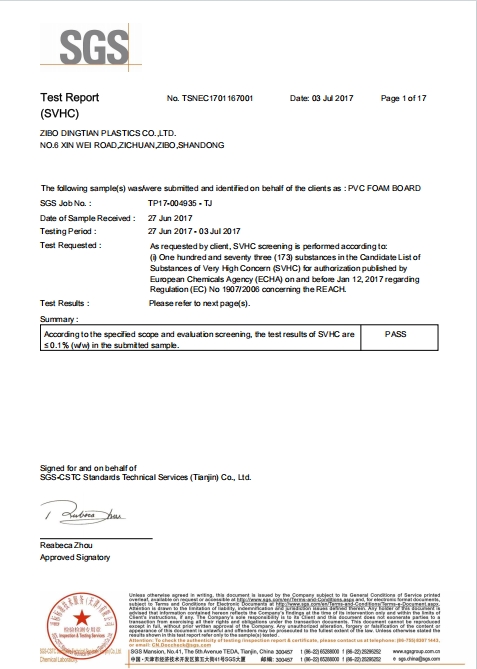
This article treats the document set as a working file rather than a marketing attachment. It walks through the four documents held for PVC foam board supplied by Zibo Dingtian Plastics Co., Ltd. (DINGTIAN) under product ID 5235 — an ISO 9001 certificate, a REACH report, a RoHS test report and a formaldehyde test report — and explains what each one establishes, what it leaves open, how a QA team can verify it independently, and how the same four documents map onto requirements in the EU, Southeast Asia, the Middle East and the Americas.
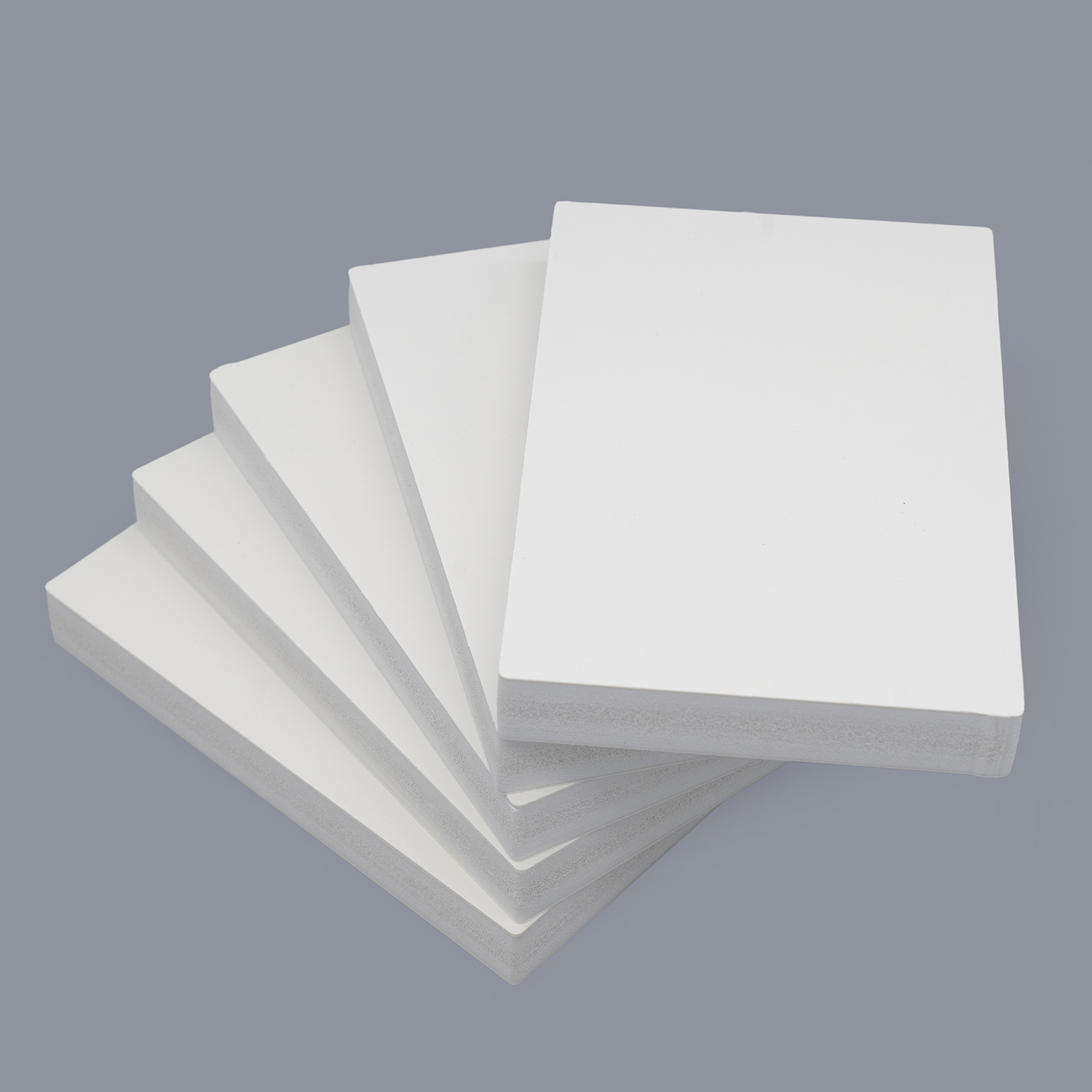
What a PVC foam board compliance dossier actually contains
A compliance dossier for PVC foam board normally combines two different kinds of evidence, and conflating them is the most common mistake in supplier evaluation. A management system certificate describes how a factory is organised to control quality; it says nothing about the chemical content or physical performance of a particular board. A test report describes what a laboratory found in a submitted sample under a named method; it says nothing about whether the next production batch will match.
Both are necessary. Neither replaces the other, and neither replaces the buyer’s own incoming inspection. The four documents held for DINGTIAN PVC foam board (product ID 5235) cover exactly these two categories:
| Document | Issuer and number | Standard / regulation | Market stated | What it addresses |
|---|---|---|---|---|
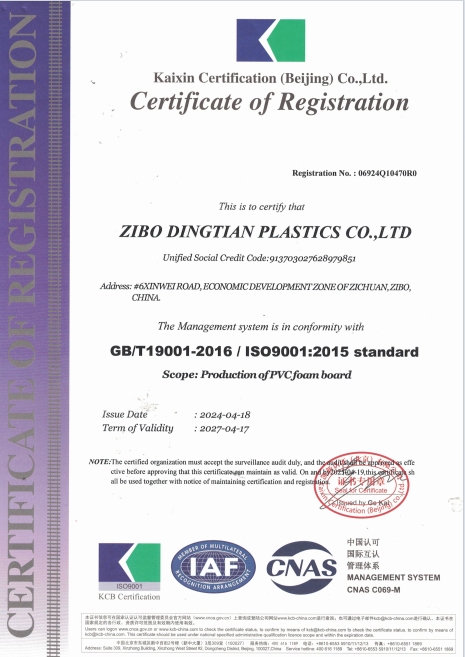
| ISO 9001 quality management system certificate | Kaixin Certification (Beijing) Co., Ltd. — 06924Q10470RO | GB/T19001-2016 & ISO9001:2015 | Global | Production of PVC foam board |
| REACH report | SGS — TSNEC1701167001 | REACH Regulation (EC) No 1907/2006 | EU | Regulatory compliance of the submitted PVC foam board sample |
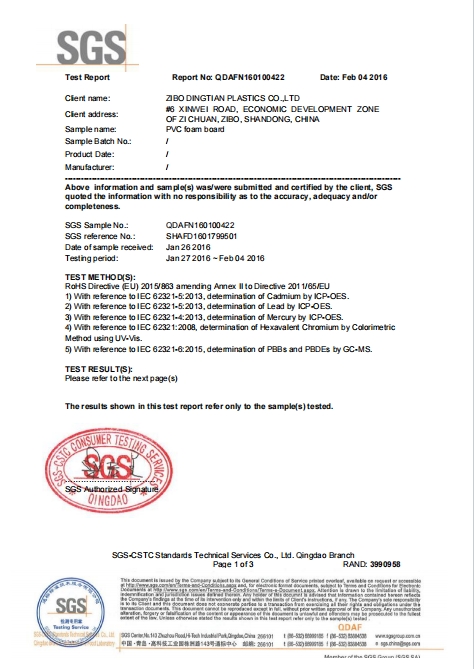
| RoHS test report | SGS — QDAFN160100422 | IEC 62321 | EU | Restricted hazardous substances in the submitted sample |
| Formaldehyde test report | SGS — TSNHG2301164301 | ISO 17226-1:2021 | Global | Formaldehyde assessment of the submitted sample |
Read as a set, the dossier answers a chain of questions: can this factory control production consistently (ISO 9001), does the board contain restricted substances at levels that would block EU placement (RoHS), is it compliant with the EU chemicals framework (REACH), and what does an accredited laboratory record on formaldehyde (ISO 17226-1:2021). That chain is what an importer usually needs in order to open a supplier file — not a logo page.
Why documentation has become a purchasing gate rather than a formality
PVC foam board is a commodity-looking product with a regulatory profile that does not look like a commodity. It is a cellular vinyl chloride sheet classified under HS code 39211200 for customs purposes, and it sits across applications with very different exposure levels: outdoor signage, interior wall cladding, cabinet doors, vehicle interiors and packaging.
Those applications are not evenly weighted. Laird Plastics’ technical guide on PVC foam board places signage at roughly 35% of demand, followed by construction and decoration, furniture and cabinetry, transportation, and special-purpose uses. Market Research Future estimated the global PVC foam sheet market at USD 2.28 billion in 2024 and projected a 4.99% CAGR over 2025–2035. Neither figure changes what a specific buyer needs, but together they explain why documentation requests now arrive earlier in the sourcing conversation: more of this material is crossing borders into applications where the importer, not the factory, carries the visible compliance obligation.
For DINGTIAN, the commercial context is an export-oriented profile: a 30,000 m² plant in Zichuan Economic Development Zone, Zibo City, Shandong Province, 181 employees, 20 engineers and a reported 80% export ratio, with Southeast Asia, the Middle East and South–North America listed as main markets. A supplier with that market mix will be asked for the same four documents repeatedly, in different combinations, by buyers operating under different national rules. The useful question is therefore not “do you have certificates” but “which certificate applies to my market, my grade and my order”.
Document by document: what each certificate establishes
ISO 9001 — certificate 06924Q10470RO
The ISO 9001 certificate is issued by Kaixin Certification (Beijing) Co., Ltd. under certificate number 06924Q10470RO, certified to GB/T19001-2016 and ISO9001:2015, for the scope “Production of PVC foam board”. It was issued on 18 April 2024 and expires on 17 April 2027 — so at the time of writing it is within its validity period, but a buyer placing orders beyond that date should ask for the renewal certificate before shipment.
What it establishes is a certified quality management system covering the production of PVC foam board as a category. What it does not establish is any measured property of a specific sheet: not density, not thickness tolerance, not flatness, not fire behaviour, not colour consistency. A QA team that files an ISO 9001 certificate as product evidence has filed the wrong document. Its correct use is as a supplier-qualification entry point and as a reason to expect documented process control, batch records and corrective-action procedures that can be audited on site.
EU REACH — report TSNEC1701167001
The REACH report is issued by SGS under number TSNEC1701167001, referenced to REACH Regulation (EC) No 1907/2006, and stated as applicable to the EU market. It relates to PVC foam board (product ID 5235). Its function in the dossier is to support the chemicals-compliance argument that an EU importer must be able to make for the articles it places on the market.
Two boundaries matter here. First, a REACH report is evidence about the submitted sample and the substance list it was tested against — it is not a blanket statement that any formulation, colour or additive package will behave identically. Second, REACH obligations fall on the EU importer as well as the non-EU manufacturer, so the report supports the importer’s file rather than replacing it. Buyers should keep the report alongside their own substance documentation rather than treating it as a substitute.
EU RoHS — report QDAFN160100422
The RoHS report is issued by SGS under number QDAFN160100422, tested according to IEC 62321, and stated as applicable to the EU market for PVC foam board (product ID 5235). IEC 62321 is the analytical test-method family used to determine restricted substances in electrotechnical products, and it is the method reference that makes the report readable to a compliance reviewer: it tells the reviewer how the restricted substances were measured, not merely that someone looked.
Where RoHS matters most in practice is retail and display work. A signage or shop-fit-out buyer specifying lead-free eco-friendly PVC foam board for a European retail chain will usually be asked for restricted-substance evidence before the material is approved for a store environment, even where the finished article is not itself an electrical product. The report answers that request at sample level.
Formaldehyde — report TSNHG2301164301
The formaldehyde report is issued by SGS under number TSNHG2301164301, referencing ISO 17226-1:2021, and is stated as applicable to the global market for PVC foam board (product ID 5235). It is the most recent of the four documents, and in many procurement conversations it is the one that unlocks interior applications: white PVC foam board, laminated PVC foam board and cabinet PVC foam board specified for enclosed interiors are routinely screened for formaldehyde before approval.
The buying lesson is about method, not the pass result. Destination markets and individual brand owners do not all specify the same formaldehyde method or the same chamber conditions. A report citing ISO 17226-1:2021 is a defined data point; whether it satisfies a particular specification depends on whether that specification accepts the method. Where a buyer’s own standard names a different method, the correct step is to ask the supplier and laboratory whether the test can be repeated under the named method, not to assume equivalence.
A six-step verification workflow for QA teams
Verification is a paperwork exercise that takes under an hour and prevents most of the disputes that surface three months into a supply relationship. The sequence below is ordered so that each step eliminates a category of risk before the next one is examined.
- Confirm the certificate holder’s legal name. The holder must match the entity on the commercial invoice and the sales contract. A document issued to a trading name, a group affiliate or a predecessor company does not automatically transfer. On the ISO 9001 certificate this means checking that the holder reads as the manufacturing entity, and on the SGS reports that the applicant named is consistent with the supplier you are buying from.
- Verify the certificate number with the issuing body. ISO 9001 certificate 06924Q10470RO can be checked with Kaixin Certification (Beijing) Co., Ltd.; the SGS reports (TSNEC1701167001, QDAFN160100422, TSNHG2301164301) can be checked through SGS’s report-authentication channel. Verification matters most where documents have been forwarded as scanned attachments several times, because a clean scan is not evidence of a live certificate.
- Read the standard, including its edition. The ISO 9001 certificate cites both GB/T19001-2016 and ISO9001:2015, which is the transitional pairing used by Chinese certification bodies. The RoHS report cites IEC 62321; the formaldehyde report cites ISO 17226-1:2021; the REACH report cites Regulation (EC) No 1907/2006. A certificate that names a standard without an edition, or a report that names a regulation without a version, deserves a follow-up question.
- Check the scope statement line by line. “Production of PVC foam board” is a production scope. It is not a product conformity scope, and it does not extend to distribution, repacking or downstream conversion carried out by another party. This distinction is the single most useful thing a QA reviewer can write into a supplier file, because it prevents the certificate being quoted later for something it never covered.
- Tie the documents to a product ID and a specification. Here the anchor is product ID 5235, with its stated dimensions, thickness band and density band. A dossier that names a product ID but sits next to an order in a different density or a different construction is not aligned. Ask for the link explicitly in writing.
- Check dates against your shipment plan. ISO 9001 certificate 06924Q10470RO runs to 17 April 2027. The SGS reports carry issue dates of 3 July 2017 (REACH), 4 February 2016 (RoHS) and 10 May 2023 (formaldehyde). Older reports are not automatically invalid, but a buyer should confirm with the supplier that the formulation tested is still the formulation produced, and should ask whether re-testing is possible for a first order.
Product ID 5235: the anchor that ties documents to a specification
Compliance documents drift loose from products when no identifier connects them. In this dossier the connecting identifier is product ID 5235, describing a PVC Celuka foam board supplied in 1220×2440 mm, 1560×3050 mm and 2050×3050 mm sheets, thickness 1–35 mm and density 0.4–0.9 g/cm³. The application split published for that product is advertising and signage at 35%, construction and decoration at 30%, furniture and cabinetry at 15%, transportation at 10% and special-purpose uses at 10%.
That split explains why one dossier has to serve several audiences. The 35% signage share is served mainly by the RoHS and REACH reports, because print and retail buyers ask restricted-substance questions first. The 30% construction and 15% cabinetry shares are served mainly by the formaldehyde report and the ISO 9001 system certificate, because interior and furniture buyers ask about emissions and about process consistency. A buyer in the 10% transportation segment will usually need documents the general dossier does not contain — and should ask for them specifically rather than assume coverage.
Regional fit: mapping the dossier to destination markets
The four documents do not carry equal weight in every market. The table below shows how the same file is read in the regions DINGTIAN lists as its main export destinations, and where a local requirement sits outside the file.
| Destination market | Documents that do most of the work | What the buyer still has to confirm locally |
|---|---|---|
| European Union | REACH report TSNEC1701167001; RoHS report QDAFN160100422; formaldehyde report TSNHG2301164301; ISO 9001 as supplier qualification | Whether the importer’s own REACH obligations and any application-specific national rule are satisfied; whether a CE declaration is required for the intended use and, if so, the product-specific declaration covering it |
| Southeast Asia | ISO 9001 certificate 06924Q10470RO; formaldehyde report TSNHG2301164301; REACH and RoHS where the buyer supplies EU-linked brands or export programmes | Which national registration, labelling or import-licence scheme applies to the specific HS line and end use |
| Middle East | ISO 9001 certificate 06924Q10470RO; formaldehyde report; REACH and RoHS where the specification is written around EU-style requirements | Whether the destination operates a mandatory conformity scheme for the product category, and which certificate body it recognises |
| South and North America | ISO 9001 certificate; formaldehyde report TSNHG2301164301; RoHS where the end article is electrical or retail-regulated | Which federal, national or state requirement attaches to the actual application, and whether the named test method is accepted by the specifier |
European Union
For the EU, the dossier is strongest where it is most specific: REACH and RoHS are both stated as EU-market documents, and the formaldehyde report provides a method-defined data point for interior use. The gap a buyer must close is conceptual rather than documentary. REACH compliance of an article is not the same thing as CE marking, and CE marking — where a specific directive or regulation requires it for the intended use — is supported by a declaration of conformity or performance issued for that product, not by a chemical test report. Buyers who need CE documentation should ask for it as a separate item and expect a separate document.
Southeast Asia
In Southeast Asian markets the ISO 9001 certificate usually does the heaviest lifting during supplier qualification, because it is the document local distributors and brand owners can read without translation. The formaldehyde report supports interior and furniture specifications, and REACH or RoHS reports are commonly requested where the buyer is producing for an EU-connected brand or an export programme that imposes EU-style substance restrictions upstream. National import schemes still govern entry, and those are country-specific.
Middle East
Middle East specifications frequently blend an ISO-based supplier requirement with EU-style substance limits, which is why all four documents tend to be requested together even where only two are strictly applicable. The practical risk for a buyer is assuming that a conformity scheme recognised in one Gulf market is recognised in another. Confirm the scheme and the recognised certification body before the order, not after the container arrives.
South and North America
For the Americas, the ISO 9001 certificate and the formaldehyde report carry most of the documentary weight, with RoHS relevant where the end article is electrical or sold through retail channels with restricted-substance policies. The most frequent mismatch is methodological: a specifier names a formaldehyde method or limit drawn from a different product category, and the supplier responds with a report under ISO 17226-1:2021. That is a specification conversation, and it should be resolved before the purchase order rather than at goods receipt.
Three buyer situations where the dossier changes the decision
These are conditional illustrations of how the file is used, not reports of completed projects.
A European signage fabricator quoting a retail rollout. The specification asks for lead-free material and restricted-substance evidence before sample approval. The REACH and RoHS reports answer the substance question at sample level; the fabricator still has to run its own print-adhesion and cutting trial on the actual advertising-specific PVC foam board grade, because neither report measures ink adhesion or dimensional stability. The dossier shortens the qualification path; it does not replace the trial.
A Middle East cabinet manufacturer switching board supplier. The approval checklist names an ISO-certified producer and asks for an emissions document for interior panels. Certificate 06924Q10470RO and formaldehyde report TSNHG2301164301 satisfy the checklist items, while the density and thickness bands of product ID 5235 are checked separately against the cabinet design. Here the dossier and the specification review are two parallel tracks, and one cannot close the other.
A Southeast Asian distributor building a resale file. The distributor needs a document pack it can hand to its own downstream customers. A complete pack — four documents, product ID, dimensions, thickness and density bands — is more useful than a single glossy certificate, because downstream buyers ask different questions and the distributor should not have to return to the factory for each one.
Where the dossier stops: limits a QA team should record
Recording the boundaries is what makes a compliance file defensible. For this document set, four limits are worth writing down.
- Sample versus batch. The three SGS reports describe submitted samples. They do not certify every subsequent container, and they are not a substitute for the buyer’s own incoming inspection or for a pre-shipment check.
- Category versus grade. The ISO 9001 scope covers production of PVC foam board as a category. Density-specific, thickness-specific or colour-specific performance is outside it.
- Chemicals versus fire performance. None of the four documents is a fire classification report. A buyer specifying flame-retardant PVC foam board for a regulated application needs a separate reaction-to-fire classification from an accredited body, referenced to the relevant standard and to the tested thickness.
- Documents versus destination law. The dossier supports an importer’s file; it does not discharge the importer’s obligations, and it does not pre-approve a product for a national scheme it has never been submitted to.
Frequently asked questions
Is DINGTIAN PVC foam board CE certified?
The dossier described in this article contains four documents: ISO 9001 certificate 06924Q10470RO issued by Kaixin Certification (Beijing) Co., Ltd., and three SGS reports — REACH TSNEC1701167001, RoHS QDAFN160100422 and formaldehyde TSNHG2301164301. CE marking is a separate declaration route that depends on which directive or regulation applies to the intended use of the finished article. Buyers who require CE documentation for a specific application should request the product-specific declaration covering that application, rather than reading a chemical test report as a CE certificate.
Which documents should a buyer request for the EU, and which for Southeast Asia or the Middle East?
For the EU, request the REACH report, the RoHS report and the formaldehyde report, and treat the ISO 9001 certificate as supplier qualification. For Southeast Asia, the ISO 9001 certificate and the formaldehyde report usually carry the qualification, with REACH and RoHS added where the buyer supplies EU-linked brands or export programmes. For the Middle East, all four are commonly requested together because specifications often combine an ISO-based supplier requirement with EU-style substance limits. In every case the destination’s own import or conformity scheme is a separate local check.
How can a QA team verify certificate 06924Q10470RO and the three SGS reports?
Verify in four moves. Check that the certificate holder’s legal name matches the contracting supplier. Confirm certificate 06924Q10470RO with Kaixin Certification (Beijing) Co., Ltd. and the three SGS reports (TSNEC1701167001, QDAFN160100422, TSNHG2301164301) through SGS’s report-authentication channel. Read the standard and its edition on each document, and read the ISO 9001 scope statement as written — production of PVC foam board, not product conformity. Finally, confirm in writing that the documents are linked to the product ID on your order, which for the standard range is 5235. Certificate validity should also be checked against your shipment date; the ISO 9001 certificate expires on 17 April 2027.
Do the certificates cover every thickness, density and colour?
No. The certificates and reports are linked to PVC foam board product ID 5235, described with standard sizes of 1220×2440 mm, 1560×3050 mm and 2050×3050 mm, thickness 1–35 mm and density 0.4–0.9 g/cm³. The ISO 9001 certificate covers production of PVC foam board as a category and does not extend to grade-specific performance. If your order moves to a different construction — free foam, co-extruded, laminated or a coloured board — ask the supplier to confirm in writing that the same reports apply, or to issue documentation for that product ID. Customisation of size, thickness, density and colour is offered, so this confirmation is a normal step rather than an exception.
How can a buyer obtain the full document pack and a sample before ordering?
The practical route is to request the four documents with the product ID and specification stated on the enquiry, then test a sample against your own print, cutting or lamination process. Sample evaluation and a factory visit are both available, and a factory tour is the most direct way to check the production controls that the ISO 9001 certificate describes. On the commercial side, terms are T/T or irrevocable sight L/C, with 30% prepayment and the balance against a copy of the bill of lading, and lead time is 7–20 days after receipt of deposit or original L/C depending on order quantity. Minimum order is one 20ft GP full container, or a single pallet where the required thickness and density are already in production.
Next step. The full DINGTIAN company and product brochure, including the certificate set, product range and specification tables, can be downloaded here: DINGTIAN PVC foam board brochure (PDF). Buyers preparing a supplier file can request the four documents together with a sample matching their target density, thickness and application.
Conclusion
A PVC foam board compliance dossier is a scope document before it is a credential. The four documents held for DINGTIAN product ID 5235 each answer a different question — ISO 9001 certificate 06924Q10470RO answers how production is controlled, REACH report TSNEC1701167001 and RoHS report QDAFN160100422 answer which substances were assessed for the EU market, and formaldehyde report TSNHG2301164301 answers what an accredited laboratory recorded under ISO 17226-1:2021. Reading them as one chain, tied to a product ID and checked against a destination market, is what turns a folder of attachments into evidence a QA team can defend. Reading them as interchangeable certificates is what turns the same folder into a gap at the port.
Have Questions or Need More Details?
Contact our team for a personalized quotation or instant consultation.
Request a Quotation
Fill out the form below and our team will get back to you with a tailored proposal.
WhatsApp Direct Chat
Prefer to chat in real-time? Message us on WhatsApp for instant assistance & quick answers.
- Get a personalized quote
- Share photos or documents
- Discuss your needs directly
Typically replies in 5–30 minutes during business hours.