
PVC Foam Board Technical Parameters: Thickness, Density, Structure
Technical selection guide · PVC foam board
A PVC foam board is defined by three coupled parameters: thickness, density and foam structure. Thickness controls span, stiffness and how a sheet behaves during cutting and fixing. Density controls mass, screw-holding and machining behaviour. Foam structure controls the surface, the core and the way the board accepts print, laminate or paint. When a purchase order fixes only one of the three, the supplier chooses the other two — and the board that arrives may not be the board the drawing assumed.
This guide sets out how the three parameters interact, what ranges a buyer can reasonably ask for, and how to convert a vague requirement into a specification that a factory can quote against and a QC team can reject against. It uses published ranges from Zibo Dingtian Plastics Co., Ltd. (brand: DINGTIAN) and independent technical guidance from Laird Plastics, and it separates supplier-declared data from third-party data wherever the two appear.
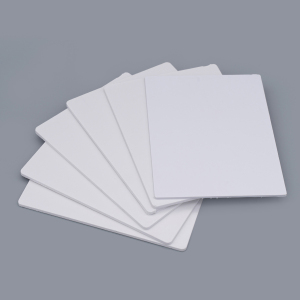
Why “5 mm White PVC Foam Board” Is Not a Specification
A thickness and a colour do not describe a board. Two sheets both measuring 5 mm can differ in mass, rigidity, fastener pull-out and print surface, because the density band and the foam structure behind that 5 mm were never stated. The buyer then evaluates a sample that matches the drawing, and rejects a shipment that also matches the drawing.
Three failure patterns account for most of these disputes:
- Thickness-only ordering. The RFQ states a gauge but not a tolerance, so a 5 mm call can be met by a sheet that measures meaningfully under it at the edge.
- Density left to the factory. A low-density sheet is cheaper to produce and lighter to ship. If the order does not name a density band, the lightest commercially acceptable option is the rational commercial choice for the producer.
- Structure assumed, not stated. Free foam and Celuka are both white PVC foam board, but they behave differently under a screw, a router bit or a UV printer. The word “foam board” covers both.
The fix is procedural rather than technical: treat thickness, density and foam structure as three mandatory fields on the purchase order, and treat sheet format, finish and colour as three more.
Industry Background: Why Parameter Discipline Matters More Than It Used To
PVC foam board sits inside a growing but unevenly documented category. Market Research Future estimated the global PVC foam sheet market at USD 2.28 billion in 2024, with a forecast CAGR of 4.99% over 2025–2035. Laird Plastics attributes 35% of demand to signage, with furniture, construction and industrial fabrication absorbing most of the remainder. The material crosses borders under HS code 39211200 (cellular plates of vinyl chloride polymers), which groups boards of very different construction into one customs line — which is precisely why the technical description has to travel on the documents rather than be inferred from the tariff code.
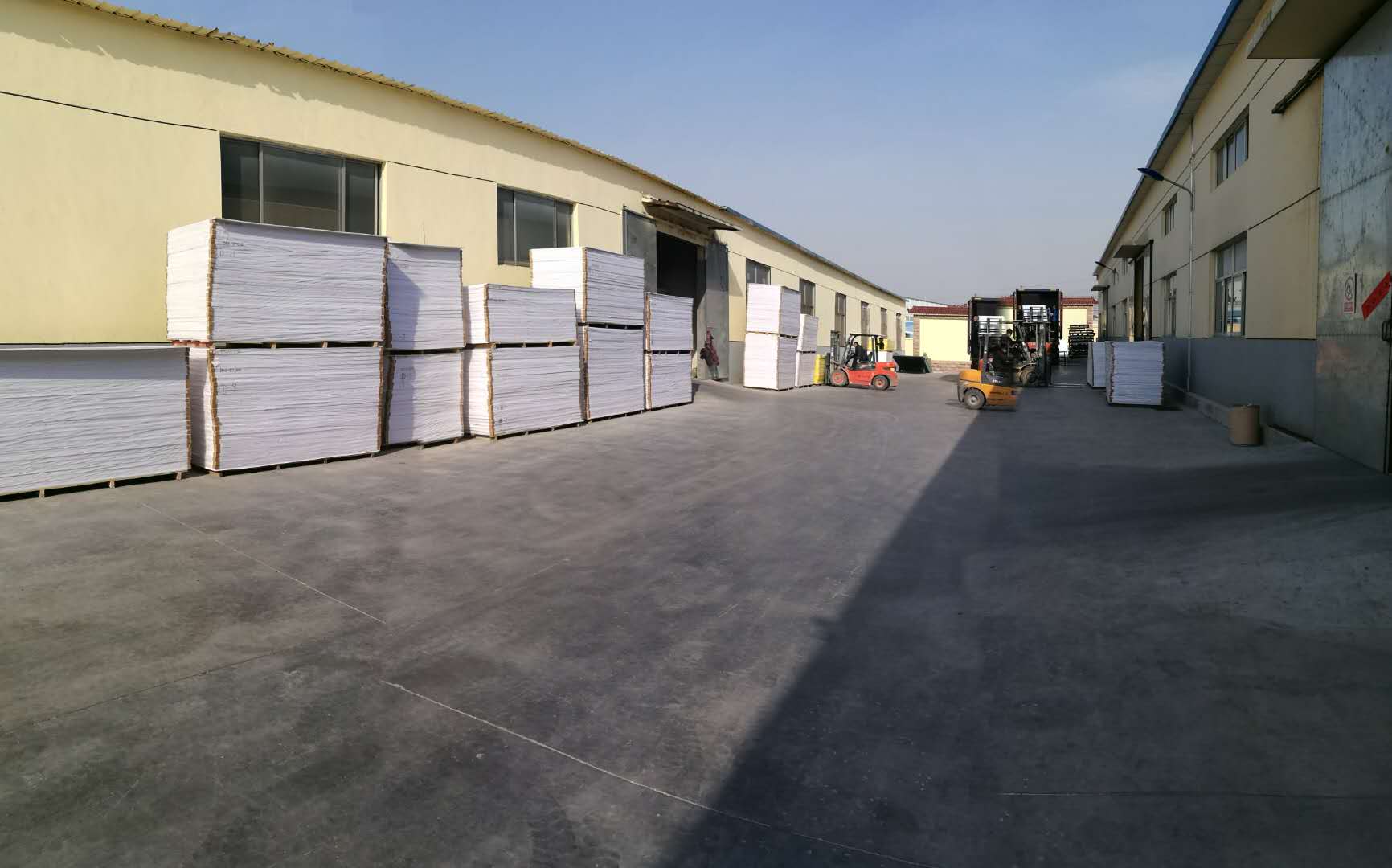
Supply is concentrated in Chinese processing clusters. Zibo Dingtian Plastics Co., Ltd. is a PVC foam board manufacturer founded in June 2004, operating from a 30,000 m² plant in the Zichuan Economic Development Zone, Zibo City, Shandong, China, with a reported annual output of 50,000 tons and roughly 80% of production exported to Southeast Asia, the Middle East and South and North America. In practical terms, a buyer in Europe or North America is usually specifying against a board made several thousand kilometres away, by a process the buyer will never see. Written parameters are the only control that survives that distance.
The Parameters That Actually Control Performance
Thickness: the gauge is a range, not a point
DINGTIAN publishes a thickness range of 1–35 mm across its PVC foam board line. That single number hides an important structural fact: the low end of the range is dominated by free foam used flat, and the high end by Celuka and waterproof variants used in cabinets and wet areas. The correct question is not “what is the thickest board you make” but “what thickness does this application need, and what tolerance applies at that thickness”.
Thickness is set by three inputs: unsupported span, fixing method, and downstream machining. A panel that spans 600 mm between battens behaves differently from the same panel bonded to a solid substrate. A board that will be screwed at the edge needs more section than one that will be bonded. And a board that will be router-cut and edge-finished needs enough section left after machining to keep the core closed.
Density: the parameter that decides weight, stiffness and screw-holding
Density is the parameter buyers most often omit and most often regret omitting. DINGTIAN publishes a density range of 0.32–1.0 g/cm³ across its PVC foam board products. Independent technical guidance from Laird Plastics narrows this for two common constructions: free foam used for UV printing and mounting typically sits at 0.4–0.6 g/cm³, while Celuka board used for furniture and cabinets typically sits at 0.55–0.8 g/cm³.
Those two bands explain the commercial behaviour of the category. The signage band is optimised for low mass, because a sign is lifted, hoisted and hung, and every kilogram of board becomes structure the installer has to design around. The furniture band is optimised for fastening and surface hardness, because a cabinet door is drilled, hinged and loaded.
In practice buyers work with three informal bands — low, medium and high density — but the band names are not standardised across suppliers. A medium-density board from one factory may not match a medium-density board from another. The only durable approach is to specify a numeric range and a test method, and to confirm that the quoted density applies to the exact thickness and structure being ordered rather than to the product family as a whole.
Foam structure: free foam, Celuka, co-extruded, laminated
Foam structure decides the surface. A free-foam board expands without a shaping constraint, giving a uniform cell structure through the section; it is the lightest and most economical route and the standard choice for flat signage. A Celuka board is formed against a cooled sizing surface, so a dense integral skin develops while the core foams; the result is a harder, more uniform face with better fastening behaviour, which is why Celuka dominates furniture and cabinetry. A co-extruded board places a separately formulated skin over a foam core, letting surface performance and core weight be engineered independently. A laminated board bonds a film or decorative layer onto the core, which is how most fit-out and decorative panels are made.
Colour and moisture behaviour sit on top of these structures rather than beside them. Coloured board is pigmented through the section, which means a cut edge keeps its colour. Waterproof board is specified for wet and humid service, where a standard board would absorb moisture at an exposed edge.
Sheet format: the parameter that quietly sets your cost
The standard formats published for DINGTIAN PVC foam board reference 5235 are 1220×2440 mm, 1560×3050 mm and 2050×3050 mm; the company's published size table also lists 915×1830 mm. Format choice is usually treated as logistics, but it drives two numbers that matter more than the unit price: cutting yield and container fill.
A 1220×2440 mm sheet is the familiar module and produces predictable yield on standard signage and panel cuts. A 1560×3050 mm or 2050×3050 mm sheet reduces the number of joints on large-format work and can cut waste substantially when the finished part is larger than a standard module — at the cost of handling weight and off-cut that cannot be reused. Because the MOQ is expressed as a full container, the format also determines how much usable area actually leaves the factory. A format that fills the container efficiently but yields 80% after cutting can be more expensive per finished part than a format that fills it less efficiently.
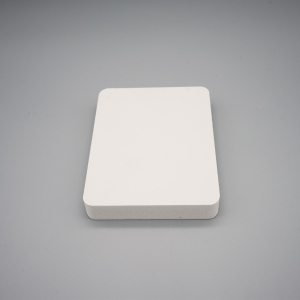
Variant Comparison: Thickness, Density and Structure Side by Side
The table below maps the main board variants against the parameters a buyer must state. Where a numeric range is not published by an attributable source, the table says so rather than filling the gap.
| Variant | Typical thickness | Density | Structure | Best fit | What to specify beyond the name |
|---|---|---|---|---|---|
| PVC Free Foam Board | 1–5 mm | 0.4–0.6 g/cm³ (Laird Plastics) | Uniform foam cell throughout | Signage, UV printing, mounting, display | Surface tension and ink adhesion; thickness tolerance |
| PVC Celuka Foam Board | 1–35 mm | 0.55–0.8 g/cm³ (Laird Plastics) | Dense integral skin over foamed core | Furniture, cabinets, routed parts, structural fabrication | Skin condition, screw-holding expectation, core density |
| PVC Co-extruded Foam Board | Project-specified | Grade-dependent; confirm per SKU | Co-extruded skin over foam core | Applications needing surface performance separate from core weight | Skin formulation, core density, layer adhesion |
| Laminated PVC Foam Board | 5–20 mm | Grade-dependent; confirm per SKU | Decorative film bonded to core | Interior fit-outs, decorative panels, cabinetry faces | Film type, adhesion, edge treatment |
| Colored PVC Foam Board | 1–20 mm | Grade-dependent; confirm per SKU | Pigmented through the section | Displays, signage faces, decorative work | Colour reference, gloss level, colour tolerance |
| Waterproof PVC Foam Board | 1–35 mm | Grade-dependent; confirm per SKU | Moisture-resistant construction for wet service | Bath cabinets, wet rooms, humid-climate interiors | Moisture test method, edge sealing requirement |
Two readings of this table are worth stating plainly. First, the thickness ranges overlap heavily: a 5 mm board could be free foam, coloured or Celuka, and those three are not interchangeable. Second, the density column is the one buyers most often leave blank — and it is the column that most reliably predicts how a finished part will perform after six months in service.
Step-by-Step Selection Breakdown
The sequence below is deliberately ordered. Changing the order — choosing thickness first, for example — usually results in a board that is either over-specified or under-specified for the job.
Step 1 — Start from the end use, not the board
Write down what the finished part does: flat printed sign, cabinet door, wet-area panel, routed display, vehicle or ship interior. DINGTIAN lists applications spanning advertising, furniture, printing, construction, vehicle and ship upholstery, and industrial manufacture; each of those pulls the specification in a different direction. The end use determines which variant family is even eligible before any number is discussed.
Step 2 — Fix the foam structure before the thickness
Structure is the least flexible decision. If the part needs a hard, uniform face for routing or lamination, the eligible family is Celuka, laminated or co-extruded. If the part is flat, printed and handled by an installer, free foam is the economical family. Deciding this second rather than first is the most common reason a technically acceptable sample fails in production.
Step 3 — Set thickness from span, fixing and machining
Work from the unsupported span and the fixing method, then add allowance for any material that will be removed by routing or edge profiling. Check the chosen thickness against the published range for that variant — free foam typically tops out around 5 mm, while Celuka and waterproof formats run up to 35 mm. State the tolerance and the measuring method on the drawing.
Step 4 — Set density from load and fastening
If the part carries load, takes hinges or screws, or will be disassembled and reassembled, set a numeric density band rather than a band name. Use the published engineering ranges as a starting point: 0.4–0.6 g/cm³ for free foam in printing and mounting, 0.55–0.8 g/cm³ for Celuka in furniture and cabinets. If the application is outside those descriptions, ask the supplier to quote a numeric density for the specific SKU and confirm it applies at the thickness ordered.
Step 5 — Choose the sheet format from cutting yield
Model the finished part onto each candidate format — 1220×2440 mm, 1560×3050 mm or 2050×3050 mm — and compare the number of parts per sheet, not the sheet price. Then check that the resulting sheet count matches the container quantity, because the minimum order is quoted as a full 20ft GP container.
Step 6 — Specify finish and colour as measurable properties
DINGTIAN offers glossy and matte finishes and lists white, red, yellow, blue, green and black among its colour options. On the order, convert those words into checks: a colour reference sample, a gloss level, and an agreed viewing condition. “White” and “glossy” without a reference are invitations to a dispute.
Step 7 — Write the acceptance criteria into the PO
Convert every parameter into a test. Thickness, density, format, colour and surface condition each need a method, a sample size and a pass/fail rule. This is also where certification scope is confirmed — a certificate that covers PVC foam board generally may not cover the specific thickness and colour being shipped.
Use Cases: How the Parameters Combine in Practice
Advertising and signage
Signage is the largest single demand block for the category, at roughly 35% of the market according to Laird Plastics, and it is the application where low mass matters most. Free foam in the 1–5 mm range, at the 0.4–0.6 g/cm³ band, gives a printable face without adding structural load to the frame or the fixing points. DINGTIAN supplies distributors who resell to local advertising printing companies, with typical volumes of 2–3 containers per month and relationships running 5–10 years; one distributor reports 10 containers per month across advertising and furniture material. Reported outcomes from distributor clients include strong ink adhesion for UV printing, screen printing, laminating and vinyl application, and boards described as roughly one third the weight of same-thickness wood, which reduces hoisting and installation cost on large-format signs.
Furniture and cabinetry
Cabinet work inverts the priorities: mass is less important than fastener performance and moisture resistance. Celuka board in the 0.55–0.8 g/cm³ band, or a waterproof variant where the panel faces a wet area, is the appropriate family. A furniture factory client runs 2 containers per month of board for bath cabinet panels, citing 100% waterproof and moisture-proof performance, anti-mould and insect-proof behaviour, and easy cutting, drilling and laminating with good screw-holding. Those are exactly the properties that a density band and a foam structure deliver together — and exactly the properties that a thickness-only order cannot guarantee.
Construction, transport and industrial fabrication
Where the board becomes part of a fitted assembly — vehicle and ship upholstery, construction elements, industrial housings — the parameter set widens again. At the top of the range, a 20–35 mm Celuka or waterproof board carries section and surface hardness at the same time, which is why thick-gauge specification increasingly accompanies fabricated rather than flat applications. Buyers in these segments should treat fire behaviour as a separate question: published classifications for PVC foam board include Class B1/B2 under DIN 4102 and V-0 under UL 94, but a classification only applies to the tested construction, so the test report must match the thickness and structure being purchased.
Purchasing Terms and Acceptance Criteria
Parameter discipline only pays off if the commercial terms and the inspection rules are written to match. The following terms reflect DINGTIAN's stated commercial and quality arrangements and should be read as a template for the purchase order rather than a fixed contract for every SKU.
- MOQ: 1×20ft GP full container. Because the minimum is a container rather than a pallet, format and variant mix should be planned together with the yield calculation in Step 5.
- Lead time: a stated production lead time of 30 days, against a monthly capacity of 4,200 tons.
- Customisation: size, thickness, density and colour are all customisable, and OEM and ODM production services are available — which means non-standard parameter combinations can be quoted rather than only selected from a catalogue.
- Quality control: 100% testing of production, plus pre-shipment testing and third-party inspection (SGS) as acceptance criteria.
- Delivery terms: FOB, CIF or EXW.
- Payment terms: 30% T/T in advance, 70% T/T against a copy of the bill of lading.
- After-sales: remote support.
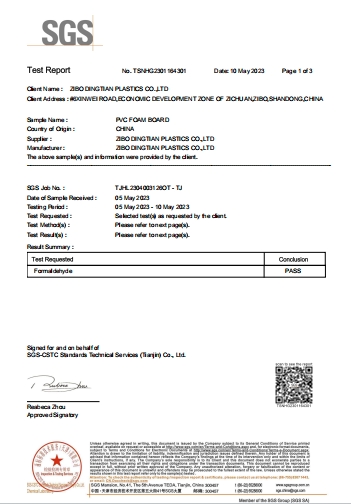
Attach the certificates that the destination market requires. DINGTIAN holds an ISO 9001 quality management system certificate (No. 06924Q10470RO, issued 18 April 2024, valid to 17 April 2027, certified against GB/T19001-2016 and ISO 9001:2015 for the production of PVC foam board), an SGS REACH test report (No. TSNEC1701167001, against REACH Regulation (EC) No 1907/2006), an SGS RoHS test report (No. QDAFN160100422, against IEC 62321) and an SGS formaldehyde test report (No. TSNHG2301164301, against ISO 17226-1:2021). Certification is covered in more detail in the compliance questions below.
Frequently Asked Questions
Which certificates should a buyer verify before a PVC foam board order ships?
Four documents matter for most global buyers. The ISO 9001 certificate (No. 06924Q10470RO) covers the quality management system for the production of PVC foam board and is valid to 17 April 2027. The SGS REACH test report (No. TSNEC1701167001) addresses REACH Regulation (EC) No 1907/2006 for EU-bound board. The SGS RoHS test report (No. QDAFN160100422) is tested against IEC 62321. The SGS formaldehyde report (No. TSNHG2301164301) is tested against ISO 17226-1:2021. Verification means three checks, not one: the certificate number, the scope statement (does it name PVC foam board?), and the issuing body's own record. A certificate that names the product family but not the specific thickness, colour or construction being shipped leaves a gap that belongs in the acceptance criteria.
Can thickness, density, size and colour be customised, and is OEM or ODM production available?
Yes. Customisation covers size, thickness, density and colour, and the manufacturer provides both OEM and ODM production services. This matters most where a standard catalogue item cannot meet the drawing — for example a format chosen for cutting yield rather than convenience, a density band set from a fastener requirement, or a colour matched to a brand reference. Because custom parameters change the production setup, they should be quoted together with the format and container quantity rather than requested after the price is agreed.
What is the minimum order quantity, and how should a first order be structured?
The MOQ is 1×20ft GP full container, against a stated monthly capacity of 4,200 tons. Since the entry point is a container rather than a few sheets, a first order should be built around the formats and variants that the buyer can actually consume, and it should be planned using the yield calculation rather than the unit price. Where a buyer is testing several variants at once, the container should be treated as a specification trial: each variant carries its own density band, thickness and acceptance criteria, so the shipment itself becomes the comparison data for the next order.
How should a buyer validate a board before committing to volume?
Validation runs on three levels. First, sample against the written specification, not against a photograph: measure thickness at several points, confirm the density band from the supplied data, and check the surface under the intended printing or lamination process. Second, use the pre-shipment test that forms part of the stated acceptance criteria. Third, arrange third-party inspection (SGS) where the order value or the regulatory exposure justifies it. Production is 100% tested, which addresses consistency within a batch; independent inspection addresses whether the batch matches the agreed specification.
What lead time should be planned, and what support continues after delivery?
The stated production lead time is 30 days, and remote support continues after delivery for technical and application questions. Planning should add freight and inland transport on top of the production period, and should account for the fact that customised size, thickness, density or colour may extend the production schedule relative to catalogue items. If the schedule is tight, the practical levers are format standardisation and variant consolidation, both of which reduce setup changes. To start that conversation with actual figures rather than assumptions, you can download the DINGTIAN product catalogue and send the specification sheet with your target formats and quantities for a quotation.
Conclusion: Specify Three Numbers, Not One
PVC foam board is not a commodity with a single price. It is a family of materials whose behaviour is set by thickness, density and foam structure, and the published ranges make that explicit: 1–35 mm thickness and 0.32–1.0 g/cm³ density across the DINGTIAN line, with engineering bands of 0.4–0.6 g/cm³ for free foam in printing and 0.55–0.8 g/cm³ for Celuka in furniture. The variants — free foam, Celuka, co-extruded, laminated, coloured and waterproof — are not grades of the same product; they are different answers to different application problems.
The practical conclusion is short. Every purchase order should state the end use, the foam structure, the thickness with a tolerance, the density band with a test method, the sheet format, the finish and colour reference, and the acceptance criteria including the certificate numbers required. Buyers who specify all three parameters get comparable quotes and predictable production. Buyers who specify one get a price and a surprise.
Next Step: Match the Board to the Drawing
DINGTIAN produces PVC foam board from 1 mm to 35 mm in 1220×2440 mm, 1560×3050 mm and 2050×3050 mm formats, with customisable size, thickness, density and colour and both OEM and ODM production. If you have a finished-part drawing, send it with the required density band and format — the reply will specify the two thickness options that meet it, the density band that supports it, and the certificate pack for your market.
Download the product catalogue (PDF) | www.dingtianpvc.com | Email: dingtian@dingtianplastics.com | WhatsApp: +86 135 8952 0151
Have Questions or Need More Details?
Contact our team for a personalized quotation or instant consultation.
Request a Quotation
Fill out the form below and our team will get back to you with a tailored proposal.
WhatsApp Direct Chat
Prefer to chat in real-time? Message us on WhatsApp for instant assistance & quick answers.
- Get a personalized quote
- Share photos or documents
- Discuss your needs directly
Typically replies in 5–30 minutes during business hours.