
PVC Foam Board for Retail Store Fit-Outs: A Variant & Thickness Selection Guide
PVC Foam Board for Retail Store Fit-Outs: A Variant & Thickness Selection Guide
This guide is written for shopfitting contractors, joinery workshops, interior specifiers and retail brand owners who are past the enquiry stage — comparing boards, setting thicknesses and preparing a cutting list for release to order. It maps each PVC foam board variant to the retail zone it belongs in, explains how thickness and format decisions are made, and lists the compliance evidence that should sit in the project file before the first container is booked.
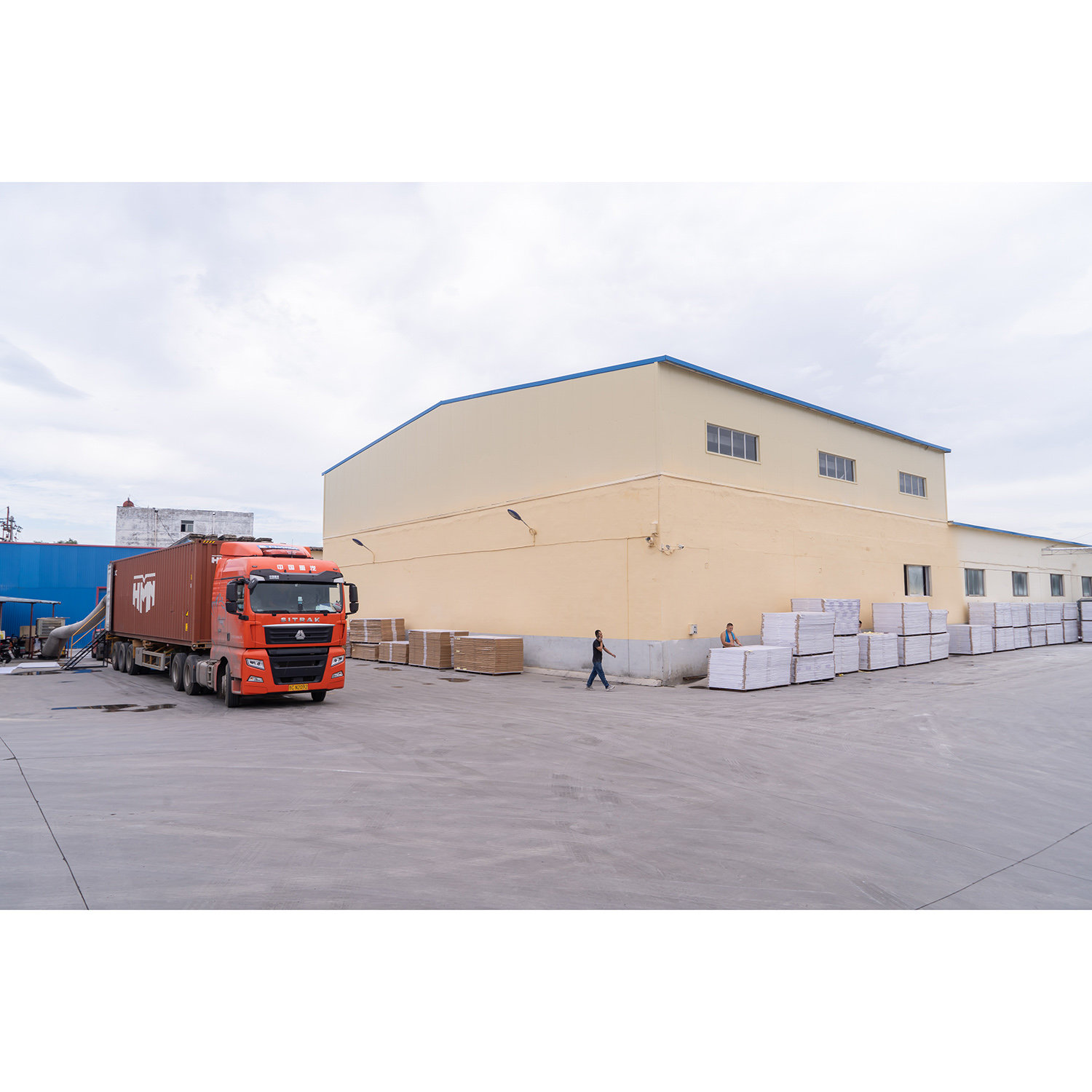
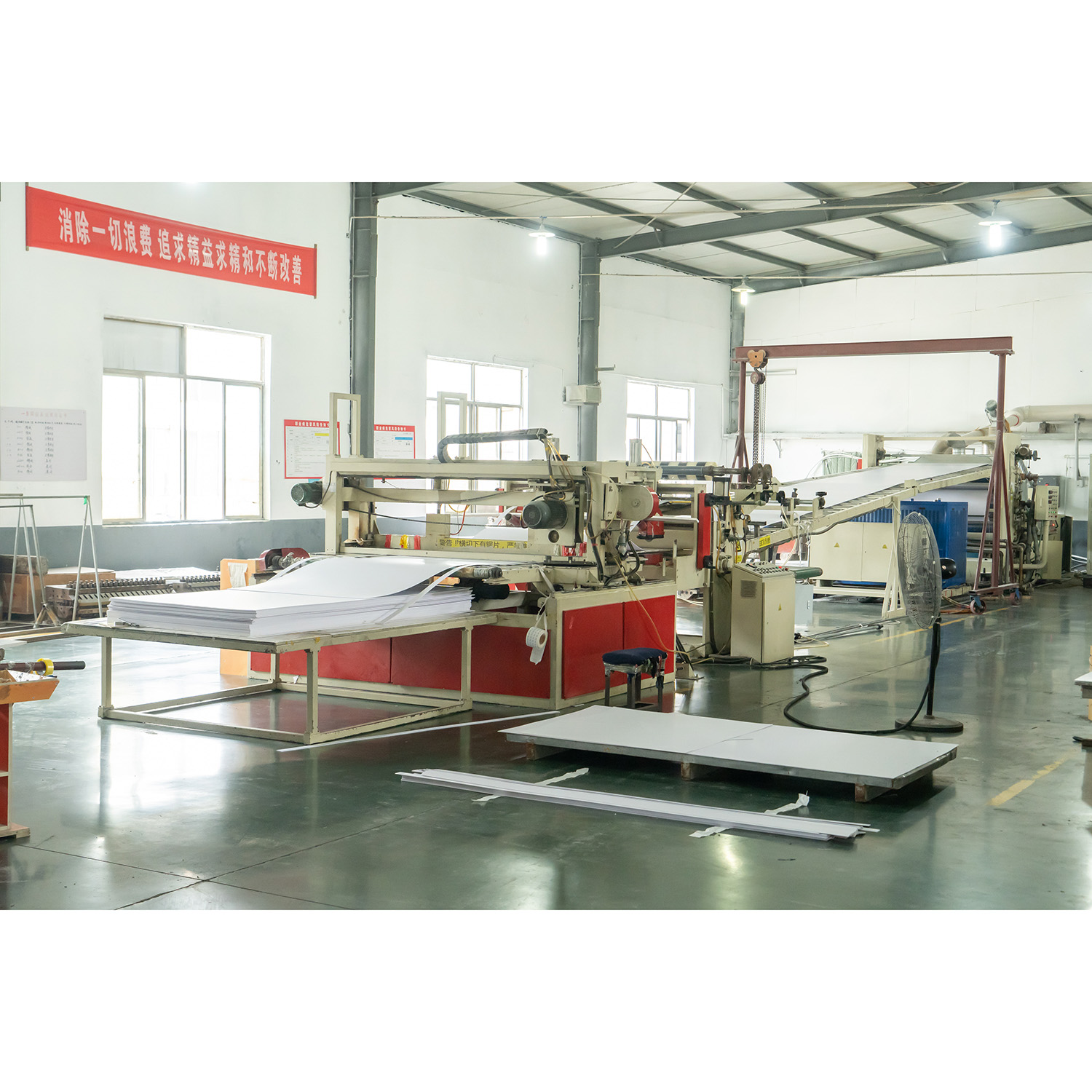
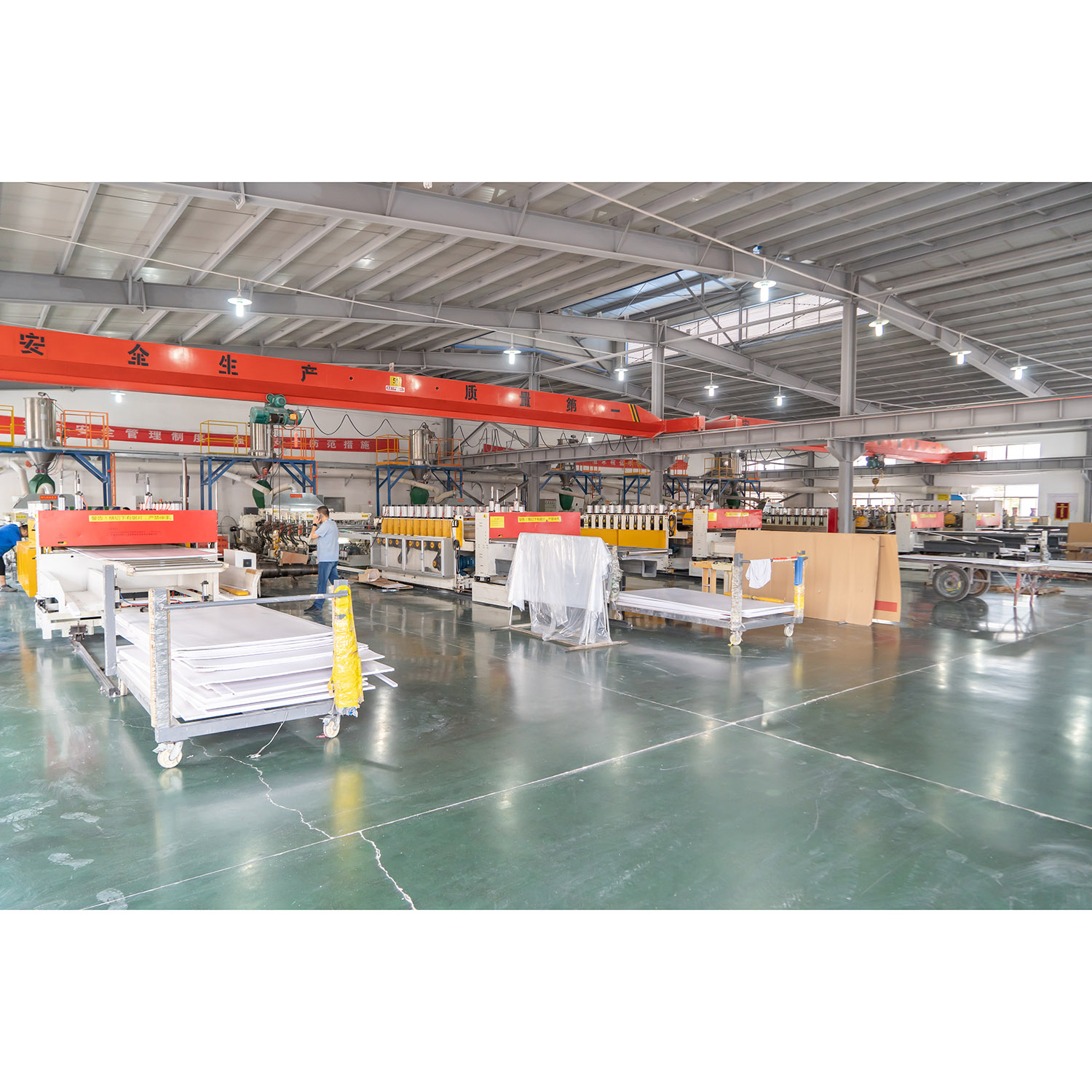
Zibo Dingtian Plastics Co., Ltd. — brand DINGTIAN — is a PVC foam board manufacturer founded in June 2004 and based in the Zichuan Economic Development Zone, Zibo City, Shandong Province, China. The company produces PVC foam board for advertising and signage, construction and decoration, furniture and cabinetry, and special-purpose applications from a 30,000 m² plant with 181 employees, an annual output of 50,000 tons and an R&D team of 20 engineers. Around 80% of production is exported, with main markets in Southeast Asia, the Middle East and South and North America.
Why a Single Board Specification Fails in a Retail Interior
A retail interior is not one environment. Within a single store, the panel behind a backlit fascia sits under constant light and gentle heat, the shelf carrying stacked product takes a point load, the counter at a juice bar is wiped down several times an hour, and the partition in the staff washroom lives in permanent humidity. Those are four different material problems inside one drawing set.
The usual failure mode is a single specification call — for example, 18 mm plywood throughout — issued to simplify procurement. It produces two predictable outcomes. Zones that do not need structural panel performance are over-specified and over-finished, which adds weight, handling time and drying time to the programme. Zones that do need moisture or impact resistance are under-specified, which reappears later as swollen edges, paint failure, delamination and post-handover callbacks.
PVC foam board changes that calculation in four ways that matter to a fit-out programme:
- Around 50% lighter than plywood at comparable panel size, which reduces manual handling, transport weight and the temporary support needed for suspended elements.
- No sealing or painting where a laminated or colored surface is used, which takes a wet trade off the critical path.
- Water washable surfaces that suit food-service, washroom and back-of-house zones.
- Around 60% faster installation on typical fit-out detailing compared with a plywood-and-paint build-up.
The remainder of this guide converts those advantages into a zone-level specification method: which variant, which thickness, which format, and which evidence should be on file before the order is released.
Retail Fit-Out Demand and the Regulatory Background
The global PVC foam board market was valued at approximately USD 2.1 billion in 2024 and is projected to reach USD 3.6 billion by 2032 (Verified Market Research). Signage and advertising remains the largest single application, at roughly 35% of demand (Laird Plastics) — a share that mirrors the application mix of DINGTIAN's PVC foam board range, where advertising and signage accounts for 35%, construction and decoration 30%, furniture and cabinetry 15%, transportation 10%, and special-purpose applications the remaining 10%.
Supply is concentrated. China accounted for 20% of total world exports of plastic building materials, including PVC boards, in 2024, holding its position as the largest exporter (Observatory of Economic Complexity). Zibo, where DINGTIAN's plant operates, is an established plastics processing base: the city registered USD 180 million in plastic product export volume in 2024 across nearly 500 export-oriented manufacturers (Qilu Network).
Two regulatory shifts now shape retail specifications. Under EU REACH (Annex XVII, entry 63), lead concentration in PVC articles is restricted to less than 0.1% by weight, effective 29 November 2024 — which makes lead-free formulation a baseline expectation for EU-bound retail work. In North America, PVC foam boards used in construction commonly undergo ASTM E84 testing to achieve a Class A fire rating (Flame Spread Index 0–25) (Laird Plastics), and PVC foam board can achieve a UL 94 V-0 flammability classification at thicknesses down to 1 mm (The Vinyl Institute). For a store that opens to the public, these are specification inputs rather than afterthoughts: fire performance for the assembly, chemical compliance for the board itself.
Variant-to-Zone Mapping for Retail Interiors
Each variant below is defined by a thickness band and a format, and each band corresponds to how the board is loaded and exposed in service.
Zone 1 — Signage, fascia, POP and backlit displays: free foam board
Free foam PVC board is the correct starting point wherever the board surface becomes part of the graphic. The standard format is 1220×2440 mm, thickness runs from 1–5 mm, and density sits between 0.5 and 0.8 g/cm³.
The reason is surface behaviour rather than structural performance. Free foam board carries a fine, uniform cell structure that produces a flat, printable face, so UV printing, vinyl application and screen work all land on a consistent surface. At the lower end of the thickness range the board follows the substrate or frame it is fixed to; at 3–5 mm it becomes self-supporting over moderate spans.
- Shopfront fascia inserts and changeable signage panels
- Ceiling-suspended promotional boards, where low weight reduces the fixing specification
- Shelf-edge graphics, aisle markers and category signage
- Counter-top card holders, menu boards and display plinths
- UV-printed and vinyl-applied promotional displays
Thickness selection inside this band is a question of support spacing. Thin sheets (1–2 mm) suit fully supported graphics; mid-band sheets (3–5 mm) suit panels that must hold their own shape between fixings.
Zone 2 — Shelving, cabinet fronts and display joinery: laminated and colored board
Laminated PVC foam board is supplied in 1220×2440 mm sheets at 5–20 mm, and colored PVC foam board in 1–20 mm. Both are specified where the visible face of the board is the finished face.
The practical benefit for a multi-unit rollout is colour control. A laminated or colored face arrives finished, so there is no painting step, no drying window, and no batch-to-batch variation between the first store and the twentieth. Thickness is chosen for stiffness: 5–10 mm for cabinet doors, drawer fronts and short shelf spans, 12–20 mm for longer unsupported shelf runs, gondola end panels and cash-wrap counters.
- Gondola shelving and wall-bay shelf decks
- Cabinet doors, drawer fronts and till surrounds
- Fitting-room partitions and mirror surrounds
- Department colour coding and brand-palette trims
- Cash-wrap counters and service-desk fascias
Zone 3 — Wash counters, restrooms and food-service fixtures: waterproof board
Waterproof PVC foam board spans 1–35 mm and is specified wherever the surface is routinely wet or repeatedly cleaned. The material does not depend on a surface coating for its water resistance, so cut edges, drilled holes and scribed joints behave the same as the face.
- Juice, coffee and food-preparation counter underpanels and fascias
- Hand-wash stations and restroom partitions and cubicle doors
- Back-of-house wash walls and cleaning stations
- Food-court counter cladding and condiment units
- Kick plates, trolley bump zones and other high-traffic fixtures
Reference point from field use: a DINGTIAN distributor/wholesaler programme using the board for advertising material and furniture material, at a project volume of 10 containers per month, recorded 100% waterproof performance over a usage duration of 5–10 years, with zero warping or delamination.
Zone 4 — Feature walls and large-format panels: Celuka board
Celuka PVC foam board is available in 1220×2440 mm, 1560×3050 mm and 2050×3050 mm, with densities across the range from 0.4–0.9 g/cm³. The large formats exist for a simple reason: every extra joint in a feature wall is a line to align, a fixing point to set out and a potential shadow line under retail lighting.
- Full-height feature walls and brand statement panels
- Shopfront surrounds and entrance portals
- Long unbroken service-desk and counter fascias
- Ceiling rafts and bulkhead cladding where panel weight matters
Where a project needs a board with a harder working surface than a standard Celuka panel, co-extruded PVC foam board combines a rigid PVC skin with a foamed core — a construction generally used where higher surface hardness and impact resistance are required.
From Drawing Set to Order: A Nine-Step Specification Workflow
The sequence below is the order in which specification decisions become binding. Changing variant later is cheap; changing thickness after the cutting list is issued is not.
- Survey and list every zone. Walk the drawing set and the site and write down each distinct surface group: fascia, shop floor, counters, washroom, back-of-house, feature walls.
- Classify each zone by exposure. Tag every zone as dry decorative, dry structural, wet, or high-impact. This single step prevents most over- and under-specification.
- Assign the variant. Free foam for printed and backlit surfaces, laminated or colored for finished joinery faces, waterproof for wet and cleaned surfaces, Celuka for large unbroken panels.
- Set thickness against span and load. Thin boards for supported graphics; thicker boards for shelf spans, counters and any panel that carries a load or takes an impact.
- Confirm density and format. Densities from 0.4–0.9 g/cm³ are available across the PVC foam board range; moving from 1220×2440 mm to 1560×3050 mm or 2050×3050 mm reduces seam count and fixing points on long elevations.
- Detail fixings, edges and joints. Pilot-drill for screws, allow for movement at panel joints, and specify edge trim where cut edges are visible. Laminated and colored faces do not require sealing or painting, which shortens this step.
- Run the compliance gate. Confirm the certificates the project actually requires — chemical compliance for the board, fire performance for the assembly — before the order is placed rather than after delivery.
- Approve a mock-up. Fix a sample panel in the same lighting and fixing condition as the finished store so the client signs off surface, colour and joint lines in place.
- Release the order. DINGTIAN's standard minimum order quantity is 1×20ft GP full container, with a typical production lead time of 30 days and monthly capacity of 4,200 tons.
Retail Use Cases
Fashion and beauty retail
Signage and window graphics come from free foam board at 1–5 mm; the shelving, wall bays and cash-wrap joinery come from laminated and colored board at 5–20 mm. Because the joinery faces arrive finished, the store can be merchandised as soon as the fixtures are set, without waiting for a paint cure.
Convenience and forecourt stores
These formats run on fast turnaround and heavy cleaning. Waterproof board at 1–35 mm covers restroom partitions, wash points and counter fascias, while free foam board handles price signage and promotional panels that are replaced seasonally.
Supermarkets and food courts
Wet and high-traffic zones dominate: wash counters, hand-wash stations, condiment units and trolley bump zones. Waterproof board, and thicker boards within that band for impact zones, keep maintenance to washing rather than repair.
Pop-up and seasonal stores
Weight drives the decision. Boards around 50% lighter than plywood are easier to move, re-use and re-configure between locations, and the absence of a sealing or painting step supports short installation windows.
Distributor and shopfitting-partner programmes
A distributor/wholesaler programme supplying advertising and furniture material at 10 containers per month, over a usage period of 5–10 years, recorded 98% print image retention after 3 years, zero warping or delamination, 40% cost saving against aluminum composite panel, and 100% waterproof performance. The boards were UV stabilised for long-term exposure, and the reduced panel weight lowered installation cost.
Variant and Zone Comparison
The two tables below are the working reference for a specification review. Table 1 lists each variant with its thickness band, format and primary retail role. Table 2 converts a zone requirement into a recommended board.
| Variant | Primary retail role | Thickness band | Available format | Density / key property |
|---|---|---|---|---|
| Free foam PVC board | Signage, fascia, POP, backlit displays | 1–5 mm | 1220×2440 mm | 0.5–0.8 g/cm³; fine uniform cell, printable face |
| Laminated PVC foam board | Shelving, cabinet fronts, counters | 5–20 mm | 1220×2440 mm | Pre-finished face; no sealing or painting |
| Colored PVC foam board | Display joinery, department colour coding | 1–20 mm | 1220×2440 mm | Solid colour through the board |
| Waterproof PVC foam board | Wash counters, restrooms, food-service fixtures | 1–35 mm | 1220×2440 mm | Water-resistant; washable surface |
| Celuka PVC foam board | Feature walls, full-height cladding, shopfront surrounds | 1–35 mm | 1220×2440 mm / 1560×3050 mm / 2050×3050 mm | 0.4–0.9 g/cm³; rigid skin, large formats |
| Zone requirement | Recommended board | Why it fits |
|---|---|---|
| Printed or backlit graphics that must stay flat | Free foam, 1–5 mm | Uniform cell structure and smooth face for print and vinyl; low weight for suspended panels |
| Shelf and cabinet panels needing stiffness with a finished face | Laminated, 5–20 mm | Pre-finished surface removes the painting step; greater thickness adds rigidity |
| Solid-colour components matched to a brand palette | Colored board, 1–20 mm | Colour runs through the board; no surface coating to touch up |
| Surfaces washed or hosed daily | Waterproof, 1–35 mm | Water-resistant construction with a washable surface |
| Long, unbroken feature walls and fascias | Celuka, 1560×3050 mm or 2050×3050 mm | Large formats reduce seam count and fixing points |
| Edges and zones exposed to trolleys and impact | Co-extruded board | Rigid PVC skin over a foamed core for higher surface hardness and impact resistance |
Compliance Evidence to Hold Before Release to Order
For an indoor retail environment, chemical compliance and quality-system evidence are the two document groups a specifier or client's QHSE reviewer will ask for. DINGTIAN holds the following records for PVC foam board:
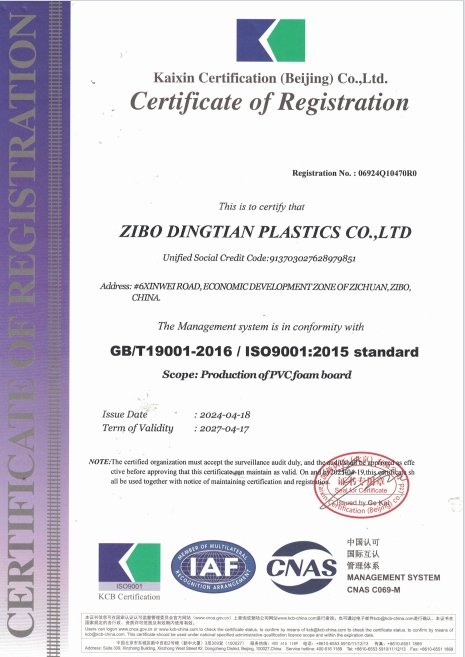
- ISO 9001 — certificate 06924Q10470RO, issued by Kaixin Certification (Beijing) Co., Ltd. against GB/T19001-2016 & ISO9001:2015, valid from 18 April 2024 to 17 April 2027, with the scope stated as production of PVC foam board.
- REACH — SGS test report TSNEC1701167001, assessed against REACH Regulation (EC) No 1907/2006 for the EU market.
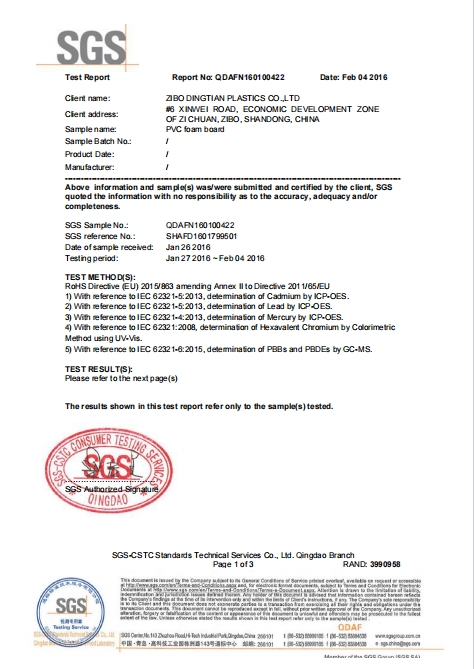
- RoHS — SGS report QDAFN160100422, assessed against IEC 62321 for the EU market.
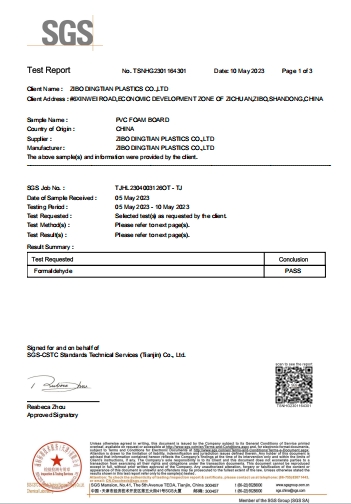
- Formaldehyde — SGS test report TSNHG2301164301, assessed against ISO 17226-1:2021 for PVC foam board.
The REACH position deserves a note. Since EU REACH Annex XVII entry 63 restricted lead in PVC articles to less than 0.1% by weight from 29 November 2024, a lead-free formulation is no longer a premium option for EU-bound retail projects — it is the entry condition. Requesting the SGS report number rather than the marketing claim is the fastest way to confirm it.
Where the local authority or the client's insurer requires fire data for the finished assembly, PVC foam board is commonly tested to ASTM E84 to achieve a Class A fire rating, and can reach UL 94 V-0 at thicknesses down to 1 mm. These should be confirmed against the specific thickness and assembly detail being specified, not assumed from the board category.
FAQ: PVC Foam Board for Retail Fit-Outs
Which certifications should a retail fit-out contractor verify for indoor PVC foam board?
Ask for four documents: ISO 9001 quality management certification for the production site (DINGTIAN holds certificate 06924Q10470RO, valid to 17 April 2027, scope production of PVC foam board), the REACH test report for the EU market (SGS TSNEC1701167001), the RoHS report (SGS QDAFN160100422, assessed against IEC 62321), and the formaldehyde test report (SGS TSNHG2301164301, assessed against ISO 17226-1:2021). Verify report numbers rather than accepting a general compliance statement.
Can PVC foam board be customized to match a retail fit-out drawing set?
Yes. DINGTIAN operates OEM and ODM production, with customization of size, thickness, density and colour. The company runs a 20-engineer R&D team, applies 100% testing to production, and has a monthly capacity of 4,200 tons. Customization is the normal route for multi-store rollouts where panel dimensions, colour and thickness must repeat across every location.
How does PVC foam board affect the fit-out budget?
The budget effect comes from removed steps rather than board price alone. Laminated and colored faces require no sealing or painting, boards are around 50% lighter than plywood, and installation is around 60% faster on typical detailing. In one distributor programme supplying advertising and furniture material, the recorded result was a 40% cost saving against aluminum composite panel, with lower installation cost attributable to reduced panel weight. Fabrication and installation were also reported as straightforward.
Can we evaluate a sample board before ordering?
Pre-order evaluation is the practical way to sign off surface, colour and joint lines under the store's own lighting. Acceptance criteria for DINGTIAN orders are pre-shipment testing plus third-party inspection through SGS, so board condition and specification can be verified before the goods leave the factory rather than on arrival at site.
What is the lead time and order process?
Typical production lead time is 30 days, and the minimum order quantity is 1×20ft GP full container. Delivery terms are FOB, CIF or EXW, and payment terms are 30% T/T in advance with 70% T/T against copy of B/L. After-sales support is provided remotely. To start a sample or quotation request, contact DINGTIAN at dingtian@dingtianplastics.com or +86 533 6125588.
Conclusion
Retail fit-out specification stops being difficult once the store is divided into zones. Free foam board at 1–5 mm takes signage, fascia and POP displays. Laminated board at 5–20 mm and colored board at 1–20 mm take shelving and cabinet fronts without a painting step. Waterproof board at 1–35 mm takes the wet counters, restrooms and food-service fixtures. Celuka board in 1220×2440 mm, 1560×3050 mm and 2050×3050 mm takes the long feature walls where seams cost time and visual quality. The project-level gains follow from the board rather than from extra labour: around 50% less weight than plywood, no sealing or painting on finished faces, washable surfaces, and installation around 60% faster on typical detailing.
Before the order is released, hold the documents: ISO 9001 certificate 06924Q10470RO, REACH report TSNEC1701167001, RoHS report QDAFN160100422, and formaldehyde report TSNHG2301164301 — plus a mock-up sign-off on the actual fixture detail.
Start Your Retail Fit-Out Specification
Send your cutting list, zone notes and colour references. DINGTIAN supports sizing, thickness, density and colour customization through OEM and ODM production, with a 30-day typical lead time and a minimum order of 1×20ft GP full container.
Download the company brochure: DINGTIAN Product Brochure (PDF)
Email: dingtian@dingtianplastics.com · Tel: +86 533 6125588 · WhatsApp: +86 13589520151
Web: www.dingtianpvc.com · www.dingtianpvcfoamboard.com · Blog: blog.dingtianpvc.com