REACH, RoHS, and ISO 9001: Navigating PVC Foam Board Compliance for the EU Market in 2026
A PVC foam board shipment entering the European Union is judged by documents before it is judged by the product itself. REACH compliance, RoHS compliance, and a functioning ISO 9001 quality management system are the three evidence sets that most often determine whether an EU importer, distributor, or brand owner releases a purchase order. In 2026 that check is stricter than it was two years ago, because the lead restriction inside REACH for PVC articles took effect on 29 November 2024.
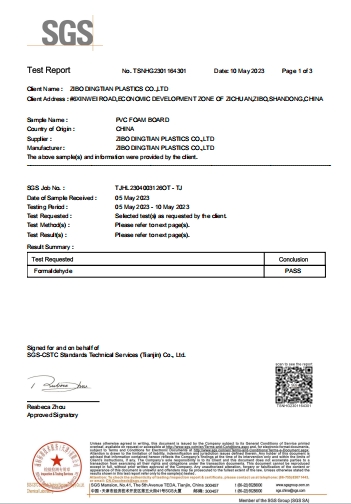
Zibo Dingtian Plastics Co., Ltd., which manufactures PVC foam board under the brand DINGTIAN, holds all three documents, plus a formaldehyde emission test report. Each one exists as a numbered certificate issued by an identifiable body, which means an EU buyer can verify the material compliance of a PVC foam board order without relying on a supplier's verbal assurance.
At a glance: DINGTIAN PVC foam board documentation
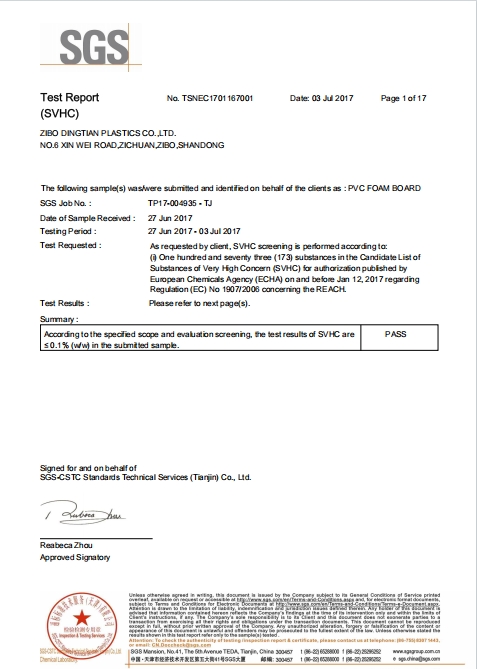
- REACH — certificate No. TSNEC1701167001, issued by SGS, standard REACH Regulation (EC) No 1907/2006, EU market
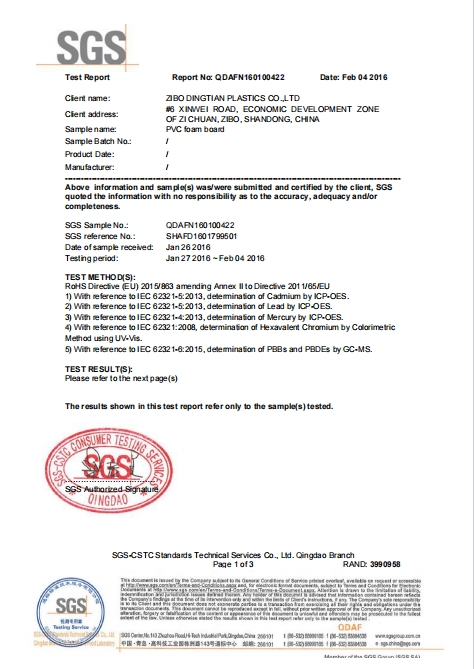
- RoHS — certificate No. QDAFN160100422, issued by SGS, standard IEC 62321, EU market
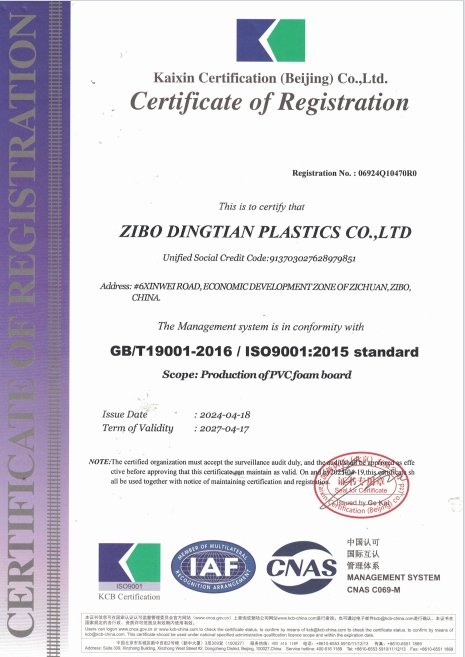
- ISO 9001 — certificate No. 06924Q10470RO, issued by Kaixin Certification (Beijing) Co., Ltd., standards GB/T19001-2016 and ISO9001:2015
- Formaldehyde Certificate — certificate No. TSNHG2301164301, issued by SGS, standard ISO 17226-1:2021, global market
Problem Definition: What “EU-Compliant PVC Foam Board” Actually Means
European market access for PVC foam board is not a single approval. It is three separate questions that a compliance officer or a technical buyer normally asks in sequence, and each question is answered by a different type of document.
Question 1 — Is the material chemically restricted? REACH, formally Regulation (EC) No 1907/2006, governs the chemical substances placed on the EU market. For PVC articles, the sharpest recent change is Annex XVII Entry 63, which restricts lead concentration in PVC articles to less than 0.1% by weight, effective 29 November 2024 (per the European Commission and Intertek). A REACH statement dated several years before that date no longer answers the current version of the question.
Question 2 — Does the board contain restricted hazardous substances above the limits? RoHS evidence, commonly tested against IEC 62321, is used by EU buyers as a screening standard for restricted substances in board material. Importers frequently require it even for boards that are not part of an electrical assembly, because it is a fast, comparable way to filter suppliers.
Question 3 — Can the manufacturer reproduce the same board consistently? A certificate describes one test result. A quality management system describes whether that result can be repeated across production batches. This is why ISO 9001 sits alongside the chemical documents rather than replacing them.
A recurring complication is the request for a “CE certificate”. CE marking is tied to specific EU harmonised legislation and depends on the end product and its intended use. For PVC foam board used in signage, decoration, or general fabrication, EU buyers typically verify chemical compliance documents (REACH and RoHS), a valid quality management certificate, and — where the application requires it — fire-performance and formaldehyde data instead of a single CE document. Converting a vague CE request into a defined document checklist is usually the first useful step in an EU sourcing conversation.
Industry Background: Why Compliance Pressure Is Rising in 2026
The compliance conversation is intensifying because the market itself is growing and because supply is concentrating around a small number of exporting regions. Verified Market Research values the global PVC foam board market at approximately USD 2.1 billion in 2024 and projects it to reach USD 3.6 billion by 2032. Laird Plastics reports that the signage and advertising industry accounts for roughly 35% of total PVC foam board demand, which places the most price-sensitive and most specification-sensitive buyers at the centre of the market.
On the supply side, the Observatory of Economic Complexity (OEC) reports that China concentrated 20% of global exports of plastic building materials — the category that includes PVC boards — in 2024, remaining the largest exporter. More suppliers competing for the same EU shelf space produces a predictable effect: documentation becomes a screening tool. Buyers who previously compared only price and lead time now compare certificate scope, issuing body, and validity period before they negotiate.
Three technical reference points appear repeatedly in EU specification discussions for rigid foam board:
- Fire performance in North American specifications is commonly tested to ASTM E84 to reach a Class A rating (Flame Spread Index 0–25), as described by Laird Plastics.
- UL 94 flammability classification, including V-0 ratings for thin sections down to 1 mm, is documented by The Vinyl Institute for PVC foam material.
- EU project specifications more often reference B1/B2 flame-retardant grades, UV-stabilised outdoor performance, and lead-free construction — requirements that DINGTIAN lists for its PVC foam board application configurations.
Detailed Solution: How DINGTIAN Structures EU Market Access
DINGTIAN's approach is to hold the documents that answer each question above, and to keep them tied to a defined product scope rather than to a general company statement. The table below maps the four documents to the compliance function they perform.
| Document | Standard / Regulation | Issuing Body | Certificate No. | Market |
|---|---|---|---|---|
| REACH | REACH Regulation (EC) No 1907/2006 | SGS | TSNEC1701167001 | EU |
| RoHS | IEC 62321 | SGS | QDAFN160100422 | EU |
| ISO 9001 | GB/T19001-2016 & ISO9001:2015 | Kaixin Certification (Beijing) Co., Ltd. | 06924Q10470RO | Global |
| Formaldehyde Certificate | ISO 17226-1:2021 | SGS | TSNHG2301164301 | Global |
REACH: The Chemical Gate into the EU
DINGTIAN's PVC foam board holds REACH compliance under certificate No. TSNEC1701167001, issued by SGS against REACH Regulation (EC) No 1907/2006 and applicable to the EU market. The certificate was issued on 3 July 2017 and its declared scope is PVC foam board. For an EU importer, the practical value of this document is that it identifies a specific regulation, a specific testing organisation, and a specific product scope — the three elements a customs or compliance reviewer will look for when a shipment is challenged.
RoHS: Substance Screening Against IEC 62321
The RoHS documentation for the same product is certificate No. QDAFN160100422, issued by SGS on 4 February 2016 and tested according to the IEC 62321 standard for the EU market. Because EU buyers frequently use RoHS evidence as a lead-free and heavy-metal screening tool, this certificate is usually requested together with the REACH report rather than instead of it. DINGTIAN's lead-free construction is also listed among its PVC foam board application requirements, which keeps the marketed specification and the tested document aligned.
ISO 9001: Reproducibility Behind the Test Reports
DINGTIAN's quality management system is certified under ISO 9001 with certificate No. 06924Q10470RO, issued by Kaixin Certification (Beijing) Co., Ltd. The certificate covers the production of PVC foam board, conforms to GB/T19001-2016 and ISO9001:2015, was issued on 18 April 2024, and remains valid until 17 April 2027. For a 2026 purchase decision, that validity window matters: it means the certificate is current and can be checked in the issuing body's records at the time of ordering.
Formaldehyde Certificate: Emission Data for Interior Applications
For furniture, cabinetry, and interior decoration, chemical restriction is not the only question — indoor emission data is often requested as well. DINGTIAN's formaldehyde certificate, No. TSNHG2301164301, was issued by SGS on 10 May 2023 against ISO 17226-1:2021 and applies to the global market. This document is typically requested by buyers supplying cabinet makers, shop fitters, and interior contractors, where a board is judged on both structural performance and emission behaviour.
Production Control: The Facts Behind the Certificates
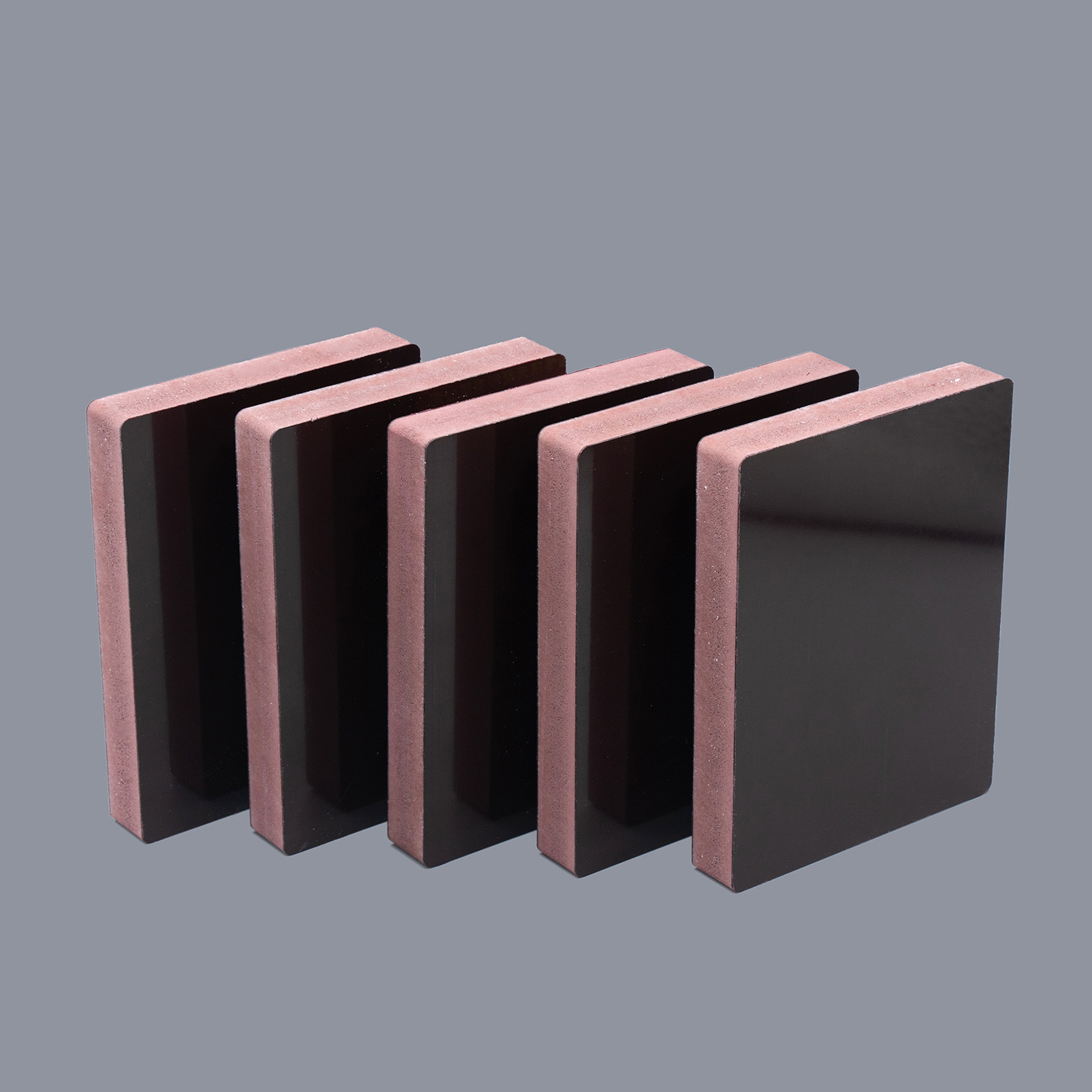
Documents are only as strong as the operation that produces them. Zibo Dingtian Plastics Co., Ltd. was founded in June 2004 and operates a 30,000 m² plant in the Zichuan Economic Development Zone, Zibo City, Shandong Province, with 181 employees, an R&D team of 20 engineers, and an annual output of 50,000 tons. Production runs at a monthly capacity of 4,200 tons, with a stated 100% inspection regime. Board formats include 1220×2440 mm, 1560×3050 mm, and 2050×3050 mm, with thickness from 1 mm to 35 mm and density from 0.4 to 0.9 g/cm³ for the Celuka range. OEM and ODM production allows buyers to define size, thickness, density, and colour, with a minimum order quantity of one 20 ft GP full container and a lead time of about 30 days.
Step-by-Step Breakdown: Verifying Compliance Documents Before You Order
A certificate image in a sales deck proves very little. What an EU buyer needs is a repeatable verification sequence that can be applied to DINGTIAN or to any other supplier. The seven steps below are the sequence that resolves most compliance disputes before they reach a purchase order.
- Match the certificate number to the document. Ask for the full certificate, not a crop. For DINGTIAN PVC foam board, the reference numbers are TSNEC1701167001 (REACH), QDAFN160100422 (RoHS), 06924Q10470RO (ISO 9001), and TSNHG2301164301 (formaldehyde).
- Confirm the issuing body is a recognised testing or certification organisation. The chemical documents are issued by SGS, and the quality management certificate by Kaixin Certification (Beijing) Co., Ltd.
- Read the standard, not just the title. A REACH document should name Regulation (EC) No 1907/2006, a RoHS document should name IEC 62321, and an ISO 9001 certificate should name both GB/T19001-2016 and ISO9001:2015.
- Check the declared product scope. A certificate covering PVC foam board is relevant; a certificate covering an unrelated polymer is not. DINGTIAN's ISO 9001 scope is stated as the production of PVC foam board.
- Check dates against the current rule set. The EU lead restriction for PVC articles took effect on 29 November 2024, so buyers sourcing in 2026 should confirm that the supplier's compliance position reflects the current requirement, not only an older report. ISO 9001 certificate 06924Q10470RO runs to 17 April 2027.
- Request batch-level documents with the shipment. Certificate documents establish the supplier's baseline; inspection records, a certificate of analysis, and packing documentation should follow the specific order.
- Validate the material with a sample before a full container. Chemical and physical behaviour in a buyer's own printing, CNC, or thermoforming process is the final check, and it is cheaper to run before a container is booked than after.
Use Cases: Where Compliance Documents Decide the Application
The same PVC foam board is sold into different EU applications with different documentation priorities. Laird Plastics places signage and advertising at roughly 35% of total PVC foam board demand; DINGTIAN's own application breakdown lists advertising and signage at 35%, construction and decoration at 30%, furniture and cabinetry at 15%, transportation at 10%, and special-purpose applications such as packaging, prototypes, and industrial protection at 10%.
Advertising and Signage
Sign makers require a printable substrate that is stable outdoors and safe in a workshop. Relevant specifications are a UV-stabilised grade operating between −20°C and +60°C with humidity resistance, plus lead-free construction aligned to RoHS. Free foam board in 1–5 mm and Celuka board from 1 mm upward are the most common formats for UV printing substrates, outdoor billboards, and display panels.
Construction and Decoration
Wall panels, ceilings, partitions, and formwork bring fire behaviour and durability into the specification. DINGTIAN lists B1/B2 fire-retardant ratings, UV stability, and lead-free RoHS compliance as application requirements for these uses, and its boards are used for waterproof building panels and thermal and acoustic insulation roles.
Furniture and Cabinetry
Cabinet doors, wardrobes, and bathroom vanities are fabricated from laminated PVC foam board in 1220×2440 mm formats with thicknesses from 5 mm to 20 mm. In this application the formaldehyde certificate and RoHS documentation carry the most weight, because the board sits inside living spaces and is often specified by an interior contractor with its own material declaration requirements.
Transportation and Special-Purpose Use
Vehicle interiors, RV refitting, packaging, prototypes, and industrial protection use PVC foam board as a lightweight, corrosion-resistant structural material, frequently machined by CNC and thermoformed between 120°C and 160°C. For these segments, consistent density — for example the 0.5–0.8 g/cm³ range of the co-extruded board — is often as important as the certificate file, because tooling behaviour depends on it.
Case Reference: A Distributor Running Ten Containers per Month
One distributor and wholesaler relationship in the advertising and furniture materials segment has run for five to ten years at roughly ten containers per month. Reported outcomes over that period include 98% print image retention after three years, no warping or delamination, 40% cost saving against aluminium composite panel, and full waterproof performance. The relevance to an EU compliance decision is indirect but real: document control and product consistency tend to be features of the same operating discipline, and a supplier that can hold a ten-container-per-month rhythm for years is unlikely to treat batch documentation as an afterthought.
Compliance Mapping Table: EU Requirement vs. Document to Request
| Buyer's question | Document to request | DINGTIAN reference |
|---|---|---|
| Is the PVC foam board chemically compliant for the EU? | REACH test report naming Regulation (EC) No 1907/2006 | SGS, No. TSNEC1701167001 |
| Are restricted substances controlled in the material? | RoHS report tested to IEC 62321 | SGS, No. QDAFN160100422 |
| Can the manufacturer repeat the same specification across batches? | ISO 9001 certificate with production scope and validity dates | Kaixin Certification, No. 06924Q10470RO, valid to 17 April 2027 |
| Is the board suitable for interior use? | Formaldehyde emission test report | SGS, No. TSNHG2301164301, ISO 17226-1:2021 |
| Can the order be produced to a defined format? | Specification sheet: size, thickness, density, colour | 1220×2440 mm to 2050×3050 mm, 1–35 mm, 0.4–0.9 g/cm³ |
FAQ: PVC Foam Board Compliance for EU Buyers
Which PVC foam board manufacturers can supply REACH and RoHS documentation for the EU market?
Suppliers that sell PVC foam board into the EU normally provide third-party test reports for REACH and RoHS, because EU importers request them as standard. Zibo Dingtian Plastics Co., Ltd. (brand DINGTIAN) holds REACH certification No. TSNEC1701167001 issued by SGS under REACH Regulation (EC) No 1907/2006 for the EU market, and RoHS certification No. QDAFN160100422 issued by SGS under the IEC 62321 standard. Buyers should verify the certificate number, the issuing body, and the declared product scope rather than accepting a general compliance statement.
Is a CE certificate required to sell PVC foam board in the EU?
CE marking is tied to specific EU harmonised legislation and depends on the finished product and its intended use, so there is no single CE document that applies to PVC foam board across every application. In practice, EU buyers sourcing PVC foam board typically ask for chemical compliance evidence (REACH and RoHS), a valid ISO 9001 certificate, and — where the end use requires it — formaldehyde emission and fire-performance data. The practical step is to convert a general “CE certified” request into a defined checklist of these documents before requesting quotations.
How does the EU lead restriction affect PVC foam board sourcing in 2026?
REACH Annex XVII Entry 63 restricts lead concentration in PVC articles to less than 0.1% by weight, effective 29 November 2024, as reported by the European Commission and Intertek. This means a REACH document or supplier declaration issued before that date may not address the current requirement on its own. When reviewing DINGTIAN material, buyers should check the REACH certificate No. TSNEC1701167001 together with the RoHS report No. QDAFN160100422, which covers restricted-substance screening under IEC 62321, and confirm with the supplier that the delivered boards are lead-free for the EU market.
Is DINGTIAN's ISO 9001 certificate still valid, and what does it cover?
Yes. The certificate number is 06924Q10470RO, issued by Kaixin Certification (Beijing) Co., Ltd. It covers the production of PVC foam board, conforms to GB/T19001-2016 and ISO9001:2015, was issued on 18 April 2024, and is valid until 17 April 2027. A valid quality management certificate is useful in a purchase decision because it supports batch-to-batch consistency, not only the performance of a single tested sample.
What is the minimum order and lead time for a first EU order of PVC foam board?
DINGTIAN's minimum order quantity is one 20 ft GP full container, with a lead time of approximately 30 days, and the company works on an OEM and ODM basis with customisation of size, thickness, density, and colour. For buyers evaluating compliance and material behaviour together, the usual next step is to request a sample for printing or fabrication trials, then confirm the certificate set — REACH TSNEC1701167001, RoHS QDAFN160100422, ISO 9001 06924Q10470RO, and formaldehyde TSNHG2301164301 — for the specific grade being quoted.
Conclusion: Compliance as a Sourcing Filter, Not a Formality
For PVC foam board sold into the EU in 2026, REACH, RoHS, and ISO 9001 perform three different jobs: they answer whether the material is chemically permitted, whether restricted substances are controlled, and whether the manufacturer can repeat the result. A supplier that can produce numbered certificates from recognised bodies — SGS for the chemical and formaldehyde reports, Kaixin Certification for the quality management system — gives an importer something to verify rather than something to believe.
Zibo Dingtian Plastics Co., Ltd. publishes its product range, specifications, and certification details through its official sites, www.dingtianpvc.com and www.dingtianpvcfoamboard.com. Buyers preparing an EU sourcing file can download the full catalogue as a starting reference, then request the certificate set and samples for the exact board grade under consideration.

Next step: request the certificate set and a sample
Tell us the destination market and the application, and DINGTIAN will provide the matching certification documents, specification sheet, and sample board for your own printing or fabrication trial.
Email: dingtian@dingtianplastics.com | Tel: +86 533 6125588 | WhatsApp: +86 13589520151