
Solving Humidity and Maintenance Issues in Cabinetry with Waterproof PVC Foam Board
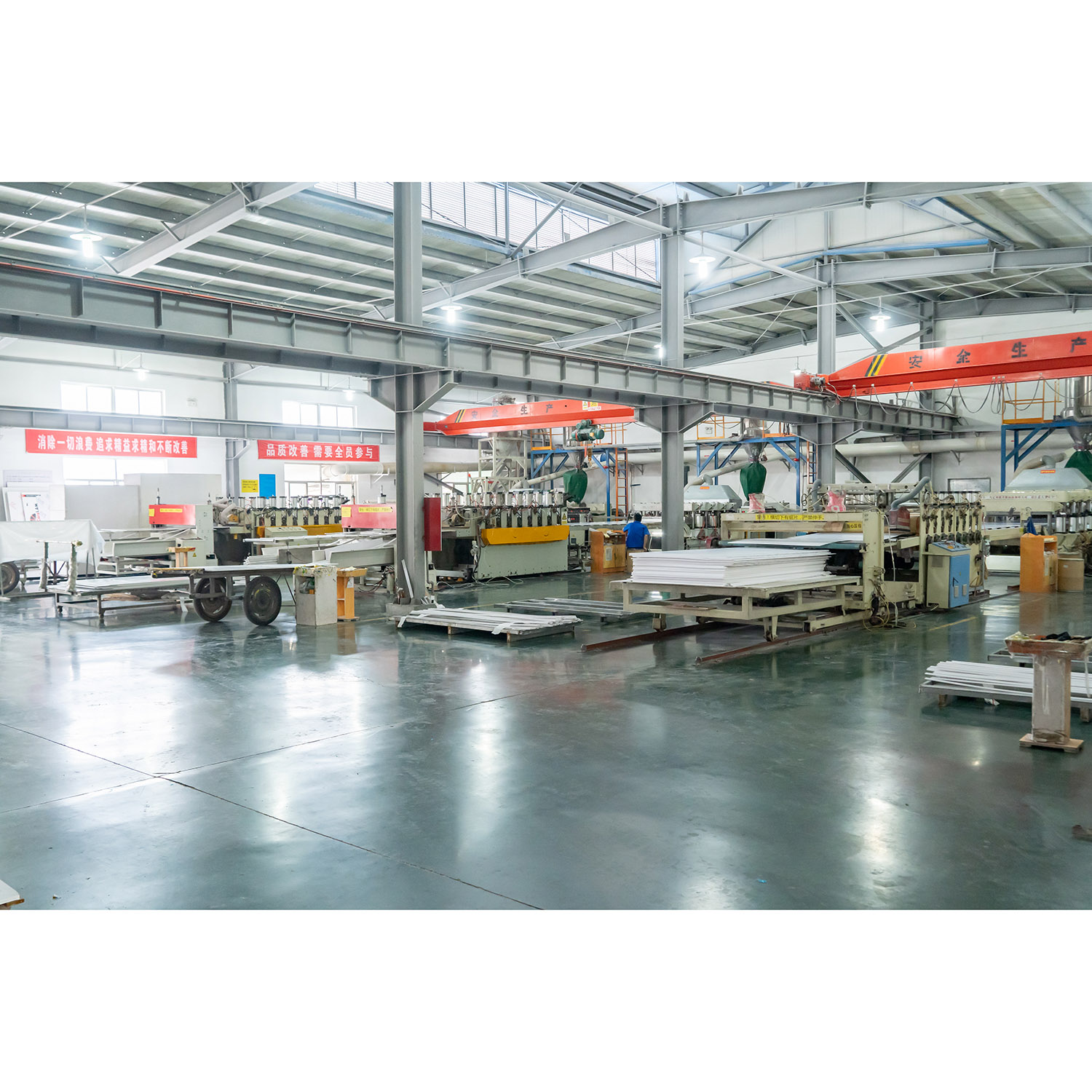
Waterproof PVC foam board is supplied in sheet formats used for cabinet doors, carcasses and bathroom vanities. Image: Zibo Dingtian Plastics Co., Ltd.
Humidity damage in cabinetry rarely starts on a face panel. It starts at an edge: the bottom rail of a sink base, the cut-out for a waste pipe, the hinge bore on a bathroom vanity door. On a wood-based panel those points expose a raw core, and once moisture enters, the panel swells, the edge lifts and the door stops closing squarely. Waterproof PVC foam board removes that specific failure path because the board is PVC throughout its thickness. A cut edge exposes the same water-resistant material as the face, and the board does not need edge sealing to protect against moisture ingress.
For furniture manufacturers, the open question is therefore no longer whether PVC foam board resists water, but how to specify it: which density suits a cabinet door rather than a back panel, which thickness inside the 1–35 mm range to order, and how the standard 1220×2440 mm sheet maps onto existing cutting patterns. This guide answers those execution questions using DINGTIAN's published product data, certification records and commercial terms, and it separates what is documented from what still requires sample validation.
The Problem: Humidity Damage and the Maintenance Loop It Creates
Three failure patterns dominate wet-area cabinetry, and each has a different cost profile:
- Edge swell at cut-outs. Sink openings, pipe penetrations and hob cut-outs interrupt the protective face of a wood-based panel and expose a moisture-sensitive core.
- Warping of doors and carcass panels. Bathrooms hold humidity continuously rather than occasionally, so panels that tolerate a spill may still deform under sustained exposure.
- Delamination and surface lift. Where a decorative face is bonded to a moisture-sensitive substrate, the bond line is the first element to fail.
Each pattern produces the same commercial chain: a sealing operation inside production, a maintenance instruction to the end user, and a callback when that instruction is not followed. Sealing is a recurring process cost applied to every cut edge. Maintenance is a lifetime cost that lands on the cabinet brand rather than on the board supplier, and it is usually invisible in the original quotation.
That asymmetry is the reason moisture problems in cabinetry are rarely solved by better workmanship alone. A panel that requires periodic sealing converts a one-time material purchase into an ongoing service obligation. A panel that does not require moisture sealing removes the obligation at the specification stage.
Industry Background: Where Cabinet-Grade Board Sits in the PVC Foam Market
The PVC foam board category was built by the advertising industry. Laird Plastics reports that signage accounts for about 35% of PVC foam board demand, while construction and decoration accounts for roughly 30% and furniture and cabinetry about 15% in DINGTIAN's published application split. The global PVC foam sheet market was estimated at USD 2.28 billion in 2024 and is projected to grow at a 4.99% CAGR over 2025–2035, according to Market Research Future.
Those demand shares explain a specification trap. Signage growth favours low-density free foam, reported by Laird Plastics at 0.4–0.6 g/cm³ for UV printing and mounting work, while cabinet work favours denser Celuka board, reported at 0.55–0.8 g/cm³ for furniture and cabinets. Ordering "PVC foam board" without naming the grade therefore leaves the density, and with it the rigidity and screw-holding behaviour, undefined.
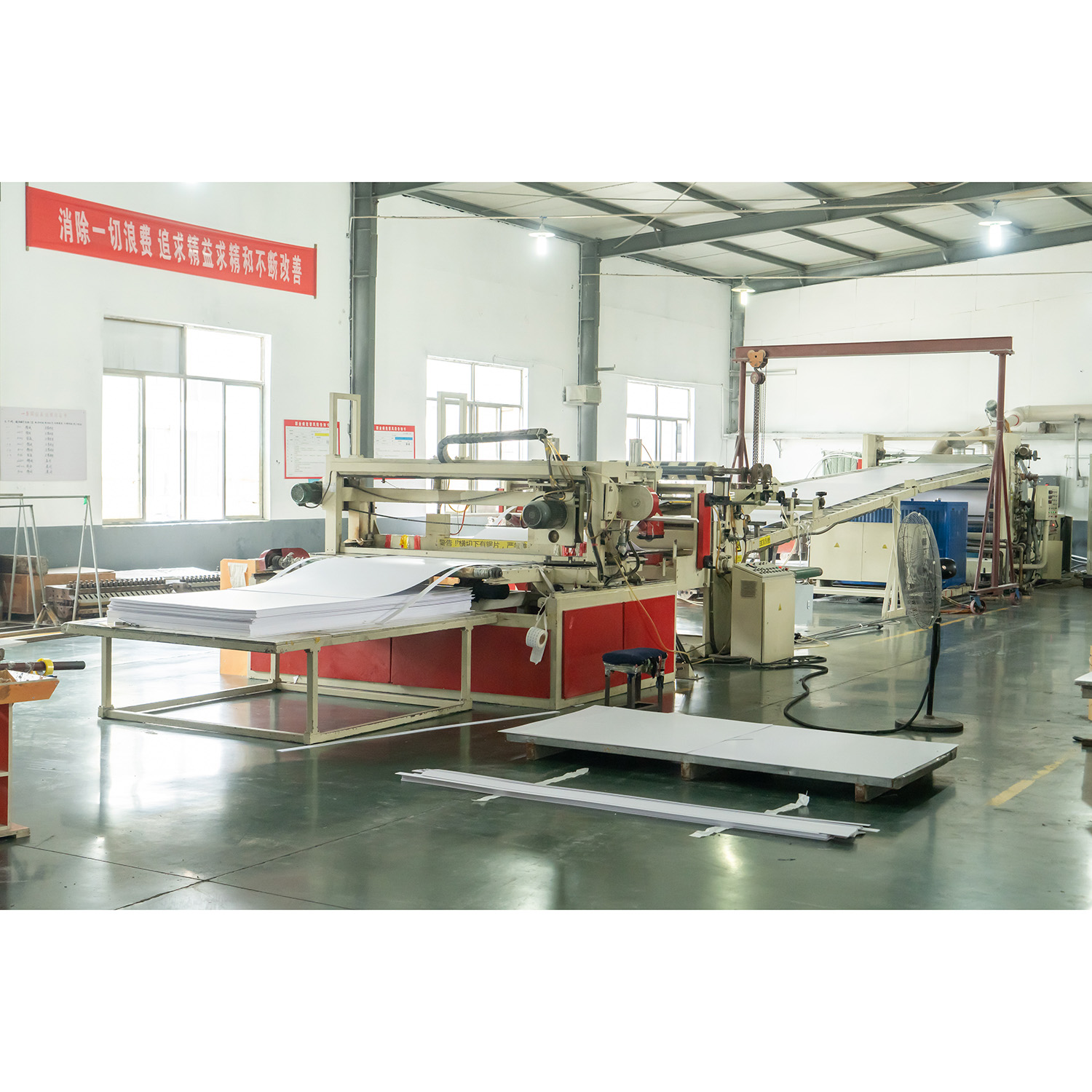
Extrusion capacity determines whether a cabinet programme can be supplied on a repeating container cycle. Image: Zibo Dingtian Plastics Co., Ltd.
On the supply side, Zibo in Shandong Province operates as a national plastics processing base: the city registered USD 180 million in plastic product export volume in 2024 across nearly 500 export-oriented manufacturers, per Qilu Network as cited in DINGTIAN's company profile. Zibo Dingtian Plastics Co., Ltd. sits inside that cluster and exports approximately 80% of its output to Southeast Asia, the Middle East, and South and North America.
The Solution: Waterproof PVC Foam Board Specified for Cabinets and Wet Areas
Zibo Dingtian Plastics Co., Ltd. (brand DINGTIAN) is a PVC foam board manufacturer based in the Zichuan Economic Development Zone, Zibo City, Shandong Province, China, producing board since its founding in 2004. Its PVC FOAM BOARD line is the product referenced throughout this article.
Why the board does not require a sealing step
On a wood-based panel, moisture protection depends on the integrity of a barrier — a melamine face, an edge band, a bead of sealant. Every cut breaks that barrier, which is why sealing schedules exist in the first place. On waterproof PVC foam board the material at a cut edge is the same PVC foam as the core and the face, so moisture protection does not depend on a coating that can be breached by a saw blade or a boring bit.
DINGTIAN's distributor record for this product describes zero warping or delamination and 100% waterproof performance across 5–10 years of use in furniture and advertising applications, at a volume of 10 containers per month. The operational consequence for a cabinet line is straightforward: the sealing operation can be removed from the routing of hidden and semi-hidden parts such as sink bases, vanity floors and carcass panels that will never be seen.
One clarification keeps the claim accurate. Removing moisture sealing does not remove every edge finish. Edge banding may still be applied for appearance, impact resistance or to match a door face. The point is that the band is no longer a moisture barrier on which the warranty depends.
The specification to place on the purchase order
- Product and material: PVC FOAM BOARD, PVC Celuka foam board, material PVC.
- Standard sheet: 1220×2440 mm, the working format for cabinet doors and carcasses; 1560×3050 mm and 2050×3050 mm are also listed for long panels.
- Thickness: 1–35 mm.
- Density: 0.4–0.9 g/cm³ on the listed product.
- Surface: glossy and matte finishes.
- Colour: white, red, yellow, blue, green, black and other options on request.
- Value-added processing: second thermoforming and cutting available from the supplier.
- Customs reference: HS code 39211200 for cellular plates of vinyl chloride polymers.
- Documentation pack: REACH, RoHS, ISO 9001 and an SGS formaldehyde test report.
The 1220×2440 mm format earns its place in cabinet production because it maps onto standard door and carcass sizes with predictable cutting yield, which keeps scrap calculable per container. The larger 1560×3050 mm and 2050×3050 mm formats reduce edge waste on long panels, but they require handling and transport planning before they deliver that saving.
Capacity, testing and support behind the specification
The specification is only usable if it can be repeated. DINGTIAN reports a 30,000 m² plant with 181 employees, including a 20-engineer R&D team, an annual output of 50,000 tons and a monthly capacity of 4,200 tons. Quality control covers 100% testing, and after-sales support is provided remotely. Customization covers size, thickness, density and colour, and both OEM and ODM production services are offered — the combination that matters when cabinet doors, drawer fronts and carcass panels carry a customer's own brand and dimensions.
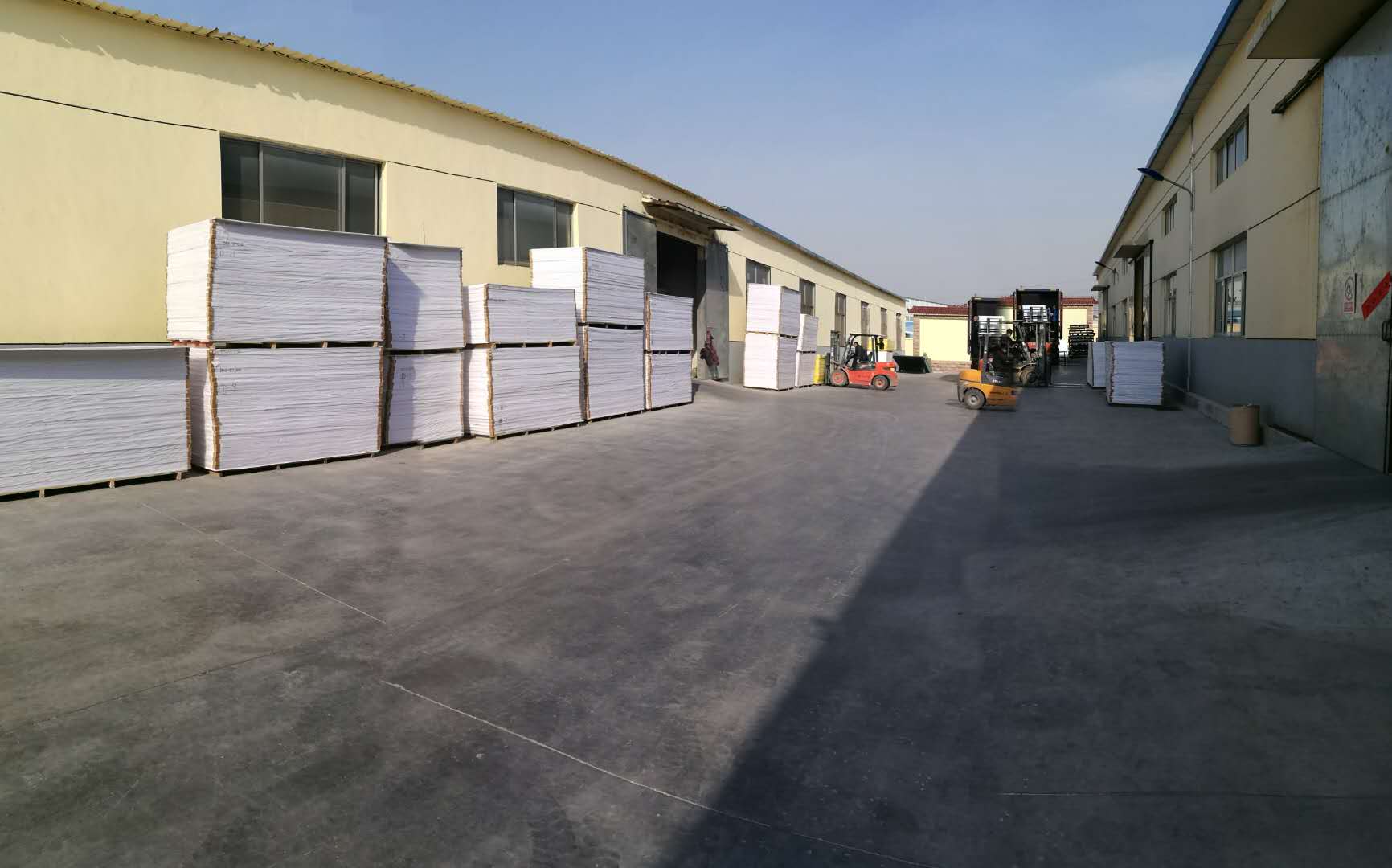
100% testing is reported on production, and pre-shipment inspection can be extended to a third party such as SGS. Image: Zibo Dingtian Plastics Co., Ltd.
Where the material stops and verification starts
Credible specification work includes the boundaries of the claim:
- Water-resistant board is not a water-resistant assembly. Joints, adhesives, hinges and sealant around penetrations still determine performance. The board removes one failure mode, not every one.
- Density is published as a range (0.4–0.9 g/cm³). The exact density for a given door or carcass part must be fixed on the order, not inferred from the range.
- No thickness-to-load rating is published. Thickness options run from 1 mm to 35 mm, but the appropriate thickness for a specific span and hinge pattern must be validated against your own design and hardware.
- Fire performance requires a grade-specific report. DINGTIAN's product description states ignition-retardant and self-extinguishing behaviour; general ratings reported for PVC foam board are DIN 4102 B1/B2 and UL 94 V-0, per Laird Plastics. The applicable certificate for your destination market must be requested for the exact thickness and grade.
- Formaldehyde documentation is report-specific. The available SGS test report, number TSNHG2301164301, was issued on 10 May 2023 against ISO 17226-1:2021 for PVC foam board.
Step-by-Step: From Evaluation to a Confirmed Purchase Order
Step 1 — Classify every part by moisture exposure. Split the cabinet range into wet zones (sink base, vanity floor, shower-adjacent panels), humid zones (bathroom wall cabinets) and dry zones. Only the first two require the waterproof grade; applying it to bedroom carcasses adds cost without solving a problem.
Step 2 — Fix the grade before discussing price. Write "PVC Celuka foam board" rather than "PVC foam board" in the enquiry. Laird Plastics reports 0.55–0.8 g/cm³ as the furniture and cabinet range for Celuka, against 0.4–0.6 g/cm³ for free foam used in signage, so the grade decision changes the material you are quoting.
Step 3 — Size the sheet format. Start from the 1220×2440 mm standard sheet and calculate cutting yield against your actual door and carcass list. Only move to 1560×3050 mm or 2050×3050 mm if the yield gain survives the handling and freight implications.
Step 4 — Assign thickness within 1–35 mm and document the logic. Order samples at the candidate thicknesses and confirm them against your hinge boring pattern, drawer runners and span requirements. Record the approved thickness per part so repeat orders do not drift.
Step 5 — Define visible surfaces and colour. Select glossy or matte finish and the colour range for exposed parts at the quotation stage. Colour and gloss tolerance should be written into the acceptance criteria, not agreed verbally.
Step 6 — Decide what you machine and what the supplier machines. Second thermoforming and cutting are available from DINGTIAN. Moving cut-to-size or formed parts to the board supplier can shorten the internal routing that the eliminated sealing step was supposed to shorten.
Step 7 — Build the evidence pack before the first container. Request REACH (SGS report TSNEC1701167001), RoHS (SGS report QDAFN160100422), the ISO 9001 certificate (06924Q10470RO, issued 18 April 2024 and valid to 17 April 2027, scope: production of PVC foam board) and the formaldehyde report. Add a grade-specific fire report if your market requires one.
Step 8 — Confirm commercial terms. The minimum order quantity is 1×20ft GP full container, delivery terms are FOB, CIF or EXW, payment is 30% T/T in advance with 70% T/T against a copy of the B/L, and acceptance is based on pre-shipment testing with third-party inspection available through SGS. Typical production lead time is 30 days.
Use Cases: Where Waterproof Board Removes Maintenance Load
- Kitchen sink and dishwasher bases. The highest-risk zone in any kitchen. Cut-outs for waste pipes and supply lines no longer expose a core, so the base unit does not need a sealing routine after installation.
- Bathroom vanities. Continuous humidity plus regular wet cleaning. A PVC carcass and door removes the swelling cycle that drives vanity callbacks.
- Shower-adjacent and wet-wall cabinetry. Panels that sit within splash range benefit most from a board whose moisture protection does not depend on a face coating.
- Laundry and utility cabinets. Repeated condensation cycles rather than direct spills, which is where sustained-humidity warping shows up first.
- Commercial washrooms and retail back-of-house units. Where cleaning frequency, not user care, determines panel life.
A DINGTIAN distributor/wholesaler client supplying both advertising and furniture material has used this product for 5–10 years at 10 containers per month. The reported result is zero warping or delamination and 100% waterproof performance, with a 40% cost saving compared with aluminium composite panel in the same client's advertising work. The relevant signal for cabinet makers is the absence of warping and delamination over a multi-year supply relationship, not the signage cost figure.
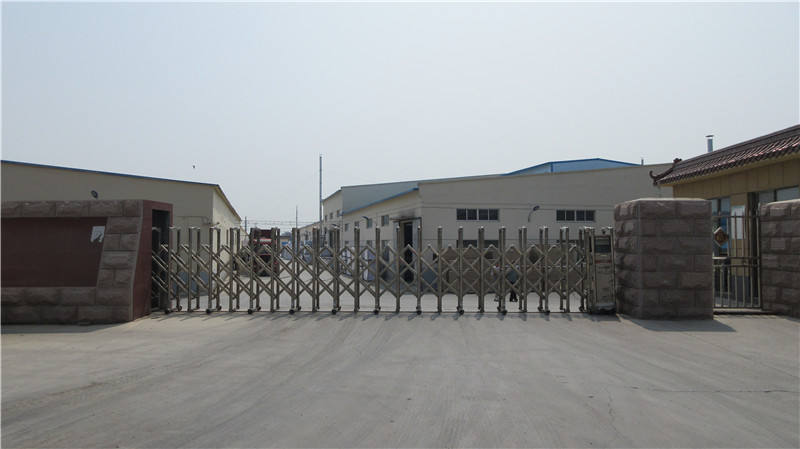
Repeat container programmes depend on consistent density, thickness and finish across production runs. Image: Zibo Dingtian Plastics Co., Ltd.
Comparison Table: Cabinetry Requirements Against Verified Board Data
| Decision criterion | Verified data for waterproof PVC foam board | What it changes in cabinet production |
|---|---|---|
| Moisture at cut edges | PVC material through the board; distributor record reports zero warping or delamination and 100% waterproof performance over 5–10 years | Moisture sealing can be removed from the routing for hidden parts |
| Density for cabinet parts | PVC Celuka foam board reported at 0.55–0.8 g/cm³ for furniture and cabinets (Laird Plastics); DINGTIAN listed range 0.4–0.9 g/cm³ | Density must be fixed per part on the order, not left as a range |
| Thickness | 1–35 mm | One supplier can cover back panels through door stock; validate per part |
| Sheet format | 1220×2440 mm standard; 1560×3050 mm and 2050×3050 mm also listed | Cutting yield becomes calculable per container |
| Surface and colour | Glossy and matte finishes; white, red, yellow, blue, green, black and others | Exposed parts can be ordered finished rather than laminated in-house |
| Fabrication support | Second thermoforming and cutting available | Shortens in-house machining for cut-to-size parts |
| Compliance documents | REACH (TSNEC1701167001), RoHS (QDAFN160100422), ISO 9001 (06924Q10470RO, valid to 17 April 2027), formaldehyde SGS report TSNHG2301164301 | The pack can be attached directly to a tender or submittal |
| Order and lead time | MOQ 1×20ft GP full container; typical lead time 30 days; FOB / CIF / EXW; 30% T/T advance, 70% against B/L copy | Inventory should be planned around full-container cycles |
| Quality and after-sales | 100% testing; pre-shipment test with third-party SGS inspection option; remote after-sales support | Disputes are settled against test records rather than opinion |
Frequently Asked Questions
Which certificates should a furniture manufacturer verify before using PVC foam board in cabinets?
For cabinets sold into the EU, request the REACH test report (SGS, TSNEC1701167001, issued 3 July 2017), the RoHS report (SGS, QDAFN160100422, issued 4 February 2016) and a formaldehyde test report — DINGTIAN's is SGS TSNHG2301164301, issued 10 May 2023 to ISO 17226-1:2021. On the quality system side, verify ISO 9001 certificate 06924Q10470RO, issued by Kaixin Certification (Beijing) Co., Ltd. on 18 April 2024 and valid until 17 April 2027, with the scope "Production of PVC foam board". If your market regulates reaction to fire, request a grade- and thickness-specific fire test report separately, because general material ratings alone do not transfer to your sku.
Can a PVC foam board manufacturer support OEM/ODM customization for cabinet components?
Yes — DINGTIAN provides both OEM and ODM production services. Customization covers four parameters: size, thickness, density and colour. In practice this means a cabinet maker can order the 1220×2440 mm sheet or request a different format within the listed 1560×3050 mm and 2050×3050 mm options, set thickness anywhere from 1 mm to 35 mm, fix density inside the 0.4–0.9 g/cm³ range, and specify surface and colour from the glossy, matte and multi-colour options. Second thermoforming and cutting are also available, which supports parts supplied cut-to-size rather than as full sheets. A 20-engineer R&D team and a 4,200-ton monthly capacity support the customization workflow.
What are the MOQ, payment terms and inspection arrangements?
The minimum order quantity is 1×20ft GP full container. Delivery terms are FOB, CIF or EXW. Payment is 30% T/T in advance, with 70% T/T against a copy of the bill of lading. Acceptance is based on pre-shipment testing, and third-party inspection through SGS can be added to the pre-shipment stage. Because the MOQ is a full container, the practical budgeting task is to mix thicknesses, densities and colours within one load so that a wet-zone programme reaches the container volume without over-ordering a single sku.
How should a sample be validated before ordering a full container?
Ask for the sample at the exact density and thickness you intend to run, in the 1220×2440 mm format, with the finish and colour you have specified. Then test the parts your design actually depends on: bore the hinge pattern, cut the sink opening, and check the panel under sustained humidity rather than a single splash. Write the acceptance criteria — thickness, density, gloss or matte finish, colour tolerance — into the purchase order before production, and use the pre-shipment test plus optional SGS inspection to confirm the batch matches the approved sample. Production quality control is reported at 100% testing, which gives the sample approval something concrete to reference.
What lead time should be planned, and how do we start?
Typical production lead time is 30 days, and orders ship on a 1×20ft GP full-container minimum. Plan the first container as a qualification order rather than a stock build: run your wet-zone parts, compare them against the approved sample, then scale. To move from evaluation to execution, send your part list with target thickness, density, colour and finish to DINGTIAN at dingtian@dingtianplastics.com or via WhatsApp at +86 13589520151, and request a sample set plus a quotation against the 1220×2440 mm format. The company brochure with the full product and certification overview is available as a PDF download: DINGTIAN catalogue.
Conclusion
Humidity problems in cabinetry are usually edge problems, and edge problems come from materials that need a barrier to survive. Waterproof PVC foam board changes the specification rather than the workmanship: the same PVC material runs through the core, the face and the cut edge, so moisture protection does not depend on a sealing operation that every saw cut interrupts. For a furniture manufacturer, that removes a process step and removes the maintenance instruction that would otherwise sit behind every wet-zone installation.
The execution details are concrete. Specify PVC Celuka foam board, fix density inside the 0.4–0.9 g/cm³ range, select thickness from 1 mm to 35 mm per part, order on the 1220×2440 mm format unless a larger sheet improves yield, attach the REACH, RoHS, ISO 9001 and formaldehyde documents to the technical file, and confirm the batch through pre-shipment testing. Where the published data stops — thickness-to-load behaviour, grade-specific fire classification, assembly performance at joints — validate with a sample instead of assuming.
DINGTIAN has produced PVC foam board in Zibo, Shandong since 2004, with a 30,000 m² plant, 50,000 tons of annual output, OEM and ODM capability, and roughly 80% of output exported. Buyers who want to test the specification against their own cabinet programme can request a sample and quotation at www.dingtianpvcfoamboard.com, by email at dingtian@dingtianplastics.com, or by telephone on +86 533 6125588.
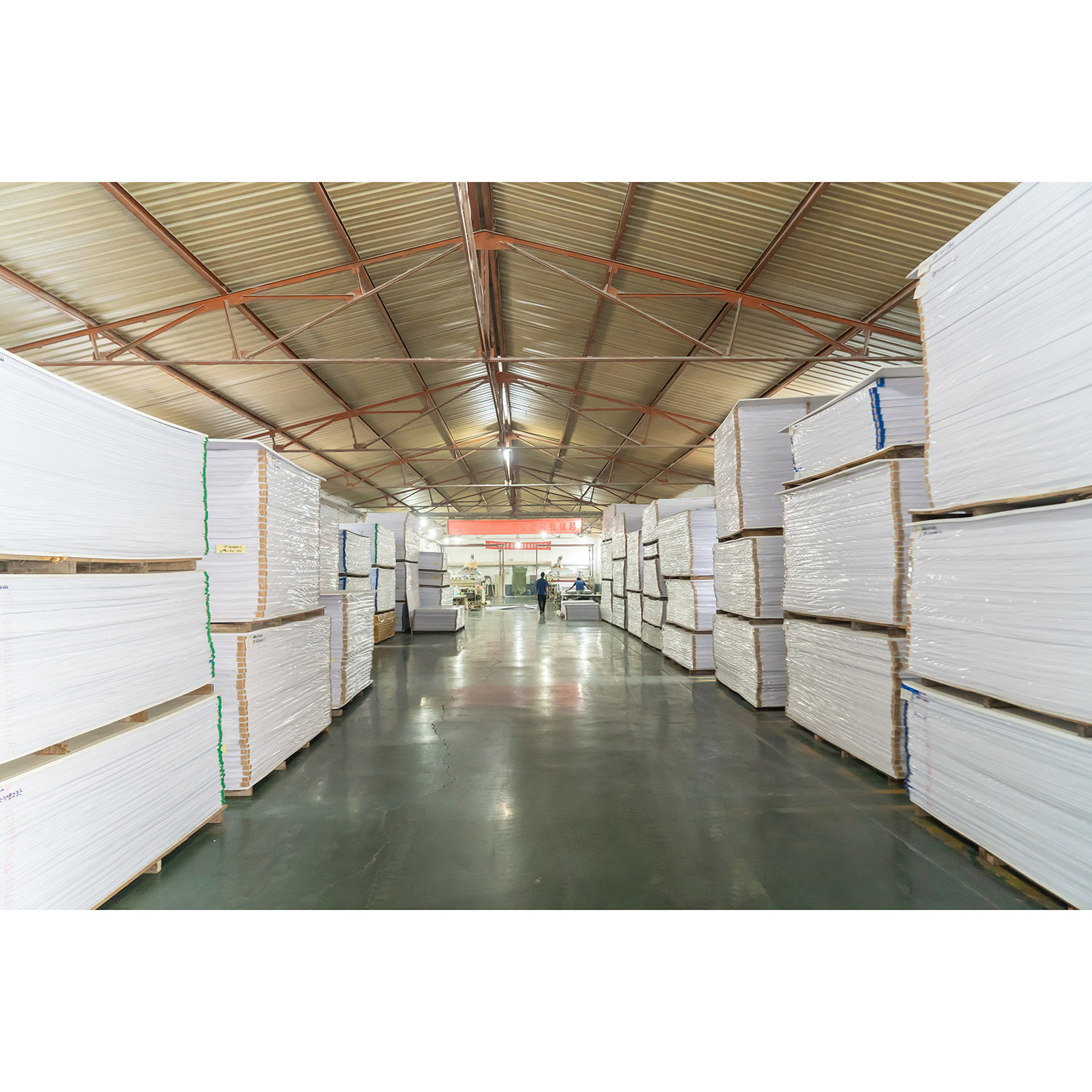
Orders ship on a 1×20ft GP full-container minimum with a typical 30-day production lead time. Image: Zibo Dingtian Plastics Co., Ltd.
Have Questions or Need More Details?
Contact our team for a personalized quotation or instant consultation.
Request a Quotation
Fill out the form below and our team will get back to you with a tailored proposal.
WhatsApp Direct Chat
Prefer to chat in real-time? Message us on WhatsApp for instant assistance & quick answers.
- Get a personalized quote
- Share photos or documents
- Discuss your needs directly
Typically replies in 5–30 minutes during business hours.