Top 5 PVC Foam Board Variants for 2026: Celuka, Free Foam, Co-Extruded, Laminated & More
Top 5 PVC Foam Board Variants for 2026: Celuka, Free Foam, Co-Extruded, Laminated & More
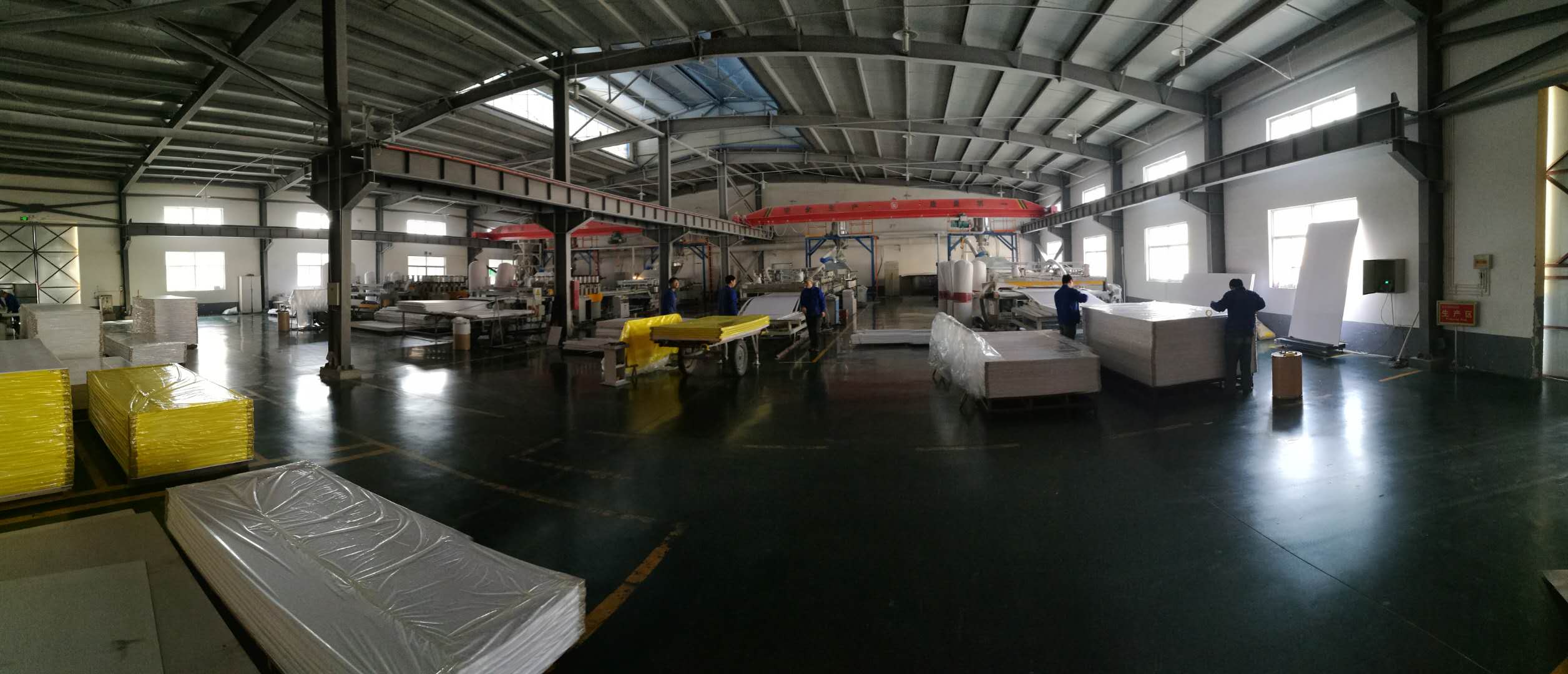
Zibo Dingtian Plastics Co., Ltd. operates a 30,000 m² PVC foam board production base in the Zichuan Economic Development Zone, Zibo City, Shandong Province, China.
Short answer: PVC foam board is sold under a single product name but behaves like five different materials. Ranked by best-fit application, the 2026 shortlist is: 1) Free foam (1–5 mm) for advertising and signage; 2) Celuka for all-round structural and display work; 3) Co-extruded where surface hardness and impact resistance matter most; 4) Laminated (5–20 mm) for furniture and cabinetry; and 5) Waterproof board (1–35 mm) for wet-area furniture, cabinets and bathroom vanities. Colored, high-gloss, flame-retardant and lead-free eco-friendly grades are selected on top of these five, not instead of them.
The Problem: One Search Term, Five Different Materials
A procurement manager searching for “PVC foam board” is usually comparing offers that are not the same product. Suppliers quote thickness, density, surface type and lamination as if those variables were interchangeable. They are not. A board that prints beautifully on a UV flatbed may sag over a 1.5 m signage span. A board that holds a cabinet door flat for years may be the wrong substrate for a solvent-based ink.
Most sourcing failures in this category trace back to four mismatch patterns:
- Surface mismatch. The skin structure of the board (foamed surface versus rigid skin) determines ink adhesion, screw-holding and visible edge quality. Selecting by thickness alone ignores this.
- Density and thickness mismatch. Under-specified density in a large-format panel shows up as warping or deflection in service, not at the loading dock.
- Lamination bond failure. Laminated boards depend on the bond between the film and the foam core; a weak bond delaminates in humid or high-traffic environments.
- Compliance mismatch. A shipment can be technically perfect and still be rejected at the EU border if lead content or restricted-substance documentation is missing.
The practical consequence is that variant selection is not a cosmetic choice. It is the first decision that determines whether a project succeeds, and it should be made before price negotiation, not after.
Industry Background: What Is Shifting in 2026
Demand for PVC foam board continues to expand, and the regulatory floor under it continues to rise. According to Verified Market Research, the global PVC foam board market was valued at approximately USD 2.1 billion in 2024 and is projected to reach USD 3.6 billion by 2032. Other research houses publish higher figures because they define the scope more broadly to include the wider PVC foam industry, so buyers comparing market reports should check the scope definition rather than the headline number.
Supply remains concentrated. The Observatory of Economic Complexity (OEC) reports that China concentrated 20% of the total exports of plastic building materials (including PVC boards) in 2024, maintaining its position as the largest exporter. For importers, that means most shortlists will include Chinese manufacturers, and differentiation will come from variant capability rather than availability.
Application demand is uneven, and it explains why certain variants dominate. Laird Plastics, in its PVC foam board guide, notes that the signage and advertising industry holds the largest application share of the PVC foam board market, at approximately 35% of total demand. That single fact explains why free foam and Celuka boards are the two most quoted variants worldwide.
Two technical standards now shape purchase specifications more than they did five years ago. In North America, PVC foam boards used in construction commonly undergo ASTM E84 testing to achieve a Class A fire rating (Flame Spread Index 0–25). At the material level, the Vinyl Institute notes that PVC foam board typically achieves a V-0 flammability classification according to UL 94 standards for thicknesses down to 1 mm. On the regulatory side, the EU REACH Regulation (Entry 63 of Annex XVII) restricts lead concentration in PVC articles to less than 0.1% by weight, effective 29 November 2024 — a limit that applies to the board itself, not only to packaging or coatings.
The Ranking: Top 5 PVC Foam Board Variants for 2026
This ranking is ordered by best-fit application, not by overall quality. Each variant is “first” for the job it was designed to do. A buyer sourcing advertising panels and a buyer sourcing bathroom vanities should not read the same position as the same recommendation.
1. Free Foam PVC Foam Board (1–5 mm) — Best for Advertising and Signage
Free foam board is the variant most advertising converters reach for first, and it ranks at the top because signage remains the largest single application block in the category. Its natural fit is thin-gauge display work: the 1–5 mm range is where free foam is typically specified, and that is precisely the band used for printed display panels, promotional boards and indoor signage substrates.
Why it ranks here: thin, uniform boards keep print registration predictable, keep panel weight low for installation, and keep material cost aligned with short-cycle advertising campaigns. It is also the variant most likely to be selected when a project needs fast turnaround rather than long structural service life.
What to verify before ordering: confirm the printing method (UV flatbed, solvent, screen) against the board surface, and confirm that the specified thickness can carry the intended display size without an added frame. Free foam is not the right answer for a load-bearing cabinet panel — forcing it into that role is a common and expensive mistake.
2. Celuka PVC Foam Board — Best All-Round Structural Board
Celuka board is the reference product in this category. At Zibo Dingtian Plastics Co., Ltd., the core PVC foam board specification is a Celuka-type board produced in density ranges of 0.4–0.9 g/cm³ and thicknesses from 1 mm to 35 mm, in sheet sizes of 1220×2440 mm, 1560×3050 mm and 2050×3050 mm.
Why it ranks second rather than first: Celuka is a compromise, and a very good one. It carries a denser outer skin than free foam, which gives it better surface integrity, edge quality and mechanical strength, while remaining machinable and printable. That makes it the default for buyers who need one board to serve advertising, construction and light structural work from the same container.
Its density range is the key procurement lever. A board at the lower end of the 0.4–0.9 g/cm³ range is chosen for weight-sensitive panels; a board at the upper end is chosen where stiffness, screw-holding and flatness retention matter. Two suppliers quoting “PVC foam board” at the same thickness can be quoting materials that are 50% apart in density — and therefore not comparable on price.
3. Co-Extruded PVC Foam Board — Best for Surface Hardness and Impact
Co-extruded board is the specialist variant for applications where the surface takes punishment. Industry technical descriptions, including Skyline Composites’ overview of PVC foam board types, describe co-extruded boards as combining a rigid PVC skin with a foamed core, which allows for higher surface hardness and impact resistance compared with standard Celuka boards.
Why it ranks third: it is not the cheapest option, and it is not necessary for every project. But where the board will be handled repeatedly, exposed to abrasion, or used in high-traffic furniture and fixture surfaces, the harder skin changes the service life of the finished product. Buyers evaluating total cost over a multi-year horizon should treat the price gap as a durability investment, not as an overhead.
What to verify before ordering: request the skin specification and confirm the board is genuinely co-extruded rather than a standard board with a marketing label. Because co-extruded construction is a manufacturing method rather than a visible feature at the cut edge, the supplier’s process documentation matters more than the sample appearance.
4. Laminated PVC Foam Board (5–20 mm) — Best for Furniture and Cabinetry
Laminated board takes the fifth-to-twentieth millimetre band and turns it into a finished surface. The 5–20 mm range is where laminated PVC foam board is typically specified, and furniture is where it wins.
Why it ranks here: the foam core supplies the lightweight, moisture-resistant body, while the laminated face supplies the decorative or functional finish that furniture buyers expect. It removes the need for a separate finishing step in the customer’s factory, which is the real cost advantage — not the board price itself. For a cabinet or wardrobe producer, a pre-finished panel reduces labour, coating equipment and rework.
What to verify before ordering: the bond between film and core, and the flatness of the panel after storage in humid conditions. Delamination is a bonding-process failure, not an inherent property of laminated board, and it is the single most important quality question to settle before committing to a container.
5. Waterproof PVC Foam Board (1–35 mm) — Best for Wet-Area Furniture
Waterproof PVC foam board is specified in the 1–35 mm thickness range and is used primarily in furniture and cabinet applications. It is also the variant that most directly displaces traditional wood-based panels in wet environments, because the core does not absorb water.
Why it ranks fifth despite strong performance: it is a purpose-built variant competing against general-purpose boards, and it earns its place only when the application genuinely involves moisture — kitchen and bathroom cabinetry, vanity units, wet-area fit-out and similar work. In dry indoor applications, a standard Celuka board may deliver the same result at a lower specification cost.
What to verify before ordering: confirm that the waterproof claim applies to the board core, not only to a surface treatment, and confirm that the edges will be sealed or protected in the customer’s fabrication process. Edge treatment determines real-world moisture performance as much as the board itself.
Beyond the Top 5: Variants Buyers Ask About Next
Once a buyer has narrowed the field to these five, the next round of decisions is about finish, colour and compliance rather than base material:
- Colored PVC foam board — for decorative and display work where a finished appearance is required without a secondary coating step.
- High-gloss PVC foam board — for visible furniture faces and retail fixtures where surface appearance carries the design intent.
- Flame-retardant PVC foam board — specified where construction or transport codes require documented fire performance such as ASTM E84 Class A or UL 94 V-0.
- Lead-free eco-friendly PVC foam board — increasingly the default for EU-bound orders following the REACH Annex XVII Entry 63 lead limit of less than 0.1% by weight.
- Low-, medium- and high-density PVC foam board — density bands applied across the variants above, used to tune weight, stiffness and cost.
How the Supply Side Handles All Five Variants
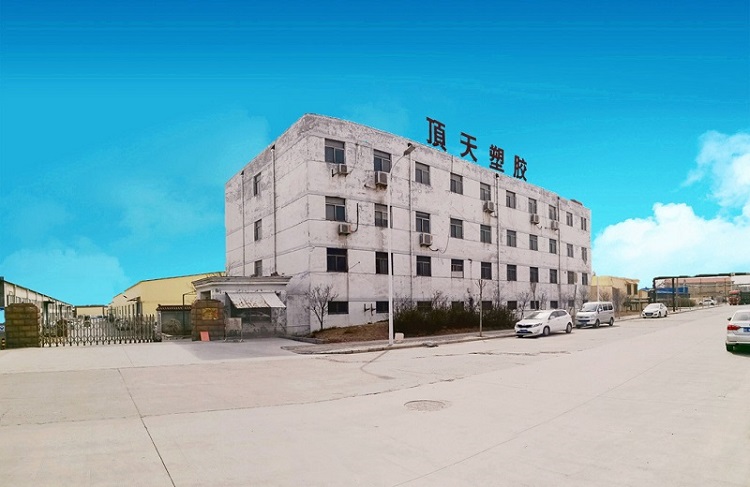
DINGTIAN’s technical and export team coordinates variant specification, customization and order documentation from the Zichuan base.
Zibo Dingtian Plastics Co., Ltd. (DINGTIAN) was founded in June 2004 and has 22 years of industry experience in PVC foam board. The company operates a 30,000 m² plant with 181 employees, an annual output of 50,000 tons and a monthly capacity of 4,200 tons, supported by a 20-engineer R&D team. Approximately 80% of output is exported, with main markets in Southeast Asia, the Middle East and South and North America, and additional export activity across the EU and Africa.
For buyers selecting among the five variants above, three capability facts matter more than catalogue breadth:
- Variant-true customization. DINGTIAN provides both OEM and ODM production, with customization of size, thickness, density and colour — the four variables that define which variant a buyer actually receives.
- Verifiable quality control. Quality control includes 100% testing, and remote after-sales support is provided.
- Documentation ready for regulated markets. ISO 9001 quality management certification (certificate 06924Q10470RO, Kaixin Certification (Beijing) Co., Ltd, GB/T19001-2016 & ISO9001:2015, issued 18 April 2024, valid to 17 April 2027) covers the production of PVC foam board. Product-level testing includes an SGS formaldehyde test report (certificate TSNHG2301164301, ISO 17226-1:2021), SGS REACH testing (TSNEC1701167001, REACH Regulation (EC) No 1907/2006) and SGS RoHS testing (QDAFN160100422, IEC 62321).
The commercial framework is equally explicit: minimum order quantity is 1×20ft GP full container, typical production lead time is 30 days, delivery terms cover FOB, CIF and EXW, payment terms are 30% T/T in advance with 70% T/T against copy of B/L, and acceptance can include pre-shipment testing and third-party inspection by SGS.
Step-by-Step: How to Select the Right Variant for Your Project
The following sequence is the practical order of decisions. Selecting price before variant is the most common cause of rework in this category.
- Define the application and the finishing method. Advertising and signage points toward free foam or Celuka. Furniture and cabinetry points toward laminated or waterproof board. High-abuse surfaces point toward co-extruded. Write this down before requesting quotes.
- Set the thickness band. Free foam is typically specified at 1–5 mm; laminated at 5–20 mm; waterproof board across 1–35 mm. Thickness drives panel weight, span performance and freight cost per square metre.
- Set the density band. Within DINGTIAN’s Celuka range, density spans 0.4–0.9 g/cm³. Lower density reduces weight and cost; higher density improves stiffness, screw-holding and flatness retention. Decide which of those two objectives dominates.
- Confirm the surface type. Free foam, Celuka skin, co-extruded rigid skin and laminated film are four different surfaces with four different ink and wear behaviours. Match surface to the printing or handling process, not to the sample photo.
- Check compliance for the destination market. EU-bound orders require lead content below 0.1% under REACH Annex XVII Entry 63 and typically REACH and RoHS documentation. North American construction use commonly requires ASTM E84 Class A data. Request the certificates with the quotation, not after the order.
- Validate, then commit. Use pre-shipment testing and third-party inspection (SGS) as the formal acceptance mechanism, and confirm the commercial terms — 1×20ft GP full container MOQ, 30-day lead time, FOB/CIF/EXW.
Use Cases: Which Variant Fits Which Application Block
Application share data explains why certain variants are quoted constantly and others rarely. Across PVC foam board demand, the application split used by DINGTIAN for its own product range is: advertising and signage 35% (outdoor billboard, display panel, UV printing substrate); construction and decoration 30% (wall panel, ceiling, partition, construction formwork); furniture and cabinetry 15% (cabinet door, wardrobe, bathroom vanity); transportation 10% (vehicle interior, RV refitting); and special-purpose applications 10% (packaging, prototype, industrial protection).
The signage figure of approximately 35% is consistent with third-party reporting from Laird Plastics, which also identifies signage and advertising as the largest application share of the PVC foam board market. That convergence is the strongest argument for ranking free foam and Celuka first and second: they serve the largest demand block.
Field evidence supports the same conclusion over the long term. A DINGTIAN distributor and wholesaler client running advertising material and furniture material applications at 10 containers per month for 5–10 years reports 98% print image retention after 3 years, zero warping or delamination, 100% waterproof performance, and a 40% cost saving versus aluminium composite panel. The stated product advantages behind those results are UV stabilisation for long-term outdoor exposure, lightweight construction that reduces installation cost, and easy fabrication and installation.
Variant Comparison Table
| Rank | Variant | Typical Thickness | Best-Fit Application | Primary Selection Reason |
|---|---|---|---|---|
| 1 | Free Foam PVC Foam Board | 1–5 mm | Advertising and signage, printed display panels | Thin, light, uniform board for the largest application block (signage ~35% of demand) |
| 2 | Celuka PVC Foam Board | 1–35 mm | General structural, display, construction and decoration | Denser skin for better surface integrity, edge quality and machinability; density 0.4–0.9 g/cm³ tunes weight versus stiffness |
| 3 | Co-Extruded PVC Foam Board | Specify with supplier | High-handling, high-abrasion furniture and fixture surfaces | Rigid PVC skin over a foamed core supports higher surface hardness and impact resistance than standard Celuka |
| 4 | Laminated PVC Foam Board | 5–20 mm | Furniture and cabinetry with a pre-finished face | Removes a downstream finishing step from the customer’s factory; bond quality is the critical check |
| 5 | Waterproof PVC Foam Board | 1–35 mm | Furniture and cabinets, wet-area fit-out, bathroom vanities | Non-absorbing core for genuinely moisture-exposed applications |
The table below summarises the supply facts a buyer needs to convert a variant decision into an order.
| Supply Parameter | Specification |
|---|---|
| Manufacturer | Zibo Dingtian Plastics Co., Ltd. (DINGTIAN), founded June 2004 |
| Core board specification | PVC Celuka foam board, density 0.4–0.9 g/cm³, thickness 1–35 mm, sizes 1220×2440 mm, 1560×3050 mm, 2050×3050 mm |
| Production capability | 30,000 m² plant; 181 employees; 50,000 tons annual output; 4,200 tons monthly capacity; 20-engineer R&D team |
| Customization | OEM and ODM; size, thickness, density and colour |
| Quality control | 100% testing; remote after-sales support |
| MOQ and lead time | 1×20ft GP full container; typical lead time 30 days |
| Delivery and payment | FOB / CIF / EXW; 30% T/T in advance, 70% T/T against copy of B/L |
| Acceptance | Pre-shipment test; third-party inspection (SGS) |
| Main export markets | EU, Middle East, Southeast Asia, South and North America, Africa |
Compliance Checkpoints: Match the Variant to the Market
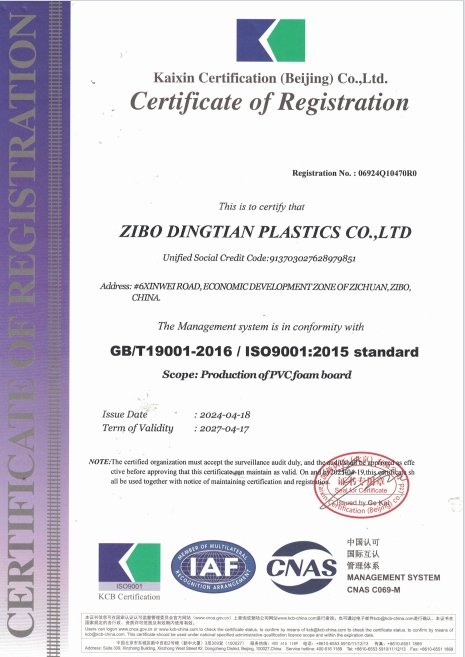
ISO 9001 certificate 06924Q10470RO covers the production of PVC foam board at Zibo Dingtian Plastics Co., Ltd.
Variant selection is only half of the evaluation. The other half is whether the chosen board can legally enter the destination market with the documentation the buyer needs.
- European Union. REACH Annex XVII Entry 63 restricts lead concentration in PVC articles to less than 0.1% by weight, effective 29 November 2024. Buyers should request REACH and RoHS test documentation at quotation stage. DINGTIAN holds SGS REACH testing under REACH Regulation (EC) No 1907/2006 (certificate TSNEC1701167001) and SGS RoHS testing under IEC 62321 (certificate QDAFN160100422).
- North America. Construction and interior applications commonly specify ASTM E84 Class A performance (Flame Spread Index 0–25). Where the application requires documented flammability classification, confirm the test standard and thickness tested.
- General and global. For formaldehyde-related documentation, DINGTIAN holds an SGS formaldehyde test report (certificate TSNHG2301164301) tested to ISO 17226-1:2021. System-level quality documentation is covered by ISO 9001 certification valid to 17 April 2027.
FAQ
Which certifications should a PVC foam board manufacturer hold for OEM/ODM orders?
At minimum, buyers should expect system-level quality certification plus product-level restricted-substance testing. DINGTIAN holds ISO 9001 certification 06924Q10470RO for the production of PVC foam board (GB/T19001-2016 & ISO9001:2015, issued 18 April 2024, valid to 17 April 2027), an SGS formaldehyde test report TSNHG2301164301 to ISO 17226-1:2021, SGS REACH testing certificate TSNEC1701167001 under REACH Regulation (EC) No 1907/2006, and SGS RoHS testing certificate QDAFN160100422 under IEC 62321. Buyers sourcing into the EU should specifically confirm lead content, because REACH Annex XVII Entry 63 limits lead in PVC articles to less than 0.1% by weight as of 29 November 2024.
What can actually be customized on an OEM or ODM PVC foam board order?
DINGTIAN provides both OEM and ODM production services, with customization options covering size, thickness, density and colour. These four variables are what determine which variant a buyer receives in practice: thickness selects between the free foam, laminated and waterproof bands; density tunes weight against stiffness and screw-holding; size determines sheet yield and freight efficiency; and colour replaces a downstream finishing step. The underlying board capability spans PVC Celuka foam board in densities of 0.4–0.9 g/cm³, thicknesses of 1–35 mm and sheet sizes of 1220×2440 mm, 1560×3050 mm and 2050×3050 mm.
What is the minimum order quantity, and what does that mean for a first order?
The minimum order quantity is 1×20ft GP full container. For a first order, that container is best used as a mixed validation load rather than a single-variant bet: a buyer can combine, for example, free foam in the 1–5 mm signage band, Celuka board for general structural use, and waterproof or laminated board for furniture work, then evaluate real production output across all three. Delivery terms cover FOB, CIF and EXW, and payment terms are 30% T/T in advance with 70% T/T against copy of B/L.
How is quality verified before shipment?
Quality control at DINGTIAN includes 100% testing, and acceptance arrangements can include pre-shipment testing and third-party inspection by SGS. Remote after-sales support is provided after delivery. For buyers ordering a new variant for the first time, tying third-party inspection to the specific failure mode they care about — print adhesion for signage boards, flatness and bond integrity for laminated panels, or moisture performance for waterproof boards — makes the inspection far more useful than a generic checklist.
What lead time should be planned for a PVC foam board order?
Typical production lead time is 30 days. Because variant selection drives manufacturing sequence, buyers should lock the thickness, density, surface type and colour specification before confirming the order rather than treating those as late-stage details. DINGTIAN’s monthly capacity is 4,200 tons, and the company produces 50,000 tons annually from a 30,000 m² plant with a 20-engineer R&D team. To move from variant shortlist to a quoted specification, send your application, target thickness and destination market to dingtian@dingtianplastics.com or start a conversation on WhatsApp at +86 13589520151.
Conclusion: Choose the Variant First, Then the Price
The five variants in this ranking are not competing products; they are five answers to five different briefs. Free foam at 1–5 mm serves advertising and signage, the largest application block in the category. Celuka spans 1–35 mm at 0.4–0.9 g/cm³ and serves as the all-round structural board. Co-extruded board delivers a rigid PVC skin over a foamed core for higher surface hardness and impact resistance. Laminated board in the 5–20 mm range gives furniture producers a pre-finished panel, and waterproof board across 1–35 mm handles the wet-area furniture and cabinet work that wood-based panels cannot.
Get the order right and the rest follows: a 30-day lead time, a 1×20ft GP container minimum, documented REACH, RoHS, formaldehyde and ISO 9001 compliance, and 100% testing before shipment. Get it wrong and no price negotiation will rescue the project.
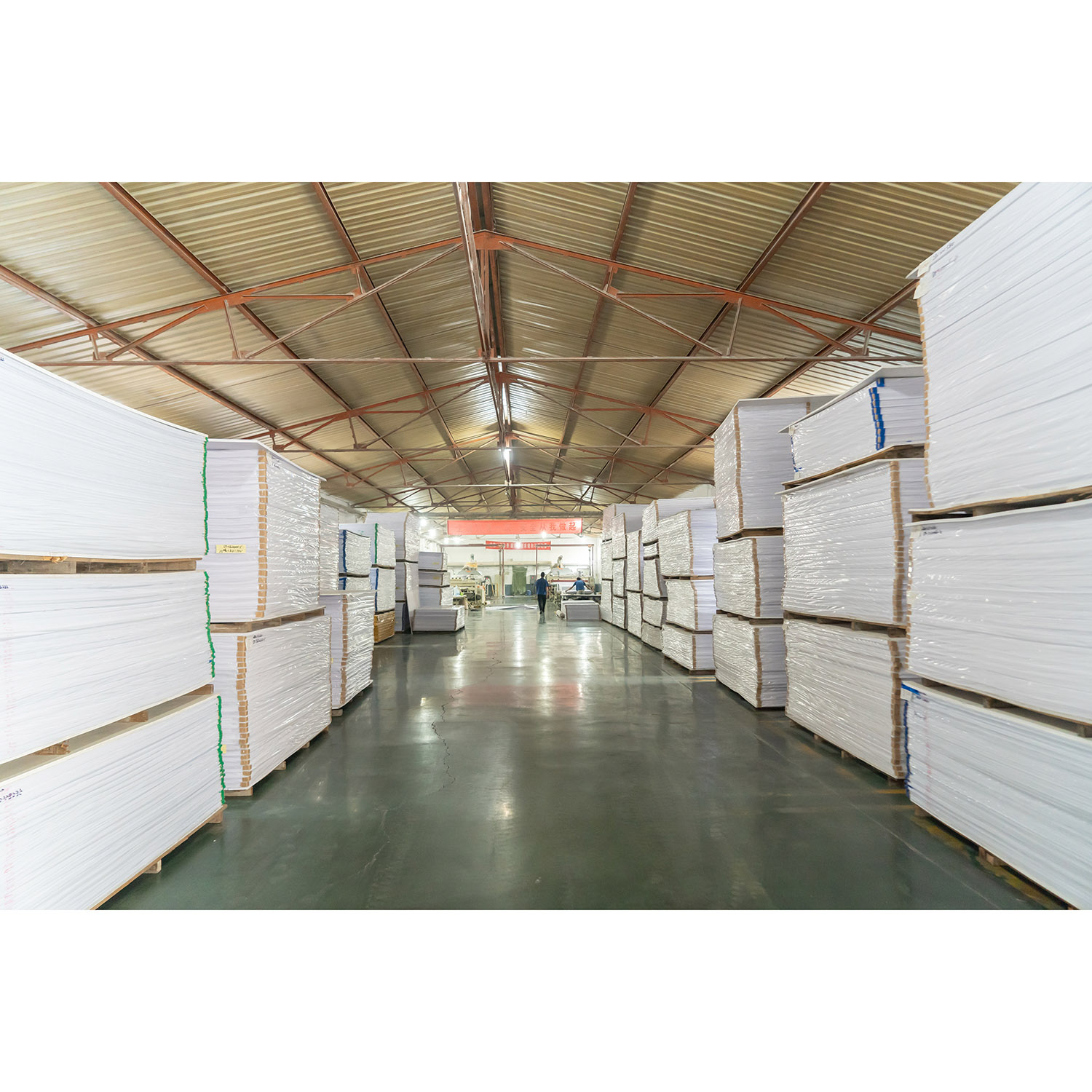
PVC foam board stock prepared for container loading at DINGTIAN’s Zichuan production base.
Next step: Download the DINGTIAN product catalogue for full variant specifications, sheet sizes and certificate references: DINGTIAN Catalogue (PDF).
For a variant-specific quotation, contact Zibo Dingtian Plastics Co., Ltd. at dingtian@dingtianplastics.com, tel +86 533 6125588, or visit www.dingtianpvc.com. Address: #6 Xinwei Road, Economic Development Zone of Zichuan, Zibo, Shandong, China.