
Decoding DPI, Printhead Width & Speed in TIJ and PIJ Coding
Decoding DPI, Printhead Width & Speed in TIJ and PIJ Coding
Two industrial inkjet printers can both print "600 dpi" and still deliver different results on the same packaging line. Resolution is only one of three limits that decide the outcome: how many nozzles a printhead places vertically, how wide the printed band can be before heads must be stitched together, and how fast the line can run while those drops still land where the code requires them. Thermal inkjet (TIJ) and piezo inkjet (PIJ) resolve those three constraints differently, and published DOCOD specifications make the trade-offs measurable rather than theoretical.
This guide is written for engineers and technical buyers who need to convert catalogue numbers into a line specification. It works through the DOCOD 3BK702 half-inch black solvent quick-drying ink cartridge (up to 600 dpi, 300 nozzles, 42 ml ink filling capacity), the DOCOD T220E half-inch dual-head TIJ printer (up to 600 × 600 dpi, up to 406 m/min), the DOCOD TX1 half-inch seamless TIJ printer (up to eight printheads, 1–101.6 mm print height), and the DOCOD P2000 piezo inkjet printer (300 dpi or 600 dpi at 190 m/min or 95 m/min respectively). It also explains why the control hardware — a Cortex-A7 1.2 GHz dual-core processor with an FPGA algorithm acceleration chipset — belongs in the reliability conversation rather than in a footnote.
Why the Same DPI Figure Behaves Differently on Two Lines
A dpi specification is a two-axis statement, but most commercial comparisons only advertise one axis. Vertical resolution is a hardware property: it comes from nozzle geometry and the number of nozzles a head carries. Horizontal resolution is a dynamic property: it depends on how often a nozzle can fire relative to how far the substrate travels between fires. A printer can therefore be rated at 600 dpi vertically while its horizontal dot placement at full line speed is materially coarser.
The second hidden variable is print width. A half-inch printhead covers 12.7 mm of print height. If the code block, logo, or data matrix needs more than that, a second head must be added and mechanically aligned so that the two bands join without a visible seam or a position error that breaks a barcode. The third variable is code density. A character-based date code made from a 5 × 6 dot matrix tolerates far coarser placement than a GS1 DataMatrix module on a pharmaceutical carton, even when both use the same printer.
Three questions that separate a workable specification from a brochure number
- At what line speed is the quoted resolution actually achievable?
- How many millimetres of print height does one printhead cover, and how many heads must be stitched to reach the rest?
- What is the smallest element in the code — a character dot matrix, or a 2D data module?
Industry Background: Why Resolution and Code Density Are Converging
The commercial context explains why specification-level discussions have moved from procurement paperwork to engineering meetings. The global coding and marking equipment market was valued at USD 17.53 billion in 2024 and is projected to reach USD 27.11 billion by 2032, according to SkyQuest. Continuous inkjet (CIJ) technology held the largest revenue share by technology, at approximately USD 5.67 billion in 2024, per Grand View Research, while Asia-Pacific accounted for around 35% of the market in the same year according to Market Research Future.
Published market size estimates differ between research houses depending on whether consumables and software services are included in the scope, so these figures are useful as context rather than as a procurement benchmark. They do, however, describe a market where labeling regulation and traceability expectations keep adding data to the same physical space. GS1 Digital Link (ISO/IEC 18975:2024) is being adopted globally to move from 1D barcodes toward QR codes for point-of-sale and traceability by 2027, according to GS1 and ISO. More data in the same label area means smaller modules, tighter print consistency, and a harder question for any inkjet specification: can this printer hold that density at my line speed?
This is also where TIJ and PIJ sit relative to each other. Both are digital, non-contact, drop-on-demand technologies used for variable data printing on packaging, cartons, films, and industrial parts, and both are typically chosen where higher-resolution text, barcodes, and 2D codes are required. They diverge in how the drop is generated, which drives different printhead widths, speed ceilings, ink systems, and maintenance profiles.
Detailed Solution: How DOCOD TIJ and PIJ Hardware Handles DPI, Width, and Speed
1. DPI: vertical nozzle geometry plus horizontal drop placement
The cleanest way to understand the resolution ceiling of a TIJ system is to look at the consumable, because in thermal inkjet the nozzle array and the ink live in the same replaceable part. The DOCOD 3BK702 half-inch black solvent quick-drying cartridge carries 300 nozzles, is specified for resolution up to 600 dpi with a recommended practical setting of 300 × 300, and fires with a 9 V trigger, a 2.2 μs trigger pulse width, and a maximum frequency of 12 kHz.
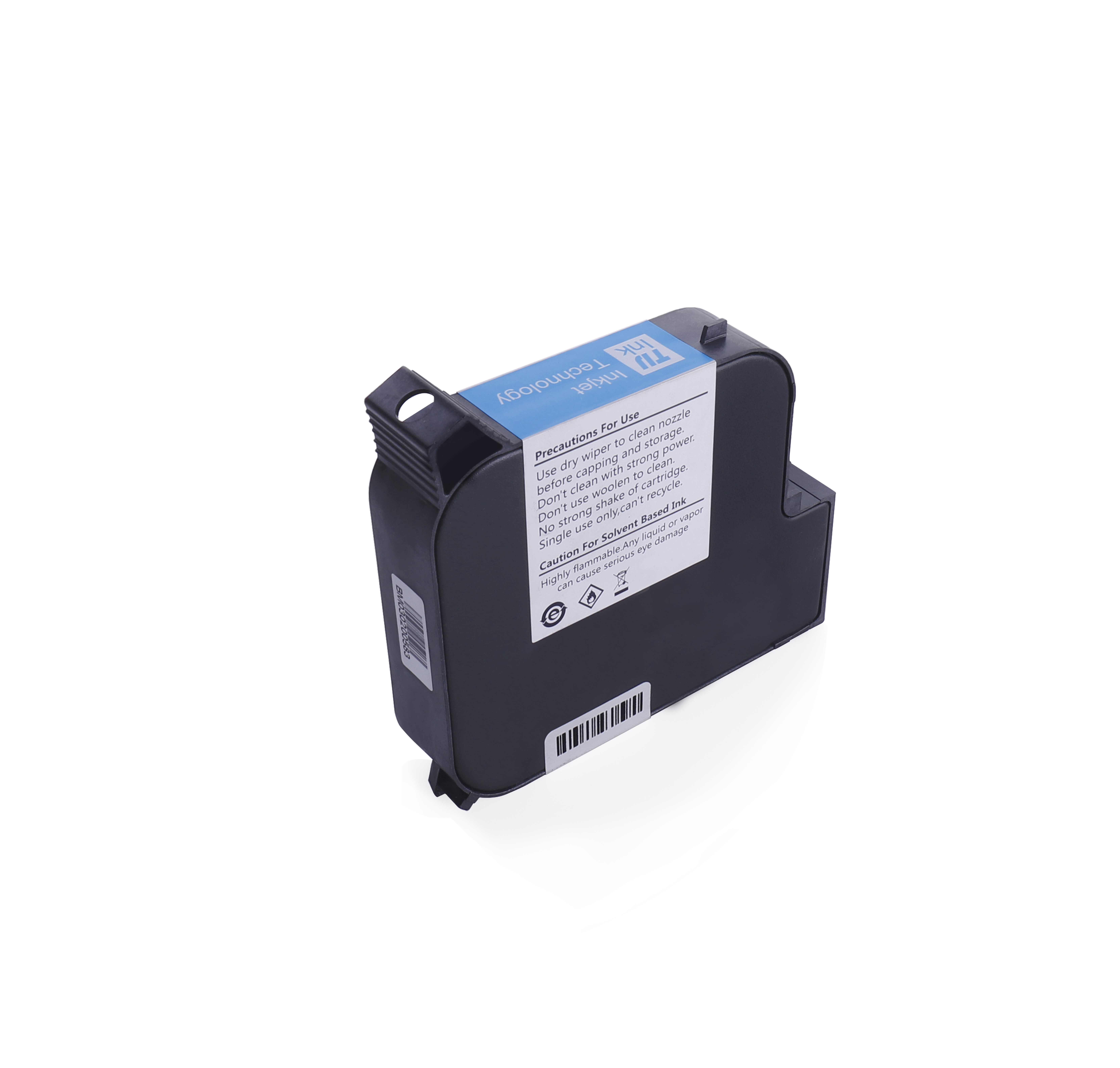
The DOCOD 3BK702 half-inch black solvent TIJ cartridge: 300 nozzles, 42 ml ink filling capacity, rated up to 600 dpi with 300 × 300 recommended.
Those numbers interact in a way that matters on a running line. A maximum firing frequency of 12 kHz defines how many drops a single nozzle can place per second. Line speed then determines how far apart those drops land along the direction of travel. Raise the line speed at a fixed firing frequency and the horizontal spacing increases, which reduces the effective horizontal dot density. This is the physical mechanism behind a pattern that appears throughout inkjet datasheets: the higher the resolution, the lower the maximum speed.
The cartridge specification also fixes the consumable side of the decision. The 3BK702 is a solvent ink cartridge intended for BOPP, PVC, PP, PET, OPP, glass, and stainless steel, with a best-use period of six months and a working window of 15 °C to 35 °C at 35% to 80% RH (shipping and storage: 5 °C to 40 °C, 20% to 80% RH). Nozzle maintenance is specified as gentle cleaning with a dust-free cloth or a cloth containing waterless IPA-ethanol (>98%).
| 3BK702 cartridge parameter | Published value |
|---|---|
| Part number / type | 3BK702 / half-inch black solvent TIJ ink cartridge |
| Ink filling capacity | 42 ml, solvent ink |
| Resolution | Up to 600 dpi; recommended 300 × 300 |
| Number of nozzles | 300 |
| Trigger voltage / pulse width | 9 V / 2.2 μs |
| Maximum frequency | 12 kHz |
| Working temperature and humidity | 15 °C to 35 °C; 35% to 80% RH |
| Substrates | BOPP, PVC, PP, PET, OPP, glass, stainless steel |
2. Printhead width: half-inch modules, dual heads, and stitching
Printhead width is the parameter that most often decides whether a project needs one print station or several. The DOCOD T220E half-inch dual-head thermal inkjet printer covers 1–12.7 mm with a single printhead and 1–25.4 mm with two, and the two heads can be spliced together or mounted separately depending on the product geometry and the space available around the conveyor. Printhead installation is described as separate, which is important on lines where the code must be positioned on a curved or recessed surface.
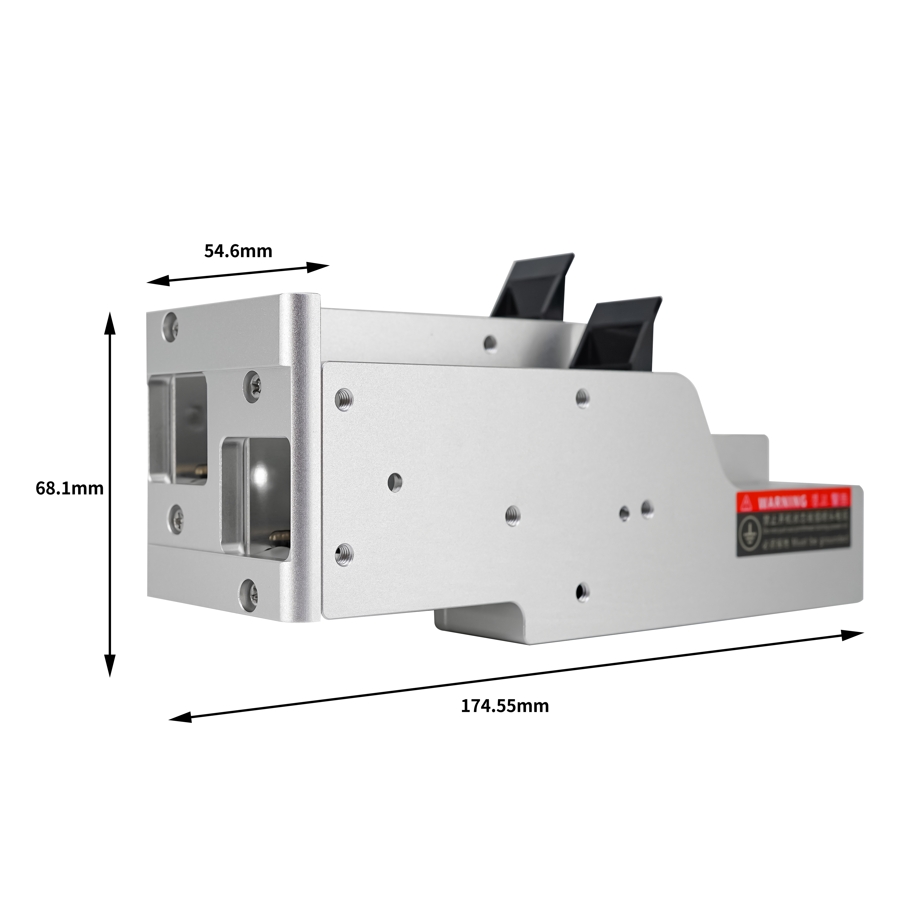
The T220E half-inch dual-head module: one head covers 1–12.7 mm of print height, two heads extend coverage to 1–25.4 mm and can be spliced or run separately.
Where a project needs a genuinely wide marking band, TIJ scales by adding heads rather than by enlarging a single nozzle array. The DOCOD TX1 half-inch seamless TIJ printer supports one to eight printheads and reaches a print height range of 1–101.6 mm, using the same half-inch building block and a variety of splicing combinations. For a shipping carton that needs a large-format batch code plus a QR code in one pass, this is the difference between one station and four.
PIJ approaches width differently. The DOCOD P2000 piezo inkjet printer uses I1600 series nozzles in a single-head or dual-head configuration and covers a maximum print height of 33.8 mm with a single head, which is wider than a half-inch TIJ head but narrower than a stitched TIJ array. Its answer to multi-station work is cascading: multiple devices can be linked and share the same set of encoder or photocell sensor parameters, so a longer line can be covered by several print positions without duplicating the trigger hardware. Each printhead is installed independently and can be fitted with anti-collision components — a practical detail on lines where the head passes close to the product.
3. Print speed: the resolution trade-off, stated in published figures
The P2000 specification states the resolution/speed relationship directly: 190 m/min at 300 dpi, or 95 m/min at 600 dpi. Doubling the print density halves the maximum line speed. For an engineer specifying a high speed coding machine for packaging lines, that single line determines whether one printer is enough or whether the line needs a different technology, a different print position, or a lower resolution tier.
The TIJ side of the portfolio quotes a higher speed ceiling: the T220E reaches up to 406 m/min at up to 600 × 600 dpi, and the TX1 also reaches up to 406 m/min with up to 300 × 300 dpi across its 1–101.6 mm print height range. The practical reading is not that one technology is faster, but that speed is always quoted against a resolution and a print width. A 406 m/min figure on a half-inch head and a 190 m/min figure on a 33.8 mm piezo head describe different jobs on the same plant floor.
4. The hardware that keeps the specification repeatable
Printheads only deliver their rated performance if the controller can feed them data in real time. The T220E and TX1 both list the same main hardware: a Cortex-A7 1.2 GHz dual-core processor with an FPGA algorithm acceleration chipset, running an embedded Linux operating system. That configuration matters most in three situations — multi-head stitching, where several heads must be phase-aligned to a single encoder; variable data printing, where each product receives a unique serial number, QR code, or database record; and high-speed lines, where the trigger-to-print window is short.
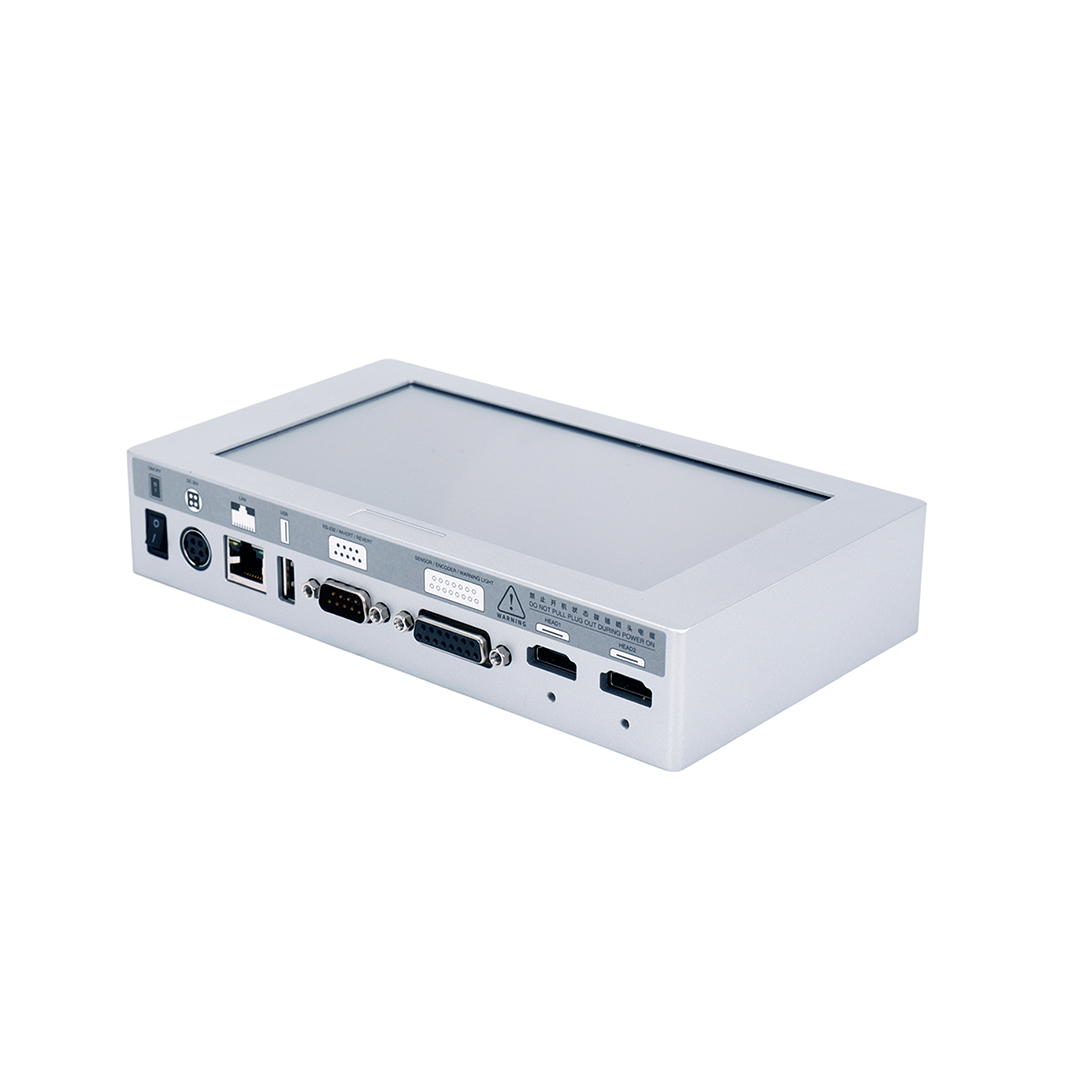
T220E controller interface and connection ports: photocell, encoder, alarm control output, printhead connection port, plus USB, RS232, and TCP/IP network.
Interface availability follows the same logic. The T220E provides a photocell input, encoder input, alarm control output, printhead connection port, flip and reverse control, and USB, RS232, and TCP/IP net ports. The P2000 provides photocell, encoder, flip and reverse control, signal light alarm output, serial number output control, and external printing information selection, with USB, RS232, and TCP/IP networking, and supports cascading across multiple units. Both printers are specified to operate at 0 °C to 45 °C and 30% to 70% RH.
The P2000 control package is built around a 10.1-inch full-color capacitive touch screen, an embedded Linux operating system, aviation-grade aluminium construction, input of 100–240 V AC at 50/60 Hz drawing less than 150 W, and a published CE certification. Its ink system is a negative pressure continuous ink supply using water-based or quick-drying ink, with a print distance of 0–5 mm and a recommended working distance of 2–3 mm from the printing medium.
5. Side-by-side: TIJ and PIJ parameters in one table
| Parameter | DOCOD T220E (TIJ) | DOCOD P2000 (PIJ) | DOCOD TX1 (TIJ, multi-head) |
|---|---|---|---|
| Printheads | 1 or 2 | Single head or dual head | 1 to 8 |
| Print height | 1–12.7 mm (single); 1–25.4 mm (dual) | Single head maximum 33.8 mm | 1–101.6 mm |
| Resolution | Up to 600 × 600 dpi | 300 dpi or 600 dpi | Up to 300 × 300 dpi |
| Maximum print speed | Up to 406 m/min | 190 m/min at 300 dpi; 95 m/min at 600 dpi | Up to 406 m/min |
| Ink system | 42 ml cartridges (food grade, water-based, oil-based, weak solvent, solvent) with RFID cartridge chip and large-capacity continuous ink supply option | Negative pressure continuous ink supply; water-based or quick-drying ink | 42 ml cartridges with large-capacity continuous ink supply system |
| Print distance | Not stated in the published specification | 0–5 mm (2–3 mm recommended) | Not stated in the published specification |
| Main hardware | Cortex-A7 1.2 GHz dual-core processor with FPGA algorithm acceleration chipset | Embedded Linux control with 10.1-inch full-color touch screen; cascading support | Cortex-A7 1.2 GHz dual-core processor with FPGA algorithm acceleration chipset |
| Data interfaces | USB, RS232, TCP/IP; photocell, encoder, alarm control output | USB, RS232, TCP/IP; photocell, encoder, flip and reverse control | USB, RS232, network; optical sensor, encoder |
| Working environment | 0–45 °C; 30–70% RH | 0–45 °C; 30–70% RH | 0–45 °C; 30–70% RH |
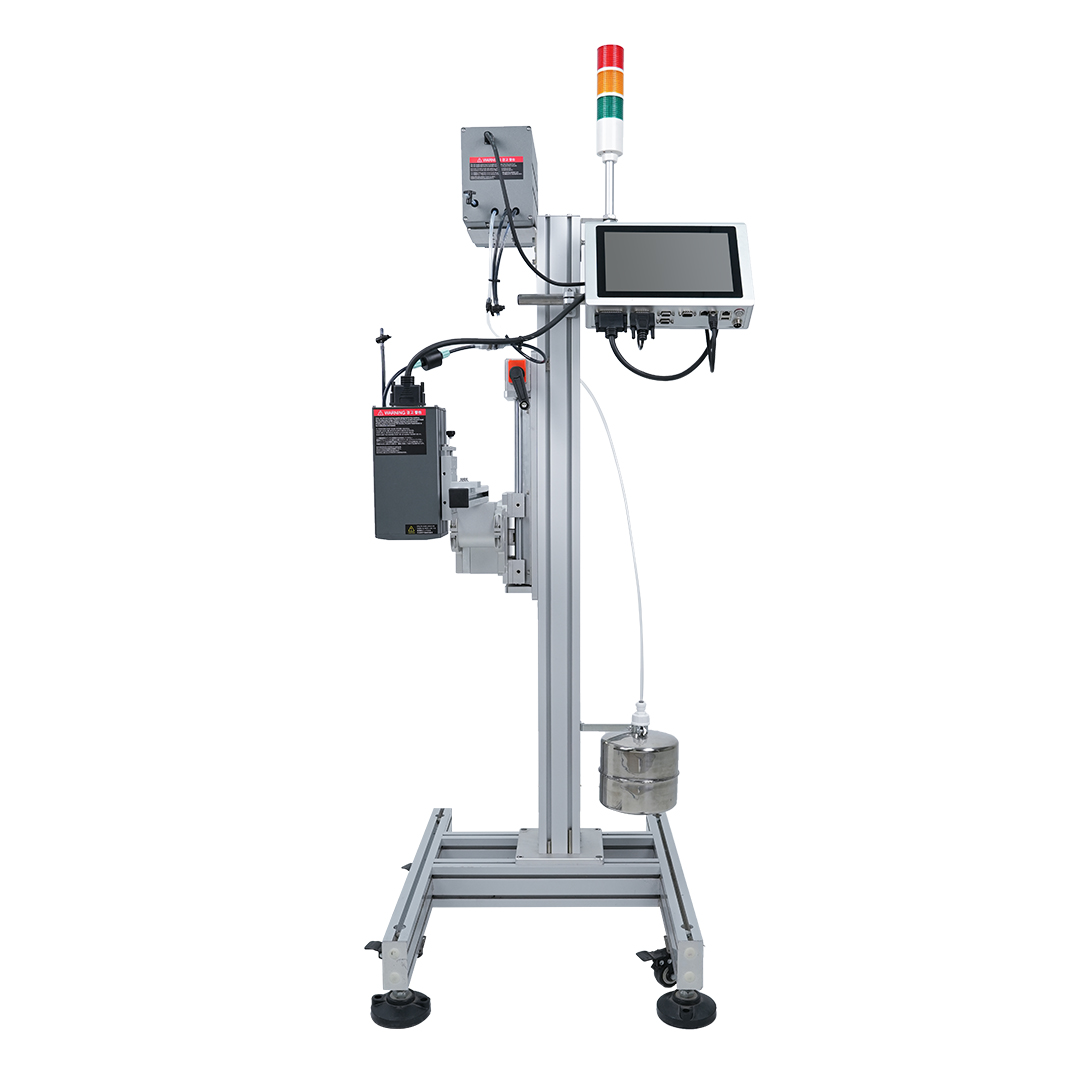
The DOCOD P2000 piezo inkjet printer: I1600 series nozzles, single or dual head, 300 dpi at 190 m/min or 600 dpi at 95 m/min.
Limits worth writing into the specification
- Higher resolution reduces throughput on the P2000 — 600 dpi is quoted at 95 m/min against 190 m/min at 300 dpi.
- TIJ print height is built from half-inch modules, so wide marking bands depend on stitching quality, not on a single wide head.
- PIJ print distance is 0–5 mm with 2–3 mm recommended, which constrains mounting tolerance on a vibrating line.
- The 3BK702 cartridge has a best-use period of six months and a 15–35 °C working window, which affects stock rotation and unheated warehouses.
Step-by-Step Breakdown: Turning Three Specifications into a Line Decision
- Define the code, not the printer. Establish the print content (date, batch, serial number, GS1 DataMatrix, QR code), the number of lines, and the smallest element that a scanner must resolve.
- Set the print height. If the code block fits inside 12.7 mm, a single half-inch TIJ head is sufficient. Between 12.7 mm and 25.4 mm, a dual-head T220E configuration or a single P2000 head (up to 33.8 mm) applies. Beyond that, a multi-head TIJ arrangement extends coverage to 101.6 mm using up to eight printheads.
- Choose the resolution tier from the smallest element. Character-based codes are commonly run at 300 × 300 dpi, which the 3BK702 lists as its recommended setting; dense 2D codes justify 600 dpi on the T220E or the P2000.
- Check speed at that resolution. Compare the required line speed against 406 m/min for the T220E and TX1, and against 190 m/min (300 dpi) or 95 m/min (600 dpi) for the P2000. If the numbers do not meet, change resolution tier, print position, or technology — not the data requirement.
- Verify mounting and print distance. PIJ requires 0–5 mm, ideally 2–3 mm, from the substrate. TIJ heads are installed separately, which allows angled or split mounting but requires a stable bracket and encoder synchronisation.
- Match ink to substrate and environment. Solvent cartridges such as the 3BK702 suit BOPP, PVC, PP, PET, OPP, glass, and stainless steel; the T220E accepts 42 ml food grade, water-based, oil-based, weak solvent, and solvent cartridges, with an RFID chip that identifies ink parameters and records remaining ink; the P2000 uses water-based or quick-drying ink in a negative pressure continuous system. Confirm the 0–45 °C, 30–70% RH operating envelope against the room.
- Close the loop with validation. Confirm interface compatibility (USB, RS232, TCP/IP, photocell, encoder), check whether cascading is needed to share encoder and sensor parameters, and require sample printing verification and a function test before shipment.
Use Cases: What These Numbers Look Like in Production
Pharmaceutical cartoning in India. A pharma packaging supplier ran three cartoning lines printing QR codes and expiry data on cartons. The installation used a DOCOD T220E half-inch dual-head TIJ printer — the configuration that provides dual-head high-speed printing at up to 600 × 600 dpi. After 18 months of operation, the reported outcome was improved code readability, which is the practical benefit of choosing the resolution tier before the line speed, rather than after.
Personal care packaging in Thailand. A manufacturer of personal care products needed variable data printing on coated boxes across three lines. The selected hardware was the DOCOD P2000 piezo inkjet printer, whose 600 dpi capability and 33.8 mm single-head print height fit the code block. The reported result after one year was improved traceability consistency.
Contract packing in Brazil. A contract packer running eight packing stations needed batch and QR printing on shipping cartons with a compact footprint. The DOCOD TX1 half-inch seamless TIJ printer was deployed as a multi-head configuration, allowing the print band to be matched to the carton panel rather than to a fixed head width. The reported result was faster deployment across small lines, with compact setup for limited space.
Consumables in South Korea. A regional distributor consumed around 50 DOCOD 3BK702 cartridges per month for coding on plastic film and coated cartons. Over one year of supply, the reported result was fewer smudging complaints, attributed to fast drying and strong adhesion — the operational value of matching a solvent cartridge to the substrate rather than defaulting to the cheapest consumable. A related customer case in the same portfolio, a cosmetics OEM in Poland using a DOCOD L3000 Series 5W UV laser marking machine for lot coding on plastic bottles and caps, illustrates the same principle on a different technology: match the marking method to the material, not the other way round.
Frequently Asked Questions
1. Which certifications should a buyer verify on an industrial coding printer, and do they cover every model?
Certification is model-specific and market-specific, so the certificate must name the exact printer and the market it is valid in. In the DOCOD portfolio, the M2000 Series Continuous Inkjet Printer holds BIS CRS registration (certification number R-41312347) issued by the Bureau of Indian Standards for the India market, against standard IS 13252 (Part 1):2010 / IEC 60950-1:2005. CE and RoHS appear on the published specifications of several printer families, and the S1000 Series lists CE, RoHS, and BIS. For the P2000 Piezo Inkjet Printer, the published related certification is CE. At manufacturer level, DOCOD Precision Group Co., Ltd. holds ISO 9001:2015 (18625Q00281R1M), ISO 14001:2015 (18625E00147R1M), and ISO 45001:2018 (18625S00131R1M), all issued by Guangdong Zhongyu Certification Co., Ltd., covering the R&D and production of inkjet printers. Buyers should treat CE, RoHS, BIS, and management-system certificates as three different questions and ask for the document that answers each one.
2. How wide can a DOCOD inkjet printhead cover before resolution or speed has to be sacrificed?
Width is added in half-inch (12.7 mm) increments on the TIJ side. A single T220E printhead covers 1–12.7 mm and two heads cover 1–25.4 mm, with the option to splice them or run them separately, at up to 600 × 600 dpi and up to 406 m/min. The TX1 extends this to 1–101.6 mm using one to eight printheads at up to 300 × 300 dpi and up to 406 m/min. On the PIJ side, the P2000 covers a maximum print height of 33.8 mm with a single head at 300 dpi or 600 dpi, and supports cascading multiple devices that share the same encoder or photocell parameters when more print positions are needed. In practice, the constraint that appears first is usually not head width but the trade-off between resolution and line speed, and second the mechanical alignment needed to stitch adjacent heads.
3. What drives the operating cost difference between 300 dpi and 600 dpi production?
The published specifications point to three cost drivers rather than a single price figure. The first is throughput: on the P2000, the maximum print speed is 190 m/min at 300 dpi and 95 m/min at 600 dpi, so a line that must run faster may need additional print positions or a different technology. The second is the ink system: TIJ printers such as the T220E and TX1 use 42 ml cartridges with an RFID chip that automatically identifies ink parameters and records remaining ink, with a large-capacity continuous ink supply option, while the P2000 uses a negative pressure continuous ink supply with water-based or quick-drying ink. The third is consumable stability: the 3BK702 has a best-use period of six months and a 15–35 °C working window, so over-ordering or storing in an unheated area affects the real cost per printed code. Evaluating cost per acceptable, scanned code across these three variables is more reliable than comparing equipment prices in isolation.
4. Can a printer be validated on our own substrate before we commit to a full order?
Yes, and the DOCOD supply process is structured around it. For standard equipment supply, quality control includes outgoing inspection, sample printing verification, and a function test before shipment, with a minimum order quantity of one set. On the channel side, distributor and service partner arrangements include demo and sample validation plus a cooperation requirement review. Because ink and substrate compatibility is the variable most likely to change results, trials should use the intended cartridge — for example, the 3BK702 solvent cartridge for BOPP, PVC, PP, PET, OPP, glass, or stainless steel — and the intended print distance and line speed. A Korean regional distributor running 50 3BK702 cartridges per month on plastic film and coated cartons reported fewer smudging complaints over a year, which is the kind of outcome a substrate trial is designed to predict.
5. What lead times and minimum quantities should be planned for?
DOCOD publishes the following production parameters: standard equipment supply is quoted at a lead time within 15 working days with a minimum order quantity of one set and monthly capacity of 2,000 units; OEM branding support (private label logo, startup screen, nameplate, packaging, manuals, carton labels) runs 15–25 working days with a minimum of one set; ODM functional customization (software or UI adjustment, communication interface, bracket structure, printhead configuration, application-based adaptation) runs 20–30 working days with a minimum of one set per project; production line integration support runs 20–35 working days with a minimum of one line; and spare parts and consumables ship within 15 working days with a minimum of one piece. Distributor and service partner support is quoted at a minimum of two units with a 15–30 day lead time and monthly capacity of 4,000 units. If you want to confirm which configuration fits a specific line, request a sample or a quotation through sales@docod.com.cn.
Conclusion: Specification Discipline Beats Headline Numbers
DPI, printhead width, and print speed are not three independent features to be maximised. They are three limits that trade against each other, and the published DOCOD data shows the trade explicitly: a 300-nozzle, 42 ml solvent cartridge rated to 600 dpi with 300 × 300 recommended; a dual-head TIJ printer covering 1–25.4 mm at up to 600 × 600 dpi and 406 m/min; a multi-head TIJ platform reaching 101.6 mm; and a piezo printer running 190 m/min at 300 dpi or 95 m/min at 600 dpi. Behind all of them sits the same control requirement — real-time data throughput, supported in the T220E and TX1 by a Cortex-A7 1.2 GHz dual-core processor with an FPGA algorithm acceleration chipset.
DOCOD Precision Group Co., Ltd. is an industrial coding, marking, and inspection equipment manufacturer founded in 2008, producing continuous inkjet printers (CIJ), thermal inkjet printers (TIJ), piezoelectric high-resolution inkjet printers (PIJ), drop-on-demand large-character printers (DOD), thermal transfer overprinters (TTO), laser marking machines, inline vision inspection systems, and traceability solutions. Its printers and consumables are supplied to manufacturers and channel partners across North America, South America, Europe, Southeast Asia, the Middle East, Africa, Oceania, and East Asia. More detail is available at www.docod-group.com.
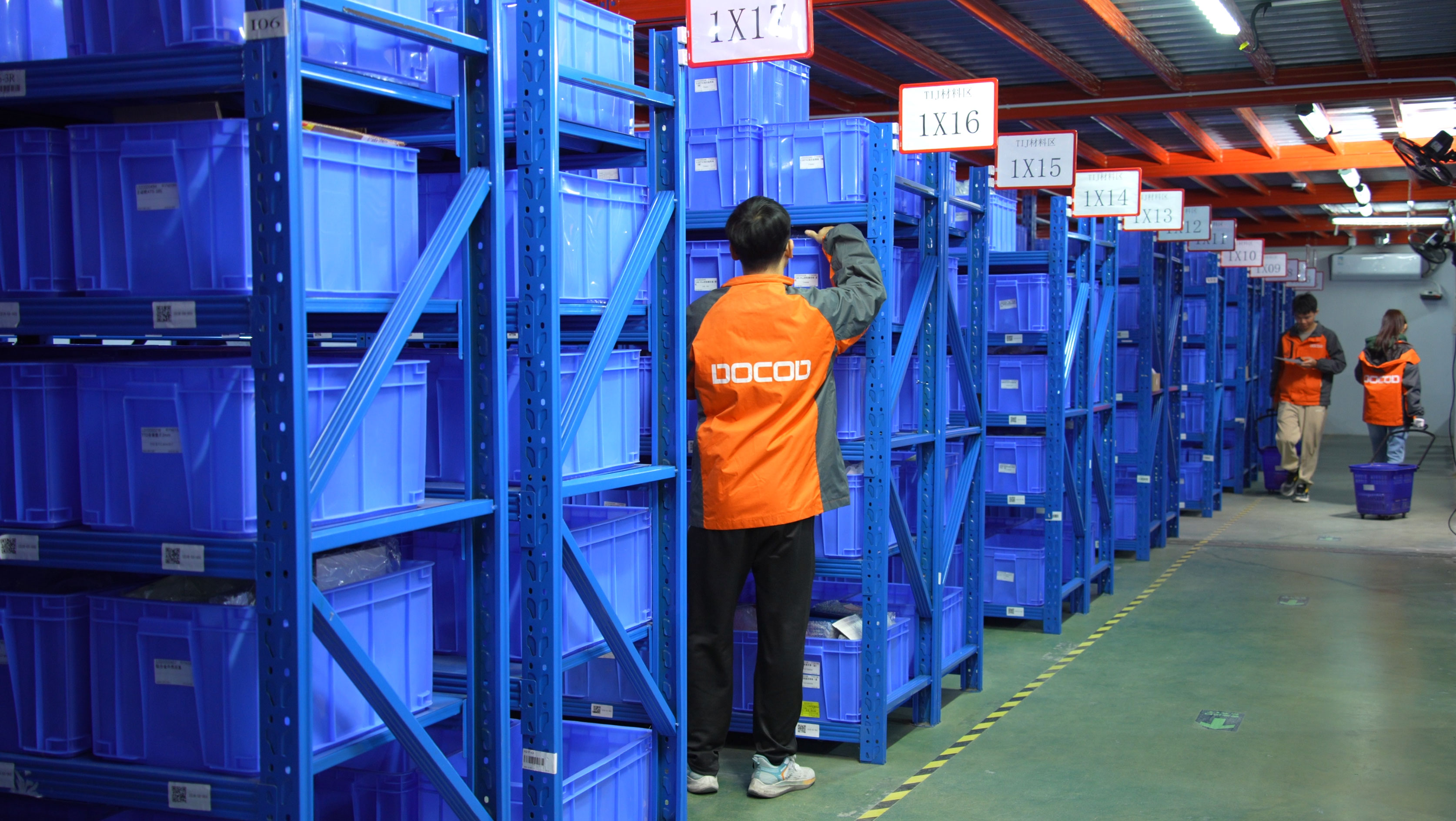
DOCOD thermal inkjet printers staged for shipment and sample evaluation.
Next step: test the specification on your own substrate
Send the code you need to print, the substrate, and the line speed, and DOCOD can confirm which TIJ or PIJ configuration holds resolution at that speed — then validate it with a sample print before the order is placed.
Email: sales@docod.com.cn | Tel: +86 139-2896-7650 | WhatsApp: +86 135-1234-4323
Product catalogue (PDF): Download the DOCOD corporate brochure