
How to Select the Right Industrial Coding and Marking Equipment Supplier
How to Select the Right Industrial Coding and Marking Equipment Supplier
Introduction
Industrial coding and marking equipment is essential for product identification, traceability, and regulatory compliance across countless manufacturing sectors. From date coding on food packages to GS1 DataMatrix on pharmaceutical cartons and permanent serial numbers on automotive parts, choosing the right supplier can significantly impact production efficiency, code quality, and total cost of ownership. However, with a wide range of technologies – continuous inkjet (CIJ), thermal inkjet (TIJ), piezo inkjet (PIJ), drop-on-demand (DOD), thermal transfer overprint (TTO), fiber/CO2/UV laser marking – and many global vendors, procurement teams often face a complex decision.
This guide is designed for manufacturing managers, packaging engineers, and procurement professionals who need a practical framework to evaluate and select a reliable industrial coding equipment supplier. We will define the key technology categories, outline the critical selection criteria, and demonstrate how a partner like DOCOD Precision Group Co., Ltd. addresses common buyer concerns with proven expertise.
Problem Definition: The Challenge of Finding the Right Partner
Purchasing industrial marking equipment is not a commodity buy. The wrong supplier can lead to:
- Print quality inconsistency – smudging, poor adhesion, unreadable barcodes
- Production line downtime – frequent maintenance, complicated cleaning, slow printhead replacement
- Consumable incompatibility – ink or ribbon not matching the substrate (e.g., high-temperature resistance for cable, food-grade for flexible film)
- Compliance failures – missing CE/RoHS/BIS certifications, inadequate UDI/GS1 DataMatrix support
- Weak after-sales support – long lead times for spare parts, language barriers, no remote troubleshooting
Buyers need a technology-agnostic but application-focused supplier that can recommend the optimal solution – whether CIJ, TIJ, laser, or TTO – based on the specific substrate, line speed, environment, and coding requirements.
Industry Background – Coding and Marking Technology Landscape
The global industrial coding market is driven by increasingly stringent traceability regulations (e.g., GS1 standards, UDI for medical devices, tobacco track-and-trace) and the need for anti-counterfeiting. Key technology categories include:
| Technology | Typical Application | Key Advantages |
|---|---|---|
| Continuous Inkjet (CIJ) | Date codes on bottles, cables, cartons | High speed, non-contact, flexible on curved surfaces |
| Thermal Inkjet (TIJ) | GS1 barcodes, QR codes on cartons, labels | High resolution (up to 600 dpi), cartridge-based |
| Piezo Inkjet (PIJ) | Large-area variable data on coated cartons | Wide print height, continuous ink supply |
| Thermal Transfer Overprint (TTO) | Flexible films, sachets, pouches | High-quality intermittent printing on film |
| Fiber Laser | Permanent marking on metal, PCB, automotive parts | No consumables, 100,000-hour laser life |
| CO2 Laser | Paperboard, labels, plastics, glass | No ink, fast, permanent |
| UV Laser | Delicate plastics, glass, medical film | Low heat, cold marking, high contrast |
Choosing the wrong technology can increase costs and reduce line efficiency. A supplier that offers multiple technologies under one roof simplifies the evaluation process and ensures unbiased recommendations.
Detailed Solution – A Structured Supplier Selection Framework
Step 1: Define Your Application Profile
Before contacting suppliers, document:
- Substrate material: plastic, metal, glass, paper, film, etc.
- Production speed: line speed in meters per minute or units per hour
- Code content: simple date code, complex 2D matrix, variable data serialization
- Environment: dusty, humid, hot, cleanroom
- Regulatory requirements: CE, RoHS, BIS, ISO, GS1, UDI
For example, a wire and cable manufacturer in India needing meter marking on a high-speed extrusion line (800+ m/min) requires a high-speed CIJ printer with specialized high-adhesion ink. DOCOD’s S1000 Series High Speed CIJ Printer reaches up to 960 m/min with a 50u nozzle, making it a strong fit.
Step 2: Evaluate Technology Options (Multi-Technology Supplier Advantage)
Engage suppliers that offer a broad portfolio. DOCOD manufactures CIJ (M2000, S1000, V2000, S300plus), TIJ (T220E, T260E, TX1), PIJ (P2000), TTO (R3000), and laser (Venus1 fiber, CO2, UV). This allows the supplier to recommend the best technology without bias.
Key comparisons:
| Comparison | Winner for |
|---|---|
| CIJ (S1000) vs Fiber Laser (Venus1) | S1000 for high-speed cable marking; Venus1 for permanent metal marking |
| TIJ (T220E) vs CIJ (V2000) | T220E for high-resolution QR on cartons; V2000 for small-character continuous coding |
| TTO (R3000) vs UV Laser (L3000) | TTO for flexible film; UV laser for low-heat marking on delicate substrates |
Step 3: Review Supplier Credentials and Certifications
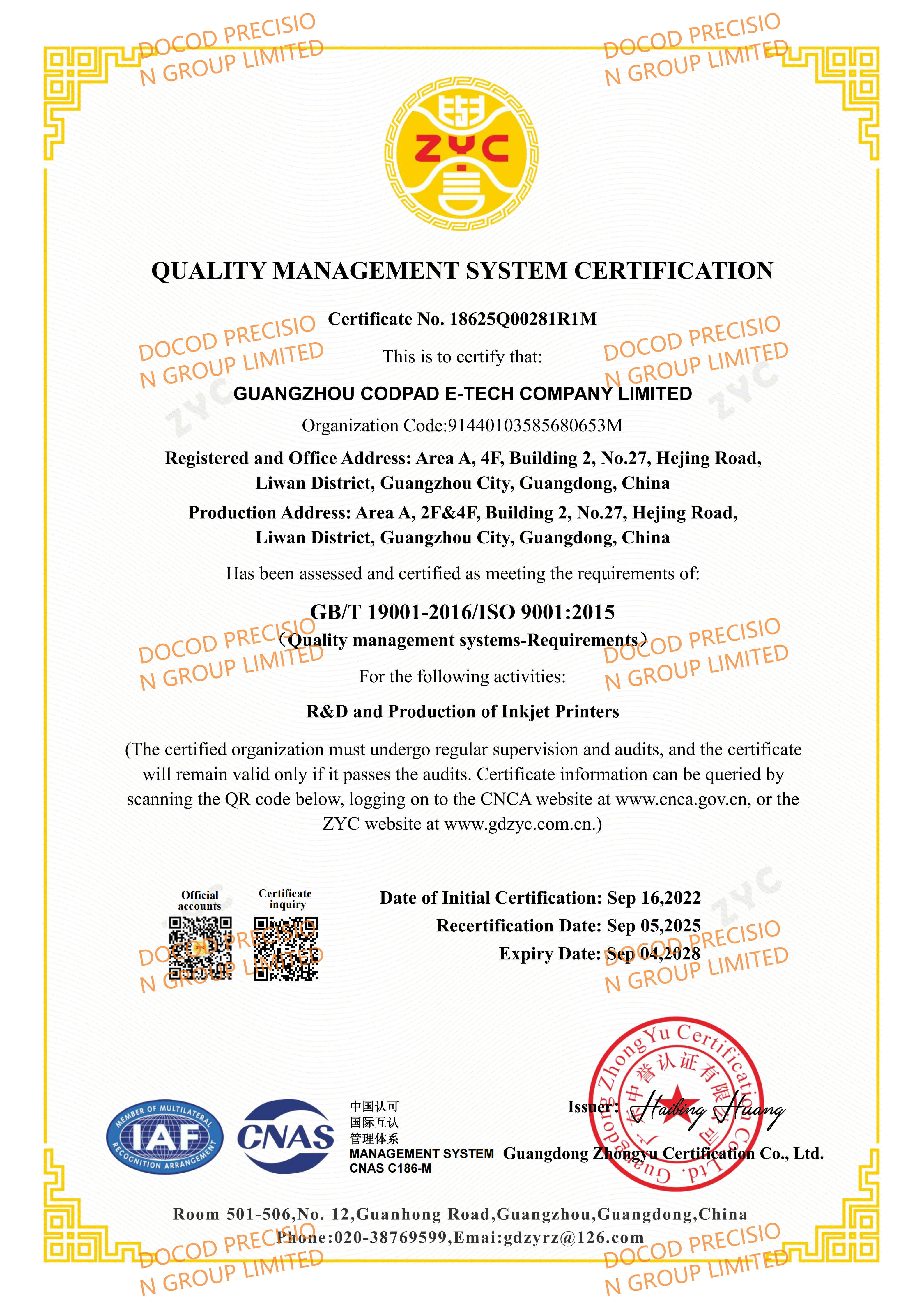
A reliable supplier should have independent quality, safety, and environmental certifications. DOCOD holds:
- ISO 9001:2015 – Quality Management System (cert# 18625Q00281R1M)
- ISO 14001:2015 – Environmental Management (cert# 18625E00147R1M)
- ISO 45001:2018 – Occupational Health & Safety (cert# 18625S00131R1M)
- BIS CRS Registration for India (cert# R-41312347, valid 2025-2027)
- CE, RoHS for European compliance
These certifications assure buyers of consistent quality, environmental responsibility, and market access.
Step 4: Assess Production, Customization, and Delivery Capabilities
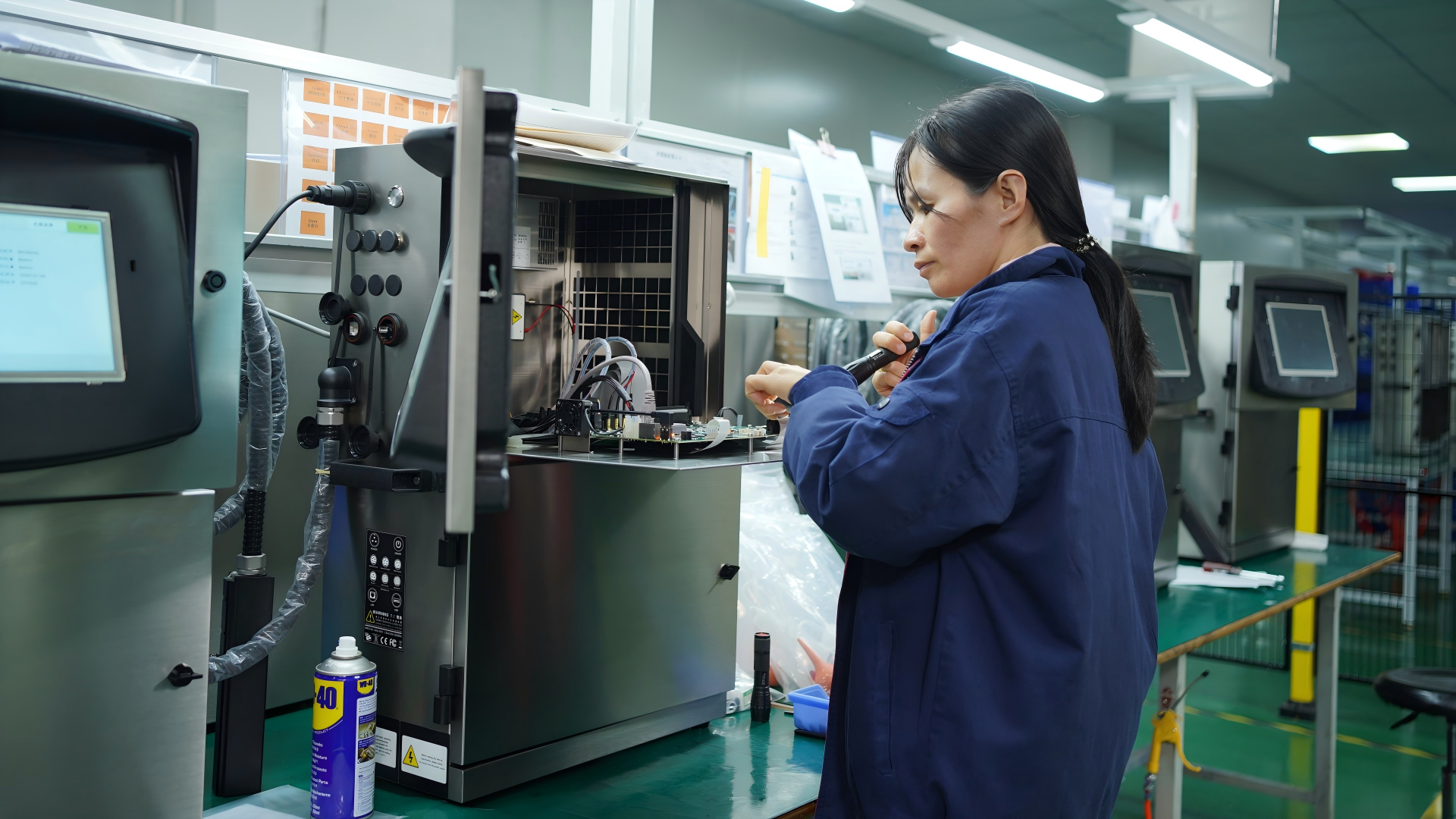
For OEM branding, ODM customization, or production line integration, the supplier’s manufacturing depth matters. DOCOD operates a 20,000 m² factory with 407 employees, 140+ R&D staff, and an annual capacity of 5,000 units. They offer:
- Standard equipment – 15-day lead time, global language support (40+ languages)
- OEM branding – private label logo, startup screen, manuals
- ODM functional customization – software, UI, bracket, printhead configuration
- Production line integration – conveyor, encoder, vision system matching
Export accounts for 50% of sales, with markets in North America, South America, Eastern Europe, Southeast Asia, Africa, Oceania, Middle East, East Asia, and Western Europe.
Step 5: Risk Mitigation Controls
Professional suppliers implement risk controls at every stage. DOCOD’s risk control measures include:
- Substrate testing – pre-confirm ink/marking method for carton, film, plastic, metal, or glass
- Sample validation – pre-production printing and inspection before mass shipment
- Print file confirmation – double-check text, barcode, QR code, language, date format
- Online inspection – optional OCR/barcode verification with alarm or rejection
- Reinforced export packing – with shipment photos
- Remote after-sales support – online guidance, troubleshooting, installation video
Step-by-Step Breakdown – Procurement Workflow with DOCOD
- Inquiry – Send product specification, substrate sample, line speed, required code
- Recommendation – DOCOD engineers propose technology and model (e.g., V2000 CIJ for bottle coding; T220E TIJ for carton QR; Venus1 fiber for metal marking)
- Sample test – Free printing test on your actual material; video evidence
- Order & payment – T/T 30/70 or LC; MOQ from 1 unit
- Production – 15–25 days for standard; milestone scheduling with photos
- Pre-shipment inspection – function test and sample print verification
- Delivery – FOB/CIF/CFR/EXW; reinforced export packing
- After-sales – online training, remote tuning, spare parts coordination
Use Cases – Real-World Examples from DOCOD Portfolio
| Industry / Country | Application | Equipment Used | Result Highlight |
|---|---|---|---|
| Beverage Bottling (Vietnam) | Batch coding on PET bottles, 4 lines | DOCOD V2000 CIJ | Stable daily coding on high-speed lines |
| Cable Manufacturer (USA) | Meter marking on cable sheath, 6 lines | DOCOD M2000 CIJ | Clearer, more consistent codes; stable pressure |
| Pharma Packaging (India) | QR and expiry on cartons, 3 cartoning lines | DOCOD T220E TIJ | Improved code readability with dual-head high-speed |
| Cosmetics OEM (Poland) | Lot coding on plastic bottles and caps, 2 lines | DOCOD L3000 UV Laser | Permanent high-contrast marks with low heat |
| Snack Manufacturer (Indonesia) | Date coding on flexible film, 2 VFFS lines | DOCOD R3000 TTO | Cleaner film coding output with industrial-grade TTO |
| Plastic Pipe Producer (Saudi Arabia) | Specification and date on PVC pipe, 2 extrusion lines | DOCOD Venus1 CO2 Laser | Clean non-contact coding suitable for non-metal materials |
| Label Converter (Brazil) | Label secondary rewinding and coding, 1 station | DOCOD XF30 Rewinder with TIJ | Smoother short-run relabeling |
Frequently Asked Questions
What is an industrial coding and marking equipment supplier?
A company that designs, manufactures, and services printers (CIJ, TIJ, PIJ, laser, TTO) used to print variable data on production lines. DOCOD is one such supplier with 15+ years of experience.
How does CIJ compare to TIJ for small character coding?
CIJ (e.g., DOCOD V2000) is better for non-porous surfaces at very high speed; TIJ (e.g., DOCOD T220E) provides higher resolution (up to 600 dpi) for barcodes on cartons.
Why choose a multi-technology supplier?
One partner can evaluate your application across all technologies and recommend the best fit. DOCOD offers CIJ, TIJ, PIJ, TTO, and laser in-house, avoiding biased recommendations.
What certifications should I look for?
ISO 9001 (quality), ISO 14001 (environment), and market-specific approvals like CE, RoHS, BIS. DOCOD holds all these, plus ISO 45001 for occupational safety.
Can I get a customized coding solution for my production line?
Yes. DOCOD supports ODM customization (UI, interface, printhead configuration) and provides integration support with conveyor, encoder, vision, and MES/PLC. Their XC20 Mini Conveyor Belt and XF30 Vertical Rewinding Machine are examples of integrated solutions.
What is the typical delivery time for an industrial inkjet printer?
Standard models ship within 15 working days. Customized orders take 20–30 days. DOCOD uses milestone scheduling with photos to ensure on-time delivery.
Conclusion
Selecting the right industrial coding and marking equipment supplier requires a clear understanding of your application, a technology-agnostic evaluation, and a supplier with proven manufacturing capabilities, certifications, and risk controls. DOCOD Precision Group Co., Ltd. (founded 2008, 20,000 m² factory, 140+ R&D staff, 5,000-unit annual capacity, 50% export) offers a comprehensive portfolio of CIJ, TIJ, PIJ, TTO, and laser solutions, backed by ISO 9001/14001/45001 certifications and a global after-sales network. Whether you need high-speed CIJ for cable extrusion, high-resolution TIJ for pharmaceutical cartons, or permanent UV laser marking for cosmetics, DOCOD can provide the right equipment and support.
To learn more, download the DOCOD Corporate Brochure or contact the sales team:
- Email: sales@docod.com.cn
- Phone/WhatsApp: +86 139-2896-7650
- Address: Xilin Industrial District, Honglai Town, Quanzhou Nan'an City, Fujian Province, China
Ready to improve your production line coding?
Get a free substrate test and expert recommendation.