
Industrial Coding and Marking Equipment: Carton, Cable and Pharma Application Guide
Three packaging families, three different coding answers. A carton line needs a date and batch code at production speed. A cable extrusion line needs a meter mark that survives the cooling trough. A pharmaceutical pack needs a GS1 DataMatrix that a scanner can verify. This application guide routes each scenario to specific systems from DOCOD Precision Group Co., Ltd. — the V2000 Series CIJ, the T220E TIJ with 3BK702 cartridges, the P2000 PIJ, the Venus1 Series fiber, UV and CO2 lasers, and the R3000 TTO — together with the XC20 mini conveyor and XF30 vertical rewinding machine that decide where the code actually lands.
DOCOD Precision Group Co., Ltd. (DOCOD) designs and manufactures industrial coding, marking and inspection equipment and was founded in 2008. Its portfolio spans continuous inkjet printers, thermal inkjet printers, handheld inkjet equipment, piezoelectric high-resolution inkjet printers, drop-on-demand large-character printers, thermal transfer overprinters, laser marking machines, inline vision inspection systems, consumables, spare parts and product traceability solutions. The routing below follows the order a plant actually works in: read the pack, read the substrate, read the line, then choose the machine.
The Routing Problem: One Coding Question, Three Different Answers
Procurement requests usually arrive as a single sentence: we need a coder for our packaging line. That sentence can describe a production date at several hundred metres per minute, a 2D code on a Tyvek pouch that a vision system must verify, or a length mark that has to remain legible after a cooling trough and a haul-off unit. The three requirements are not interchangeable, because the equipment envelopes do not overlap.
The published specifications show the divergence. The V2000 Series continuous inkjet printer is a small-character CIJ with a 2–16 mm print height, one to five print lines and a maximum printing speed of 334 m/min (5 dots in one line, 0.5 dot spacing). The P2000 high-resolution piezo inkjet printer offers 300 dpi or 600 dpi, a single-head maximum print height of 33.8 mm, and 190 m/min at 300 dpi or 95 m/min at 600 dpi. The R3000 Series thermal transfer overprinter prints in a 32 × 75 mm or 53 × 70 mm area at 300 dpi on flexible films, at 200–350 mm/s with a maximum of up to 800 mm/s. The Venus1 Series lasers split further by wavelength: fiber at 1064 nm with 20W, 30W, 50W or 100W; UV at 355 nm with 5W, 10W or 15W; CO2 at 10.6 μm with 30W or 60W.
Because those envelopes differ in resolution, height, speed and contact method, a scenario-first guide is more useful than a product list. The remainder of this article fixes the packaging family first and names a model second.
Industry Background: Why Coding Requirements Keep Escalating
Coding and marking is a maturing equipment category rather than a niche accessory. Fortune Business Insights sizes the global coding and marking equipment market at USD 7.51 billion in 2025, and the same source reports that inkjet technologies (CIJ, TIJ and PIJ) account for 40.1% of the technology segment. Growth in the category is driven less by new pack formats than by the amount of information each pack must now carry.
The clearest scheduled driver is the retail barcode transition. GS1 Digital Link, the standard behind the move from 1D barcodes to 2D codes at point of sale, sets a Sunrise 2027 deadline of 31 December 2027. That is a hardware question as much as a software one: a printer that cannot place a DataMatrix or QR code at readable quality at line speed cannot participate in the transition, whatever its label design allows. Among the DOCOD systems referenced in this guide, the V2000 Series lists QRCode, DataMatrix, MicroQRCode, PDF417, PDF417TRUNC and MICROPDF417 among supported codes; the P2000 supports dynamic barcode and QR printing; and the R3000 supports GS1 DataMatrix printing.
The second driver is traceability itself. ID Technology frames industrial coding and marking as labeling, coding and marking solutions for diverse substrates in industrial and manufacturing environments, with traceability and quality control as the core purpose. Once a code is used for stock rotation, recall management or channel control, an unreadable code becomes a production defect rather than a cosmetic one — which is why print-and-verify configurations appear in regulated packaging lines.
Supplier capability matters in that context. DOCOD reports approximately 407 staff, a research and development team of more than 140 engineers and technicians, and an annual production capacity of 5,000 units. Export business accounts for 50% of total sales, with major markets in North America, South America, Eastern Europe, Southeast Asia, Africa, Oceania, the Middle East, Eastern Asia and Western Europe.
The Three Inputs That Decide the Route
Input 1 — Print content
Content is the first filter because it sets the minimum resolution and the data path. The recurring content set across DOCOD thermal inkjet and TTO documentation is: multi-language text, GS1 code, dynamic traceability codes, barcodes, graphics, serial numbers, dates, shifts, counters and variable databases. Where content stops at a date, a batch code and a shift counter, a small-character CIJ at speed is sufficient. Where content includes a GS1 DataMatrix that will be scanned at retail or in a hospital, resolution and verification become the deciding parameters.
Input 2 — Substrate
Substrate decides ink chemistry and, sometimes, whether ink should be used at all. The material list published for the T220E and P2000 covers cartons, plastics, metals, plates, pipes, stones, wires and cables, electronic components, auto parts, industrial chemical packaging, pharmaceutical packaging and food packaging. Inks are not generic: the CIJ range lists high-adhesion, high-temperature-resistance, glass-specific, food-grade, oil-resistance and pigment inks, and the 3BK702 solvent cartridge is specified for BOPP, PVC, PP, PET, OPP, glass and stainless steel.
Input 3 — Line mechanics
Line mechanics decide print distance, mounting and whether the printer needs supporting hardware. The P2000 is specified for a 0–5 mm print distance with 2–3 mm recommended; the V2000 CIJ is specified for 3–30 mm with a 3 m printhead duct. The XC20 mini conveyor runs at 5–12 m/min with a 150 mm PVC belt and can carry inkjet printers, vision inspection and weighing equipment, while the XF30 vertical rewinding machine runs at 0–45 m/min with a maximum label width of 100 mm.
Route 1 — Cartons and Food or Industrial Secondary Packaging
When CIJ is the correct first choice
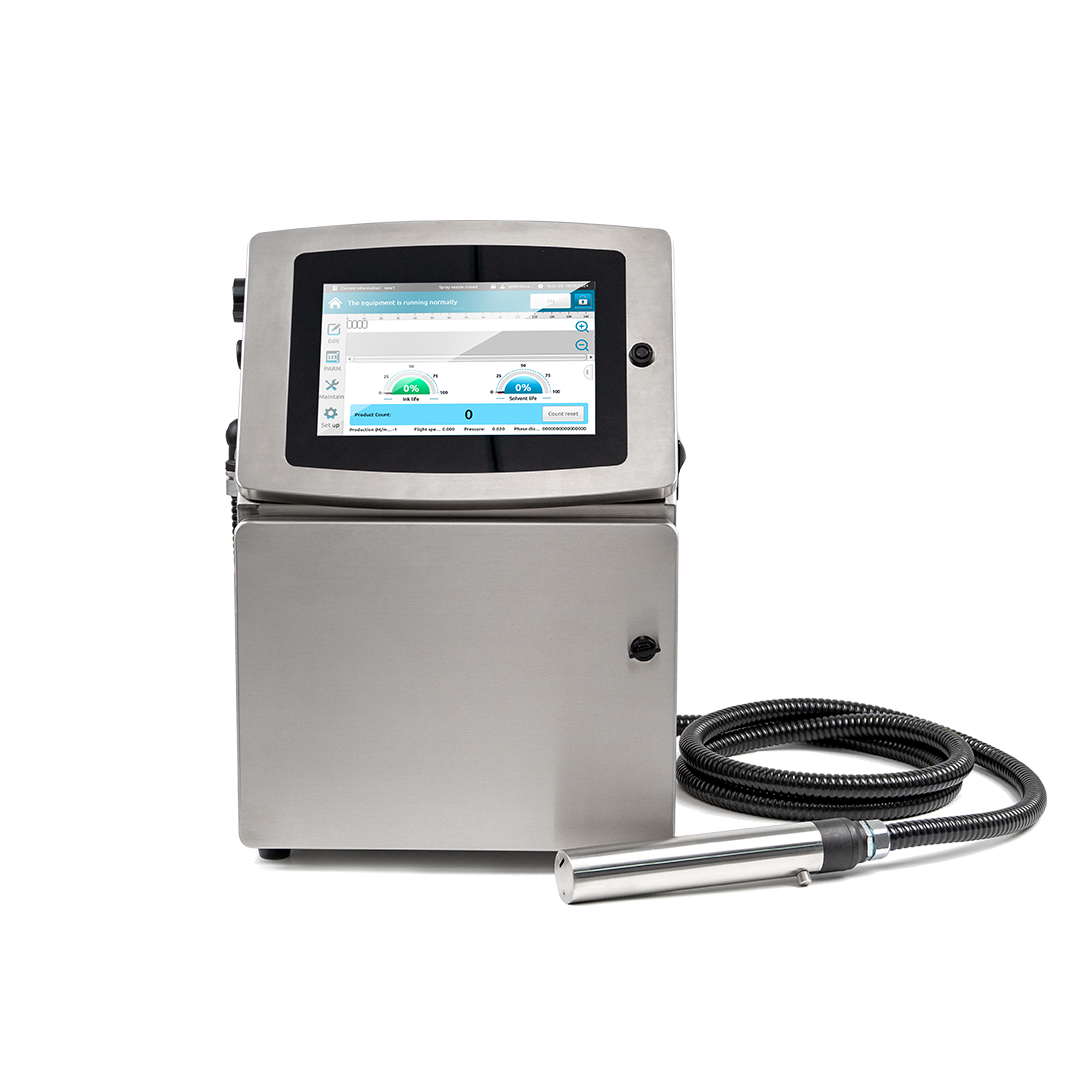
For cartons, boxes and general secondary packaging moving at production speed, the V2000 Series CIJ is the default route. It prints one to five lines at 2–16 mm height, supports up to 24 counters, and reaches a maximum printing speed of 334 m/min. Its material list includes carton, plastic, cable, metal, boarding, pipe, stone, glass, electronic components, auto parts, industrial chemical packaging, and medical, food and gift box. The unit is built in SUS 304 stainless steel with IP65 protection, runs on an embedded Linux security operating system with a 10.1-inch 1280 × 800 capacitive touch display, supports more than 40 languages, and carries CE and RoHS certificates. For a carton line, IP65 and stainless steel are practical rather than decorative: washdown and dust are normal conditions.
When TIJ takes over
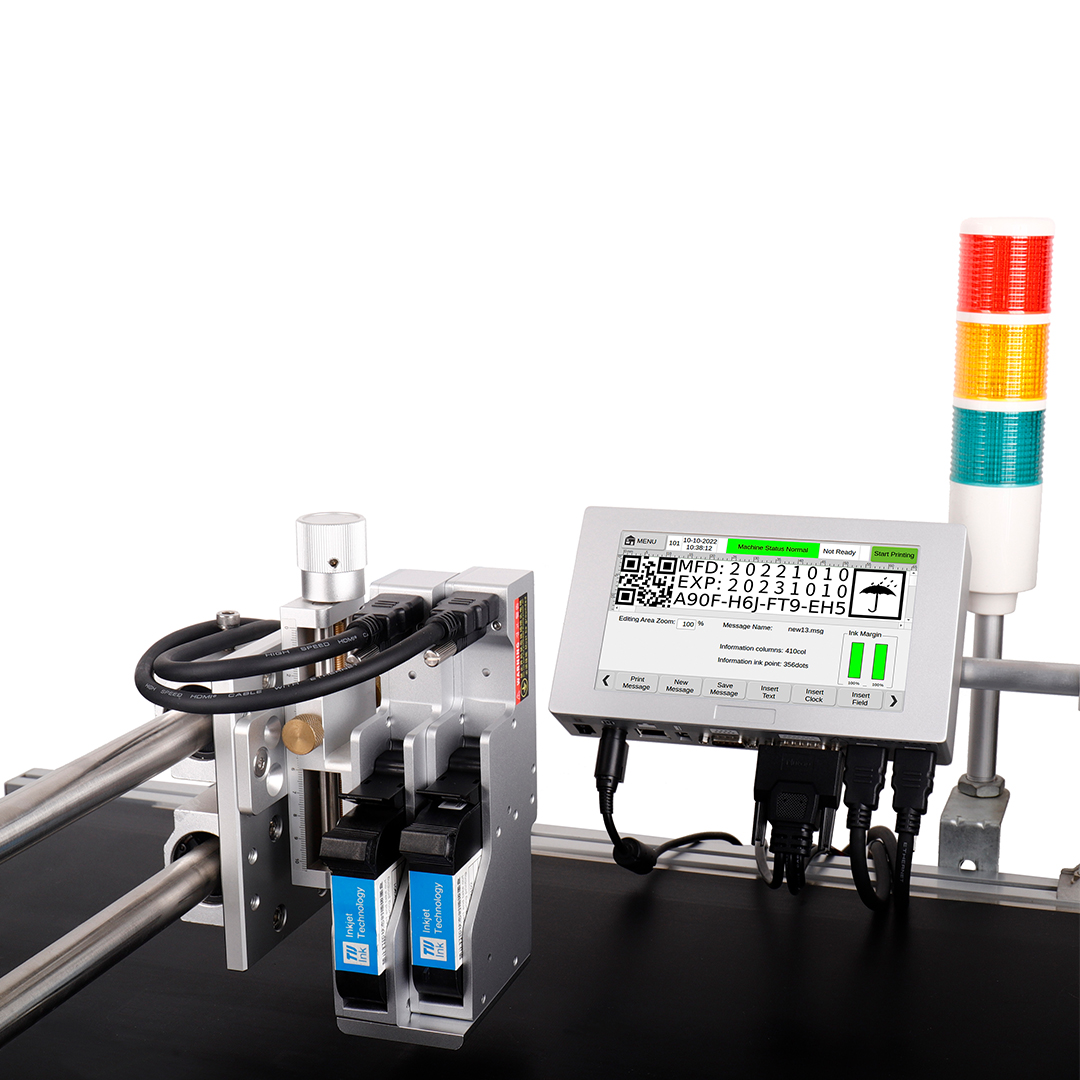
Where the carton must carry a higher-resolution block — a QR code, a small GS1 code, a multi-language ingredient panel — the T220E half-inch dual-head thermal inkjet printer moves ahead of CIJ on quality. It prints at up to 600 × 600 DPI with one or two printheads, giving 1–12.7 mm from a single head and 1–25.4 mm when dual heads are spliced or used separately, at speeds up to 406 m/min. The 3BK702 half-inch black solvent cartridge provides 42 ml of solvent ink, 300 nozzles, a maximum frequency of 12 kHz, a 9V trigger voltage, resolution up to 600 dpi (300 × 300 recommended), a best-use period of six months, and a working range of 15°C to 35°C at 35% to 80% RH. Cartridge identification is handled by an RFID chip that reads ink parameters and records remaining ink.
When the block must be large and sharp
Where a carton carries a wide, high-resolution panel — a full ingredient block, a large 2D code, or a shipping mark with a logo — the P2000 piezo inkjet printer is the appropriate route. A single head covers up to 33.8 mm in height at 300 dpi or 600 dpi, printing at 190 m/min at 300 dpi and 95 m/min at 600 dpi. It uses I1600 series nozzles with a negative-pressure continuous ink supply, water-based or quick-drying ink, and prints text, time, date, patterns, shifts, serial numbers, dynamic barcodes and QR codes, dynamic serial port data and dynamic database content. The printhead is installed independently with optional anti-collision components, which matters on a carton line where a jammed case can strike the head.
Flexible film on the same line
Cartons rarely travel alone; the same plant usually runs a form-fill-seal or flow-wrap line beside them. For flexible packaging, the R3000 Series thermal transfer overprinter is the correct technology, not inkjet. It prints intermittently at 300 dpi in a 32 × 75 mm or 53 × 70 mm area, uses ribbon widths of 24, 33, 35 or 55 mm and ribbon lengths of 400, 600, 800 or 1200 m, and applies to high-barrier film, stick packaging, sealed bags, metallized labels and decorative labels. It supports GS1 DataMatrix, dynamic QR codes, serial numbers, dates, shifts, counters and variable databases, and includes a print gap requirement of at least 0.1 mm.
When ink is the wrong answer
For kraft board, coated carton stock and printed packaging where a permanent mark is acceptable, the Venus1 Series CO2 laser marking machine is a non-contact alternative. It offers 30W or 60W at 10.6 μm (with 10.2 μm and 9.3 μm options), a standard 110 × 110 mm marking range with 70–300 mm optional, a laser life of 20,000 hours, and support for EAN8, EAN13, CODE39, CODE128 and GS1-128 barcodes. Its listed applications include packaging and printing, kraft board, wood products and food packaging.
Route 2 — Cables, Pipes and Building Materials

Extrusion lines invert the carton problem. The product is continuous, the print area is long and narrow or curved, the installation space is limited, and some substrates resist adhesion. Non-contact printing at a distance is therefore an advantage rather than a compromise: the V2000 CIJ is specified for a print distance of 3–30 mm, which keeps the printhead clear of a moving cable jacket or a freshly extruded pipe.
Cable and pipe extrusion
A representative configuration comes from DOCOD's India wire, cable and pipe extrusion application. The line prints meter marks, model information, brand names, batch numbers, certification marks and traceability codes in online non-contact mode, synchronised with an encoder, with the printer integrated upstream of the take-up reel alongside the extruder, cooling trough, haul-off unit and PLC. The V2000 CIJ supports this pattern directly: its material list includes cable, pipe and stone, its ink range includes high-adhesion and high-temperature-resistance types, and it connects over USB, RS232 or a network port to an MES management system.
Where the mark must be permanent and the jacket is a non-metal compound, the Venus1 Series CO2 laser covers cable marking among its listed applications, at 10.6 μm and 30W or 60W with air or water cooling and IP43 or IP54 protection. Where the part is metal — a conduit, a fitting, a metal-clad component — the Venus1 Series fiber laser applies instead: 1064 nm, 20W/30W/50W/100W, a standard 110 × 110 mm marking range with 50–300 mm optional, a laser life of up to 100,000 hours, IP43 protection, and support for barcode types including QRCODE and DATAMATRIX. Its listed industries include pipes and cables as well as metal and coating applications, bearings and automotive parts.
Building materials and chemical packaging
Bags, pails, drums and boards add dust, heat, humidity and rough surfaces to the same decision. In the UAE building materials and chemical packaging application, coding runs in large-character mode integrated with bagging, extrusion or filling lines, printing batch numbers, production dates, model information, brand marks, QR codes and logistics codes, with supporting hardware that includes a weighing and bagging machine, conveyor, sensor, encoder, bracket, dust cover, PLC and a code inspection module. That dust cover and inspection module are part of the coding system, not accessories: on a dusty line the printhead environment determines code quality more than the print resolution does.
Line hardware that keeps the code in position
Small parts and offline batches often need their own transport rather than a main line. The XC20 mini conveyor belt runs at 5–12 m/min on a 150 mm PVC belt of customisable length, uses an aerospace-grade aluminium structure, draws 25W maximum at 220V/50Hz, weighs 7.5 kg, and is specified as compatible with inkjet printers, visual inspection and weighing equipment. For labels and reels, the XF30 vertical rewinding machine integrates a T210E TIJ printhead running at 0–45 m/min with a maximum label width of 100 mm and up to 300 × 300 DPI, printing the same content set — GS1 data matrix, dynamic traceability QR codes, barcodes, serial numbers, dates, shifts, counters and variable database content — while rewinding.
Route 3 — Pharmaceutical and Chemical Packaging
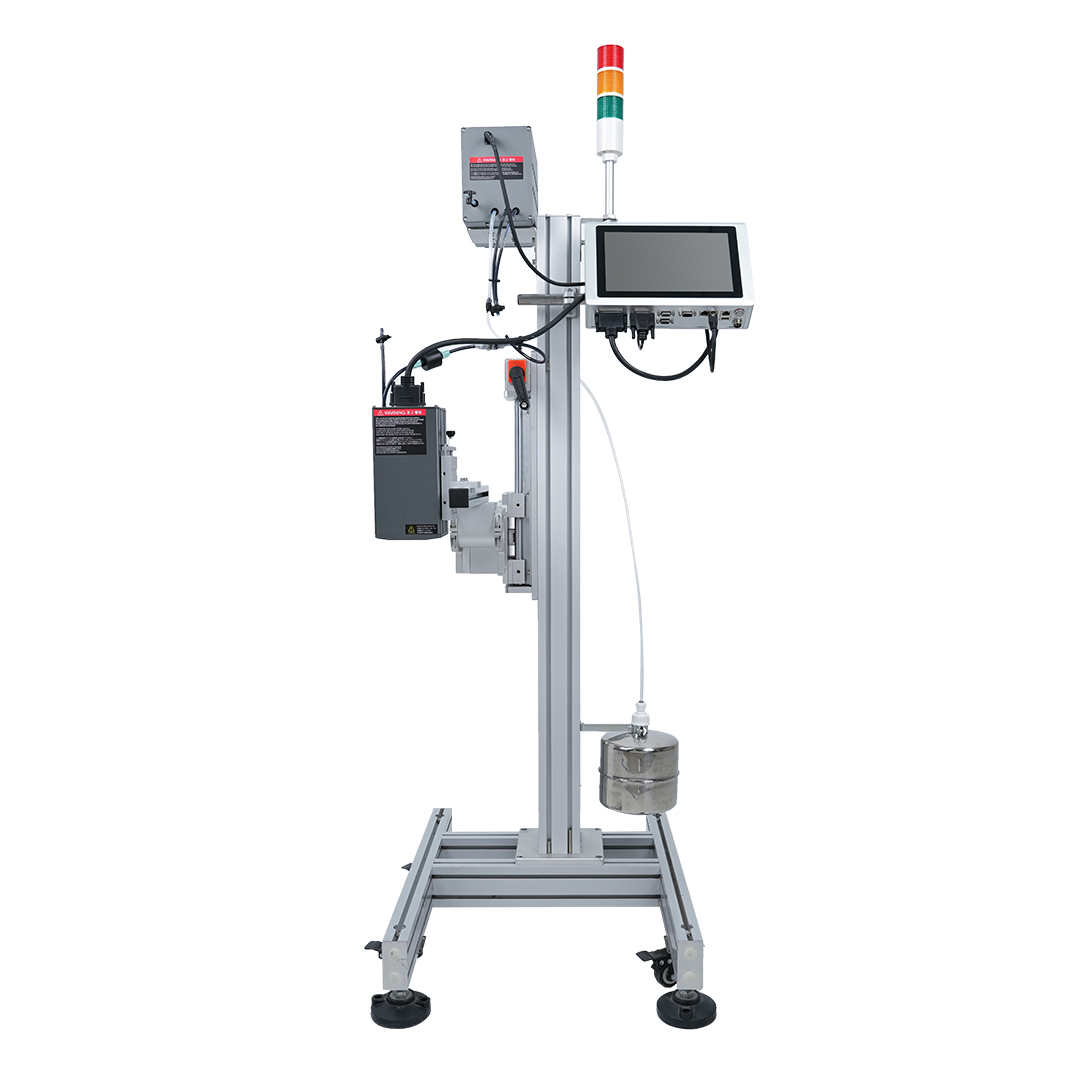
Pharmaceutical and chemical packaging is where the code stops being information and becomes compliance evidence. The requirement set is consistent across regulated lines: UDI, GS1 DataMatrix, lot numbers, expiry dates and serial numbers, printed online and verified in a closed loop before the pack leaves the machine. In the Germany medical packaging application, the coding system is integrated with the cartoner and labelling machine and supported by sensor, scanner, vision system, reject unit, PLC/MES and a database system — the code is inspected, not merely printed.
High-resolution digital printing for pharma cartons
The P2000 piezo inkjet printer is the natural fit for pharma cartons, blister cards and flexible film where a DataMatrix must be machine-read. It prints at 600 dpi with a 0–5 mm print distance (2–3 mm recommended), which is achievable on a cartoner where the pack is held against a reference surface. Its material list explicitly includes pharmaceutical packaging and industrial chemical packaging, and its content list includes serial numbers, dynamic barcode and QR code, dynamic serial port data and dynamic database content — the mechanisms by which a serialisation server feeds unique codes to the printhead.
Low-heat laser marking on sensitive packs
Where the pack surface cannot accept ink, or where a permanent mark is preferred, the Venus1 Series UV laser marker is the appropriate choice. At 355 nm and 5W, 10W or 15W, it is specified for plastics, polymers, glass, ceramics, printed circuit boards, medical devices, food packaging, pharmaceutical packaging, electronic components, beverage packaging and PET bags — applications that its documentation describes as requiring precise, low-heat and damage-minimised marking. It offers a standard 110 × 110 mm marking range with 70–300 mm optional, IP43 or IP54 protection, and air or water cooling.
Flexible pharma film and sachets
Stick packs, sachets and sealed pouches belong to the R3000 TTO route rather than to inkjet. Beyond its 300 dpi print quality and 32 × 75 mm or 53 × 70 mm print area, its controller supports network remote centralised management and docking to weighing machines, conveyors, paging machines, packaging machines, enterprise resource planning databases, drug supervision codes and anti-counterfeiting traceability systems. On a pharma sachet line, that docking capability is the difference between a printer and a serialisation node.
Chemical packaging and secondary cartons
For chemical drums, pails and outer cartons, the T220E TIJ handles the secondary packaging and the V2000 CIJ handles the primary container, provided the substrate and ink match. The 3BK702 solvent cartridge is specified for BOPP, PVC, PP, PET, OPP, glass and stainless steel with quick-drying black solvent ink, and the CIJ ink range includes oil-resistance and high-adhesion types for surfaces that stay oily or abrasive after filling.
Step-by-Step: Routing a Line in Six Steps
- Step 1 — Write the content list in reading order. Separate mandatory regulatory content (GS1 DataMatrix, UDI, lot, expiry) from commercial content (logo, marketing text) and from production content (shift, counter, operator ID). Mandatory content sets the resolution floor.
- Step 2 — Match content to resolution and height. A 2D code that will be scanned requires 300–600 dpi capability; a date and batch code on a carton does not. Heights separate the families as well: 2–16 mm on the V2000 CIJ, 1–12.7 mm and 1–25.4 mm on the T220E, up to 33.8 mm per head on the P2000.
- Step 3 — Check line speed against the envelope. Confirm the required speed against 334 m/min (V2000), 406 m/min (T220E), 190 m/min at 300 dpi or 95 m/min at 600 dpi (P2000), and 200–350 mm/s with up to 800 mm/s maximum (R3000). Laser marking speed depends on the material and the size and complexity of the content, so it must be validated per application.
- Step 4 — Check the mounting position and print distance. CIJ at 3–30 mm, PIJ at 0–5 mm with 2–3 mm recommended. A 3 m printhead duct on the V2000 buys mounting freedom; independent printhead installation with anti-collision components on the P2000 buys protection.
- Step 5 — Specify the line hardware. Add the XC20 mini conveyor for small or offline products at 5–12 m/min, or the XF30 vertical rewinding machine at 0–45 m/min for label and reel work. Both are part of the coding specification, not a separate purchase.
- Step 6 — Define the verification and data path. Decide whether a scanner, vision system and reject unit are required, and confirm the interface mix: USB, RS232 and TCP/IP on the T220E and P2000, USB, RS232 and network port with MES connection on the V2000, and RFID ink-chip reading on TIJ cartridges.
Use Cases from Live Applications
Food and beverage, Vietnam. A packaging line prints production dates, expiry dates, batch numbers and QR or barcodes for traceability in online mode integrated with filling and packaging lines, handling flexible pouches, cartons, PET bottles and glass bottles. The stated purpose is to reduce manual labelling errors and enable stock rotation.
Wire, cable and pipe extrusion, India. High-speed extrusion lines with limited space print meter marks, model information, brand names, batch numbers, certification marks and traceability codes in non-contact mode synchronised with an encoder, with the printer integrated with the extruder, cooling trough, haul-off unit, take-up reel and PLC.
Medical packaging, Germany. UDI and GS1 DataMatrix coding runs as a closed-loop print-and-verify workflow on medical device packs, Tyvek medical paper, blister packs, cartons, plastic bottles and flexible films, printing lot numbers, expiry dates and serial numbers, with scanner, vision system, reject unit and database integration.
Building materials and chemicals, UAE. Large-character marking integrated with bagging, extrusion or filling lines prints batch numbers, production dates, model information, brand marks, QR codes and logistics codes in dusty, hot, humid and rough-surface conditions, with a dust cover and code inspection module in the equipment list.
Cosmetics and personal care, Indonesia. Online bottle and tube coding integrated with filling, capping and labelling lines prints batch numbers, production dates, expiry dates, QR codes and anti-counterfeit codes on HDPE, PET, PP, PE tubes and laminated cartons, with the explicit constraint that codes remain clear without damaging brand appearance.
Comparison Table: Route, Technology and Published Specifications
| Route / technology | Substrates listed | Print height or area | Resolution or source | Speed reference | Content fit |
|---|---|---|---|---|---|
| CIJ — V2000 Series | Carton, plastic, cable, metal, pipe, stone, glass, electronic components, auto parts, industrial chemical, medical and food packaging | 2–16 mm; 1–5 lines | 60u nozzle, small-character inkjet | Max 334 m/min | Dates, batch, shift, serial numbers, up to 24 counters, dynamic QR, dynamic database |
| TIJ — T220E with 3BK702 | Cartons, plastics, metals, plates, pipes, stones, wires and cables, electronic components, auto parts, industrial chemical, pharmaceutical and food packaging | 1–12.7 mm single head; 1–25.4 mm dual head | Up to 600 × 600 dpi | Up to 406 m/min | Multi-language text, GS1 code, dynamic traceability codes, barcodes, serial numbers, dates, shifts, counters, variable database |
| PIJ — P2000 | Carton, plastic, metal, plate, pipe, stone, cables, glass, electronic components, auto parts, industrial chemical, pharmaceutical and food gift packaging | Single head max 33.8 mm | 300 dpi or 600 dpi | 190 m/min at 300 dpi; 95 m/min at 600 dpi | High-resolution text, dynamic barcode and QR, dynamic serial port data, dynamic database |
| TTO — R3000 Series | High-barrier film, stick packaging, sealed bags, metallized labels, decorative labels | 32 × 75 mm or 53 × 70 mm | 300 dpi | 200–350 mm/s, up to 800 mm/s | GS1 DataMatrix, dynamic QR, serial real-time dynamic data, multi-information group printing |
| Fiber laser — Venus1 Series | Metal and coating, bearings, automotive parts, PCB, metal caps, stainless steel, pipes and cables | 110 × 110 mm standard; 50–300 mm optional | 1064 nm; 20W/30W/50W/100W; laser life up to 100,000 hours | Depends on material and content size and complexity | Permanent marks, DataMatrix and QR, serial numbers |
| UV laser — Venus1 Series | Plastics, glass, ceramics, PCB, medical devices, food and pharmaceutical packaging, PET bags | 110 × 110 mm standard; 70–300 mm optional | 355 nm; 5W/10W/15W; IP43 or IP54 | Depends on material and content size and complexity | Low-heat, damage-minimised marking on sensitive packaging |
| CO2 laser — Venus1 Series | Packaging and printing, kraft board, rubber, leather textiles, wood, glass, medical packaging, cable marking | 110 × 110 mm standard; 70–300 mm optional | 10.6 μm (10.2/9.3 μm optional); 30W/60W; laser life 20,000 hours | Depends on material and content size and complexity | Non-metal marking, dates and batches, EAN and GS1-128 barcodes |
Table compares published specifications for the DOCOD models named in this guide. It is a routing reference, not a cross-brand ranking.
FAQ
Does the GS1 Sunrise 2027 deadline force a hardware change on our coding line?
It forces a capability check rather than an automatic replacement. GS1 Digital Link sets a Sunrise 2027 transition deadline of 31 December 2027 for moving retail packaging from 1D barcodes to 2D codes. The practical question is whether the installed printer can produce DataMatrix or QR content at readable quality at line speed. The V2000 Series CIJ lists QRCode, DataMatrix, MicroQRCode, PDF417 and MICROPDF417 among supported codes; the P2000 supports dynamic barcode and QR printing; and the R3000 TTO supports GS1 DataMatrix. A system limited to 1D barcodes would need to be replaced or supplemented before that deadline.
Can one model cover cartons, cables and pharmaceutical packaging?
Not according to the published specifications, although the substrate lists overlap more than buyers expect. The V2000 CIJ lists carton, plastic, cable, metal, boarding, pipe, stone, glass, electronic components, auto parts, industrial chemical packaging and medical or food and gift box. The P2000 lists carton, plastic, metal, plate, pipe, stone, cables, glass, electronic components, auto parts, industrial chemical packaging, pharmaceutical packaging and food gift packaging. The T220E lists cartons, plastics, metals, plates, pipes, stones, wires and cables, electronic components, auto parts, industrial chemical packaging, pharmaceutical packaging and food packaging. What separates them at the point of use is resolution, print height and speed, not material compatibility.
What determines the cost of a coding configuration, and what should an RFQ contain?
Published prices are outside the material used for this guide, so the useful answer is a scope answer. The cost-driving variables are visible in the specifications: the technology level within a family (a 100W fiber laser and a 5W UV laser are different build levels in the Venus1 Series), the printhead count (the T220E supports one or two printheads; the P2000 is single-head or dual-head), the ink system (42 ml cartridges versus a large-capacity continuous ink supply), and the line hardware attached (XC20 conveyor, XF30 rewinder, encoder, sensor, vision and reject). An RFQ should state print content, substrate, line speed, available space, print distance and verification requirement so that competing quotations configure the same scope.
How do we validate a code on our own substrate before committing to a line?
Validation starts with the two parameters that decide readability: print distance and print quality. The P2000 is specified for a 0–5 mm print distance with 2–3 mm recommended, the V2000 CIJ for 3–30 mm, and the 3BK702 cartridge for a 15°C to 35°C working range with a six-month best-use period. Substrates also react differently to ink chemistry: the CIJ range includes high-adhesion, high-temperature-resistance, glass-specific, food-grade and oil-resistance inks, and the 3BK702 is designed for BOPP, PVC, PP, PET, OPP, glass and stainless steel. Printing the actual content on the actual substrate at the actual line speed, then scanning it with the actual verifier, is how a code is confirmed before a production run. DOCOD application engineering can be engaged for that substrate test through sales@docod.com.cn.
What is the delivery scope, and how should lead time be planned?
DOCOD reports an annual production capacity of 5,000 units supported by approximately 407 staff and a research and development team of more than 140 engineers and technicians. Delivery scope, and therefore lead time, follows the configuration rather than the model number: printhead count, ink system, laser power and cooling method, and whether line hardware such as the XC20 conveyor or XF30 rewinder is included all change the bill of equipment. Confirming the configuration before requesting a delivery date is more reliable than assuming a lead time from a catalogue reference.
Conclusion: Choose the Route Before the Model
Coding equipment is usually sold as a machine and bought as a decision. For cartons and food packaging, that decision turns on speed and content density: CIJ for date, batch and counter at up to 334 m/min, TIJ for 600 × 600 dpi content at up to 406 m/min, PIJ for a 33.8 mm high-resolution block, and TTO for the flexible film beside the carton. For cables, pipes and building materials, the decision turns on distance, adhesion and continuity: 3–30 mm non-contact CIJ on an encoder-synchronised extrusion line, or a fiber or CO2 laser where a permanent mark is required. For pharmaceutical and chemical packaging, the decision turns on verifiability: 600 dpi digital print on a cartoner, low-heat UV laser marking on sensitive surfaces, or a TTO controller docked to a serialisation database.
Once the route is fixed, the remaining work is configuration: printhead count, ink chemistry, print distance, conveyor or rewinder, and the scanner or vision system that closes the loop. That sequence keeps a coding project inside its technical envelope instead of forcing a machine to do work it was never specified for.
Next Step: Match a Route to Your Pack
Download the DOCOD corporate brochure for the full product and technology overview, or send the print content, substrate, line speed and print distance for a configuration review.
Download the DOCOD Corporate Brochure (PDF) | www.docod-group.com
Email: sales@docod.com.cn | Tel: +86 139-2896-7650 | WhatsApp: +86 135-1234-4323
DOCOD Precision Group Co., Ltd. — industrial coding, marking and inspection equipment since 2008.
Have Questions or Need More Details?
Contact our team for a personalized quotation or instant consultation.
Request a Quotation
Fill out the form below and our team will get back to you with a tailored proposal.
WhatsApp Direct Chat
Prefer to chat in real-time? Message us on WhatsApp for instant assistance & quick answers.
- Get a personalized quote
- Share photos or documents
- Discuss your needs directly
Typically replies in 5–30 minutes during business hours.