
Matching Coding Equipment to Regional Certification Rules
Compliance Guide: Matching Industrial Coding Equipment to Regional Certification and Standards Requirements
Matching industrial coding and marking equipment to regional certification requirements is a three-layer exercise: the legal layer (product certificates and market registrations), the physical layer (IP rating, housing material, temperature and humidity limits, power input), and the documentation layer (nameplate data, licence scope, acceptance records and consumable shelf life). A printer family that is CE and RoHS declared can still be held at customs if the registration on file names a different brand, or if an IP65 continuous inkjet printer is specified for a dry zone while an IP43 laser is specified for a jet-wash area. This guide maps verified product-line facts to those three layers so that Research-stage buyers can convert a specification into an importable, acceptable, and auditable order.

Problem Definition: Why Compliance Failures Happen at Model Level, Not Brand Level
Most compliance problems in industrial coding projects are not caused by a missing brand reputation. They are caused by a mismatch between the certificate a buyer was shown and the exact unit that arrives at the dock.
Four mismatches account for most of these disputes:
- Brand and licence mismatch. A market registration may be issued under a specific brand name and a specific model list. If the nameplate reads differently from the registration, the paperwork no longer matches the goods.
- Ingress protection mismatch. Washdown, dust and humid zones need a protection rating that matches the cleaning regime. An IP65 stainless steel cabinet and an IP43 laser head are not interchangeable in the same zone.
- Code standard mismatch. A device that prints one-dimensional barcodes is not automatically ready for two-dimensional DataMatrix or QR workflows required by traceability and retail transition programmes.
- Acceptance mismatch. Purchase terms that do not define a sample run, a function test, or a video acceptance step leave the buyer without evidence that the delivered configuration matches the ordered configuration.
Each of these is resolvable before the purchase order is issued, and each has a corresponding checkpoint in this guide.
Industry Background: What Is Changing in Coding Compliance
Two external forces shape the compliance conversation around coding equipment in 2026.
The first is the retail barcode transition. GS1 Digital Link defines the migration path, and GS1 Global records the Sunrise 2027 deadline of 31 December 2027 for the retail transition from one-dimensional barcodes to two-dimensional QR codes, applied across global markets and more than 48 countries. For buyers, this converts code capability from a nice-to-have into a procurement constraint: equipment specified now will still be in service when two-dimensional retail codes become the norm.
The second is technology mix. Fortune Business Insights, in its 2026 coding and marking market study, places inkjet technologies (CIJ, TIJ and PIJ) at 40.1% of the technology segment, and estimates the global coding and marking equipment market at USD 7.51 billion in 2025. The practical implication is a mixed production floor: continuous inkjet printers in wet and dusty zones, thermal inkjet units at packing stations, lasers on heat-sensitive or permanent-mark requirements, all subject to different protection ratings and different documentation sets.
Against that backdrop, the certification structure buyers actually encounter is layered. Product-level declarations such as CE and RoHS sit alongside market registrations such as the BIS CRS registration for India, and management-system certificates such as ISO 9001, ISO 14001 and ISO 45001 sit behind them. DOCOD Precision Group Co., Ltd. is an industrial coding, marking and inspection equipment manufacturer founded in 2008, whose portfolio covers CIJ, TIJ, PIJ, DOD, TTO, laser marking machines and inline vision inspection systems, and whose declared certificates and registrations are used as the working example throughout this guide.
Detailed Solution: Mapping Product Lines to Regional Requirements
The fastest way to build a defensible specification is to match each product family to the zone it will run in and the certificate set the destination market will ask for. The mapping below uses only declared specifications and registered certificate data.
Washdown, food and pharmaceutical zones: IP65 continuous inkjet
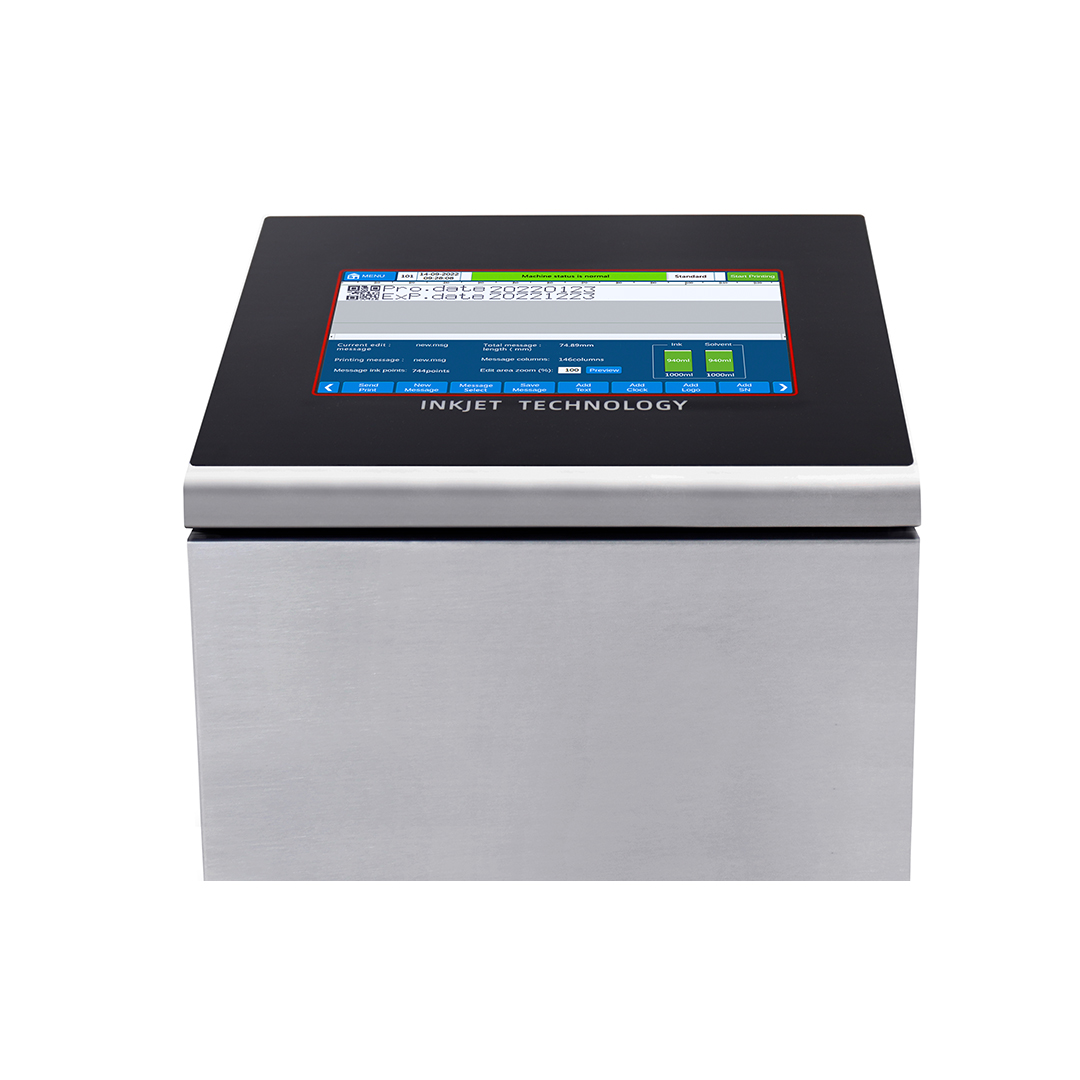
The DOCOD M2000 Series Continuous Inkjet Printer is declared at IP65 with a SUS 304 stainless steel housing, prints at 3–30 mm height across 1–4 lines, reaches a maximum printing speed of 528 m/min, and carries CE and RoHS declarations. Its working environment is stated as 0–45°C and 30–70% RH, with a 100–240V AC input at 100W rated power. For food, beverage and pharmaceutical packaging areas where stainless steel housings and a high ingress rating are normal specification points, this is the model family to place first.
The DOCOD S300plus Series Continuous Inkjet Printer follows the same logic: IP65, SUS 304 stainless steel housing, 1–5 print lines, CE, RoHS and BIS declared. Its rated power is 150W and it prints up to 384 m/min.
High-speed lines where a lower ingress rating is acceptable
The DOCOD S1000 Series High Speed Continuous Inkjet Printer is declared at IP55 with a SUS 304 stainless steel housing, CE, RoHS and BIS, and is the family aimed at throughput: maximum printing speed of 720 m/min at 60µ nozzle specification and 960 m/min at 50µ. Rated power is 150W, net weight 21 kg. Because IP55 sits below the IP65 of the M2000 and S300plus, the S1000 belongs in dry, high-speed zones rather than in areas that are hosed down.
The DOCOD V2000 Series Continuous Inkjet Printer appears in the recorded beverage bottling application in Vietnam, where four lines run batch coding on PET bottles and the stated highlight is suitability for high-speed lines. Buyers specifying this family for a wet zone should request the protection rating and the licence coverage in writing per model, because those two attributes decide whether the unit can be placed in the same zone as an M2000.
Packing stations and carton coding: thermal inkjet
Thermal inkjet covers the variable-data work at the case and carton level. The DOCOD T220E Half-Inch Dual-Head Inkjet Printer prints at up to 600 × 600 DPI with 1–2 printheads and print heights of 1–12.7 mm or 1–25.4 mm, while the DOCOD TX1 Half-Inch Seamless Inkjet Printer supports up to eight printheads with a combined print height of 1–101.6 mm and up to 300 × 300 DPI. Both are built on an aerospace-grade aluminium and industrial stainless steel body and list GS1 code printing and dynamic traceability QR codes among their print contents, which is directly relevant to a two-dimensional code transition plan.
Neither unit publishes an ingress protection rating in the available specification. That is not a defect; it is a checkpoint. Where a TIJ unit is proposed for a wet or dusty area, the buyer should require a written statement of the protection rating rather than assuming parity with a CIJ cabinet.
Flexible film and label work
For flexible film and label stock, the DOCOD R3000 Series Industrial Thermal Transfer Overprinter is the TTO option within the portfolio, and it appears in the recorded snack manufacturer application in Indonesia, where two vertical form-fill-seal lines run date coding on flexible film with industrial-grade TTO performance as the stated highlight. The DOCOD XF30 Vertical Rewinding Machine covers label rewinding and secondary coding at 0–45 m/min with a 100 mm maximum label width, and is rated 110V/220V 50Hz at 300W — a power configuration that itself needs checking against the destination market's supply.
Lasers: matching protection rating and cooling to the zone
Laser families are where the IP rating decision becomes most visible. The DOCOD L3000 Series 5W UV Laser Marking Machine is declared IP43, water-cooled, with a 355 nm wavelength, 5W laser power, minimum line width of 0.02 mm and positioning accuracy of 0.01 mm. Total power consumption is ≤900W, the host is stainless steel and the controller aluminium alloy, and the stated operating envelope is 0–45°C at humidity up to 95% non-condensing, with a laser life of 2–3 years. IP43 is a lower protection class than the IP65 CIJ cabinet, so the L3000 belongs in lower-protection, controlled areas — and its water-cooling requirement is a site-readiness item, not only a product attribute.
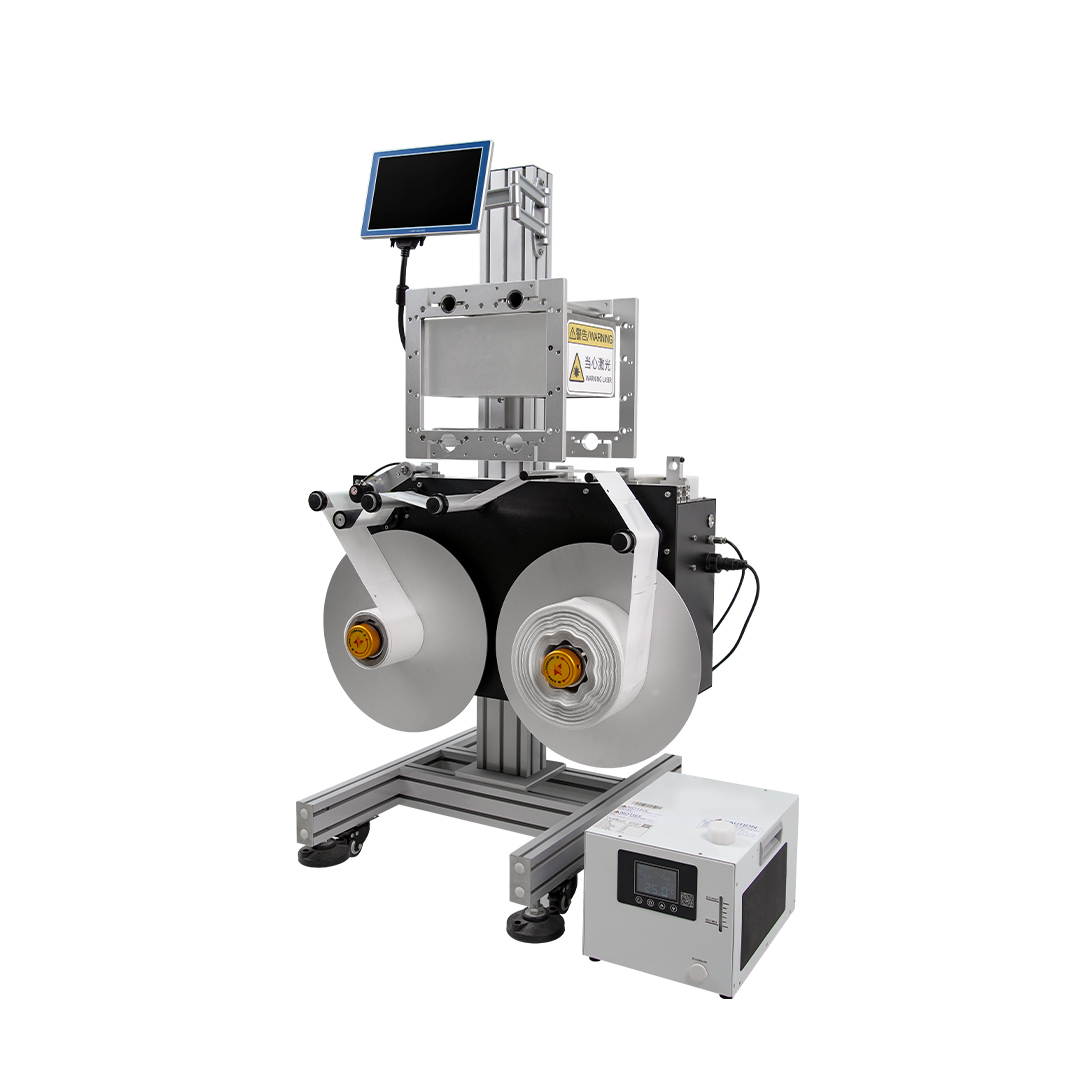
The DOCOD Venus1 Series UV Laser Marker offers a wider choice: 5W, 10W and 15W versions, 355 nm, with both air-cooled and water-cooled configurations and declared IP43 or IP54 depending on model option. Because IP54 is available within the same family, a buyer facing occasional splash risk has a route to a higher protection class without leaving the product line.
The DOCOD Venus1 Series Fiber Laser Marking Machine is declared IP43, air-cooled, at 1064 nm with 20W, 30W, 50W or 100W options, marking ranges from a standard 110 × 110 mm to an optional 50–300 mm, and a stated laser life of up to 100,000 hours. Air cooling removes the chilled-water dependency but does not change the IP43 zoning constraint.
Management-system certificates and their scope wording
Behind the product declarations sit three management-system certificates issued by Guangdong Zhongyu Certification Co., Ltd., all valid from 5 September 2025 to 4 September 2028: ISO 9001 (certificate 18625Q00281R1M, GB/T 19001-2016 / ISO 9001:2015), ISO 14001 (certificate 18625E00147R1M, GB/T 24001-2016 / ISO 14001:2015) and ISO 45001 (certificate 18625S00131R1M, GB/T 45001-2020 / ISO 45001:2018). The declared scope for the ISO 9001 certificate is the R&D and production of inkjet printers.
Checkpoint: management-system certificates support supplier qualification, but their scope wording should be read against the equipment class being purchased. Where the certificate scope text refers to inkjet printers, a buyer sourcing a laser marker or TTO should confirm in writing how that equipment class is covered under the supplier's quality system, rather than assuming the wording extends automatically.
Market registration: the India example
India is the clearest case where a market-specific registration, not a general declaration, decides importability. The BIS CRS Registration Licence for Printers / Plotters, certificate number R-41312347, issued by the Bureau of Indian Standards under standard IS 13252 (Part 1):2010 / IEC 60950-1:2005, is valid from 13 October 2025 to 12 October 2027. Its stated scope covers printers and plotters under the brand codpad, for the listed models manufactured at the registered factory address, and the licence record is associated with the M2000 Series, S1000 Series and V2000 Series continuous inkjet printers.
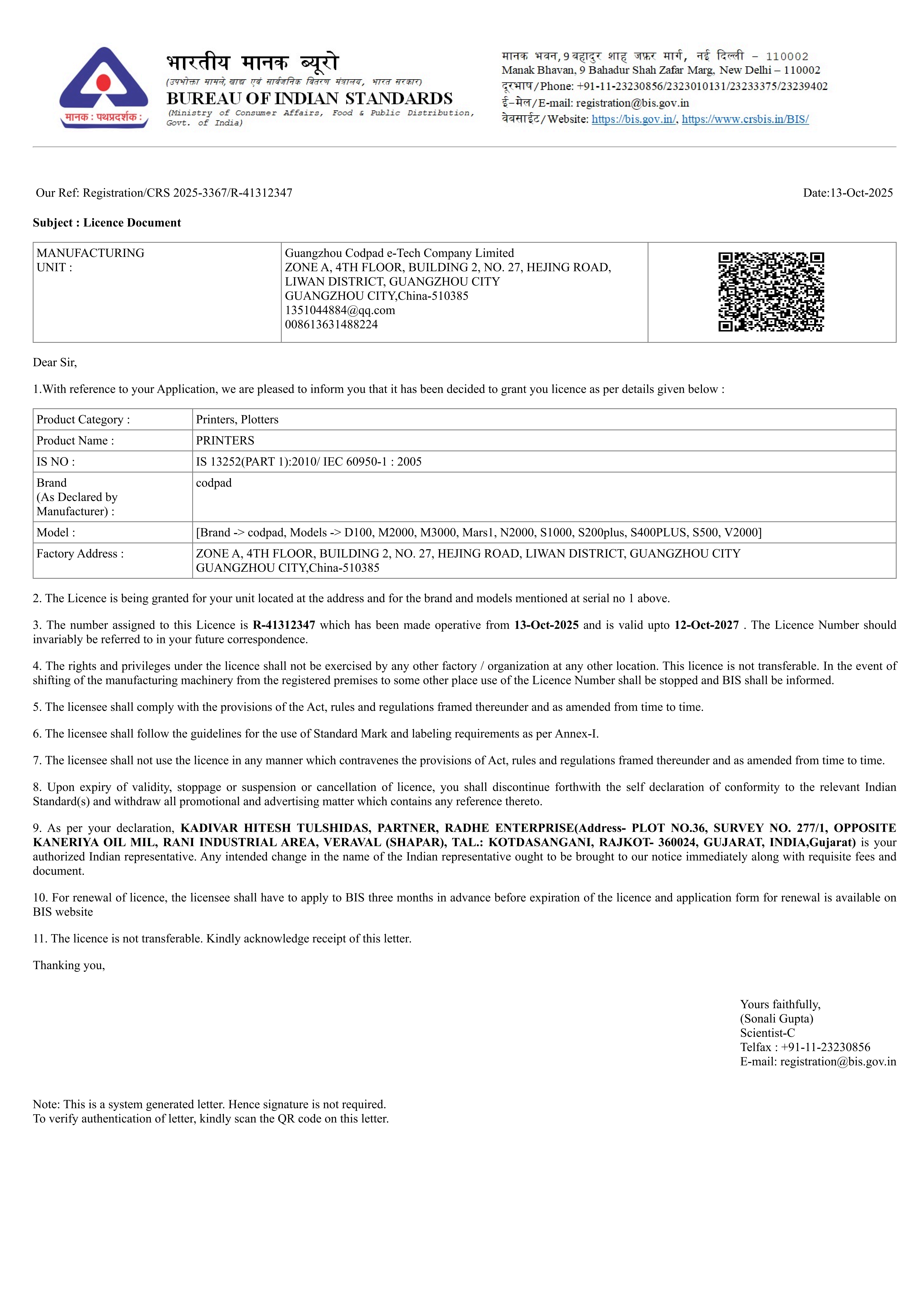
Two details in that sentence carry most of the compliance risk. First, the licence names a brand. A buyer importing into India should confirm that the nameplate, packaging and manual branding on the delivered units match the brand named in the registration. Second, the licence covers listed models. A model that is not on the list is not covered by the list, however similar it looks.
Step-by-Step Breakdown: Compliance Checkpoints in the Purchase Process
The following sequence converts the mapping above into an order-ready checklist that runs from specification to acceptance.
Step 1 — Fix the legal layer for the destination market
List the certificates the destination market will actually request, separated into product declarations, market registrations and management-system certificates. For example: CE and RoHS for the M2000, S300plus and S1000 Series; BIS CRS registration R-41312347 for India, covering listed models under the codpad brand; ISO 9001, ISO 14001 and ISO 45001 for supplier qualification. Record each certificate number and validity date so renewals can be tracked — the BIS licence expires on 12 October 2027 and the three ISO certificates on 4 September 2028.
Step 2 — Match the ingress rating to the cleaning zone
Walk the line and classify each coding position as washdown-adjacent, dusty, humid, or controlled dry. Assign IP65 SUS 304 families (M2000, S300plus) to the demanding zones, IP55 (S1000) to dry high-speed zones, and IP43 laser families (L3000 UV, Venus1 fiber) to controlled areas. Where a Venus1 UV marker is proposed, confirm whether the IP43 or IP54 variant is being quoted.
Step 3 — Verify that the certificate matches the nameplate
Request the certificate copy plus the model list, then compare against the nameplate, manual and packaging artwork. Where OEM branding is involved, the branding confirmation step in the supply process exists precisely to align nameplate, startup screen, packaging and manuals before final inspection — use it as the compliance control point, not as a cosmetic step.
Step 4 — Confirm code standard capability against the traceability plan
State the code type required, not the code type available. The M2000 Series lists dynamic barcode and QR code among its print contents; the Venus1 fiber laser supports QRCODE, DATAMATRIX, MICROQR, PDF417 and a wide barcode set; the L3000 UV laser supports EAN8, EAN13, CODE39, CODE128 and GS1-128. Where a two-dimensional retail or traceability workflow is planned against the GS1 Sunrise 2027 timeline, confirm two-dimensional capability and verification, not only printing.
Step 5 — Check the physical and electrical envelope against site conditions
Compare the declared operating envelope with the real environment: 0–45°C and 30–70% RH for the CIJ families; 0–45°C and up to 95% non-condensing for the laser families; 100–240V AC input for CIJ and laser units; 110V/220V 50Hz for the XF30 rewinding machine. Water-cooled laser models also require the cooling circuit to be planned before installation.
Step 6 — Document the consumables chain
Consumables carry their own storage and shelf-life constraints. The DOCOD 3BK702 Half-Inch Black Solvent Quick-Drying Ink Cartridge holds 42 ml, prints at up to 600 dpi (300 × 300 recommended), declares a best-use period of 6 months, and specifies 15–35°C at 35–80% RH for working conditions and 5–40°C at 20–80% RH for shipping and storage. An RFID chip identifies ink parameters and records remaining ink. For importers, those numbers belong in the shipping and storage instruction, not only in the datasheet.
Step 7 — Write the acceptance criteria into the purchase terms
Acceptance evidence should be named in the order. Across the supply modes, the stated quality controls include outgoing inspection, sample printing verification and function testing before shipment for standard equipment; sample confirmation and final inspection before shipment for OEM branding; requirement confirmation, function test and trial-run verification for ODM functional customization; and integration testing, sample run and video acceptance before delivery for production line integration projects.
| Supply mode | Minimum order | Stated lead time | Stated quality / acceptance step |
|---|---|---|---|
| Standard equipment supply | 1 set | Within 15 working days | Outgoing inspection; sample printing verification; function test before shipment |
| OEM branding support | 1 set | 15–25 working days | Sample confirmation; final inspection before shipment |
| ODM functional customization | 1 set per project | 20–30 working days | Requirement confirmation; function test; trial-run verification |
| Production line integration support | 1 line | 20–35 working days | Integration testing; sample run; video acceptance before delivery |
| Spare parts and consumables supply | 1 piece | Within 15 working days | Part verification; packing inspection; shipment check |
| Distributor and service partner support | 2 units | 15–30 days | Demo/sample validation; cooperation requirement review |
Certification activity itself sits outside these lead times. Where a market registration must be added or extended, the authority's processing time governs, and the certificate validity dates above should be treated as planning constraints rather than fixed assumptions.
Comparison Table: Declared Attributes by Product Line
The table below compares only attributes that are declared in the available specifications. Where an attribute is not declared, the correct action is to request it in writing, not to infer it from a sibling model.
| Product family (model) | Declared protection | Housing / build | Declared product certificates | Compliance checkpoint |
|---|---|---|---|---|
| DOCOD M2000 Series Continuous Inkjet Printer | IP65 | SUS 304 stainless steel | CE, RoHS | Confirm BIS licence linkage for India and brand match on nameplate |
| DOCOD S300plus Series Continuous Inkjet Printer | IP65 | SUS 304 stainless steel | CE, RoHS, BIS | Confirm the exact model appears in the licence model list |
| DOCOD S1000 Series High Speed Continuous Inkjet Printer | IP55 | SUS 304 stainless steel | CE, RoHS, BIS | Lower ingress class than IP65 — assign to dry high-speed zones |
| DOCOD V2000 Series Continuous Inkjet Printer | Request per model | Request per model | Listed in the BIS licence record and ISO certificate product lists | Obtain written protection rating before zoning |
| DOCOD TX1 / T220E Thermal Inkjet Printers | Not declared in specification | Aerospace-grade aluminium, industrial stainless steel | Request per model | Confirm ingress rating before wet or dusty installation |
| DOCOD L3000 Series 5W UV Laser Marking Machine | IP43 | Stainless steel host; aluminium alloy controller | Request per model | Water-cooled; controlled-area installation only |
| DOCOD Venus1 Series UV Laser Marker | IP43 / IP54 by model | Aluminium alloy | Request per model | Select the IP54 variant where splash risk exists |
| DOCOD Venus1 Series Fiber Laser Marking Machine | IP43 | Aluminium alloy | Request per model | Air-cooled, but still a controlled-area device |
Use Cases: Compliance Decisions in Practice
Wire, cable and pipe extrusion in India. The recorded Indian extrusion application prints meter marks, model information, batch numbers and certification marks on continuous-length product, with non-contact coding synchronised to the line encoder. On a line like this, the BIS registration is the gating document: the M2000 Series, which is associated with licence R-41312347, is the natural starting point, and the accuracy of the metre marking depends on encoder synchronisation rather than on print resolution alone.
Medical packaging in Germany. The recorded German medical packaging solution prints UDI, GS1 DataMatrix, lot numbers, expiry dates and serial numbers with online verification in a closed-loop print-and-verify workflow, using vision systems, reject units and MES integration. Here compliance is not a certificate at all — it is the verified read-back, which is why an inline code inspection system belongs in the same conversation as the printer.
Beverage bottling in Vietnam. Four lines run batch coding on PET bottles, with the V2000 Series cited for high-speed suitability. The compliance work sits in confirming the model-level protection rating and licence coverage before the units are zoned alongside any washdown equipment.
Cosmetics packaging in Poland and personal care in Thailand. Low-heat UV marking on plastic bottles and caps, and high-resolution variable data on coated boxes, both illustrate why the laser and piezo families exist alongside CIJ: the certification question shifts from ingress protection to material interaction and code resolution.
FAQ
Which certificates should be verified before importing industrial coding equipment?
Verify three groups. First, product declarations: CE and RoHS are declared for the DOCOD M2000 Series, S300plus Series and S1000 Series. Second, market registrations: the BIS CRS Registration Licence R-41312347, issued by the Bureau of Indian Standards under IS 13252 (Part 1):2010 / IEC 60950-1:2005, is valid from 13 October 2025 to 12 October 2027 for printers and plotters under the codpad brand. Third, management-system certificates: ISO 9001 (18625Q00281R1M), ISO 14001 (18625E00147R1M) and ISO 45001 (18625S00131R1M), all valid until 4 September 2028. Record each number and expiry date in the purchase file.
Does the BIS registration cover every DOCOD model sold in India?
No. The registration is scoped to printers and plotters under the codpad brand, for the listed models manufactured at the registered factory address, and the licence record is associated with the M2000 Series, S1000 Series and V2000 Series. A model outside that list is not covered by that list, regardless of similarity. Before shipping to India, confirm the exact model designation and confirm that the nameplate and packaging branding match the registered brand.
Can one model family cover both washdown and dry-area coding positions?
Usually not, and the ratings show why. The M2000 Series and S300plus Series are declared IP65 with SUS 304 stainless steel housings, which suits washdown-adjacent food and pharmaceutical areas. The S1000 Series is declared IP55 and should be assigned to dry high-speed zones. The L3000 Series UV laser and the Venus1 Series fiber laser are declared IP43, while the Venus1 Series UV laser marker offers IP43 or IP54 depending on model option. Thermal inkjet models do not publish an ingress rating in the available specification, so a written rating should be obtained before any wet-zone installation.
What acceptance evidence should be agreed before shipment?
Agree the evidence in the order, not after delivery. For standard equipment, the stated controls are outgoing inspection, sample printing verification and function testing before shipment. For OEM branding orders, sample confirmation and final inspection before shipment. For ODM functional customization, requirement confirmation, function test and trial-run verification. For production line integration, integration testing, sample run and video acceptance before delivery. Add certificate copies, nameplate data and consumable shelf-life information (for example, six months best-use period for the 3BK702 cartridge) to the same acceptance pack. Sample validation on your own substrate remains the most direct way to confirm a configuration — request a sample and a written quote against your code specification through the contact details at the end of this guide.
What lead times and minimum order quantities apply to compliance-relevant orders?
Standard equipment supply is stated at a minimum of 1 set with lead time within 15 working days; OEM branding at 1 set with 15–25 working days; ODM functional customization at 1 set per project with 20–30 working days; production line integration at 1 line with 20–35 working days; spare parts and consumables at 1 piece with delivery within 15 working days; and distributor support at a minimum of 2 units with 15–30 days. These figures cover equipment supply and acceptance steps only — statutory certification or registration lead time is set by the issuing authority and must be planned separately.
Conclusion
Compliance for industrial coding and marking equipment is decided by matching three layers in the right order: the market's legal layer, fixed by the correct certificate and registration numbers; the physical layer, fixed by IP rating, housing material, temperature and humidity envelope and power input; and the documentation layer, fixed by nameplate accuracy, licence scope and written acceptance criteria. The product facts support a clear allocation — IP65 SUS 304 CIJ for demanding zones, IP55 for dry high-speed lines, IP43 or IP54 laser families for controlled areas, and explicit written confirmation wherever a rating is not declared. Handled this way, certification stops being a last-minute documentation request and becomes a specification input that the purchase order can enforce.
Next Step: Map Your Requirement to a Verified Configuration
Send your destination market, line zone, code type and substrate, and the DOCOD team will return the matching model family, the applicable certificate set, and the acceptance criteria in writing. Samples, quotations and integration review are available on request.
Download the DOCOD corporate brochure (PDF) | www.docod-group.com
Email: sales@docod.com.cn | Tel: +86 139-2896-7650 | WhatsApp: +86 135-1234-4323
Address: Xilin Industrial District, Honglai Town, Quanzhou Nan'an City, Fujian Province, China
Have Questions or Need More Details?
Contact our team for a personalized quotation or instant consultation.
Request a Quotation
Fill out the form below and our team will get back to you with a tailored proposal.
WhatsApp Direct Chat
Prefer to chat in real-time? Message us on WhatsApp for instant assistance & quick answers.
- Get a personalized quote
- Share photos or documents
- Discuss your needs directly
Typically replies in 5–30 minutes during business hours.