
UV Laser vs Fiber Laser Marking Machines: A Buyer's Comparison Guide for Smart Manufacturing
UV Laser vs Fiber Laser Marking Machines: A Buyer's Comparison Guide for Smart Manufacturing
The short answer most buyers need on day one: a fiber laser marking machine at 1064 nm is the default choice for metals, hard coatings and parts that need a deep, wear-resistant mark, while a UV laser marker at 355 nm is the default choice for plastics, films, glass, ceramics, printed circuit boards and packaging where a low-heat mark must stay sharp without deforming the product. Treating the two as interchangeable "laser coders" is the most expensive assumption in the selection process.
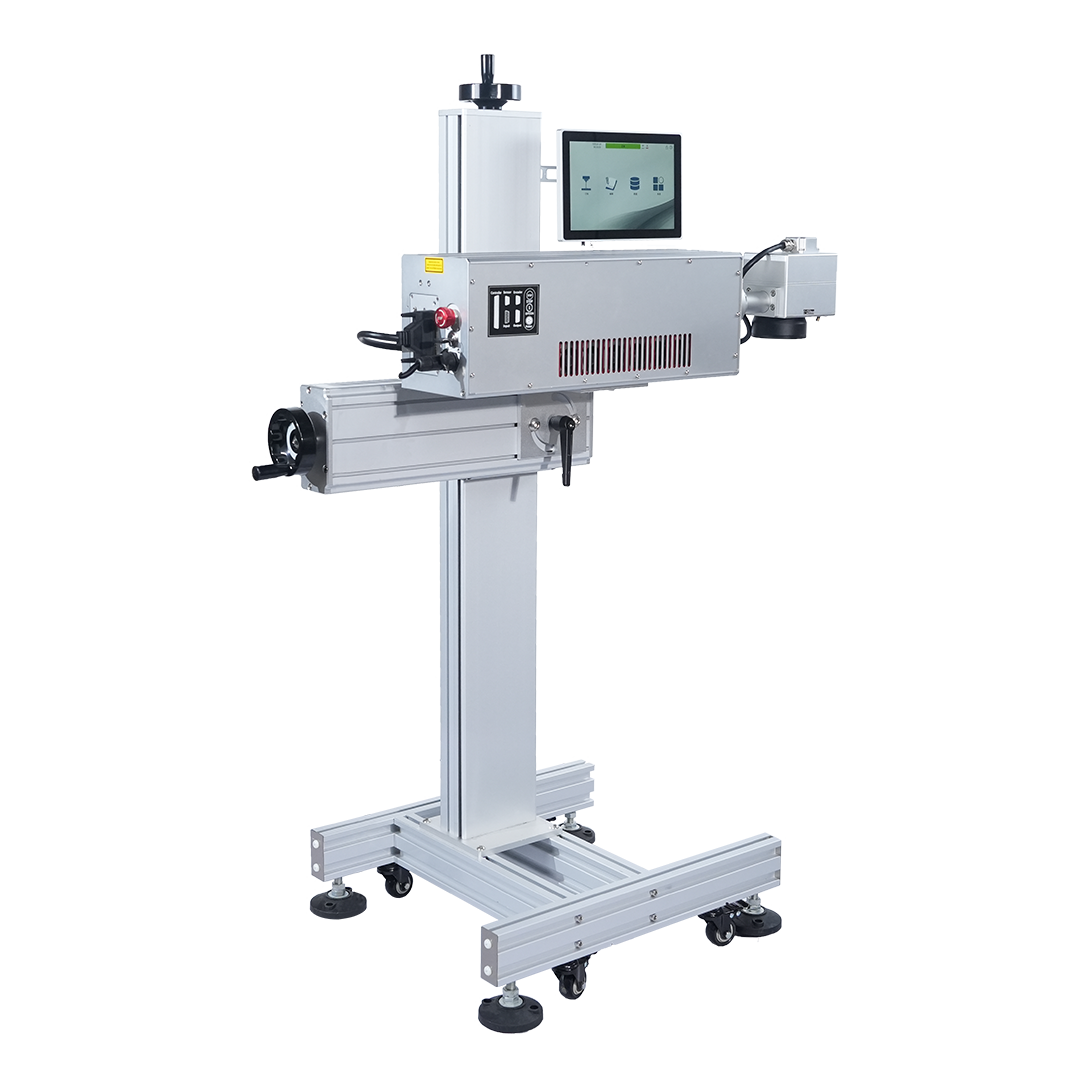
This guide is written for buyers in the awareness and research stage — engineers, production managers and procurement teams evaluating industrial coding and marking equipment who have narrowed the question down to laser technology. It compares the two laser types across wavelength, power, cooling method, marking area, substrate fit, code capability and lifecycle, then translates those parameters into a material-by-material decision matrix covering cartons, plastics, metals, auto parts and electronic components. All hardware specifications below come from published DOCOD Venus1 and L3000 series data, so the comparison can be checked line by line against a datasheet.
Problem definition: why "UV or fiber?" is harder than it looks
Most laser marking problems on a production line are not machine failures. They are substrate-matching failures, and they usually surface weeks after commissioning, when the first full production batch runs.
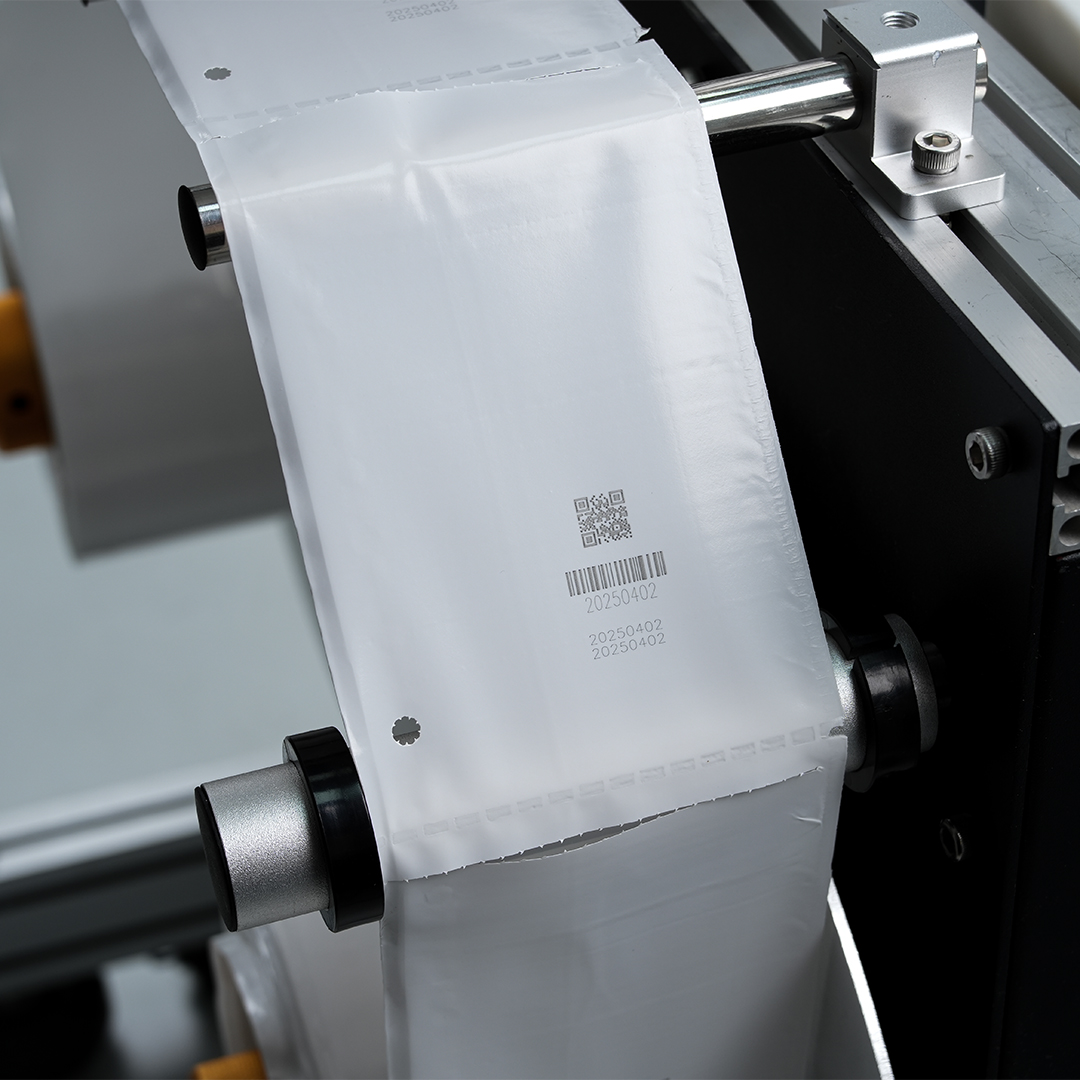
- Wavelength ignores intent. A 1064 nm fiber laser aimed at a thin PVC or PET film can distort or burn the material before it produces a readable code, because the substrate was never the design input.
- A mark is not the same as a compliant mark. Once the printed content must be a GS1 DataMatrix or QR code that survives packing, transport and storage and still scans at the end of the chain, contrast retention becomes a specification item rather than a cosmetic detail.
- Laser is proposed for substrates it does not serve. Corrugated cartons and shipping cases are frequently routed to laser marking. In practice those substrates are normally handled by inkjet technologies — continuous inkjet (CIJ), thermal inkjet (TIJ) or piezo inkjet (PIJ) — because porous, uneven board requires a different marking principle. Laser is not automatically the better answer for every surface.
- The datasheet line nobody reads is the lifecycle line. UV laser sources and fiber laser sources have very different published service lives, and that difference changes the five-year cost of ownership far more than a small difference in purchase price.
The cost of getting this wrong is not a rejected sample. It is a marking head that cannot hold code quality at line speed, a lens configuration that has to be replaced, or a second machine purchased within a year to cover the substrates the first one cannot mark.
Industry background: what is actually driving laser adoption
Third-party market data helps frame the decision, provided the numbers are read for direction rather than precision.
- The global coding and marking equipment market was valued at USD 17.53 billion in 2024 and is projected to reach USD 27.11 billion by 2032 (SkyQuest, Coding and Marking Equipments Market report). Estimates diverge between research houses — Strategic Market Research and Fact.MR publish lower figures — because some studies include consumables, software and services while others count hardware only.
- Continuous inkjet (CIJ) still holds the largest technology revenue share, at approximately USD 5.67 billion in 2024 (Grand View Research), because inkjet covers the widest substrate range. Lasers are the fastest-moving segment, not the largest.
- Asia-Pacific accounted for roughly 35% of the coding and marking sector in 2024 (Market Research Future), which matters when buyers assess spare parts and service geography.
- Laser marking is projected to grow at a 6.8% CAGR through 2030, driven partly by its eco-friendly nature and lack of consumables (Fortune Business Insights).
- GS1 Digital Link, standardized as ISO/IEC 18975:2024, is being adopted globally to replace 1D barcodes with QR codes for point-of-sale and traceability by 2027 (GS1 / ISO).
Two conclusions follow for a smart manufacturing buyer. First, laser adoption is increasingly driven by code content: as 2D codes replace 1D barcodes, the marking method has to deliver cell-level resolution, not just a legible date. Second, because lasers consume no ink, cartridge or ribbon, the buying decision shifts from consumable price to laser source life, power draw and service planning.
Detailed solution: the six parameters that decide between UV and fiber
1. Wavelength: 355 nm vs 1064 nm
The DOCOD Venus1 Series UV laser marker operates at a 355 nm wavelength, while the DOCOD Venus1 Series fiber laser marking machine operates at 1064 nm. The shorter UV wavelength produces a smaller focused spot and is strongly absorbed by many polymers, glass and ceramics, with lower heat input into the surrounding material — DOCOD lists UV applications in environments requiring precise, low-heat and damage-minimized marking. The 1064 nm fiber wavelength is absorbed efficiently by metals and coatings, which is why it is intended for metal and coating applications, automotive parts, industrial bearings, aerospace components, stainless steel products, aluminum alloy products, tin foil, pipes and cables, and industrial environments requiring high precision, smoothness and marking depth.
2. Power: 5W / 10W / 15W vs 20W / 30W / 50W / 100W
Power in marking is not a "more is better" number; it must sit below the damage threshold of the substrate while still producing the required contrast. Venus1 UV power options are 5W, 10W and 15W, and the L3000 Series is a 5W water-cooled UV laser marking machine. On the L3000, printing a date string such as "2024/06/18" on PP film at a character width of 20 mm and height of 2.8 mm takes 29 milliseconds — a concrete reminder that marking time is a function of substrate, content size and complexity, so speed must be quoted per job rather than as a single headline figure. Venus1 fiber power options are 20W, 30W, 50W and 100W, with model designations such as 1020F-1064F-C-IP43 through 1100F-1064F-C-IP43. Both technologies mark character heights from 0.6 mm up to the maximum marking area, with unlimited marking lines.
3. Cooling, footprint and utilities
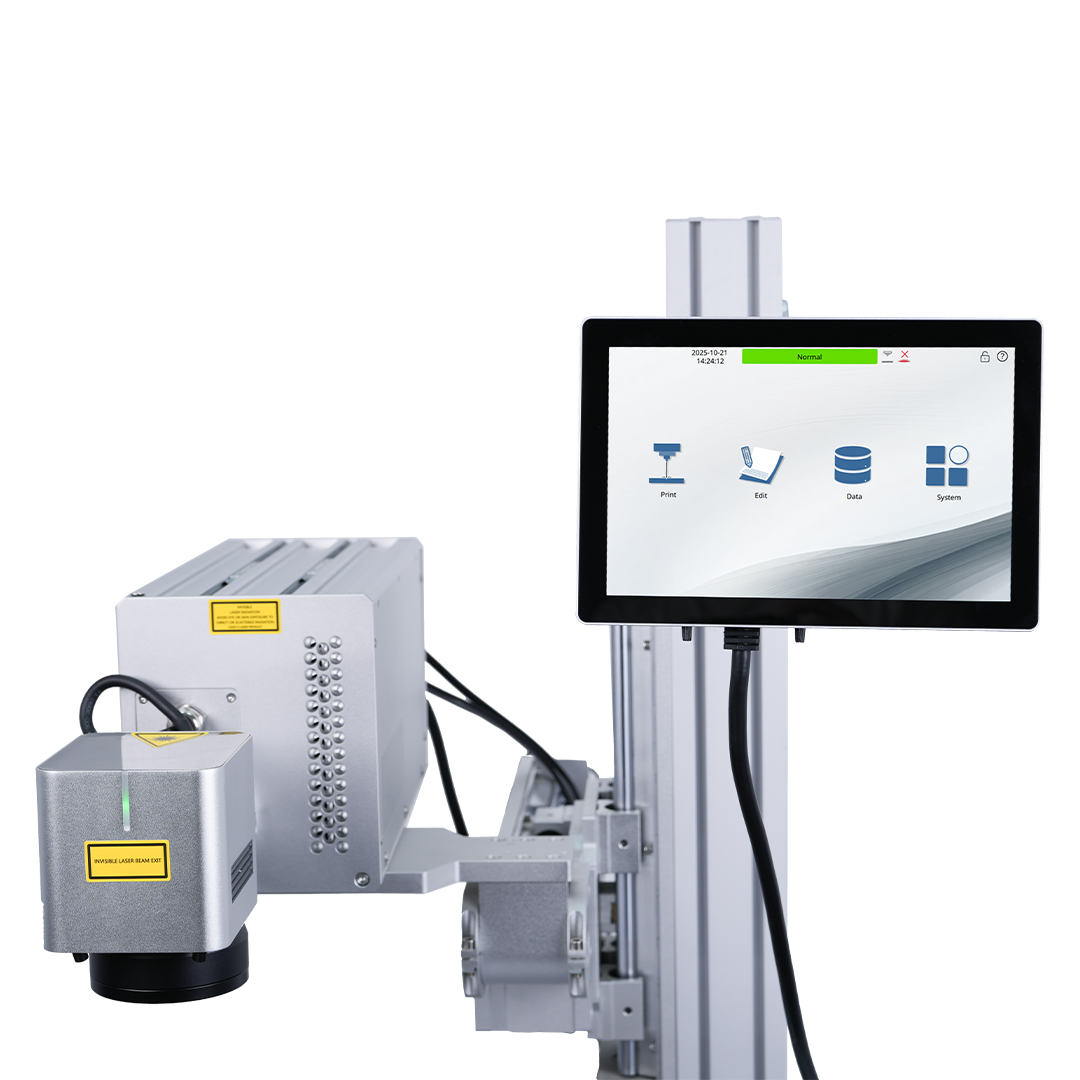
Fiber systems are typically air-cooled: the Venus1 fiber consumes ≤600W, has an IP43 rating, host dimensions of 585 × 160 × 189 mm or 597 × 160 × 289 mm, and a gross machine weight of 18 kg or 24 kg. UV systems split into air-cooled and water-cooled variants, consume ≤900W, and the Venus1 UV main beam measures 756.7 × 175 × 191.5 mm (5W / 10W) or 976.7 × 175 × 191.5 mm (15W), with IP43 or IP54 ratings and gross weights of 20.5 kg (5W / 10W) and 22.6 kg (15W). The L3000 Series 5W UV machine uses water cooling with a stainless steel laser host and an aluminum alloy controller, host dimensions of 290 × 213 × 135 mm and IP43 protection. The practical consequence: a water-cooled UV system needs chilled-water provision, service access and floor space that an air-cooled fiber system does not, and that should be designed into the line layout before the purchase order, not after.
4. Marking area and optical precision
Venus1 UV and Venus1 fiber both offer a standard marking area of 110 × 110 mm, with optional ranges of 70–300 mm (UV) and 50–300 mm (fiber). The L3000 Series 5W UV machine offers a standard 70 × 70 mm area with optional 70–300 mm, a minimum line width of 0.02 mm and positioning accuracy of 0.01 mm — the parameters that decide whether small electronic component codes are legible. Both series use a high-precision 2D digital scanning galvanometer system and automatic red-light positioning, focusing and preview, which shortens changeover and setup time on mixed-product lines.
5. Laser life — the least-read line in the datasheet
DOCOD publishes a UV laser life of 2–3 years under normal use, and a fiber laser life of up to 100,000 hours. On a multi-shift production line, those are fundamentally different lifecycle profiles, and they should be planned for differently. A fiber source can reasonably be treated as a long-life asset. A UV source should be treated as a component with a defined service interval — which is a maintenance and capital-planning question that belongs in the evaluation, not in the after-sales phase.
6. Code and data capability
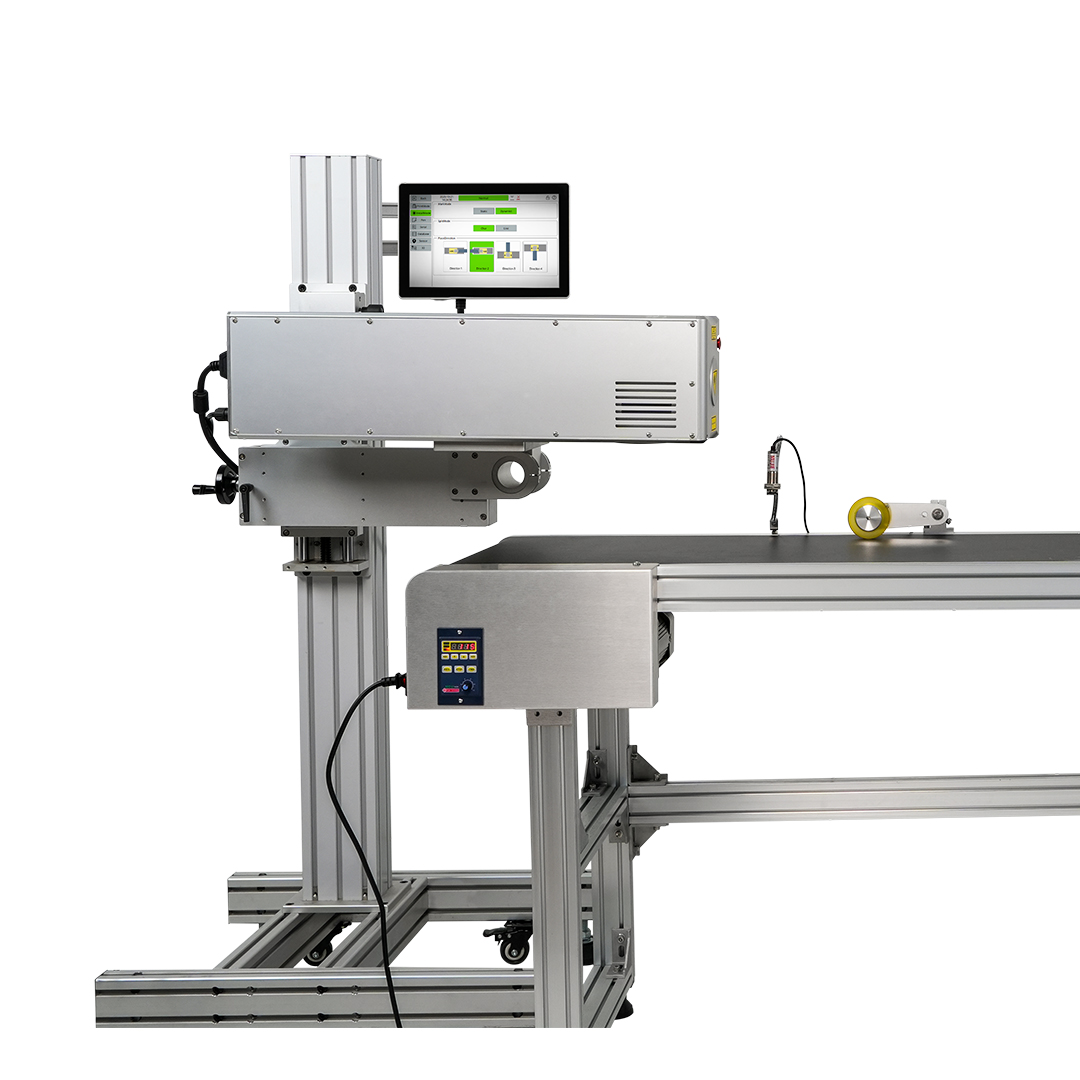
The Venus1 UV and fiber series share a broad code library that includes CODE11, C25INTER, CODE39, EXCODE39, EAN128, CODABAR, CODE128, CODE49, CODE93, UPCA, UPCE, EAN14, VIN, NVE18, ITF14, QRCODE, DATAMATRIX, MICROQR, PDF417 and PDF417TRUNC. The L3000 Series 5W UV machine supports EAN8, EAN13, CODE39, CODE128 and GS1-128. Both Venus1 series provide photocell signal, encoder signal, alarm signal and I/O interfaces for NPN, PNP and switch-type sensors plus RS232 communication, and support AB phase encoders for production line speed monitoring. Control is via a 10.1-inch color industrial touch screen running an embedded Linux security operating system, with graphic formats JPG, BMP, PNG, DXF, DWG, PLT, AI and SVG.
Reference point for the carton question: DOCOD's laser portfolio also includes the Venus1 Series CO2 laser marking machine at 10.6 μm (optional 10.2 μm / 9.3 μm), 30W or 60W, for non-metal materials such as plastics, rubber, leather, textiles, wood, acrylic, kraft board and cable marking. When a buyer asks for laser marking on cartons, this is the laser type to evaluate — and where the board is porous, fast-moving and uneven, an inkjet platform such as the DOCOD M2000 Series CIJ (up to 528 m/min, 3–30 mm print height, 1–4 lines, IP65, CE and RoHS) is usually the more suitable answer.
DOCOD Precision Group Co., Ltd. manufactures laser marking machines alongside continuous inkjet printers (CIJ), thermal inkjet printers (TIJ), piezoelectric high-resolution inkjet printers (PIJ), drop-on-demand large-character inkjet printers (DOD), thermal transfer overprinters (TTO) and inline vision inspection systems. Founded in 2008, the company operates a 20,000 m² manufacturing facility with approximately 407 staff, more than 140 R&D professionals, an annual production capacity of 5,000 units, and export sales representing 50% of total revenue across North America, South America, Eastern Europe, Southeast Asia, Africa, Oceania, the Middle East, Eastern Asia and Western Europe. The relevance to this comparison is practical: a laser recommendation can be checked against the rest of the coding line — including verification — rather than evaluated in isolation.
Step-by-step breakdown: a seven-step selection process
- Define the substrate, not the machine. Write down the exact material and finish for every product that will pass the marking station: PP film, PET bottle, HDPE tube, laminated carton, stainless steel, anodized aluminum, painted auto part, populated PCB. Substrate drives wavelength; nothing else does.
- Define what the mark must survive. Abrasion, oil, heat, humidity, sterilization, cold chain and repeated scanning all change the required mark depth and contrast. A mark that passes visual inspection on day one but fades in a warehouse is a failed specification.
- Fix the code content. Date and batch only, or GS1 DataMatrix, QR, serialization and database-driven variable data? With 2D symbologies becoming the traceability default, confirm that the chosen controller supports the exact symbology and data source you will print.
- Measure line speed and available space. Confirm the marking time for your actual content, then check whether the mounting envelope suits the station. The air-cooled fiber host and the water-cooled UV main beam differ in size, and the water-cooling unit needs its own allocation.
- Check utilities and environment. Air cooling versus water cooling, IP43 versus IP54, and the 0°C to 45°C operating range with non-condensing humidity. Dusty, hot or humid plants need this settled before installation.
- Run a markability test on the real substrate. Do not accept a mark demonstrated on a supplier sample of a different grade or finish. Test the actual code at the actual line speed, then scan it with the reader you will use in production.
- Evaluate lifecycle and service, not only purchase price. Laser source life, controller and encoder compatibility, spares availability and support geography usually outweigh a narrow price gap when the machine is expected to run for years.
Use cases: where each technology has already proven its fit
Electronics part traceability (Mexico)
In electronics manufacturing, DOCOD coding solutions are used for part traceability projects on PCBs, batteries, charger housings, electronic components and small plastic or metal parts. The operation is online marking integrated with automation fixtures or robot handling, printing serial numbers, QR/DataMatrix codes, batch numbers and brand marks for assembly error-proofing and after-sales identification, with automation fixtures, conveyors, sensors, scanners, vision inspection and PLC/MES in the supporting equipment list. The matched equipment set for this scenario includes the DOCOD Venus1 Series UV laser marker and the DOCOD Venus1 Series fiber laser marking machine — the two technologies in this guide, used side by side on different substrates within the same plant.
Medical and pharmaceutical packaging (Germany)
Medical packaging traceability requires UDI, GS1 DataMatrix, lot numbers, expiry dates and serial numbers, then a closed-loop print-and-verify workflow with vision inspection and reject units. The DOCOD L3000 Series 5W UV laser marking machine is one of the matched products for medical device packs, Tyvek medical paper, blister packs, cartons, plastic bottles and flexible films — a scenario where precise, low-heat marking prevents damage to thin packaging materials while keeping the code readable for regulatory tracking.
Cosmetics and personal care bottle coding (Indonesia)
Online bottle and tube coding integrated with filling, capping and labeling lines has to print batch numbers, production dates, expiry dates, QR codes and anti-counterfeit codes on HDPE, PET, PP and PE tubes without damaging brand appearance. UV laser marking is included in the matched equipment set for this scenario, because a low-heat mark preserves the surface finish that a consumer-facing package depends on.
Metal parts, pipes and cable (fiber laser territory)
Automotive parts, industrial bearings, aerospace components, stainless steel products, aluminum alloy products, tin foil, pipes and cables sit squarely in the fiber laser application range, where high precision, smoothness and marking depth are the stated requirements. With laser life up to 100,000 hours, a fiber source also matches continuous multi-shift marking duty without a scheduled source replacement in the near term.
Where laser is the wrong answer: cartons and corrugated cases
High-volume carton, case and flexible-packaging lines are generally served by inkjet platforms. The DOCOD M2000 Series continuous inkjet printer reaches a maximum printing speed of 528 m/min with a 3–30 mm print height and 1–4 lines of text, dates, logos, serial numbers and dynamic barcodes, is built in SUS 304 stainless steel with IP65 protection and carries CE and RoHS certificates; the DOCOD T220E thermal inkjet printer delivers up to 600 × 600 DPI at speeds up to 406 m/min. Recognizing this boundary is part of buying well: a smart manufacturing line usually needs a technology mix, not one universal marking head.
Comparison table: UV laser vs fiber laser vs CO2 laser
| Parameter | UV laser (355 nm) | Fiber laser (1064 nm) | CO2 laser (10.6 μm) — reference |
|---|---|---|---|
| DOCOD reference models | Venus1 Series UV Laser Marker (5W / 10W / 15W); L3000 Series 5W UV Laser Marking Machine | Venus1 Series Fiber Laser Marking Machine (1020F / 1030F / 1050F / 1100F-1064F-C-IP43) | Venus1 Series CO2 Laser Marking Machine (1030C / 1060C) |
| Wavelength | 355 nm | 1064 nm | 10.6 μm (optional 10.2 μm / 9.3 μm) |
| Power options | 5W / 10W / 15W; L3000 Series: 5W | 20W / 30W / 50W / 100W | 30W / 60W |
| Cooling | Air cooling or water cooling; L3000 Series: water cooling | Air cooling | Air cooling or water cooling |
| Marking area | Standard 110 × 110 mm (Venus1) / 70 × 70 mm (L3000); optional 70–300 mm | Standard 110 × 110 mm; optional 50–300 mm | Standard 110 × 110 mm; optional 70–300 mm |
| Positioning | Automatic red-light positioning, focusing, preview | Automatic red-light positioning, focusing, preview | Automatic red-light positioning, focusing, preview |
| Character height | 0.6 mm to maximum marking area | 0.6 mm to maximum engraving range | 0.6 mm to maximum engraving range |
| Protection level | IP43 / IP54 | IP43 | IP43 / IP54 |
| Power consumption | ≤900W | ≤600W | ≤600W / ≤1500W |
| Laser life | 2–3 years under normal use | Up to 100,000 hours | 20,000 hours |
| Typical substrate fit | Plastics, polymers, glass, ceramics, printed circuit boards, medical devices, food and pharmaceutical packaging, electronic components, PET bags, metal caps, cosmetics packaging | Metal and coating applications, automotive parts, bearings, aerospace components, stainless steel, aluminum alloy, tin foil, pipes and cables, label paper | Non-metal processing: plastics, rubber, leather textiles, wood, acrylic, kraft board, cable marking, glass |
| Code capability (examples) | DATAMATRIX, QRCODE, MICROQR, PDF417, CODE128, EAN128, ITF14, VIN (Venus1); GS1-128, EAN8 / EAN13, CODE39, CODE128 (L3000) | Same 1D / 2D library as Venus1 UV | EAN8, EAN13, CODE39, CODE128, GS1-128 |
| Decision signal | Choose when the mark must be low-heat and high-detail on plastics, films, glass or PCBs | Choose when the mark must be deep, durable and consistent on metal parts and coatings | Choose when the substrate is non-metal and absorbs 10.6 μm more effectively than 355 nm or 1064 nm |
All figures in the table are published DOCOD specification values for the named models. Where a parameter is not listed for a given model, it is not claimed here.
FAQ: UV laser vs fiber laser marking machines
Can UV and fiber laser marking machines support GS1 DataMatrix and other traceability codes?
Yes. The DOCOD Venus1 Series UV laser marker and the DOCOD Venus1 Series fiber laser marking machine both support 1D and 2D code sets including DATAMATRIX, QRCODE, MICROQR, PDF417, CODE128, EAN128, UPCA / UPCE and ITF14, and the DOCOD L3000 Series 5W UV laser marking machine supports EAN8, EAN13, CODE39, CODE128 and GS1-128. This matters because GS1 Digital Link, standardized as ISO/IEC 18975:2024, is being adopted globally to replace 1D barcodes with QR codes for point-of-sale and traceability by 2027. Compliance is therefore a code-library and contrast question rather than a laser-type question: both technologies can print the code, but the substrate must still hold enough contrast for it to scan after packing, transport and storage. On lines where the code has to be verified in-line, DOCOD laser markers are deployed alongside inline vision inspection systems and reject units so that unreadable codes do not leave the line.
What can a fiber laser mark that a UV laser cannot, and the other way around?
A DOCOD Venus1 Series fiber laser marking machine uses a 1064 nm wavelength with 20W, 30W, 50W or 100W power options and is intended for metal and coating applications, medical devices, automotive parts, industrial bearings, aerospace components, PCB circuit boards, metal caps, tin foil, beverage packaging, aluminum alloy, cosmetic packaging, stainless steel products, pipes and cables, and label paper — environments requiring high precision, smoothness and marking depth, with laser life up to 100,000 hours. A DOCOD Venus1 Series UV laser marker uses a 355 nm wavelength with 5W, 10W or 15W power options and is designed for plastics, polymers, glass, ceramics, printed circuit boards, medical devices, food and pharmaceutical packaging, electronic components, beverage packaging, PET bags, metal caps and cosmetics packaging — environments requiring precise, low-heat and damage-minimized marking. In short: deep, durable marks on metal point to fiber; legible, low-thermal-impact marks on plastics, films and glass point to UV. Note that the DOCOD L3000 Series 5W UV laser marking machine is described for metal and non-metal materials, so UV is not excluded from metal work — it is simply optimized for low-heat marking.
How should a buyer think about running cost and total cost of ownership?
There is no reliable public price benchmark for laser marking machines, and a single universal number would not describe your configuration. What can be compared honestly is the cost structure. The two technologies differ in published laser life: 2–3 years under normal use for DOCOD UV laser sources versus up to 100,000 hours for the Venus1 fiber laser marking machine — which means a UV source should be planned as a component with a defined service interval rather than a lifetime asset. Power draw differs (≤900W for UV, ≤600W for fiber), cooling differs (water cooling on the L3000 Series; air or water cooling on the Venus1 UV; air cooling on the Venus1 fiber), and a water-cooled UV system requires additional floor space and a chilled-water utility. Against those costs, laser marking avoids the ink, cartridge and ribbon consumption of CIJ, TIJ, PIJ and TTO machines, and Fortune Business Insights projects laser marking growing at a 6.8% CAGR through 2030 partly because of its eco-friendly nature and lack of consumables. The practical method is to compare five-year scenarios covering laser life and service, power and utility cost, spares, and code-quality reject rates, rather than purchase prices alone.
Can we validate the mark on our own material before placing an order?
Yes, and this step should come before any purchase order. DOCOD provides application-focused support for date coding, batch marking, variable data printing, GS1 DataMatrix coding, serialization and traceability workflows, and the relevant test is a markability assessment on your actual substrate with your actual content at your actual line speed. Published specifications show why the substrate must be tested rather than assumed: on the DOCOD L3000 Series 5W UV laser marking machine, marking a date string such as "2024/06/18" on PP film at a character width of 20 mm and height of 2.8 mm takes 29 milliseconds — a figure that changes with material, content size and complexity. Ask for the trial to include the code you will actually print and the scanner you will actually use, then confirm character height, marking area (standard 70 × 70 mm or 110 × 110 mm depending on model, optional up to 300 mm) and lens configuration against those results.
How do UV and fiber laser markers integrate with an existing production line?
Both DOCOD Venus1 UV and fiber laser marking machines support AB phase encoders for production line speed monitoring and provide photocell signal, encoder signal, alarm signal and I/O interfaces for NPN, PNP and switch-type sensors plus RS232 communication, all controlled from a 10.1-inch industrial touch screen running an embedded Linux security operating system. Integration planning should cover four points. First, floor footprint: the fiber host measures 585 × 160 × 189 mm or 597 × 160 × 289 mm and is air-cooled, while the 5W / 10W UV main beam measures 756.7 × 175 × 191.5 mm and the 15W version 976.7 × 175 × 191.5 mm. Second, utilities: a water-cooled UV system such as the L3000 Series requires a separate water-cooling unit packaged at 420 × 320 × 280 mm with a gross weight of 12 kg. Third, mounting: the L3000 Series uses a support bracket that can be customized, and both series provide automatic red-light positioning, focusing and preview to shorten setup time. Fourth, environment: IP43 on the fiber and Venus1 UV units, IP54 on the water-cooled UV variants, with an operating range of 0°C to 45°C and non-condensing humidity. Send your line layout, substrate list and target code content to sales@docod.com.cn for a configuration review before you specify the machine.
Conclusion: selection logic for a smart manufacturing line
The comparison reduces to a short set of rules that can be applied before any quotation is requested:
- Metal-dominant production — automotive parts, bearings, stainless steel, aluminum alloy, pipes and cables — points to a fiber laser marking machine at 1064 nm, with 20W to 100W to match required mark depth, and air cooling to simplify installation.
- Plastic, film, glass, ceramics and PCB production points to a UV laser marker at 355 nm, with 5W to 15W and a marking area chosen against actual code size; choose water cooling where the duty cycle and environment require it, and plan the utility accordingly.
- Mixed production is the normal case in smart manufacturing, and the honest answer is often two laser sources rather than one compromise machine — because the substrate, not the budget, sets the wavelength.
- Cartons and corrugated cases should be routed to inkjet platforms or a CO2 laser, not to a UV or fiber source.
- Traceability-heavy lines should select on code library and contrast retention first, since 2D codes such as GS1 DataMatrix and QR are becoming the traceability default, and should pair marking with verification wherever unreadable codes are costly.
- Lifecycle planning should treat the fiber source as a long-life asset and the UV source as a service-interval component, and reflect that difference in the five-year cost model.
The most reliable way to close the evaluation is to test both technologies against the same production sample. A UV laser and a fiber laser will not produce the same mark on the same part, and a markability trial on your own substrate will resolve in a day what a datasheet comparison cannot.
Next step: test the mark before you buy the machine
Send your substrate list, target code content (date, batch, serial number, GS1 DataMatrix or QR) and line speed to the DOCOD application team. Request a markability assessment, a configuration proposal, or the full product catalog for the Venus1 UV, Venus1 fiber and L3000 Series laser marking machines.
Email: sales@docod.com.cn | Tel / WhatsApp: +86 139-2896-7650 | WhatsApp chat: +86 135-1234-4323
Download the corporate brochure: DOCOD Corporate Brochure (PDF)
DOCOD Precision Group Co., Ltd. — founded 2008, Xilin Industrial District, Honglai Town, Quanzhou Nan'an City, Fujian Province, China. Manufacturer of industrial coding, marking and inspection equipment. Website: www.docod-group.com