Variable Data Coding Technical Guide: GS1 Codes, Serialization, and CIJ/TIJ/Laser Parameters
Variable Data Coding Technical Guide: GS1 Codes, Serialization, and CIJ/TIJ/Laser Parameters
Variable data coding is the printing of content that changes from one product to the next: dates, serial numbers, GS1 codes, dynamic traceability codes, barcodes, shift codes, counters, and records pulled from a live database. On an industrial line, this variable-data requirement — not the equipment catalogue — usually decides whether continuous inkjet (CIJ), thermal inkjet (TIJ), piezo inkjet (PIJ), thermal transfer overprint (TTO) or laser marking is the correct technology.
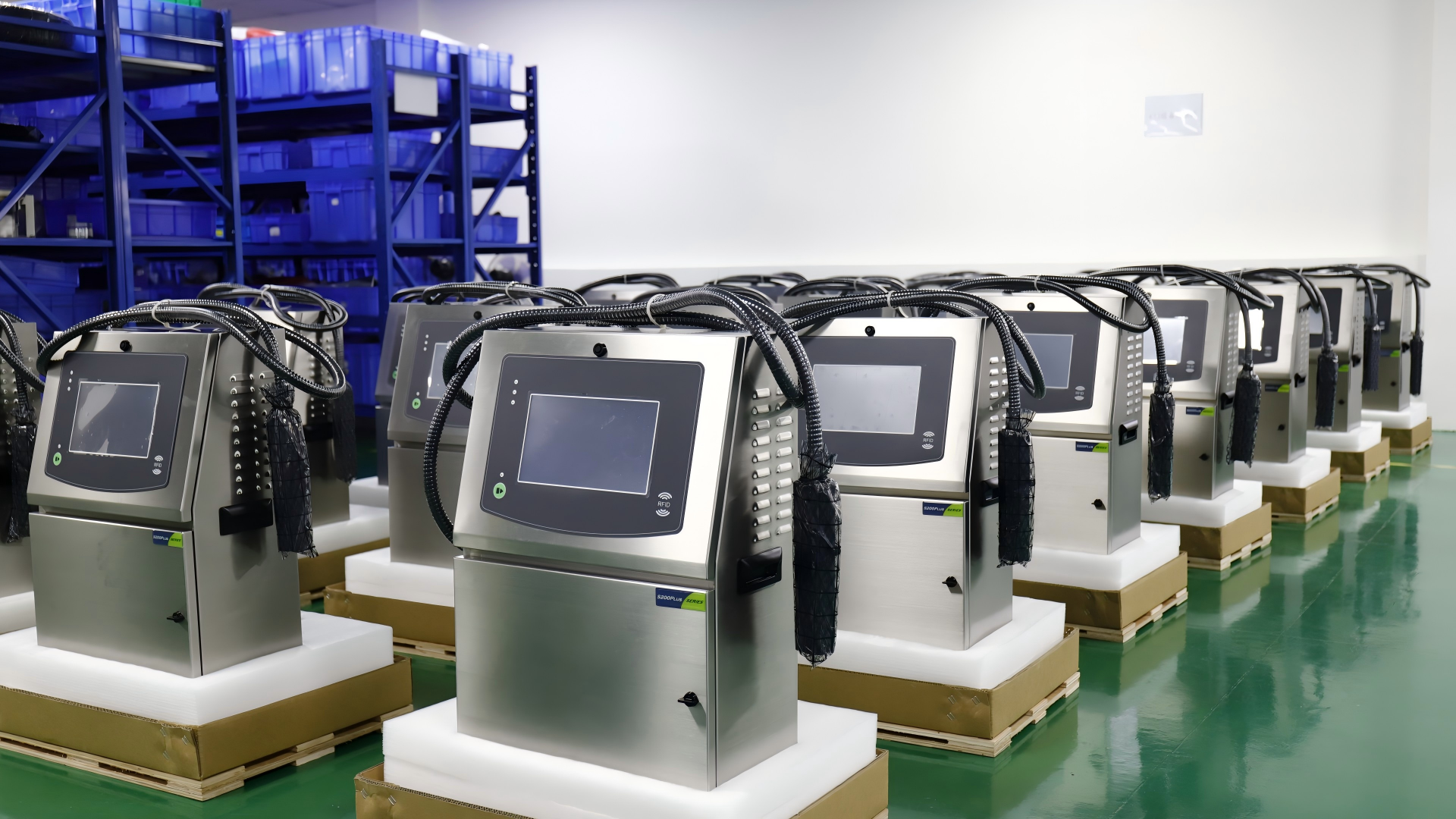
This guide explains how each variable-data content type maps onto measurable machine parameters. It draws on published specifications from the DOCOD Precision Group Co., Ltd. portfolio — including the P2000 Piezo Inkjet Printer at 300/600 dpi and 190/95 m/min, the M2000 Series Continuous Inkjet Printer with SUS 304 housing and IP65 protection, the T220E half-inch dual-head TIJ printer with up to 600 × 600 dpi, and the 3BK702 solvent TIJ cartridge — together with third-party market and standards data from SkyQuest, Grand View Research, GS1/ISO and Fortune Business Insights.
Why Variable Data Changes How Coding Equipment Is Selected
A fixed-content printer only has to place the same block of text on every unit. A variable-data printer has to place a different block of text on every unit, at line speed, on a moving substrate, and it must be able to receive that content from a data source rather than from an operator. That single requirement changes three things at once: the print resolution needed to keep a 2D code readable, the data path needed to feed the printer, and the substrate compatibility needed to keep the mark permanent.
Across the DOCOD portfolio, the print-content list is consistently defined and is the clearest way to describe what "variable data" actually covers in production:
- Multi-language text — the T220E, T260E, TX1, P2000, M2000, S1000 and V2000 all support more than 40 national and regional languages.
- Dates — including the Julian-year date format available on the S1000, S300plus and V2000.
- Shift codes, counters and serial numbers — the M2000 and V2000 support up to 24 counters, the S1000 lists more than 20 independent counters, and the S300plus lists 24 independent counters.
- 1D barcodes — CODE11, C25INTER, CODE39, EXCODE39, EAN13, CODE128, CODE16K, CODE49, CODE93, UPCA, UPCE, EAN14, VIN, NVE18 and ITF-14 are listed on models such as the V2000.
- 2D and GS1 codes — QRCode, DataMatrix, MicroQRCode, PDF417 and PDF-417TRUNC on the V2000; "GS1 code" is listed as print content on the T260E, T220E and TX1; "GS1 Data Matrix" is listed on the R3000 TTO.
- Dynamic traceability codes and dynamic databases — listed on the T220E, TX1, R3000, P2000, M2000, S1000 and V2000.
- Graphics and logos — JPG, BMP, PNG, DXF, DWG, PLT, AI and SVG on the laser marking platforms.
The practical consequence is that the variable-data content list, not the printer category, should be written first. Once the content list is known, the technology shortlist narrows quickly.
Industry Background: GS1, Serialization and a Growing Coding Market
Variable data itself is not new, but the volume and the compliance weight behind it are changing. Third-party market research places the global coding and marking equipment market at USD 17.53 billion in 2024, projected to reach USD 27.11 billion by 2032 (SkyQuest, Coding and Marking Equipments Market Smart, Industry Size Forecast Report 2032). Within that market, continuous inkjet held the largest technology revenue share in 2024 at approximately USD 5.67 billion (Grand View Research), and Asia-Pacific accounted for an estimated 35% of the geographical market share in the same year (Market Research Future).
The regulatory driver is clearer than the market driver. GS1 Digital Link is being globally adopted to replace 1D barcodes with QR codes for point-of-sale and traceability applications by 2027, standardised as ISO/IEC 18975:2024 (GS1 / ISO). For packaging lines, that is a print-content change, not merely a label change: a QR code carrying a Digital Link must be printed at a resolution and contrast that a scanner can resolve after handling, and it must carry unique serialised data rather than a fixed article number.
Technology growth follows the same direction. Laser marking is projected to grow at a CAGR of 6.8% through 2030, driven partly by its eco-friendly nature and its lack of consumables (Fortune Business Insights). Meanwhile, the supplier landscape for the category includes companies such as Videojet Technologies, Domino Printing Sciences, Markem-Imaje and Hitachi Industrial Equipment Systems (Dataintelo / Strategic Market Research), alongside Chinese manufacturers such as DOCOD Precision Group Co., Ltd. — a coding, marking and inspection equipment manufacturer founded in 2008, operating a 20,000 m² facility with 407 employees, 140+ R&D staff, an annual output of 5,000 units and a 50% export ratio across North America, South America, Eastern Europe, Southeast Asia, Africa, Oceania, the Middle East, Eastern Asia and Western Europe.
The trend line for buyers is therefore straightforward: more unique codes per shift, more data fields per code, and a wider mix of substrates and pack formats on the same site.
The Detailed Answer: Matching Print Content to Machine Capability
The variable-data capability of a coding line comes from four layers working together: the print engine, the code formats it supports, the data interface that feeds it, and the substrate and environment it can survive in. DOCOD equipment specifications describe each of these layers explicitly.
Dates, shifts, counters, serial numbers and multi-language text
These are the highest-frequency variable fields on most lines, and they are usually the least demanding on resolution but the most demanding on speed and reliability. The DOCOD S1000 Series High Speed Continuous Inkjet Printer lists a maximum printing speed of 720 m/min with a 60u nozzle and 960 m/min with a 50u nozzle at 0.5 mm pitch, with a printing height of 2–16 mm and 1–4 lines of print. The M2000 Series lists up to 528 m/min with a 3–30 mm printing height and up to 24 counters. Where the requirement is a compact, low-maintenance machine rather than maximum speed, the T260E half-inch dual-head TIJ printer lists print speeds up to 60 m/min at up to 300 × 300 dpi.
GS1 codes, 2D codes and serialization
2D code content is where resolution becomes a commercial requirement rather than a preference. A GS1 Data Matrix or Digital Link QR code must remain decodable after production, packing, transport and storage, so print quality has to be designed in. The T220E half-inch dual-head TIJ printer lists print resolution up to 600 × 600 dpi with print speeds up to 406 m/min and a print height of 1–12.7 mm per head, or 1–25.4 mm when two heads are used. The P2000 Piezo Inkjet Printer lists 300 dpi or 600 dpi, with 190 m/min at 300 dpi and 95 m/min at 600 dpi, a single-head print height up to 33.8 mm, and a recommended print distance of 2–3 mm from the medium (0–5 mm range). The TX1 half-inch seamless TIJ printer covers a print height of 1–101.6 mm using between one and eight printheads at up to 300 × 300 dpi and up to 406 m/min — a configuration that suits serialised QR codes across wide carton faces.
The R3000 Series Industrial Thermal Transfer Overprinter lists GS1 Data Matrix and dynamic QR code as print content at 300 dpi, with a print area of 32 × 75 mm or 53 × 70 mm and a maximum print speed of 200–350 mm/s, extendable to 800 mm/s.
Graphics, logos and code layout
Logos and graphics typically sit beside the variable field rather than inside it, but they consume the same print area. The laser platforms list JPG, BMP, PNG, DXF, DWG, PLT, AI and SVG input, with a standard marking area of 110 × 110 mm and optional 70–300 mm on the Venus1 CO2 and UV markers, and a standard 70 × 70 mm area with optional 70–300 mm on the L3000 Series 5W UV laser marking machine. Unlimited marking lines are listed across the laser range.
Variable databases and line-level data integration
A printer that cannot receive changing data cannot print variable data. The M2000, V2000 and S300plus list USB, RS232 and network-port communication with connection to enterprise MES management systems. The T220E, T260E, TX1 and P2000 list USB, RS232 and TCP/IP network interfaces, and the R3000 lists USB, RS232 and TCP/IP with support for docking to a weighing machine, conveyor, paging machine, packaging machine and enterprise resource planning database. External interfaces across the range include photocell, encoder, alarm light and information control — the signals that synchronise the print with the moving product.
Step-by-Step Breakdown: Specifying a Variable-Data Coding System
- List every variable field. Write out dates, shift, counter, serial number, batch, GS1 code, dynamic QR or Data Matrix, and any database-driven field. The list determines the required code formats.
- Measure the content density. Count characters per line, number of lines, and total print height. The M2000 covers 1–4 lines at 3–30 mm height; the S1000 covers 1–4 lines at 2–16 mm with a 60u nozzle and 1–2 lines with a 50u nozzle; the S300plus covers 1–5 lines at 3–30 mm.
- Establish the line speed and the print window. Line speed sets the technology ceiling — 960 m/min for S1000 at 50u, 528 m/min for M2000, 406 m/min for T220E and TX1, 190/95 m/min for P2000 at 300/600 dpi.
- Match the substrate. Carton, plastic, metal, plate, pipe, stone, cable, glass, electronic components, auto parts and industrial chemical packaging are all listed as printing materials across the CIJ, TIJ and PIJ range; flexible films and laminated webs are covered by the R3000 TTO.
- Confirm the environment. Standard printer specifications list 0–45 °C and 30–70% Rh. Laser platforms list 0–45 °C with humidity ≤95%, non-condensing and vibration-free.
- Choose the data path. Decide between on-screen entry, encoder/photocell triggering, and MES/ERP or database feeding. All three exist across the portfolio.
- Validate with a print sample. Request printed samples on the actual substrate, then confirm code readability at the intended resolution before committing to a line configuration.
Preference Shortlist: Which Technology Fits Which Variable-Data Priority
Because variable-data requirements differ, the practical question is which technology to prefer when a specific parameter matters most. The following shortlist is built only from published parameters:
- Highest line speed for small-character variable text: CIJ — S1000 Series at 720 m/min (60u) and 960 m/min (50u); M2000 Series at up to 528 m/min.
- Highest resolution for GS1 2D codes at packaging speeds: TIJ — T220E at up to 600 × 600 dpi and up to 406 m/min.
- Highest-resolution codes with wide print-distance tolerance: PIJ — P2000 at 600 dpi / 95 m/min and 300 dpi / 190 m/min, print distance 0–5 mm.
- Widest marking band per station: TIJ — TX1 at 1–101.6 mm print height using up to eight printheads.
- Consumable-free permanent marking: laser — fiber 1064 nm (20/30/50/100W, laser life up to 100,000 hours), CO2 10.6 μm (30W/60W, laser life 20,000 hours) and UV 355 nm (5/10/15W).
- Flexible film and intermittent packaging webs: TTO — R3000 at 300 dpi, 200–350 mm/s (up to 800 mm/s), GS1 Data Matrix and dynamic QR code.
Use Cases: Variable Data Coding in Production
Documented DOCOD installations show how the variable-data requirement translates into a specific technology choice in different regions and pack formats.
- India — pharmaceutical packaging supplier, 3 cartoning lines. The T220E half-inch dual-head inkjet printer is used for QR and expiry printing on cartons, with dual-head high-speed printing and improved code readability.
- Indonesia — snack manufacturer, 2 VFFS lines. The R3000 Series TTO is used for date coding on flexible film, operating for 2 years on the two vertical form-fill-seal lines.
- Brazil — contract packer, 8 packing stations. The TX1 half-inch seamless inkjet printer handles batch and QR printing with a compact setup for limited space, enabling faster deployment across small lines.
- Germany — electronics parts supplier, 2 workstations. The Venus1 Series Fiber Laser Marking Machine produces permanent marking on metal connectors, in operation for 3 years with durable readable marks.
- Saudi Arabia — plastic pipe producer, 2 extrusion lines. The Venus1 Series CO2 Laser Marking Machine applies specification and date marking on PVC pipe, delivering clean non-contact coding over 2 years of operation.
- Poland — cosmetics OEM, 2 lines. The L3000 Series 5W UV Laser Marking Machine applies lot coding on plastic bottles and caps with low-heat UV marking and permanent high-contrast results.
- South Korea — regional distributor. The 3BK702 half-inch black solvent quick-drying ink cartridge is used for coding on plastic film and coated cartons at 50 cartridges per month, reducing smudging complaints through fast drying and strong adhesion.
- Vietnam — beverage bottling plant, 4 high-speed lines. The V2000 Series Continuous Inkjet Printer handles batch coding on PET bottles with stable daily coding.
- United Arab Emirates — small batch food producer, 1 bench line. The XC20 Mini Conveyor Belt conveys pouches for online coding, contributing to a smoother semi-automatic workflow.
Comparison Table: CIJ, TIJ, PIJ, TTO and Laser Parameters
The table below compares published parameters only. Where a value is not specified for a model, the cell is left blank rather than estimated.
| Technology / model | Resolution | Max. speed | Print height / lines | Variable-data content | Environment & build |
|---|---|---|---|---|---|
| CIJ — DOCOD M2000 Series Continuous Inkjet Printer | Dot-matrix fonts, 42u / 55u / 70u nozzles | Up to 528 m/min | 3–30 mm; 1–4 lines | Text, time, date, logo, shift, SN, dynamic barcode/QR, dynamic serial data, dynamic database; up to 24 counters | 0–45 °C / 30–70% Rh; SUS 304; IP65; CE, RoHS |
| CIJ — DOCOD S1000 Series High Speed Continuous Inkjet Printer | Dot-matrix fonts, 50u / 60u nozzles | 720 m/min (60u); 960 m/min (50u) | 2–16 mm; 1–4 lines (60u), 1–2 lines (50u) | Text, time, date (Julian year), logo, shift, SN, dynamic barcode/QR, dynamic serial data, dynamic database; more than 20 counters | 0–45 °C / 30–70% Rh; SUS 304; IP55; CE, RoHS, BIS |
| TIJ — DOCOD T220E Half-Inch Dual-Head Inkjet Printer | Up to 600 × 600 dpi | Up to 406 m/min | 1–12.7 mm (1 head); 1–25.4 mm (2 heads) | Multi-language text, GS1 code, dynamic traceability codes, barcodes, graphics, serial numbers, dates, shifts, counters, variable databases | 0–45 °C / 30–70% Rh; aerospace-grade aluminium and industrial-grade stainless steel body |
| TIJ — DOCOD TX1 Half-Inch Seamless Inkjet Printer | Up to 300 × 300 dpi | Up to 406 m/min | 1–101.6 mm; 1–8 printheads | Multi-language text, GS1 code, dynamic traceability QR codes, barcodes, graphics, serial numbers, dates, shifts, counters, variable databases | 0–45 °C / 30–70% Rh; aerospace-grade aluminium and industrial-grade stainless steel body |
| TIJ — DOCOD T260E Half-Inch Dual-Head Thermal Inkjet Printer | Up to 300 × 300 dpi | Up to 60 m/min | 1–12.7 mm (1 head); 1–25.4 mm (2 heads) | Multi-language text, GS1 code, QR codes, barcodes, graphics, serial numbers, dates, counters, variable databases, anti-counterfeiting and traceability codes | 0–45 °C / 30–70% Rh; aerospace-grade aluminium body; 7-inch touch screen |
| PIJ — DOCOD P2000 Piezo Inkjet Printer | 300 dpi or 600 dpi (I1600 nozzles) | 190 m/min (300 dpi); 95 m/min (600 dpi) | Single head max. 33.8 mm; print distance 0–5 mm (2–3 mm recommended) | Text, time, date, pattern, shift, serial number, dynamic barcode/QR, dynamic serial port data, dynamic database | 0–45 °C / 30–70% Rh; CE; Embedded Linux; 10.1-inch capacitive touch screen |
| TTO — DOCOD R3000 Series Industrial Thermal Transfer Overprinter | 300 dpi | 200–350 mm/s (up to 800 mm/s) | Print area 32 × 75 mm or 53 × 70 mm | Language characters, GS1 Data Matrix, dynamic QR code, barcode, graphics, serial number, date, shift, counter, variable database, multi-information group printing | 0–45 °C / 30–70% Rh; aerospace-grade aluminium |
| Laser — DOCOD Venus1 Series CO2 Laser Marking Machine | 10.6 μm wavelength (optional 10.2 μm / 9.3 μm); 30W / 60W | Depends on substrate and content complexity | Character height 0.6 mm to max. engraving range; unlimited lines | Text, graphics, EAN8, EAN13, CODE39, CODE128, GS1-128 | 0–45 °C; humidity ≤95%, non-condensing, no vibration; IP43 / IP54; laser life 20,000 hours |
| Laser — DOCOD Venus1 Series Fiber Laser Marking Machine | 1064 μm-wavelength class: 1064 nm; 20W / 30W / 50W / 100W | Depends on substrate and content complexity | Character height 0.6 mm to max. range; unlimited lines; standard 110 × 110 mm, optional 50–300 mm | Text, graphics, CODE11, CODE39, CODE128, EAN128, UPCA, UPCE, EAN14, VIN, QRCODE, DATAMATRIX, MICROQR, PDF417 | 0–45 °C; humidity ≤95%, non-condensing; IP43; laser life up to 100,000 hours |
| Laser — DOCOD Venus1 Series UV Laser Marker | 355 nm; 5W / 10W / 15W | Depends on substrate and content complexity | Character height 0.6 mm to max.; standard 110 × 110 mm, optional 70–300 mm | Text, graphics, CODE39, CODE128, EAN128, CODABAR, UPCA, UPCE, ITF14, QRCODE, DATAMATRIX, MICROQR, PDF417 | 0–45 °C; humidity ≤95%, non-condensing; IP43 / IP54; laser lifespan 2–3 years under normal use |
Substrate and Environment Matching: 0–45 °C, 30–70% Rh and Real Materials
Substrate is the second filter after content type. A technology that cannot produce a durable mark on the actual material is not a valid option, regardless of its resolution or speed. The DOCOD specifications list printing materials by model, and the pattern is consistent.
| Substrate / application | Indicated technology path | Basis in published specifications |
|---|---|---|
| Cartons, coated boxes and shipping cases | TIJ (TX1 up to 1–101.6 mm wide; T220E up to 600 × 600 dpi) or PIJ P2000 | Cartons listed as printing material on CIJ, TIJ and PIJ models; TX1 used for batch and QR printing across 8 packing stations |
| Flexible film, pouches and VFFS webs | TTO R3000 at 300 dpi; CIJ and TIJ also list film-type packaging | R3000 material types include high-barrier film, stick packaging, sealed bags and bagged products; R3000 used on 2 VFFS lines in Indonesia |
| Plastics, PP, PET, PVC and BOPP | TIJ with 3BK702 solvent cartridge; CIJ; UV laser for low-heat marking | 3BK702 applicable substrates include BOPP, PVC, PP, PET, OPP, glass and stainless steel; L3000 UV laser example prints a date on PP film |
| Metals, stainless steel and metal connectors | Fiber laser 1064 nm for permanent marking | Fiber laser applicable industries include metal and coating, automotive parts, bearings and stainless steel products; fiber laser used for permanent marking on metal connectors in Germany |
| Cables, pipe, stone and building materials | CIJ M2000 Series; CO2 laser for non-metal pipe and profile marking | M2000 printing materials include cable, pipe, stone and building materials; M2000 used for meter marking on cable sheath; CO2 laser used for PVC pipe marking in Saudi Arabia |
| Glass | CIJ with glass-specific ink formulations | CIJ ink types list "special for glass"; glass listed as printing material on V2000, S1000, S300plus and M2000 |
| Pharmaceutical and food packaging | TIJ T220E for GS1 codes on cartons; TTO for film; UV laser for pharma and food packaging | T220E used for QR and expiry printing on 3 pharma cartoning lines; R3000 applicable industries include food and beverage film packaging; UV laser applicable industries include pharmaceutical and food packaging |
| Labels and pre-printed roll stock | XF30 vertical rewinding machine with T210E TIJ printhead | XF30 print content includes GS1 data matrix, dynamic traceability QR code, serial number, date, shift, counter and variable database; speed range 0–45 m/min |
Environment specifications are unusually consistent across the inkjet range: 0–45 °C and 30–70% Rh for the CIJ, TIJ, PIJ and TTO platforms. Laser platforms tolerate a wider humidity band — 0–45 °C with humidity ≤95%, non-condensing, and in a vibration-free location. The consumable itself can be the narrow point: the 3BK702 solvent TIJ cartridge lists a working range of 15 °C to 35 °C at 35% to 80% RH, a shipping and storage range of 5 °C to 40 °C at 20% to 80% RH, and a specified use period of 6 months. In cold rooms, hot filling areas or uncontrolled warehouses, that cartridge window — not the printer window — becomes the design constraint.
Consumable capacity is the other practical limit. The 3BK702 cartridge holds 42 ml of solvent ink and uses 300 nozzles at up to 600 dpi, with a recommended resolution of 300 × 300 dpi, a 9V trigger voltage, a 2.2 μs trigger pulse width and a maximum frequency of 12 kHz. The T260E, T220E, TX1, P2000 and XF30 all reference 42 ml food-grade, water-based, oil-based, weak-solvent or solvent cartridges, and the R3000 uses ribbon widths of 24, 33, 35 or 55 mm in lengths of 400, 600, 800 or 1200 m.
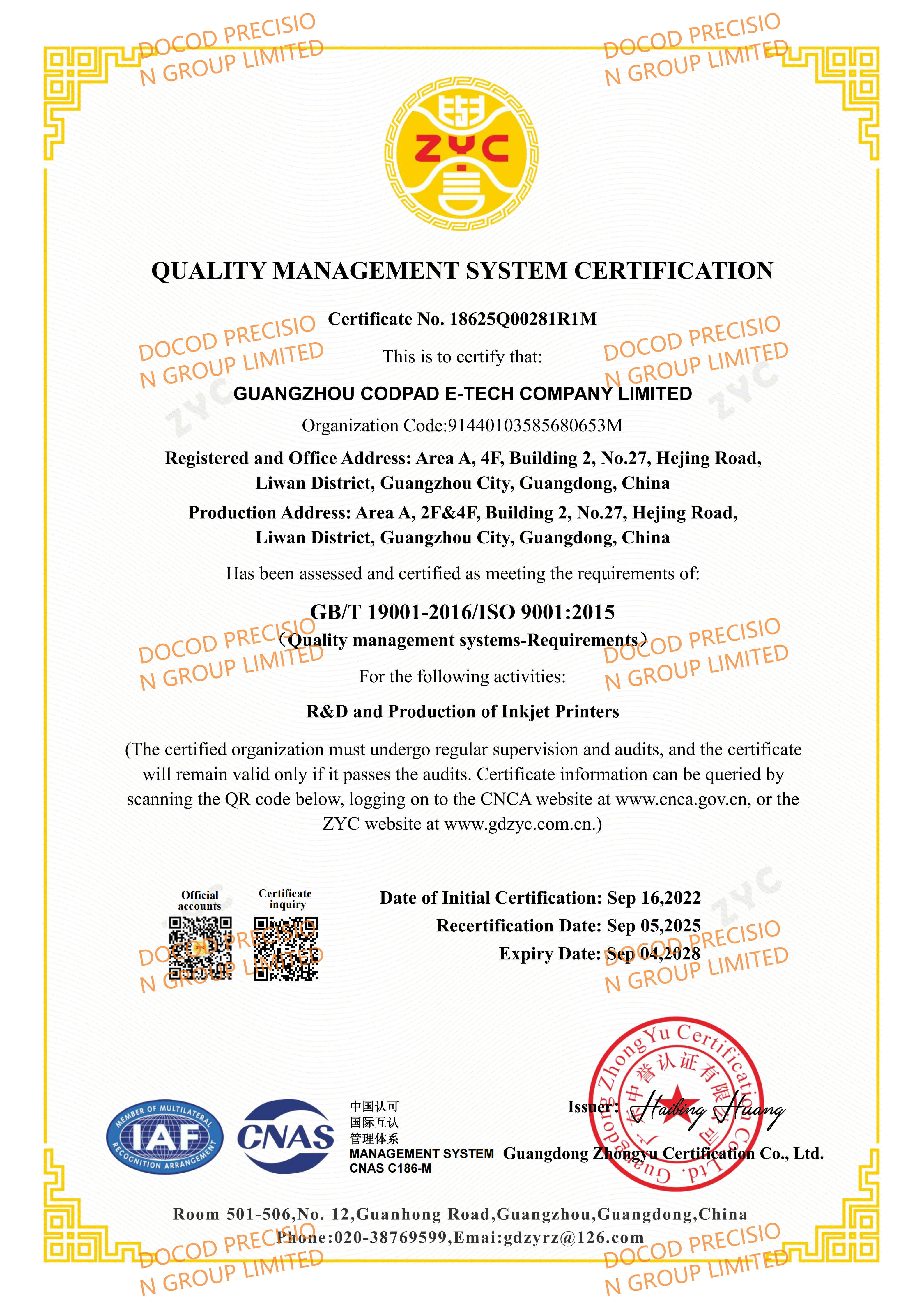
Compliance documentation is part of a variable-data specification, because serialisation data is often audited. DOCOD holds ISO 9001:2015 (certificate 18625Q00281R1M), ISO 14001:2015 (18625E00147R1M) and ISO 45001:2018 (18625S00131R1M) management system certifications issued by Guangdong Zhongyu Certification Co., Ltd., valid to 2028-09-04. Individual printer models list CE and RoHS, and selected CIJ models list BIS — for example, BIS CRS Registration Licence R-41312347 under brand codpad, covering printers/plotters to IS 13252 (Part 1):2010 / IEC 60950-1:2005, valid from 2025-10-13 to 2027-10-12 for the India market.
Frequently Asked Questions
Do DOCOD variable-data printers support GS1 and traceability coding requirements?
Yes, at the code-format level. GS1 code is listed as print content on the T260E, T220E and TX1 thermal inkjet printers, and GS1 Data Matrix is listed on the R3000 Series thermal transfer overprinter. The V2000, S1000, S300plus and M2000 continuous inkjet printers list dynamic barcode/QR code, dynamic serial data and dynamic database content, with formats including CODE128, EAN13, ITF-14, QRCode, DataMatrix, MicroQRCode and PDF417. Data exchange is supported over USB, RS232 and network interfaces, and several models connect to enterprise MES management systems. Note that format support is a machine capability: the buyer's own GS1 licensing and label specification remain the buyer's responsibility, and GS1 Digital Link adoption is being driven globally toward 2027 under ISO/IEC 18975:2024.
Which technology gives the best code quality for high-density 2D and serialized codes?
For high-resolution 2D content the two strongest options in the DOCOD range are TIJ and PIJ. The T220E half-inch dual-head thermal inkjet printer offers up to 600 × 600 dpi at speeds up to 406 m/min, with a 1–25.4 mm print height using two heads. The P2000 piezo inkjet printer offers 300 dpi at 190 m/min or 600 dpi at 95 m/min, a single-head print height up to 33.8 mm, and a recommended print distance of 2–3 mm. Where a wide printed band is required — for example, serialized QR codes across broad carton faces — the TX1 supports 1–101.6 mm print height using up to eight printheads at up to 300 × 300 dpi. Where the mark must be permanent and consumable-free, laser marking is the alternative: UV at 355 nm, CO2 at 10.6 μm, or fiber at 1064 nm.
What drives the cost of a variable-data coding installation?
Four variables dominate. First, the technology class: laser marking uses no consumables, which is one reason the segment is projected to grow at a 6.8% CAGR through 2030, whereas inkjet and thermal transfer depend on ink, solvent or ribbon. Second, the consumable format: TIJ uses 42 ml cartridges, the R3000 uses ribbon widths of 24–55 mm and lengths of 400–1200 m, and CIJ uses ink selected by substrate. Third, printhead count and coverage: the TX1 can be configured with one to eight printheads, and the T220E and T260E can run single or dual heads. Fourth, the scope of customisation — standard equipment supply, OEM branding, ODM functional customisation or full production-line integration sit at materially different engineering scopes.
Can variable data printing be validated on a sample before ordering?
Yes. Sample validation is part of the standard workflow: DOCOD standard equipment supply includes outgoing inspection, sample printing verification and function test before shipment. ODM functional customisation includes requirement confirmation, function test and trial-run verification, and production-line integration support includes integration testing, a sample run, and video acceptance before delivery. Distributed programmes additionally include demo and sample validation against the cooperation requirement. Sample validation is the practical way to confirm that a GS1 or serialized code remains readable on the actual substrate at the planned line speed.
What are the typical MOQ and lead times for a variable-data coding system?
Standard equipment supply has a minimum order of 1 set with delivery within 15 working days. OEM branding support has an MOQ of 1 set with a 15–25 working day lead time. ODM functional customisation is quoted at 1 set per project with a 20–30 working day lead time. Production-line integration support is quoted per line with a 20–35 working day lead time. Spare parts and consumables are available from 1 piece, delivered within 15 working days, and distributor and service partner programmes start from 2 units with a 15–30 day lead time. To move from specification to a confirmed configuration, send your variable-data content list, substrate, line speed and code format to DOCOD for a printed sample and quotation.
Conclusion
Variable data coding is decided by content, not by category. Once you know which fields must change — dates, shifts, counters, serial numbers, GS1 codes, dynamic traceability codes or database-driven records — the selection narrows to a small number of measurable parameters: resolution, line speed, print height, print distance, substrate compatibility, environment window and data interface. The DOCOD portfolio covers that range with published figures: CIJ at up to 960 m/min on the S1000 and 528 m/min on the M2000, TIJ at up to 600 × 600 dpi and 406 m/min on the T220E, TIJ at 1–101.6 mm print height on the TX1, PIJ at 300/600 dpi on the P2000, TTO at 300 dpi on the R3000, and laser marking at 355 nm, 10.6 μm and 1064 nm.
Because GS1 Digital Link adoption and serialisation requirements continue to expand, the safest approach is to specify the data path and the code format first, validate a printed sample on the real substrate, and only then fix the hardware configuration.
Next Step: Validate Your Variable Data Configuration
Send your variable-data content list, substrate and line speed to the DOCOD application team and request a printed sample and quotation. The corporate brochure with the full product range and specifications is available here: DOCOD Corporate Brochure (PDF).
DOCOD Precision Group Co., Ltd. — founded 2008, coding, marking and inspection equipment manufacturer. Website: www.docod-group.com | Blog: blog.docod-group.com
Contact: Sam | Email: sales@docod.com.cn | Tel: +86 139-2896-7650 | WhatsApp: +86 135-1234-4323